Tag Archives: memoir

Stanley and Lucy

Spring is the time that the Canadian geese are visiting in the Metro West Industrial Park in Plymouth, Michigan. Since Chrysan has the biggest front lawn on Keel Street in the industrial park, naturally we have more geese as guests who were looking for worms on the lawn. Occasionally I had to make a sudden stop when a flock of geese were crossing from one lawn to another with little goslings. With a “honk, honk” they crossed the busy street without any rush, just waddling.

A lonely goose waddling on the lawn is very rare. They are always in flocks, or at least in a pair, but once I saw one goose alone on the front lawn. Mmm, that cannot happen … just one goose. Talking to myself, I looked around the south end of the building. Following the pair rule, the male goose was heading to the north with the “honk, honk”, thereby telling her he was coming.

“Kwang, geese never travel alone. They are always in groups or at least in pairs.” He was silent without any comment on my observation. He was digesting why I brought up this unusual subject and also calculating what I wanted from him this time. “So, let’s go everywhere together like geese,” I continued without looking at his face. He was still silent with his face down over the Detroit News. I assumed that his ears were filtering what he wanted to hear. “You are silent. Silence means ‘yes’. Let’s go,” I added.

“Where?” finally Kwang broke his silence in surprise.

“To Grandma’s,” I answered with a soft voice, reading his expression. My mother’s grave is on the corner of Novi Road and 12 Mile Road, at Oakland Cemetery. Our family calls it “Grandma’s grave”.

“No”, with strong rejection, and then he lowered his voice one octave, “You go alone.”

“I just explained about geese in pairs theory, going everywhere together.” My voice was almost begging him to go together to Grandma’s. Late afternoon at the end of March the sky was gray … a snowstorm might start any moment instead of rain. It was getting cold and windy. Once a week visit to Grandma’s is one of my regular scheduled stops since 1996 if I am in town. The most powerful geese’s pair theory let Kwang’s heart thaw, or was it my nagging power … and we went to Grandma’s together as a couple before we finished our cups of coffee as geese.

Two years ago a goose was nesting at the south side of our plant. Actually near the loading dock. For Heaven’s sake, why here? There are many other places to make their nest, I murmured with surprise and uneasy feelings. Then I went to Jeff, the plant manager, who was unloading bulk base oil from a tank wagon. “Hey, Jeff, how long has the goose been sitting on the nest without moving or changing position?” When I asked Jeff, my voice was vibrating with a mixture of deep concern and excitement with the goose nesting.

“Oh, no, Kook-Wha, they take turns. The gander is watching the nest very carefully from a distance, and he takes a turn to let her rest.”

“How do you know if it is female or male?”

“Geese are always together as a pair. The gander is protecting the female who is on the nest all of the time.” Jeff’s observation made perfect sense but he forgot my question … how many weeks has she been sitting on her nest?

I could not control my curiosity. I approached the nest closer and closer, and stopped two yards away. Suddenly with a loud “honk, honk” a goose flew down from the sky. Actually, he came from the roof with “honk, honk”, and he was ready to attack me in full force. I ran away from the nest as fast as I could.

Jeff came over and warned me, “See, Kook-Wha, be careful. You may get hurt. Sometimes they can become quite nasty,” he warned me.

Holding my breath, “Yes. I should.” Then I went back to my office without further observation. A cup of coffee helped my disturbed mind to settle down and I sank into deep thought. Why was the gander on the roof?

“Kook-Wha, is something wrong? You look very tired,” Julie, our office manager, asked me with serious concern.

“Nothing. I am fine.”

Julie left my office shaking her head that she could not understand my unusual behavior.

About one month later Jeff ran into my office. He was almost screaming with excitement. “A baby came out. A baby came out.”

“How many? How many?” I screamed back at him.

Jeff did not answer my question but went back to the nest area. With extreme joyfulness, I wanted to follow him and check into it, but instead I calmed down and just waited in my office for further news.

Through the windows I could see the gander standing five yards away from the nest in the middle of the truck driveway with his head up to the sky. “Honk, honk” expressing his excitement. Jeff still did not give me any numbers. The next morning I saw that the gander was still in the same spot protecting the nest.

In the afternoon I heard really loud “honk, honk” through the windows. It echoed a mixture of desperation and misery. Jeff came to me again quite emotional, and upset … “One baby was killed. A truck ran over it. The gander will not move from the spot.” I saw through the window that the gander was flapping his wings and honking. The poor goose, I turned back from the window and wondered how many goslings were left unharmed.

In the spring of 2009, when I came back from the trip in Asia I found a new goose nest this time it was by the flowerbed on the north side of the building which is near the employee entrance under the conference room windows. It was a much safer place than near the loading dock, but it is still a heavy traffic area. The nest was under the tall shrubs and between the hydrangeas and the Christmas poinsettia. In the morning there was nice sunlight and in the afternoon it has reasonable shadows to protect the geese from sunburn. I am not sure whether a goose can get a sunburn.

Again this foolish goose makes a nest near busy traffic. I talked to myself thinking that I hope this time nothing goes wrong and they have a successful hatch.

As soon as I entered my office Bonnie mentioned, “Did you see the nest?”

“Yes. I saw it. How long has the nest been there?”

“About a week,” Bonnie answered with her face full of smiles.

I did not like her answer at all. I wished It is ready to hatch was her answer instead.

“Just one week?” I questioned her, and then I changed the subject, talking about the trip to Asia. I was getting a headache from anxiety and frustration from previous experiences of geese hatching. How can we keep the nest three or four weeks more without any accidents in order to have the goslings born safely.

I took a picture of the goose sitting on the nest from about 5 feet away. She sat calmly without moving her body but her head was moving to the left and right with fear of my approach. You will be okay, I am trying to protect you as much as possible. Hello, goose, do not worry, I promised her.

Soon I heard a “Honk, honk, honk” noise coming from the roof. The goose was looking down at me from above my head on the roof and he was ready to attack me. Oh, my gosh. Again I upset the gander. Hello, gander, I will not hurt your friend. Believe me, I will not.   I took a picture of him on the roof, too and quickly went back to my office. I was relieved that at least he did not jump on me from the roof.

The next day was Saturday. I got to the office later than usual. Oh, no. Oh, my gosh, what happened last night? I screamed and screamed when I saw the broken nest. Luckily nobody was near to hear my screams. One large unbroken egg was about two feet away from the nest and a couple of broken eggs were on the top of the nest. What happened? What happened? I could not control my screaming from desperate anxiety. I phoned Kwang, seeking comfort from him. As usual he was quiet at the end of the telephone. I hung up slowly, trying to forget the broken eggs.

That same day in the evening we had dinner with friends from Carmel, Indiana. They told us an interesting story about Canadian geese that built their nest just under the dining room window again in the flowerbed. They named them Lucy and Stanley. For weeks Lucy sat on the nest and Stanley guarded it. Even if we had the exact same experience twice, we did not make any comment. We just listened to their story with curiosity and thrills.

Ken and Nancy told us the whole four weeks experience with unbelievable excitement. They gave all sorts of support to have 100% successful hatching. They did not use the front entrance of their house and just watched them from a distance. Also, they told the same story, Stanley was on the roof protecting and watching Lucy on the nest. Their house is in a gated community with five car garage and there is quite a distance between the houses. For four weeks they could only use the entrance from the garage without any inconvenience. Also, human traffic was much less in their community, and in their absolutely quiet neighborhood Lucy and Stanley had the best conditions for hatching the goslings in peace and comfort.

One day they saw seven baby goslings going in a straight line into the pond in their back yard. Of course, Lucy was in the front and the seven goslings followed her. The newborn goslings went into the pond without any fear or hesitation and were swimming away except for one. The last one was hesitating at the edge of the pond and could not jump into the pond. Then later Lucy and Stanley came back and escorted the last one to the pond and watched to make sure that it went into the water.

We did not tell Ken and Nancy our two unsuccessful sad experiences. I could not get rid of the image of the broken eggs in the nest from my mind for a couple of days. As my five-year-old grandson, I asked myself why? Why couldn’t our geese make it in our yard?  I understood the first failure well enough. There was too much heavy traffic of trucks. For the second one all the employees did their best to protect her without disturbing her by walking on tiptoes and closing doors quietly. But if the geese could not hatch in our yard, then what is the reason?

The list of clues of the second failure popped into my mind. It could be blamed on the wild animals. In our large wooded back yard there are still deer, raccoons and other wild animals living there. Every winter I have seen footprints of deer near the evergreen trees around the plants. Maybe at night while looking for food they came and destroyed the nest. One gander could not protect the nest against a wild animal attack.

The vanished nest was about six inches deep and two feet wide, like a fort. A nest consists of mulch with very tight, strong structure like a concrete wall. It cannot be destroyed easily, not like a bird’s floppy nest of straw and branches. It was several layers of mulch with sturdy construction.

I hope they come again as a pair for third and fourth attempts. We will do our best for a successful hatching.
Suspense

Suspense! That’s what brings readers back again and again. If you want your readers to keep reading, you have to give them a reason to go to the next paragraph, turn the page or come back a month later. That’s why I ended my blog last month the way I did.

What did happen to Abram? He had the visa. He could come to America right away. Why did he insist on stopping off in Switzerland first? And, most of all, why did he never get to America?

Abram tried. He really did. His plan was to go from Beirut to Geneva by train.

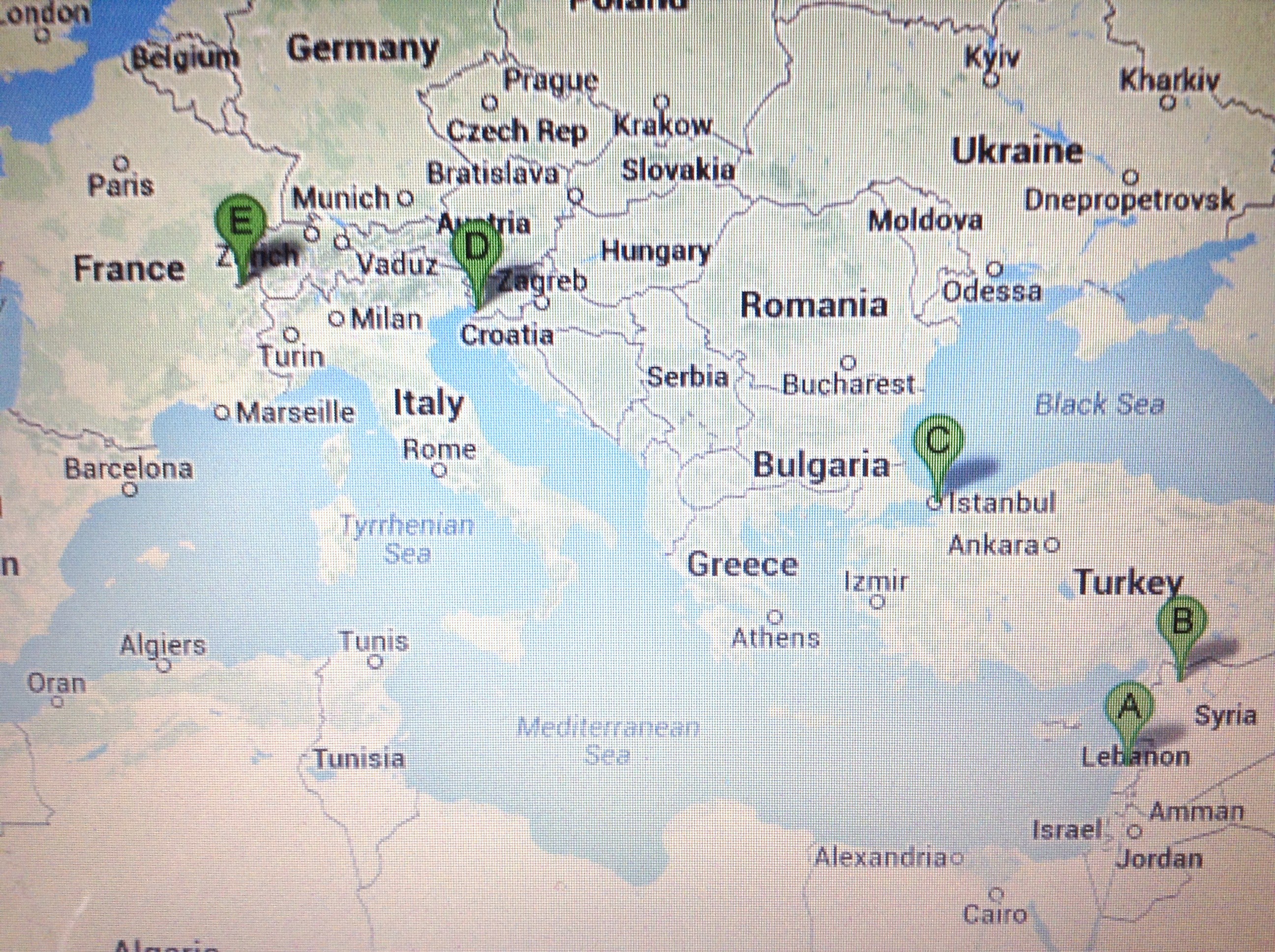
I just finished looking at a Google Map of the area. I can’t imagine what made him think he could pull it off. He was a Jew, in the middle of World War II. He’d have to travel from Beirut, Lebanon to Aleppo in Syria and then on to Istanbul, Turkey. From Istanbul, he’d have to pass through Bulgaria, Serbia, Croatia to Trieste, Italy. Then it would be a relatively short shot to Geneva.

This is a journey of over 2,395 miles. It’s the same distance as from San Francisco, California to St. Petersburg, Florida. Only he’d have to travel through seven countries, all of them either at war or on the edge, and most of them on Hitler’s side. Today, when I put the information into Google, it said, “We could not calculate directions between Beirut, Lebanon and Geneva, Switzerland.”

Map Picture

I would love to know what he was thinking. How did he plan to do it? Why did he even want to?

Traveling by train, all that distance, would be difficult. How many days would it take? Where would he sleep? How would he pay for his tickets and food? Money was already a problem in Beirut. He wouldn’t be able to travel first class like in the past. And, at his age, he was in his sixties…

I wonder, was Abram ever frightened as he planned his journey? Did he feel overwhelmed? Did he worry that he wouldn’t be able to do it?

To try to figure out how Abram might have planned it, I did a little research on my computer. If I wanted to make the trip today, I’d have to take a bus or taxi from Beirut (A on the map) to Aleppo (B). That’s 186 miles. Then I’d take the train to Istanbul (C) for 768 miles. After that I’d travel for another 991 miles by train to Trieste (D). From there it would be 450 miles more to Geneva (E) and he would have made it!

But I’d be doing it as an American on an American passport. Abram was doing it in late 1941 as a Jew with an American visa that could be dangerous for him to show until he boarded the ship because the countries he was passing through were controlled by the Nazis.

Germany’s puppet government in France controlled Lebanon and Syria until the Allied Invasion of July, 1941. Turkey was neutral in 1941 but Hitler had taken Bulgaria on March 1, Croatia on April 10 and Serbia on April 17. Abram didn’t start out until sometime after June.

What was he planning to use for papers? What acceptable reason could he give for traveling? How did he disguise himself so he could blend in with the other travelers? How did he get enough sleep and to eat so he could function?

The one thing he did have going for him, besides his American visa, was that he spoke a number of languages: Romanian, German, French, English, Italian and probably Yiddish.

Looking at the map, I still can’t believe it that Abram made it as far as he did. He must have been very brave, determined and resourceful. He had a lot of guts. He made it most of the way. He was so close. Then he had bad luck, very bad luck.

Somewhere on the train between Serbia and Italy some Nazis found him. He had almost made it to Trieste, only half a day’s travel from Geneva.

The Red Cross finally found out the truth but not until after the war was over. So for years my parents and Grandma and Papa wrote, telephoned and cabled the Red Cross and anyone else they thought could find Abram and help him come to America. They always believed he was still alive until the night the telegram came.

It was a Sunday in 1948 or ’49. There was a knock at our door. It was Western Union. The messenger had gone to my grandparents’ apartment in Pacific Heights first, and when no one answered, their neighbors told the messenger that every Sunday night Grandma and Papa went to their daughter’s house out by the ocean. They gave him the address. The telegram was from the Red Cross.

I remember my father coming into the dining room, taking my brother’s and my dinner plates, telling us to bring our glasses of milk, and come with him. He took us to our room, put the plates on the floor and turned on the radio to the “Lone Ranger”. Dad told us to stay in the room, keep the door closed and listen to the program. He’d come back and get us.

I remember thinking, this is strange. We were never allowed to bring food to our room or listen to the radio during dinner.

Then I heard my Grandmother scream. I can hear it today in my imagination as I write this. It was so loud and so sad and it came again and again, drowning out “The Lone Ranger”.

I could hear Papa saying, “Clara, Clara”, over and over.

The telegram was from the Red Cross. It said that Abram had taken the train to Switzerland. Somewhere, along the way, just before Trieste, Nazi soldiers had boarded it and found him. When they got to Trieste they took him off and to a hotel room. There they robbed and killed him. All this had happened in 1941. He’d been dead all this time and we never knew.

Why, once he had the visa to America, didn’t he come right away? Why did he insist on making this long, dangerous journey to Switzerland first?

We may never know for sure. But I don’t think it was what he told the family: He was sick and wanted to see a doctor to help him get well before he came to America. I think he had a much bigger, more important reason, one that would make him, a man in his sixties, a Jew in a world at war, make this 2,395 mile journey first.

Next month I’ll write about what I think his reason was.


Kwang’s Game with Groundhogs

This story shows Kwang’s, my husband, tenacious efforts to get rid of groundhogs in our back yard and win over their territory that they had before we moved in.

On August 13, 2001 we moved into our new house at the Northville Golf Course, Northville, Michigan, that is located between Five and Six Mile Roads.  It has high ceilings and several big windows facing south, providing us with the warm sunshine in the winter.  Our back yard ends up at the bump with huge pine trees to separate the empty lots to Five Mile Road.  This lot will be the future home of Northville Technology Park.

A couple of months after we moved in, we could hear an unidentifiable noise similar to birds chirping inside of our house.  I told Kwang with an uneasy feeling, “Birds are somewhere inside the house. There is no way that any animal or bird can get inside the house, probably in the chimney,” Kwang told me, showing that it was not an interesting subject.  “But we hear birds chirping,” I told him bluntly with anger.  “Since the builder put the net on top of the chimney, no birds could be inside the chimney,” he commented.

I was quiet, wondering if he might be deaf.  “This cannot be, because the builder already put the net on the top of the chimney to prevent any animals from going into the chimney.” I repeated his comment.  But the noises got louder and louder every day and especially at night.  Even the scratching sounds in the wall came from the chimney, almost as if something fell down inside of it.  Finally Kwang built a fire in the fireplace and the noise disappeared.  This was the beginning of a seesaw game between Kwang and the animals in our back yard to win control of the territory.

“Kwang, our house is surrounded by many different species of animals like the zoo,” I told him, anticipating an exciting answer, but he was quiet and did not show any interest.

For a while we enjoyed watching several species of birds on our deck, gray pigeons, red robins, sparrows, black crows and others.  They showed us their tricks and talents; chirping at each others’ beaks, and showing us their affection and  caring for each other.  Sometimes they just landed like shooting stars from the sky to find worms on the ground.

The more we enjoyed watching the birds, the more the mess piled up on our deck from the birds.  On the top of the picnic table, chairs and rails.  One afternoon Kwang and I tried to clean it up with just rags and laundry detergent.  It did not work.  The mess was coated on the wooden surface like white paint.  I scrubbed the surface with a steel brush with Ajax until my arms were getting numb.  Now Kwang’s tolerance level for the mess did not exist anymore.

Sami and Mike, our next-door neighbors, told us the best method to chase the birds away is to put an owl on the deck.  From fear of the owl’s big shiny eyes they never come back.  Initially I thought they meant a real live owl, then for a moment, not a real one.  What can you do with a live owl?  It would maybe give you even more headaches.

I rushed to Meijer, where Mike bought his plastic owl.  The old gentleman at the entrance who gave me a shopping cart said  with a routine greeting “Welcome to Meijer”.  Before his sentence was over, I asked him “Where are the owls?”  I should have asked, “Where is the location of the section for the owls for gardens?”  He did not understand me at all.  He came close to me and listened carefully to what I pronounced.  He could not guess that I was looking for a plastic owl.  I could not wait for his assistance and went straight to the garden shop leaving him behind.  In the garden section there are many animated animals, turtles with stones and plastic, rabbits, owls and two young children, carved in stone, who are reading a book affectionately together on the bench and many more plastic and stone sculptures for gardens.

Finally I found two owls, one was a dark brown and the other is a lighter brown color.  I chose the darker one because the owl’s eyes are brighter and shinier.  It is hollow and lightweight, like paper and we had to put weight inside.  Kwang fixed it on the rail with a bolt and nut in the middle of the deck.  For a while we did not see any birds sitting on the deck and we were extremely happy without having any more mess.  One Saturday when Kwang and I had lunch in the kitchen, a small gray pigeon was on the guardrail of the deck, and then later one more came and they played by flapping their wings for a few minutes and flew away.  Even if the owl’s eyes were shining, the smart pigeons knew it was a fake.  We were speechless with our huge disappointment and I just looked at Kwang’s stormy face.

A couple weeks went by again without paying attention to our owl or the birds.  One day we saw a small blackbird go inside the barbecue grill on the east side of the deck, through the space between top cover, in and out.  Later she came back with a small straw in her mouth.  She built a large nest inside the grill even though the owl was standing about three feet away.  The plastic owl totally lost its power and authority to chase the birds away.

One early warm winter day, Kwang and I had a cup of coffee at the kitchen table and saw a gray pigeon sat on the owl’s head.  “Wow!  Unbelievable!”  I screamed, “A bird is on the owl’s head”.  She stayed there about ten or fifteen seconds and flew away.  Seesaw games with birds and us seemed never ending.  Again the mess on the deck was all over.

Along with these bird issues, Kwang had another game in our back yard with groundhogs.  With less than one acre of land we had so many episodes with animals.  “Kwang, if we live on huge land with heavily wooded area, we will have extremely unexpected and maybe interesting activities with animals.”  I meant deer, wild turkey, rabbits, and other animals.

Kwang told me a groundhog was living under the rocks in our flowerbed.  Our flowerbed has several large rocks on a slanted smallhill.  The holes were everywhere.  Kwang’s first strategy was to totally seal the entrance with rocks and he hoped the groundhogs wouldn’t leave the hole and would die trapped inside.  Kwang was so pleased at not seeing any new holes for about a week.  I saw his face reflecting his feeling of triumphant victory over them.

A couple of days later Kwang asked me for mothballs.  He hates mothballs because of the awful smell and he also believes it causes cancer.  Kwang does not allow me to use mothballs in our closets.  I had to ask him “why?” with surprise.

His answer was short … “To kill the groundhogs.”  Kwang poured about a half box of mothballs, about one pound, into the hole.  He did not tell me the results of the mothballs with the groundhogs.

On the weekend he was in front of the computer for hours, and his face was reddish purple with anger.  He started to search for information on how to kill groundhogs, after failures at blocking the entrance holes with rocks and mothballs.

Meanwhile the groundhogs moved their home to under the pine trees over the bump in the wide open field about thirty feet away from the flowerbed.  “The groundhogs made two new holes,” Kwang told me in a grumpy voice.  I do not know if they are connected or separate holes in the bump,  Kwang mumbled to himself.

Late afternoon I came back from Indiana.  It was getting dark but not pitch black yet.  Kwang told me that he had to show me something in the yard before dinner.  I was hungry and a bit tired from the long drive, but as soon as I put down my bags on the kitchen floor we went out to my rock garden.  What do you expect?  In the middle of the rock garden I saw a windmill.  The pole was about six foot tall and two inches diameter.  It was spinning at 180 miles per hour.  The blades were about one and one-half foot long and four inches in diameter.  The wind was strong, you could not see the fan blades.  Just one circular one was turning round and round.  I lost all the words in the world.  I was speechless,  Crazy Kwang,  I told myself.  He explained to me that he saw on the Internet that with a windmill you can chase away groundhogs by the vibrations and noise of underground.  He showed me one more windmill on the bump.  I could not see well but  saw the fan was moving fast.  He thought it was all set and the groundhogs would not come again.  He was extremely confident about this device.  The vibration and noise analysis are using pump wear and failure analysis at the manufacturing plant, but in the green fields to kill groundhogs with this technique, I could not understand him.  But he is usually a much better engineer than I am for application of theory.  Also, he has great common sense.  I had to accept his practice this time.

Immediately my thoughts attached to this windmill, to the development of bearing lubricant for a windmill which is demanding industry for the alternative energy.  What a good opportunity for me to test the lubricant in our back yard with our own two windmills.  I hid my smile inside and went into the kitchen and had dinner.

Every evening Kwang asked me “How are the windmills?”  He got a monotonous answer from me, “It is working.”  The November winds in Michigan were getting stronger and stronger and the blades of the windmill were falling one by one.  Now, a couple of weeks later, only the bare pole was left in my rock garden.  The blades of the windmills were gone before performing my lubricant experiment and the groundhogs ran away.

One afternoon Kwang asked me to come up to the bump.  Kwang ran the water to fill the hole for four or five hours.  He hoped filling the hole with water would drown the groundhogs.  I only saw dark deep holes and could not see any water which soaked into the soil.  Several groundhog holes in the back yard made it hard for him to cut the grass with the tractor and two pine trees were already dead because the groundhogs ate the roots.

Now Kwang did not tell me his plan about the groundhogs.  He just stuck to the computer for many hours.  A couple of days later we received a trap (cage) by mail.  Kwang still did not tell me what his plan with the cage was.  There was no way he could win the battle.  A week later another trap came but I never heard that he caught anything.  No activities and no comments from Kwang about the groundhogs for three or four weeks.

The Post Office delivered a large package to our front door.  It was twice the size of the previous traps.  It was huge.  Now Kwang was getting confidence that he could catch anything in the world.  Kwang asked me for slices of apples.  For several days there was no news from Kwang and I saw the huge trap was in our garage for several months.  Later he told friends that he caught a raccoon instead of groundhogs.

Kwang’s battles against the groundhogs lasted about two years.  Kwang could not get any new knowledge from the Internet and he started to ask friends for wise and practical advice.  He thought now was the time to share his anger and frustration with friends.  Some people gave advice to Kwang casually with common sense and others simply did not have any similar experience.

One idea from a friend was to put fireworks in the holes and let them choke from the smoke.  Friends suggested that the plan should be done at night when all groundhogs are inside their holes.  With a flashlight Kwang and I went to the holes.  Kwang put fireworks in the holes and sealed the holes with dirt as quickly as possible.

A couple weeks later Kwang said the groundhogs did not come anymore and did not make any new holes.  This is the method that people used to get rid of them and Kwang even recommended it to Mike, who is our neighbor.  Kwang was so happy and he was just like a marching soldier of victory and regretted that he did not use this method a long time ago.  I agreed, too, that this was the best idea and it would work with toxic chemicals, smoking fireworks, but the feeling of victory did not last long, soon there were two new holes at different locations under the pine tree on the hill.  I did not have any concern or anxiety at this time, like he had unless the holes were not under my flowerbed.

Kwang was digging out more information from the Internet.  One day I found a one-gallon jug half filled with yellow liquid in the garage.  I thought maybe it was floor cleaner from our plant to clean the garage.  We have not cleaned the garage for almost one year.  Now it was early spring and just the right time to clean out the garage.

“Is that floor cleaner in the garage?  There is no label,” I asked Kwang.  He did not answer me and I did not ask him why there was no label, but later after we finished dinner I told him again, “If you take a product without a label, it is not good practice.  Our employees may have made a mistake and put the wrong label on the container and without any Material Safety Data Sheet.”

He had a light smile on his lips and said, “It is my urine.”  This is another device to chase away groundhogs from the Internet and he showed me an Internet article.  I thought this time Kwang was going insane.  Maybe he has to go into a mental hospital.  I did not say anything.  I just thought how stupid I was asking him questions about groundhogs.  He had practiced this quite a while without results.  Again a couple of months were gone.

This time he found out that groundhogs like vegetables, especially cabbage, and they only come out of their holes in the daytime to eat vegetables.  As I mentioned before, Kwang lost more confidence fighting with the groundhogs.  Even though we have three traps, he never caught a single one.  Will vegetables make a big difference, I wondered.  Kwang took several pieces of cabbage from me and put them into the biggest trap of the three.  On May 30, 2007, one groundhog was inside the trap.  His eyes were wide open looking for escape methods.  Kwang was so exultant he almost jumped into the sky.  It seemed to tell us, “See it does work with vegetables.”  Kwang showed it to Mike and they went together to Northville Park near the women’s correction facility to release the groundhog in the park.

On May 31, 2007, he caught another one.  This time Kwang told me it was bigger than yesterday.  Kwang asked me to go together to release it in the park.  I said no.  The groundhog might bite me when Kwang released it.  On June 1, 2007 and June 2, 2007, he caught two more groundhogs.  We caught a total of four.  Kwang finally won on the battlefield.  I told Kwang the groundhogs did not communicate with each other about the traps on the hill.  They are foolish to be caught in Kwang’s trap.

In my mind, I should learn from Kwang his tenacious attitude to solve issues.

Abram

After two serious pieces, I was planning on writing a lighter, more humorous blog, this month, something more tied to my first piece which came out in February.  That seems so long ago. It’s hard to believe that I once was having a problem thinking of something to write about.

Then I reread the comments people made about “More Voices From the Past”. I immediately noticed something new. I had readers. Real readers. Readers who not only read what I wrote but took the time to comment on it! I was convinced. I needed to stop worrying about lightening the mood and write about what they wanted to know: What happened to Abram?

I’ve grown up with the story of Abram. I’ve known it by heart, ever since I was a young child. Writing about him now, I wanted to see if there was something more, some detail that I didn’t know or might have forgotten. So I decided to call my Mom. She’s now 101 and living with my sister in California. She remembers everything as if it happened yesterday.

We talked for a while and went over the major points. I had a few more questions I wanted to ask when she said, “Claire, this is so sad. I don’t want to talk about it anymore. Let’s change the subject.” Imagine, I thought, this is seventy-three years later and for my Mom it was like it had happened yesterday. Poof! Seventy-three years vanishing in a few seconds and the terrible sadness and loss is still there.

Mom remembered that my Dad had finally gotten Abram the visa to come to the U.S., probably sometime in late 1941. But Abram had insisted (and I remember Grandma and Papa saying the same thing) that he had to stop off in Switzerland for his health first. He wasn’t feeling well. He’d see a doctor and after that he’d come straight to America.

Why? Why? Why did he insist on stopping off in Switzerland first and then coming to America? I remember my parents and grandparents asking this question over and over for many years. There was never an answer.

Abram never came again to America, not in 1941 or ’42 or ever. It was a fateful decision.

Next time I’ll talk about what happened to him and how we found out.

Read, Read, Read

“If you want to be a writer, you must do two things above all others: read a lot and write a lot.”

~Stephen King

I met a young man in a critique group who had an excellent premise for his novel. I asked him if he read anything in that genre. His unflinching reply, “Oh, I don’t read books.”

Unbelievable!

Good writers read and write a lot. Inspiration can come from various sources, not just their own genre. As a memoir and fiction writer, I’ve read a number of books that have helped me improve my creative skills. Some books I’ve kept in my do-not-lend collection.

The Cry and the Covenant, the historical fiction by Morton Thompson, chronicles a doctor’s efforts in preventing women from dying of childbed fever. As a teaching physician at a hospital, he insisted that his students and colleagues wash their hands after working on a cadaver and before helping a woman deliver her baby. This was before widespread acceptance of germ theory and his colleagues resisted his efforts. Women continued to die. Thompson’s description of the ignorance of the medical staff and the doctor’s frustration was powerful.

I reread Lynn S. Hightower’s Flashpoint to study her writing style and because I enjoyed the fact that a female serial killer was quite intriguing and believable. Hightower is excellent in this genre.

Charles Pellegrino’s Dust is a terrifying tale of a worldwide biological chain of events that threatens the survival of mankind. Since reading that book, I haven’t met a dust bunny I didn’t try to kill.

Phantom by Susan Kay is a powerful prequel to The Phantom of the Opera. Each chapter is told from the point of view of the person with whom the phantom comes in contact, beginning with his mother who recoiled at the sight of her disfigured newborn. This book demonstrates strong character development.

The World’s Love Poetry, edited by Michael Rheta Martin, contains more than 500 poems – lyrical, bawdy, tragic, beautiful, and moving – from centuries ago to modern times.

The Stovepipe by Bonnie E. Virag is an emotionally moving memoir of a young girl’s struggle and survival after she and her many siblings were taken from their home and put in foster care. The book ends with “After Thoughts,” a touching recap of her family members’ whereabouts.

I’ve enjoyed rereading the adventures and viewing the awesome pictures of the travels of Kwang and Kook-Wha Koh in their book, Hopping Seven Continents, Maybe one day I can go to some of the places they’ve been.

The young man I mentioned did self-publish his book, but the story wasn’t fully developed or well-written. No surprise there. He should have read more books.

What are you reading?