Tag Archives: ideas

Reflections on Resolutions and Writing

‘Tis the season.

What does your season look like?

It’s December, and I’m running around with holiday madness. I don’t have the time to remember my gift list let alone what I did or didn’t accomplish this year. In fact, if hadn’t written them down, I’d have forgotten I even had thoughts to change my world.

I don’t believe in resolutions. Too often they’re wishes without a specific plan for success. That’s why I embraced my writers’ group commitment to three Non-Resolutions for 2015. The challenge was to identify the “specific and concrete” steps to “improve yourself as a writer.” I did this thinking it a simple challenge something specific and easy it’s the end of the year, tis the season to look ahead while looking back. so I share my successes and failures in life, the universe and everything else.

How did I do? Let’s just say I take ownership of my actions and my non-actions. These were my commitments:

1.(A) Find an editor and (B) publish my memoir before June 2015.

Nope. Nope, nope, nope. Not even close. Every time I sat down to edit, thinking the book just needed some tweaking, I found a jumble of sentence fragments and missplelled words instead. I suspected that organizing the non-chronological series of vignettes was the problem. I came up with creative ways to procrastination. I read blog posts by fiction and nonfiction writers to learn how they handled organization. I read a memoir to see how it was organized. I found checklists to follow, but still my story didn’t flow.

That got me thinking about format and tools to ease my struggles. I purchased Scrivener, a software program has a “corkboard” to organize my thoughts and scenes so I can rearrange as often as needed with a swift swipe of my mouse. This is a useful procrastination, I told myself. I spent two weeks slugging through the detailed tutorial and then hit a snag with the program. I set it aside in frustration to continue after November’s NaNoWriMo. It’s December and is still untouched.

2.Explore at least one new book/genre and revisit an old favorite.

This was a flop. Aside from reading that one memoir early in the year, I didn’t finish another book.


I started what I presumed was “an old favorite” but it wasn’t as interesting as I remembered. I found a sci-fi book that both Mom and I read. I committed to read it at night, maybe not every night, but I put it and a spare pair of reading glasses on my nightstand for convenience. The only space available was at the edge, so the book is too far to reach, and my clumsy, ill-fitting dollar store glasses are awkward to wear. I have made reading more complicated than it should be.

3.Set aside time to journal at least once a month.

I accomplished this! I may have skipped weeks at a time, but I wrote more, that I know. That I feel.  I mingled my thoughts with blog posts and ideas, sprinkled between to-do lists and notes from writers’ conferences and meetings. I rediscovered that I write more fluidly by hand, so I spent more time journaling just for the fun and love of writing on paper. Writing by hand is organic to me, so I will keep journaling.

Nothing is truly a failure. These commitments did not need to be complete, nor did they need to be completed for me to succeed. I learned about myself and gained some valuable perspectives and insights into my actions.

What did I learn?

I need to break my writing and editing tasks into smaller snippets and set a timer. Tell myself “Tuesday morning, research editors” and allot 27 minutes only. I’ll know at the end of the timer I’ll either need a break or feel inspired to keep working. It’s how I survived and won NaNoWriMo.

In 23, 27 or 33 minute segments, I wrote 50,721 words in the last 20 days of the months. I started on November 11, so this equaled 2500 words/day which for me was about 1 1/2 hours per day. That means I can find the time to write because I have the time when I’m not distracted by Major Crimes on TV or Angry Birds on my phone. I remind myself of this daily because not only is it motivating but because in the madness of the month, I discovered a 25,000-word story, a complete one that I can actually work with and interests me. I consider the purchase a distraction and a success. I can use Scrivener to organize this book as I edit to publish by the end of 2015, a swift spellbinding sequel to my initial Jimmy the Burglar book.

Getting back to my roots of handwriting gave me the opportunity to see what I was thinking. Words on paper, written by my hand, helped me focus on what I want to do with my writing. I will change the focus of my blog to include more writing, insights, interviews and inspiration. Posts on Deadwood Writers Voices may change. I want to entertain my readers, offer them something worthwhile, while writing topics that excite my passion and enthusiasm. I’m exploring what those topics may be.

As for reading books, I will purchase a better pair of reading glasses.
Four Tips about Writing and Everything Else

It’s the middle of November; how are your resolutions or yearly goals progressing?

I am incredible. My NaNo word count is a work in progress.

I am incredible. My NaNo word count is a work in progress.

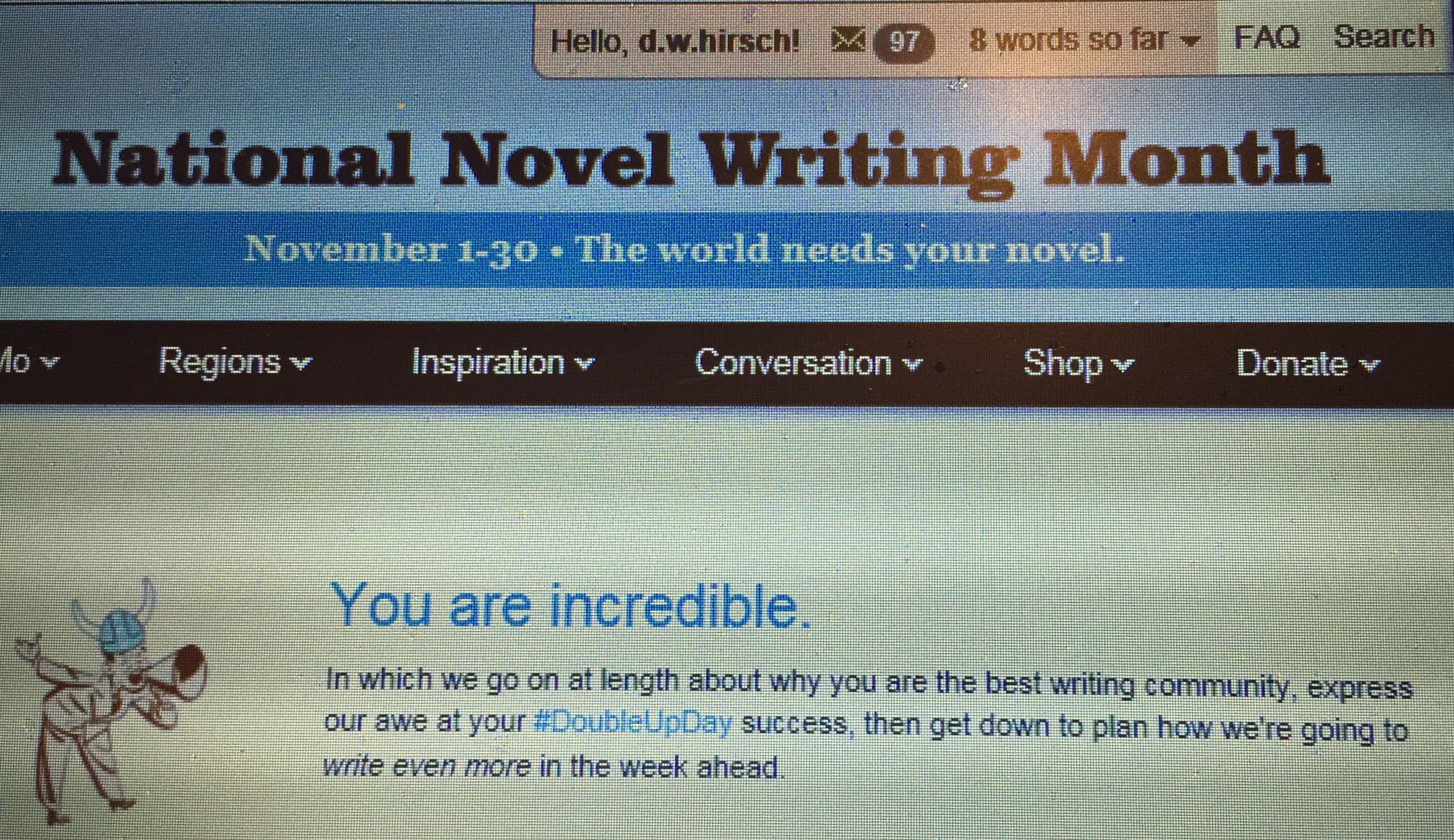
This is the heart of National Novel Writing Month (NaNoWriMo), the month where every writer and would-be writer suddenly finds the time to write 50,000 words in 30 days. Accomplishing this feat results in nothing more than bragging rights and the messy first draft of the novel you’ve been meaning to write. How do we make time now when we didn’t have one spare moment in the past 11 months?

The holiday season kicks off, too. If you’re a crafter, the stress of making Christmas cards is here because only 37 days remain until Christmas. To you chefs, the Thanksgiving meal is 8 days away. Other celebrations and holidays are a few weeks from now. What happened to your New Year’s Resolutions?

Oh, right. Those.

Why do you let everything and everyone else get in the way of your plans? How can you change that?

Schedule writing time, and I mean put it in your calendar. Would you miss a doctor or dentist appointment? What about your child’s football championship? Are you planning to miss your child’s trumpet solo at the musical recital? Writing time–or anything else–is a meeting with yourself. It is important, so block that time off in your calendar.

Set a timer for every activity you do, then switch to something new when the alarm sounds. I’ve heard that tip before, and I blew it off as corny…until I tried it. In increments of 23 minutes, I can wash a load of laundry, take a short walk or exercise, empty the dishwasher, catch up on one social media outlet, reply to some emails, or write a few dozen words.

Set deadlines. If you have a project due at work, do you blow it off and say, “I’ll get to it when I can.” There are unpleasant consequences for doing that. If you’re moving, you have boxes packed and mail forwarded by your departure date. I bet you don’t ignore such timeframes, so set a goal for yourself and stick to it. No excuses.

Reward yourself for completed tasks. If you have something good waiting for you at the end of a journey, you’re more likely to finish. Rewards don’t have to be big and expensive. Buy yourself something goofy from the dollar store. Get yourself a bouquet of flowers, one piece of Godiva chocolate, your favorite craft beer, or a coloring book. Tuck individual rewards you’ve listed in sealed envelopes, and choose one at each milestone you set. Surprises are extra-fun. Whatever you choose, be kind to yourself. If this is the first time you scheduled time for yourself and you didn’t accomplish everything, still reward your effort.

Small, simple changes: that’s how resolutions become accomplishments. “Losing weight” can only be accomplished by first “eating more veggies” followed by “climbing stairs at work for exercise.” That’s why NaNoWriMo is successful: 50,000 words at 1667 words per day. You can make small changes now, even if you’re feeling overwhelmed by the holiday season. Take time and test yourself by doing something you love. Write. There’s always enough blank space on the calendar to fit that in, even if it’s only five minutes.

Living by example, come back next month to see how this writer has handled life, the universe and everything else.

What is Writing?

What is writing to you? Writing can mean many things to different people.

1–Writing is exhausting.

Remembering the rules of syntax and sentence structure is a struggle. Perfection halts our progress putting words to paper.

1–Writing is exhilarating.

Initially, don’t worry about spelling and sentence structure. There is a freedom to words. Getting your struggles and thoughts out of your mind and onto paper clears your head. Once they are released into your world, you can address them. Accomplishing that is a thrilling expression.

2–Writing is personal.

It is risky to write. You expose yourself to others’ judgement. Your self-image becomes vulnerable to criticism. Those are scary moments.

2–Writing is personal.

When you share your words, you share your experience. Others do relate to that. Hearing someone say “I learned from this,” “I was entertained,” and “this made me cry,” is a compliment and a success.

3–Writing is reclusive.

Writing is just between you and your thoughts; nothing else. You have no coworkers or teammates to rely on.

3–Writing is sociable.

Virtual communities of writers understand your struggles. Social media connects people around the globe. Local writing groups strengthen that support. A kind, inquisitive word from a stranger in a coffee shop is supportive and reminds you that you are not alone.

4– Writing is frustrating.

Ideas are fleeting. Motivation rises and falls. You slam into the Writers Block wall over and over and over again.

4–Writing is invigorating.

By declaring, “Writing is worth making the time for,” you choose to commit to yourself. You whisk a reader away into a world you control. You paint with words, drawing scenes in your readers’ minds. Extra incentive comes from the release into the world. It is rewarding to receive a positive review on a reading website or from someone who is not your immediate family network and friends.

5–Writing is limited.

Only a few rare people get a publishing contract. Large publishing houses have limited resources of time, printing, ink, and space. If you do not make a living by writing, then you do not have a “real” job. If you just dabble in your journal, you’re not doing any real writing. Without public validation, all efforts are snubbed as “just a hobby.”

5–Writing is limitless.

If expression is your only goal, then laptops, electronic tablets, journals or paper and pen are all friends. Writing anywhere is accessible. If publishing is a goal, the publishing options range from working with a Big 5 publishing house to a small startup publisher. Self-publishing has become mainstream, be it an eBook, paperback or picture book. You own your options and control your future.

6– Writing is work.

Standard books are long. Whatever your measurement–word count of page length–completing something that complex is a massive task. Revisions take time, a lot of time, and are often disappointing. Writing is intimidating.

6–Writing is work.

There is power in writing the words “The End” on your work.

That’s what writing is to me.

What is writing to you?

Using Social Media to Overcome Writer’s Block?

Writing takes practice.

Sure, we all know that, but too often, we are frozen by the blank screen or paper we call Writers Block. At least, that’s the excuse we tell ourselves.

The only way to break down that wall is to write.

And that brings us back to the beginning. How do we begin writing? Where do we find ideas?

Blog Writing Challenges

 Whether you have written or write for a blog, you need some social media presence to maximize this option. People are sharing their creative arsenal to battle the widespread war of writer’s block across the webisphere. These challenges are sites all across the Internet. Your journey is to find them.

I’m a fan of the social media site Twitter. Unlike Facebook, it’s an open media without memberships or restrictions. Connecting with writers and readers and celebrities is a Follow click away. Unlike LinkedIn, it’s not business-focused. Unlike Google+, this is not a new, unknown experiment. Twitter is established, creative and short to swallow with its 140-character limit in each Tweet. It’s easy to find similar topics and groups with a simple #hashtag search.

On the day I wrote this, I found an array of challenges with directed yet general hashtag searches. Some of these lead directly to the moderator’s website, while others simply group posts together under that specific hashtag.

Searching the Twitter hashtag #challenge showed writing and non-writing Tweets.  Scrolling through feed, the most relevant ones came from users like @convince to post a photo with every Tweet for one week, @RonovanWrites with his weekly haiku prompt  and @lettrs posing a #WordOfTheDay challenge.

One of my favorite hashtags is #6WordStory, a challenge posed by @Kelsye. Other searches relevant and directed to writers include: #WritingChallenge; #poetrychallenge; #FiveSentenceFiction; #haikuchallenge; and #fictionchallenge.

Twitter is not case-sensitive, so upper- and lower-case usage is personal preference. The words get you to the same location. I like to capitalize some of the longer hashtags to make them easier to read.

The beauty of Twitter is the prompts are provided, and the ideas out there are bountiful. Once you find an inspirational idea, attack that challenge with all your creative energy. Many people link to their personal blogposts, but you don’t need a blog to participate. Create a separate file on your computer and dedicate 15 minutes a day to play with words. Do an email exchange with a friend or family member. If you are uncomfortable sharing, choose a journal to write in for your personal enjoyment.

If you want to publicly share your accomplishments submit these, or parts of it, on your social media or link posts to your personal blog. If you want to make a visual expression of your art, use a smartphone app like InstaQuote or Notegraphy to create a graphic to share with others or save to your camera roll.

Using photos allows your social media reach to increase. The Twitter user @asilartist tied her #9WordStory challenge together by cross-posting from her @reclaimed poet Instagram account. The same hashtag exploration applies there. I found creative posts with the tags: #WritingChallenge; #PoetryChallenge; #threewordstory; #poemaday; #flashfiction; and #4WordStory.

Beware! Most users will use more than one tag, adding several related hashtags so their post can reach various audiences. As your curiosity increases, you will find yourself winding through a maze of related hashtags so that you can forget the original hashtag you started searching for. It’s glorious. It’s frustrating.

There are worse things than being lost in a new tag that connects to a newer tag that inspires you to search for a personal interest of yours. It’s the only way to drag yourself over that tall writers block wall.

What to Expect When Your Writing Class is Online

Tempted by the forty free online writing classes available at my public library, I enrolled as an experiment. The full catalog of 350 courses competed with MOOCs (massive open online courses) and delivered a shorter continuing education opportunity in writing and other business topics. I joined with a hundred online learners from across the country and Canada for a brief six weeks of creative writing lessons. The interaction and other classmates were as interesting as the course content.

The exercises began innocently enough asking each student’s reason for taking the class. I’ll share several of my submissions. For instance, here’s my introduction:

The dog made me do it. He worries about neglecting important things like watching sunsets, skipping rocks at the lake and hiking nearby trails.

sitting writer2It was irreverent compared to the other classmates’ expressions of genuine excitement and unbridled nervousness. They used their first name, their full name or a nickname like Jelly Bean, Milwaukee Maiden, GalSal or Mother Bird. The anonymous classroom became a haven for over sharing. I discovered, most of the class was currently in crisis – death of a loved one, newly retired, birth of an infant, empty nests, schizophrenia, cancer, abuse, graduates from high school or college, English lit major wanna be’s, traumatized veterans, divorcees, joblessness, dead end jobs, stressful “on the verge of quitting” jobs, sexuality concerns, and caregivers to parents and spouses. The class offered an outlet to cope, a catharsis for the traumas of the past, present and future.

To that note, I was not so far removed from crisis myself. One of the assignments required writing about a candle. Pent up emotions spilled into this exercise. Yes, tears fell on the keyboard over an imaginary candle with a fictitious past.

The tin box sits next to an empty and worn book of matches from a Mexican restaurant near my mother’s old house and a cigarette lighter I confiscated when my teenager flirted with smoking. Graphic whirls of block printed roses decorate the lid. The image resembles both my college hand-carved block printing and my Connecticut rose garden including the wicked, hateful thorns of the floribundas deceptively named Cinderella. Yet, the tin hints of a different Cinderella – purses, crowns, wavy flourishes and little flower dots of pink – and a costume, plastic face mask on top of a printed rayon tunic visible through the cellophane window of a shallow cardboard box. I lift the candle’s lid, smell the sickly perfume of roses and remember my mother. I spark the lighter. The candle wick, a charred nub at the bottom of a melted ring in the wax, fails to light. I return the heart-shaped tin and matches to the drawer with other keepsakes and throw the lighter in the trash under the sink.

Two months after writing about that candle, I reread my passage and still feel the complex emotional mother child relationship, filled with roses, thorns and cigarette lighters. Fortunately, the next assignment was safe from my own memories and focused on a prompt, an ex-spouse arriving on a bus in a snowstorm. Each student chose a point of view and present or past tense. My classmates, more savvy to the woes and causes of divorce, wrote of anger, betrayal, infidelities, abuse and addiction. Instead, I wrote of a homesick young man uncertain of his future.

John jolted awake at the bus driver’s announcement of Grand Haven. The snow globe effect of pelting white flakes obscured the view of his hometown bus depot. He grabbed his backpack and rushed to the door to find whichever family member drew the short straw and had to pick him up in this miserable weather. His mom probably paced at home at the front door waiting for him, having planned a family get-together to hear his tales of living in New York, the small bit part in an off Broadway theater and his new friends in the city. Bounding down the steps, John slipped on the last wet step, tumbled out the door and landed spread eagle on top of a woman waiting with her bag. Expecting her to be angry or hurt, John jumped up only to discover Martha hysterically laughing and joking about his daring dive and poor timing to wait until their divorce was final for a grand effort.

The most joyful assignment embraced free writing – unfiltered and unedited. The instructor explained about Galumphing and Bricolage. Galumphing was to select an item from three different categories – a person, a place, and an object. I chose Bricolage which was to write whatever comes to mind about trivial objects, such as a candy wrapper.

The iridescent candy wrapper rested in my palm, a tidy two inch square of yellowish cellophane. In my kitchen, I sucked on the hard candy, mystified at the pleasant, yet unrecognizable, exotic flavor. And when I glanced again at the wrapper, it was twice the size. I scratched at my head, pondering where had I found this odd candy. Oh yes, it was in the console of my car after I had let my lost, and recently found, relative Larry take the car for the week to Burning Man. I wanted to ask him about the candy, but Larry, was still sleeping in my guest bedroom, a walk-in closet if you want to be precise, and by the sound of his snoring, probably out of contact for the next four to six days. Now, the candy wrapper was weighing heavy on my hands and increasing to the size of a poster board. I reached for the ruler in my kitchen drawer and found I was too short. The wrapper had not grow; I had shrunk. Naked, I slipped out of my very large clothes and tore a bit of the wrapper to use for petite clothing. I vaguely remembered seeing other candies in different colored wrappers. If the yellow wrapped candy made me small, what did the others do? Which color should I eat next?

For each of the assignments The instructor urged the class to follow the golden rule of feedback – give comments to receive comments. My fragile crisis-fraught classmates needed support, encouragement and praise for their brave undertakings. And every evening, I returned to the class website to see the comments left for me, such as the ones below on my Bricolage candy wrapper exercise.

Jenn on 5/28/2015 10:09:51 AM

What a great twist! I love it! Makes me think of Alice in Wonderland or Charlie and the Chocolate Factory. So creative!

GalSal on 5/28/2015 12:46:57 PM

Wow–I was so fooled until you said you had shrunk.  Great imagination!

Chuck on 5/29/2015 8:17:01 AM

Great creativity, it kept me spellbound.  Are we having fun yet?

Joy on 5/29/2015 5:27:38 PM

I struggled with bricolage but you made it seem easy to be creative with something so simple

Dave on 5/30/2015 10:10:56 AM

A great start and you could take it in two interesting ways.  The obvious, fantasy way, is to go on a hunt for the other candy.  The other way, the candy having come from Burning Man, is that the character is tripping and she might have some explaining to do to people that wonder why she is running around naked with a piece of candy wrapper for clothing.

Lea on 5/30/2015 6:42:35 PM

It also makes me think of Alice in Wonderland! I like the normalcy at the beginning while it slowly starts to become magical. Great 🙂

Mama Crow on 6/1/2015 5:53:07 AM

What an adventurous piece! Great job keeping the imagination vividly strong!

Milwaukee Maiden/Linda on 6/3/2015 4:52:21 PM

Very good storyline with a twist. I enjoyed reading it. You will make a great writer.

The course made me appreciate the ability of technology to engage humanity across the country. The encouraging comments were fun and an unexpected treasure. Before the class ended and all the words deleted, I copied the comments to a file and saved them for a time when I might need generous and supportive comments. For now, another class begins.