When writing non-fiction, there is much from fiction that can be incorporated. Metaphors and storytelling are important tools in such a writer’s toolbox. In what may be a series of pieces about bookstores across the United States, and a few other countries along my travels, I will explore these locations with an eye for using tools that are similar to writing fiction. I hope you share this journey. Please share your favorite bookstores in the comments section. If I pass through your area, I’ll visit, and bring the experience to this blog… John McCarthy
The Dawn Treader is one of those ports of call that from the outside appears to be a typical storefront. Bookshelves line the sidewalk in front with the bargain books for a dollar or less. All are used or well loved in usage depending on your view point. Like any seafaring ship, you must enter to find the treasure inside. And oh what plunder there is to be gained.
On first setting foot inside, I’m reminded of the time I took my son on a sleepover in a submarine. For such a small vessel, the inside was packed with compartments that, had I’d not known better, I’d think the sub was much larger from the outside. The same illusion occurs on first entering the Dawn Treader. The store entrance is spacious and open–that is if you consider a 6’ by 10 foot area surrounded by bookshelves as open. On the left is the cash register with stacks of books on the floor and desk, siren’s temptation that calls to you when making a purchase—“buy me, just one more book.” There are a few shallow steps up into what can only be described as narrow winding passageways of shelves filled with books. The different paths take you deep into the store–more so than one would believe could be the capacity from the view outside of the store front.
Antiquities to contemporary books pack the shelves. Along one passage there is a cart of mystery and suspense novels that are all signed by the authors. On this sojourn, I found two such treasures, King of the Corner by Loren D. Estelman and The Book of Lies by Brad Meltzer–both 1st editions & 1st printings.
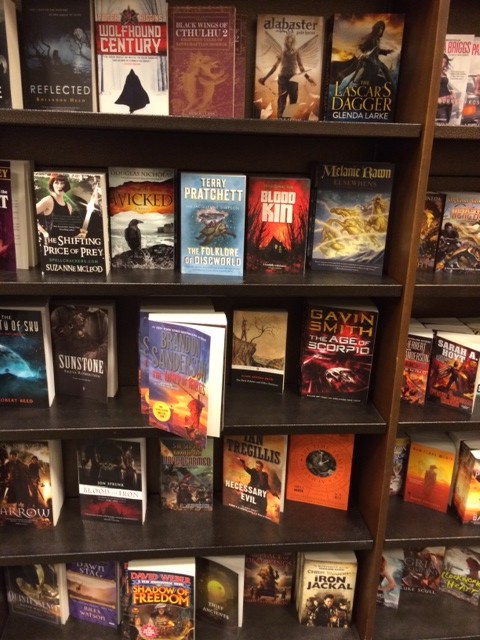
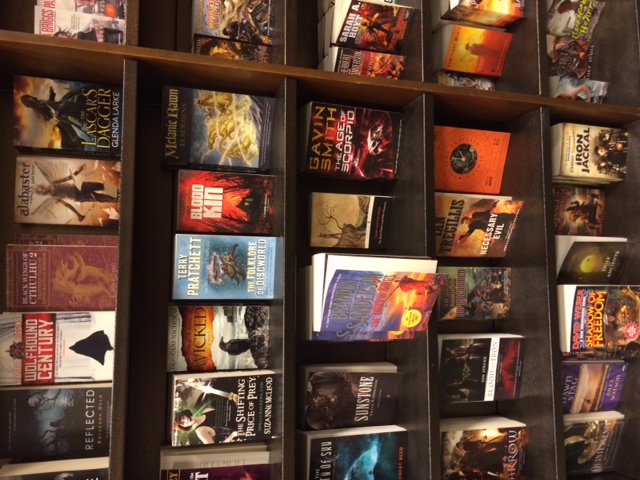
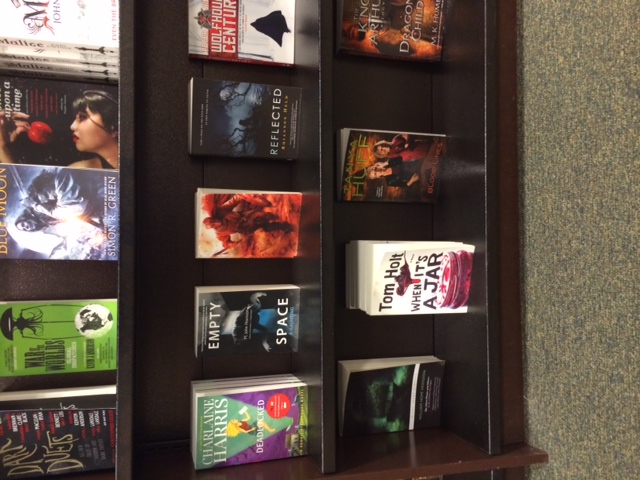
At the furthest depths of the store the “passageway” opens up into the best collection of Science Fiction/Fantasy that I’ve seen anywhere. It rivals even King Bookstore, a 5 story monolith bookstore in the heart of Detroit. A curving 20-30’ wall contains floor to ceiling shelves of tightly packed hardcovers. Three rows of 2 sets of bookshelves, also floor to ceiling, are tightly packed with paperbacks. Many decades are well represented by great stories, such as the 1970s. I uncovered original paperbacks from classic, and still incredible series, such as Thieves’ World, Conan, and the original Star Trek.
Part of lore for the magical world of the Fey is that time spent there does not measure in the same way as the mortal world. Time exploring the “decks” of the Dawn Treader is the same. Beware of entering the store, thinking you have ten minutes to kill, as an hour will pass when next you leave the premises. Enter if you dare.
Dawn Treader – Established since 1992 (per website)
The 1st page, the 1st paragraph, the 1st words can determine whether the author hooks a reader to share the storytelling journey, or if the book gets returned to the shelf for another author. There is so much competition for a reader’s attention, whether on first entering a bookstore or viewing the first page of a virtual store.
John Jakes, a prolific writer, said that in the 1st page of a story, the author should introduce a main character, the setting, and a conflict. These are the key elements for engaging a reader towards investing time in a good story. Let’s look at the opening of one of his classic novels, North and South:
“THE LAD SHOULD TAKE my name,” Windom said after supper. “It’s long past time.”
It was a sore point with him, one he usually raised when he’d been drinking. By the small fire, the boy’s mother closed the Bible on her knees.
Bess Windom had been reading to herself as she did every evening. From watching her lips move, the boy could observe her slow progress. When Windom blurted his remark, Bess had been savoring her favorite verse in the fifth chapter of Matthew: “Blessed are they which are persecuted for righteousness’ sake: for theirs is the kingdom of heaven.”
The boy, Joseph Moffat, sat with his back against a corner of the chimney, whittling a little boat. He was twelve, with his mother’s stocky build, broad shoulders, light brown hair, and eyes so pale blue they seemed colorless sometimes.”[i]
The opening words are infused with tension, coming from a very flawed character. His wife’s non-verbal reaction messages that the demand is not well received, and a sore topic. The pages that follow portrays an abusive family, from which Joseph Moffat dreams of escaping, yet held back with the helpless desire to protect his mother from an alcoholic step-dad. In the end, the boy gains his freedom, but at a high cost. And that’s just the prologue.
Engaging openings draw the reader into the story. You feel connected to a character and their immediate situation, such as Joseph Moffat. The initial conflict might not be THE conflict, but there’s enough tension to promise more if the reader continues to turn pages. Other times, the opening scene may be an accident in slow motion—metaphorically. The reader might not identify with the characters just yet, but the situation is something we cannot look away from, no matter how uncomfortable one might become. Ernest Hemingway masterfully creates such a scene in the first paragraph of The Old Man and the Sea. Here’s just the first half of the 1st paragraph:
“He was an old man who fished alone in a skiff in the Gulf Stream and he had gone eighty-four days now without taking a fish. In the first forty days a boy had been with him. But after forty days without a fish the boy’s parents had told him that the old man was now definitely and finally salao, which is the worst form of unlucky, and the boy had gone at their orders in another boat which caught three good fish the first week.”[ii]
Here’s a man so down on his luck that he’s lost credibility in his profession. Hemingway, following the same concept as John Jakes, introduces the Old Man, the title character, the setting, and THE conflict of the story in the first couple of paragraphs. Life is so hard for the old man that the boy–his former apprentice who is now learning from another–buys him a beer. With tight writing, which is a topic for a different article, Hemingway draws in the reader to view someone worse off than themselves. The old man’s stoic kindness and the boy’s devotion to him keeps us reading, and wondering, “things have got to get better, right?” Yet the rest of the story takes us deeper into experiencing the old man’s sacrifices, struggles, and loss that becomes a form of victory and vindication. But the key is the opening lines about a slow motion car wreck that we just can’t stop watching with the opening page.
Another approach is to open a story in the middle of the action. This entry has the advantage of immersing the reader into the chaos of an immediate conflict. Thrown into the deep waters of action, most often violence, the intent is to build instant momentum. Matthew Reilly is a master of this style. I credit him with establishing the genre of high octane storytelling, where there are no pauses where a character can become introspective, or an author can philosophize. The story is go, Go, GO! Conflict IS the story. One example comes from Scarecrow Returns:
“THE PLANE hurtled down the airstrip, chased by furious machine-gun fire, before it lifted off with a stomach-lurching swoop and soared out over the vast expanse of Arctic sea ice that stretched away to the north.
The plane’s pilot, a 60-year-old scientist named Dr. Vasily Ivanov, knew he wouldn’t get far. As he’d lifted off, he’d seen two Strela-1 anti-aircraft vehicles—amphibious jeep-like vehicles that were each mounted with four 9M31 surface-to-air missiles—speeding down the runway behind him, about to take up firing positions.
He had perhaps thirty seconds before they blasted him out of the sky.”[iii]
While the reader is drawn into the conflict, Reilly follows the theme of introducing a main character,[iv] providing scene context, and a conflict—death is 30 seconds away. The reader needs the three elements to anchor themselves within the chaos. We identify with his desire to escape, and wonder at his fatalistic belief—remember the slow motion car crash strategy. The conflict is intense—machine-gun fire, plane pulling Gs on take-off, and surface-to-air missiles moving into range. If this is the opening, how will the rest of the story continue to climb? Reilly meets this challenge, where other writers fail. They lead with an explosion, and then leave the reader coughing through the smoke of the rest of the story. Few will take that journey.
Good non-fiction starts with a strong opening. Authors, like Chip and Dan Heath, use their opening to illustrate the focus of the book. The focus would be similar to the plot. Here’s the opening to their major book, Switch. What do you think their focus is about?:
“One Saturday in 2000, some unsuspecting moviegoers showed up at a suburban theater in Chicago to catch a 1:05 p.m. matinee of Mel Gibson’s action flick Payback. They were handed a soft drink and a free bucket of popcorn and were asked to stick around after the movie to answer a few questions about the concession stand. These movie fans were unwitting participants in a study of irrational eating behavior. There was something unusual about the popcorn they received.
It was wretched. In fact, it had been carefully engineered to be wretched. It had been popped five days earlier and was so stale that it squeaked when you ate it. One moviegoer later compared it to Styrofoam packing peanuts, and two others, forgetting that they’d received the popcorn for free, demanded their money back.”[v]
The Heath brothers open with a social experiment that draws in readers with a story about a scene that most of us have experienced—eating popcorn at a movie theater. They turn the experience on it’s head by offering free popcorn that’s “wretched” in various sizes. Regardless if the study participants got a medium, large, or extra large tub, of the 5 day old popcorn, they ate all of it. From there the book lays out an elaborate argument about the difficulty for people to change, and how to go about succeeding in changing mindsets. What’s important here is that the opening paragraphs suck in readers, who before they realize it, are 3-4 chapters into a book about complex ideas—and they’re invested.
Characters, scene, conflict: starting with the 1st words, all three elements are present in the first paragraph, of the first page of most books that succeed in drawing in readers. Now once you have them, the next challenge is keeping them. How that works is another tale to be told. But as readers, you already know what those might be…
__________________________
[i] Jakes, John (2013-05-21). The North and South Trilogy: North and South, Love and War, and Heaven and Hell (Kindle Locations 204-211). Open Road Media. Kindle Edition.
[ii] Hemingway, Ernest (2002-07-25). The Old Man and the Sea (p. 3). Scribner. Kindle Edition.
[iii] Reilly, Matthew (2012-01-03). Scarecrow Returns (Kindle Locations 256-262). Simon & Schuster, Inc.. Kindle Edition.
[iv] Actually, Dr. Vasily Ivanov dies five pages later. He’s not the main character of the story. That would be Scarecrow. But Dr. Vasily is the key character of the prologue. All of the elements that John Jakes discussed are present to draw and satisfy readers.
[v] Heath, Chip; Heath, Dan (2010-02-10). Switch: How to Change Things When Change Is Hard (p. 1). Crown Publishing Group. Kindle Edition.
In the United States, if you visit a bookstore’s Fantasy section, urban and contemporary genres are dominant. Kelly Armstrong, Jim Butcher, Simon Green, and Patricia Briggs are some of the authors you’ll find that define fantasy literature. Magic and paranormal races exist in worlds that are familiar to us in interesting and personal ways. Jim Butcher’s Dresden Files series is based in Chicago where I grew up. Although Butcher does not live in Chicago (as of this post) he does a great job using the city as a base for great storytelling.
The age of sword and sorcery, middle age and ancient world time periods, are not passed, but just explored by a smaller group of authors. Just look at a store’s bookshelves to see what’s present on the real estate. Jennifer Roberson, Tamora Pierce, Brandon Sanderson, George Martin, and R.A. Salvatore offer worlds of wonder, magic, and swordplay that entertains with strong characters and in-depth culture and/or politics.
The fantasy writers that may be on the endangered species list represent the gritty underbelly of the ancient worlds as told by Robert Howard, David Gemmell, and Mary Gentle. Battles are unsanitized, the heroes are not clean spirited individuals who’s actions can go mostly unquestioned as the “right” and “fair” choice. Authors like George Martin have such elements—although his stories fill the need for taking a balcony view of intrigue and governance from mostly the leadership perspective.
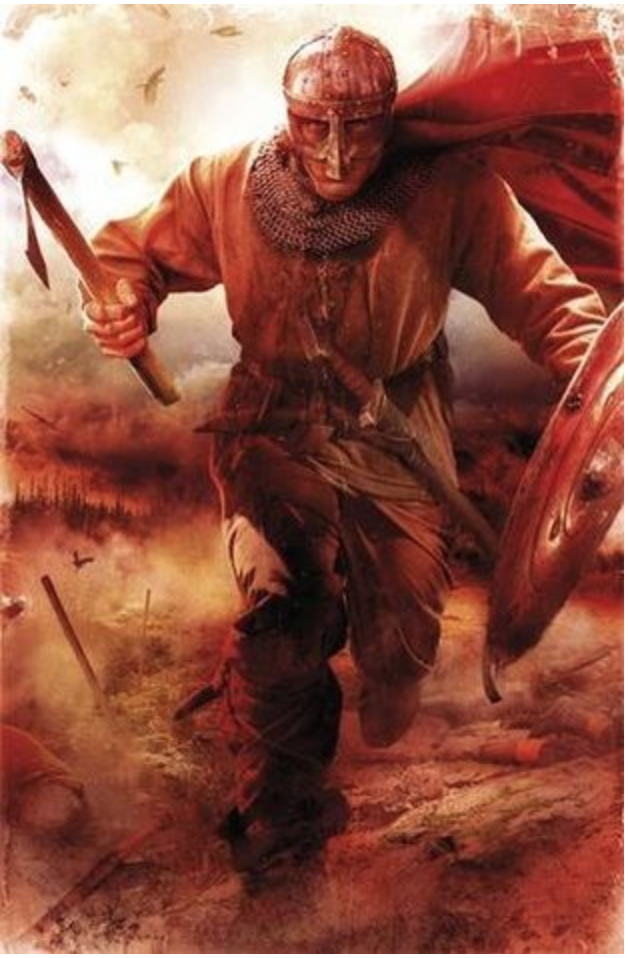
Nathan Hawke represents the next cohort of authors who picked up the banner from David Gemmell and others to continue to tell the gritty tale of complex heroes whose choices leave the reader unsettled even while accepting the choices made. Nathan Hawke’s Gallow—a 3 book series—uses the motif of the loner warrior who reluctantly takes on the cause of others.
Character Complexity
“Beside him Sarvic turned to run. A Vathan spear reached for him. Gallow chopped it away; and then he was slipping back and the whole line was falling apart and the Vathen were pressing forward, pushed by the ranks behind them, stumbling over the bodies of the fallen. For a moment the dead slowed them. Gallow turned and threw himself away from the Vathan shields. The earth under his feet was slick, ground to mud by the press of boots and watered with blood and sweat. A spear point hit him in the back like a kick from a horse. He staggered and slipped but kept on running as fast as he could. If the blow had pierced his mail he’d find out soon enough. The rest of the Marroc were scattering, fleeing down the back of the hill with the roars of the Vathen right behind. Javelots and stones rained around him but he didn’t look back. Didn’t dare, not yet.”[i]
With this opening in the first book, Nathan Hawke takes readers on a grand and gritty journey with Gallow, a warrior gifted at killing in a shield wall or alone against many. All he wants is to be left alone as a family man and a blacksmith for a community that despises him. Yet his sense of honor drives him along a path that takes him far from home, risking his life and those of others, and making deadly enemies of those he once called friends.
Hawke’s writing style is spare, reminiscent of Hemmingway. If a camera represented his writing craft, it would be tight focus images of people and places, exposing the imperfections and failings—so that no character that moves the stories forward is static or stock. And none are completely good or evil. Cruel men are capable of random acts of kindness, and good characters may commit heinous acts in the name of what they hold dear. Such character complexity effectively engages readers to follow each story line, and wonder at the potential unpredictability. For example, after a battle where Prince Medrin orchestrates the death of one of his generals, Screambreaker, he attends his funeral and speaks genuine words of honor to the dead:
“…the Lhosir stopped what they were doing and honoured the Screambreaker and the dead who’d fallen beside him. [Medrin] let the old ones do that, Tolvis Loudmouth and the rest. Let them start the pyre and, when the pyre was built, put the bodies of those they most wanted to honour on top and set it alight. [Medrin] said a few words himself, because he was their prince after all, then let the old ones who’d fought with the Screambreaker against the Marroc finish speaking him out. The pyre was huge and there probably wasn’t a single Lhosir who hadn’t put a piece of something on it.”[ii]
Prince Medrin enjoys torturing common people and then mutilating their bodies on stakes along roadways for all to see and fear. Yet, he pays honor to a fallen champion who he perceived as a rival. This is Hawke’s gift for character development that also moves the story forward.
Sword and Sorcery
In Nathan Hawke’s world there are ancient artifacts of power such as a red sword that cuts through steel like butter, which can only be effectively blocked by a special shield. There are ghoul dogs that hunt tirelessly in swamps and forests for human flesh. All of these pale to the much feared Shadewalkers:
“When Oribas walked toward the end of the arc of salt, the shadewalker moved with him. It kept moving, stepping gingerly along the line until it found its end and looked up. Its dead face didn’t change but perhaps its eyes gleamed a little brighter as it sensed its victory. It advanced quickly. Addic cried out, turned and ran while Oribas simply stepped over the line of salt to be on the other side. The shadewalker came at him, stopped abruptly at the salt and began to walk along the line again, looking for a way past.”[iii]
Shadewalkers are undying or undead warriors, who are nearly impossible to destroy, unless you have knowledge of the ancients and unshaking courage. The magic does not dominate the story. Hawke uses it judiciously in parts of the story for the greatest impact.
Some would point out that authors like Robert Jordan, George Martin, R.A. Salvatore, Steven Erikson, and Glen Cook also carry the mantel for Sword and Sorcery. All deserve credit for skillful craft in their own right. Of these authors, only Glen Cook comes closest to the grainy side of fantasy in ancient settings that brings alive the starkness of humanity through complex characters. David Gemmell was the leader in this area in recent decades, until his passing.
Last November I visited several bookstores in Sydney Australia. I was immediately struck by the volume of authors who wrote in this genre of Fantasy. Many have yet to land on American shores, but can be found via e-books and places like Abebooks. Perhaps on my personal journey to find more like Nathan Hawke, I will find that the lands to explore are across oceans.[iv] Until then, check out Nathan Hawke’s stories for engaging and powerful author’s craft.
(As of this posting, Nathan Hawke comes to U.S. Bookstores: BN in Ann Arbor MI)
“Good-bye then, and really good-bye!” said Gandalf, and he turned his horse and rode down into the West. But he could not resist the temptation to have the last word. Before he had passed quite out of hearing he turned and put his hands to his mouth and called to them. They heard his voice come faintly: “Good-bye! Be good, take care of yourselves— and DON’T LEAVE THE PATH!”[i]
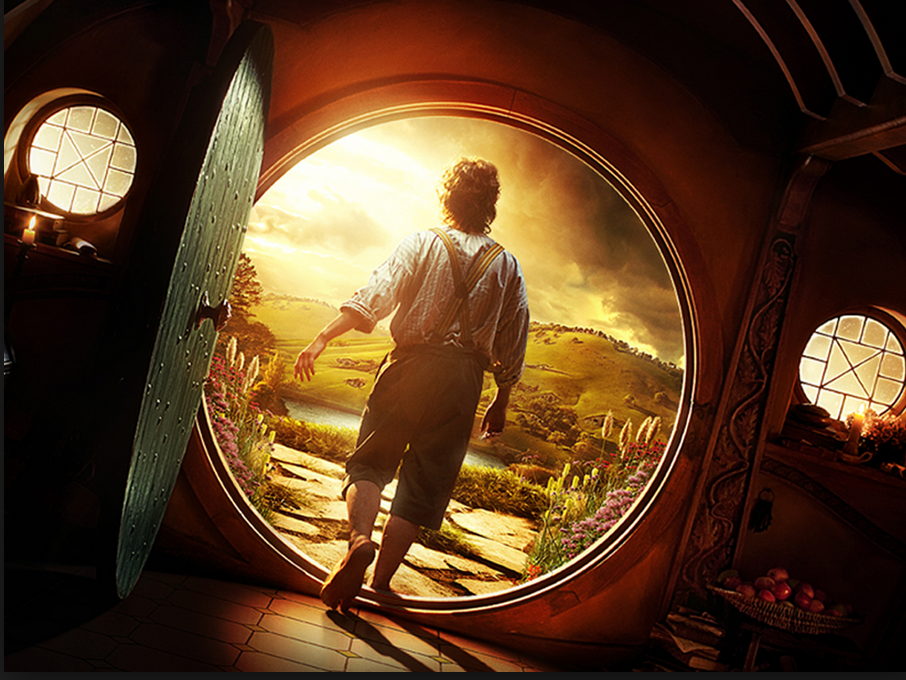
J.R.R. Tolkien’s The Hobbit is a story that I never seem to tire of re-reading. Written as a children’s story (300 pages) in 1937, with it’s dragon, dwarves, elves, magic, and—of course—it’s hobbit, the novel stands the test of time today, and I suspect will engage future generations of readers well beyond the 22nd century.
It is not the Peter Jackson’s polarizing interpretation, which will conclude with the final installment of The Hobbit on December 17, 2014. As enjoyable is I thought the series thus far, the tone is certainly different. The high octane and visually stunning movies are no G-Rated experience.
The Hobbit is light compared to the Lord of the Rings trilogy (LOTR). But this is for good reason as LOTR is a grim story of sacrifice and fortitude to save the world from eternal darkness. Engaging story in it’s own right, LOTR is filled with history and lore, complex characters fighting for their souls and free will—Boromir, Frodo, and Gollum—just to name a few. Whereas the Hobbit is meant to draw children of all ages—from youth to adult. The experiences are both risky and dangerous, yet reassuring as Tolkien acts as a guide along the way.
How did Tolkien craft a story that has such lasting staying power? What lessons can we learn from him to infuse into your and my craft? That is the path we will follow, laid out by Tolkien by way of three technical craft skills from his writer’s toolkit:
The Aside: Author conversation with the reader
Humor
Protagonist identification with the readers
The Aside: Author conversation with the reader
History and lore is the backdrop of the Hobbit, but it’s not on full display as with LOTR. There is some storytelling about the Misty Mountains in Bilbo’s Hobbit hole, and songs are sung by Dwarves and Elves that reflect their respective cultures. Tolkien deliberately excludes the role of lecturer, keeping the story simple with rich world development that hints at the hidden treasure just beneath the surface.
At different points in the story, Tolkien breaks from 3rd person point of view of the characters to himself talking to the reader. At these times, he shares short details that the characters could not know. His intent seems to give the reader a broader context of the world, or a heightened sense of the desperate situations the 14 adventurers were in because they lack the knowledge that Tolkien, the author, shared with the reader.
Gollum: “What iss he, my preciouss?” whispered Gollum (who always spoke to himself through never having anyone else to speak to).[ii]
Later in the Mirkwood forest, the adventurers kept finding lights and song. But when they drew near, all would go dark, and the lights and song would reappear in the distance. About this, Tolkien tells the reader:
“The feasting people were Wood-elves, of course. These are not wicked folk. If they have a fault it is distrust of strangers. Though their magic was strong, even in those days they were wary. They differed from the High Elves of the West, and were more dangerous and less wise.”[iii]
Humor
The Hobbit is on the surface a story about dwarven revenge and reclamation of their identity. Thorin leads 12 dwarves to return to the Misty Mountain where Smaug the dragon sleeps. Long ago, at the height of dwarven power, Smaug swooped in and single-handedly wiped out the Dwarf and Human kingdoms. He ate most of Thorin’ s people and usurped the Misty Mountains as his home. This story could easily have been a dark tale of vengeance, deadly combat, political intrigue, and—Oh wait…it is all of these without the “darkness.”
Tolkien keeps the story light by taking grim events and inserting humor that keeps off the edginess that comes with monsters and life & death situations. In chapter two, Roast Mutton, the 14 adventurers encounter 3 trolls.
These brutes are dangerous, with more hunger than brains, capture the dwarves and Bilbo, and immediately make dinner preparations. The trolls bicker like siblings, and are sucked into a conversation with a hidden Gandalf (unlike the movie part 2, where it’s Bilbo) about how best to cook dwarves for the best flavor.
“Trolls simply detest the very sight of dwarves (uncooked).”[iv]
In “Riddles in the Dark” (Chapter 5), Gollumn—the tragic loner, sociopath—talks to his bad self about how best to cook Bilbo during a riddle contest. Bilbo wins with a questionable riddle, which Gollum should have appealed if only there were decent instant replay.
“What have I got in my pocket?” he said aloud. [Bilbo] was talking to himself, but Gollum thought it was a riddle, and he was frightfully upset. “Not fair! not fair!” he hissed. “It isn’t fair, my precious, is it, to ask us what it’s got in its nassty little pocketses?” Bilbo seeing what had happened and having nothing better to ask stuck to his question, “What have I got in my pocket?” he said louder.[v]
In Chapter 9, “Barrels out of Bond”, the dwarves are locked in the dungeon of the Wood-Elves, where they can expect to live out their remaining years because their leader is too stubborn to compromise with the elven king. Fortunately, Hobbit with magical ring that turns the wearer invisible + elves partying late into the night with wine = dwarves escape in the empty wine casks. Irony?
“Come give us a taste of your sleeping-draught before we fall to! No need to wake the turnkey yonder. He has had his share by the looks of it.” Then they [Wood-Elves] drank once round and became mighty merry all of a sudden.[vi]
Protagonist identification with the readers
While the surface story is about the adventure, the internal story that is the magical glue that makes the novel worth reading again, and again, is Bilbo. Tolkien crafts a character that the reader can identify with. The title character is someone we look at and say “there but for the grace of God could be me.” Don’t believe me? Consider when Gandalf laments (insincerely one might suspect) that he can’t find anyone to go off on an adventure:
“I am looking for someone to share in an adventure that I am arranging, and it’s very difficult to find anyone.”
If some eccentric old dude that you’ve heard was good at producing fireworks events propositioned you to drop everything and go on a trip with no guarantee of returning alive, would you answer differently?
“I should think so— in these parts! We are plain quiet folk and have no use for adventures. Nasty disturbing uncomfortable things! Make you late for dinner! I can’t think what anybody sees in them,” said our Mr. Baggins[vii]
Tolkien creates in Bilbo Baggins someone who lives a normal life, without life and death decisions to make every day. Bilbo thrust himself into a group of dwarves and a wizard for what the possibility of adventure might unfold. He doesn’t know if it’ll be good or bad, but he believes he’ll regret not going for the rest of his life. Bilbo is a civilian among seasoned warriors. He has an unrealistic idea of the travels ahead, but he maintains an endearing personality throughout his experiences on the road. Such as on first seeing Trolls, which Tolkien emphasizes Bilbo’s naiveté with humor:
“But they were trolls. Obviously trolls. Even Bilbo, in spite of his sheltered life, could see that: from the great heavy faces of them, and their size, and the shape of their legs, not to mention their language, which was not drawing-room fashion at all, at all.”[viii]
Bilbo is like us, minus needing size 50 shoes, not that hobbits need shoes. By the end of the story, Thorin, thus far consumed with revenge and regaining the wealth of his home, on his death bed realizes the true value of Bilbo:
“There is more in you of good than you know, child of the kindly West. Some courage and some wisdom, blended in measure. If more of us valued food and cheer and song above hoarded gold, it would be a merrier world. But sad or merry, I must leave it now. Farewell!”[ix]
How do 13 dwarves + 1 hobbit expect to defeat a dragon where two kingdoms failed? Well, it is a children’s story. Tolkien keeps it light through humor that leads us to believe, “Well, they’ll think of something—providing they survive Orcs (think muscle-bound human with a pig’s head) on wargs (gigantic wolves), giant spiders, 3 armies, and… oh… a fire-breathing dragon who eats kingdoms after a good nap.
We all have our favorite authors. They’re ones whose storytelling draws us in. Their characters’ voices speak inside our heads as old friends or familiar voices that send chills through our body. Some authors have a writing style so distinctive that when a passage is read out of context, we can identify them. A sampling includes: Barbara Parker (list), J.K. Rowlings (list), Ernest Hemingway (list), J.R.R. Tolkien (list), and Richard North Patterson (list). There are many authors who successfully craft writing, whether it’s fiction or non-fiction.
I find myself doing what I’ve heard many other writers do—read other authors for how they use writer’s craft. Reading for author craft while reading a book is a surreal experience. It’s like listening to music while reading a review of the performer. If not careful, it’s easy to succumb to the book’s seductive call to get lost in the writing. Yet when focus is maintained on the craft, there are treasures to unearth that can be used in one’s own writing. Every published author I’ve spoken to has said that they are constantly reading—to stay knowledgeable and—I suspect—to learn how others use writing skills.
For example, I want to learn how…
Hemingway uses spare language to create story tension and characters:
In the excerpt that follows from the beginning of The Old Man and the Sea, Hemingway(1) establishes the setting, conflict, and the relationship between characters…
“Everything about him was old except his eyes and they were the same color as the sea and were cheerful and undefeated.
“Santiago,” the boy said to him as they climbed the bank from where the skiff was hauled up. “I could go with you again. We’ve made some money.”
The old man had taught the boy to fish and the boy loved him.
“No,” the old man said. “You’re with a lucky boat. Stay with them.”
“But remember how you went eighty-seven days without fish and then we caught big ones every day for three weeks.”
“I remember,” the old man said. “I know you did not leave me because you doubted.”
“It was papa made me leave. I am a boy and I must obey him.”
“I know,” the old man said. “It is quite normal.”
“He hasn’t much faith.”
“No,” the old man said. “But we have. Haven’t we?”
“Yes,” the boy said. “Can I offer you a beer on the Terrace and then we’ll take the stuff home.”
“Why not?” the old man said. “Between fishermen.”
I’m amazed at what’s accomplished in one conversation. Hemingway understood that every word on the page must move the story forward. The purpose served must contribute to the whole story, even if it’s what appears to be a casual conversation.
Barbara Park uses language that sets both tone (humor) and character through dialog:
I can recognize Barbara Park’s main character in any passage, like as a parent, I know my children’s voices in a crowd of students in a loud hallway. She creates a signature character with a unique and irreverent voice: Junie B. Jones—“The B stands for Beatrice. Except I don’t like Beatrice. I just like B and that’s all.“ What follows is a conversation with her Kindergarten teacher on the first day of school(2):
“Her name was Mrs.— I can’t remember the rest of it. Mrs. said I looked cute.
“I know it,” I said. “That’s because I have on my new shoes.”
I held my foot way high in the air.
“See how shiny they are? Before I put them on, I licked them.
“And guess what else?” I said. “This is my bestest hat. Grampa Miller bought it for me. See the devil horns sticking out the sides?””
There is so much to love, laugh, and learn about Junie from this short exchange. Her lack of a filter sets the tone for many situations she gets involved in. There is much to be enjoyed by kids and adults from these stories.
How authors use craft is the stuff of this blog series. On the 3rd of each month, I will focus on an author. Exploring their use of writing skills to craft compelling stories and messages. Feel free to join in the exploration of their use of craft as I will provide an advance on what author will be explored.
March 3rd: J.R.R. Tolkien, The Hobbit
Feel free to read the same book, or refer to a different book by the same author. Uncovering Author’s Craft matters more than which book a person explores.
Park, Barbara (2012-05-22). Junie B.’s First Ever Ebook Collection!: Books 1-4 (Junie B. Jones) (Kindle Locations 67-71). Random House Children’s Books. Kindle Edition. From book 1 – Junie B. Jones and the Stupid Smelly Bus


 Fiction/Fantasy that I’ve seen anywhere. It rivals even King Bookstore, a 5 story monolith bookstore in the heart of Detroit. A curving 20-30’ wall contains floor to ceiling shelves of tightly packed hardcovers. Three rows of 2 sets of bookshelves, also floor to ceiling, are tightly packed with paperbacks. Many decades are well represented by great stories, such as the 1970s. I uncovered original paperbacks from classic, and still incredible series, such as Thieves’ World, Conan, and the original Star Trek.
 Dawn Treader – Established since 1992 (per website)