Author Archives: Phil Rosette

About Phil Rosette

THE FREYA PROJECT was my first novel (Countinghouse Press, 2004). FREYA is a globe-trotting technology suspense that is still in print. I had a lot of fun doing readings at more than a dozen bookstores and book clubs throughout Michigan when it first came out. In 2009, I digitally self-published SEOUL LEGACY, THE ORPHAN’S FLU, a story about the buildup to WW III started on the Korean Peninsula by pandemic. I promote SEOUL LEGACY on my website.

Rambling Thoughts on a Winter’s Day…

The internet is old enough now to be new all over again. Ten years ago, “hyperlinks” were all the rage for how to get your website ranked higher in the search engines. Popular sites “recommend” other popular sites by exchanging links with them to produce higher browser rankings for both. Think of it as word-of-mouth advertising with an “e” on the front end or as the geneses of Facebook’s “Like.” Well, links are back in vogue again. Apple, Google and Microsoft make the browsers we all use to surf the web, and they battle each other with light sabers and dark forces for supremacy in this market. Shaking up the sequence algorithm – that’s the crunch and grind of data that decides who gets to be Number 1 – keeps the internet fresh. That’s a good thing because of how large and vast the beast is today, but it does make for more work at the individual website level…

One of the nicest things about running your own business is you get to set the schedule. Running a small business means you are never without something to put on that schedule, and January is one of those months when a lot of things come due. January is the time to compare and to project, too, and maybe make a few resolutions. In the online advertising business, it’s about keeping my clients ahead of the pack, or at least within their budget…

In the novel writing business, it’s hibernation time for me. The fingers are quiet but the mind is still churning out plotlines, ideas that need to ferment in the gray matter a while longer. It’s time to find an agent and a publisher, and I can’t wait to see what Jenna Jinks comes up with for cover art for Broken String, but there is nothing else I can do for the novel itself at this point. I bought the Writer’s Digest’s 2016 Guide to Literary Agents. The book-buying landscape has changed drastically since The Freya Project was published twelve years ago and there’s a lot to absorb inside the Guide’s 330 pages…

Funny thing, the first words you read on the cover are about how to register online to take full advantage of their free, one-year online membership that came with the purchase of this book about how to get your book into print…

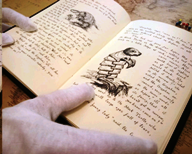
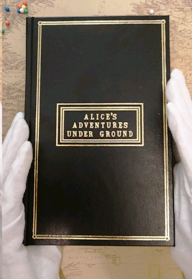
When I published Seoul Legacy, The Orphans Flu in the summer of 2012, self-publishing did not have the respectability or acceptability it has today. Fifty Shades of Grey was barely fifty days old. Today, we have Kickstarter.com as one way of funding a novel, and I speak from first person experience when I tell you it can work. The Alice’s Adventures Under Ground Project was an overwhelming success and a class-act to boot. When my printed copy arrived, well before the promised date of Christmas, the first thing I unpacked from the box was a pair of white gloves. They were cheap knockoffs to what the British Library Historian might wear while handling the original Alice, but what a perfect gift for a facsimile book! That’s classy stuff for a classic story. What could I include with Broken String? Something outstanding yet inexpensive? Good ideas gladly accepted here…

February is a leap month this year… What are you going to do with your extra day?

Read On!

-Phil
Onward and Upward in 2016

Over the years I’ve come to realize the world is a fast changing place, and once things change there is no going back. The real world doesn’t work in reverse.

One thing that has not changed over the years is the appreciation I have for the people around me: my family, friends, readers and fellow writers. This is the time of the year to say Thank You. I truly value your friendship and the input and comments you’ve provided this past year.

That’s it for this month, too close to Christmas to go on when a simple Thank You says it best. Have a fun Holiday and a wonderful New Year!

Onward and Upward in 2016!

-Phil

November can be Tough

Things always seem to go to hell in November. But first, an update on Alice. The 150th Anniversary Edition of Alice’s Adventures Under Ground is due to be released in book format on 11/22 (yesterday), but I received my e-book version of the story last week and was delighted. The quality is excellent. They kept to the original, hand-written format with the drawing around the text, which cannot be enlarged on an e-reader, like a normal typeset document can. It worked perfectly on my “iBooks” app and was easy to read in portrait mode. Charles Dodgson’s original tale differs greatly from the commercial version of Alice in Wonderland. For one thing, there is no Mad Hatter in the Under Ground version, and the ending is… well, I won’t spoil the plot — for fear the Queen of Hearts will point at me and shout off with his head!

Broken String is back from my two editors and all of their comments and corrections are in. The final edit trims to 111,200 words. That, from 122,800 in first draft, or about nine percent. I don’t know what that means, but I’m a nut for statistics.

Artist Jeanna Jinks of Wake Forest, North Carolina, is doing a cover art example for Broken String. If you are not familiar with her works, drop by her online studio, JinksStudio.com. Jeanna’s paintings are captivating and I’m anxious to see what she comes up with.

In other news, I can now add Manservant to my resume. I have Mo home recovering from foot surgery she had on Veteran’s Day. One of the hazards of being a nurse is that you are on your feet all day. Her employer gave her eight weeks to recover, which is great for her and not so much for me. I am writing this the day after her surgery. For the first five days of recovery, Mo will spend 55 minutes of every hour with her foot “up” and five minutes walking. Early mornings and late nights, I’m up and down the stairs refilling the ice bag that keeps the swelling down. She tells me I’m a dear. I’m trying to get my lap time under two minutes.

Starting day-six, Mo will only need to spend 40 minutes an hour with her foot up. It’s her left foot, so she can drive on her own after that. She has a temporary handicap parking sticker but you can bet dear will be driving Miss Mo around more than she’ll be taking herself places. Thanksgiving and Christmas fall during her recovery period.

This should be fun, and I say that with tongue fully extended from cheek.

Normally, it’s just me and the dogs during the day, and they’re usually asleep. Mo and Ben are off working and I don’t turn on the radio or television while working online or writing. I like quiet, find it more soothing than any music. The perfect background for thought. But right now, I can hear the living room television playing some TV serial Mo’s recorded in advance, in anticipation of binge watching away the tough months of November and December… Note to self; get Mo headphones for Christmas, give them to her way early.

I say this in jest, of course. Mo knows my sour sense of humor, she even encourages me when it’s aimed at others. I’ve no doubt she’ll run to grab a stick when she sees the piñata that looks like her ice bag.

So, I Asked Alice…

Here comes fall. What an appropriate name for a season in which the leaves drop as fast as the temperature.

AliceUnderground1My blog last month talked about possibly using crowdsourcing to publish Broken String, my new novel that is now in final edit. I received several comments at Deadwood Writers Voices and thanks to all of you for that.

To better understand Kickstarter.com, I decided to “back” one of their book projects. To get a feel for how this might work, I backed the 150th Anniversary Edition of Alice’s Adventures Under Ground. It is being produced in Australia under License from the British Library.

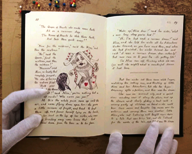
This is Charles Dodgson’s original version of Alice and it includes the 37 illustration Dodgson did himself, with the story in his own hand writing. Lewis Carroll was a pseudonym for Charles Lutwidge Dodgson. His penname was derived from the Latin spelling of his first and middle names, and then reversed and translated back to English.

This 150th Anniversary Edition is leather bound with gold embossed titles with black and white and two-color illustrations. I’m looking forward to seeing it on my classics shelf, after I’ve read it.

AliceUnderground3If you are not familiar with the backstory of Alice, Dodgson originally wrote it as a short story for his College Dean’s daughter. After hearing him tell the tale, twice, during two rowboat trips, Alice Liddell, asked him to write it down for her. He wrote it out in long hand and did his own illustrations, then he had it bound together and gave it to Alice as a Christmas present in 1864. He was encouraged to have it printed for sale and so expanded the story from 15,000 words to 27,500, and brought in renowned illustrator John Tenniel to do better illustrations. He self-published the story, retitled, one year later. That 1865 typeset version is now known as the first edition of Alice in Wonderland. One hundred fifty years later, we have a finely crafted tome of the author’s original words and illustrations, as he presented it to twelve-year-old Alice.

AliceUnderground2Participating with this project has given me insight in how a successful program works. Their costs were projected at AU$20,000 and they raised over AU$109,000 from 1,081 backers worldwide. During the six weeks, I received several emails with updates on the project, complete with pictures of set pages and workers busy on the production. It was a very easy process and it gives me some hope.

Now, I’m not the British Library and my story hasn’t been loved by children of all ages for 150 years, but seeing how they organized the campaign and how they grew interest from under 100 the first week to over 1,000 backers by the end is encouraging.

For my project, I’ll first need to gather a core group of readers, friends and fellow writers to back the project once the campaign does start. Kind of give it a push out the door. Getting that core group to reach out to the friends they know who might enjoy a suspense novel like Broken String is critical to the overall success. Backers of my project would receive deep discounts on signed, first editions of the printed book and first day delivery of the e-book, much like the Alice project offers. I would like to offer versions in limited edition, hard cover, trade paperback and e-book to have the widest price range for backers.

It’s still just an idea germinating in my head. I’ll keep you updated, but I would love to hear from more of you as far as what you think of this idea. What kind of a discount would entice you? Or, what else would be enticing enough for you to back a project like this?

Wanted: Graphic designer for the cover art. Can you recommend anyone?

Crowdsourcing

I was looking into crowdsourcing as a possible way to publish Broken String next year. Kickstarter.com is the one I was looking at, but there are others. Crowdsourcing is a way to find supporters to fund your “project.” That project can be just about anything from a space satellite to a movie, or a book. You start by pledging something in return for supporters’ dollars. One project offered to shout out your name in a ballpark for a pledge of one dollar, but most just offer tee-shirts, mugs or deep discounts on the product they are trying to get started. Kickstarter has had some success with publishing books, but mostly graphic novels and children’s books from what I see on their website. They’ve had a little success with fiction books, but most fiction titles I see are “non-starters;” projects that did not raise the amount of money needed in the time allowed. Non-starters don’t happen and no one is obligated to anything. The project turns into digital dust.

Gulp.

It’s like a poker game where you’re all in. If you win, you’re up, up and away. But if you lose, you’re left with just hot air and no balloon. I’d love to hear from someone who’s published a novel this way, to get an idea of their experience. I’m not afraid to take a chance, I just want to have a look over the cliff before I jump.

Reading through some of Kickstarter’s history and success stories, it seems the most fully funded projects are the ones where you, yourself, bring in a lot of supporters in the beginning. The best way seems to have a rollout where you create a lot “buzz.” Then launch the project on a specific day and get your “circle” to “support” the project on Day-1. That initial surge of interest gets the casual Kickstarter members checking out what all the fuss is about.

That’s great if you’re a big satellite company or a movie mogul where you’ve got thousands following you on social media, but it’s scary for a lonely fiction writer whose circle of friends could be corralled with his belt.

I’d love to hear your thoughts on this. Check out Kickstarter.com if you haven’t already. It’s easy to get lost in some of the projects, many of which are fascinating new ways to tackle old problems, like the mechanic’s glove with a magnetic index finger to hold nuts and washers in place at odd angles. Brilliant!

Would a suspense novel be a success? Would folks want to read it enough to actually buy it? You know, with money? What do I have to lose? Well, confidence for one thing. It’s like amateur night and I’m at the mike. Hope people will laugh at my jokes, but what if they don’t? This isn’t my first trip to the mike, so to speak. Guess I won’t know if my audience is growing or shrinking unless I try.

Kickstarter gives “publish or perish” a whole new ring to it these days. Any hints, ideas or suggestions to help me sleep at night?