Category Archives: Marketing

Slogging Through the Jungle with a Hatchet

You may have heard something about the ongoing fight between Amazon and Hachette Book Group. It started in the boardrooms of both companies over the new contracts that, effectively, allow Amazon to set the prices for Hachette’s and eventually all publishers products.

But that’s not all. It also says the publisher, by a certain future date, must submit “electronic versions” of their books – and covers – with shipments, and to allow Amazon to print-on-demand (POD) any orders the publishers cannot fulfill within a specified amount of time. I haven’t seen the contract, but enough people have to warrant over 1000 authors signing a letter and buying a two-page ad in the New York Times Sunday Edition to protest the contract’s language. It’s getting nasty, just the kind of stuff that good, suspense novels are made of!

Diana Hirsch got this topic started back in August with her Amazon, Hachette and the wretched $9.99 price point, but I saw a sidebar there that warrants a bit more discussion. I wear both hats in this fight. My first novel, The Freya Project, was published by Countinghouse Press. I self-published my second book, Seoul Legacy, the Orphan’s Flu, with aid of the University of Michigan Library’s Espresso Book Machine. Anyone can use their million-dollar “book” printer. My per-unit cost in each case (tradition vs. POD) was about the same. The difference was that I could have printed just one POD book if I wanted instead of hundreds or thousands, so the overall publishing cost difference was huge and that’s what drove my decision to POD for my second book.

You can bet Amazon has a few Espresso Book Machines at the ready, and what’s really at stake here are jobs. Thousands of workers bees throughout the book distribution channel are about to be handed pink slips. Traditional printing houses will fall if they don’t get onboard the e-train, and the biggest ones will fall the hardest. Publishing is going to bleed all the way back to the pulp forests. This contract, this new business model, if it comes to fruition, will literally rewrite the definition of the word “print” in all dictionaries by the year 2050. I alluded to this in my blog back in March, And now, the 2050 POE prize winner for…. Amazon has already captured the prize – the consumer.

Don’t blame Jeff Bezos and his Amazon.com; he just expanded the vision. Blame Johannes Gutenberg; he started it when he put all the first scribes out of business! By 1460 – a mere 21 years after he invented it – Gutenberg’s moveable type presses were operating all over Europe. What happened next changed the course of history. Over the next 500 years, print would evolve into the worldwide format for all sciences, medicines, religions, and all other forms of education. It allowed us to record history and for the masses to learn. Jeff is merely taking over where Johannes left off.

I don’t care how they define “print” in 2050, so long I’m still able to read it. That’s the consumer’s hat I wear in this fight, and it’s the hat I care about the most. I don’t care what price point publishers put on e-books, either, so long as Mr. Bezos & Co. keep their long-standing consumer protection clause; Amazon’s seven-day, no questions asked, money back guarantee. If you don’t like an e-book, return it for a full refund within a week. I have both bought and sold eBooks this way on Amazon.com for years, and have yet to experience a refund from under either hat.

Amazon’s consumer protection clause is the rising tide that lifts all boats. If the author or publishing house insists on staying anchored to their price-point, then let them, just as long as the consumer can get a refund if they don’t like the book for whatever reason. Frankly, Amazon’s seven-day policy should be thirty-days, to encourage bulk purchases.

The main reason new authors have such a hard time breaking into the industry has been the same for hundreds of years; they are just not-quite-good-enough to warrant the all expenses required to “launch” a new author. Amazon’s proposed business model finally buries that hatchet. It allows a publisher to take a chance with someone or something new without the fear of going broke. It allows the author to take a chance without the fear of losing audience. It also allows the reader to take a chance without wasting a lot of time, or money.

Too many good voices are going unheard. For every one David Baldacci there are fifty Bonnie Virag’s. I dare you to put down her The Stovepipe, a true story about growing up in the Canadian Children’s Aid Society. Hers is the most gripping novel I’ve read since Frank McCort’s Angela’s Ashes. Virag only has 29 five-star reviews on Amazon.com, compared to McCort’s 2,400, but download The Stovepipe and I guarantee you will want to be number 30.

As I see it, new authors are the only authors who will need an agent – a megaphone, if you will – in the Amazon business model. Word-of-mouth has always been the best form of advertising. If readers like what you write they will tell two friends who will tell two friends, etc. They always have and they always will, especially where reading material is concerned. The internet only amplifies today’s voice, but it does so on the same scale that moveable type amplified reading almost 500 years ago.

Right now, Hachette & Co. should be driving fast and taking chances instead of slogging along in the fast lane and holding up traffic. Think of the internet as the carpool lane in rush hour, Mr. Hachette – give someone else a lift and you’ll both get there faster.  Smaller advances, say, a tenth of the size of Baldacci’s, could be paid to new promising authors. All publishers should be trying to find –and fund – new voices like Ms. Virag’s. If only one turned out to be as successful as David Baldacci or Frank McCort have they’d be in the money. Two or more and they’d be fat cats with cigars. Again.


Next Month. A look at what the future holds for pulp.

I have no doubt someone will print a 600th Anniversary edition of the Gutenberg Bible. I suspect all religious material will still be in “print” by 2055, but what chance do newspapers have? Or magazines? Or books? And, what does history hold for all the printed matter in existence now? Is a first edition of J. K. Rowling’s Harry Potter and the Goblet of Fire treasure or trash? Those questions answered, and more, in November. Thanks for dropping by!
You can write and publish your story in 10 hours

I dare you.

Do you remember when writing was fun and carefree? I do. As a kid, I would pull out a notepad and write stories just because that’s how I chose to pass the time. I mostly wrote fantasy stories, some science fiction without all that technical mumbo-jumbo. My dragons had their own rules of behavior and almost every character had an apostrophe in their name.

I created bizarre plot twists. I didn’t fuss with grammar or sentence structure. I didn’t care if the stories were proper writing; I just wrote a rough draft that I always thought was complete. I had fun.

Somewhere along the way, writing became structured and proper. Because of that formal format reality, I look at those drafts now and I think, “What silly little creations.” Why did I bother? Why did anyone or I care?

I expect that if you’re reading this blog, you remember that feeling, or you know someone who has. You, as a reader, can tell when the writer was having a good time and when it was an assignment. I invite you to rediscover that freedom and write with abandon. No doubt, you still have one of those stories down on paper or in your head. This month, I dare you to complete it and publish.

I talk a lot about self-publishing as if it’s gospel. The fact that I’ve done it twice–soon to be three times–does not make me an expert, but I feel confident in it. I know the powerful feeling of control, a feeling that comes from writing, editing and finishing a piece of work. Hitting the Publish button on Amazon is a daring and satisfying moment. I want you to experience that feeling.

Why should you?

Even if you don’t dream of publishing, I challenge you to do this. It’s a sense of accomplishment to write a draft, to edit that draft and by publishing it that means you finish something that you’ve started. Maybe you just have a story to tell, say it’s a letter to your parents, and wouldn’t it be cool to download it onto their Kindle for Christmas? Maybe you have a story about you and your friend. How cool would that be?

When you were in school and had an essay exam, the class eventually ended and you handed in your work as-is. At that moment, you were done. It was a relief, wasn’t it?

National Novel Writing Month (NaNoWriMo) is coming up in November. The concept behind NaNoWriMo is to kickstart you into completing a full-length first draft, but writing 50,000 words in 30 days can be intimidating. Even though that breaks down to 1667 words a day, or 69 words an hour, that finite number may be too large to be comforting. I suggest something doable.

My idea is a spin off from JA Konrath’s blogpost back in August 22, 2013.  The idea mingled fun with structure. Pretend writing is your business. Sit down at the beginning of your 8-hour business workday and write a story, edit it and publish it online. It can be that easy.

My two published short stories have been a result of that challenge. My approach was to start at 8am with a cup of coffee and an open Word document. I write one sentence so the screen is no longer blank. Then I just write, completing my first, rough draft by 12noon. I take a typical hour lunch break. From 1-5pm, I rewrite and edit my text. You can format and upload your text in that timespan as well, but consider taking a dinner break, and then work an hour or two of overtime creating an account, formatting the text, uploading it to the site, and adding cover art.

True, each time I began with a vague story idea and direction, but that was it. There was no outline, no structure, and no definitive plan. I could just as easily have pulled out one of my silly little fantasy stories and see what I can do with it now.

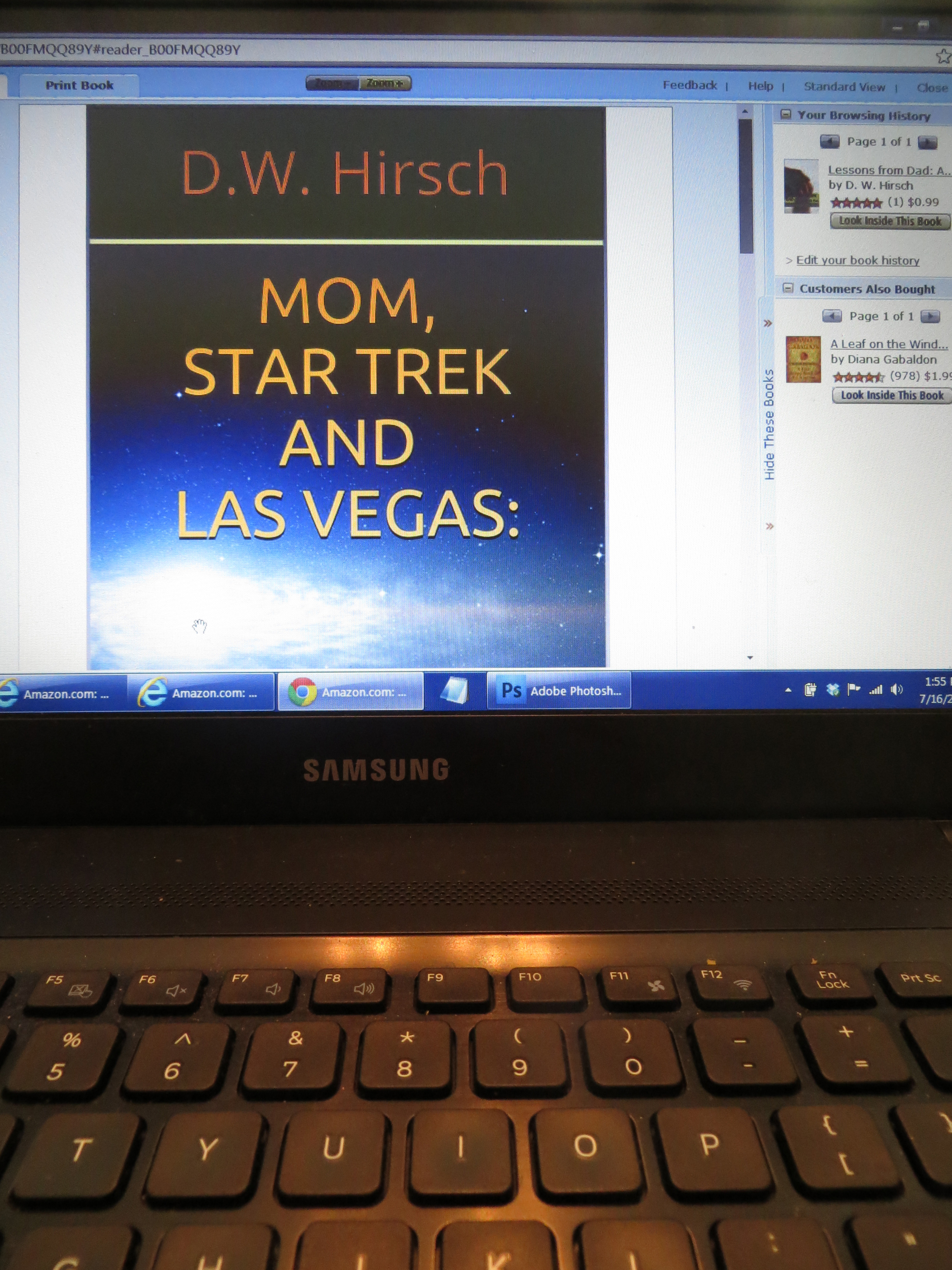
My first e-Book experience was my memoir about a trip my mom and I took. The book–Mom, Star Trek and Las Vegas: A Grand Adventure required research because Trekkies or Trekkers will know if a name is incorrect or a date is wrong. I thought I could sit down in one eight-hour stretch, but I did not. I wrote an hour here, two hours there, made 20 minutes for research here and so on. I was committed to finishing it, whatever the timeframe.

Writers who took the 8-hour challenge, published by August 30. That was eight days after the issued challenge. I’ve read some of the published work and some of them read as if written in 8 hours. But so what? The author wrote, edited, and completed the work. That was the fun of it.

On October 6, after 18 hours and 45 minutes, give or take, I was an officially published author. That was 45 days after the initial post. Final word count: 5657 words, about 22 pages.

My mom memoir e-Book won a national award: third place in the NFPW 2014 Communications Contest.

My second eBook–Lessons from Dad: A Letter to You–was a prelude to my upcoming novel memoir. I released it on June 14, 2014: Father’s Day. I counted it by the number of edits–four, including initial draft–rather than hours, which I estimate took 12 hours. That book is 5111 words, or 21 pages. For 99cents, both books are a bargain read.

What’s the number one reason people don’t do this? Without conducting scientific research, my personal experience is “I don’t have the time.” Wrong. You don’t make the time.

You say you’re too busy, that there are too many other tasks distracting you? You have dinner to cook. Your kids have after-school activities and you’re the driver. You volunteer at the library. You work a 9-to-5 job and commute an hour each way. You have a report to write. There are weekly soccer matches to attend, so you wake up at 6:45am every Saturday. You go to church. You have a monthly date night with your spouse. Your favorite TV show has begun a new season. Repeat week.

Excuses. All excuses. They are reasons, but they are also excuses.

I will attempt this by my next blog post. So, what does my life look like? I don’t have kids to factor in, but I picked up about five extra shifts at my part time job between now and then. I’m traveling out-of-state, teaching Zentangle classes, co-hosting a monthly art group, having a Halloween scrapbook crop at my house, celebrating my 11th wedding anniversary, and raising funds to dance in February’s THON.

I am madly editing my dad memoir novel for ePublication on November 20, my father’s birthday. I’m promoting that book on Twitter, Instagram and my Facebook Author page. Let’s not forget that I have my own blog to maintain, including my annual Halloween blog hop post.  There are articles to write for Michigan Scrapbooker Magazine. I’m editing posts for this blog, critiquing submissions for this writers group, and writing the follow-up November post of this challenge. In utter madness, I also signed up for NaNoWriMo this year.

And there are the daily mundane To-Do items: doctor appointments, cooking, grocery shopping, laundry, mailing birthday cards. Did I mention I was married and have a husband to not ignore?

If I can find time in that, then you can make time in your schedule.

This is not a setup. I don’t have a finished work sitting in the wings planned for this blog challenge. I have ignored my Jimmy the Burglar story for way too long. I mentioned it first back on this blog in March and haven’t touched it since. That’s seven months. I’ve written segments in my head but nothing on paper.

Do you feel that if you don’t write for X-minutes at a time then you’ll lose your flow, and focus and might as well not even start? If you choose to accept this challenge, make it work for you. Don’t have a whole day? I bet you can find an hour a day for 8 days. Maybe 30 minutes for 16 days. Does it take longer than 10 hours? So what? Don’t let the timeframe freeze you, but use it as a guideline, an incentive, a strong deadline.

Don’t be embarrassed by it. Don’t expect best-selling material, although you might surprise yourself. It’s most likely a short story, and there is nothing wrong with that. My books are the length of approximately three of this 1650-word blog post.

What’s in it for you is a sense of accomplishment and completion. As writers, we are always in the middle of something. Or, we write that first draft and never go back to it. I’ve done NaNoWriMo for three years, and I have yet to continue one of those 50K drafts. Unfinished work is a plague on would-be writers.

Stop whining.

You raise kids and release them into the world after 18 years. You write that college essay in 50 minutes and then submit it for a grade. You plan a wedding and eventually the bride walks down the aisle. At some point, there’s that moment of letting go. Stop the mindless edits and let your writing be that free.

As an incentive, I promise to download your book and read it and review it, even if it takes me a few months to get through them. Add your link to the comments section in my November 18 post, or share your thoughts about the overall experience.

Discover what kind of book you can to write in 10 hours!

What Do You Know?

“Write What You Know.” Original Author Unknown

“Beware of advice—even this.” Carl Sandberg


Creative juices are flowing. Your protagonist takes a high-powered position in a renowned law firm to be closer to her love interest. The romance is simple for you to write, however you know almost nothing about a criminal law firm. To make the story realistic, research is necessary. Even the pros do it.


Tom Clancy, known for espionage and military based novels such as The Hunt for Red October, Patriot Games, The Sum of All Fears, and Clear and Present Danger, was never in the military. Clancy had a bachelor’s degree in English literature and worked in the insurance business. His fascination with the military motivated him to do the research to create his best-selling novels.


Vince Flynn, a dyslexic who graduated with a degree in economics, was medically disqualified from entering the Marine Aviation Program. He quit his commercial real estate job to work full time on his first novel, Term Limits, a political thriller. Flynn also wrote Transfer of Power, The Third Option, and Act of Treason. Having no military or political background, he did a lot of research to get essential facts correct.


Harlan Coben studied political science in college and writes mysteries, such as Tell No One, Deal Breaker, Just One Look, and Six Years.


Some best-selling authors use the knowledge of their occupations to create heart-stopping plots. Robin Cook is a physician who writes medical thrillers, i.e. Coma and Contagion. Tess Gerritsen is a physician who wrote Call After Midnight, a romantic thriller, as well as a series of novels that spawned the television series, “Rizzoli & Isles.”


Michael Crichton, an anthropology professor, studied medicine and did exhaustive research to write medical thrillers. He is well-known for Jurassic Park, Twister, and The Andromeda Strain which were made into popular movies. Crichton also created the television series, E. R.


Are you motivated enough to thoroughly research your topic of interest to complete your novel? Will you be the next Tom Clancy, Tess Gerritsen, or Vince Flynn? What are you interested in researching?

Yes, you can publish a book

My thoughts on self-publishing


What is stopping you from publishing your book?  You are.

I have self-published two books so far, and I am thrilled about it.  With the introduction of eReaders, writers have complete freedom in their craft.  You have the ability to post anything online through a blog and various social media, and now you have the socially-accepted ability to publish a book.  But that was not always the case.

As recent as 10 years ago, the only way to buy a book was as a printed copy in a brick-and-mortar bookstore.  The only way to get your book into those stores was to sign a contract with one of the traditional publishing houses headquartered in New York.  These companies controlled physical book distribution, and they didn’t make the process of acceptance easy.  Even with well-crafted query letters and strong sample chapters, you still needed a smidgeon of luck that your manuscript found its way to the right editor or agent to believe in you.  If you made it through that professional vetting process, then you had the validation of being a “real” writer.

If your work wasn’t good enough to be accepted by the industry, then the only way to get your story to readers was to fake professionalism.  You had to print it on your own, with the stigma of “vanity press” trailing your byline.  I believe that was a phrase created by publishing houses.  If you had to print and peddle your wares yourself, then you weren’t a professional writer.  This legitimized publishing houses and enhanced their aura of attraction.  Without any sense of quality control or standards, what was there to keep the sludge out?  Such a book was an ego trip, and the only sales would come from family and friends.

On a base level, I understand that perception, especially after my experience at a 1998 independent publishing convention in New York City.  Unknown authors sat at tables just as if they were at a real book signing, so I figured there must have been some judging or invitation to be there.  I came across a hardback book with a colorful cover protected by a clear plastic slipcover.  It was a subject I was interested in writing, so I bought it.  Anyone who looked good must be good.  However, after reading the book, I learned that if you flip to a random page, any page, you will come across a grammatical error, a spelling mistake or a bombing of the F-word.  I’m serious.

No wonder people didn’t trust vanity press authors.  How could you tell a skilled writer from a sloppy ego trip?  Anyone can slap pieces of paper between a sturdy cover; professional-looking photography on the outside doesn’t guarantee that editing and grammatical care was taken on the inside.  I fell for that with the college book.  For all I know, those writers paid to rent table space, so anyone with money could have been there.  Reputable publishers guaranteed those services and more, so you took your chances with independents.

I didn’t have extra cash to toss around just to be labeled a phony.  If I wanted legitimacy as a writer, I would have to play the publishing lottery.

Now welcome to the brave new world of indie publishing.

“Vanity press” fades into obscurity as “self-publishing” gains legitimacy through e-pioneers like vampire series author Amanda Hocking , fantasy writer H.P. Mallory  and mystery-thriller author J.A. Konrath . Self-publishing is now a viable, accepted method of getting books to readers, especially with the popularity of eReaders.

Self-publishing gives anyone the opportunity to be a Published Author.  Young or old, newbie or established, there are no arbitrary opinions guidelines to keep otherwise-successful writers out of the market.  There are no external factors in this enterprise.  No one is sandwiched into a particular subject matter because new genres are created all the time.  Established genres are combined.  There is an outlet for niche topics directed at specialized audiences.  Story length is not limited to traditional page counts. These fringe elements, un-tested and un-proven as even mildly popular, are things traditional publishers would never touch. But you can.

Anyone can be a fantastic storyteller.

Now we can legitimize ourselves.  All writers have egos.

With such ease, there is still that initial concern: how to navigate through the slush to ferret out the gems.  Well, how do you do it now?  When you walk into a bookstore, what do you gravitate towards?  Is it a particular genre, the bestsellers, the sale items or the staff picks?  What makes you pick up a book: cover art, the subject material, the title or reviews and recommendations?  Online browsing is no different.  The book’s “back cover” summary is listed above the reviews.  Just like flipping through pages in a store, many writers offer the reader a sample to download and preview.  Ultimately, you don’t know how good a book is until you read it, just like any traditionally published book.  What is “good” and “bad” is subjective, but now you have more options, authors and books to discover.  It is more likely you’ll find a story worth reading, one you’re interested in.  This is a good thing.  It’s a great thing!

Given that, does a publishing house matter?  Nope.  Readers do not need publishers for distribution because eBooks are available electronically.  I’ve always bought books based on my interest, not the publisher.  Quick, without looking it up online, who publishes Stephen King?  Dean Koontz?  Danielle Steel?  Nora Roberts?  I find that people are brand-loyal with dishwashers, coffee, laundry detergent, cereal and soda pop, but not books.  Think about movies.  Have you ever heard anyone say, “Oh, I won’t see that movie because it’s not produced by 20th Century Fox.” ?  In fact, it’s an honor to have your film selected for the Cannes International Film Festival.  Is that called “vanity filmmaking”?  Many unknown filmmakers are introduced there because artistic quality (good storytelling) is the key there, not the big-name directors (best-selling authors) financed by big-name production studios (publishing houses).

Some writers need that perceived validation.  Some may not want to be involved in the details of work outside of the actual writing.  That’s personal preference.  I’m not one of those people.  I prefer the creative freedom.

Think about it.  You create the cover art you want.  You choose your editor, or make the decision not to use one.  There are no printing costs outside of any print on demand (POD) because publishing is electronic.  You set the price, and you can change that any time and as often as you wish.  At this time, royalties are higher than with a traditional publisher so you earn more money.  You can upload a story of any genre or any length because today’s readers accept both.  You publish on your schedule.  You can upload new versions at any time, thus customizing or updating content.  All it costs you is your time.

Note the theme above?  It’s control.

For all those reasons, I chose to self-publish.  Why not?  As of this post, I have two books available on Amazon.  At short stories that are 21 pages each, no publishing house would waste the ink and dead trees.  I don’t blame them, and I don’t fault them, so I took the power and launched them myself.

Remember that ego thing I mentioned earlier?

Does self-publishing my work–the lack of a traditional publisher– make me less of a writer?  Does having a book in print make me more of one?  I don’t think so, but it’s a fun thing to do.

So far, my self-publishing journey has been a positive one.  I hope you’ll follow me along this adventure because this is not the end.  I’ll continue to share my experiences.  Feel free to share yours in the comments below.

Will I be successful, whatever the definition of “success” is?  Would you be?  How will you ever know if you don’t try?

Nothing is stopping you but you.


Finding the Mind of a Villain

Recently, a computer guru, otherwise known as my husband, replaced my hard-drive with a solid-state drive. Arriving the following evening at the local coffee shop to write, I realized all my files had been transferred to our computer network, leaving me without my manuscript.

“So now what,” I asked myself, taking a sip of my coffee.

It took a few minutes to decide what would be the best use of my time. I decided research stemming from my blog post titled Fear, appearing on June 10, 2014, sounded interesting. I wanted to delve into the psychology of a Villain. Why is he the way he is? I tapped Wikipedia for basic information, and found some good resources to read, regarding Maslow’s hierarchy of needs and Frederick Irving Herzberg’s Two-Factor Theory (A theory to improve job satisfaction, oddly enough).

Maslow’s hierarchy of needs, combined with Herzberg’s Two-Factor Theory, made for an interesting dichotomy of how I could create sanity and insanity in a character, based on my interpretation of the theories. Look at Maslow’s theory of needs that include, self-actualization, esteem, love and belonging, safety, and finally physiological needs, and combine this thinking with Herzberg’s theory, using it as a life satisfaction theory instead of a job satisfaction theory. It makes things a little clearer as to what a villain’s motivation will be and where his life diverted from happy and content to one that dips into insanity.

With the list of human needs that Maslow speaks of, each of us makes the decision to be happy or not, but what if that choice is taken away from us by outside forces. Looking back to my blog Fear, the child seeing friendly ghosts is now a teenager. The boy would have turned out sane and well balanced if left alone, but instead is locked away in a mental facility by his evil stepmother. Drugged by the doctors on a regular basis, per the stepmother’s wishes, and mentally bombarded by evil entities like the one I described toward the end of Fear, it is easy to see why the entities follow him into adulthood. He has no shields against them. The evil shadow creatures have free reign to whisper their vile thoughts and twist the teenagers mind.

Based on Maslow’s list, what does the character lose? One, I can assume the character loses self-actualization because he is drugged. Two, previous friend’s label him crazy when they find out he’s in an institution, losing his respectability causing his self-esteem to plummet. Does he find love and belonging sitting in an 8×8 white room in a drugged out haze? No. This turns love and belonging into hate. The people that were supposed to protect him threw him away. He’s no longer safe. The entities voices slither into his thoughts, his drugged state causing him to lose independent thought. Top everything off with his physiology, he’s now skinny and white in pallor, because the doctors don’t let him get out for exercise, and the character has become something entirely different.

These two theories combined create a catalyst to the characters motivation. While he’s trapped in the mental facility, ideas spin, evil overwhelms. All he can think about is revenge.

Now a man, he escapes.

Whom does he go after? You guessed it, the family that threw him away. Only the stepmother is dead and the only one left is the daughter, his only focus. To make it more interesting, the evil entities tag along with our villain, attacking the heroin in the dark alley, which I described in my blog titled Fear.

It’s amazing how an hour of research, that wasn’t planned, is now motivation to develop a story based around a couple paragraphs from a blog post. How do you think a story might flourish once you do a little research?

Happy writing!

Here are some other subjects I researched regarding psychology of the human mind.

Phobias

Paraphilias

Motivation

Psychoanalysis