Category Archives: Nonfiction

A Tale of 3 Bookstores in Seoul: YPBooks

A Tale of 3 Bookstores in Seoul: Part Two

YPBooks

영풍문고 종로본점

South Korea, Seoul, Jongno-gu, Seorin-dong, 33

Traveling to Seoul, South Korea was an amazing experience. The people are polite and courteous. The various places that I traveled in South Korea, including Seoul, were pristine. ‘Clean streets’ does not begin to describe how well the locals take care of their area. I’d finished a water bottle while exploring, and had to carry it until I found a public Men’s room, where I found a garbage can. One of my hosts explained to me best by sharing what was said to him by a friend: “Why should anyone else be responsible for your trash? That is your responsibility.”

The downtown area in Seoul was no exception to cleanliness. The half block walk along a busy street held so much to gawk at. The tall buildings are like any other downtown area, but for an American, seeing familiar company logos with Korean signs was something to soak in.

The entrance to YPBooks looks like a subway booth, or Dr. Who’s Tartarus (phone booth). Down a flight of stairs brings you into the book space. Like the other bookstore, Bandi Luni’s, it too has connections to the subway, and the main merchandise is books. Also like the other store, you can buy much more. What intrigued me most here was their food court were sitdown restaurants. I arrived just before the lunch hour, which my body clock would have placed as just after dinner (+13 hours in Seoul). This being my first full day in the area, I decided to have lunch as I worked to get my body clock on local time. Much of the fare was Asian–no surprise–and they were high quality. McDonalds was available on the street, but when in Rome (or Seoul)….

Local food is always my choice when traveling. Why go somewhere that you can find at home? But my one concession came at this bookstore. Starbucks. Had to settle for a Frappuccino 😉 because Very Berry Hibiscus Refresher is not an item sold in Seoul. Still it was a nice experience, even if I could not pay via my app. The WiFi was free!

The books are laid out on tables and shelves in perfectly organized rows. There are two levels to this store, where both are underground. Many of the books found in the United States are sold, although you’ll have to know Korean to read them. There is a small section of books printed in English to choose from, and could make a special gift. At the time of my visit, those books were on the top most floor. My preference was to find a beloved book that’s translated into Korean, which I’d already done at the final bookstore of this series. The one that you can expect to spend much of the day.

Moon Walker, Apollo 16

On January 5, 2011, the ms Amsterdam, of the Holland America Cruise Line, cruised around the world from Fort Lauderdale, Florida. Through the Panama Canal she crossed the endless azure Pacific Ocean and stopped at the islands of Bora Bora and Tahiti for our days of swimming at the beautiful beaches in the lagoon. Then we arrived at the ports in New Zealand and Australia. We were in Christchurch, New Zealand ten days before the devastating earthquake struck and later learned that over 200 people were killed.

The ship passed through southeast Asia, the Suez Canal, and the Mediterranean Sea. The final port was Funchal in Portugal. On April 26, 2011 the cruise ended after 112 days at Fort Lauderdale, Florida.

During the 112 days cruise many activities were provided, including watercolor painting, Tai Chi, writing classes, evening shows, and movies.  There were also lectures by resident and guest speakers in a variety of different fields from several countries. Apollo 16 astronaut, Charles Duke, talked about his moon landing.  A 30,000-mile bicycle trip from Siberia to London that took three years on one bicycle was shared by Rob Lilwall and was a very interesting topic. “The Sound of Music” and “Dr. Zhivago” were memorable movies, which I enjoyed watching several times.

On February 20, 2011, the ms Amsterdam docked at Sydney Harbor, Australia. The famous white Sydney Opera House was glittering in the late afternoon sunshine. The Sydney Harbor Bridge across from the opera house was another landmark. It took fourteen years to finish the Opera House because of conflicting ideas of architecture and construction problems.  Finally they completed a beautiful and stunning shell shaped structure on the Circular Quay, designed by a young architect, Jorn Ulzon. Inside the opera house, the colorful concert hall, restaurants and shops are with dark colors in contrast with the white roofs.

The Sydney Harbor Bridge was completed in 1932 during the depression period. It did boost the economy by hiring laborers and engineers. The bridge design and construction were a masterpiece of engineering triumph. Nicknamed as “the coat hanger”, it has arch-type steel trusses, connecting the north shore and city center. It saved a twelve-mile distance crossing between two points. The chief engineer, Dr. John Bradfield, supervised all aspects of the design and construction over a twenty-year period.

Kwang and I leaned on the rail on the top deck of the ship and admired the magnificent scenery of the bridge on our left and the beautiful opera house on our right. I got coffee from the bar and started to read “The Explorer”. It was a daily news list of activities on the ship.  It listed the guest speaker for the next four sea days from Sydney to Hong Kong. He was Brigadier General USAF Ret. Charles Duke, an astronaut with the Apollo 16 moon landing.

While holding the “Explorer” in my left hand, I sipped the lukewarm black coffee without any words to Kwang. We were both quiet for a moment. It seemed that Kwang also read the name Charles Duke”with surprise. With another sip of coffee, my thoughts went back that he was a soccer coach and astronaut in Houston, Texas. I continued, “Yes, he is Charles Duke.” My memories of the soccer field came back to me similar to a big screen cinema.

The young soccer coach ran up and down the field yelling to the players, with his hands on his mouth giving them instructions, even though he knew the players could not hear him.

“Sam, run, run, Sam.”

“John, the ball is coming to you.”

“Tom, watch out for the yellow shirt.”

“Sam, kick it, kick it.  That’s the boy,” the coach screamed.  Sam made the goal.

“Wow, wow!!  Sam, good job.  Good job.”

The parents clapped their hands, standing up from the lawn chairs instinctively.

The early evening heat in Texas was still unbearable for the parents, but the players under ten years old did not mind it at all, wiping the running sweat away with their arms or with their jerseys.  The Falcon team won two to one over the Vikings. The boys were around the coach and listened carefully to his instructions while they were drinking water or Gatorade. A couple of them poured water on their heads to eliminate the burning heat.

Our three sons and the coach’s two sons were on the Falcon team when we lived in Clearlake Forest, near the NASA Space Center in Houston, Texas for eight years.

Now, on the Amsterdam, Bruce, the ship’s Entertainment Director, introduced Brigadier General USAF Ret. Charles Duke as a guest speaker on moon landing and present and future NASA programs.  He would be talking for the next four days at sea with “moon walking” as his topic.

“It is absolutely unbelievable. What an encounter,” I told Kwang and grabbed his arm. “Kwang, Charles Duke was the soccer coach for our sons.”

Kwang was quiet, as usual.

“Remember, Kwang, the astronaut who has a twin brother who was a biologist on the cruise ship?” I continued, “Maybe he will not remember us at all.”

Kwang interrupted, “Of course not.”

During Mr. Duke’s lecture, I pictured the soccer field instead of listening to him. He was up and down in the field, lifting his foot in the air without a soccer ball, pretending to kick it to make a goal. Frequently he made a whistle to get the boys’ attention that echoed in my ear drums clearly.

After his first lecture, he had a moment for a book-signing event for his autobiography, “Moon Walker”. I approached him. “Mr. Duke, our boys were on your soccer team with your sons.” I spoke to him quietly and cautiously, watching the expression on his face while he signed his book for other people.

“Yes, yes. Do you remember I was a coach?”  He asked me.

“Yes.  Yes, you were.” I was shocked at his memory. I was thrilled that he could remember his soccer team forty years later.  I almost jumped to the ceiling. He signed his book for me with his wife Dotty, as follows:  “To:  Family Koh, as a soccer coach in El Lago, Charles Duke.  Son, Tom, now 43, Son, Charles, now 45.” I bought his book and DVD for our children and grandchildren.

In three out of a four parts lecture series, he spoke about his childhood, schooling, finishing with a Master’s Degree in Mechanical Engineering at MIT (Massachusetts Institute of Technology) and the interesting and compelling stories about choosing to be an astronaut among tough competition. With endurance and hard work, he became an astronaut for the Apollo 16 Program and landed on the moon. The fourth part was a question and answer period covering all of his lectures.

He spoke not only on technical aspects of the Apollo programs in layman’s terms, but included some humorous incidents that took place inside of the module under zero gravity, such as candy bars and bananas floating around inside the capsule and sleeping under a chair to avoid floating. The most difficult task was disposal of human discharge. At that time, the device for vacuum suction was not available for the toilet.

He showed the different landing positions on the moon from Apollo 16, Apollo 11 and other Apollo Programs.  He also shared his indescribable emotions when he took his first step on the eight-foot high ladder from the module. Once on the surface of the moon, he spoke quietly to himself with compelling feelings, “God, thank you for this opportunity. I am proud of myself and also of working for the American people.” He continued to mumble to himself. Mr. Duke praised several times President John F. Kennedy’s compelling speech, “We want and must send a man to the moon before the turn of the century.”

He showed us pictures of himself bouncing around on the dusty surface of the moon. The Lunar Rover went around the small valleys and plains covering the tiny rocks with sand. Next, he managed to put the American flag on the surface of the moon. He added with a big smile on his wrinkled face, “Since there is no air on the surface of the moon, the flag was not flapping from airflow. When the American people saw it on the TV, the flag seemed to be flying with air.  Actually, it was a phenomenon that one astronaut waved the flag.”

The main mission of Apollo 16 was to collect valuable scientific information on the moon.  One of the tasks of these assignments was to collect as many rocks as the team possibly could.  Under zero gravity, and wearing a layered spacesuit and heavy helmet, it was very difficult to pick up the rocks from the surface. In one instance he fell.  Falling and standing up in a heavy spacesuit under zero gravity is another time consuming and challenging task, but luckily he managed well and stood up again without being caught by TV cameras.

The most beautiful, memorable event for him was that he left his family photo of his wife and his two sons on the surface of the moon. He prayed, “Eternal moment for my life and family on the moon and maybe on the planet.” The black picture frame was laid on the lonely surface of the moon. During this eleven day journey, there were a couple of minor problems, such as communication with Houston Space Control Center when returning to earth, but due to luck, or his scientific technical wit, he overcame the problems and reentered the earth’s atmosphere safely.

When he spoke of the future of NASA’s program, his face changed and he could not hide the gloomy and uncertain future fate of the space program at NASA.

“Since the cold war is over, there is no imminent threat between the superpowers to compete in the space program. The NASA programs in the future will be slowing down unless we pursue the landing on Mars. Nobody knows.” Then after a moment, “Maybe research projects on the space and landing on Mars or other planets could be active in the private sector.” Sadly, he concluded the future fate of NASA would not be bright, based on defense budget cuts and the slow economic recovery.

One of the most interesting questions he is frequently asked is, “Did our astronauts really go to the moon and put their feet on the soil of the moon?”

With a quiet smile and holding his two hands behind his back, “I am here on your cruise ship with you.” He gave us more than 100% assurance that he was on the moon. After a moment’s hesitation, he said, “Another frustrating comment I get from friends and people around the world is that they think all astronauts are millionaires.” To answer this, he showed us his salary and compensation package with detailed numbers. Considering the tremendous risk of life, and the extremely difficult training under zero gravity, the compensation was a ridiculously nominal amount, like a drop of water in the ocean.

Since he retired from the NASA program in the 1970’s, he has had his own investment and consulting company and is very active as a guest speaker. He is enjoying his life with his wife, Dotty, as a new-born Christian.

He was an unforgettable encounter in my life in beautiful Sydney Harbor, Australia.
I Do Not Believe…

This is an opinion piece. It expresses my opinion and only my opinion. I hope, after you read this, you will agree with me. I understand that you may not. Either way, I look forward to reading your comments in the Comments Section at the end. – Claire Murray

“I Do Not Believe…”

At a private dinner featuring Governor Scott Walker, Rudy Giuliani said, “I do not believe, and I know this is a horrible thing to say, but I do not believe that the president loves America. He doesn’t love you. And he doesn’t love me. He wasn’t brought up the way you were brought up and I was brought up through love of this country.” (Darren Samuelsohn, Politico)

What does Rudy mean? What is he trying to say? This is my opinion of what he means when he says these things:

If President Obama doesn’t love America and he wasn’t brought up the way we were brought up, what is the message?

I think the message is code for President Obama is not like us. He’s not a true American like we are. In other words, he’s not white. And, if you’re not white, you can’t be patriotic and love America. Everyone in the United States today knows that only white people are patriotic and love America. It comes with the skin color.

When I first heard Rudy’s comment, I started thinking about the future, say 35 years from now. That’s not so far away. According to current predictions (CNN), by 2050 the majority of American citizens will be Afro-Americans, Hispanics, Asians and other people of color. They’ll have the tan skin that we white people lay out in the sun for hours trying to acquire.

If all these people don’t love America because they’re not like us, how is the U.S. going to survive?

Maybe the problem is, Rudy doesn’t know what it means to be patriotic and love America. Maybe he wasn’t as lucky as I. He didn’t learn about patriotism and how to love America in school.

I learned about it a long time ago when I was a child. It meant starting each school day pledging allegiance to the flag and singing the Star- Spangled Banner. It meant learning American history, especially about the early heroes and founders of our country, people like George Washington, James Madison and Crispus Attucks.

I don’t think Rudy learned about Crispus. He was the first man shot and killed in the Boston Massacre. This was the first battle in the Revolutionary War. Crispus was black. Giving his life for his country, for people like you and me, and even Rudy, I feel, makes him very patriotic. He loved America before there was a country to love.

So, Rudy, maybe you want to rethink things. All people can be patriotic and love America if they choose to. Skin color doesn’t make you patriotic. Your actions do.

Your comments?


Additional References:

US Census Bureau

December 12, 2012: https://www.census.gov/newsroom/releases/archives/population/cb12-243.html

March 2015: https://www.census.gov/content/dam/Census/library/publications/2015/demo/p25-1143.pdf


The Gentleman’s Game and a Lady’s Ambition

Dear Readers, I had planned on blogging about a carpenter who uses his professional talents in his pastime of building sand sculptures. I met him and his wife last month and intend to share his story. However, I’ve decided to submit that article to a magazine and hope to get it published. For those of you, especially Marc and Debbie, who were expecting to read that article here, this month, please stay tuned for an update. If all goes well, I’ll have good news, and the article itself, to reveal at a later date. For now, please enjoy the following post in which I explain my perspective on golf.


“Do you golf?” seems to be a polite way for a golfer to ask someone else what he or she really wants to know: “Are you a good golfer?” The first question, although gentle, invokes just a hint of tension, as in “What do you do for a living?” The more specific second question verges into the realm of intrusiveness, like “How much money do you make?” A skillful, confident golfer would respond with a simple “Yes,” and no additional explanation would be needed. Instead, both good and bad golfers feel compelled to either elaborate on their level of expertise or mention how little they get out and practice.

Married to a golf addict, I refuse to be a golf widow. I play just enough so that I have a decent drive, can handle my irons, and don’t embarrass my husband too badly on the course. The one important thing I need to work on, however, is establishing my handicap—a golf score average developed from more than par, in my case. Somehow, I’ve avoided attaching the tell-tale label of a high handicap to myself for my entire golf life. Now I’m realizing the far-reaching extent of not embracing the numbers and exposing my personal limitation: I’m in golf limbo.

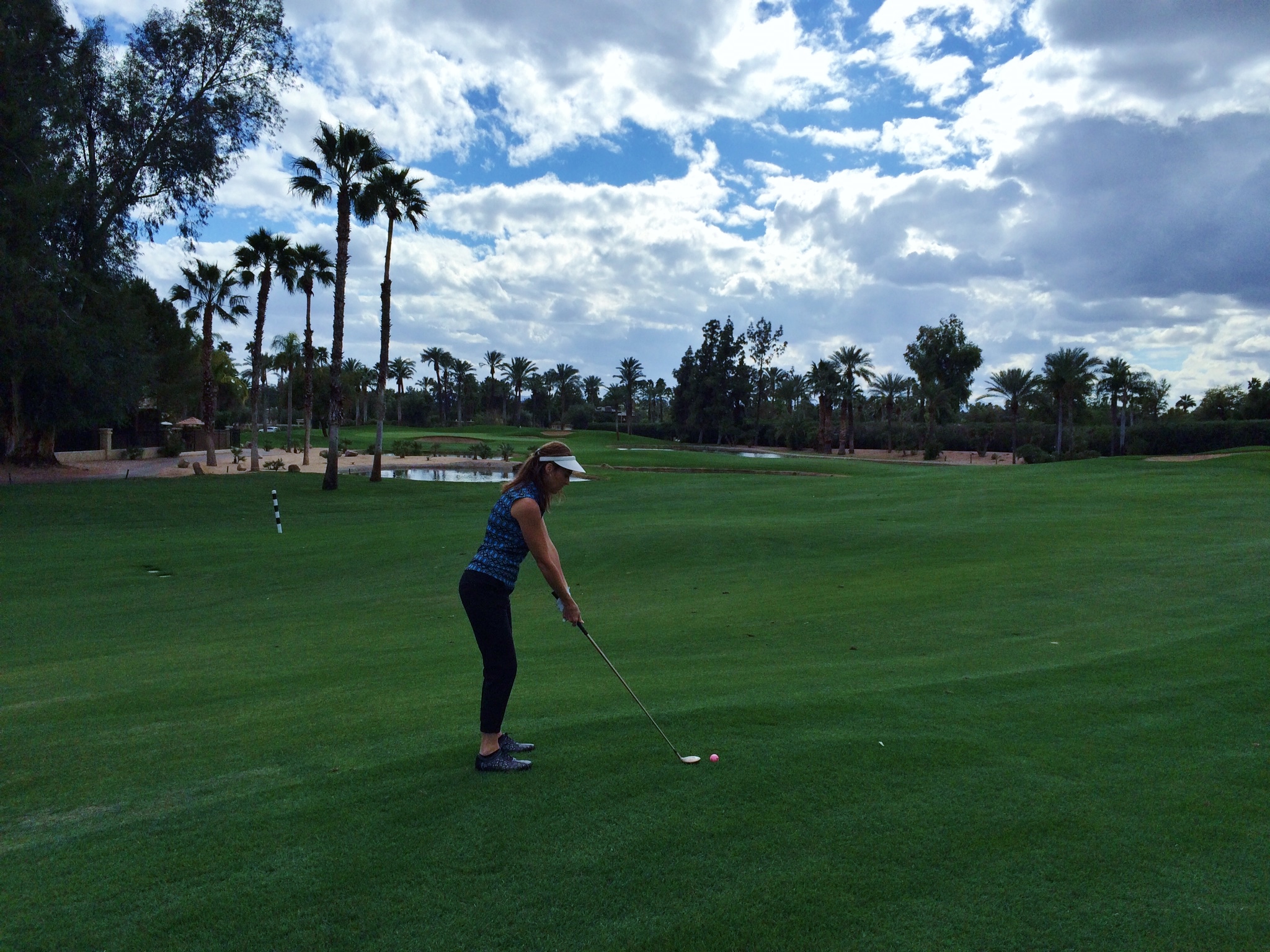
IMG_1858

Oasis Nine fairway, The Phoenician. Scottsdale, AZ. Photograph by Greg Bixby, March 2015.

Without figuring out my own handicap, I can’t expect other golfers to know if I can keep pace or if I’ll slow the game down and burden my partners. To play with undesignated handicappers like me calls upon gracious golfers to offer, “We’re just out to have fun.” They’re good sports. Impatient golfers quickly seek to round out their foursomes with other known decent golfers so they can avoid the discomfort of playing with someone who makes it on the green in two and then takes a four putt.

I appreciate the gracious and can’t blame the impatient. Athletes of all kinds push themselves harder when they know their competitors have talent. Good golfers are motivated that way, and sometimes it’s just more fun to be evenly paired. You’re more likely to be relaxed and finish each hole in a timely manner.

Because I don’t play regularly, my golf prowess is subject to speculation. There’s a tendency for people who don’t know me to pass judgement on my abilities. Recently, after a round of golf during a business event, a woman who hadn’t been able to golf that day herself asked me if I had gotten stuck behind the slow group. I was pretty sure she thought I was the cause of the delay, since I was the only female in the two foursomes, and it’s often presumed to be difficult for women to keep pace with men. Feeling a bit defensive, I carefully selected my response and admitted to her, “I think we were the slow group.”

I wasn’t significantly hampering my group’s time, however. One of the men hadn’t played in several years. It took him a little while to get used to the set of clubs he had borrowed from the course and to find his swing again after being away from the sport for so long. As he worked out the kinks in his play, I relaxed more and more and shot one of my best games to date.

IMG_1896

Sunset view from the 8th tee, Desert Nine, The Phoenician. Photograph by Kelly Bixby, March 2015.

Even so, I realize that I have to focus on lowering my average score. Not just because of the image I want to present, but so I can enjoy specific privileges. I discovered that without an established handicap of 36 or less, I can’t play at world-renowned St Andrews Links, known synonymously as “the home of golf.”

Located in Scotland, St Andrews offers seven courses and is revered by golf’s masters. The Links’ online history page proudly boasts, “When Nicklaus waved goodbye to his adoring fans from the Swilcan Bridge in his final round of professional golf at the 2005 Open it demonstrated the warmth and affection held for the place where the game started.” Jack Nicklaus himself professed: “If a golfer is going to be remembered, he must win the title at St Andrews.” As one of the world’s most accomplished players, he achieved three Open wins, and two were at St Andrews on The Old Course.

St Andrews is open to the public and fuels the aspirations of amateurs, including my husband. His passion has infected me and I’ve learned to love and respect the gentleman’s game. After years of warming up to it, I’ve gathered fond memories: a particularly awesome chip shot and a well-played round; gorgeous scenery connected by expertly-groomed greens and fairways; intrinsic challenges and friendly conversations. My husband’s pilgrimage to golf mecca is important to me as well and is a part of our future plans. Someday it will be my turn to step upon the sacred ground at The Old Course, push my tee into the soft earth, and square up to take a swing. By nightfall, I’ll tally my score and tuck away favorite moments from across the pond. ‘Till then, I’m perfecting my answer to that loaded question, “Do you golf?” by simply and confidently replying, “Yes!”

Trombone

Lowrey Elementary School Band Director, Mrs. Johnson, came into our 6th grade homeroom the first week of the new school year, wanting us to learn to play an instrument and join her band. Two friends and I envied a 7th grader beating drum-sticks on school steps, so we wanted to be drummers in the worst way. Mrs. Johnson saw me in her dimly-lit office next to the band room, offering a new world of opportunity. “Well, my dear”, she asked in a kindly voice over her horn-rimmed glasses, “What sort of instrument were you thinking of playing?”

“Well, Ma’am, I want to be a drummer ‘cause I saw a friend beating drumsticks and it sounded good.” The simple truth was best and she seemed unperturbed by a straightforward answer.

“Tell you what. I’ll loan you drumsticks and a pad for practice, but you have the lips to play trombone. I happen to need a trombonist and can lend you a trombone.” She assembled one before my eyes. “Here’s a mouthpiece for you to practice. Put your lips together and buzz into it like this. You’ll get the hang of it and I’ll see you next week.”

Even at my young age, I knew it was a trap. The trombone was longer than I was tall and a lot more expensive than drumsticks, but I couldn’t get out of seeing her the following week because I had to return the sticks, pad, and mouthpiece.

I asked my friends what happened with their visits to Mrs. Johnson. The first was still in a state of shock. “I have to take this cornet home along with the drumsticks and try them both out. She needs cornets, so she lent me this.” I was mystified my friend had given up so easily on drumming. The other was even less satisfied.

“She ran out of drumsticks because you guys took them all. I have a saxophone mouthpiece to try but I get the drumsticks next week. Dad says Charlie Parker is the world’s greatest jazz saxophonist. Who’s he, anyway?” By the time I got home, I figured Mrs. Johnson had all the drummer-trainees she would ever need. The drumsticks would be taken from my grasp, to be delivered to someone else, and I would be snookered into a lifetime of playing trombone if I wasn’t smart enough to find a way out.

Sitting around the kitchen table a few nights later, my mother said, “I had a call from Mrs. Johnson and she says you have a nice embouchure. Tommy Dorsey and Glenn Miller were the greatest American band leaders and trombonists ever, except Glenn Miller blew up in an airplane in World War II.”

I was appalled to discover the trap had been sprung. “Mom, all the mouthpiece does is make “Thrrrp” noises and spit comes out. I don’t have trombone lips; I have braces. Why can’t I play guitar? And what’s embouchure anyway?” Diversionary guitar tactics weren’t going anywhere, despite scary visions of trombonists blowing up in airplanes.

“Mrs. Johnson wants to see you tomorrow. She’s going to lend you one to try out.”

Mrs. Johnson had invaded my life to an awesome extent. Who was this Tommy Dorsey so enthralling my mother? I had serious doubts about satisfying her Tommy Dorsey needs but, within weeks, I was a struggling elementary school trombonist. In a few more years, I was an acceptable junior and then high school trombonist. In my senior year, our orchestra was in the play “Brigadoon” with a cast party after the last performance.

My father let me drive his new 1957 V8-powered Chevrolet to the party, a special privilege. However, a rat-faced band member challenged me to race his dad’s new 6-cylinder Dodge Coronet. We decided to race one block. At a signal, we took off and God was kind that night because we didn’t crash. At the end of the block, I had beaten him handily. In frustration, he gunned his car and turned left, his left front hitting the right front of our brand-new Chevrolet. We both got out, shaking. His father’s car had damage but, try as we might, we couldn’t find anything wrong with the Chevy. Then I realized the trombone had been lying on the back seat and was now on the floor.

Driving home, trembling all the way, I knew there must be some damage to the Chevrolet. If I hadn’t been talked into playing trombone by Mrs. Johnson years before, this never would have happened. Next morning, before I could look at the car, my father said, “It’s the strangest thing. I didn’t tell your mother but a few days ago I hit the right front bumper of our new car on a telephone pole. It pulled it out two inches, a lot of money to fix. But now it’s like it never happened. It’s back in place without a mark on it.”

I croaked, “Wow, dad, that’s amazing. They must have a new kind of steel that reforms into place if it’s hit. I’ve never heard of anything like that.” I went outside and checked the bumper in bright sunlight. There wasn’t a scratch or ding. Back in my bedroom, I found a slight dent in the trombone bell, but no one would ever know except me.