Tag Archives: travel

Two Scientists In My Life

For more than fifty years I have been surrounded by scientists and engineers that are my colleagues, teachers, customers and suppliers. Naturally I have great admiration for all my acquaintances and all dedicated scientists, like Madam Curie and Albert Einstein.

I am not stingy in expressing my admiration of my colleagues who are working long hours at their offices and laboratories, sacrificing their private and family lives. But recently I have had two scientists on my mind and I wish to follow in their footsteps and do as they are doing. One is Elaine Smith in California and the other is Joe Ferenci from Hungary.

Elaine is five feet, two inches tall and weighs maybe less than one hundred pounds. She is second generation American of Japanese origin and in her late fifties. She is working at a large oil company and I understand she is the developmental chemist for engine oil additives. Nowadays engine oil specifications are getting tighter to meet EPA requirements. The percentage of Sulfur, NOX content, viscosity of oil in the winter months and fuel economy are great concerns in our industry. Global warming and green chemistry are additional items to make scientists and engineers busier and work diligently to find the right solution.

Two years ago Elaine invited me for lunch at her company function at the International Colloquium of Tribology at the Technische Akademie Esslingen in Esslingen, Germany, near Stuttgart.

She made the presentation of her paper just before lunch about new additives for engine oil. Several colleagues were still discussing her paper about the interesting results and possible joint developmental work for further application under her supervision. I believe that whatever presentation she made it will contribute greatly to the lubricant industry.  Over our buffet lunch I was listening to their discussion with great interest. Her voice was monotonic and she carefully explained the experimental results and cited numbers on Sulfur and Zinc contents in engine oil and the amount of NOX content after a six months field trial in the Los Angeles, California area.

One thing was very clear, that the people around her showed great respect for her and her work. Her innovation might be a great jump to meet the GF-5 new specifications in engine oil.

After lunch I exchanged business cards with her colleagues. Then Elaine and I left the restaurant and walked to the conference. It was a fifteen minute walk from the restaurant to the place the conference was held. In January Esslingen’s temperature is not terribly low but damp. I felt it was colder than in Detroit that has dry low temperature. We walked on the street, lightly covered with snow and ice.

Elaine wore a winter jacket that she used to wear on the East coast, about thirty to forty years ago when she was in college. It did not look warm and the faded gray coat did not fit her well at all, but she did not seem to mind.

“It is chilly and colder than in Detroit,” I said as I broke the silence. “Really?” Elaine said as a question. Quickly I saw her lips had turned purple. “I am getting cold too,” she admitted. “The hot soup at lunch does not affect us in the cold January weather in Esslingen.” After this comment I was quiet for a while.

Later we talked about the conference topics and research issues on engine oil additives and industrial lubricants. Of course, she did most of the talking. After this we split up for different sessions. She went to the fundamentals of lubrication and I was in the metalworking fluids session. During the session I could not concentrate on the speakers.

Elaine’s image came into my mind continually. She did not care about what she wore or what the world thought about her appearance. She continuously devoted her time to research without any distractions.

This was quite a contrast from my case. Before I left for the conference, I organized my suits for each day with different clothes. On Monday, a gray pants suit, Tuesday, a pink wool suit with shirt, Thursday, a red wool jacket and black pants. I even brought medium high heels. I took the same care with my hairdo. I went to a beauty parlor and had a haircut and dye job. I do not spend a lot of time on my appearance but I do care for clean clothes and try to match my clothes to the weather, season and the occasion.

I could feel and imagine that her focus was on just one thing, her work, and her research on additives for engine oil disregarding everything else. Her path is straightforward to achieve her goals.

That evening when I talked with Kwang about Elaine’s devotion, I told him again that I enjoyed being with her and respected her and wished I could have that single-minded devotion to my work. He did not say a single word on the other end of the telephone, but for a long time I had not spoken of my work ethics with him, and I was thrilled that he had just listened. Always my mind was focused on the priority in my life “family is first”.

A week later, after the close of the conference, Kwang picked me up at the Detroit airport. On the way home, in the car, I talked about Elaine and my wish to do research like her for forty five minutes straight, without touching any other topic. After he had listened to me patiently, “Remember your age, Kook-Wha,” was Kwang’s final comment.

Now Joe Ferenci is about five feet, three inches and one hundred twenty five pounds, and very old. He resides in Budapest, Hungary. He has a thin layer of gray hair and wears thick gold-framed eyeglasses.

In the last eight years I have seen him every other year at the International Colloquium Tribology in Esslingen, Germany. I saw him from a distance at the conference room and hall at the mayor’s receptions in Esslingen and Stuttgart. I did not have a chance to say “hello” to him because of my busy schedule with other colleagues from the Netherlands, Czechoslovakia, Germany and other countries. We were catching up on industry news, especially new product lines and new rules for EHS (environmental, health and safety) in Europe.

In January 2010 Joe was at the Parker, the same hotel in Esslingen where I stayed. I sat at a table where I could see the people come to the door for breakfast.  Joe came in wearing a black suit with a white shirt. I forget what color of necktie he wore, but one special thing hanging around his neck was a black traveler pouch which contained a name tag for the conference inside. He sat down two tables across from me and got coffee and stood up and approached the buffet table. His fragile figure and the very slow movements of his feet added years to his actual age. Then he put a pile of food on his dish and on a separate plate he placed two German sourdough rolls, and sat at the table and started to have breakfast.

While I was chewing my boiled egg and cucumber I was trying to guess his age and debated about how I might start a conversation with him. I ordered one more refill of my coffee and the waiter poured the coffee with precision, not spilling a drop. “Danke Schoen,” I told him, smiling. He nodded and disappeared.

Joe was busy with his breakfast. He had a big appetite. He had not brought any reading material, such as daily newspapers, Die Spiegel or other magazines, like most of the other gentlemen did. He just seemed to concentrate on his eating. After a couple of sips of coffee, I approached his table.

“How are you, Joe? I have seen you at every conference,” I started.

“Yes.  Yes,” Joe replied with a strong accent. He tried to look at my nametag to catch my name.

“My name is Kook-Wha Koh and I come from the USA and attend every conference as you do.”

“Yes. Yes.” Again he said “Yes. Yes.” with a very quiet and brittle voice with no strength at all.

“Where do you come from?” I asked him his country of origin.

“Budapest.” Again a short whispered answer.

“Hungary.” I finished for him.

I hesitated for a few minutes as to whether I should ask him his age. Taking all my courage, “May I ask your age?”

“Eighty-two years old. Next month I will be eighty-three.” Surprisingly, his voice was quite louder than before as he proudly told me his age.

“Thank you.” I asked for his hand and held his hand very tightly.

“When is your presentation?”

“Tomorrow. Wednesday.” Again he answered with a stronger voice.

“Mine is on Thursday, the last day of the conference,” I told him.

With a strong accent, he said, “I developed a new engine oil additive and it improved fuel economy ten to fifteen percent in the field test.” He finished with sparkling bright eyes and several hand gestures.

I thought ten to fifteen percent improvement is great but it depends on the base line that is chosen. Improvement of fuel economy, even one to three percent is a great number. Ten to fifteen percent is an extremely good number if we can achieve it. Frankly, both scientists who I admire are working on engine oil additives. I had many questions as a layman on engine oil additives, but I stopped my line of questions and praised his work for his age.

Before I left the breakfast room I said, “Good luck, Joe, with your presentation tomorrow.”

Joe Ferenci continues to work as a technical director in Budapest. His research work is presented to the world and contributes to our society. I prayed for his health and that he may have many more years of research work.

Admiring these two scientists and continuing my own work, I hope that I also have many more years to go before my own retirement with the following prayer:

Please, always put my family first, and let my passion for my work stay in my heart for a long, long time.

* The story is factual but the names have been changed to protect their privacy.

The Java Script: Where Genres Come to Life

The following post is one of several reasons I love my job. Travel can be tough, like the time I worked in 3 different states in one week while fighting flu-like symptoms. Then there are times like this trip that introduced me to The Java Script. I met people who love their job, running a unique and impressive bookstore that I happened upon via Yelp. It’s stores like these that gives me hope that the independent bookstores can thrive. As I continue these journeys I’ll be adding more pictures to my Pinterest board, and tweeting about them at @jmccarthyeds. There are many precious gems to keep alive. Here’s another one. Enjoy.

The Java Script: Where Genres Come to Life by John McCarthy

JavaScript_storefront

Texarkanna is a tale of two states shared by one city. Three hours away from Dallas, its distant cousin—Texarkanna is a center where all roads must pass through. Some might look upon the city with its many pawn shops and see what might have been. This would be an error of lack of vision. Like any urban community, the city has many worthwhile places to stay, eat, and visit. One such gem is The Java Script, a mom and pop (literally) bookstore on the Arkansas side, a block away from one of the main thoroughfares.

Owners

The bookstore name implies a café that serves coffee. No coffee is for sale as of this posting, although if you ask Debra Hall and Gene Keller, the owners, for a cup, they might provide one, given their hospitable nature. When I entered the store, they treated me like an invited guest, and I’m sure that’s how everyone coming to the store is made to feel. Debra Hall gave me a tour of the rooms—each decorated to fit the genre theme of the books it housed. I felt like I was on a journey inside the worlds of Western, Mystery, Science Fiction, and others. My favorite was the YA & Children’s room. Carpeted in fake grass and a picnic table, the bookshelves lined one wall in the brightly lit room. In the main room there is a bookcase of books by local authors and books signed by authors.

The store once held antique typewriters and other artifacts. Unfortunately, a week prior to my visit, those items were stolen. When you visit this store, and it is worth a visit if you are within 3 hours, such as  Dallas or Little Rock, you’ll realize how depraved a robber must be to intrude on the lives of these people. I arrived at the store with an hour to spare before they closed. That day was Debra’s birthday, which they did not mention until I was ready to leave. Had I known, I would have left sooner, but such is their hospitality.

This is the first bookstore that I’ve explored that did such a brilliant job of designing the rooms based on the genres they sold. Amazing! The selection is modest, yet substantive enough that I found 5 books to enjoy.

When passing through Texarkanna, Texas, visit The Java Script. The experience will be better than a caffeine boost. What gems of bookstores have you discovered?

The Java Script

1313 Hazel Street, Texarkana, Texas 75501

http://www.javascriptbookstore.com/about-us.html

Here are pictures from some of the rooms. Can you name the genre for each room? Post your guesses in the comments 🙂

1.ReligionPhilosophy 2.SciFi 3.Western 4.YAChildren

Why Go to Switzerland?

Just as suspense keeps a story going and your audience interested, there comes a point when you have to tell them what happened. You have to answer the questions you’ve implied or asked directly earlier in the piece.

Why did Abram insist on stopping off in Switzerland first and then coming to America second? The world was at war. He was in Beirut, Lebanon. Switzerland was a long way away. The Nazis controlled many of the countries he would have to pass through and he was a Jew. All good reasons, I would think, to come to America immediately now that he had the Visa and could do it. There was nothing more to wait for.

The excuse he gave my parents and grandparents doesn’t make sense. He needed to stop off in Switzerland first because he had some medical problems. After the Swiss doctors helped him, then he would come.

The world was too dangerous for him to make a stop like that for health reasons. The chances of him being killed were too high. There were plenty of doctors in America he could see after he arrived. No, I believe he had another, much more important reason for going to Switzerland first and then coming to America.

Abram had been a very successful businessman. He grew up in Bucharest, Romania. Later, after he became head of an Italian-American shipping line, the King of Italy knighted him. He was important and wealthy. He was also very generous with his family. He took care of his mother for many years, supporting her in Bucharest and later moving her to live with him in Constantinople (now Istanbul).

Abram was also very generous with his oldest sister, Clara, my grandmother.  World War I ended on November 11, 1918. Abram came to San Francisco sometime in 1919. He invited Grandma, Papa, my Mom and Maximillian, his younger brother who was traveling with him, to travel around Europe for a year, visiting family and seeing the sights.

Everyone was thrilled at the opportunity. From the stories my Mom tells, they had an absolutely marvelous time! They started by taking the ferry from San Francisco, across the Bay to Oakland, where they caught the train to New York City. From there, they sailed on the RMS Aquitania, one of the most luxurious ocean liners of the time.

Mom was six and Maximillian sixteen, not exactly a child but not all grown up either. He used to take her to the park, the circus and out for ice cream while the adults went to shows like the Folies Bergère or out for drinks.

They traveled to France, Switzerland, Rumania and Turkey. From my Mom’s stories, Paris was one of the highlights of the trip: the Louvre, the shops, the people, and the atmosphere. I grew up always wanting to go to Paris, walk down the Champs-Élysées and see if it was as wonderful as she said. It is!

At some point they took the Orient Express to Constantinople. The trip took 80 hours—three days, eight hours. They had a sleeping car and ate in the dining room. Mom talked about how exciting and wonderful everything was!

They stayed a while in Constantinople visiting family. Mom became fast friends with her cousin, Eva, who was about the same age. I’ve seen pictures of them standing together, dressed the same—two cute six year olds with smiles from ear to ear.

Later they went to Romania. One night there was a birthday party at Papa’s mother’s house, with lots of singing and dancing. The highlight of the evening was Papa dancing a Viennese waltz with his mother on her 80th birthday. Many people had tears in their eyes.

Then, in 1929, just before the Stock Market Crash, Abram came again to San Francisco to visit. He also brought Maximillian. Mom was now sixteen and Maximillian twenty-six. Soon they and Grandma and Papa were off for another year in Europe, traveling and visiting family.

Mom had just graduated early from Lowell High School so she could make the trip. When she came back a year later, she started college at the University of California in Berkeley.

When I think about this, it seems clear that Abram was a very generous man, who was also well off, and was happy to share his good fortune with his family. I also think, like many other well off Europeans of that time, he put his money in Swiss banks. It would be safe and secure and the Nazis couldn’t touch it.

When my Dad got Abram the American Visa in 1941, and let him know that the family in America would take care of him, Abram must have thought, I’ve got money in Switzerland. There’s a war going on. Hitler may win. I may never be able to return to Europe. I need to take it with me.

There were no computers in those days. Abram couldn’t just go online and transfer his money from one bank or country to another. He must have found it hard at that point in his life to leave all his wealth behind and be dependent on his America family for the rest of his life. Why not try to bring it with him?

Considering all the odds against him, I don’t know how he thought he could do it. He did know a lot of people and maybe he thought some of them might help him. He spoke a number of languages and he might have thought that would help too.

Abram’s always sounded like a very optimistic person; someone who believed they could succeed against all odds. It must have been awful for him to come so close, Trieste, less than a day’s travel from Geneva, only to be captured. I can’t imagine what it must have been like for him when the Nazis took him off the train and to the Savoia Hotel, where he’d lived for so many years. Did he think he could make some kind of arrangement with them until the very end, or, once they took him off the train, did he know it was over?

If my interpretation is correct, what happened to the money? Abram was murdered in his hotel room at The Savoia Hotel in Trieste, Italy sometime in late 1941. He never made it to Switzerland. So he was never able to send his money to America.

For that answer, you’ll have to come back next month.

Suspense

Suspense! That’s what brings readers back again and again. If you want your readers to keep reading, you have to give them a reason to go to the next paragraph, turn the page or come back a month later. That’s why I ended my blog last month the way I did.

What did happen to Abram? He had the visa. He could come to America right away. Why did he insist on stopping off in Switzerland first? And, most of all, why did he never get to America?

Abram tried. He really did. His plan was to go from Beirut to Geneva by train.

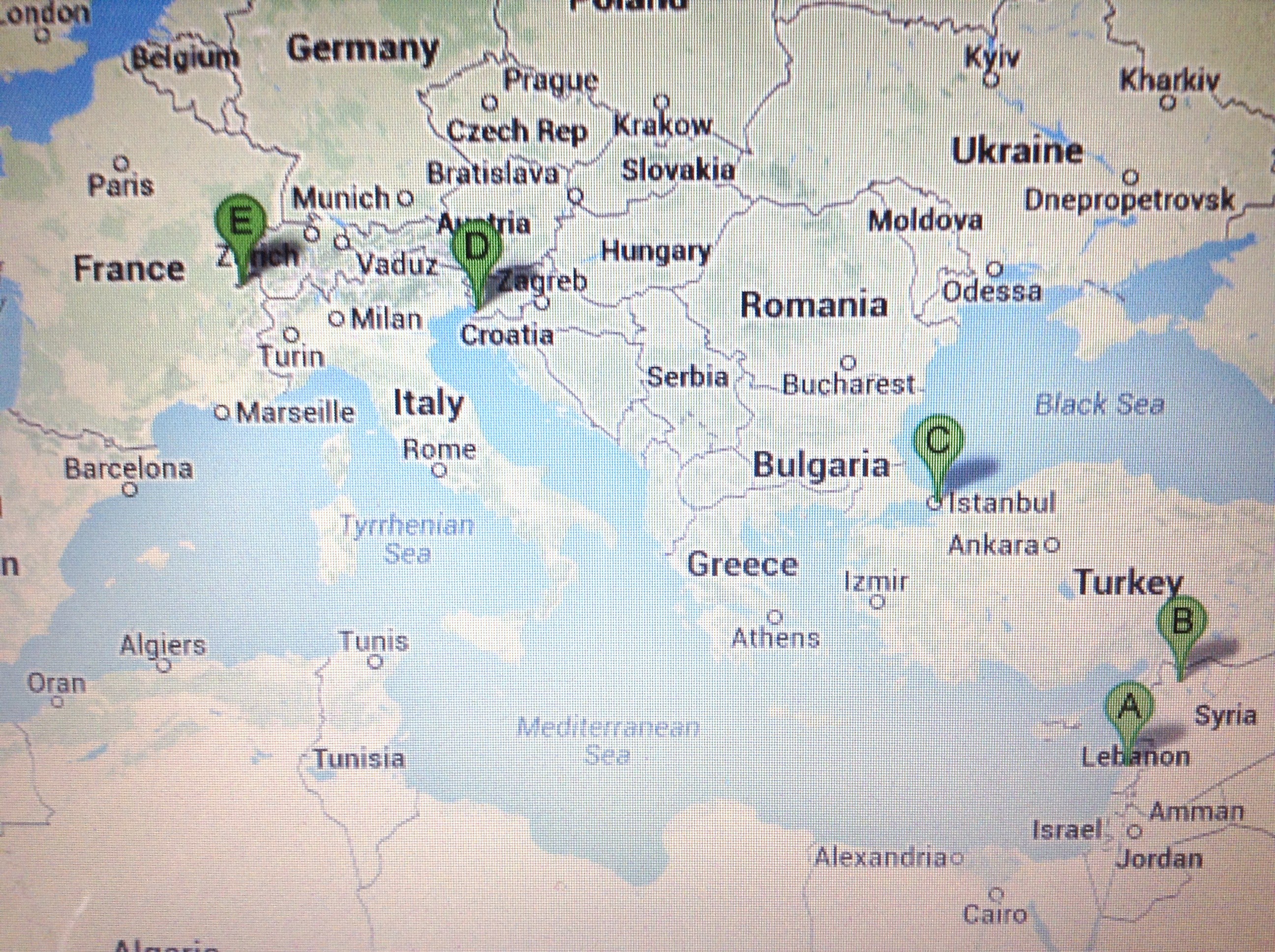
I just finished looking at a Google Map of the area. I can’t imagine what made him think he could pull it off. He was a Jew, in the middle of World War II. He’d have to travel from Beirut, Lebanon to Aleppo in Syria and then on to Istanbul, Turkey. From Istanbul, he’d have to pass through Bulgaria, Serbia, Croatia to Trieste, Italy. Then it would be a relatively short shot to Geneva.

This is a journey of over 2,395 miles. It’s the same distance as from San Francisco, California to St. Petersburg, Florida. Only he’d have to travel through seven countries, all of them either at war or on the edge, and most of them on Hitler’s side. Today, when I put the information into Google, it said, “We could not calculate directions between Beirut, Lebanon and Geneva, Switzerland.”

Map Picture

I would love to know what he was thinking. How did he plan to do it? Why did he even want to?

Traveling by train, all that distance, would be difficult. How many days would it take? Where would he sleep? How would he pay for his tickets and food? Money was already a problem in Beirut. He wouldn’t be able to travel first class like in the past. And, at his age, he was in his sixties…

I wonder, was Abram ever frightened as he planned his journey? Did he feel overwhelmed? Did he worry that he wouldn’t be able to do it?

To try to figure out how Abram might have planned it, I did a little research on my computer. If I wanted to make the trip today, I’d have to take a bus or taxi from Beirut (A on the map) to Aleppo (B). That’s 186 miles. Then I’d take the train to Istanbul (C) for 768 miles. After that I’d travel for another 991 miles by train to Trieste (D). From there it would be 450 miles more to Geneva (E) and he would have made it!

But I’d be doing it as an American on an American passport. Abram was doing it in late 1941 as a Jew with an American visa that could be dangerous for him to show until he boarded the ship because the countries he was passing through were controlled by the Nazis.

Germany’s puppet government in France controlled Lebanon and Syria until the Allied Invasion of July, 1941. Turkey was neutral in 1941 but Hitler had taken Bulgaria on March 1, Croatia on April 10 and Serbia on April 17. Abram didn’t start out until sometime after June.

What was he planning to use for papers? What acceptable reason could he give for traveling? How did he disguise himself so he could blend in with the other travelers? How did he get enough sleep and to eat so he could function?

The one thing he did have going for him, besides his American visa, was that he spoke a number of languages: Romanian, German, French, English, Italian and probably Yiddish.

Looking at the map, I still can’t believe it that Abram made it as far as he did. He must have been very brave, determined and resourceful. He had a lot of guts. He made it most of the way. He was so close. Then he had bad luck, very bad luck.

Somewhere on the train between Serbia and Italy some Nazis found him. He had almost made it to Trieste, only half a day’s travel from Geneva.

The Red Cross finally found out the truth but not until after the war was over. So for years my parents and Grandma and Papa wrote, telephoned and cabled the Red Cross and anyone else they thought could find Abram and help him come to America. They always believed he was still alive until the night the telegram came.

It was a Sunday in 1948 or ’49. There was a knock at our door. It was Western Union. The messenger had gone to my grandparents’ apartment in Pacific Heights first, and when no one answered, their neighbors told the messenger that every Sunday night Grandma and Papa went to their daughter’s house out by the ocean. They gave him the address. The telegram was from the Red Cross.

I remember my father coming into the dining room, taking my brother’s and my dinner plates, telling us to bring our glasses of milk, and come with him. He took us to our room, put the plates on the floor and turned on the radio to the “Lone Ranger”. Dad told us to stay in the room, keep the door closed and listen to the program. He’d come back and get us.

I remember thinking, this is strange. We were never allowed to bring food to our room or listen to the radio during dinner.

Then I heard my Grandmother scream. I can hear it today in my imagination as I write this. It was so loud and so sad and it came again and again, drowning out “The Lone Ranger”.

I could hear Papa saying, “Clara, Clara”, over and over.

The telegram was from the Red Cross. It said that Abram had taken the train to Switzerland. Somewhere, along the way, just before Trieste, Nazi soldiers had boarded it and found him. When they got to Trieste they took him off and to a hotel room. There they robbed and killed him. All this had happened in 1941. He’d been dead all this time and we never knew.

Why, once he had the visa to America, didn’t he come right away? Why did he insist on making this long, dangerous journey to Switzerland first?

We may never know for sure. But I don’t think it was what he told the family: He was sick and wanted to see a doctor to help him get well before he came to America. I think he had a much bigger, more important reason, one that would make him, a man in his sixties, a Jew in a world at war, make this 2,395 mile journey first.

Next month I’ll write about what I think his reason was.


What Happens in Vegas, Doesn’t Have to Stay in Vegas

Timing is interesting. Just before our meeting at Barnes and Noble was to begin, my writers’ group was interrupted by an adorable boy who was obviously young enough to be an elementary school student, maybe about seven years old. He held his arms straight down at his sides as he stood tall and still, almost at attention, just outside our circle of chairs. Adorned in a dark-colored dress shirt and slacks, he looked like a miniature version of a suit and tie guy on business casual Friday. This young entrepreneur didn’t waste time on pleasantries or even smiling. He had a very serious look upon his face as he spoke clearly and loudly. I listened as he rushed through a well-practiced, robotic-sounding speech and asked us to donate five dollars for a Mrs. Fields cookie. The money would help him travel from Michigan to Washington, D.C. where he would visit the nation’s capital with his school.

Despite the formality, he was cute as could be. I compared him to my own boys, now young men, who used to get dressed up (at my insistence) for church and significant occasions. Neat and tidy, clean and respectable, he was dressed for success. The innocent youthfulness of this child was persuasive enough to cause several of us to waver as we tried to determine if we had any cash on hand. One verbally acknowledged what some of the rest were thinking: five dollars for one cookie was a lot (unless it happened to be really big).

That’s when a young adult woman stepped forward from a nearby aisle. I hadn’t noticed her until that moment, but it made sense that the boy wouldn’t have been there alone. She pulled a cookie out from the purse she was holding and restated the need for our help in sending the boy to DC with his class at school. Was she his older sister or his mother? I sized her up based upon her appearance, her voice, her request. The two didn’t really look very much alike. I remembered that my own children didn’t go to our nation’s capital with their school until they were in eighth grade.

Her intrusion into the exchange had made me uncomfortable. Because she was hiding the cookies, I was confident that the bookstore management didn’t know the two were working their way through its customers. I wasn’t sure if the money would ever help that little boy. How would it really be used? Had this woman just engineered a very good way of soliciting? I wanted to ask questions of the pair and caution the other writers, but I felt like such a scrooge and I certainly didn’t want to appear like one.

I had a good reason to be skeptical. Years before, my husband and I helped a stranger at a service plaza along the Ohio Turnpike. The stranger claimed he had left his wallet behind as he rushed out from home to drive to a hospital where his daughter was giving birth to her first baby. He had run out of gas and needed money to fill his tank before he could continue the drive. I was at that rest stop long enough to witness the man hand over our $20 donation to a female companion, who then went shopping inside the plaza and came out with a newly purchased video to watch in their gas-tank-empty car as the not-so-much-in-a-hurry-anymore man continued to ransack the parking lot.

Based upon that experience, with the boy standing before me at the bookstore, suspicions flowed freely through my mind. I found an easy way to avoid the conflict going on between my cynical thoughts and my interest in helping the child reach his goal. Since I didn’t carry cash on me that night, there was no way I could have contributed to his trip even if I had become convinced of his sincerity. Instead, I sat and watched as several writers each traded their money for an over-priced cookie. The woman and boy left, and I felt relieved that the confrontation was over.KellyDeadwood-20146June-VegasPhoto

Two days later I left for Las Vegas, Nevada. Popular entertainers, including Britney Spears, Celine Dion, and Rod Stewart, commanded hundreds of dollars for good seating at their shows. Their performances took place inside richly ordained, tall and extravagant buildings set along streets lined with lowly panhandlers, who had positioned themselves (somewhat strategically) amidst bustling crowds. Bachelors out to party, girls on their nights out, married couples hoping to reconnect, singles looking for excitement, business professionals, mothers, fathers, families with children, and now I walked by the homeless.

First I saw a thin, unshaven, dirty man about my age, sitting on the edge of the sidewalk in his work clothes: a gray hoodie and jeans. The same clothes, I presume, he wore to sleep in. Video advertisements towered above us on the sides of The Mirage. The bold efforts to entice passersby to spend money were in sharp contrast to the small 10” x 12” cardboard sign this frail man held in one hand as a cigarette dangled from his rotten, tobacco stained teeth. My first reaction was to look away, but instead I stole a quick glance at what the sign said: “Need money for weed.” I’d been in Sin City before, but this was the first time I wondered whether a marketing exec had developed a new business plan for one of the locals. I couldn’t help but smile at the creative ploy. The man saw my expression and thought it gave him the opening he needed. He asked, “Hey, where ya goin’? Got any spare change?”

I didn’t want to talk to him or address his need, so I quickly continued on. I passed several more casinos, restaurants and hotels before I came across another homeless man, sitting opposite an escalator that led to a busy McDonald’s. He was in between two other men; all were smiling and laughing with one another. (Perhaps the location was lucrative.) This man held the top of a large 3’ x 4’ cardboard sign which was resting on the ground in front of him. On it was written the same proclamation I had recently seen: “Need money for weed.”

The writer in me wondered who plagiarized whom. Would there be a fight between the two at some point because one was profiting from another’s creativity and hadn’t given credit where credit was due?

I overheard a woman’s reaction to seeing the larger sign. She didn’t just smile. She burst out laughing and pointed the sign out to the man she was with. They talked about the “truth in advertising” approach to begging and seemed as impressed as I had been when I first spotted the novel way to pander. It made us take notice. For a fleeting moment, we actually paid attention to the plight of these destitute individuals.

The awareness spurred serious thinking within me. Do I or don’t I spare a little something? Do I really help someone by giving directly to his cause, or am I enabling him to continue a forlorn lifestyle? I found it difficult to decide.

During the next ten minutes of my walk, I encountered a woman who struggled to take care of a handicapped son, a young man who was stranded and needed to get home, a middle-aged man who was being encouraged to “Keep moving!” along the sidewalk of a posh hotel (The Venetian) and another man holding nothing but a plastic cup as he huddled at the base of a highly traveled escalator. Each down-and-out individual brought me closer to giving. They seemed to be in far greater need than the freshly showered salespeople who stood outside store fronts, shoved cards in my face, and slyly forced samples of pricy lotions (that I didn’t want) into my hands.

I passed a woman dressed neatly in a white shirt and jeans. She was holding a bucket and asking for donations to “Help the Homeless.” The permit sticking out of her white container made her look official…but I was once again suspicious. I wondered if the money collected would be used as promised. I thought back to the boy who was selling cookies at Barnes and Noble. Whether or not he and his female guardian were actually fundraising for a trip, I may never know.

So there I was, withholding spare change and scrutinizing the intentions of each beggar I had passed, even that cute little boy back in Michigan. I wondered why some people give so freely and others, like me, have to strictly analyze situations. Yes, too many people knock on my door to try to sell me something. Yes, my phone often rings with incessant telemarketers. Yes, I’ve been taken advantage of by unscrupulous strangers. Admittedly yes, because there is no end in sight to the number of upturned palms that are in need, I am compelled to carefully consider how best to share what God has blessed me with.

He directs Christians like me to “…stop just saying we love people; let us really love them, and show it by our actions” (1 John 3:18 of The Living Bible). Knowing there is widespread poverty means that I can’t ignore the situation. What I offer may seem like just a small drop in a very large bucket, but it’s the least I can do.