Monthly Archives: June 2015

Snow Bunny

Learning to downhill ski all began with a $15 high school birthday present. A friend and I had seen a skiing movie and it seemed so easy, gliding down snowy slopes and carving turns. We needed to get our hands on the equipment and teach ourselves how to slide down hills. What could be simpler? We were soon wandering the floors of a downtown sporting goods store.  

New ski equipment was appallingly expensive, but we found used wooden rental skis for sale at $15 a pair. The ski bindings were called Ski-free, with metal cables and springs to hold ski boots in place against a swiveling toe-plate. We would have to guess how to adjust them. In theory, when a ski twisted, sliding downhill, a spring-loaded part rotated to one side and released the ski boot instead of breaking an ankle. We were now snow-bunnies, but needed poles. I found a pair so short the grips only came to my waist, not knowing they were sized for six-year-olds. I couldn’t afford real ski boots, but World War II movies showed soldiers skiing down mountains with heavy packs and weapons. Since they wore combat boots, why not install toe clips on old ill-fitting combat boots I already had? Today, a single ski ticket and lesson cost more than my total outlay. 

Determined to learn to ski as soon as the snow flew, I enrolled in the first Detroit Free Press Beginners Ski School. It was free to anyone who found their way to a now-defunct ski area called Mount Dryden. In the parking lot, just before the 7:00 p.m. lesson was to start, I discovered a binding so loose a critical ball-bearing had fallen out and was lost. I was about to miss my first lesson unless I fixed it. Rummaging in the gravel, I found a tiny round stone and inserted it in place of the ball-bearing. Reassembling the binding, I didn’t realize I had effectively locked it in position. Instead of releasing normally, I would snap an ankle as easily as a Sunday dinner chicken leg if I fell. Carrying my now-almost-lethal skis to the top of the beginner’s slope, I fastened the combat boots on and joined eight other participants.  

The crisp evening was enchanting, snowy slopes sparkling in Mount Dryden’s arc lights. So this was what downhill skiing was like. How wonderful watching real skiers swoop and swoosh past, and we all hoped to be doing the same in an hour. Our official ski instructor glided over and did a double-take inspecting my strange equipment. Since everyone had signed a waiver absolving the Free Press if anything went wrong, he shrugged and slid a short distance below before showing us how to align our skis in a basic ‘snow-plow’ position. We all leaned forward, putting our weight through our boots into our ski edges, but mine didn’t seem to work very well. A snow-plow maneuver is the first and simplest method of controlling speed and direction we were supposed to learn.   

Each of us slid gently forward a few yards before stopping, again forming a line. Everyone with the right equipment had no problem and turned expectant gazes on the last one in line, me, having arrived a few minutes after my parking lot repair. They didn’t have much time to watch because without any structure in my combat boots, I couldn’t transfer any weight into the ski edges. Once I began sliding toward the group, I had no control. Even with the skis in proper position, I couldn’t turn, slow down, or even stop. This may explain why ski schools are no longer conducted at seemingly the top of the tallest hill in a ski complex. I flew past both instructor and open-mouthed group with a yell, accelerating over the edge and down Mount Dryden’s steepest slope.  

It was a hell of a ride and why I never fell half-way down and broke something, I have no idea but I must have been traveling 50 mph at the bottom when I ran out of Mount Dryden’s well-groomed artificial snow. In fact, I ran out of Mount Dryden. Understanding I had probably finished my first and last ski lesson, still traveling at a terrific pace, I flew between the last hay bales and arc lights before exploring Lapeer County’s interesting countryside in total darkness.  

With no way to stop, other than falling and breaking something, I hoped I wouldn’t run into a fence or a tree large enough to break me in two. I sincerely doubt management thought any skiers would find themselves out beyond their property line. Unfortunately, that left a frozen swamp facing me, mostly underbrush, cattails, saplings, and rough-plowed field, to stop an out-of-control snow-bunny. I was far beyond a lot of it when I finally somersaulted in a tumbling heap of skis and poles.   

I lay there, head spinning, ears buzzing. Miraculously, nothing was broken or sprained, just a few bits of torn clothing to show for my adventure. Still wondering what happened, I lay there deciding I must now be a downhill skier since I was now downhill and had begun by wearing skis. So it had been a successful evening after all. I retrieved everything in total darkness and began the climb back to civilization, managing to skirt both ski-instructor and group on the way back.  

When I got to the car, I discovered the locked-together Ski-free binding was, sure enough, still locked together. Perhaps, I decided, I should break down and get some real ski boots and bindings before trying again.
Idea Spring

shower

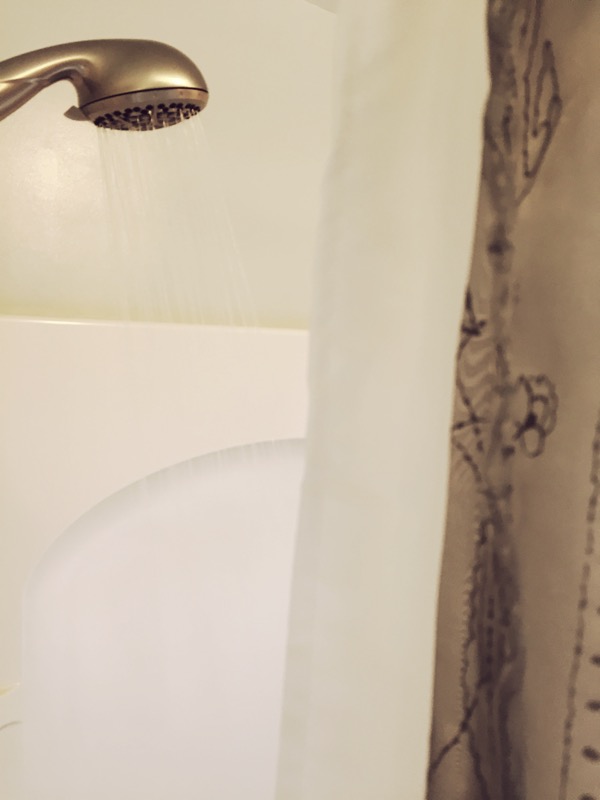
I had a thought about a story I’m working on, it just happened to be while I was in the shower. Of course, it was gone before I could write it down, which is as frustrating as an itch I just can’t quite reach. It’s the one place not conducive to paper, pencil, a computer, or recording device.

What’s funny is most authors have these moments. Kimberly Kincaid, author of the upcoming book Reckless, A Rescue Squad Novel, which you can pre-order at Amazon.com, recently shared one of her own on Facebook. She was in line at a big-box convenience store and saw they had double sided bra tape by the register and a great way to deal with a sex scene popped into her head and she had to record her musings. Messaging back and forth with her this morning, she clarified, “…it made me think how funny it would be if a heroine was taped into a dress when she really wanted it off…” In the checkout line, she started furiously whispering the scene into her phone. If you want to read how the scene turned out you’ll have to keep your eyes peeled for the second book in A Rescue Squad Novel series, her current W.I.P.

Other places I’ve had ideas spark are in my car. I can use my phone to record the idea but only while at a red light, and I pray the idea doesn’t flit out of my head before that happens. The doctor’s office is another, which can be embarrassing, since it is usually pretty quiet and my ideas can be pretty steamy in the romance department. Most of my ideas spring open while I’m at the bookstore when I’m actually getting some quality ideas down.

Because I’ve been concentrating on my next W.I.P. I’ve not had time for anything else. Unfortunately, that means the piece, be it fiction or non-fiction, I would have written for this post is still up in my head. Therefore, I thought I’d ask a question instead:

What are the top five places, not including in front of your computer, where your writing ideas spring?


One Part Genesis, One Part Darwin and One Part Machiavelli

Although I might plan to relax or sleep, writing ideas germinate at the oddest times. I jot a note on Monday to write about one topic. Tuesday counters with a new subject or two. Wednesday offers three more choices. After the month passes, I have pages of new ideas for short stories, posts, and even novel worthy topics. The difficulty comes in choosing and debating the strength of each idea.

A genesis process begins before each project. An idea fragment initiates a chain reaction. In true Genesis fashion, here’s what happens to an idea for something as simple as a blog post.

The Paris Review tweets a 1980s interview with Raymond Carver which begat
rereading “What We Talk About When We Talk About Love” which begat
watching Birdman and the use of Carver in the movie which begat
finding other films directed by Alejandro G. Inarritu which begat
studying Inarritu’s co-writers and the two years to write the script which begat
researching cinematography for a one-shot narrative which begat
discussing the similarities between Birdman and a play which begat
outlining theme connections between Carver’s story and the film which begat
finding examples of magical realism . . .

Now Darwin, the scientist whose name symbolizes survival of the fittest, comes into play. The possibilities for the Carver idea within what I call my “genesis stage” are numerous. I keep this idea, and who knows, it might be a post on this blog in the future. The subject interests me much more than one of my other ideas about the financial funding of literary magazines. Although valuation practices and financial topics are potential dinner conversation at my table, the rest of the world might be in REM sleep after appetizers. Unless a topic can evolve, the idea turns cold, extinct and not fit to survive in my black and white world of words.

As the deadline approaches, I enter the “Machiavellian stage” of decision making. In the example of this blog post, three ideas remain – the Carver Birdman Connection (CBC), Writing of Mom (MOM), and Genesis, Darwin and Machiavelli (GDM). Now, my brain wrestles with the competing ideas.

CBC: There’s research into my idea. But how will it hold together?
MOM: Remember mother’s birthday is on the post date.
GDM: There’s not much time. The MOM topic is a bit too sentimental.
MOM: What about “writing secrets” kept from mom?
CBC: That could be rich.
GDM: MOM is too fluffy for June. That’s an August topic.
CBC: I suppose it is between GDM and me. I have a wealth of material.
GDM: Carver-Birdman is too heavy for a June post.
CBC: My topic is fascinating. It could be more than a blog post.
GDM: You’re right, it’s too big for a blog post. Discussion over. Now write.

With the argument settled, the post topic practically writes itself. Tomorrow begins a new round of genesis, Darwinism and Machiavellian debate over which story to finish or whether it’s time to return to the manuscripts.

In the Beginning – Make It Up

“The scariest moment is always just before you start.” – Stephen King

What causes a writer to stare uncertainly at the blank white page: lack of unique ideas, not sure of how to start a powerful memoir, or even the most effective way to begin a thriller?

“Story Starters” by Lou Willett Stanek, PhD. has some excellent ideas to help jump start your creative juices. Chapter 8 suggests using found objects as a story starter. There could be a fascinating story in an old letter found hidden in a drawer liner, in the words of a secret diary, in the gruff sounding chime of a grandfather clock, in the glass angel for the top of a Christmas tree, or in a bronzed baby shoe. These objects could be the subject of a short story, the beginning of a novel, or could trigger a long lost memory to begin your memoir.

Chapter 5 talks of the dangers of using real-life events or people. Stanek’s advice for fiction writers is to “Make it up.” Using real-life for your stories can be boring (people already know the true story), libelous (someone could sue you for writing about them), or even didactic (people don’t like being lectured to).

If you want to write about real-life events or people, “Make it up.” Alter the premise of the story, switch the genders of the protagonists, select a different location, or change the outcome of the situation.

Keeping a Journal of Ideas is a common suggestion for writers. This journal is not a diary of what you had for lunch but what you see, hear, smell, taste, or touch that might trigger a memory or idea that could be developed. Filling your journal with descriptions of places you’ve visited, unusual names of people, or paraphrasing a conversation you’ve overheard could help you begin a story. Then the next time you find yourself staring at that blank white page, open up your Journal of Ideas and pick one.

What suggestions do you have to for dealing with the dreaded blank white page?

The Bookbug: Catch the bug

While visiting Kalamazoo, MI for the show, Last Comic Standing, at Western Michigan University, I came across a gem of a bookstore: The Bookbug.

IMG_0473


Located in a plaza, the Bookbug is an independently owned store in an area with one other bookstore, Barnes and Noble. This can make survival of a small business challenging. Yet, on entering the store, I immediately felt like I was in a cozy warm café, where I could sample some books and find the one or few to purchase for home. Full disclosure: there is no café in the store. It just has that inviting feeling to relax and read. The selections are quite wide so as to satisfy any type of reader. There is a fun area for little ones to explore many treasures.

IMG_0461

The owner started the store because of her passion for bookstores along her travels. Settled in Kalamazoo, she found the courage to start Bookbug. It’s a worthy store whose qualities would easily compete with many bookstores across the country.

IMG_0465

If you pass through Kalamazoo, stop in at Bookbug. You will be refreshed and inspired.

The Bookbug

3019 Oakland Dr, Kalamazoo, MI 49008
(269) 385-2847

Bookbug_KalamazooMI