Category Archives: Author’s Craft

Four Tips about Writing and Everything Else

It’s the middle of November; how are your resolutions or yearly goals progressing?
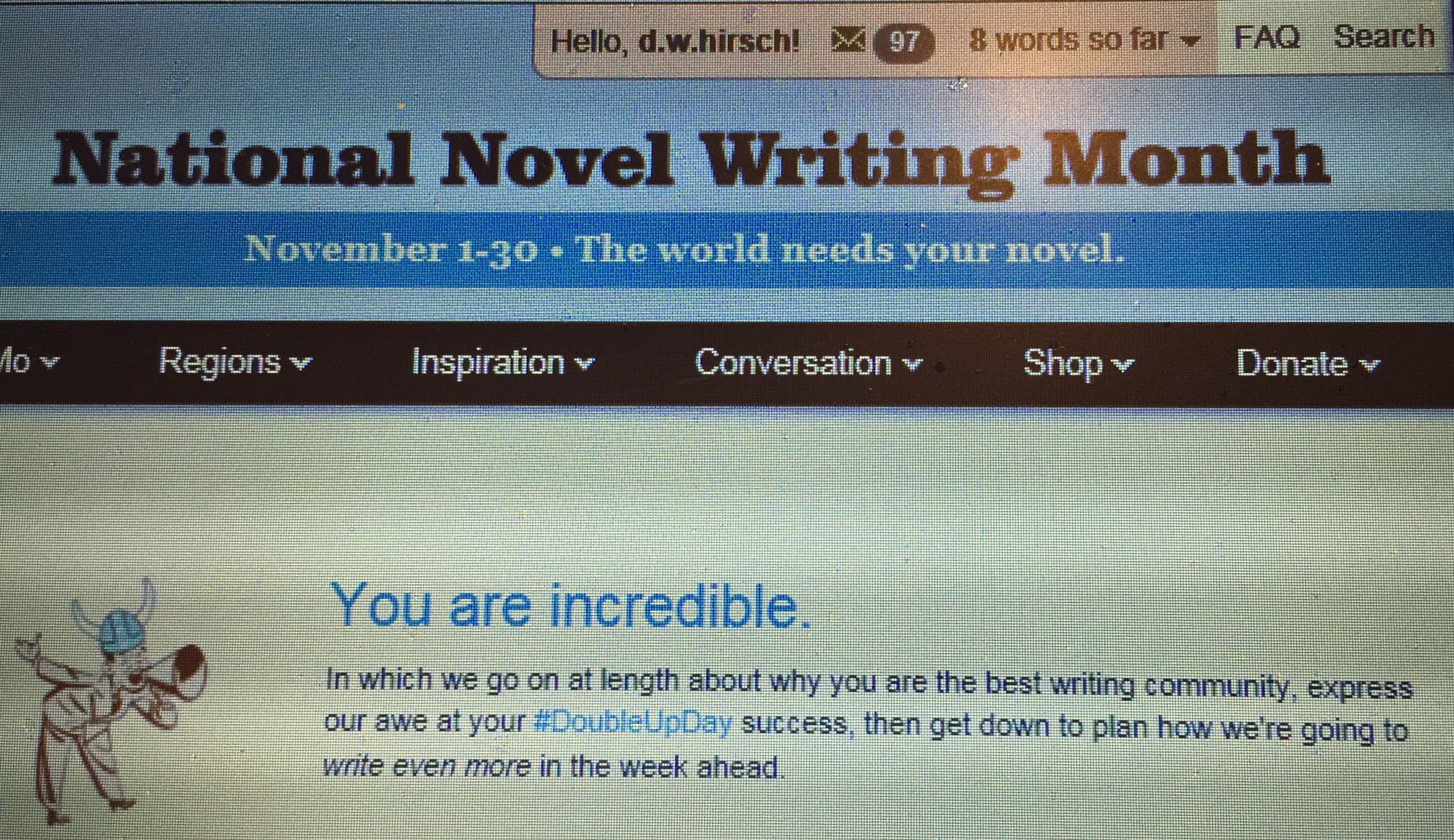
I am incredible. My NaNo word count is a work in progress.

I am incredible. My NaNo word count is a work in progress.

This is the heart of National Novel Writing Month (NaNoWriMo), the month where every writer and would-be writer suddenly finds the time to write 50,000 words in 30 days. Accomplishing this feat results in nothing more than bragging rights and the messy first draft of the novel you’ve been meaning to write. How do we make time now when we didn’t have one spare moment in the past 11 months?

The holiday season kicks off, too. If you’re a crafter, the stress of making Christmas cards is here because only 37 days remain until Christmas. To you chefs, the Thanksgiving meal is 8 days away. Other celebrations and holidays are a few weeks from now. What happened to your New Year’s Resolutions?

Oh, right. Those.

Why do you let everything and everyone else get in the way of your plans? How can you change that?

Schedule writing time, and I mean put it in your calendar. Would you miss a doctor or dentist appointment? What about your child’s football championship? Are you planning to miss your child’s trumpet solo at the musical recital? Writing time–or anything else–is a meeting with yourself. It is important, so block that time off in your calendar.

Set a timer for every activity you do, then switch to something new when the alarm sounds. I’ve heard that tip before, and I blew it off as corny…until I tried it. In increments of 23 minutes, I can wash a load of laundry, take a short walk or exercise, empty the dishwasher, catch up on one social media outlet, reply to some emails, or write a few dozen words.

Set deadlines. If you have a project due at work, do you blow it off and say, “I’ll get to it when I can.” There are unpleasant consequences for doing that. If you’re moving, you have boxes packed and mail forwarded by your departure date. I bet you don’t ignore such timeframes, so set a goal for yourself and stick to it. No excuses.

Reward yourself for completed tasks. If you have something good waiting for you at the end of a journey, you’re more likely to finish. Rewards don’t have to be big and expensive. Buy yourself something goofy from the dollar store. Get yourself a bouquet of flowers, one piece of Godiva chocolate, your favorite craft beer, or a coloring book. Tuck individual rewards you’ve listed in sealed envelopes, and choose one at each milestone you set. Surprises are extra-fun. Whatever you choose, be kind to yourself. If this is the first time you scheduled time for yourself and you didn’t accomplish everything, still reward your effort.

Small, simple changes: that’s how resolutions become accomplishments. “Losing weight” can only be accomplished by first “eating more veggies” followed by “climbing stairs at work for exercise.” That’s why NaNoWriMo is successful: 50,000 words at 1667 words per day. You can make small changes now, even if you’re feeling overwhelmed by the holiday season. Take time and test yourself by doing something you love. Write. There’s always enough blank space on the calendar to fit that in, even if it’s only five minutes.

Living by example, come back next month to see how this writer has handled life, the universe and everything else.
Wordplay: My Geek Is Showing

I failed my children by not pushing them further in studying spelling and vocabulary. One of my sons, a senior in high school, said to me that he just doesn’t know very many words. His limited repertoire made writing essays for his college applications a difficult and grueling process. Writing never came easily to him.

In contrast, I’ve always loved penning my thoughts and studying the mechanics of grammar, selecting the right words to convey my meaning. I love playing Boggle and Scrabble, and I look forward to quizzing myself with Reader’s Digest’s “Word Power.” I stop myself from giving my son too much writing advice because it’s important that he express his own thoughts in his own way. In looking back at the differences in our educations, I have an idea of why he struggles more than I do.

My elementary and junior high schools encouraged participation in spelling bees. I spent hours on rote memorization with the help of my patient mom. She read pages full of words out loud to me, one word at a time. I never once thought to ask her what the origin of an unfamiliar word was, but today’s top spelling bee contestants frequently make use of that rather sophisticated technique. If I had known there was more to studying spelling than memorization, I might not have lost first place to Kathy Trotter in the sixth grade. I didn’t know how to spell curry. Rote memorization only got me so far. Fortunately, I wasn’t competing for a college scholarship. The short-term goal was simply praise, a dictionary, and a trophy. The lifetime benefit was that I became a good speller.

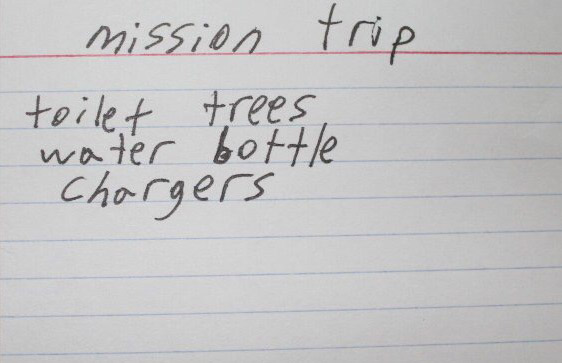
KellyDeadwood-2015-11Nov-ToiletTreesList

Spelling and vocabulary matter: I had to let my son know that toiletries would be easier to pack.

Sixth grade for my children was a different experience. Their spelling words were taken from their own journal entries. The children were tested on words which they individually used in their own writing exercises. I understood the practicality of holding students responsible for using self-selected words correctly. But I wanted a bigger challenge for my kids. How would they learn new and unfamiliar words and to expand their knowledge of language?

I reminded myself that teachers aren’t solely or primarily responsible for our children’s educations. As parents, we need to instruct and guide. To complement my children’s elementary school lessons, I developed a game that I thought would challenge them and be fun for our entire family.

During one week, I randomly selected a word each day from our two-volume dictionary. By the end of the week, we all had to know how to spell the seven chosen words and combine them into one sentence. The sentence could be longer than seven words, but it had to reflect correct usage and meaning. Essentially, the family and I studied a word a day—similar in scope to what Merriam-Webster currently offers online—but my game involved the added challenge I was seeking.

So that you can see how this game worked, I’m going to borrow the seven “Word of The Day” selections which Merriam-Webster promoted from October 29 – November 4, 2015. First, we have to consider the definitions of the words. The list below is taken verbatim from www.merriam-webster.com.

Pellucid: admitting maximum passage of light without diffusion or distortion; reflecting light evenly from all surfaces; easy to understand

Underwhelm: to fail to impress or stimulate

Ebullient: boiling, agitated; having or showing liveliness and enthusiasm; exuberant

Microburst: a violent short-lived localized downdraft that creates extreme wind shears at low altitudes and is usually associated with thunderstorms

Ruddy: having a healthy reddish color; red, reddish

Confidant: one to whom secrets are entrusted; especially: an intimate friend

Trepid:  timorous, fearful

Now comes the hard part: we have to consider those definitions in anticipation of using the seven words to construct one sentence. Here’s my solution to the puzzle:

My ruddy confidant was caught in a microburst which left her so trepid that, when she couldn’t describe the situation in a pellucid manner, I was underwhelmed, despite her apparently ebullient experience.

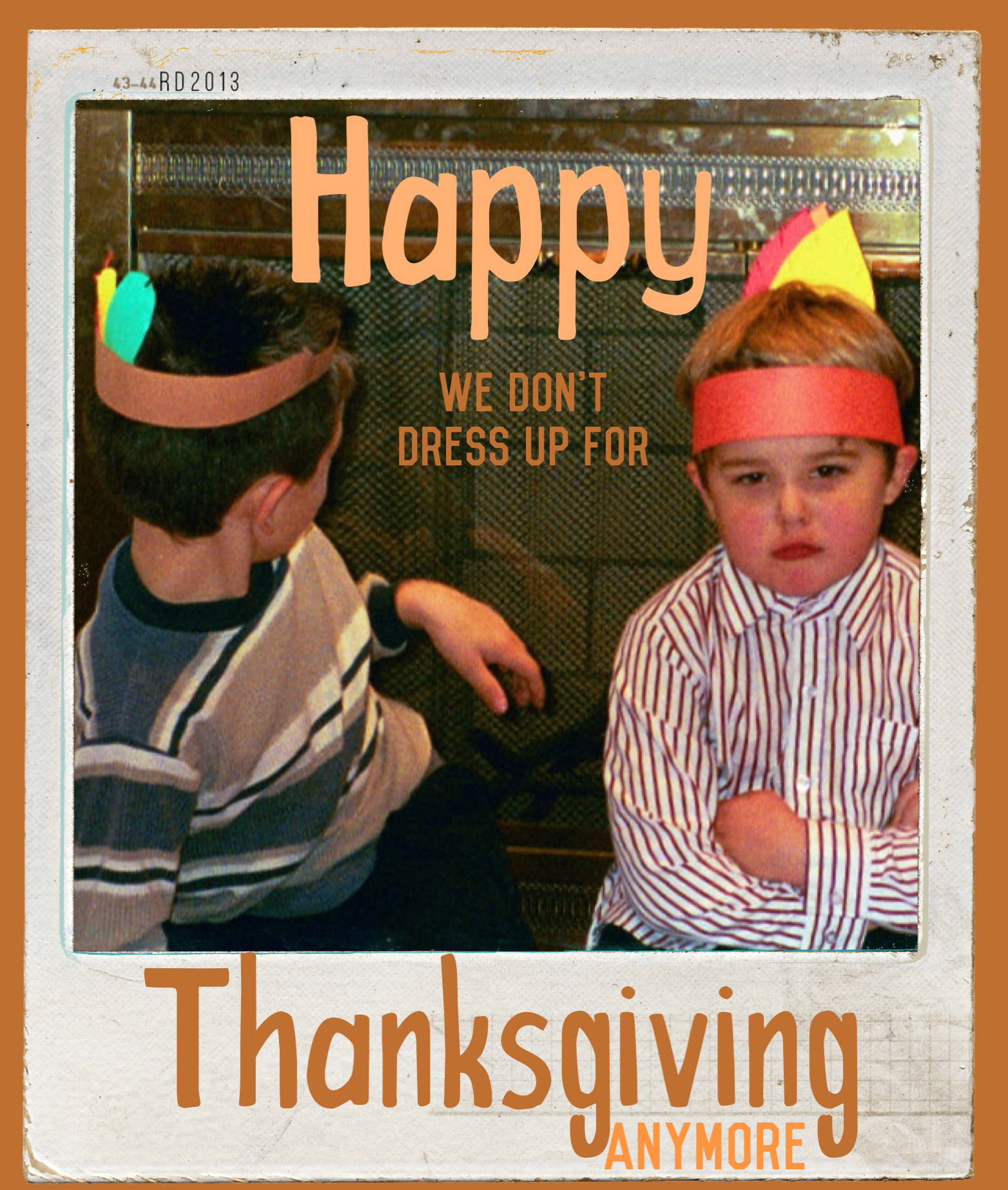
KellyDeadwood-2015-11Nov-KellyMemeThanksgiving

If I wanted to break the rules of grammar when creating this meme, I would have written Happy Givingthanks.

.
Sadly, my kids never really enjoyed the game as much as I did, and it was quickly forgotten. But thank goodness, they now have smart phones and can share highly entertaining, often grammatically incorrect, internet memes with one another. If only people like my kids understood the rules before they broke them.

Superfan Powers Activate!

I've found the new workbook as useful for blogging as the original book (another reason to share).

I’ve found the new workbook as useful for blogging as the original book (another reason to share).

What is a Superfan, you ask? Good question.

A Superfan is someone who adores, loves, admires and worships your artistic work. It’s not a phrase I coined, but a word someone wrote on a blog sometime mid-2015. If anyone out here has also read that intriguing post, please let me know so I can correctly credit the author. The word stuck with me, and it’s a way I now frame my thoughts and perceptions and just about anything when it comes to supporting fellow writers.

I am a Superfan of some writers, meaning I devour anything they write. I promote them by screaming from the rooftops and through my typing fingertips on social media. They owe me nothing, but I owe them my inspiration. Something about their writing, artwork, photography or personal interests resonates with me and I can’t not support them.

I stumbled on Marcie Hill’s book, “62 Blog Posts to Overcome Bloggers Block,” at a time when I was struggling with my blogging topics. The tip that resonated with me most was: It’s not cheating to publish a pictures-only blog post. I never thought about that, even though I have seen such posts elsewhere. I devoured her book, used some of her tips, and then I left an adoring review on Amazon. She wrote me back, “Thank you for that review.” I followed her blog and her Twitter account. Without asking, she did the same, and that’s how our relationship started.

Part of Superfandom is how writers treat me. It’s that personal touch, that sharing with others. I prefer to show my appreciation of Instagram photos with words rather than just Liking them. After commenting on @josameys.words poem about villains and heroes, we had an intense, and rather hilarious, discussion about the pros of being a villain and which Disney villains have the best wardrobe.

Remember the key word in social media: Social.

These authors, artists and other people talk with me. I couldn’t attend a weekly Twitter Chat with Nori (@ReadWriteLove28), so I Tweeted her.

“Wish I could’ve made it, but was still getting over bronchitis.”

She Tweeted back, “@dianahirsch Oh no 🙁 I hope you’re feeling better now!”

I replied, “Yep. Finally better. Took 2+ lingering weeks, but I’ll be ready next #RQWN.”

She replied, “@dianahirsch Oh good, I’m glad!”

Someone who takes that much time and attention is my idol. To show my appreciation for anyone who does that, I retweet their Tweets, I {heart} their videos on Vine and Like their Facebook page, when I’m on Facebook. Beyond such standard protocol, I ask questions and send encouragement through Direct Messages (DM). I show my hero worship by engaging with them on a personal level.

You can make people like you and have your own Superfans by doing those same things. Make sure there’s personal interaction not just some stock “Thank You for Following Me” auto reply. Be polite. Be sincere; don’t say something if you don’t mean it. Make followers feel important; they are your best advertisement and supporters. Answer questions. Send loads of virtual warm fuzzies across the Internet. Emulate the people you want to be.

Make people smile. They will adore you for that. It’ll make you feel good, too.

Frustration

“Writing: Somewhere between torture and fun.” – The Write Practice

“I just sit at my typewriter and curse a bit.” — P.G. Wodehouse

Frustration

My current project, an historical novel, started as a short story written during a creative writing class. The sudden death of an important, but minor, character propelled the scenes to a heartbreaking conclusion. After reading my final version aloud, I looked up to see tears flowing from the eyes of several classmates. Pleased that my work received the emotional response I desired, I shelved the story with no plans for further development.

For several years the characters continued to invade my thoughts insisting I reveal more about their lives. I finally relented and gave them proper historical names, added more dialogue, and expanded their storyline. My short story became the catalyst, but not the beginning, of a novel.

The words spilled onto the pages for months until suddenly the plot stalled because my characters rebelled at the direction I took them. The character who died now wanted a more significant role than originally planned. This character asked for, no, demanded to be resurrected to find a place in this world, to see the changing seasons, to experience adventures, to feel loved.

This frustrated me because that character’s inclusion changed the entire plot forcing me to do more research to add authenticity to the details.

Call me crazy if you wish, but I now believe what some writers have said about their characters talking to them. The characters know their story better than I do. After all, it is their story, not mine. I’m only the storyteller or historian whose job it is to simply tell their story in a convincing, thought provoking way.

Do your characters speak to you? If so, do you listen? Have you changed a storyline to accommodate your characters’ desires?

What is Writing?

What is writing to you? Writing can mean many things to different people.

1–Writing is exhausting.

Remembering the rules of syntax and sentence structure is a struggle. Perfection halts our progress putting words to paper.

1–Writing is exhilarating.

Initially, don’t worry about spelling and sentence structure. There is a freedom to words. Getting your struggles and thoughts out of your mind and onto paper clears your head. Once they are released into your world, you can address them. Accomplishing that is a thrilling expression.

2–Writing is personal.

It is risky to write. You expose yourself to others’ judgement. Your self-image becomes vulnerable to criticism. Those are scary moments.

2–Writing is personal.

When you share your words, you share your experience. Others do relate to that. Hearing someone say “I learned from this,” “I was entertained,” and “this made me cry,” is a compliment and a success.

3–Writing is reclusive.

Writing is just between you and your thoughts; nothing else. You have no coworkers or teammates to rely on.

3–Writing is sociable.

Virtual communities of writers understand your struggles. Social media connects people around the globe. Local writing groups strengthen that support. A kind, inquisitive word from a stranger in a coffee shop is supportive and reminds you that you are not alone.

4– Writing is frustrating.

Ideas are fleeting. Motivation rises and falls. You slam into the Writers Block wall over and over and over again.

4–Writing is invigorating.

By declaring, “Writing is worth making the time for,” you choose to commit to yourself. You whisk a reader away into a world you control. You paint with words, drawing scenes in your readers’ minds. Extra incentive comes from the release into the world. It is rewarding to receive a positive review on a reading website or from someone who is not your immediate family network and friends.

5–Writing is limited.

Only a few rare people get a publishing contract. Large publishing houses have limited resources of time, printing, ink, and space. If you do not make a living by writing, then you do not have a “real” job. If you just dabble in your journal, you’re not doing any real writing. Without public validation, all efforts are snubbed as “just a hobby.”

5–Writing is limitless.

If expression is your only goal, then laptops, electronic tablets, journals or paper and pen are all friends. Writing anywhere is accessible. If publishing is a goal, the publishing options range from working with a Big 5 publishing house to a small startup publisher. Self-publishing has become mainstream, be it an eBook, paperback or picture book. You own your options and control your future.

6– Writing is work.

Standard books are long. Whatever your measurement–word count of page length–completing something that complex is a massive task. Revisions take time, a lot of time, and are often disappointing. Writing is intimidating.

6–Writing is work.

There is power in writing the words “The End” on your work.

That’s what writing is to me.

What is writing to you?