Category Archives: Grammar

In One Ear and Out the Other


A waitress at a nice restaurant my wife and I like to frequent said, “No Problem,” after I thanked her for topping off our water glasses. I asked her, “what would be a problem?” She just stared at me.

I asked her, “If freshening my water isn’t a problem, would sending back my meal be a problem?”

We hadn’t been served yet, so that only confused her more. My wife interrupted and told her I was just being funny. Perhaps I was, but this waitress gave less forethought to her words then a parrot does. I know she was just using a common and well excepted version of you’re welcome, her heart was in the right place, but in this scenario, that remark does not mean the same thing as “you-are-welcome.” Left on its own, the implication is no problem this time, and even left unspoken it still rings in my ear the same way fucked rings in my ear every time I hear a newscaster or politician use the acronym SNAFU.

As a fiction writer, I work with innuendos and inferences all the time, they are the salt and pepper of suspense. But the older I get the less tolerance I have for them in real life. When that answer cropped up again a few weeks later, my wife and I agreed to just keep score. Now, rather than reprimand or ridicule, I just reduced my tip by one-percent every time they say it. We’ve saved some money, but more than that it’s taught me which waiters and waitresses not to ask for when we return. I want to be their patron, you see, not their problem.

That isn’t my only vernacular pet peeve. Another is when a stranger asks, How Are You, by way of introduction. This is the most common salutation of all, almost silent in fact, but it sounds like an invasion of privacy coming from a telemarketer or car salesman. I started having fun with these people years ago, by answering, “Sitting up and taking solids now. Thanks for asking… How are you?” Fully half just answer, “Fine,” and go right into their spiel. They don’t hear my initial comment any more than they hear their own first words. Makes me wonder what else they’re not going to hear. Another smartass answer I like is, “Unless you are my doctor or my life insurance agent, that’s none of your business!” That one they usually hear, but they still just go right into their pitch.

Another un-favorite is, Unbelievable, and it’s raising to the top of the list fast. With current events being where they are, what with real and phake news getting equal time it seems, this comment is cropping up with alarming regularity. The next time someone tells you something is unbelievable, take them for their word – don’t believe them! Instead, interrupt with, “Wait! Why do you want to tell me something you yourself don’t believe? That’s just a waste of my time, and it doubles the time you’ll waste on it.”

There are others that itch. Here are my un-favorite, irritable, ambiguous comments, and how they ring in my ear.

“No problem.” (server) Be careful what you ask for.

“How are you?” (stranger) What are you selling? 

“Unbelievable.” (casual acquaintance) Are you a fool?

“Let me think about it.” (spouse or S.O.) No. And don’t ask again.

“You never know,” or, “It’s hard to say.” (boss) Oh, you know alright, you’re just not telling me.

Any double-negative, like; “I don’t know that it’s not true.” (politician) It’s a lie, and they know it.

Finally, the most eye-rolling statement of all, “Congratulations!” (stranger) You want my money.

What are yours, and how do they ring in your ear?
Wordplay: My Geek Is Showing

I failed my children by not pushing them further in studying spelling and vocabulary. One of my sons, a senior in high school, said to me that he just doesn’t know very many words. His limited repertoire made writing essays for his college applications a difficult and grueling process. Writing never came easily to him.

In contrast, I’ve always loved penning my thoughts and studying the mechanics of grammar, selecting the right words to convey my meaning. I love playing Boggle and Scrabble, and I look forward to quizzing myself with Reader’s Digest’s “Word Power.” I stop myself from giving my son too much writing advice because it’s important that he express his own thoughts in his own way. In looking back at the differences in our educations, I have an idea of why he struggles more than I do.

My elementary and junior high schools encouraged participation in spelling bees. I spent hours on rote memorization with the help of my patient mom. She read pages full of words out loud to me, one word at a time. I never once thought to ask her what the origin of an unfamiliar word was, but today’s top spelling bee contestants frequently make use of that rather sophisticated technique. If I had known there was more to studying spelling than memorization, I might not have lost first place to Kathy Trotter in the sixth grade. I didn’t know how to spell curry. Rote memorization only got me so far. Fortunately, I wasn’t competing for a college scholarship. The short-term goal was simply praise, a dictionary, and a trophy. The lifetime benefit was that I became a good speller.

KellyDeadwood-2015-11Nov-ToiletTreesList

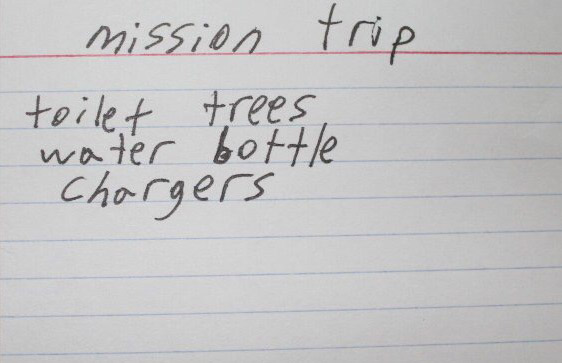
Spelling and vocabulary matter: I had to let my son know that toiletries would be easier to pack.

Sixth grade for my children was a different experience. Their spelling words were taken from their own journal entries. The children were tested on words which they individually used in their own writing exercises. I understood the practicality of holding students responsible for using self-selected words correctly. But I wanted a bigger challenge for my kids. How would they learn new and unfamiliar words and to expand their knowledge of language?

I reminded myself that teachers aren’t solely or primarily responsible for our children’s educations. As parents, we need to instruct and guide. To complement my children’s elementary school lessons, I developed a game that I thought would challenge them and be fun for our entire family.

During one week, I randomly selected a word each day from our two-volume dictionary. By the end of the week, we all had to know how to spell the seven chosen words and combine them into one sentence. The sentence could be longer than seven words, but it had to reflect correct usage and meaning. Essentially, the family and I studied a word a day—similar in scope to what Merriam-Webster currently offers online—but my game involved the added challenge I was seeking.

So that you can see how this game worked, I’m going to borrow the seven “Word of The Day” selections which Merriam-Webster promoted from October 29 – November 4, 2015. First, we have to consider the definitions of the words. The list below is taken verbatim from www.merriam-webster.com.

Pellucid: admitting maximum passage of light without diffusion or distortion; reflecting light evenly from all surfaces; easy to understand

Underwhelm: to fail to impress or stimulate

Ebullient: boiling, agitated; having or showing liveliness and enthusiasm; exuberant

Microburst: a violent short-lived localized downdraft that creates extreme wind shears at low altitudes and is usually associated with thunderstorms

Ruddy: having a healthy reddish color; red, reddish

Confidant: one to whom secrets are entrusted; especially: an intimate friend

Trepid:  timorous, fearful

Now comes the hard part: we have to consider those definitions in anticipation of using the seven words to construct one sentence. Here’s my solution to the puzzle:

My ruddy confidant was caught in a microburst which left her so trepid that, when she couldn’t describe the situation in a pellucid manner, I was underwhelmed, despite her apparently ebullient experience.

KellyDeadwood-2015-11Nov-KellyMemeThanksgiving

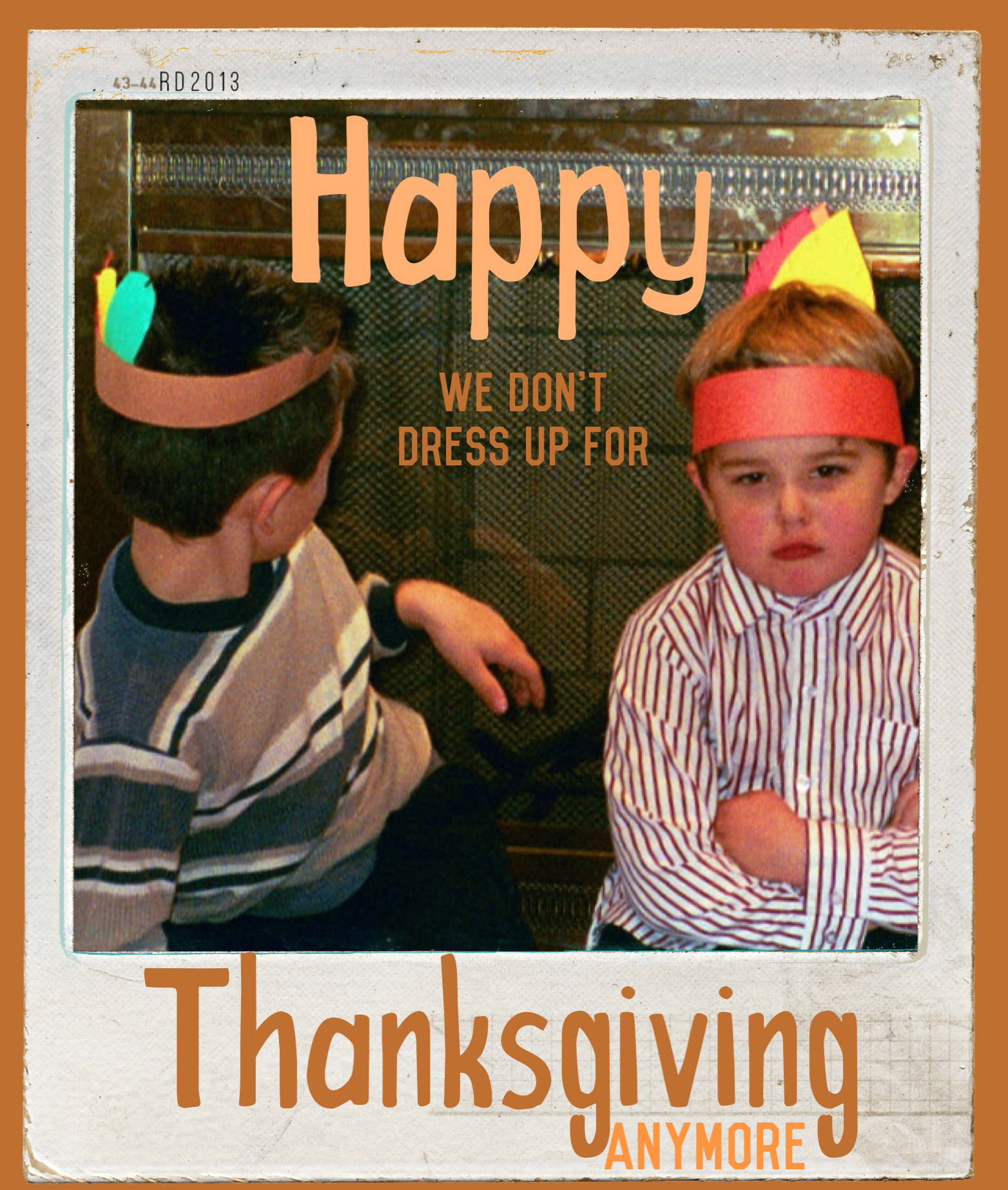
If I wanted to break the rules of grammar when creating this meme, I would have written Happy Givingthanks.

.
Sadly, my kids never really enjoyed the game as much as I did, and it was quickly forgotten. But thank goodness, they now have smart phones and can share highly entertaining, often grammatically incorrect, internet memes with one another. If only people like my kids understood the rules before they broke them.

Marital Advice for Grammarians

I never want to be thought of as an annoying individual who likes to point out other people’s mistakes. With that in mind, when my husband recently said “…for you and I,” I stopped myself from saying, “You mean, ‘for you and me.’”

KellyDeadwood-2015-8Aug-TightCrop

In that brief moment between hearing the mistake and wanting to straighten it out, I decided that I wasn’t about to trade marital bliss for a lofty disposition.

Does anyone—even a supportive husband—ever really appreciate unsolicited grammar advice? It may be meant as constructive, but when it’s directed at you, the unexpected input seems like full-blown criticism. As if you failed a test that you didn’t know you were being graded on. You feel disrespected by the Grammar Police, insulted and stifled from saying whatever was on your mind.

A member in one of my online writing groups recently posed a question to the rest of the group. I immediately noticed that his question contained a common error: using “there” instead of “their.” Pretty much everyone is prone to making similar mistakes. We forget to apply certain rules or are guilty of little typos. In those instances, we simply lower our guard and something slips, unchecked and uncensored, through our fingertips. I wasn’t about to publicly point out the blogger’s mistake since it wasn’t important to the ensuing conversation.

Another writer, however, was excessively harsh. This stickler rudely asserted his opinion that “someone ought to be using a dictionary to improve THEIR spelling.” Ouch! Point made, although it wasn’t really a spelling error but more of an error in word choice. Notably, no one—myself included—seemed bothered enough by that faux pas to make an issue out of it.

Similarly, there was no good reason that the there/their matter couldn’t have been addressed in a friendlier, less offensive, and perhaps even private way. By politely ignoring the situation altogether, the rest of the group sent a subtle message to the one outspoken member that perfection isn’t always necessary, especially in informal settings.

I was glad I had sided with the discerning writers who let both the original mistake and the poor response go unaddressed. But it’s hard for me to subdue my persnickety nature. I admittedly harbor some intolerance towards common grammatical mistakes. There are standards, and writers are expected to lead by example. We’re judged not only by our ability to tell a story, but also by our mastery of punctuation, spelling, word usage, and sentence structure.

We have decisions to make over the tiniest details. For example, do we use a numeral or spell out the number itself when referring to a centennial home as being one hundred years old? (Usually it is spelled out, but there are exceptions.) Should e-mail be hyphenated? (Yes.) Can we abbreviate okay as Ok? (No. Capitalize the entire abbreviation, as in OK.) Is the title to a blog italicized or placed within quotation marks? (The name of the Web site is italicized and an article posted on the site is placed in quotation marks.) Do we trust our phone’s spell check when it inserts an apostrophe into our family’s last name…when we’re not showing possession? (No! The Bixbys don’t like that.)

A writer’s ability to convey clear and concise thoughts is dependent upon all these things, in addition to understanding the basic parts of speech. It is our job to expertly unite a myriad of facets—nouns, pronouns, adjectives, verbs, adverbs, prepositions, conjunctions, and interjections—so that our work reflects both definitive grammar and intuitive usage.

There is a lot to remember, so let’s find support in reputable guidebooks, like The Chicago Manual of Style. Then understand that despite our best efforts, occasionally, you and I are going to mess up. We should strive for—but not expect—personal perfection, be kind when offering advice to others, and relax with the people we love.

Typo!

Every novelist needs a copy editor. Why? Because a copy editor makes sure the author is wearing his pants before he steps on stage, makes sure the author doesn’t have a trail of toilet paper stuck to her high heel as the lights come up. Yes, typos are that glaring.

Novelists cannot correct their own typographical errors because they know too much. Knowing what was meant to be said, the author reads what’s in their head not what’s on the page. It’s not a fault, just a fact. A copy editor will not have those preconceived blind spots. They will catch where you wrote breathe instead of breath. Copy editors will see the wrong use of their, they’re and there where your eyes will not. They will find your misplaced commas and misused semi colons and correct grammar where necessary. They will pick up on common wrong-word errors that spellcheck cannot, like typing were when you want where. And at finding missing little words like, for, an, and, at, or and so. Your mind’s eye does not see these kinds of mistakes, either.

Your copy editor is the last person to edit your story before you send it off to your publisher, so you’ll want to entrust this person with as polished a manuscript as possible. The best way to do this is to re-read your entire novel one last time, only lip-syncing it from start to finish.

You don’t have to say the words out loud, but you do need to move your tongue, lips and jaw. What happens is your mouth slows down your mind and forces you to say and see what is on the page. You are also likely to discover syntax errors, run on sentences, passive voices and homonyms, all the stuff that trips up coordination between the tongue and the eye. You’ll discover errors in pacing and entire passages that, really, can be cut. Your only criteria at this point is to clean up and clarify; everything else should be done. Reading like this will catch most of these common errors.

A good copy editor is essential today, whether you are self-publishing or have an agent. What comes out of his or her hands is what will stand the test of time. You, the author, will make all the suggested changes (or not) and correct the typos before submitting it, so in that sense you always have the last word. But by lip-syncing your novel one last time, you will make the copy editor’s job much easier, and much faster.

Who should you hire for this? Yes, I said hire, not ask as a favor. If you are really serious about wanting others to recognize your work, don’t skimp here. Ask other writers who they’ve used and who they would recommend. When you find someone you hear is good, and available, take them to dinner. You don’t have to wine and dine them, but get to know them and what they like to read. Ask them about their funniest stories with editing. That will tell you how much they like their job. Offer a few quips of your own about your research or who your protagonist is based on. At the end of dinner, you’ll both know each other better. You’re looking for someone who wants a personal stake in your novel, who wants to be as proud as you are to see their name attached to it. What they charge, what you pay, should be secondary to that.

How much you should pay is entirely up to you and your copy editor. Somewhere between a dollar a page and three dollars a page seems to be the going rate. The two copy editors I have worked with both charged a flat rate. I paid $250 for my first novel and $350 for my second, but they both moonlighted and neither could be bound to a timeline. The first time I hired a librarian, the second time an accountant. Both were equally methodical. I discovered accountants are very good at finding words that don’t add up, if you hire one who has a good command of the English language.  English teachers are another good source. An editor who reads your genre can be helpful, but don’t make that your only criteria. Critical editing is not what a copy editor edits for. All of your plot development, character development and timelines should be nailed down long before a copy editor sees it.

One final word on typos. No one gets them all, and that’s a good thing if you are in the antiquarian, collectable book business. If you don’t believe me, just go ask Alice. Or Huck. Or that “fool Red Cross woman” in One Flew over the Cuckoo’s Nest. True first print runs of these classics, identified by their typos, are selling for several times what a second printing will fetch. But that still doesn’t bode well for the author.

Playing Leapfrog

phil7.1.12With Knock Softly (KS) finished, it’s time to clean up. But first, the statistics.

With “The End,” KS crossed the finish line at 128,814 words, 448 pages in manuscript format, in 44 Chapters. It took 21 months to write and I compiled 28 pages of notes, plus a thick folder of printed articles. There are four main characters and four support characters as well as a cast of over two dozen doctors, nurses, lawyers and the like. There are two main settings and a couple of side trips. And two dogs. And one mysterious friend who seems to know everything. Done.

Then I played “Leapfrog” with the novel, only going backwards. I re-read chapters 43 and 44, then re-read 41 and 42, then 39 and 40 and so on, until I finished back at chapter one. This allowed me to know where I was going and to be sure each chapter led clearly and succinctly to the next. It also allowed me to “kill my darlings.” I’ve spoken of them before; those cleaver little verses that seemed so cute at the time. But in leapfrog, they appeared as obstacles that only got in the way of a good jump. I also identified areas that needed shoring up for what comes next, and those I marked with an “R/W.” I did not rewrite anything, just cut and identified what needed more work.

The manuscript now weighs in at 120,090 words, 429 mms pages. It took seven days and produced another page and a half of notes. Twenty pages went into the dust bin, 8,800 worthless words. Bye, darlings.

Now comes the real fun part; I get to play God! I will start again from the beginning, only now knowing all, I will tighten the read, heighten the valleys and smooth the jagged edges with that last chapter, last page, paragraph, the very last word, in mind.

Some of the things I will be on the lookout for are, first and foremost, character development. I want to be sure my folks develop on pace and keep with their persona. I was amazed at how many times my characters cried. I didn’t set out to make weaklings but that’s how they appeared in some scenes. I noticed a lot of character movements when a simple he said, she said, would work better, faster. Even after leapfrog, the characters are still smiling 148 times, sighing 48 times, and mad or angry 51 times. Not to mention all the tears. I’ve still got work to do.

You don’t see these things while writing first draft because you are wearing each character’s hat and navigating them through uncharted waters. Your adrenalin is flowing and you just want to keep the action moving forward. You forget they’re human, that they need to breathe, too. I don’t how much more there is to cut. I don’t have a target word count or anything. I’m letting KS sit for a few weeks before I come back to it with fresh eyes.

Am I happy? So far. Satisfied? Not yet. Eager? Yep!

Next month, we’ll take a look at correctile dysfunction; the author’s inability to line edit their own work.

-Phil


Seoul40  Freya40

Seoul Legacy, The Orphan’s Flu is available in paperback on Abe, and on Amazon in paperback & ebook.

The Freya Project is available in hardcover and limited edition from the author. Quantities from Countinghouse Press.