Category Archives: Fiction

Writing: Promises or Priorities?

They say timing is everything.  I agree.

So is letting go.  That’s why I say to whomever “they” are that I’m extending my 10-hour book publishing challenge to December 18.

Why?  First of all, it’s my blog challenge and I set the rules.  (And my blog editors said it was okay.)

Second, I felt overwhelmed by things crashing into each other.  Fundraising to dance in THON clashed with my seeking financial support for my Indiegogo campaign.  The extra shifts for my part-time job slammed into prep work time for my Zentangle classes.

The last and most important time-suck of the month was me.  I watched my Major Crimes DVDs over and over, obsessing because the new season starts next week.  I wandered aimlessly through the playgrounds of Instagram.  I tell myself that writing haiku through Ku and Notegraphy phone apps was a productive use of my time, but, really, that was another distraction.

I sound just like that person I wrote about last month.

Now, I did catch a cold.  I was not so sick that wiggling my toes hurt, but I sniffled enough where leaning over my keyboard caused my nose to drip and drool on the keyboard. Any precious time I could snort the mucus back, I spent that time on my memoir.

Outside of that, I chose to be careless with my time, and now I’m here apologizing and making excuses.  Why did I not value my time and talent?

I thought about it.  I figured I’d have more success collecting donations for THON when I wasn’t asking people to buy my book.  Rather than compete with holiday parties and family events, it made more sense to me to plan a marketing strategy for my Zentangle classes in the New Year when I wasn’t marketing my memoir and my Indiegogo crowdfunding campaign.  At some point, the money from working extra hours at my job was not worth the time that could have been spent writing my memoir.

Are you seeing the theme here?  Believe it or not, I didn’t at first.  When you think about your responsibilities–I mean, really think about them–listing your life out like chapter outlines will identify the events that really matter to you. Here I’ve moved on to the next step, the follow-through that freezes many would-be writers: I’m letting go of extraneous tasks and planning.  Not everyone does that.  They usually give up.

I didn’t give up; I refocused. That’s not an excuse, although we may see it as such. If we do, then we fail, fizzle and flop.  I didn’t think I needed to prioritize, but I couldn’t identify what really mattered until then. Of all the items on my list, my memoir was most important to me.  Knowing that, I could push everything else aside.

All of this brings us back to the postponed eBook challenge. Yes, some readers who were expecting Part Two this month may be disappointed, but remember, I’m rescheduling it, not giving up.  Think of it as…increased anticipation.

How has this shift in priorities helped my memoir time? With the extra time, I was open to rearrange and commit to the Chapter order.  After doing that, the process flowed better. Both self-editing and finding an editor takes longer than I thought.  Re-launching the Indiegogo campaign was frustrating and disappointing, but the descriptions and perks are now more enticing.  I’ve explored marketing ideas and am planning specific actions of specific dates.  For other ideas, I’m letting those all percolate.

Did you make a writing promise to yourself and were unsuccessful?  No one can change what happened yesterday.  It’s been done, but that doesn’t mean you’re a failure.  How do we start fresh without feeling guilty?

First, forgive yourself.  We’re all human, but we can do simple, little things.  What should you consider when planning your writing time, or anything else, really?  I can offer some advice.

1. Don’t rely on To-Do lists.  From my experience, they appear organized but are often overwhelming, and thus counterproductive.

2. Don’t say yes to things just because that time isn’t blocked off on your calendar.

3. Break up your lunch hour by standing up and physically moving away from your desk.  If that’s the time you squeeze in exercise, give yourself permission to write during one or two of those times.  Take your laptop into an empty conference room or even your car to write away from distractions.  No laptop? Use paper and a pen, as we dinosaurs did in the pre-digital age.

4. Family and relationship time is important so look for ways to balance the two. I can write in the living room on the couch next to my husband as we watch episodes of The Big Bang Theory.

No matter what you do, the key is making the time.

Did I say any of this would be easy?  If it was, we’d be doing it all and there would be no need for me to write this post.  We’d all be published authors with worldwide readership.

We know self publishing is possible. I can’t promise readers will love your stories, but if you don’t publish, how will people be able to read them?  If you have already completed the 10-Hour Challenge and published a book, leave the link information below in the comments.  If not, then you have another 30 days.  Timing is everything.

Ready? Set. Go!
Slogging Through the Jungle with a Hatchet

You may have heard something about the ongoing fight between Amazon and Hachette Book Group. It started in the boardrooms of both companies over the new contracts that, effectively, allow Amazon to set the prices for Hachette’s and eventually all publishers products.

But that’s not all. It also says the publisher, by a certain future date, must submit “electronic versions” of their books – and covers – with shipments, and to allow Amazon to print-on-demand (POD) any orders the publishers cannot fulfill within a specified amount of time. I haven’t seen the contract, but enough people have to warrant over 1000 authors signing a letter and buying a two-page ad in the New York Times Sunday Edition to protest the contract’s language. It’s getting nasty, just the kind of stuff that good, suspense novels are made of!

Diana Hirsch got this topic started back in August with her Amazon, Hachette and the wretched $9.99 price point, but I saw a sidebar there that warrants a bit more discussion. I wear both hats in this fight. My first novel, The Freya Project, was published by Countinghouse Press. I self-published my second book, Seoul Legacy, the Orphan’s Flu, with aid of the University of Michigan Library’s Espresso Book Machine. Anyone can use their million-dollar “book” printer. My per-unit cost in each case (tradition vs. POD) was about the same. The difference was that I could have printed just one POD book if I wanted instead of hundreds or thousands, so the overall publishing cost difference was huge and that’s what drove my decision to POD for my second book.

You can bet Amazon has a few Espresso Book Machines at the ready, and what’s really at stake here are jobs. Thousands of workers bees throughout the book distribution channel are about to be handed pink slips. Traditional printing houses will fall if they don’t get onboard the e-train, and the biggest ones will fall the hardest. Publishing is going to bleed all the way back to the pulp forests. This contract, this new business model, if it comes to fruition, will literally rewrite the definition of the word “print” in all dictionaries by the year 2050. I alluded to this in my blog back in March, And now, the 2050 POE prize winner for…. Amazon has already captured the prize – the consumer.

Don’t blame Jeff Bezos and his Amazon.com; he just expanded the vision. Blame Johannes Gutenberg; he started it when he put all the first scribes out of business! By 1460 – a mere 21 years after he invented it – Gutenberg’s moveable type presses were operating all over Europe. What happened next changed the course of history. Over the next 500 years, print would evolve into the worldwide format for all sciences, medicines, religions, and all other forms of education. It allowed us to record history and for the masses to learn. Jeff is merely taking over where Johannes left off.

I don’t care how they define “print” in 2050, so long I’m still able to read it. That’s the consumer’s hat I wear in this fight, and it’s the hat I care about the most. I don’t care what price point publishers put on e-books, either, so long as Mr. Bezos & Co. keep their long-standing consumer protection clause; Amazon’s seven-day, no questions asked, money back guarantee. If you don’t like an e-book, return it for a full refund within a week. I have both bought and sold eBooks this way on Amazon.com for years, and have yet to experience a refund from under either hat.

Amazon’s consumer protection clause is the rising tide that lifts all boats. If the author or publishing house insists on staying anchored to their price-point, then let them, just as long as the consumer can get a refund if they don’t like the book for whatever reason. Frankly, Amazon’s seven-day policy should be thirty-days, to encourage bulk purchases.

The main reason new authors have such a hard time breaking into the industry has been the same for hundreds of years; they are just not-quite-good-enough to warrant the all expenses required to “launch” a new author. Amazon’s proposed business model finally buries that hatchet. It allows a publisher to take a chance with someone or something new without the fear of going broke. It allows the author to take a chance without the fear of losing audience. It also allows the reader to take a chance without wasting a lot of time, or money.

Too many good voices are going unheard. For every one David Baldacci there are fifty Bonnie Virag’s. I dare you to put down her The Stovepipe, a true story about growing up in the Canadian Children’s Aid Society. Hers is the most gripping novel I’ve read since Frank McCort’s Angela’s Ashes. Virag only has 29 five-star reviews on Amazon.com, compared to McCort’s 2,400, but download The Stovepipe and I guarantee you will want to be number 30.

As I see it, new authors are the only authors who will need an agent – a megaphone, if you will – in the Amazon business model. Word-of-mouth has always been the best form of advertising. If readers like what you write they will tell two friends who will tell two friends, etc. They always have and they always will, especially where reading material is concerned. The internet only amplifies today’s voice, but it does so on the same scale that moveable type amplified reading almost 500 years ago.

Right now, Hachette & Co. should be driving fast and taking chances instead of slogging along in the fast lane and holding up traffic. Think of the internet as the carpool lane in rush hour, Mr. Hachette – give someone else a lift and you’ll both get there faster.  Smaller advances, say, a tenth of the size of Baldacci’s, could be paid to new promising authors. All publishers should be trying to find –and fund – new voices like Ms. Virag’s. If only one turned out to be as successful as David Baldacci or Frank McCort have they’d be in the money. Two or more and they’d be fat cats with cigars. Again.


Next Month. A look at what the future holds for pulp.

I have no doubt someone will print a 600th Anniversary edition of the Gutenberg Bible. I suspect all religious material will still be in “print” by 2055, but what chance do newspapers have? Or magazines? Or books? And, what does history hold for all the printed matter in existence now? Is a first edition of J. K. Rowling’s Harry Potter and the Goblet of Fire treasure or trash? Those questions answered, and more, in November. Thanks for dropping by!

A Picture is worth a Thousand Words

When you read the title, A Picture is worth a Thousand Words, I bet most of you think of an award-winning photo. Maybe you think of the famous photo in Times Square with the sailor kissing the girl on V – J Day. Or, maybe it’s the little girl running naked and burned after the bombing of Hiroshima. Maybe it’s a more romantic image, say of Marilyn Monroe getting her skirt blown up from the air vent. The question I’d like to ask you is, what do all of these images have in common?

They each tell a story.

For this blog, I decided to do a writing exercise with you. I went to my Pinterest account where I have a board called Scene Inspiration and another one called Possible Character Images. I picked the images below and combined them together to tell a story. When I’m brainstorming or have writers block, I find it helpful to pull inspiring images that help me flush out a character, setting, etc. that I’m interested in adding to my many manuscript ideas. It especially helps when I’m just starting a project. In this case, it was because I was having trouble deciding where I wanted to go next in an existing manuscript. Stumped on one thing, it’s helpful to free-write when your creative mojo decides to take a hike, so that’s what I did. I encourage you to do the same thing if you’re having trouble.

As I was writing, something interesting happened. I’ll discuss what it was after the free-write below.

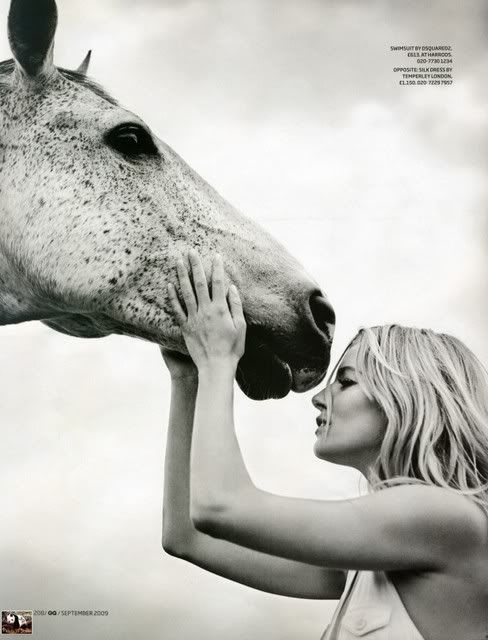
horse and woman

GQ Magazine UK, 15 February 2010, Sienna Miller: Out in the Open, Photo by Simon Emmett

 tree tunnel

Imgur.com, 2012, Gallery, 1000 Year Old Yew Trees in West Wales


I call it the Central Park incident. The only thing I remember of my life before then is my name, Anna Maria Bonite, and a majestic white speckled horse that felt like he was a part of who I am, and trees so gnarly, black, bloodied, and twisted, they give me nightmares. My driver’s license, which the police found in my pocket, said I was twenty-four at the time, and that I lived in New York City.

           It isn’t that I don’t try to remember my life before then, it’s that I can’t. Every time I try to open up that part of my memory, it’s as if I’m drowning in a sea of emotional pain so thick, it gives me the cold sweats and shakes bad enough that the symptoms hold me immobilized in bed for days.

It has taken me a long time to control the blank pockets of time locking that part of my consciousness away even though I desperately want to know what happened before stepping into the park. What made all those memories disappear? The one and only time I entered Central Park, there was a flash of memory that brought the insidious image of the trees to life. The memory was evidently so painful my brain decided to fritz out, protecting my psyche. It felt like my head split wide-open as sharp daggers sank into my skin, then only darkness. When I woke up, it was in a bed, a week later, at Mount Sinai Hospital. The doctors told me they could find nothing wrong with me physically, but whoever I was before that day was a dark, blank canvas. I was a functional, healthy person, able to do normal things. I was perfectly educated, but with no personal identity, no memories of going to school, of friends, of where I grew up; nothing.

Lately, things have been slipping pass my hard built walls, the walls in my psyche made of layers of steel and barbed wire. I can no longer keep my fear at bay while working and I have to fight the mounting panic. If it wasn’t for the blaring horns, the racing taxis that zig and zag through traffic, pedestrians at all hours, the sounds of people jabbering on phones, friends talking at the sidewalk cafes, the construction machines moving steel and concrete through the air as I walk the paved streets of my city, I would have gone mad years ago. It’s when I’m near a living landscape surrounded by trees that my memories deliver the sharp pain.

Six years have gone by since the Central Park incident, since all the smaller attacks in between.

Because of my “condition”, I’m not able to hold down a job for very long. Employers don’t take too kindly to me being absent more than a couple days a month. Well, okay, more than a couple days a month. Looking back on that morning getting fired never got any easier.

***

“I’m sorry, Anna Maria. I’m gonna have to let you go,” my latest boss mumbled while looking at his scuffed shoes. He felt bad, she knew. They always did.

I heard his words and I felt the weight of them on my shoulders. Was I surprised? No. That’s why that morning I decided for a change of scenery. The words still hurt though.

That morning, when the sun leaked into my tiny Manhattan apartment, I crawled out from under my favorite white satin sheets and down comforter–my only luxury– and made my first cup of coffee. Wandering over to the map, tacked to the wall, the fifty states stood out in a pastel array of colors. Lifting my mug, I blew out a breath, watched the steam float away, and took a sip, hoping my first delicious swallow of Columbian goodness would help me decipher my troubled thoughts.

“Where should I go?”

***

I didn’t want to leave New York, but I was feeling a pull in my gut toward something, I just didn’t know what. My eyes kept drifting toward the west coast but eventually they moved over the map’s mitten state. I felt it in my stomach, a small flutter getting wilder and wilder every time my eyes landed on Michigan.

A shiver raced up spine and out my fingertips. There were too many trees in Michigan. Why was my brain telling me to go there?

Maybe if I moved to a larger metropolis, I would be okay.

Moving closer to the map, scanning the bigger cities, my eyes landed on Detroit. It was no Manhattan, but I could make it work. I just had to forgo all the great parks that the state touted.

Another sip of coffee and I made my decision. I was moving to Michigan.

Would the change in location give me answers? I didn’t know. Whatever the pull was, I had never felt it before, so my gut was my compass and I was following it.

It wasn’t quite a thousand words but it was a worthwhile exercise. Because my thoughts are on the series I’m working on, the characters are always present in my mind, be it consciously or unconsciously. While writing, the Anna Maria Bonite character popped into my head and it created a new direction for her character. Right now in my story, the reader will presume she is dead. Therefore, even though I am stuck on the manuscript I’m working on now, something good happened trying to get myself unstuck.

Inking Out First Impressions

No doubt, you already know how to add adjectives and adverbs to Mr. & Mrs. Fashion Forward’s outward appearance, so I will hold off on the physical aspects of first impressions – height, weight, color of eyes, etc. – until the end of this blog. And I am not going to discuss what it takes for your book to make a good first impression on the shelf – cover artwork, font size, colors and the blurb on the back. That is a separate topic unto itself. This blog is about how to utilize three of storytelling’s four fundamental pillars to build the strongest, most vivid first impressions for characters and scenes, on the page:

  • Where is this story taking place? (geographical and social settings)
  • When is this story taking place? (historically, seasonally)
  • Who is it about? (age and wisdom, but not physical appearance)

It is these three spiraling timelines – where, when and who – that I use to create memorable first impressions.

The other pillar – What is happening? – is plot line, which I discussed in July.

Where. Your story’s setting should have a “connection to place” if you want to make a good first impression. Get to know your scenery up close and personal. Visit. If you can’t go, then find that location in Google Maps, click “street view” and see what it looks like. Search “local events” to get a flavor for the eats, beats and treats around the area, and then pick out a feature or landmark that can help cement your story. Scenery is usually set during your book’s slower moments, away from the action, but don’t go crazy here; it’s only minutiae. One or two quick, accurate, local details will do.

Where also indicates social position. Who are your characters’ circle of friends? What are their family and workplace situations like? How do your characters behave in their community? Not that authors needs to tell all of this stuff to make a good story, but they do need to know all of it in order to develop their characters – in character. It is the action of your characters within their social, home and work settings that shows where their motivation lies.

Case in point. In my upcoming novel, Knock Softly (working title), the protagonist, Edvard Bergman, at the age of seven, loses both of his parents in a house fire. That event dictates how he manages his business and his family in the story. There is no prelude. Readers do not know the backstory when Knock Softly opens, 38 years after the fire. First, the reader sees that Edvard has built a fire station on his research campus because the nearest fire department is 12 miles away. At home, Edvard has installed sprinklers in the kitchen and garage ceilings, as well as above the fireplace, a fireplace that’s never been lit. Readers learn that Ed will not allow his children to sleep with locked doors, and that all second story bedrooms have rope ladders. Ed’s demeanor is played out in actions and reactions long before readers learn why he is pyrophobic.

When. In order to write realistic fiction, the author must be in touch with the era in which the story takes place. That is why contemporary suspense is so popular. It’s the easiest for the author to imitate, and it’s the easiest for the reader to follow. Before you write the scene, think about what was really going on at that point in time. Read the local newspaper for around the time of your story and see what everyone was talking about. You just might discover something newsworthy that will help place your story to that time in that town, city or park. Incorporating history and a few seasonal aspects into your background will lend authenticity to your story and make it seem more real.

Watch out for seasonal changes in longer stories, they can cause slipups that are hard to spot by the author. I needed to cut the line “…acorns crunched under his step…” from one scene in Knock Softly because that scene takes place in July. I first wrote it in the fall of last year. At the time, I was attempting to incorporate a soft sound into a quiet walk in the park. It was just minutiae, but I never caught the error until last July, when I was walking my dogs in the park and could not find a single acorn to crunch under foot… Oops!

Who. Very young kids, up to about the age of seven, will believe anything their parents, teachers, guardians and older siblings tell them. That’s why they make lousy protagonists in suspense. On the page, just have very young characters do what their elders tell them and you’ll be fine. But after about age seven, appropriate behavior for kids is the toughest feature of all to nail down. Especially through puberty – when shoe sizes and career goals change overnight.

Be careful what your characters say with older kids on the page – they absorb everything. Gossip, and how children interpret what they overhear, will grab a kid’s attention in a way that telling them directly cannot. It’s, I learned verses you told me, to their young minds. The older we get, the less we trust hearsay and gossip, but to kids it’s golden nectar.

You can use these three factoids to make great suspense between young and old:

  • Kids and young adults are constantly looking outward to see what else is available. Adults are ego-focused by their mid-thirties.
  • You can’t teach a know-it-all and teenagers already know everything, so they say and do the first thing they think of. A rational adult will take whatever time necessary to make the right decision.
  • When confronted with unknown situations, kids become flustered and everything speeds up for them. Adults become keenly aware in unfamiliar situations, and everything slows down.

These transitions do not begin until we gain more confidence in our decisions–twenty-something for most people.

As you start to draw your older characters, imagine you are meeting them for the first time, just like your readers really are. Your character’s life doesn’t begin at this point. You and your readers are effectively dropping in on them. Yet, even though the reader knows very little about the character’s past, there is much they will assume until you tell them otherwise. I have found these assumptions are true with most adults:

  • Day by day, our ambitions spiral us onward and upward to bigger and better.
  • But in reality, our life becomes focused through a narrower and narrower lens as we gray.
  • The older we get, the more we want, but the less we are willing to accept.

Some glues harden quicker than others, but most people set their course in life by thirty-something. That’s not to say life can’t come unglued. Read: midlife crisis. There are tons of suspense and mystery novels built around this time in a character’s life and it is fun, fun stuff to write. Just keep in mind that by midlife most mortal characters know what sorts of things they’re good at, what kinds of people they like to be around and what entertains them. And they go for more, not less, in life’s next chapter.

Exceptions, of course, always make for better stories. Exceptions to the norm that give depth to the storyline can build lasting first impressions, but if the “exception” does not move your story forward, the words are just bulk. That’s true for scenes and character traits.

As for the physical aspects of character, let me ask you: what color were Dracula’s eyes? On which cheek was Capone’s scar? In the Sherlock Holmes series, on which leg did Doctor Watson received his old war wound? Once your characters are fleshed out, you can color their eyes, skin and hair and dress them as you like; it won’t matter. Fangs, scars, limps and the like all make for great imagery, but it is the personality to which these images are attached that readers will remember first and foremost.


Next Month: Not sure yet. Any suggestions? Contact me via the comments section below.

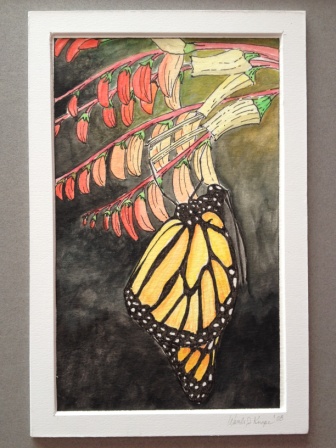
The Monarch

Knape, Wendi. Monarch Butterfly, 2008. Ink and watercolor on paper.

Knape, Wendi. Monarch Butterfly, 2008.
Ink and watercolor on paper.

In my last blog Clarity I talked about how much my work has improved since I started writing. What you don’t know is the inspiration that started my writing journey was a monarch butterfly.

Laid off from an at-will company (the company didn’t have to tell me why they let me go) in 2003, I felt lost. My mind spit out all sorts of detritus about why I was let go, bogging me down in a depression that had its claws deep. I was unsure of my talent in my chosen field, which was architectural design. I didn’t know how I should move forward with my career, though I knew that I needed to do something that I would enjoy. At the time I decided to focus more on my family; it just wasn’t going to be enough. The stay-at-home-mom label wasn’t for me. There’s nothing wrong with the designation. Parenting is hard work, and raising my children so they become good adults is important to me, I just wanted something more, so I let my thoughts percolate.

Drawing and painting is a passion of mine, but having the time to do it was hard with a full time job so, I always put it off for another day. Reading is another joy that helped me through some awful days too. Getting lost in worlds that other people create was something that helped pull me out of my mental fog. Eventually, the idea of taking my talent in art and my love of reading got me thinking about pushing my career in a new direction. I asked myself, was it viable? The problem was I didn’t know what it was. Did I have what it would take to make something out of my love of art and reading? Could I help support my family by drawing or painting? How could I take the joy of reading and make it into something worthwhile? I didn’t know, so the thoughts kept going round and round, making me undecided on what street to walk down.

My mind was in a continual loop of worry, as I drove to the store, when a monarch butterfly flew past my windshield. The first thing that popped into my head was, I should paint that. The second thing was what if I wrote a story about the monarch. Could I write as well as the authors I read? I was reading children’s books at the time, my two girls ages were five and three, and those books were illustrated. Could I write and illustrate a book?

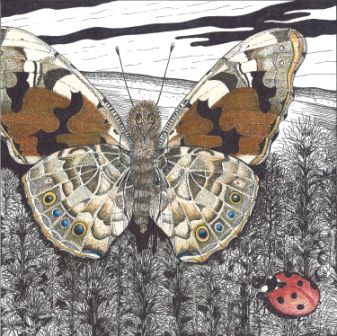
That was my ‘aha’ moment. I felt lighter than I had in a long time and got excited about what it could mean for my family and me. Seeing the butterfly wasn’t the only factor, but a primary one, allowing me to throw away thoughts circling in my head that weren’t doing any good. I started illustrating and writing my first picture book, Becoming Lucy, a story about a painted lady caterpillar being bullied because she had yet to go through her metamorphosis.

Knape, Wendi. Painted Lady w/ Ladybug, 2008. Ink and colored pencil on paper.

Knape, Wendi. Painted Lady w/ Ladybug, 2008.
Ink and colored pencil on paper.

You’re probably wondering how I went from writing and illustrating children’s picture books to writing paranormal romance novels. It was a gradual shift, moving from the picture book to middle grade stories, to young adult and finally to adult stories. It was a better headspace for me. Some people would tell you children’s genres are easy to write, but they are not. Getting into the mindset of a child, pre-teen or teen is difficult. I was too serious as a kid and I couldn’t remember how to be a kid and wasn’t able to capture the essence of one. Therefore, I shifted my thinking and tried my hand at something I love to read, romance, eventually paranormal romance.

Already in the Deadwood Writers Group, with their support and encouragement the other writers told me I should try my hand at the romance genre. The change was nerve racking, but I gave it a go and wrote my first sex scene, jumping head first into the deep end of the pool. It felt weird and exhilarating all at the same time, I even laughed aloud because I couldn’t believe I was writing one. It was like a river racing toward a waterfall. Ideas started pouring from my mind into a large pool, it harboring ideas for later. It was fun and I haven’t stopped since. I’m comfortable here. It’s not an easy business to break into but I keep my hope close to my chest that one day it will pay off. I still draw and paint, but writing is my inspiration, and I’m very satisfied.

Happy writing!