Category Archives: Writers

Inking Out First Impressions

No doubt, you already know how to add adjectives and adverbs to Mr. & Mrs. Fashion Forward’s outward appearance, so I will hold off on the physical aspects of first impressions – height, weight, color of eyes, etc. – until the end of this blog. And I am not going to discuss what it takes for your book to make a good first impression on the shelf – cover artwork, font size, colors and the blurb on the back. That is a separate topic unto itself. This blog is about how to utilize three of storytelling’s four fundamental pillars to build the strongest, most vivid first impressions for characters and scenes, on the page:

  • Where is this story taking place? (geographical and social settings)
  • When is this story taking place? (historically, seasonally)
  • Who is it about? (age and wisdom, but not physical appearance)

It is these three spiraling timelines – where, when and who – that I use to create memorable first impressions.

The other pillar – What is happening? – is plot line, which I discussed in July.

Where. Your story’s setting should have a “connection to place” if you want to make a good first impression. Get to know your scenery up close and personal. Visit. If you can’t go, then find that location in Google Maps, click “street view” and see what it looks like. Search “local events” to get a flavor for the eats, beats and treats around the area, and then pick out a feature or landmark that can help cement your story. Scenery is usually set during your book’s slower moments, away from the action, but don’t go crazy here; it’s only minutiae. One or two quick, accurate, local details will do.

Where also indicates social position. Who are your characters’ circle of friends? What are their family and workplace situations like? How do your characters behave in their community? Not that authors needs to tell all of this stuff to make a good story, but they do need to know all of it in order to develop their characters – in character. It is the action of your characters within their social, home and work settings that shows where their motivation lies.

Case in point. In my upcoming novel, Knock Softly (working title), the protagonist, Edvard Bergman, at the age of seven, loses both of his parents in a house fire. That event dictates how he manages his business and his family in the story. There is no prelude. Readers do not know the backstory when Knock Softly opens, 38 years after the fire. First, the reader sees that Edvard has built a fire station on his research campus because the nearest fire department is 12 miles away. At home, Edvard has installed sprinklers in the kitchen and garage ceilings, as well as above the fireplace, a fireplace that’s never been lit. Readers learn that Ed will not allow his children to sleep with locked doors, and that all second story bedrooms have rope ladders. Ed’s demeanor is played out in actions and reactions long before readers learn why he is pyrophobic.

When. In order to write realistic fiction, the author must be in touch with the era in which the story takes place. That is why contemporary suspense is so popular. It’s the easiest for the author to imitate, and it’s the easiest for the reader to follow. Before you write the scene, think about what was really going on at that point in time. Read the local newspaper for around the time of your story and see what everyone was talking about. You just might discover something newsworthy that will help place your story to that time in that town, city or park. Incorporating history and a few seasonal aspects into your background will lend authenticity to your story and make it seem more real.

Watch out for seasonal changes in longer stories, they can cause slipups that are hard to spot by the author. I needed to cut the line “…acorns crunched under his step…” from one scene in Knock Softly because that scene takes place in July. I first wrote it in the fall of last year. At the time, I was attempting to incorporate a soft sound into a quiet walk in the park. It was just minutiae, but I never caught the error until last July, when I was walking my dogs in the park and could not find a single acorn to crunch under foot… Oops!

Who. Very young kids, up to about the age of seven, will believe anything their parents, teachers, guardians and older siblings tell them. That’s why they make lousy protagonists in suspense. On the page, just have very young characters do what their elders tell them and you’ll be fine. But after about age seven, appropriate behavior for kids is the toughest feature of all to nail down. Especially through puberty – when shoe sizes and career goals change overnight.

Be careful what your characters say with older kids on the page – they absorb everything. Gossip, and how children interpret what they overhear, will grab a kid’s attention in a way that telling them directly cannot. It’s, I learned verses you told me, to their young minds. The older we get, the less we trust hearsay and gossip, but to kids it’s golden nectar.

You can use these three factoids to make great suspense between young and old:

  • Kids and young adults are constantly looking outward to see what else is available. Adults are ego-focused by their mid-thirties.
  • You can’t teach a know-it-all and teenagers already know everything, so they say and do the first thing they think of. A rational adult will take whatever time necessary to make the right decision.
  • When confronted with unknown situations, kids become flustered and everything speeds up for them. Adults become keenly aware in unfamiliar situations, and everything slows down.

These transitions do not begin until we gain more confidence in our decisions–twenty-something for most people.

As you start to draw your older characters, imagine you are meeting them for the first time, just like your readers really are. Your character’s life doesn’t begin at this point. You and your readers are effectively dropping in on them. Yet, even though the reader knows very little about the character’s past, there is much they will assume until you tell them otherwise. I have found these assumptions are true with most adults:

  • Day by day, our ambitions spiral us onward and upward to bigger and better.
  • But in reality, our life becomes focused through a narrower and narrower lens as we gray.
  • The older we get, the more we want, but the less we are willing to accept.

Some glues harden quicker than others, but most people set their course in life by thirty-something. That’s not to say life can’t come unglued. Read: midlife crisis. There are tons of suspense and mystery novels built around this time in a character’s life and it is fun, fun stuff to write. Just keep in mind that by midlife most mortal characters know what sorts of things they’re good at, what kinds of people they like to be around and what entertains them. And they go for more, not less, in life’s next chapter.

Exceptions, of course, always make for better stories. Exceptions to the norm that give depth to the storyline can build lasting first impressions, but if the “exception” does not move your story forward, the words are just bulk. That’s true for scenes and character traits.

As for the physical aspects of character, let me ask you: what color were Dracula’s eyes? On which cheek was Capone’s scar? In the Sherlock Holmes series, on which leg did Doctor Watson received his old war wound? Once your characters are fleshed out, you can color their eyes, skin and hair and dress them as you like; it won’t matter. Fangs, scars, limps and the like all make for great imagery, but it is the personality to which these images are attached that readers will remember first and foremost.


Next Month: Not sure yet. Any suggestions? Contact me via the comments section below.
Write What You Know

When I first started writing for Deadwood Writers’ Voices a few months ago, I agonized over what I was going to write about. Then I went to California. There I read some letters that members of my family, who I’d heard about but never met, had written long ago. The letters brought them to life. I could hear my relatives speaking in their own words. I felt that we’d finally met.

I started writing their stories. That was very helpful, besides being enjoyable. I didn’t have to ask myself each month, what am I going to write about? I knew. I was going to write the next part of the story.

Now the series is finished. I need to find something new to write about. This morning I decided to try a different approach. Instead of panicking, I was going to do what all the books said: Write what you know. To be honest, I didn’t have much faith in this approach, but what did I have to lose?

I decided to go swimming. It’s my favorite form of exercise: 45 minutes in the warm water pool going back and forth. I feel so good afterwards, relaxed, happy, stress free. The icing on the cake is I’ve actually lost a few pounds along the way.

It was a perfect day. The sun was shining. It was still cool outside. I felt energized.

I threw my swim bag in the front seat, popped into my car and started driving. It’s eight minutes from my garage to a parking spot at the WCC Health Club.

I drove out of the condo and turned left to go down Dixboro Road. Wow! All I could see on my side of the street was a line of red taillights and not one of them was moving. Ugh! It was five minutes to nine.

The first intersection was exactly one mile south on Geddes. It handles all the cars of people going to work coming down Dixboro and those exiting from I-23 to go down East Huron River Drive to get to Washtenaw Community College, St. Joseph Mercy Hospital and, most important to me, the Health Club.

It’s always busy this time of day but never like this: One mile of taillights and no one moved. This was a first! Then I remembered last night’s storm. The stoplight at the corner was probably out. And, knowing the Ann Arbor police, they probably hadn’t sent anyone to direct traffic. Their philosophy is, “Let them work it out.”

In the distance, I could see the headlights of three cars coming toward me. Suddenly the two cars in front of me made very fast U-turns and went up Woodridge Avenue to my right.

Mmmmm. If I’m quick, I could do the same thing. That would take me to Earhart, which would bring me to Plymouth Road where I could get on #I-23 and go south around this mess to Washtenaw Avenue. Then I could turn up Golfside and, voilà, I’d be there. In other words I could make a circle going west around the whole area, come in from the east side and have my swim after all. It shouldn’t take more than about ten minutes.

Congratulating myself on my quick thinking, I turned onto Plymouth Road and drove across the top of I-23 so I could get on the ramp going south.

“Ugh!” was all I could say. Looking down at the southbound lanes I wanted to cry. No one was moving there either. It was just one long parking lot.

O.K. now it’s time for another brilliant idea and this one better work. I could go south on Green Road, then west a little to Huron River Parkway. I could still make the western circle and I’d be down on Washtenaw, which hopefully would be moving.

Then I looked up. Straight ahead, Plymouth Road was stopped. The light was red. The intersection was clogged. No one was going in any direction and it didn’t look like anyone would be anytime soon.

Suddenly, although the sun was still shinning and the air was crisp, it wasn’t such a beautiful day anymore.

Luckily I was able to maneuver myself into the left lane and turn into the strip mall. I drove past Zamaaman’s, the Korean Restaurant, and turned left past Busch’s. Now I could skip the sea of cars at the light and exit onto Green Road.

Heading south on Green Road, I started to smile again: no traffic. The same was true on Huron Parkway. I just floated along and made a left onto Washtenaw and even that wasn’t too bad.

Best of all, every light was working all the way east to Golfside. I turned left at East Huron River Drive, drove past St. Joe’s and into the WCC Health Club’s parking lot at exactly 9:33. Not bad, only 38 minutes to drive what should have taken eight!

Crowdfunding Your Writer Dreams

Did you know people would donate money to help publish your book?

I’m not talking about a publishing house advance. I’m talking about regular people like the grocery store clerk, other writers and your favorite coffee shop barista.  These people believe in you and your project.  How is this possible, you ask?  It’s because of crowdfunding.

Crowdfunding is “the practice of funding a project or venture by raising monetary contributions from a large number of people, typically via the Internet.” These sites allow artists and inventors to connect with supportive people who are willing to invest in something they believe in a product as much as you do. The methodology is similar to the phone fundraising campaigns by public television stations: People give you money to work on your project. You give them stuff in return as thanks.  That’s it.

Weird, right? Why would strangers believe in your work so much that they want you to succeed?  That they want to read your book and help you get that published?  I mean, it’s one thing to ask a friend “Can I borrow $20?” only these people aren’t necessarily intimate in your life.  Since I cannot draw from my 401K, cash in my vast inheritance or withdraw from my millions in lottery winnings, I am exploring this option to get funds to hire an editor and cover artist.

After discussing experiences with others who have used various crowdfunding sites,

I chose Indiegogo for my experiment. Kickstarter was my initial choice because I had explored the site previously, but you only receive the funds if your project is completely funded.  If you ask for $600 but only get $597 in pledges, all the money refunds to the backers.  Indiegogo gives you the option to set up your account to keep whatever money you’ve raised minus a percentage.  To me, something is better than nothing is, so that sold me.  I also found more book projects on that site than on others to use as examples.

HOW TO GET STARTED

To begin a campaign, you have to do some initial research about costs and timing. How much does an editor, developer, or production house charge for their services?  What company offers the best quality of materials?  What is the turnaround time?  Once you have that information, you’ll need to backtrack to determine an end and start date.  Crowdfunding sites offer different lengths for your campaign, much like running an eBay auction.  You have to set up your account, fill in project ideas, possibly make a video…and all of this takes time, so backtrack even further.  Time management is important here.

WHAT WILL I OFFER?

Since I’m writing a memoir, I am looking for personal things. I can’t name a character after a backer–although if I was writing a fiction novel, I’d offer that perk–but I can offer other things like  photos of me and Dad, special unpublished stories, autographed limited print editions, or even an actual letter from Dad to me.

HOW DO I FIND THESE PEOPLE?

How will I find these helpful, adventurous folks to contribute to my dream? Aside from my email list of friends and relatives, I plan to promote it on my various social media.  This is where my “author’s platform” comes into play.  I have a network of people who like my tweets, who read my blog, follow my boards on Pinterest, enjoy my Instagram writing photos, connect with me on LinkedIn and are Facebook friends.  It’s a start.

CONCLUSION

Setting a deadline is good for motivation. Proclaiming it to the world, holding myself accountable to others is a good thing.  My book is publishing on November 20, 2014, which was my Dad’s birthday, and that’s a very good thing.  I have a lot to do in the next 61 days.  If you want to follow my progress, check out my memoir campaign [coming soon].  I’ll continue to share my experiences here and on my personal blog, Wolf Howlings.  I hope you’ll learn something along with me.  It’s a bold new world out there, and you have to be bold.  Just like Dad, I am bold.

Singing a Motown Story

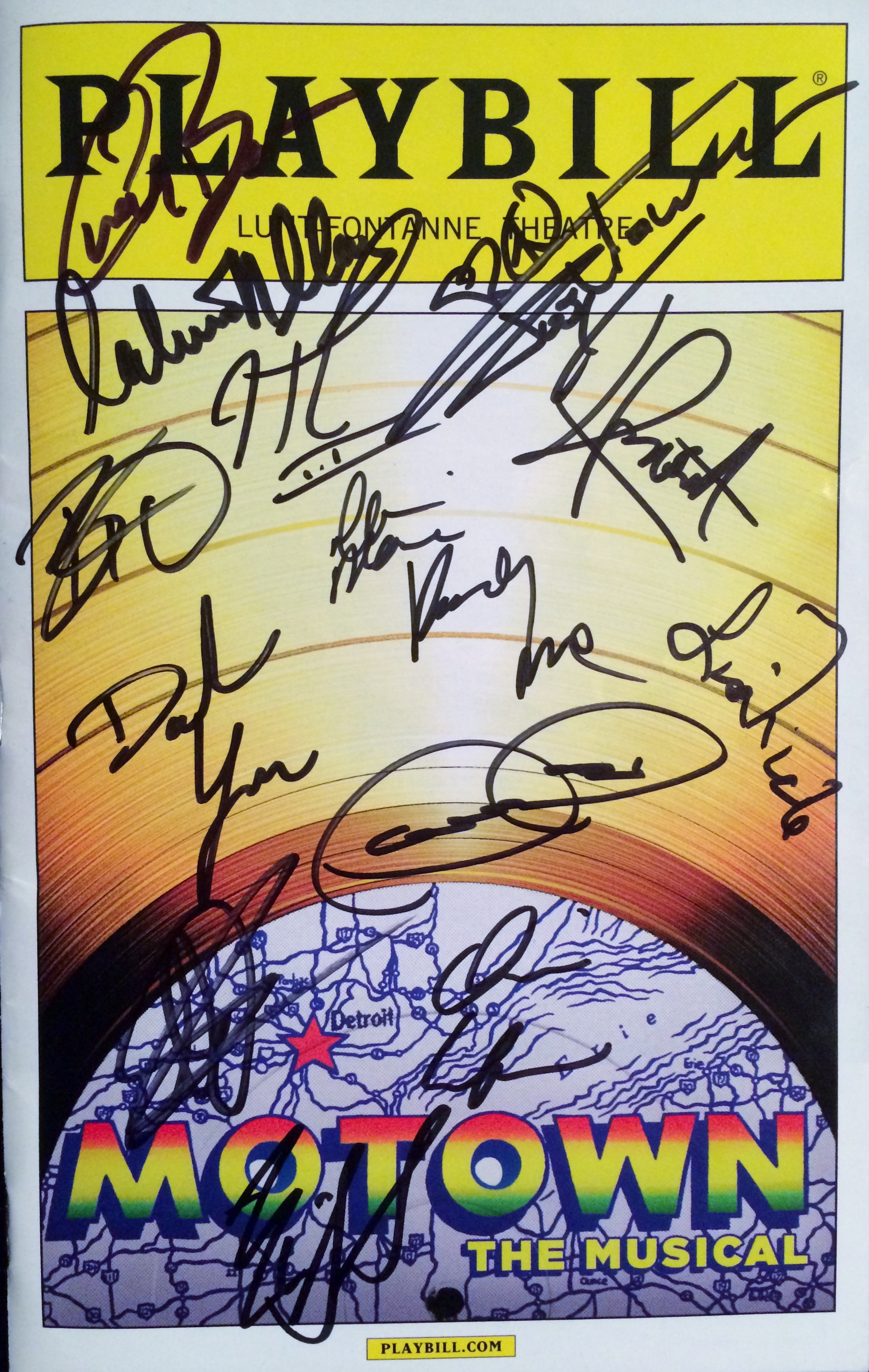
Motown playbill“A song is like a short story with a beginning, middle and end,”[1] instructs Berry Gordy. He’s speaking to his friend, Smokey Robinson, who hasn’t written a timely ending to a song. It’s early in both their careers, and the insightful Gordy shows Robinson a way to improve his songwriting skills. In this case, it’s by truncating Robinson’s lyrics once they’ve become redundant and are no longer adding value. (Sound familiar to any writers out there?) That one line from Motown the Musical resonated for me. I had to agree that songs do tell concise stories. The musical was loaded with about sixty of them. Each one was skillfully placed so that by the end of the main story, the giant Motown story, audience members were left wondering if the sensational songs were indeed inspired by the experiences of the rising stars who sang their way into history.

The Broadway production was based upon Gordy’s book, To Be Loved: The Music, the Magic, the Memories of Motown, which was first published in 1994. Subsequently, an electronic version was released in 2013, most likely to coincide with the debut of the musical. Think: strategic marketing. It worked on me. Having enjoyed the play, I was enticed to download his e-book. In the not-to-be overlooked preface, Gordy explained why he penned his life’s story. He wanted to preserve his perspective and offer to readers the truth, as he experienced it, surrounding the entity he had created. He wrote, “…misconceptions about me and Motown became so great I finally had to deal with them.”[2]

Similarly, the musical story presents Gordy’s point of view to theater patrons. During the second scene, we learn of his upbringing in Detroit. A young Gordy and his family gather near a radio in their home and cheer on Joe Louis as he defeats German heavyweight champion, Max Schmeling, in a one round, knockout fight. The triumph is a source of pride for many people throughout the United States and impresses upon Gordy “a burning desire to be special, to win, to be somebody.”[3] The following scenes depict how Gordy achieves those things over a span of thirty years. Having written the script, he takes viewers through the rise and fall of his record label, unveils once-private moments, and sends a consistent message of the uniting force of love. Through civil riots, hate crimes, injustice and prejudice, Motown music spreads love and destroys boundaries between blacks and whites.

Although some serious subject matter permeates the show, the action moves so quickly there isn’t time to dwell on somber moments. Through Broadway magic and over 350 costumes,[4] the cast transforms into the characters they represent. All the favorites: Diana Ross and the Supremes, Smokey Robinson and the Miracles, Marvin Gaye, Stevie Wonder, Michael Jackson and the Jackson 5, The Four Tops, The Temptations, The Commodores, Martha Reeves and the Vandellas, Gladys Knight and the Pips, The Marvelettes, and more.

At some point, I stopped comparing the actors to the originals. Their singing, dancing, and portrayals made the show entertaining and fun, engaging, and convincing. The most conflicting thought I had while sitting in the audience was whether or not it would be rude to sing along. (Well, there was also the immediate development of my cougar-crush for Eric LaJuan Summers when he came onstage as Rick James. Until then, I hadn’t fully appreciated how hard he works…out.)

Still sharing his talents with the world, Mr. Gordy turns 85 years old on November 28th and doesn’t seem to be done telling stories just yet. He continues to invent ways of keeping our beloved Motown Sound alive and, in so doing, serves as inspiration to us writers. Motown the Musical complements his legacy and earns its own place in history.

Congratulations to everyone involved in the production, including Detroit’s own Jawan M. Jackson. Well done.

Detroiters, Motown is coming to the Fisher Theatre October 21-November 16. Hope to see you there, singing and dancing in the seats.

[1] Motown the Musical. By Berry Gordy. Dir. Charles Randolph-Wright. Perf. Josh Tower. Lunt-Fontanne Theatre, New York City. 10 Aug. 2014.

[2] Gordy, Berry. To Be Loved: The Music, the Magic, the Memories of Motown. (1994; New York: RosettaBooks LLC, Electronic Edition for iPad 2013) 20.

[3] Ibid., 41.

[4] Backstage at Motown: the Musical with Marva Hicks! (Video file). Retrieved from

http://www.youtube.com/watch?v=cTUx5tPmX18#t=76.

The Monarch

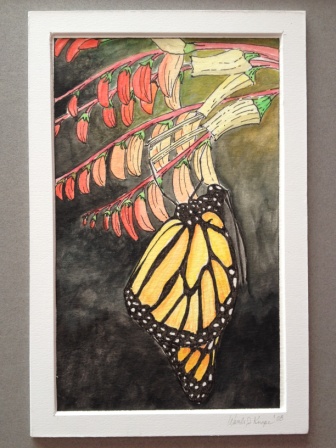
Knape, Wendi. Monarch Butterfly, 2008. Ink and watercolor on paper.

Knape, Wendi. Monarch Butterfly, 2008.
Ink and watercolor on paper.

In my last blog Clarity I talked about how much my work has improved since I started writing. What you don’t know is the inspiration that started my writing journey was a monarch butterfly.

Laid off from an at-will company (the company didn’t have to tell me why they let me go) in 2003, I felt lost. My mind spit out all sorts of detritus about why I was let go, bogging me down in a depression that had its claws deep. I was unsure of my talent in my chosen field, which was architectural design. I didn’t know how I should move forward with my career, though I knew that I needed to do something that I would enjoy. At the time I decided to focus more on my family; it just wasn’t going to be enough. The stay-at-home-mom label wasn’t for me. There’s nothing wrong with the designation. Parenting is hard work, and raising my children so they become good adults is important to me, I just wanted something more, so I let my thoughts percolate.

Drawing and painting is a passion of mine, but having the time to do it was hard with a full time job so, I always put it off for another day. Reading is another joy that helped me through some awful days too. Getting lost in worlds that other people create was something that helped pull me out of my mental fog. Eventually, the idea of taking my talent in art and my love of reading got me thinking about pushing my career in a new direction. I asked myself, was it viable? The problem was I didn’t know what it was. Did I have what it would take to make something out of my love of art and reading? Could I help support my family by drawing or painting? How could I take the joy of reading and make it into something worthwhile? I didn’t know, so the thoughts kept going round and round, making me undecided on what street to walk down.

My mind was in a continual loop of worry, as I drove to the store, when a monarch butterfly flew past my windshield. The first thing that popped into my head was, I should paint that. The second thing was what if I wrote a story about the monarch. Could I write as well as the authors I read? I was reading children’s books at the time, my two girls ages were five and three, and those books were illustrated. Could I write and illustrate a book?

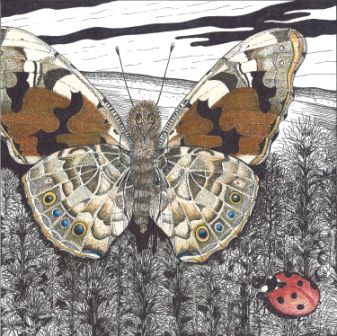
That was my ‘aha’ moment. I felt lighter than I had in a long time and got excited about what it could mean for my family and me. Seeing the butterfly wasn’t the only factor, but a primary one, allowing me to throw away thoughts circling in my head that weren’t doing any good. I started illustrating and writing my first picture book, Becoming Lucy, a story about a painted lady caterpillar being bullied because she had yet to go through her metamorphosis.

Knape, Wendi. Painted Lady w/ Ladybug, 2008. Ink and colored pencil on paper.

Knape, Wendi. Painted Lady w/ Ladybug, 2008.
Ink and colored pencil on paper.

You’re probably wondering how I went from writing and illustrating children’s picture books to writing paranormal romance novels. It was a gradual shift, moving from the picture book to middle grade stories, to young adult and finally to adult stories. It was a better headspace for me. Some people would tell you children’s genres are easy to write, but they are not. Getting into the mindset of a child, pre-teen or teen is difficult. I was too serious as a kid and I couldn’t remember how to be a kid and wasn’t able to capture the essence of one. Therefore, I shifted my thinking and tried my hand at something I love to read, romance, eventually paranormal romance.

Already in the Deadwood Writers Group, with their support and encouragement the other writers told me I should try my hand at the romance genre. The change was nerve racking, but I gave it a go and wrote my first sex scene, jumping head first into the deep end of the pool. It felt weird and exhilarating all at the same time, I even laughed aloud because I couldn’t believe I was writing one. It was like a river racing toward a waterfall. Ideas started pouring from my mind into a large pool, it harboring ideas for later. It was fun and I haven’t stopped since. I’m comfortable here. It’s not an easy business to break into but I keep my hope close to my chest that one day it will pay off. I still draw and paint, but writing is my inspiration, and I’m very satisfied.

Happy writing!