Artful view of Book Inc.

The Bookstore Ethnographer by John McCarthy

Every bookstore has character. That’s what engages or deters customers from frequent visitation. Some are polished formal affairs that feel like a museum or perhaps an art gallery—look but don’t touch. While others may be rustic family affairs where the shopkeepers are boisterous, compelling visitors to engage them in the news of the day or talk about favorite books and authors. Then there are the places where the shopkeeper responds with grunts to give clear directions of book availability and to make change. Along with the people, the books and store structure add to that character.

I’m John McCarthy, and I’m a Bookstore Ethnographer. I travel to many places for my work of Education Consulting. During my “free” time, I love to visit bookstores, where other travelers might find the local pub, golf course, restaurant, or beach. These posts are not intended as reviews. I am a social activist who speaks on behalf of the books. My intention is to capture the character of each store, which is shaped by the selection and care of books by the shopkeepers and the store structure. Follow my Pinterest board for pictures of the stores I visit and follow me on Twitter  for more about my work in Education, Bookstore Ethnography, and other articles. Share your bookstores by comment below or a tweet to @jmccarthyeds. If I’m in the area, I will very likely visit.

Artful view of Books, Inc., 1760 4th St, Berkeley, CA 94710

2014-06-21 15.18.42 HDR

A block from the bookstore is an Apple Store, where I stopped to get help with my laptop. The area is filled with shopping and restaurants in what appears to be an affluent neighborhood. Parking close by offers 2 hours of free parking, where I was lucky to find someone just leaving a spot.

The front of Book Inc. reminded me of an art gallery store front with large windows and stone stairs up to a common porch with other stores. Inside, the single room is deep, well lit, and showcases a pristine set up of bookshelves and open lanes to any section of the store. Every genre is represented with new books in tightly fitted shelving. The selection for each genre is modest, which may be due to the size of the store. You can find anything that’s current, with little from past decades except for classics.

2014-06-21 15.04.45

Like some bookstores, there are staff recommendation cards posted by books or author series that share why customers might take a chance on such a purchase. What I found unique to my travels were the reviews posted by customers. The store keeps a basket of index cards, and encourages customers to write their own book reviews. There was one by a high school student whose review was for a YA novel. It makes good business sense to invite these comments, like we find on Amazon and other places. I wonder why I have not seen this great strategy in other bookstores?

2014-06-21 15.05.04

Several employees talked to each other about book related stuff, looking busy as they went about their responsibilities. I walked up and down the store several times without being approached for offered assistance. Maybe I looked like I was zeroed into the books, which would be better than the alternatives. The conversations was business, like you would find at many non-bookstores. Perhaps this is because of the touristy nature of the area? Hard to say from a 25 minute visit. The time was well spent in an artful-looking bookstore.

Stanley and Lucy

Spring is the time that the Canadian geese are visiting in the Metro West Industrial Park in Plymouth, Michigan. Since Chrysan has the biggest front lawn on Keel Street in the industrial park, naturally we have more geese as guests who were looking for worms on the lawn. Occasionally I had to make a sudden stop when a flock of geese were crossing from one lawn to another with little goslings. With a “honk, honk” they crossed the busy street without any rush, just waddling.

A lonely goose waddling on the lawn is very rare. They are always in flocks, or at least in a pair, but once I saw one goose alone on the front lawn. Mmm, that cannot happen … just one goose. Talking to myself, I looked around the south end of the building. Following the pair rule, the male goose was heading to the north with the “honk, honk”, thereby telling her he was coming.

“Kwang, geese never travel alone. They are always in groups or at least in pairs.” He was silent without any comment on my observation. He was digesting why I brought up this unusual subject and also calculating what I wanted from him this time. “So, let’s go everywhere together like geese,” I continued without looking at his face. He was still silent with his face down over the Detroit News. I assumed that his ears were filtering what he wanted to hear. “You are silent. Silence means ‘yes’. Let’s go,” I added.

“Where?” finally Kwang broke his silence in surprise.

“To Grandma’s,” I answered with a soft voice, reading his expression. My mother’s grave is on the corner of Novi Road and 12 Mile Road, at Oakland Cemetery. Our family calls it “Grandma’s grave”.

“No”, with strong rejection, and then he lowered his voice one octave, “You go alone.”

“I just explained about geese in pairs theory, going everywhere together.” My voice was almost begging him to go together to Grandma’s. Late afternoon at the end of March the sky was gray … a snowstorm might start any moment instead of rain. It was getting cold and windy. Once a week visit to Grandma’s is one of my regular scheduled stops since 1996 if I am in town. The most powerful geese’s pair theory let Kwang’s heart thaw, or was it my nagging power … and we went to Grandma’s together as a couple before we finished our cups of coffee as geese.

Two years ago a goose was nesting at the south side of our plant. Actually near the loading dock. For Heaven’s sake, why here? There are many other places to make their nest, I murmured with surprise and uneasy feelings. Then I went to Jeff, the plant manager, who was unloading bulk base oil from a tank wagon. “Hey, Jeff, how long has the goose been sitting on the nest without moving or changing position?” When I asked Jeff, my voice was vibrating with a mixture of deep concern and excitement with the goose nesting.

“Oh, no, Kook-Wha, they take turns. The gander is watching the nest very carefully from a distance, and he takes a turn to let her rest.”

“How do you know if it is female or male?”

“Geese are always together as a pair. The gander is protecting the female who is on the nest all of the time.” Jeff’s observation made perfect sense but he forgot my question … how many weeks has she been sitting on her nest?

I could not control my curiosity. I approached the nest closer and closer, and stopped two yards away. Suddenly with a loud “honk, honk” a goose flew down from the sky. Actually, he came from the roof with “honk, honk”, and he was ready to attack me in full force. I ran away from the nest as fast as I could.

Jeff came over and warned me, “See, Kook-Wha, be careful. You may get hurt. Sometimes they can become quite nasty,” he warned me.

Holding my breath, “Yes. I should.” Then I went back to my office without further observation. A cup of coffee helped my disturbed mind to settle down and I sank into deep thought. Why was the gander on the roof?

“Kook-Wha, is something wrong? You look very tired,” Julie, our office manager, asked me with serious concern.

“Nothing. I am fine.”

Julie left my office shaking her head that she could not understand my unusual behavior.

About one month later Jeff ran into my office. He was almost screaming with excitement. “A baby came out. A baby came out.”

“How many? How many?” I screamed back at him.

Jeff did not answer my question but went back to the nest area. With extreme joyfulness, I wanted to follow him and check into it, but instead I calmed down and just waited in my office for further news.

Through the windows I could see the gander standing five yards away from the nest in the middle of the truck driveway with his head up to the sky. “Honk, honk” expressing his excitement. Jeff still did not give me any numbers. The next morning I saw that the gander was still in the same spot protecting the nest.

In the afternoon I heard really loud “honk, honk” through the windows. It echoed a mixture of desperation and misery. Jeff came to me again quite emotional, and upset … “One baby was killed. A truck ran over it. The gander will not move from the spot.” I saw through the window that the gander was flapping his wings and honking. The poor goose, I turned back from the window and wondered how many goslings were left unharmed.

In the spring of 2009, when I came back from the trip in Asia I found a new goose nest this time it was by the flowerbed on the north side of the building which is near the employee entrance under the conference room windows. It was a much safer place than near the loading dock, but it is still a heavy traffic area. The nest was under the tall shrubs and between the hydrangeas and the Christmas poinsettia. In the morning there was nice sunlight and in the afternoon it has reasonable shadows to protect the geese from sunburn. I am not sure whether a goose can get a sunburn.

Again this foolish goose makes a nest near busy traffic. I talked to myself thinking that I hope this time nothing goes wrong and they have a successful hatch.

As soon as I entered my office Bonnie mentioned, “Did you see the nest?”

“Yes. I saw it. How long has the nest been there?”

“About a week,” Bonnie answered with her face full of smiles.

I did not like her answer at all. I wished It is ready to hatch was her answer instead.

“Just one week?” I questioned her, and then I changed the subject, talking about the trip to Asia. I was getting a headache from anxiety and frustration from previous experiences of geese hatching. How can we keep the nest three or four weeks more without any accidents in order to have the goslings born safely.

I took a picture of the goose sitting on the nest from about 5 feet away. She sat calmly without moving her body but her head was moving to the left and right with fear of my approach. You will be okay, I am trying to protect you as much as possible. Hello, goose, do not worry, I promised her.

Soon I heard a “Honk, honk, honk” noise coming from the roof. The goose was looking down at me from above my head on the roof and he was ready to attack me. Oh, my gosh. Again I upset the gander. Hello, gander, I will not hurt your friend. Believe me, I will not.   I took a picture of him on the roof, too and quickly went back to my office. I was relieved that at least he did not jump on me from the roof.

The next day was Saturday. I got to the office later than usual. Oh, no. Oh, my gosh, what happened last night? I screamed and screamed when I saw the broken nest. Luckily nobody was near to hear my screams. One large unbroken egg was about two feet away from the nest and a couple of broken eggs were on the top of the nest. What happened? What happened? I could not control my screaming from desperate anxiety. I phoned Kwang, seeking comfort from him. As usual he was quiet at the end of the telephone. I hung up slowly, trying to forget the broken eggs.

That same day in the evening we had dinner with friends from Carmel, Indiana. They told us an interesting story about Canadian geese that built their nest just under the dining room window again in the flowerbed. They named them Lucy and Stanley. For weeks Lucy sat on the nest and Stanley guarded it. Even if we had the exact same experience twice, we did not make any comment. We just listened to their story with curiosity and thrills.

Ken and Nancy told us the whole four weeks experience with unbelievable excitement. They gave all sorts of support to have 100% successful hatching. They did not use the front entrance of their house and just watched them from a distance. Also, they told the same story, Stanley was on the roof protecting and watching Lucy on the nest. Their house is in a gated community with five car garage and there is quite a distance between the houses. For four weeks they could only use the entrance from the garage without any inconvenience. Also, human traffic was much less in their community, and in their absolutely quiet neighborhood Lucy and Stanley had the best conditions for hatching the goslings in peace and comfort.

One day they saw seven baby goslings going in a straight line into the pond in their back yard. Of course, Lucy was in the front and the seven goslings followed her. The newborn goslings went into the pond without any fear or hesitation and were swimming away except for one. The last one was hesitating at the edge of the pond and could not jump into the pond. Then later Lucy and Stanley came back and escorted the last one to the pond and watched to make sure that it went into the water.

We did not tell Ken and Nancy our two unsuccessful sad experiences. I could not get rid of the image of the broken eggs in the nest from my mind for a couple of days. As my five-year-old grandson, I asked myself why? Why couldn’t our geese make it in our yard?  I understood the first failure well enough. There was too much heavy traffic of trucks. For the second one all the employees did their best to protect her without disturbing her by walking on tiptoes and closing doors quietly. But if the geese could not hatch in our yard, then what is the reason?

The list of clues of the second failure popped into my mind. It could be blamed on the wild animals. In our large wooded back yard there are still deer, raccoons and other wild animals living there. Every winter I have seen footprints of deer near the evergreen trees around the plants. Maybe at night while looking for food they came and destroyed the nest. One gander could not protect the nest against a wild animal attack.

The vanished nest was about six inches deep and two feet wide, like a fort. A nest consists of mulch with very tight, strong structure like a concrete wall. It cannot be destroyed easily, not like a bird’s floppy nest of straw and branches. It was several layers of mulch with sturdy construction.

I hope they come again as a pair for third and fourth attempts. We will do our best for a successful hatching.

Emergency Kit Essential: Books on Paper

It’s May 28th around 9:30 in the morning.  I’m guessing about the time because every clock in the house is off due to a power outage, and my watch is too far away to bother with.  As I sit listening to the hum of my neighbor’s generator, I think about my other emergency kit.  Not the one with batteries, flashlights, water, duct tape and whatnot.  I’m talking about my list of things to do when I have no electricity.

For years, the top of that list has been ‘Read a Book.’  Today, the question dawned on me: What if I go completely digital in my reading?  How long would an eReader battery sustain my primary activity if the power were out for days?  Will I find myself visiting my generator-owning neighbors asking, “Please sir, may I power up my tablet?”  Will I join an anxious mob at the local bookstore chanting, “Must have books… must have books…”?  No doubt, it’s a serious problem.

I had my first chance to try an eReader on a vacation when my sister, Colleen, brought along her Gameboy and a cartridge of public domain books.  A novel by G. K. Chesterton called The Napoleon of Notting Hill caught my eye due to an off-kilter, Monty Python kind of humor.  Even with a screen only a quarter the size of a standard paperback page, I found the read enjoyable.  I didn’t finish reading the book before the end of the vacation because Colleen, oddly enough, wanted to play games with her Gameboy.

When eBooks started making the scene, I didn’t know how the technology should or would fit into my life.  My questioning the role stemmed from my sense of wanting to “do no harm.”  From that perspective, I wanted to understand if authors would gain or lose from digital books.  Also, how would the technology affect the local economy?  Brick and mortar bookstores fuel the local economy in many ways and especially by employing people from the communities they serve.  Indirect support comes from the delivery channels it takes to keep the shelves full.  At least when you buy from Amazon you still help the local economy via the delivery pipeline.  With eBooks, you cut out all benefits after the initial purchase of the eReader.

With time, it’s become clear that digital publishing can be a big boon to authors.  Unfortunately, brick and mortar bookstores have not been fairing so well.  While I believe that bookstores will not disappear completely, we haven’t reached a comfort point of knowing how many will survive.

After I returned home from that vacation with Colleen, I went to the bookstore to pick up a copy of the G.K. Chesterton book and found they did not stock it.  This is the first time I couldn’t find a book I wanted in a local store – a truly paradigm shifting moment for a booklover like me.  With the book in the public domain and no money to be made by an author, I decided to load the book to my smartphone and further test the experience.  I found some very good reasons for adopting eBooks:

I can carry a large number of books at the same time without a bone-breaking, heavy backpack

  • No matter where I’m at, if I have a few minutes I have something to read
  • If I want something new to read, I can download a new book instantly

Yet, there are some good reasons to continue purchasing books on paper:

I can’t write in the margins of eBooks

  • Flipping through an eBook to find a certain passage is harder to do without the spatial memory you need to help remember the location
  • It pretty much takes an act of God to destroy a paper book, but one momentary act of human stupidity can wipe out an entire electronic library

So, that brings me back to sitting in my house with no power, wondering what I would do without something to read.  The answer is: I’m not going to let that happen.  Truly, there is room for both literary forms in the world.  It doesn’t have to be either/or, it can be both.  I want the books that mean the most to me to live on my bookshelves and share my space.  The ones that I enjoy in transience can exist on an eReader.  And the books I want with me during an act of God will be in my emergency kit.

Author’s Note: What books would you pick to be in your ‘emergency kit?’

Pace

With the possible exception of cookbooks, dictionaries and encyclopedias, everything written has some sort of pace to it. From greeting cards to poems to speeches, each piece opens, gives a few high points and then comes to a conclusion. When done correctly, the reader takes no notice of pace. Getting a suspense novel to the point where pace fades into the fabric requires a lot of work. There are two aspects of pacing you will want to consider even before writing the opening scene: your characters’ traits and the conflicts your characters will face. More than anything else, traits and conflicts determine pace because they are the consistent threads throughout your story.

Character Traits.
Your main characters carry the story, so it is their actions that set the pace. Don’t be concerned with what your protagonist looks like at this point, just think of the conduct of your character. Think of how they act. Are they fast talkers? Are they methodical? Compulsive? Arrogant? Do they yearn for approval?

Get to know your characters personally, too. How far did they get in school? Do they have any military service? Are the married? With kids? Pets? Are they religious? What is their career, and how is that going? Any health problem that could slow them down? And, most of all, know their date of birth. All of this stuff determines your character’s psyche, and that determines how they behave. Spend one hour “interviewing” each of your main characters – like a reporter or detective would – and you will prevent a lot of future problems with pace, not to mention character traits. You’ll never use all the material garnered in an interview, but you will write more vivid characters and show truer action because you understand them better. At that point, your characters will tell you how gorgeous their eyes are, how slender their figure is, and all the rest of the eye candy.

Conflict.
The other aspect to consider before starting out is conflict. What has to be conquered to achieve your outcome? In lifelike fiction, you’ll need to consider timelines, material assets and the kinds of professional and emotional help your hero will need to succeed. You can’t have your protagonist globe-hopping conflict-to-conflict without allowing for enough time for him or her to get from hop-to-hop. The same can be said for how long it takes to build a boat out birch bark or to give birth to a baby. Lifelike fiction reads like it could really happen. Fantasy fiction, like Ian Fleming’s Agent 007, allows the author to play with things like timelines and history, facts and follies. So, for example, when Mr. Bond is dining in London at 10:00 p.m. and playing roulette in Monte Carlo at midnight – a distance of 641 miles – it does not take us out of the story. Fleming pulls this off because his character is immortal, but in mortal-drawn fiction, we have to pace ourselves to the dual drums of time and nature.

Opening scene.
Once you know you main characters and understand the obstacles they have to overcome, then you can write the opening scene. This sets the pace of your story. If you want to forecast fast and furious, then open with a tightly drawn scene that presents your protagonist already in peril. Show him witnessing a crime and then exit the scene with your character hastily being pursued by the bad guys.

However, if your story is going to evolve over several months or longer, you will want to open instead with a character-building scene, like a dinner with hubby, wife and family before he flies off to meet his fate. Then, when the lights go out in Scene Two, we care what happens to him. You’re pace is set.

In the first approach, you’re broadcasting to the reader, Hold on, this is gonna be some ride! With the second approach, you’re saying, Here’s someone you’re gonna like. Or dislike, if you choose to open on the antagonist. The difference is compelling.

Word choice.
As far as word count is concerned, the faster the pace, the shorter the sentences. If you want to broadcast a slower pace, then use more commas, and longer, compounded sentences, so you have to use even more commas. Really, it’s that simple.

Action should be consumed in small bites, but tension-building descriptions and internal reflections that lead up to the action scene should be drawn-out affairs. Action sprints across the page, and like a sprint it should be over in no time. Tension uncoils like a spring. That doesn’t mean the entire scene is completed in one or two paragraphs. It means the action is shattered into shards of short, breath-taking bits, and the tense descriptions into nail-biting disquiet.

In fast-paced scenes, use descriptive words by their first reference only, not their second or third meaning. Use words that are easily understood, or words that play on a previous scene or trait. Stick with simple character tags of he said and she said so as not to slow down the pace. Find the fewest words possible to keep the action moving.

Pause scenes.
Another strong consideration should be the pause button. After an action scene, give your readers a break. Use this time for your characters to reflect on what just happened; they need a break, too. Use this space to have them discuss how that last action scene changes what they need to do next. Pause scenes are excellent places for foreshadowing.

Read it out loud.
“Read your piece loud enough for the folks in the back of the room to hear you.” That’s the best advice I ever received involving pacing. If you read it in the same tone your character speaks, you’ll hear the cadence in their voice, too, as well as the meaning of the words. Does this “sound” like this character? You’ll pick up on idiosyncrasies like back-to-back tongue-twisting words, unnecessary adverbs or adjectives, and weak or overstated nouns. Reading aloud forces you to enunciate every word and hear every syllable through your outer ear. That shows you – the writer – what it sounds like to the reader’s inner ear. Now have someone else read it to you. Close your eyes and imagine that you’re someone who just bought this book and is hearing this for the first time. Did they stumble? Did they emphasize the right parts? Did your inferences come across? Does it sound like the same one you wrote? That’s the acid test!

Follow your plot line by alternating between action scenes and pauses. Sometimes, because of timelines and whatnot, one action scene will need to get dumped right on top of the last, or a longer pause will be needed to allow for time to catch up to your next scene. These deviations in pace need to be written with tender, loving care. You’re asking your reader to change cadence from the pace you set in the beginning. Where this does happen in your novel, try to connect the change in pace with a common thread or theme, to give it a pace of its own. Done correctly, your readers won’t even notice, but write it haphazardly and folks are going to trip up.

Subplots work nicely for pause scenes, especially in longer stories, providing they conclude with your story’s ending. Subplots need their own satisfying ending, too, so you’re effectively telling two stories at this point. Subplots need to be fully fleshed out and relevant to your main story. Subplots don’t need to be action-packed, but they do need to develop “in character” and in a timeline with your main plot. Ironically, the best subplots give rise and reason for dramatic character changes. Give subplots a lot of forethought because they are not easy to do well. Subplots not only take the reader out of the main story, but you as well, and a poorly developed subplot will only bog you down when you want to be at your most creative. And remember: What you put in your story, you must take out.

Next month: Plotting.
When Founding Father Ben Franklin famously said, “We must, indeed, all hang together, or assuredly we shall all hang separately,” he could have been talking about the fate of a story’s plot line instead of the fate of new nation. Plotting is a game that fiction writers play while conjuring up good ideas for their story. We’re the only genre of writers that plays What if…?

Changes throughout your story are the plot line’s development. And, like an architect’s set of detailed drawings, your plot line must conclude with a full rendering of your House of Cards if you expect anyone to buy it. Next month, we’ll look at how a plot line “hangs together.”

Suspense

Suspense! That’s what brings readers back again and again. If you want your readers to keep reading, you have to give them a reason to go to the next paragraph, turn the page or come back a month later. That’s why I ended my blog last month the way I did.

What did happen to Abram? He had the visa. He could come to America right away. Why did he insist on stopping off in Switzerland first? And, most of all, why did he never get to America?

Abram tried. He really did. His plan was to go from Beirut to Geneva by train.

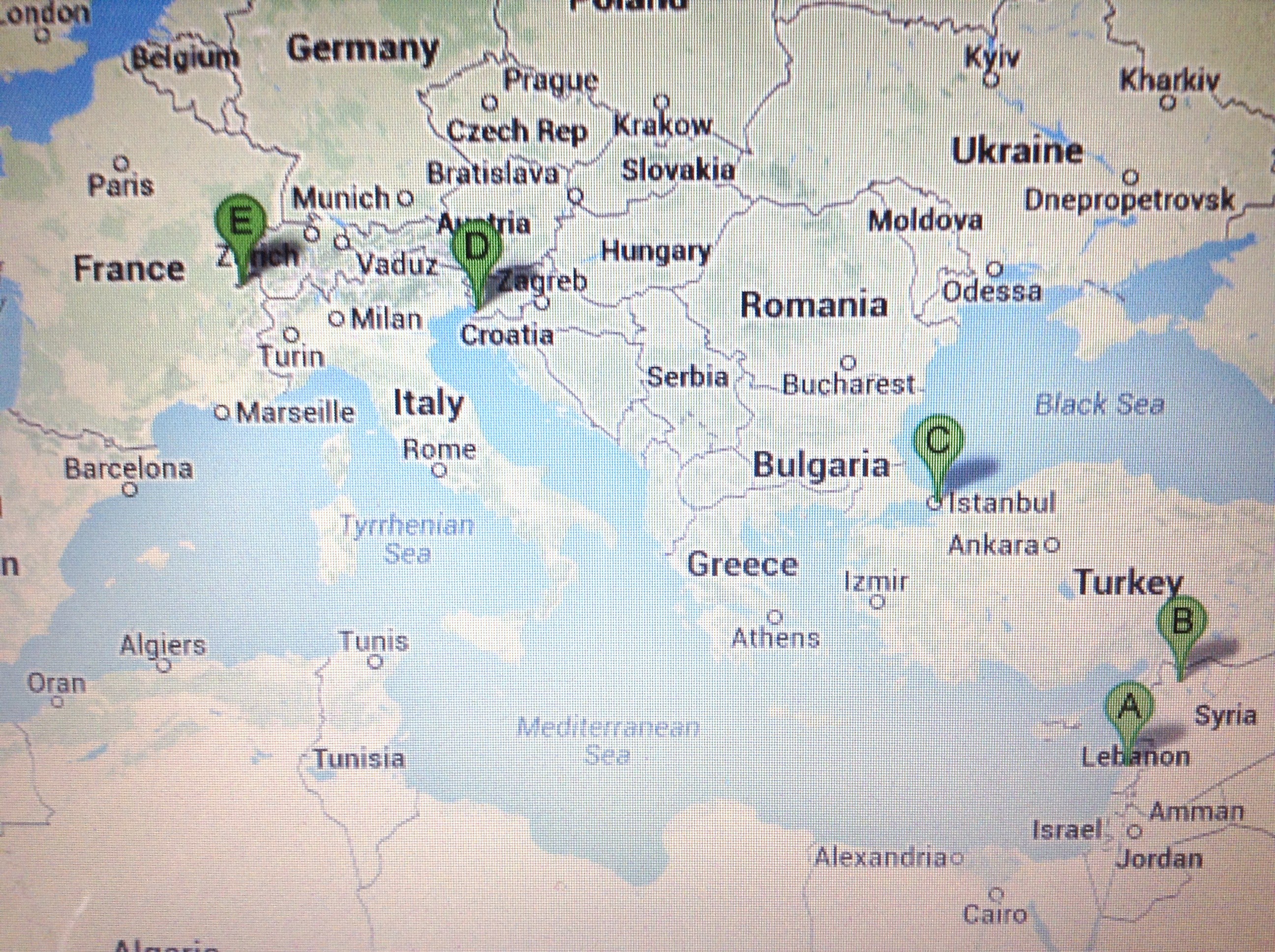
I just finished looking at a Google Map of the area. I can’t imagine what made him think he could pull it off. He was a Jew, in the middle of World War II. He’d have to travel from Beirut, Lebanon to Aleppo in Syria and then on to Istanbul, Turkey. From Istanbul, he’d have to pass through Bulgaria, Serbia, Croatia to Trieste, Italy. Then it would be a relatively short shot to Geneva.

This is a journey of over 2,395 miles. It’s the same distance as from San Francisco, California to St. Petersburg, Florida. Only he’d have to travel through seven countries, all of them either at war or on the edge, and most of them on Hitler’s side. Today, when I put the information into Google, it said, “We could not calculate directions between Beirut, Lebanon and Geneva, Switzerland.”

Map Picture

I would love to know what he was thinking. How did he plan to do it? Why did he even want to?

Traveling by train, all that distance, would be difficult. How many days would it take? Where would he sleep? How would he pay for his tickets and food? Money was already a problem in Beirut. He wouldn’t be able to travel first class like in the past. And, at his age, he was in his sixties…

I wonder, was Abram ever frightened as he planned his journey? Did he feel overwhelmed? Did he worry that he wouldn’t be able to do it?

To try to figure out how Abram might have planned it, I did a little research on my computer. If I wanted to make the trip today, I’d have to take a bus or taxi from Beirut (A on the map) to Aleppo (B). That’s 186 miles. Then I’d take the train to Istanbul (C) for 768 miles. After that I’d travel for another 991 miles by train to Trieste (D). From there it would be 450 miles more to Geneva (E) and he would have made it!

But I’d be doing it as an American on an American passport. Abram was doing it in late 1941 as a Jew with an American visa that could be dangerous for him to show until he boarded the ship because the countries he was passing through were controlled by the Nazis.

Germany’s puppet government in France controlled Lebanon and Syria until the Allied Invasion of July, 1941. Turkey was neutral in 1941 but Hitler had taken Bulgaria on March 1, Croatia on April 10 and Serbia on April 17. Abram didn’t start out until sometime after June.

What was he planning to use for papers? What acceptable reason could he give for traveling? How did he disguise himself so he could blend in with the other travelers? How did he get enough sleep and to eat so he could function?

The one thing he did have going for him, besides his American visa, was that he spoke a number of languages: Romanian, German, French, English, Italian and probably Yiddish.

Looking at the map, I still can’t believe it that Abram made it as far as he did. He must have been very brave, determined and resourceful. He had a lot of guts. He made it most of the way. He was so close. Then he had bad luck, very bad luck.

Somewhere on the train between Serbia and Italy some Nazis found him. He had almost made it to Trieste, only half a day’s travel from Geneva.

The Red Cross finally found out the truth but not until after the war was over. So for years my parents and Grandma and Papa wrote, telephoned and cabled the Red Cross and anyone else they thought could find Abram and help him come to America. They always believed he was still alive until the night the telegram came.

It was a Sunday in 1948 or ’49. There was a knock at our door. It was Western Union. The messenger had gone to my grandparents’ apartment in Pacific Heights first, and when no one answered, their neighbors told the messenger that every Sunday night Grandma and Papa went to their daughter’s house out by the ocean. They gave him the address. The telegram was from the Red Cross.

I remember my father coming into the dining room, taking my brother’s and my dinner plates, telling us to bring our glasses of milk, and come with him. He took us to our room, put the plates on the floor and turned on the radio to the “Lone Ranger”. Dad told us to stay in the room, keep the door closed and listen to the program. He’d come back and get us.

I remember thinking, this is strange. We were never allowed to bring food to our room or listen to the radio during dinner.

Then I heard my Grandmother scream. I can hear it today in my imagination as I write this. It was so loud and so sad and it came again and again, drowning out “The Lone Ranger”.

I could hear Papa saying, “Clara, Clara”, over and over.

The telegram was from the Red Cross. It said that Abram had taken the train to Switzerland. Somewhere, along the way, just before Trieste, Nazi soldiers had boarded it and found him. When they got to Trieste they took him off and to a hotel room. There they robbed and killed him. All this had happened in 1941. He’d been dead all this time and we never knew.

Why, once he had the visa to America, didn’t he come right away? Why did he insist on making this long, dangerous journey to Switzerland first?

We may never know for sure. But I don’t think it was what he told the family: He was sick and wanted to see a doctor to help him get well before he came to America. I think he had a much bigger, more important reason, one that would make him, a man in his sixties, a Jew in a world at war, make this 2,395 mile journey first.

Next month I’ll write about what I think his reason was.