Tag Archives: ideas

You can write and publish your story in 10 hours

I dare you.

Do you remember when writing was fun and carefree? I do. As a kid, I would pull out a notepad and write stories just because that’s how I chose to pass the time. I mostly wrote fantasy stories, some science fiction without all that technical mumbo-jumbo. My dragons had their own rules of behavior and almost every character had an apostrophe in their name.

I created bizarre plot twists. I didn’t fuss with grammar or sentence structure. I didn’t care if the stories were proper writing; I just wrote a rough draft that I always thought was complete. I had fun.

Somewhere along the way, writing became structured and proper. Because of that formal format reality, I look at those drafts now and I think, “What silly little creations.” Why did I bother? Why did anyone or I care?

I expect that if you’re reading this blog, you remember that feeling, or you know someone who has. You, as a reader, can tell when the writer was having a good time and when it was an assignment. I invite you to rediscover that freedom and write with abandon. No doubt, you still have one of those stories down on paper or in your head. This month, I dare you to complete it and publish.

I talk a lot about self-publishing as if it’s gospel. The fact that I’ve done it twice–soon to be three times–does not make me an expert, but I feel confident in it. I know the powerful feeling of control, a feeling that comes from writing, editing and finishing a piece of work. Hitting the Publish button on Amazon is a daring and satisfying moment. I want you to experience that feeling.

Why should you?

Even if you don’t dream of publishing, I challenge you to do this. It’s a sense of accomplishment to write a draft, to edit that draft and by publishing it that means you finish something that you’ve started. Maybe you just have a story to tell, say it’s a letter to your parents, and wouldn’t it be cool to download it onto their Kindle for Christmas? Maybe you have a story about you and your friend. How cool would that be?

When you were in school and had an essay exam, the class eventually ended and you handed in your work as-is. At that moment, you were done. It was a relief, wasn’t it?

National Novel Writing Month (NaNoWriMo) is coming up in November. The concept behind NaNoWriMo is to kickstart you into completing a full-length first draft, but writing 50,000 words in 30 days can be intimidating. Even though that breaks down to 1667 words a day, or 69 words an hour, that finite number may be too large to be comforting. I suggest something doable.

My idea is a spin off from JA Konrath’s blogpost back in August 22, 2013.  The idea mingled fun with structure. Pretend writing is your business. Sit down at the beginning of your 8-hour business workday and write a story, edit it and publish it online. It can be that easy.

My two published short stories have been a result of that challenge. My approach was to start at 8am with a cup of coffee and an open Word document. I write one sentence so the screen is no longer blank. Then I just write, completing my first, rough draft by 12noon. I take a typical hour lunch break. From 1-5pm, I rewrite and edit my text. You can format and upload your text in that timespan as well, but consider taking a dinner break, and then work an hour or two of overtime creating an account, formatting the text, uploading it to the site, and adding cover art.

True, each time I began with a vague story idea and direction, but that was it. There was no outline, no structure, and no definitive plan. I could just as easily have pulled out one of my silly little fantasy stories and see what I can do with it now.

My first e-Book experience was my memoir about a trip my mom and I took. The book–Mom, Star Trek and Las Vegas: A Grand Adventure required research because Trekkies or Trekkers will know if a name is incorrect or a date is wrong. I thought I could sit down in one eight-hour stretch, but I did not. I wrote an hour here, two hours there, made 20 minutes for research here and so on. I was committed to finishing it, whatever the timeframe.

Writers who took the 8-hour challenge, published by August 30. That was eight days after the issued challenge. I’ve read some of the published work and some of them read as if written in 8 hours. But so what? The author wrote, edited, and completed the work. That was the fun of it.

On October 6, after 18 hours and 45 minutes, give or take, I was an officially published author. That was 45 days after the initial post. Final word count: 5657 words, about 22 pages.

My mom memoir e-Book won a national award: third place in the NFPW 2014 Communications Contest.

My second eBook–Lessons from Dad: A Letter to You–was a prelude to my upcoming novel memoir. I released it on June 14, 2014: Father’s Day. I counted it by the number of edits–four, including initial draft–rather than hours, which I estimate took 12 hours. That book is 5111 words, or 21 pages. For 99cents, both books are a bargain read.

What’s the number one reason people don’t do this? Without conducting scientific research, my personal experience is “I don’t have the time.” Wrong. You don’t make the time.

You say you’re too busy, that there are too many other tasks distracting you? You have dinner to cook. Your kids have after-school activities and you’re the driver. You volunteer at the library. You work a 9-to-5 job and commute an hour each way. You have a report to write. There are weekly soccer matches to attend, so you wake up at 6:45am every Saturday. You go to church. You have a monthly date night with your spouse. Your favorite TV show has begun a new season. Repeat week.

Excuses. All excuses. They are reasons, but they are also excuses.

I will attempt this by my next blog post. So, what does my life look like? I don’t have kids to factor in, but I picked up about five extra shifts at my part time job between now and then. I’m traveling out-of-state, teaching Zentangle classes, co-hosting a monthly art group, having a Halloween scrapbook crop at my house, celebrating my 11th wedding anniversary, and raising funds to dance in February’s THON.

I am madly editing my dad memoir novel for ePublication on November 20, my father’s birthday. I’m promoting that book on Twitter, Instagram and my Facebook Author page. Let’s not forget that I have my own blog to maintain, including my annual Halloween blog hop post.  There are articles to write for Michigan Scrapbooker Magazine. I’m editing posts for this blog, critiquing submissions for this writers group, and writing the follow-up November post of this challenge. In utter madness, I also signed up for NaNoWriMo this year.

And there are the daily mundane To-Do items: doctor appointments, cooking, grocery shopping, laundry, mailing birthday cards. Did I mention I was married and have a husband to not ignore?

If I can find time in that, then you can make time in your schedule.

This is not a setup. I don’t have a finished work sitting in the wings planned for this blog challenge. I have ignored my Jimmy the Burglar story for way too long. I mentioned it first back on this blog in March and haven’t touched it since. That’s seven months. I’ve written segments in my head but nothing on paper.

Do you feel that if you don’t write for X-minutes at a time then you’ll lose your flow, and focus and might as well not even start? If you choose to accept this challenge, make it work for you. Don’t have a whole day? I bet you can find an hour a day for 8 days. Maybe 30 minutes for 16 days. Does it take longer than 10 hours? So what? Don’t let the timeframe freeze you, but use it as a guideline, an incentive, a strong deadline.

Don’t be embarrassed by it. Don’t expect best-selling material, although you might surprise yourself. It’s most likely a short story, and there is nothing wrong with that. My books are the length of approximately three of this 1650-word blog post.

What’s in it for you is a sense of accomplishment and completion. As writers, we are always in the middle of something. Or, we write that first draft and never go back to it. I’ve done NaNoWriMo for three years, and I have yet to continue one of those 50K drafts. Unfinished work is a plague on would-be writers.

Stop whining.

You raise kids and release them into the world after 18 years. You write that college essay in 50 minutes and then submit it for a grade. You plan a wedding and eventually the bride walks down the aisle. At some point, there’s that moment of letting go. Stop the mindless edits and let your writing be that free.

As an incentive, I promise to download your book and read it and review it, even if it takes me a few months to get through them. Add your link to the comments section in my November 18 post, or share your thoughts about the overall experience.

Discover what kind of book you can to write in 10 hours!
Writers Always Write

“A writer never has a vacation. For a writer, life consists of either writing or thinking about writing.” — Eugene Ionesco

As I was teeing up my golf ball one day, I noticed the name on the ball was Crystal. Aha, I thought. I know the perfect name for my character. She’ll be called Pearl. Stay with me. I don’t always do straight line thinking. Crystal reminded me of a pearl, which is a perfect name for the character in my historical short story. This demonstrates that I think about writing while in the midst of other activities.

When I first met my future in-laws, I was fascinated by the patriarch’s extensive stamp collection, his brother-in-law’s love of fishing from his motor boat on the lake, the small town they lived in, and the scary idea that most of the people knew each other and all their juicy gossip. In my mind, those details created a convoluted family murder mystery waiting to be written. I’m still working on that one.

As I was reading Claire Murray’s February 21st blog, “Finding Something to Write About,” I started thinking about how I find ideas for my stories. When I sit in a waiting room, on a plane, or in a restaurant, I sometimes overhear conversations that tweak my interest. I may discover a plot idea, an interesting scenario, an intriguing title, or see a person I feel would make a fascinating character.

Reading books or magazine articles sometimes gives me ideas. Because I also recognize some of the TV stories that are “ripped from the headlines,” I’ve started paying more attention to the news. Reading newspapers or listening to the news also gives me the opportunity to do a “what if” story. Tim Franklin’s February 27th blog addresses the “What if?” in a fascinating take on the demise of the dinosaurs.

My cousins-in-law were going through their aunt’s belongings helping her decide what should be given to family members, sold at auction, donated to the local historical society, or trashed. I was intrigued by the contents of an old, unwanted notebook. The cousins gave it to me. That notebook provided the plot for “Pearl’s Legacy,” which I’m preparing for a short story contest.

I keep a supply of notebooks, pens, and pencils in every room in the house and notebooks in various sizes to fit my purses, bags, and suitcases to catch any fleeting ideas before they escape my grasp. My handy, idea filled notebooks help jump start my writing long before I face that intimidating blank screen. Without my notebooks, I think I’d still be staring at a sea of white space without a clue of what I should write about.

A Cracker Jack prize: story ideas

Story ideas do not come in a box of Cracker Jack…or can they?

When I was a kid, the box of molasses-flavored popcorn-nut mix contained cool toys.  It was a delight to pull out some plastic blue ring, too small for any human hand, and squeeze it halfway onto my pinkie finger and imagine it was…anything.  It was a secret decoder ring, and only I had the clues to save the world from the alien spaceship about to destroy humans.  Or the ring gave me super powers, and I would defeat villains by zapping them with my ring from atop flying horses.  I was boundless.

These days, the prizes are downright boring and cheesy if you ask me, but you can still take those cartoon baseball stickers or temporary dragon tattoos and write with abandon.  How?  Good question.

The all-powerful “They” say to choose a situation, emotion or object and launch from there.  Stories come from within so just start writing.  Yeah, that’s easier said than done.

Finding that starting point can be challenging.  I dislike catchphrase advice because without specific examples, I don’t know how to apply those general tips to my writing.  Two tips that annoy me are the seemingly useless “look around you” or “write what you know” how-to suggestions.  Those phrases are cliché until I learned how to make those work specifically for me.

There really is something to the generic advice to “look around you” for ideas.  Consider this: It’s Chinese takeout night, and when you get to dessert, you remember the classic fortune cookie joke-fortune, “Help! I’m a prisoner in a Chinese fortune cookie factory.”  That sentence alone opens countless opportunities.  If you write romance, imagine the hero sweeping in and rescuing the trapped maiden only to be chased by her vengeful lover who locked her away in the factory in the first place.  For the science fiction fans, is the prisoner actually an alien waiting to capture humans?  If you’re geared towards mysteries or thrillers, what does the hero encounter as he or she enters the factory only to discover that the true purpose of the factory is…?

Expand from that plot sentence and “write what you know” to develop characters.  What charming habits do you have that your alien can have to humanize it?  What annoying phrases does your aunt say that could provide tension between the hero and your damsel in distress?  Does your friend have a nervous tic that could distinguish your sleuth?  Could your spouse’s nickname be the name of a Young Adult character?  If your character’s favorite food is Cracker Jack, the same as yours, does this vice affect the story’s outcome?

Suddenly, writing is fun again.

If you feel that your life has not been exciting to this point, then start now.  Take advantage of where you are right now.  “Look around you” and study people at the mall, the dog park, the grocery store or wherever you hang out.  Imagine their stories.  As a wanna-be coffee shop hipster, I hear random snippets of conversation that are fascinating story fodder.  Always carry a journal, napkin or phone notepad to record these moments.  If you tell yourself “Oh, I’ll remember that later,” you probably won’t, at least not with the same flavor you had at that moment.

This personal exploration of people and their traits feels natural for a creative non-fiction writer like me.  I discovered that I can “write what I know” and tell my life story three different ways from three different perspectives: my relationship with my dad; my interactions with my mother; and episodes told from an outsider’s point of view.  Talk about maximizing your material.

I found more “write what you know” opportunities when a few months ago, I rediscovered folders full of high school and college essays, stories and poetry.  I flipped through them and wondered, how did I ever earn a passing grade on that?  What the *bleep* was I thinking when I wrote this crap?  Shudder.  However, reading these embarrassing scraps of paper more closely, I actually found some moments of brilliance and passages I can salvage.  Really, I was that creative?  Really, I was that creative.

If you don’t have past material to repurpose, it is not cheating to borrow inspiration from tools designed to spur imagination.  A quick search of “story ideas” yielded numerous phone apps: Lists for Writers; Storyteller; The Brainstormer; Story Seed Generator; Story Starters; and Flash Fiction Prompter.

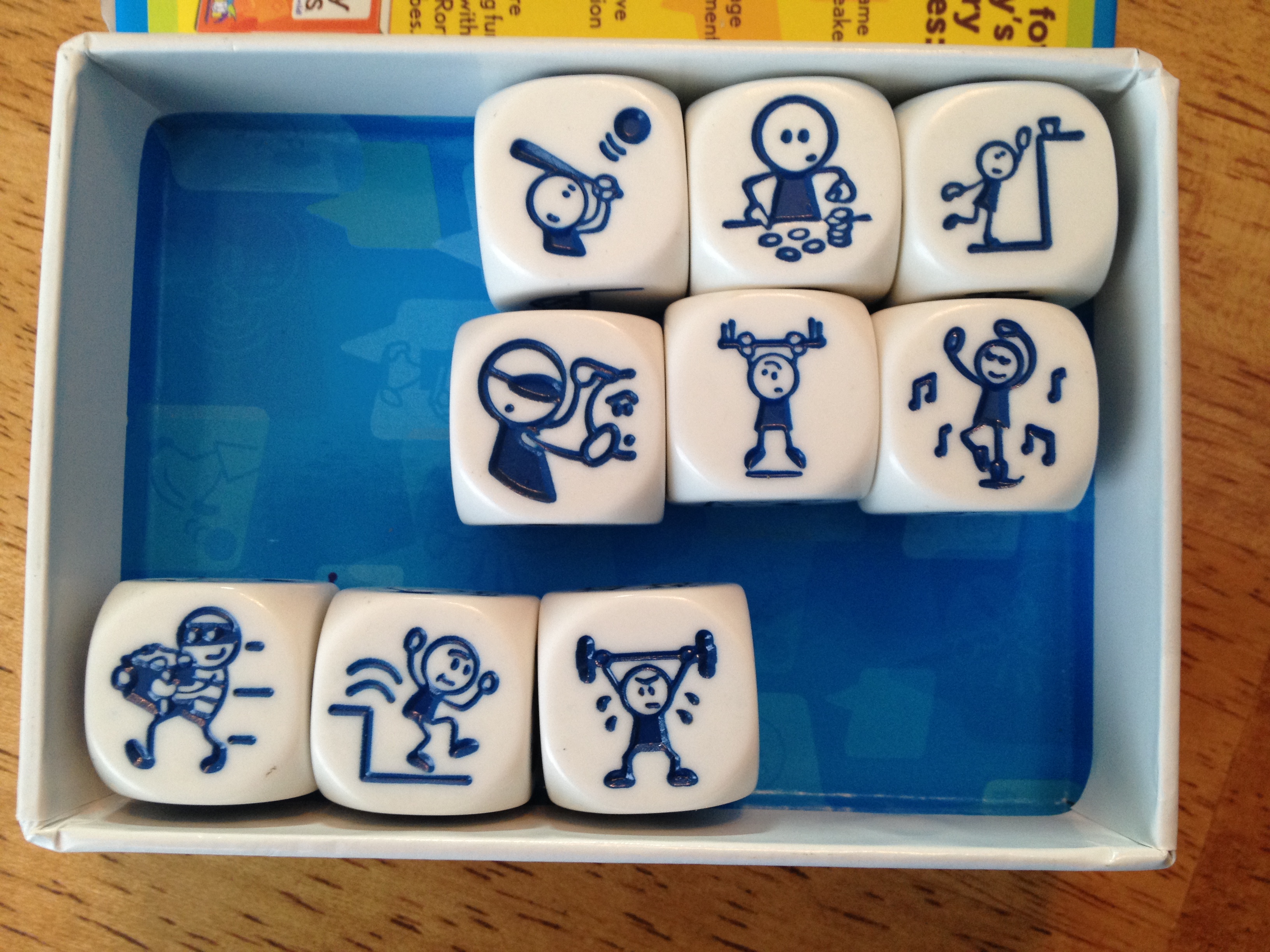
I have not used any of those products, but I did stumble upon the interactive game Story Cubes, which are themed picture dice sets.  Rolling all dice in the Actions set generated an intriguing random assortment.

My Story Cubes inspiration

boxofdice

From this, my character Jimmy the Burglar was born, including the first line of his story:  “Jimmy the Burglar could barely pick his nose let alone a lock.”

Is that a story you would read?

This came from the roll of the dice instead of a Cracker Jack box, but still….  Just think of what you can come up with when you look around and write what you know.

YOU’RE TRASH! Sift Through Some Garbage and Find Your Real Character

Something I almost never read about in the cozy mysteries I love so much is trash. Refuse. The detritus of human life. Lots of my favorite series deal with cooking, pets, books, bookstores, libraries, and crafting, but none of the characters spend time throwing stuff out. Most of my favorite authors would probably say that’s because a character doesn’t move a story forward while she’s taking out the trash. Unless she comes across a lifeless body hidden in a dumpster. But writers, think about what a revelation examining someone’s trash can be.

At my house, for example, a trash raider will find many empty potato chip bags in my garbage can and empty sour cream containers in my recycle bin. (I’ve been stress eating.) (Don’t judge me.) The invader will also find about two boxes worth of used facial tissues (I hope he gets my cold), banana peels, beverage cups from McDonald’s, soy milk cartons, an empty jar of peanut butter, a flattened box of chili mix, plastic grocery bags, and wrinkled packages of shredded cheese with crumbs in them. What can the trash connoisseur deduce about me? Well, he can guess that I don’t eat well-rounded meals, I’m probably sick, and I buy food often, rather than stocking up once a week like a lot of other consumers. Is that information useful? Maybe, maybe not, but it shows my character quirks very well.

What’s not in my trash is also revealing. No shredded paper, no bills, no used check registers or cancelled checks, no newspapers, but a few magazines and lots of junk mail. What does that say about me as a character? Am I a hoarder? Do I live off the grid? Do I embrace an electronic lifestyle and get my bills and news via the internet? Perhaps.

If you’re struggling with a character that is important to your story but remains elusive, try touring her trash. It might help you nail down her personality and give her some pizzazz. “Normal” items like cat food cans, chicken bones, egg shells, and empty yogurt containers won’t help you, so it’s OK to bypass those. You’re after more telling garbage . . . like that mailer with a return address from Frederick’s of Hollywood, the empty Ativan prescription bottle that was renewed five days ago, or the used tampon applicator. (Ewww.)

Let your imagination wander through the wastebasket. If your character is shy or bookish, would she order lingerie? Why would she order lingerie if there’s a Victoria’s Secret in town? There’s nothing unusual about taking an antidepressant these days, but why is the bottle empty already? If she’s almost 55 years old, would she still need to use tampons?

Dumpster diving won’t often wind up on the printed page, and that’s as it should be. Just visualizing it is a creative exercise you can do to identify specific traits of a character who isn’t acting the way you want her to. Organizational charts and diagrams only help you so much. You’re looking for telltale clues, like a half-finished confession or a discarded suicide note, that give you a picture of her life and help you get to know her personally. Then it’s easier to make her actions match her personality.

Your hero, your villain, your victim, your recurring characters may be well known friends to you by the time you write them. You may never need to raid their trash to get a good sense of who they are. But the elusive ones can come to life if you look at the things they throw away.

What are your characters putting in their trash this week?