Tag Archives: ideas

Pinterest for promotion: Tips and inspiration

Penn State PinterestSocial media: is it selling or sharing?

These days, it’s a bit of both.  As a writer, or anyone with a product to promote, social media presents powerful platforms. You can spend more time socializing than writing, so where do you focus your attention?

Pinterest is a social media cut-n-paste website to collect and save online items meaningful to you. Neater than a folder of newspaper clippings from back in the dinosaur days, when you find an image or idea that you want to remember, you “Pin” that image to a “Board” that you create.  Presto! Your collection begins.

The anatomy of a Pin is an image, the description and the website link.  The image is the specific, intriguing picture from the website. If the site isn’t set up to instantly open Pinterest when you hover over the image, you can manually add the image to your Board with the Pin It button you download from Pinterest and save to your computer’s internet taskbar.  The description is whatever you type in as a reminder to you–a cool title, the inspiration for saving it, your impressions–all in 500 words or less.

The website’s link automatically attaches as an electronic sticky note to the “Pinned from” line, and this takes you back to the original post.  If you Pin directly from your smartphone, the Pinned from line simply states, “uploaded by user,” thus creating a static image gallery.

Boards group specific topics or themes together, such as: recipes; parenting; DIY crafts; men’s fashions; travel destinations; and home décor. Quotes and infographics are popular, too.  If you want to connect with users—or Pinners—who share your interest, search the site by category, keyword or user names.  Here’s where the social aspect steps in.

When you discover an image someone else saved, you can Pin that Pinner’s pin to a Board you created, and vice versa.  To see a Pinner’s latest discoveries, you “Follow” that person, and then you choose to follow all or just some of their Boards.  The most popular Pins, popular by Likes or Pins, come up highest on any search.  It’s important to be social to be discovered.

Remember that, “Pinned from”, direct link I mentioned above?  This is where the promotion aspect steps in.  You want to send people to where the action is, so create Boards that link directly to your blogsite, etsy shop or Amazon page.  Create exciting titles and use the description box wisely.  Like other social media, use #hashtags to group your pins and to be instantly site-searchable.  Type in an additional website link in the description box, and it is an active link, giving you additional promotion tool option.

Who do I like?  Who uses Pinterest well?  Who inspires me?

Drive traffic back to your own website like blogger Laurel Regan (Alphabet Salad) by grouping her blog posts, most recently for her April 2015 A to Z Blog Challenge posts.  I found her through that blog hop, and she inspired me to create my own A to Z blog posts Board.

Intrigue your current and future readers like writer Wendi Knape (Wendijowrites) does by teasing them with images that inspire her writing.  One of her stories, Jacob and Charlotte – Meet Cute, features the characters Jacob and Charlotte. Wendi created a Pinterest Board to describe her characters’ “development, clothes, hair, living space [and] favorite foods.”  This inspired me to give readers insights into my own writing process through my “Author Inspiration” board.

My use of Pinterest has been a mixture of art and writing.  “Scrapbooking and artsy-fartsy stuff” collects mini-album and ephemera ideas to pitch to my editor of Michigan Scrapbooker Magazine for future articles.

My Zentangle boards promote my classes as a Certified Zentangle Teacher (CZT) and artwork that inspires me.  Why not let others know what moves me, as well as inspires my works of art?

“Holiday Festivities” gathers spooky ideas and recipes I use to create great visual images for my blog’s annual Halloween post.  See how I used the ideas to create party atmosphere in my 2014 Halloween Party blogpost.

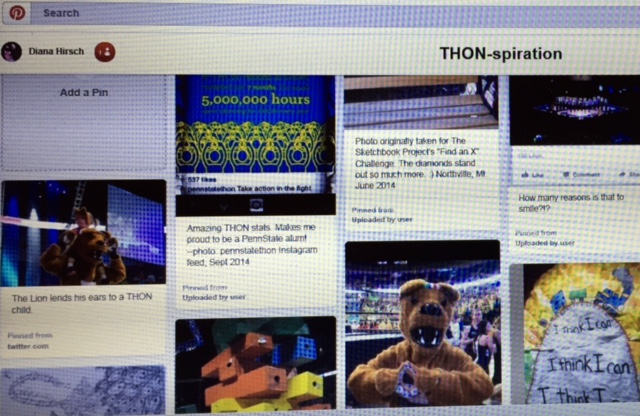
“THON-spiration” collects images related to the fight against childhood cancer and The Penn State Dance Marathon (THON); it is currently my most popular board.

As I was typing this post, I created “Books by D.W. Hirsch” Board.  In the first 24 hours, I had 24 followers.  How cool is that!

I can’t guarantee any success like that, but I can share tips I’ve discovered along this social journey.

Tips to get the most exposure to yourself and your Boards:

  • Creative titles.  Make your Boards sound so exciting that people can’t resist clicking on them.
  • Maximize the description box.  Don’t write wordy paragraphs; space out long sections of sentences.  Include hashtags, keywords, and related websites, but use tabs or double-spaces between these words.
  • Choose the most interesting, active image to Pin if you have multiple options from a website.
  • Credit the original artist every time you share personal content.  Let them know you’ve done that and they may follow you back.
  • For more ideas, search a general word.  Type the word “writing” and you get subcategories of novel; inspiration; prompts; quotes; and more

Some writing-related Board ideas include:

  • Writers you like and blogs you follow.  Be sure to describe why you include them.
  • Books you like or want to read.  This gives people a look into your personal likes, and they may discover a new book to read after seeing your interests.
  • Share and be social: promote other bloggers or writers by posting their content.
  • List blog or writing challenges for future exploration.
  • Promote personal blog posts.  Group these sites into related categories and boards.
  • Share other media images like screenshots of your Twitter posts.  Be mindful of others’ privacy.
  • Favorite quotes

Pinterest works best for people who actively wander around the Internet.  Creating a Board or Pinning an item can take as little as 3 minutes, but this may be an awkward medium for some.  It takes time to ensure the correct link, to write an appropriate description, and then roam around Pinterest looking for people to connect and share interests.

What site platform works best for you?  Are you still discovering?  Share your thoughts in the comments below.
One Part Genesis, One Part Darwin and One Part Machiavelli

Although I might plan to relax or sleep, writing ideas germinate at the oddest times. I jot a note on Monday to write about one topic. Tuesday counters with a new subject or two. Wednesday offers three more choices. After the month passes, I have pages of new ideas for short stories, posts, and even novel worthy topics. The difficulty comes in choosing and debating the strength of each idea.

A genesis process begins before each project. An idea fragment initiates a chain reaction. In true Genesis fashion, here’s what happens to an idea for something as simple as a blog post.

The Paris Review tweets a 1980s interview with Raymond Carver which begat
rereading “What We Talk About When We Talk About Love” which begat
watching Birdman and the use of Carver in the movie which begat
finding other films directed by Alejandro G. Inarritu which begat
studying Inarritu’s co-writers and the two years to write the script which begat
researching cinematography for a one-shot narrative which begat
discussing the similarities between Birdman and a play which begat
outlining theme connections between Carver’s story and the film which begat
finding examples of magical realism . . .

Now Darwin, the scientist whose name symbolizes survival of the fittest, comes into play. The possibilities for the Carver idea within what I call my “genesis stage” are numerous. I keep this idea, and who knows, it might be a post on this blog in the future. The subject interests me much more than one of my other ideas about the financial funding of literary magazines. Although valuation practices and financial topics are potential dinner conversation at my table, the rest of the world might be in REM sleep after appetizers. Unless a topic can evolve, the idea turns cold, extinct and not fit to survive in my black and white world of words.

As the deadline approaches, I enter the “Machiavellian stage” of decision making. In the example of this blog post, three ideas remain – the Carver Birdman Connection (CBC), Writing of Mom (MOM), and Genesis, Darwin and Machiavelli (GDM). Now, my brain wrestles with the competing ideas.

CBC: There’s research into my idea. But how will it hold together?
MOM: Remember mother’s birthday is on the post date.
GDM: There’s not much time. The MOM topic is a bit too sentimental.
MOM: What about “writing secrets” kept from mom?
CBC: That could be rich.
GDM: MOM is too fluffy for June. That’s an August topic.
CBC: I suppose it is between GDM and me. I have a wealth of material.
GDM: Carver-Birdman is too heavy for a June post.
CBC: My topic is fascinating. It could be more than a blog post.
GDM: You’re right, it’s too big for a blog post. Discussion over. Now write.

With the argument settled, the post topic practically writes itself. Tomorrow begins a new round of genesis, Darwinism and Machiavellian debate over which story to finish or whether it’s time to return to the manuscripts.

Read Books, Review Books, Remember Books

FullSizeRenderOn this blog, I’ve written about journal writing.  I’ve written about reading books.  There was a time when I did both: I read books and journaled about them. Go figure.

After last month’s journal expedition, I wandered through my bookshelf and discovered a journal wherein I reviewed books for myself as a reminder of what I read and what I thought.  I forgot I had done that.

My inspiration came from those funky “record your recollections” books found in your bookstore’s gift section.  The fun titles and decorative covers invite you to review wines, where you drank them and save the wine labels. You could write about the places you traveled and significant snippets of the journey. Journal titles encouraged memories of meals and restaurants, favorite songs, meaningful quotes, garden plantings, lists and more. Since my two main interests were books and movies, I decided I would chronicle my impressions of each.

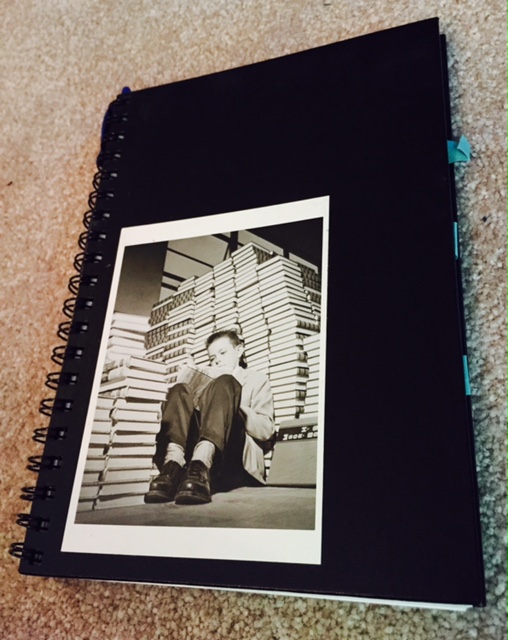
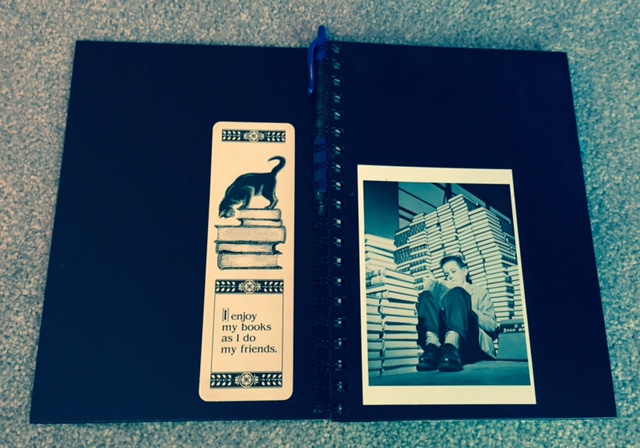
Rather than pay for a fancy-schmancy, pretentious book with pages too small for a proper review,    I could make my own book better than any preprinted book. Besides, I found a pair of regal spiral bound notebooks, elegant in their 8″x10″ stature. The simple black hardcover was perfect for a funky, relevant, inspirational postcard. I clipped identical, important-looking blue gel pens in the rings.  I was set to write whether at home or on-the-go.

I recorded each book in the same look, manner, and design: “The Title” by Author; Month and year I finished reading, and my review.

It was the prehistoric equivalent of modern day Goodreads.

FullSizeRender2I tabbed four sections. The front main pages were reviews of the books I read. The second tabbed section I reserved for books recommended to me or that I wanted to read. The last section has some pencil scribblings on the first page; it looks like I planned a “books I borrowed or loaned.” I didn’t know enough people who read books. There is a third section tabbed off but with nothing written on those pages I have no clue what I intended.

I reviewed books from July 1999 through September 2002. My first reviewed book will remain nameless because it is so horrible. I wrote: “College life…here was my chance to see how someone else does it. I’ve learned how not to do it. I have no idea what any of the characters look like. Everyone swore, drank and got drunk. C’mon, a keg at your final? A torture to read but I had to finish it for story’s sake. I forgot that there had been a framing structure at the beginning. Events just end and everything is summed up neatly, compactly, and smoothly like the end of the stereotypical sitcom. Now writing about it, I can put it out of my mind.”

That book was my first exposure to self-published books, often called vanity press back then. This book had to be good. After all, it was a hardback book, with a colorful cover, I discovered at an independent book fair in New York City. That gave it validation. Ever since I read it, this is the book I refer to anytime I need an example of poor writing and the desperate need for an editor.

The General’s Daughter by Nelson DeMille. July 1999

“Print from this ‘old style’ trade paperback dirties my fingers. I like the movie better than the book. Narrator often sounded like the author, not the character.” The ending was given away too soon. Very few ‘he said’ in text and was often confused by who was speaking. Movie was more coherent, flowed better.”

The House of Seven Gables by Nathaniel Hawthorne. November 5, 1999

“Never was I so glad to finish a book!”

I developed a fascination about writing the true story of a real person. I moved away from fiction and desperately sought solid nonfiction. I read a series of disappointing memoirs after that. One review included my insightful comment: “In the last two memoirs, the struggle is established at the beginning but then the readers never reap the benefits of success.”

Good advice to remember as I finish my memoir.

Tuesdays with Morrie by Mitch Albom. November 25, 1999

“This book made me uncomfy [uncomfortable]. That was wonderful! I want to read it again.” In January 2000, I did just that. “The second reading as powerful as the first. Real writing, honest and true yet not sappy. There’s a reason this has been on the best seller list for over 100 weeks.”

Falling Leaves by Adeline Yen Mah. Saturday, March 4, 2000

“A tragic memoir wonderfully told. Her words: simple, and I got so caught up in her storytelling I didn’t notice.”

The Joy Luck Club by Amy Tan. June 2000

“Good example of a story told through many smaller, seemingly unrelated stories. I’d like to see how the movie translated this fine book.”

As of this writing, I have not yet seen the movie.

The Girl’s Guide to Hunting and Fishing by Melissa Bank. August 13, 2000

“What a quick read! Recommended by Jane, I echo her thoughts: I wish I’d written this book.”

Memoirs of a Geisha by Arthur Golden. March 2001

“It has been so long since a book snagged me so completely. I was up nights swallowing every word until way past my practical bedtime.”

I wrote about the Harry Potter series from December 1999 to 2002. Interesting how my opinion has changed since those initial readings.

My last entry is Diary of a Mad Bride by Laura Wolf. September 2002

“B-day gift from Dawn, I read it in about one week. Funny, and a lot more truth in there than any bride would care to admit. Written in short journal entries, it’s easy to read. I must read this closer to my wedding 🙂 again!”

I never did read that book again, but maybe I will now, especially since I am married.  One part of my New Year’s Non-Resolutions is to revisit and reread an old favorite book.  I’m faced with a dilemma: which one do I choose?

Do you have any recommendations of good books to read, or ones to avoid?

Insta-success with Instagram

Twitter is stupid, and Instagram is for people who can’t read.”–Max, 2 Broke Girls

I always think of that quote when I mention Instagram to others.  Instagram is a social site for sharing snapshots.  If you don’t like imagetaking pictures, this post won’t be for you, but you should read to the end just to make sure.

As a writer, or any business owner, you need to find social media platforms that work for you and your desired end goals.  The sites need to be ones that you will maintain and that are fun for you.  I think Facebook is a big time-suck with algorithms that don’t let me see the feeds of everyone I want to in the order that I want to.  Still, I have a Facebook Author Page that I modestly keep up with.  I have discovered informative people through Twitter and it seems to be popular for writers.  It’s hard to keep up with the news feed some days, but there’s some good interaction with my tweets.

What about Instagram?  I’m a scrapbooker and, by default, take hundreds of photos every month.  I’m surprised it took me so long to find the value in Instagram.  My first two photos posted the week of June 10-16, 2012 (138 weeks ago) when I was just playing around with some filters on my first smartphone.  They were pictures of teddy bears.  I didn’t know what else to do with it, so I trailed off and lost interest.  I picked it up again the week of February 2-7, 2014 (53 weeks ago, or just over a year) as an outlet to showcase my writing, initially my haiku poetry.  Now I use Instagram for my writing and…well, stop on over and check out my photos at @dwhirsch.

I use Instagram as a marketing tool as much as a social experience.  I don’t pretend to know everything about Instagram.  I read information from bloggers who have done the research, such as @jenns_trends, who is a goddess on Insta-information.  What I’m offering is my personal experiences and successes adapting those tools.

To use Instagram effectively, you have to decide what you plan to share.  This can change over time, but start with some initial rules.  My guidelines are the same ones I have for my personal blog.  I never post pictures of friends or family without first getting their consent.  I don’t post photos of my house because I have “location services” turned on my phone.  I don’t want people to know where not to find me when I’m out of town.  There’s nothing valuable, explicit, religious, political, controversial or anything my dad–were he still alive–would be disappointed to read about me.

image

Instagram is Insta-easy to use, and the site’s features are relatively uncomplicated and obsessively playful.  It’s free to set up, and I recommend you snag your profile information now: create your Name (generally your real name or business) and Username (what you’ll be known @as). Photos are posted in a square, and most smartphones have a “square” option in the camera settings. If not, or if a square cuts off some important part of your photo, there are many free apps that will shrink your photo and place a border around it. To post, just upload a photo or 15-second video that you take live or have stored in your smartphone library. You can alter your media with black-and-white, sepia or color filters, with additional tools to adjust the image’s brightness, contrast or saturation level.  Finish it off with a frame or vignette, add a caption and press Share.

Now that you’re live, how do people find you?  Your 153-character bio, along with your photo’s caption, and hashtags need to be creative, potent and relevant.  Going back to Max’s quote comparing Twitter and Instagram, the latter is not restricted to 140 characters.  Your photo or video should tell a complete story, but you can use about 440 words to explain that image. This comment section is vital because you can tell your story and highlight your image using crucial hashtags.

Instagram is hashtag heaven. People with similar interests will find you based on how you tag your images.  Common hashtags reflect those you find on Twitter, but you don’t have to be familiar with Twitter to use Instagram.  Think about what your picture is about and tag your image with common terms.  As a snapshot in the moment, you can showcase a twisted #tree branch, a royal #sunset, a #selfie in your awesome new #shirt, an art exhibit or the #bananabread you’re baking.  You’ll get a feel for tags once you start using them.  Tags have no spaces and use just alphabet characters with no suggestions, so type in exactly what you’re looking for.  Much like Twitter lists, you can also create hashtags to group your own images in a somewhat folder design.  Some of mine include #iamapoetess, #SnuffletFinse and #Champsp. Be sure to check out this group’s posts, which are under the same hashtag as on Twitter: #dwriters.

The Explore tab complements tags by suggesting people to follow based on tags you use, images you’ve ‘Liked’ and people or companies that your followers follow.

image

Oh, yes, companies use this.  Instagram is a successful marketing tool, a highly-used space to display products from #clothing to #cosmetics. Check out companies like @Bathandbodyworks, @Ford and @Applebees.

I sometimes stage my work because I want my followers to see the best of me.  I give my followers a peek into my writing, #Zentangle art and my overall creative process while infusing my quirky personality and personal interests.  Think about it: if I follow a particular author, I feel more connected to the “person” rather than to the “celebrity.”  Therefore, I’ve taken my book cover image and overlaid a part of a review on top of it.  I type up actual text from my latest #shortstory or #poetry.  Photo editing can be fun.

Given my goals, I show images of blue-inked-up work as I edit my current draft.  I show the #coffee shops where I #amwriting. I show the stages of my Zentangle #wip so people can see my creation from start to finish. I have too much fun with it on the go not to let it be organic.

Remember, social media is social. I share my work and myself because like Max on #twobrokegirls, the experience on Instagram is more social. I comment more than I Like because the image doesn’t always grab me but the story in the caption section does.
image When someone takes the time to comment on my work, I respond to every–and I mean every!–comment made to me even if that person replied with a smiley face emoji.  I appreciate the time that person spent appreciating me, similarly the gratitude when I receive a #bookreview on #Amazon or #Goodreads.  If nothing else, I reply “Thank you.”  People like you when you like them.

What are the benefits?  The most important is meeting people with similar interests.  I’m reading a #memoir recommended by a follower who is #writing her own memoir. I’m inspired by new #art and #painting techniques.  I’ve been challenged to take pictures in #blackandwhite.  I could meet any number of them for #coffee if I was in their area.  I have a connection to these people. You can do the same with your peers and have fun doing it.

I Published a Book in 10 Hours

Jimmy the burgler

I did it!

Families inspire us and intimidate us.  Jimmy’s mother, father and brother are all members of the Burglars Union Guild (BUG), and he is expected to follow in their footsteps.  Jimmy has slippery fingers and not in the slick, pickpocket ways; he drops things.  That lack of dexterity is just the start of his struggles to gain entrance into the most elite thief organization.  The story of his life is now immortalized in electronic bytes.  I published a book.

I didn’t do all that writing in one day, as I proposed in my original challenge.  I also spent more than 10 hours writing Jimmy the Burglar.  Regardless, I completed the challenge.

I feel really good about that because this is my first fiction piece in a long, long time.  Fiction is easier to write than memoir because I could make up whatever stuff I wanted.  Fiction is also harder to write than a memoir because I had to make up whatever stuff I wanted.

This is my third self-published book, and I learn new elements with each effort.  This time, I experimented by writing the first draft in longhand.  At 2 hours and 56 minutes of writing, I hit a wall: great story elements, but no tension.  Typing that first part in gave me time to think about the story I wanted to tell here and now and in 10-ish hours.  I initially focused on the entire family history as related to the evolution of the Guild, but in that writing, I developed incredible backstory fodder for future Jimmy short stories.  The tale worth telling today is the evolution of Jimmy’s final exam for BUG membership: his MOTH (Modus Operandi Thesis Heist).  After the humiliation he experienced working with Big M, it is vital that Jimmy’s MOTH get all the details right.

At 7 hours and 42 minutes, I was having Too Much Fun writing. So much fun that, I forgot to reset the timer at one point.

After 16 hours (approximately) and 5100 words (23 pgs.), you can read Jimmy the Burglar’s first adventure on Amazon.com.

How did your story turn out?  If you completed the challenge, post your link below.  If you didn’t, share your thoughts now about the experience for all of us so we can learn from it.  And for me, I’d love to know your thoughts about my book. Whaddya think?

If you’re looking for some inspiration and encouragement to complete a book like this, there is a day-long workshop planned for early 2015 in the metro Detroit area.  Stay tuned for the details.

Even if publication isn’t your goal, doing a challenge like this is immensely satisfying. I have typed “The End” on a piece of my writing and am now moving on to “The Next.”