Tag Archives: inspiration

I Published a Book in 10 Hours

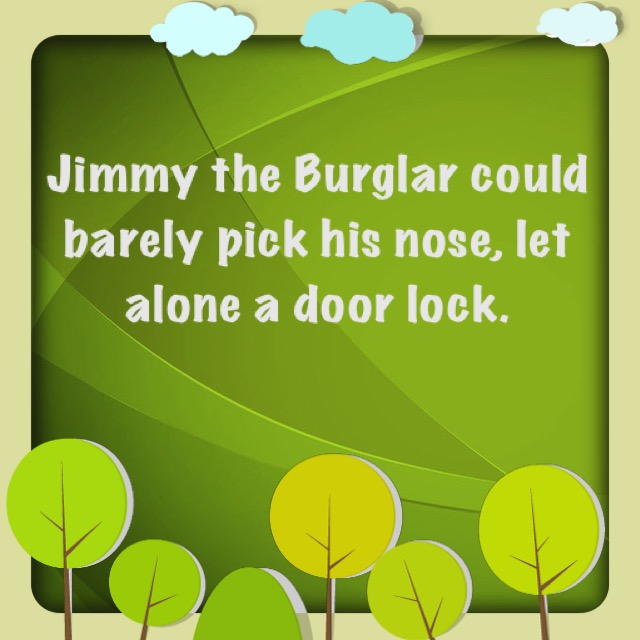
Jimmy the burgler

I did it!

Families inspire us and intimidate us.  Jimmy’s mother, father and brother are all members of the Burglars Union Guild (BUG), and he is expected to follow in their footsteps.  Jimmy has slippery fingers and not in the slick, pickpocket ways; he drops things.  That lack of dexterity is just the start of his struggles to gain entrance into the most elite thief organization.  The story of his life is now immortalized in electronic bytes.  I published a book.

I didn’t do all that writing in one day, as I proposed in my original challenge.  I also spent more than 10 hours writing Jimmy the Burglar.  Regardless, I completed the challenge.

I feel really good about that because this is my first fiction piece in a long, long time.  Fiction is easier to write than memoir because I could make up whatever stuff I wanted.  Fiction is also harder to write than a memoir because I had to make up whatever stuff I wanted.

This is my third self-published book, and I learn new elements with each effort.  This time, I experimented by writing the first draft in longhand.  At 2 hours and 56 minutes of writing, I hit a wall: great story elements, but no tension.  Typing that first part in gave me time to think about the story I wanted to tell here and now and in 10-ish hours.  I initially focused on the entire family history as related to the evolution of the Guild, but in that writing, I developed incredible backstory fodder for future Jimmy short stories.  The tale worth telling today is the evolution of Jimmy’s final exam for BUG membership: his MOTH (Modus Operandi Thesis Heist).  After the humiliation he experienced working with Big M, it is vital that Jimmy’s MOTH get all the details right.

At 7 hours and 42 minutes, I was having Too Much Fun writing. So much fun that, I forgot to reset the timer at one point.

After 16 hours (approximately) and 5100 words (23 pgs.), you can read Jimmy the Burglar’s first adventure on Amazon.com.

How did your story turn out?  If you completed the challenge, post your link below.  If you didn’t, share your thoughts now about the experience for all of us so we can learn from it.  And for me, I’d love to know your thoughts about my book. Whaddya think?

If you’re looking for some inspiration and encouragement to complete a book like this, there is a day-long workshop planned for early 2015 in the metro Detroit area.  Stay tuned for the details.

Even if publication isn’t your goal, doing a challenge like this is immensely satisfying. I have typed “The End” on a piece of my writing and am now moving on to “The Next.”

Vacation Suspense – Part 2

Blog 13 04

Television producers try to get you to come back for more by showing scenes from “the next exciting episode” of whatever program you’ve just watched.  Writers have to do the same thing sentence to sentence, paragraph to paragraph, and chapter to chapter.  Suspense is one of the tools of the author’s craft that helps pull the reader along.

For me, suspense is the essence of a story that makes me skim a few pages more because I have to know what comes next before I put the book down for the night.  Though most easily seen in cliffhanger thriller and action pieces, suspense is also present in more subtle ways when a story has engaging characters or a compelling storyline.  Will the young lovers stay together in the face of pressure from their parents?  Will the social activist win against the sea of opposition?  Stay tuned for the next sentence, paragraph, or chapter to find out.  That’s suspense.

A few days prior to my vacation in October, John McCarthy challenged the members of the Deadwood Writers Book Study Group to write a paragraph containing suspense.  I took the idea on the trip with me not knowing if I’d do anything with it.  While sitting on the beach I wondered how I might describe the scene around me in such a way to make it interesting.  What started as an exercise in scene setting became one for developing suspense:

A warm breeze passed over Sarah as she scanned the overcast sky.  The clouds kept the sun from making it scorching hot, yet enough blue shown through to make it a pleasant day at the beach.  Sunbathers spread out across the sand with no one closer than a hundred feet between.  The more cautious among them sat beneath the colorful umbrellas that peppered the landscape.  When screams rang out from the ocean, Sarah’s heart raced and her eyes scanned the surf left, right, left, right for the source.  It took her several eternal seconds to find the sounds came from a young surf boarder having a good time.  “Calm down, Sarah,” she told herself, as she wiped sweat off her face that had nothing to do with the midday heat.  “No one’s caught in a riptide like before.”

There are questions this passage provokes that I hope would cause a reader to want to know more and keep reading:

  • Who is this character named Sarah? A lifeguard, tourist, or maybe a resident on the beach?
  • Who got caught in the riptide? Was it someone close to Sarah?
  • Did the person drown or get saved?
  • Why did the incident affect Sarah so much?
  • What role did she play?

As writers, we must always be aware of what will keep a reader tuned in for more.  Thinking about the questions our passages inspire is a good check on the suspense we are trying to create.  As we begin to answer those questions, we need new ones to continue the process until we reach a conclusion.  Does that mean you have to answer all the questions by the end of your piece?  Not necessarily.  Sometimes you want to leave a person on a thought provoking note.  If you’re writing a series, you might leave the reader with something that nudges them to read the next book or blog post.

Consider these memorable ways that writers/authors have tempted their audiences:

Same bat time, same bat station.

Luke, I am your father.

Happiness is…

Elementary, my dear Watson.

Even if somewhat misquoted, people were so taken with the lures that the lines have become part of the modern lexicon.  How can you reach that level of popularity?  It all starts when you figure out how to entice your readers to ‘stay tuned.’

You can write and publish your story in 10 hours

I dare you.

Do you remember when writing was fun and carefree? I do. As a kid, I would pull out a notepad and write stories just because that’s how I chose to pass the time. I mostly wrote fantasy stories, some science fiction without all that technical mumbo-jumbo. My dragons had their own rules of behavior and almost every character had an apostrophe in their name.

I created bizarre plot twists. I didn’t fuss with grammar or sentence structure. I didn’t care if the stories were proper writing; I just wrote a rough draft that I always thought was complete. I had fun.

Somewhere along the way, writing became structured and proper. Because of that formal format reality, I look at those drafts now and I think, “What silly little creations.” Why did I bother? Why did anyone or I care?

I expect that if you’re reading this blog, you remember that feeling, or you know someone who has. You, as a reader, can tell when the writer was having a good time and when it was an assignment. I invite you to rediscover that freedom and write with abandon. No doubt, you still have one of those stories down on paper or in your head. This month, I dare you to complete it and publish.

I talk a lot about self-publishing as if it’s gospel. The fact that I’ve done it twice–soon to be three times–does not make me an expert, but I feel confident in it. I know the powerful feeling of control, a feeling that comes from writing, editing and finishing a piece of work. Hitting the Publish button on Amazon is a daring and satisfying moment. I want you to experience that feeling.

Why should you?

Even if you don’t dream of publishing, I challenge you to do this. It’s a sense of accomplishment to write a draft, to edit that draft and by publishing it that means you finish something that you’ve started. Maybe you just have a story to tell, say it’s a letter to your parents, and wouldn’t it be cool to download it onto their Kindle for Christmas? Maybe you have a story about you and your friend. How cool would that be?

When you were in school and had an essay exam, the class eventually ended and you handed in your work as-is. At that moment, you were done. It was a relief, wasn’t it?

National Novel Writing Month (NaNoWriMo) is coming up in November. The concept behind NaNoWriMo is to kickstart you into completing a full-length first draft, but writing 50,000 words in 30 days can be intimidating. Even though that breaks down to 1667 words a day, or 69 words an hour, that finite number may be too large to be comforting. I suggest something doable.

My idea is a spin off from JA Konrath’s blogpost back in August 22, 2013.  The idea mingled fun with structure. Pretend writing is your business. Sit down at the beginning of your 8-hour business workday and write a story, edit it and publish it online. It can be that easy.

My two published short stories have been a result of that challenge. My approach was to start at 8am with a cup of coffee and an open Word document. I write one sentence so the screen is no longer blank. Then I just write, completing my first, rough draft by 12noon. I take a typical hour lunch break. From 1-5pm, I rewrite and edit my text. You can format and upload your text in that timespan as well, but consider taking a dinner break, and then work an hour or two of overtime creating an account, formatting the text, uploading it to the site, and adding cover art.

True, each time I began with a vague story idea and direction, but that was it. There was no outline, no structure, and no definitive plan. I could just as easily have pulled out one of my silly little fantasy stories and see what I can do with it now.

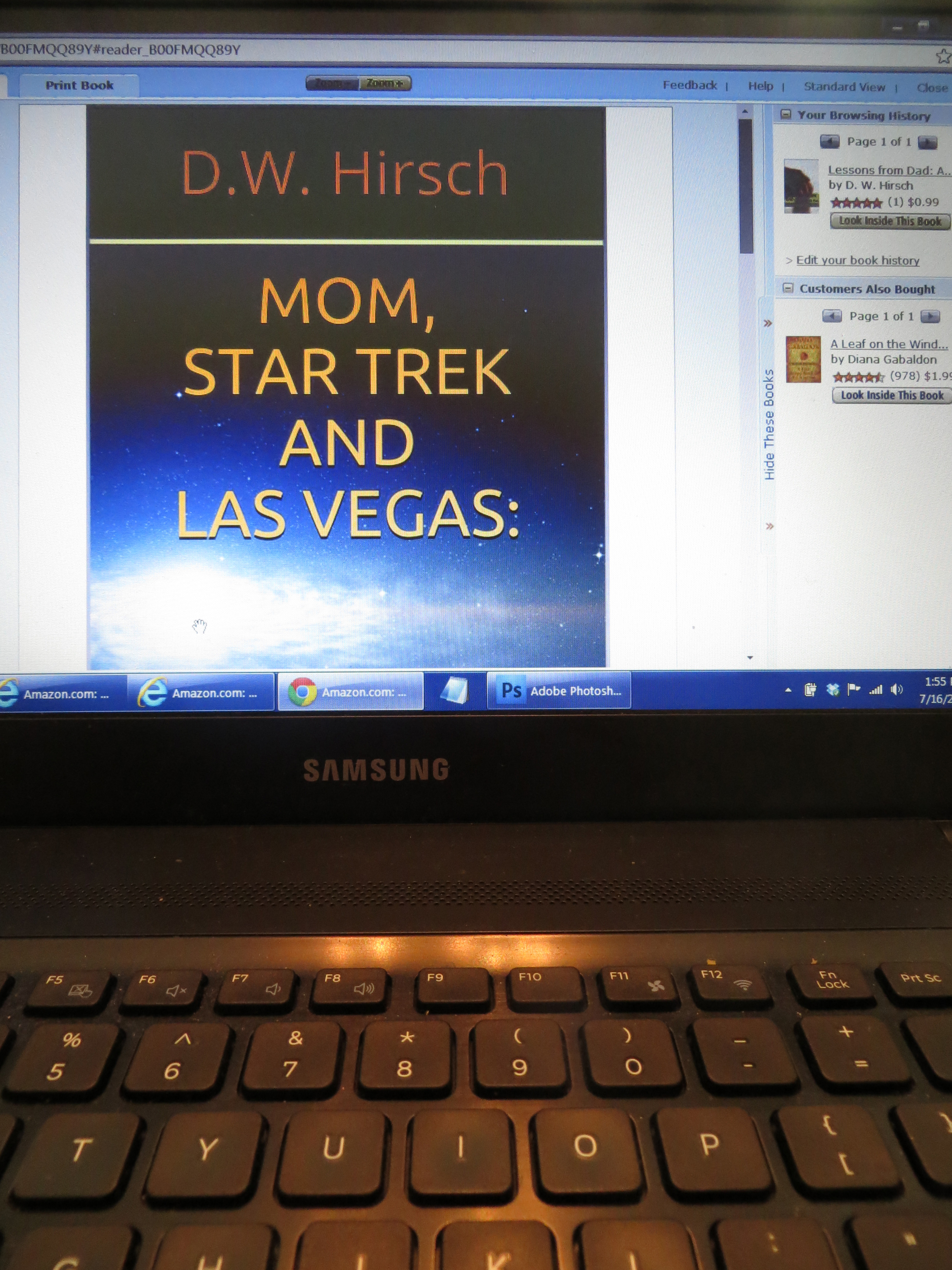
My first e-Book experience was my memoir about a trip my mom and I took. The book–Mom, Star Trek and Las Vegas: A Grand Adventure required research because Trekkies or Trekkers will know if a name is incorrect or a date is wrong. I thought I could sit down in one eight-hour stretch, but I did not. I wrote an hour here, two hours there, made 20 minutes for research here and so on. I was committed to finishing it, whatever the timeframe.

Writers who took the 8-hour challenge, published by August 30. That was eight days after the issued challenge. I’ve read some of the published work and some of them read as if written in 8 hours. But so what? The author wrote, edited, and completed the work. That was the fun of it.

On October 6, after 18 hours and 45 minutes, give or take, I was an officially published author. That was 45 days after the initial post. Final word count: 5657 words, about 22 pages.

My mom memoir e-Book won a national award: third place in the NFPW 2014 Communications Contest.

My second eBook–Lessons from Dad: A Letter to You–was a prelude to my upcoming novel memoir. I released it on June 14, 2014: Father’s Day. I counted it by the number of edits–four, including initial draft–rather than hours, which I estimate took 12 hours. That book is 5111 words, or 21 pages. For 99cents, both books are a bargain read.

What’s the number one reason people don’t do this? Without conducting scientific research, my personal experience is “I don’t have the time.” Wrong. You don’t make the time.

You say you’re too busy, that there are too many other tasks distracting you? You have dinner to cook. Your kids have after-school activities and you’re the driver. You volunteer at the library. You work a 9-to-5 job and commute an hour each way. You have a report to write. There are weekly soccer matches to attend, so you wake up at 6:45am every Saturday. You go to church. You have a monthly date night with your spouse. Your favorite TV show has begun a new season. Repeat week.

Excuses. All excuses. They are reasons, but they are also excuses.

I will attempt this by my next blog post. So, what does my life look like? I don’t have kids to factor in, but I picked up about five extra shifts at my part time job between now and then. I’m traveling out-of-state, teaching Zentangle classes, co-hosting a monthly art group, having a Halloween scrapbook crop at my house, celebrating my 11th wedding anniversary, and raising funds to dance in February’s THON.

I am madly editing my dad memoir novel for ePublication on November 20, my father’s birthday. I’m promoting that book on Twitter, Instagram and my Facebook Author page. Let’s not forget that I have my own blog to maintain, including my annual Halloween blog hop post.  There are articles to write for Michigan Scrapbooker Magazine. I’m editing posts for this blog, critiquing submissions for this writers group, and writing the follow-up November post of this challenge. In utter madness, I also signed up for NaNoWriMo this year.

And there are the daily mundane To-Do items: doctor appointments, cooking, grocery shopping, laundry, mailing birthday cards. Did I mention I was married and have a husband to not ignore?

If I can find time in that, then you can make time in your schedule.

This is not a setup. I don’t have a finished work sitting in the wings planned for this blog challenge. I have ignored my Jimmy the Burglar story for way too long. I mentioned it first back on this blog in March and haven’t touched it since. That’s seven months. I’ve written segments in my head but nothing on paper.

Do you feel that if you don’t write for X-minutes at a time then you’ll lose your flow, and focus and might as well not even start? If you choose to accept this challenge, make it work for you. Don’t have a whole day? I bet you can find an hour a day for 8 days. Maybe 30 minutes for 16 days. Does it take longer than 10 hours? So what? Don’t let the timeframe freeze you, but use it as a guideline, an incentive, a strong deadline.

Don’t be embarrassed by it. Don’t expect best-selling material, although you might surprise yourself. It’s most likely a short story, and there is nothing wrong with that. My books are the length of approximately three of this 1650-word blog post.

What’s in it for you is a sense of accomplishment and completion. As writers, we are always in the middle of something. Or, we write that first draft and never go back to it. I’ve done NaNoWriMo for three years, and I have yet to continue one of those 50K drafts. Unfinished work is a plague on would-be writers.

Stop whining.

You raise kids and release them into the world after 18 years. You write that college essay in 50 minutes and then submit it for a grade. You plan a wedding and eventually the bride walks down the aisle. At some point, there’s that moment of letting go. Stop the mindless edits and let your writing be that free.

As an incentive, I promise to download your book and read it and review it, even if it takes me a few months to get through them. Add your link to the comments section in my November 18 post, or share your thoughts about the overall experience.

Discover what kind of book you can to write in 10 hours!
Yes, you can publish a book

My thoughts on self-publishing


What is stopping you from publishing your book?  You are.

I have self-published two books so far, and I am thrilled about it.  With the introduction of eReaders, writers have complete freedom in their craft.  You have the ability to post anything online through a blog and various social media, and now you have the socially-accepted ability to publish a book.  But that was not always the case.

As recent as 10 years ago, the only way to buy a book was as a printed copy in a brick-and-mortar bookstore.  The only way to get your book into those stores was to sign a contract with one of the traditional publishing houses headquartered in New York.  These companies controlled physical book distribution, and they didn’t make the process of acceptance easy.  Even with well-crafted query letters and strong sample chapters, you still needed a smidgeon of luck that your manuscript found its way to the right editor or agent to believe in you.  If you made it through that professional vetting process, then you had the validation of being a “real” writer.

If your work wasn’t good enough to be accepted by the industry, then the only way to get your story to readers was to fake professionalism.  You had to print it on your own, with the stigma of “vanity press” trailing your byline.  I believe that was a phrase created by publishing houses.  If you had to print and peddle your wares yourself, then you weren’t a professional writer.  This legitimized publishing houses and enhanced their aura of attraction.  Without any sense of quality control or standards, what was there to keep the sludge out?  Such a book was an ego trip, and the only sales would come from family and friends.

On a base level, I understand that perception, especially after my experience at a 1998 independent publishing convention in New York City.  Unknown authors sat at tables just as if they were at a real book signing, so I figured there must have been some judging or invitation to be there.  I came across a hardback book with a colorful cover protected by a clear plastic slipcover.  It was a subject I was interested in writing, so I bought it.  Anyone who looked good must be good.  However, after reading the book, I learned that if you flip to a random page, any page, you will come across a grammatical error, a spelling mistake or a bombing of the F-word.  I’m serious.

No wonder people didn’t trust vanity press authors.  How could you tell a skilled writer from a sloppy ego trip?  Anyone can slap pieces of paper between a sturdy cover; professional-looking photography on the outside doesn’t guarantee that editing and grammatical care was taken on the inside.  I fell for that with the college book.  For all I know, those writers paid to rent table space, so anyone with money could have been there.  Reputable publishers guaranteed those services and more, so you took your chances with independents.

I didn’t have extra cash to toss around just to be labeled a phony.  If I wanted legitimacy as a writer, I would have to play the publishing lottery.

Now welcome to the brave new world of indie publishing.

“Vanity press” fades into obscurity as “self-publishing” gains legitimacy through e-pioneers like vampire series author Amanda Hocking , fantasy writer H.P. Mallory  and mystery-thriller author J.A. Konrath . Self-publishing is now a viable, accepted method of getting books to readers, especially with the popularity of eReaders.

Self-publishing gives anyone the opportunity to be a Published Author.  Young or old, newbie or established, there are no arbitrary opinions guidelines to keep otherwise-successful writers out of the market.  There are no external factors in this enterprise.  No one is sandwiched into a particular subject matter because new genres are created all the time.  Established genres are combined.  There is an outlet for niche topics directed at specialized audiences.  Story length is not limited to traditional page counts. These fringe elements, un-tested and un-proven as even mildly popular, are things traditional publishers would never touch. But you can.

Anyone can be a fantastic storyteller.

Now we can legitimize ourselves.  All writers have egos.

With such ease, there is still that initial concern: how to navigate through the slush to ferret out the gems.  Well, how do you do it now?  When you walk into a bookstore, what do you gravitate towards?  Is it a particular genre, the bestsellers, the sale items or the staff picks?  What makes you pick up a book: cover art, the subject material, the title or reviews and recommendations?  Online browsing is no different.  The book’s “back cover” summary is listed above the reviews.  Just like flipping through pages in a store, many writers offer the reader a sample to download and preview.  Ultimately, you don’t know how good a book is until you read it, just like any traditionally published book.  What is “good” and “bad” is subjective, but now you have more options, authors and books to discover.  It is more likely you’ll find a story worth reading, one you’re interested in.  This is a good thing.  It’s a great thing!

Given that, does a publishing house matter?  Nope.  Readers do not need publishers for distribution because eBooks are available electronically.  I’ve always bought books based on my interest, not the publisher.  Quick, without looking it up online, who publishes Stephen King?  Dean Koontz?  Danielle Steel?  Nora Roberts?  I find that people are brand-loyal with dishwashers, coffee, laundry detergent, cereal and soda pop, but not books.  Think about movies.  Have you ever heard anyone say, “Oh, I won’t see that movie because it’s not produced by 20th Century Fox.” ?  In fact, it’s an honor to have your film selected for the Cannes International Film Festival.  Is that called “vanity filmmaking”?  Many unknown filmmakers are introduced there because artistic quality (good storytelling) is the key there, not the big-name directors (best-selling authors) financed by big-name production studios (publishing houses).

Some writers need that perceived validation.  Some may not want to be involved in the details of work outside of the actual writing.  That’s personal preference.  I’m not one of those people.  I prefer the creative freedom.

Think about it.  You create the cover art you want.  You choose your editor, or make the decision not to use one.  There are no printing costs outside of any print on demand (POD) because publishing is electronic.  You set the price, and you can change that any time and as often as you wish.  At this time, royalties are higher than with a traditional publisher so you earn more money.  You can upload a story of any genre or any length because today’s readers accept both.  You publish on your schedule.  You can upload new versions at any time, thus customizing or updating content.  All it costs you is your time.

Note the theme above?  It’s control.

For all those reasons, I chose to self-publish.  Why not?  As of this post, I have two books available on Amazon.  At short stories that are 21 pages each, no publishing house would waste the ink and dead trees.  I don’t blame them, and I don’t fault them, so I took the power and launched them myself.

Remember that ego thing I mentioned earlier?

Does self-publishing my work–the lack of a traditional publisher– make me less of a writer?  Does having a book in print make me more of one?  I don’t think so, but it’s a fun thing to do.

So far, my self-publishing journey has been a positive one.  I hope you’ll follow me along this adventure because this is not the end.  I’ll continue to share my experiences.  Feel free to share yours in the comments below.

Will I be successful, whatever the definition of “success” is?  Would you be?  How will you ever know if you don’t try?

Nothing is stopping you but you.


Have No Fear

“Don’t be afraid to fail, be afraid not to try.” Randy Rubin

How many times have you thought about writing a story, poem, essay, or memoir and failed to even try. How many times have you questioned your desire to write and thought, “What’s the use? No one will want to read my work.”

Do you want to write the great American novel or at least a manuscript that you want published? Did you start writing the murder mystery that has kept you intrigued for a couple of years or the steamy romance that makes you need a cold shower? Did you finish your story including the revisions, and then decide that it wasn’t good enough? And then did you put your project away without sending it to an agent? Why? Afraid of failure? If you don’t try, you’ve already failed.

You must learn to ignore those negative thoughts filling your head. Also avoid the naysayers in your life who think your writing is a hobby. Listen to honest critics, not cloying friends and relatives who think everything you write is perfect. Connect with people who can give you helpful feedback on your work. Listen to the suggestions of your critique group, but remember to stay true to your own voice.

If you really want to be a writer, understand that sometimes you may fail to find an agent, fail to sell your work, or fail to win the writing contest. Continue to write your stories because you will improve with practice. But if you do not try, you have failed yourself.