Tag Archives: Phil Rosette

Crow story, part seven

By Phil & Jack Rosette

My wife is a great organizer, for things important to her, anyway. Twenty-plus years of nursing probably has something to do with that. I find our three honeymoon photo albums on the bookshelf right between the wedding album and the one dated 1990. Boy, we sure took a lot of pictures back then, I think as I take the last of the three honeymoon albums to the desk and start thumbing through it.

Like the albums, the photos are in chronological order. I find that, in fact, we were in Laramie, Wyoming on August 23rd, 1989: the same day Herman Blackclaw (a.k.a. Crow Stalker), died in that same town. A quick thumb to the back of the album and I see we were in Las Vegas three weeks later, on our way home and pregnant.

We were in Laramie three days, but I remember spending only the first night in the tipi. My wife’s notes back me up on this. I look at the pictures. Both the inside and the outside of our tipi were decorated with paintings. Inside, a headdress of eagle feathers and silver, red and yellow beads hangs high on one side. Opposite is painted a large white owl. A metal cooking pot sits in the center of the split-log floor, and skins of animals act as rugs. There is also a small table with a couple of candle holders on it, but not much else. Outside, images of bison, eagles and horses expertly circle around the outside of the tipi. Over the entrance is the image of a brave holding high over his head a hatchet in one hand and a bow in the other. The brave is staring up to the sky, and above him is a black bird in flight.

Weird is fast becoming the new norm.

I take the photo album downstairs to my desk. The Jeremy-Julia charm sits on top of the baggie, right where I left it, and it seems content to stay put if it’s not inside; not ‘bound’ as the legend says. Looking closer, nothing appears to have changed; it still weighs the same and looks the same from what I can tell. If this thing possesses magic, it isn’t clear to the naked eye. It is nothing more than a gift from a crow; a sign of gratitude to me, for effectively providing its murder an easy meal. Or is it?

I did watch the first three of Crow Stalker’s videos a few days ago. I could follow it through subtitles and now know what some of a crow’s basic movements mean, like looking at you with only one eye, and turning their back to you. He explains how crows ask questions with calls and head movement simultaneously. Pitch and repetition indicate important differences that they had to learn. The videos are short so I replay them several times until I think I can hear some of the subtle differences. Now I need a crow to test them on.

Since my mind has mostly gone to the birds in recent days, I look forward to returning to the park the next morning. It is cold outside, unseasonably so for late July. Taking my coffee on the back deck, I had to grab a jacket. The pockets were full of dog treats from the last time I wore it to take Gracie and Joker to the park. Forward thinking.

The chills in my shoulders make me mistake the smoke from my cigarette for the fog of my breath. Is it really this cold, or is it just me? The dogs pawing at the door to be let inside seem to think so. I put the smoke out, gulp down the rest of my coffee, and head back inside. As I approach the door, off in the distance, I hear a familiar, chilling sound.

Caw! Caw! Caw!

I turn around at once. Nervously, my eyes dart from tree to tree, perch to perch. The chills have proliferated; I am trembling all over.

Caw! Caw! Caw!

I turn away from the door, and the dogs follow me. I scan the whole backyard, looking up toward the roof, around the fence, in our bushes, in the neighbors’ yard, yet see nothing.

‘You got something for me, Jeremy?’ I cry out in frustration. It has been a couple of months since the last time I saw him, though I swore he called after us in the park when the dogs burst after that fawn. Despite all my recent research, I feel unprepared to greet this animal again.

Caw! Caw! Caw! Caw! Caw!

Five! Curious. I’ve only ever known him to speak in groups of three. What’s more, these don’t seem like the happy caws I heard when he dropped off his nametag. From Crow Stalker’s videos, I recognize the short bursts of monotone caws as ‘companion’ calls. He wants me to come with him.

‘Where are you?’

Caw! Caw!

‘I can’t follow you if I don’t know where you are! Show yourself!!’

I wait for a reply, but receive none.

‘Well??’

I wait for about two minutes, but no response. Exasperated, I finally walk back into the house. ‘Come on, girls,’ I say to the confused but excited dogs. ‘Let’s go to the park.’

At this, they fly inside, whining the whole way. They run circles around me as I attempt to fix their leashes. It takes a couple of the treats in my pocket to get them to sit still for ten seconds. Once I have them on the leashes, we step outside.

I open the door and let go of the whiny dogs. They know the park routine well enough to wait expectantly outside the car for me to open the door for them, instead of sprinting away to get lost in suburbia. I flip the lock and close the door, but instead of dashing to the car, the dogs are frozen in place. I look up and understand why.

Caa-AAH! Caa-AAH!

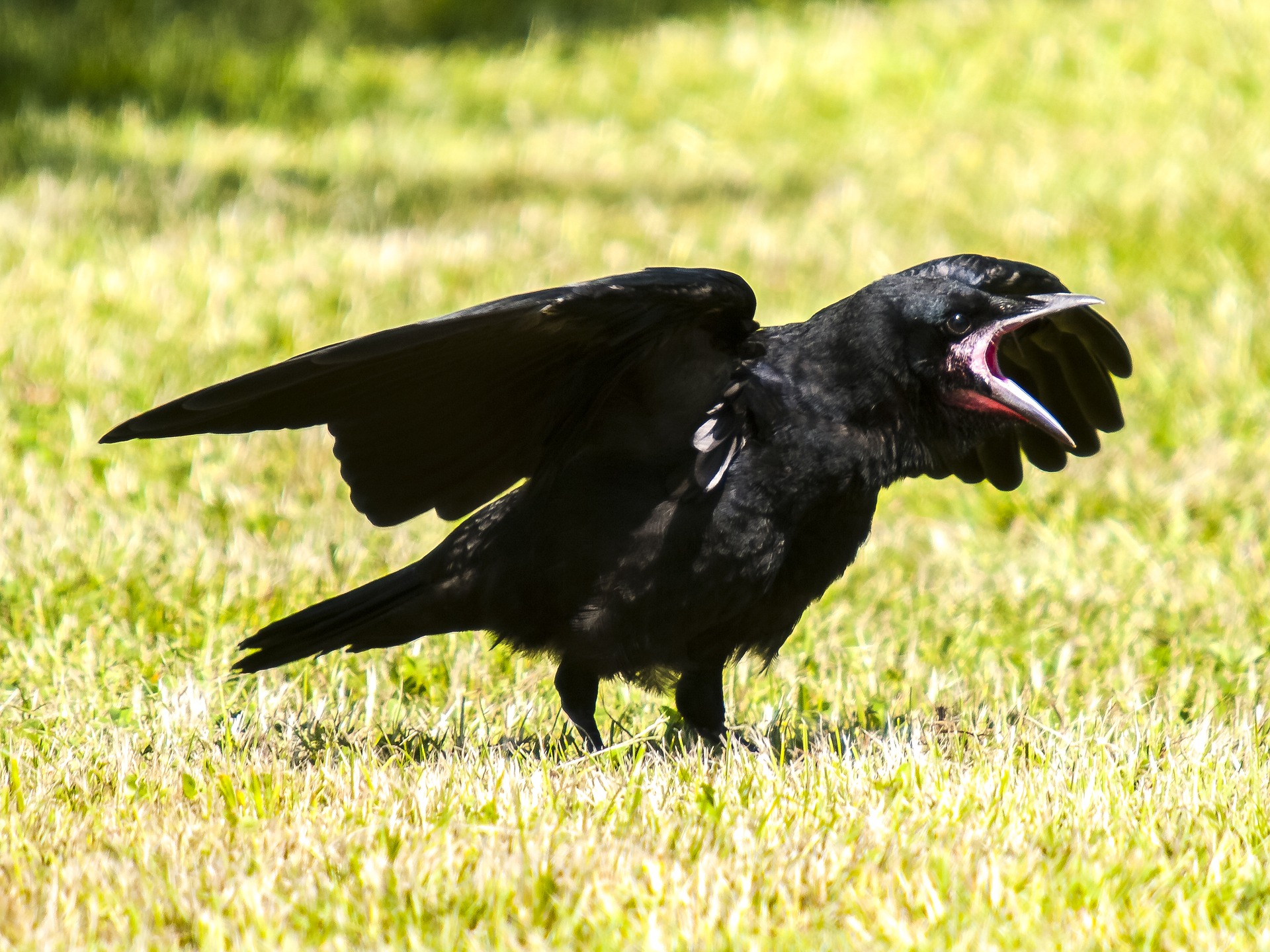
There he is, perched in the oak tree directly in front of our house. The dogs are both in prone position, waiting. I feel the blood rush from my face. My chills return. The bird repeats himself.

Caa-AAH! Caa-AAH!

This is not a companion call; this is an alarm call. He turns his head to the side and looks at me with one eye – the focused stare of a binocular creature – then does a shimmy motion with his neck. Follow me.

Before I can reply, he spreads his wings and swoops down, flying in the opposite direction. Gracie and Joker dutifully chase him through the front yard and across the street.

‘Gracie! Joker!’ I call after them, but to no avail. ‘Dammit, Fatso!!’ The bird has left me no choice. I hop in the car as fast as I can and try and keep pace with the three flying animals.

Fortunately for me, Jeremy heads straight down the long street, so I am able to catch up with them after about a quarter of a mile. The crow flies low to the ground so the dogs can play catch-up – thankfully, on the sidewalk and not on the road. I pull up side-by-side as the fork in the road ahead approaches. Their tongues flap in the wind, and their leashes drag behind them like broken chains. I momentarily consider the irony of being in a car and chasing dogs, but that thought is cut short when the bird leads us all to the left.

A brief drive down this road leads us to a dead end. Jeremy heads left again, along the fenced-in sidewalk that leads to a wooded area in the back of the neighborhood elementary school. That bird just took three left-turns to get here, I reflect. He easily could have just flown over top. He wanted to make sure I could follow. Recalling the alarm in his voice when he called from my oak tree, I shudder to think what he could be leading us to.

The dogs, by now having sprinted at least a mile, start to slow down to a trot, which gives me time to park in the dead end and try to catch up. Alas, they still have four feet to my two, and are able to run into the woods after the bird faster than I can pursue them. I lose sight of all of the animals as they enter the trees. The cold air rasps in my lungs and exits in clouds of thick haze.

Having lost my eyes, I turn to my ears to guide me. I hear the crow again – Caa-AAH! Caa-AAH! Caa-AAH! – and expect to hear barks, but instead hear whimpers and whines. Worried, I start to run.

I see Jeremy perched on a branch above a small clearing. The dogs are no longer focused on him, and as I approach I find their rear ends poking out of a structure – a tipi! Perhaps constructed by some elementary kids playing fort defense, or some teenage couple looking to steal away. My dogs are fully engrossed with whatever is inside.

I call the dogs again. They start toward me, but the whimpers continue. They return to the tipi, and I follow them. As I turn the corner to peer inside, I hear Jeremy’s calls behind me – Caw! Caw! Caw! – and the wind from his powerful wings bristles my hair as he flies away. His job is done.

Inside the structure, a white dog lay still: broken, curled up, and whimpering. I gingerly scoop it up and return to the car as fast as the wind could carry me.
 

The Legend of Sun Breast

crow story, part six.

Sun Breast is a young warrior, a savvy tracker and the Son of the Chief of the Great Nation in the time soon after the long, long winter has passed and the lakes have returned. He is born with hair as bright as fire and with a great fire spot upon on his breast.

As soon as Sun Breast is old enough to keep up with the elders, he becomes a forward-hunter because he is such a good tracker. But mostly, Sun Breast is an adventurer who is always sprinting ahead, beyond where the others can see. He hurries the older braves, almost to the point of their collapse and his boredom. His quest for knowledge cannot be satisfied. Others cannot keep up. He is impatient.

Sun Breast learns all the stories of Spirit Lake, a mythical place where lost spirts are reborn. He is enchanted.

One day, before ten-and-four winters have passed, Sun Breast sets out to find Spirit Lake. He travels alone as he faces the cold winds for several moons. He travels past earth-shaking herds of thick-coats and thick-heads. And past groves full of berries, and hills full of potatoes and turnips. Past so many lakes dammed by beaver and full of turtle.

He eats only what he can pick until he comes upon a huge black bird standing on a log in a clearing. After many nights without meat or fish, he seizes the opportunity, steps from the shadows, and furies his blade with a true aim.

The crow does not take flight. It opens its wings to reveal a burning-red breast that repels the blade and sends it back just as fast.

Sun Breast catches the blade, but it does not cut his hand. ‘How is this possible?’ he asks.

The crow’s breast glows, and he says, ‘you cannot kill your own spirit.’

The young warrior lifts his shirt and shows the bird his own fire mark, which starts to glow for the first time.

‘Why have you traveled so far from your Nation?’

Sun Breast tells him he is in search of Spirit Lake.

The crow says, ‘At Spirit Lake, flesh turns to clay.’

‘I seek not death, only adventure. The legends are many. I want to know if they are true.’

The crow says, ‘Some truths have come before. Some have been lost forever. If you believe they are true, they are true.’

The bird says, ‘my name is ‘Red Crow’ and that the time has come for us to reunite, to travel Grandmother Island as one spirit, unbound.’

Sun Breast removes his shirt and the crow draws long his wings and they face each other a short distance apart. Their two breasts glow red, then yellow, then white as their light reflects off each other, until they shine so bright that shadows are cast in all directions. Until the Sun is gone from the sky. The two breasts slowly dim and fade to ember under a moonless night.

The next morning, Sun Breast awakes with eyes so keen he sees a moth across the field. He hears snakes slither, and the high-pitch songs only the great wings and wolves can hear and sing. He can detect dark movements in the night and feel the wind groan as it passes through the trees. He can taste the slightest scent of fear in the air.

Red Crow awakes the next morning anxious to tell Sun Breast about a dream, his first dream!

For ten-and-two seasons, teacher becomes student and student becomes teacher as each learns the other’s songs, dances and dreams, until they can communicate flawlessly.

Red Crow takes Sun Breast to a tall, tall ridge overlooking the forbidden Spirit Lake, and warns him, ‘No further, or become what you see.’

What he sees is a vast, crystal-clear, frozen lake that falls off the horizon. Above it, colorful lights dance beneath the stars and reflect off the ice. Shadows dance from the thousands of full-coated, full-color clays that stand frozen in time. There are clays of braves who have come before him, and clays of crows, but so, too, clays of fox, owl, wolf, eagle, cicada, turtle and a lean, golden-horned, pale animal he’s never seen before. All, frozen in time.

Red crow tells him, ‘Spirits know many forms and fight many foes. Not all battles are won. Look and see the many spirits who lost. Watch and see their shadows dance together. When two clays become one shadow, their spirit becomes flesh anew on Grandmother Island.’

After three harsh winters have passed, Sun Breast returns to the Great Nation with Red Crow on his shoulder. He no longer has bright hair or a fire spot on his breast, but he is now as tall as three strides are long.

He learns his father has died, and he is now Chief of the Great Nation. And the Great Nation is starving.

Red Crow guides young Chief Sun Breast and his braves to the expanding white forests where trees become canoes and firewood abounds, and to the great hunting plains where the warm-coats roam. Red Crow guides them to soils richened by swollen rivers, and to many distant lands where his people prosper, and live in tipi warmed by fire and fur. The Great Nation survives.

As time goes on, Chief Sun Breast sends many young brave and young winchinchala in all directions to find and fertilize new lands, and to bring back their riches and their stories. He has born to him many sons and daughters that pass on his spirit to many sons and daughters. Many First Nations are born.

Red Crow fathers many offspring that pass on the spirit to their offspring, and for generations too vast to count, Red Crow’s descendants have acted as guides to easy prey, and as lookouts for all unseen dangers. Descendants can tell when the winds will rise and when the rains will fall, and they can see the path ahead before it arrives. Descendants of Red Crow still roam the Americas today, guiding all First Nations’ peoples and their spirits to richer lands, in this life and the next.

End of story.

It makes no sense to me. Even if Jeremy is a decedent of Red Crow, why us? I’m not Native American. Neither is my wife.

I turn to the book, Crow Stalker, the Man Who Mastered Crows. The life and times of Herman Blackclaw. This, too, is translated by Mr. Seven Blackclaw. All the stories, it says, are transcribed from videotaped interviews done between 1985 and 1987 with his father, in Ojibwa with subtitles. The original tapes are in the Seven Suns museum. You can download videos of Crow Stalker’s interviews, complete with crows. It says to understand the messages you must understand the emphasis that is put on each word or song. And to observe the physical movement of the wings, feet, eyes and their stance. ‘Crow’ is more body language than vocal.

It might be useful to see exactly what crows mean when they bob their heads or dart their stare from one eye to the other. I am curious, but my head is already dizzy from Sun Breast.

Crow Stalker’s biography is much easier to read, even with all the Algonquin and Ojibwa native words. Pictures help a lot, too, so do the images of the old posters and fliers that were used in advance of his appearances from Albany to Winnipeg. These are at least in plain, if ignorant, English.

But I want my first question answered before I delve into this old man’s magic, so I look up his vital statistics.

Herman Blackclaw was born in Joliet, Illinois in the winter of 1887-88. The exact date was not recorded. He was father to seven sons and four daughters from three winchinchala. He died one-hundred-one years later, on August 23, 1989, in Laramie, Wyoming.

‘Laramie!’ I say in a gasp.

One of the unforgettable adventures we took in on our three-month long honeymoon in the summer of 1989 was in Laramie, Wyoming. I don’t remember now if it was before or after Las Vegas, but it was the only night out of eighty-nine nights that we didn’t have indoor plumbing. We slept on bison skin rugs on a dirt-floor in a tipi to experience what life was like in Wyoming in the 1500’s. Some adventure! It rained all night with thunder and lightning that created eerie flashes on the side of our tipi.

I remember it was a cuddly-up-tight kind of a night, and not all the thunderclaps were outside the tent. But recalling that evening now, 28 years later, gives me goosebumps.

end part six.

Phil Rosette


Dear readers,

On September 14th, 2017, Phil Rosette passed away after a short bout with an aggressive bladder cancer. This letter is being sent by his son, Jack. Before he left us, I had promised him that I would finish this story on his behalf, in his voice, to the best of my ability. This blog entry, written for the month of September, was the last one that he had written before entering the hospital, and thus, the last completed post for the Crow Story as told by my father. I was anticipating having to write this one out from scratch, until we found this completed draft on his computer. As it turns out, I would have taken a similar approach as my father had to writing out The Legend of Sun Breast, which gives me encouragement for the future of the series. My father never gave me specific instructions to ending the series, only that it could be done in one more post or three more posts depending on a few things. Having read the series over several times now, it will likely be three more posts, as I don’t see a reasonable conclusion happening in a single entry, and I believe my father promised a 10-part series anyway. This will take the story out to the end of 2017.

A few personal notes: the service was held on Tuesday, September 19th, and was well-attended by family, friends, and fellow writers. Phil’s body was cremated, and his ashes will be spread at Brands Hatch race park in Kent, England. If you have not done so already, you can leave your respects here: http://www.desmondfuneralhome.com/obituary/Phil-Rosette/Michigan/1753137.  Phil’s first book, The Freya Project, is available to anybody who wishes to take it – just email me at jackrosette41@gmail.com and I will happily send it to you for the cost of shipping, or I can arrange to bring it to a Deadwood Writers meeting soon. He had left a note here to update everybody on the wedding, so I’ll do that now. My brother and his wife are now happily married, spent their honeymoon out in Canada, and (believe it or not) are now expecting a child. We all wish that Phil could have lived to see his grandchild, but his memory will be passed on through the lessons my brother and his wife will impart.

Thanks for reading, everybody! Until next month,

-Jack Rosette