In my August 2016 blogpost, I stated that the 2012 video game, Resident Evil 6, deserved its own list of nitpicks. It’s my opinion that RE6’s developers went way overboard in terms of content, and it resulted in one of the most flawed video games I’ve ever played. Though none of the previous games in the series is entirely perfect, the one thing that they all have going for them is that they operated on a small scale. Generally, each is limited to 1-3 main characters that the player can control throughout the game and take place in areas that are limited in scope.
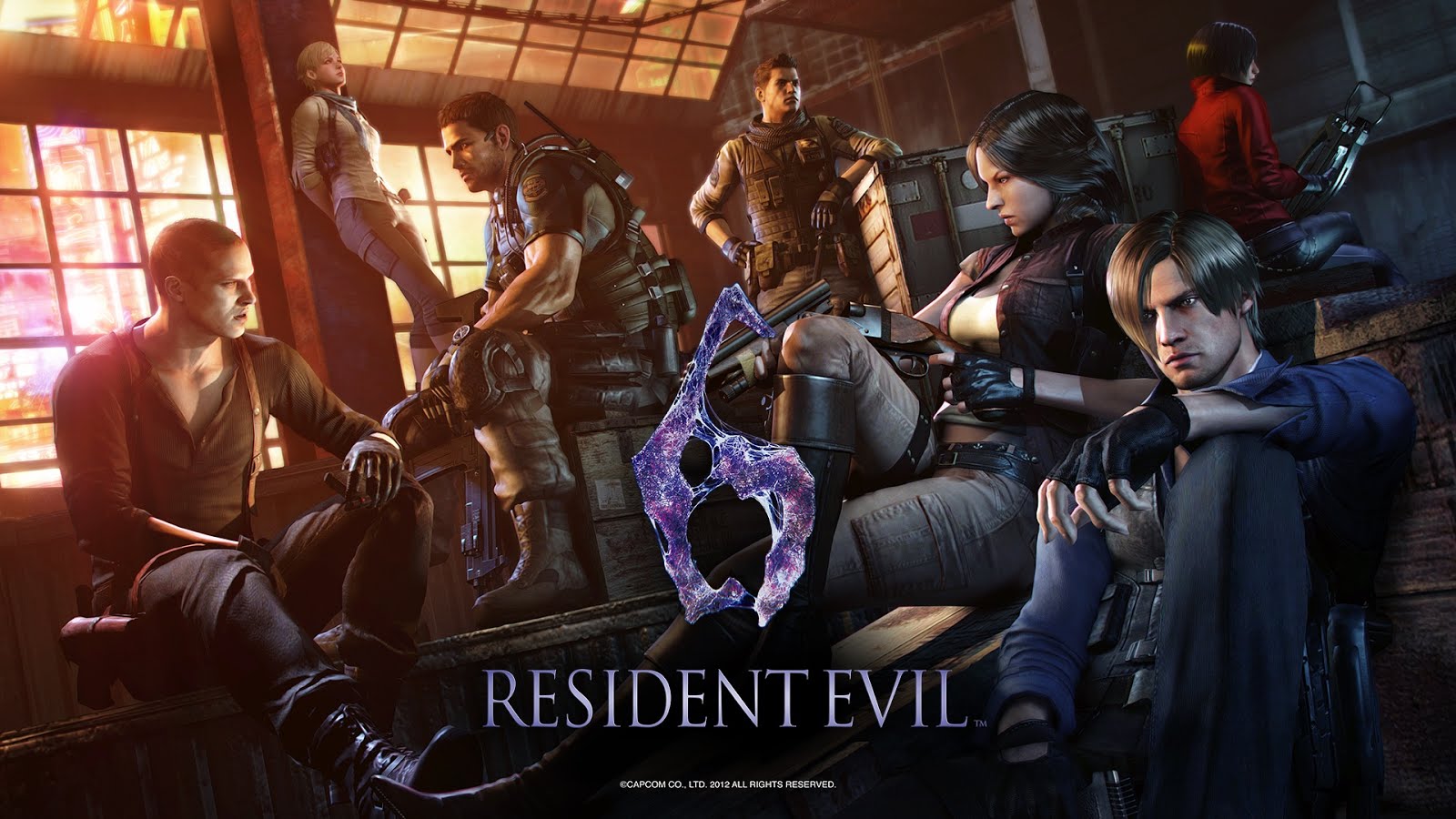
From L to R – Jake, Sherry, Chris, Piers, Helena, Leon, Ada (photo credit below)
RE6 upped the ante by giving the player their choice of seven separate characters to play – four returning from previous games and three newcomers – and having the action taking place in the United States, China, and somewhere in Eastern Europe, as well as on a submarine, a jumbo passenger jet, an aircraft carrier, and a deep-sea oil rig. I feel that both elements ended up hurting the game since more time was spent on their development than on crafting a solid story. (Photo credit) As if the game didn’t suffer enough with its wider character selection and global scale, I found RE6’s many monsters either annoying or over-the-top. If the developers had spent as much time working out the kinks in the narrative as they did designing the characters, creatures, and environments, the game would be much more enjoyable.
While I have my share of problems with this game, I don’t hate it as much as many players whose scathing reviews I’ve seen. I consider myself pretty open-minded, and one of the things I do like is how RE6 has four separate campaigns that each contain a piece of a much larger story.
Before I delve into a breakdown on what irked me the most about RE6, I’ll start with an overview of each of the four scenarios. Government agent Leon Kennedy strives to expose the mastermind behind a string of outbreaks and teams with a rogue Secret Service agent named Helena Harper who was coerced into committing acts of terrorism. Captain Chris Redfield of the Bioterrorism Security Assessment Alliance (B.S.A.A.) seeks revenge against a female terrorist who decimated a military team he commanded, while Chris’ protégé, Piers Nivans, strives to keep him from crossing the line. NSA operative Sherry Birkin undertakes a mission to find and protect a mercenary named Jake Muller, whose blood may hold the key to neutralizing a new manmade virus that’s been unleashed on the world. And corporate spy Ada Wong launches her own investigation when she discovers she will be made a scapegoat for these new acts of bio-terrorism. For anyone who may not have played this game but would like to, please be warned that there are spoilers ahead.
And now, on with the list.
10) Leon has an insane amount of patience.
After being forced to kill the zombified U.S. President, Adam Benford, at the start of her and Leon’s story, Helena comments out loud that the President’s death is her fault. Each time Leon questions her for an explanation throughout the first two chapters of their campaign, she continually makes excuses for procrastinating. Even though he was close friends with President Benford and only just met Helena, I can understand Leon letting it slide once or twice. But it’s a wonder he doesn’t lose it after she blows him off a total of five times. What makes the scenario even more insane is that when Helena finally does reveal what going on, her whole character is called into question. At the end of the second chapter, she discloses that she was compromised because her sister’s life was on the line.
9) Psychological trauma, what’s that?
Chris’ story kicks off with him going AWOL after the loss of almost his entire squad, trying to lose himself in a bottle as a means of forgetting. Piers tracks his former captain down after six months have gone by with the intention of bringing him back into the fold. Yet, the immediate response of everyone in the B.S.A.A. is to throw Chris right back in the field without any treatment whatsoever. It’s even more boggling that Chris has any sense left in between coming off a serious drinking binge, suffering from PTSD, and later obsessively pursuing the woman who killed his teammates.
8) Might as well have a neon sign that says ‘I’m up to no good.’
One of the things I found most puzzling about Resident Evil 6 were the gargantuan humanoid creatures called Ogroman in Chris’ campaign. For the sake of argument, I will say that RE6’s villainess, Carla, was the one who manufactured the enormous beasts encountered by the protagonists. I will also assume that she wanted to keep her activities hidden from the game’s other villain, Simmons, so he wouldn’t swoop in and shut her down. Yet she still tempts fate and blatantly throws several creatures that are larger than a two-story house at the military, as well as spearheads a bio-terrorist organization called Neo-Umbrella. Since Simmons is a character who has government connections, likes to maintain order, and stay on top of things, it’s a wonder that Carla is able to operate unhindered for at least a six-month period.
7) The villains who wield far too much power.
I can understand the need for RE6’s game designers, after the apparent death of the series’ supervillain, Wesker, in the fifth game, to come up with a bad guy or two worthy of filling the void. Yet both Carla and Simmons are able to get away with an awful lot. Between the two of them, they lay claim to a total of three or four enormous secret facilities or bases, orchestrate a presidential assassination, destroy a U.S. city with a guided missile, cause not one but two massive outbreaks that kill at least half a million people, put a big dent in the forces of a global militaristic organization, manufacture one of the most destructive genetic-altering viruses present in the Resident Evil series, and almost bring about the end of the world. On top of all that, either Carla or Simmons has an aircraft carrier, an oceanic oil rig, and a nuclear sub in their possession. Dead or not, I imagine that Wesker has to envy these two for greatly outdoing him in the very game that marks their first appearance.
6) Daddy issues.
I consider Sherry and Jake’s campaign the most polished and straightforward out of the four, but I also feel that it held a wasted goldmine of dramatic elements that could easily have been brought into the story. Midway through their campaign, Jake discovers that the father he’s never known is none other than the late Albert Wesker. If it were up to me, I would have put more emphasis on how Jake deals with the revelation that his absentee dad was the world’s most wanted bioterrorist. It would have been interesting to see more of Jake’s transition from a selfish, greedy soldier of fortune at the start of the game to a character who aims to be the antithesis of everything his father stood for. Even the scene between Jake and his dad’s greatest rival, Chris, toward the end could have been better written and a much more defining moment, for both of them. Instead, Jake, who has shown hatred toward his father through interactions with Sherry, is inexplicably angry at Chris for having killed Wesker.
5) Carla shares Simmons’ obsession with Ada?
The source of the conflict between the two villains in RE6 has an interesting basis, even if the plot itself was not well thought out. More than a decade prior to the events in the game, Simmons was deeply infatuated with Ada, to the point that he didn’t take it well when she left him. He spent a great deal of time experimenting with genetics and harming countless people in an attempt to create a doppelganger. He ultimately succeeded with his devoted lab assistant, Carla, who he brainwashed to behave like the real Ada. This scheme backfired when Carla regained her memory and went mad with thoughts of revenge. The one thing I find the most unbelievable about this whole scenario is that Carla makes no attempt to change her appearance once she remembers. Throughout an entire game that takes place over a six month period, both Ada and Carla have hairstyles that are a perfect match. One could argue that Carla made sure she’d be indistinguishable from the real Ada when it came to framing her. But given that Carla’s master plan was to destroy the world, why bother?
4) Time for a career change.
From the time of her first appearance in Resident Evil 2 in 1998, Ada has never been known as anything other than a freelance spy. One can assume that she enjoys what she does or she wouldn’t still be at it by the time the sixth game rolls around in 2012. While it’s puzzling why Carla even attempts to pin the latest string of terrorist attacks on her, there is a plot element toward the end of Ada’s campaign that makes even less sense. A peek into Ada’s thoughts reveals that she intends to destroy any evidence that would prove she’d played no part in instigating the attacks. Unless being labeled as a bioterrorist is some weird way of increasing her notoriety or deepening the pool of people looking to hire her, Ada must really be begging to spend the rest of her days behind bars if any law enforcement agency or the military ever catch her.
3) Zombies on a plane.
My explanation for the plane crash that occurs in chapter 4 of Leon’s campaign is that the game developers must have really wanted a grand spectacle to mark Leon and Helena’s arrival in China. But the events leading up to it are just plain idiotic. The buildup to this scenario is as follows. Leon learns from one of his allies that Simmons is en route to China, and Leon and Helena book a flight in pursuit. Sometime during the last leg of their trip, the heroes discover that the pilot has fallen victim to a virus and has mutated into a horrific creature that is infecting everyone on board, except for the protagonists. The game’s biggest mystery is that it never explains how or why the pilot is targeted. By this point, Simmons had just been made aware by Ada that Carla is on a rampage, so his focus had to be primarily on dealing with her. And it’s doubtful Carla would set her sights on eliminating Leon and Helena out of nowhere since she pretty much ignores them throughout the whole game. Unless there was an unknown third villain in play operating from the shadows, it would have been impossible for anyone to start an epidemic aboard a specific jet that had been in the air for roughly twelve hours.
2) Just die already!
Generally, I’m someone who likes a challenge and to square off with any game’s final boss that takes extra time and effort to triumph against. But RE6 sets the bar ridiculously high when it comes to Leon and Helena battling against Simmons. Within minutes of being exposed to Carla’s specially-made viral cocktail, Simmons mutates into an oversized canine-like creature and is seemingly stopped when he gets dragged underneath a bullet train that subsequently derails. But it doesn’t stop there. For Round Two, he transforms into a mutant T-Rex and seemingly dies again after getting pumped full of lead. Round Three sees him go back to his first stage mutation and supposedly bite it when Ada stabs him in the side and drops him into a raging inferno. For the final round, he becomes a giant housefly – God,I wish I was kidding about this – and is ultimately defeated after several lightning strikes courtesy of a metal antenna that gets stuck in him and getting shot by a rocket launcher. And yet what finally kills him is that he reverts to his human self, gets impaled on an obelisk, and bleeds out. To say all of this is overkill is a vast understatement.
1) If the monsters don’t get you, the camera angles will.
One thing that annoyed me the most about RE6 aside from the many plot holes was a certain game mechanic that got me killed more than once. Sometimes, when my character was running from something dangerous, the tendency of the camera view to shift by a 90 or 180 degree angle without warning often resulted in said character sprinting in the wrong direction. This aspect was never more frustrating than when I was playing the last chapter in Chris’ campaign and had to run up this inclined spiral walkway to get away from a giant creature that was after me. The game keeps track of how many times you’re killed, and in all other chapters, my death count averaged from 3-5. For Chris’ final chapter, I got killed well over a hundred times before I got it right. To give an idea, here is a video recorded by another player of the scenario in question.
For a game that has this many flaws, you might ask why I’m in the minority of people who don’t flat out hate it. I would say that as a writer with a very vivid imagination, I see ways in which those imperfections can be corrected. I have even done so through writing my own What-If fanfiction stories. I am currently working on an alternate take of the events in the fifth game, a story titled Tangled Web. And I have some ideas in store for a sequel to said story that will borrow the best elements from RE6.
And, whenever I get around to writing my planned fanfiction sequel to Tangled Web, I can guarantee a cooler climax than battling a giant insect.