Author Archives: dwhirsch

Superfan Powers Activate!

I've found the new workbook as useful for blogging as the original book (another reason to share).

I’ve found the new workbook as useful for blogging as the original book (another reason to share).

What is a Superfan, you ask? Good question.

A Superfan is someone who adores, loves, admires and worships your artistic work. It’s not a phrase I coined, but a word someone wrote on a blog sometime mid-2015. If anyone out here has also read that intriguing post, please let me know so I can correctly credit the author. The word stuck with me, and it’s a way I now frame my thoughts and perceptions and just about anything when it comes to supporting fellow writers.

I am a Superfan of some writers, meaning I devour anything they write. I promote them by screaming from the rooftops and through my typing fingertips on social media. They owe me nothing, but I owe them my inspiration. Something about their writing, artwork, photography or personal interests resonates with me and I can’t not support them.

I stumbled on Marcie Hill’s book, “62 Blog Posts to Overcome Bloggers Block,” at a time when I was struggling with my blogging topics. The tip that resonated with me most was: It’s not cheating to publish a pictures-only blog post. I never thought about that, even though I have seen such posts elsewhere. I devoured her book, used some of her tips, and then I left an adoring review on Amazon. She wrote me back, “Thank you for that review.” I followed her blog and her Twitter account. Without asking, she did the same, and that’s how our relationship started.

Part of Superfandom is how writers treat me. It’s that personal touch, that sharing with others. I prefer to show my appreciation of Instagram photos with words rather than just Liking them. After commenting on @josameys.words poem about villains and heroes, we had an intense, and rather hilarious, discussion about the pros of being a villain and which Disney villains have the best wardrobe.

Remember the key word in social media: Social.

These authors, artists and other people talk with me. I couldn’t attend a weekly Twitter Chat with Nori (@ReadWriteLove28), so I Tweeted her.

“Wish I could’ve made it, but was still getting over bronchitis.”

She Tweeted back, “@dianahirsch Oh no 🙁 I hope you’re feeling better now!”

I replied, “Yep. Finally better. Took 2+ lingering weeks, but I’ll be ready next #RQWN.”

She replied, “@dianahirsch Oh good, I’m glad!”

Someone who takes that much time and attention is my idol. To show my appreciation for anyone who does that, I retweet their Tweets, I {heart} their videos on Vine and Like their Facebook page, when I’m on Facebook. Beyond such standard protocol, I ask questions and send encouragement through Direct Messages (DM). I show my hero worship by engaging with them on a personal level.

You can make people like you and have your own Superfans by doing those same things. Make sure there’s personal interaction not just some stock “Thank You for Following Me” auto reply. Be polite. Be sincere; don’t say something if you don’t mean it. Make followers feel important; they are your best advertisement and supporters. Answer questions. Send loads of virtual warm fuzzies across the Internet. Emulate the people you want to be.

Make people smile. They will adore you for that. It’ll make you feel good, too.
What is Writing?

What is writing to you? Writing can mean many things to different people.

1–Writing is exhausting.

Remembering the rules of syntax and sentence structure is a struggle. Perfection halts our progress putting words to paper.

1–Writing is exhilarating.

Initially, don’t worry about spelling and sentence structure. There is a freedom to words. Getting your struggles and thoughts out of your mind and onto paper clears your head. Once they are released into your world, you can address them. Accomplishing that is a thrilling expression.

2–Writing is personal.

It is risky to write. You expose yourself to others’ judgement. Your self-image becomes vulnerable to criticism. Those are scary moments.

2–Writing is personal.

When you share your words, you share your experience. Others do relate to that. Hearing someone say “I learned from this,” “I was entertained,” and “this made me cry,” is a compliment and a success.

3–Writing is reclusive.

Writing is just between you and your thoughts; nothing else. You have no coworkers or teammates to rely on.

3–Writing is sociable.

Virtual communities of writers understand your struggles. Social media connects people around the globe. Local writing groups strengthen that support. A kind, inquisitive word from a stranger in a coffee shop is supportive and reminds you that you are not alone.

4– Writing is frustrating.

Ideas are fleeting. Motivation rises and falls. You slam into the Writers Block wall over and over and over again.

4–Writing is invigorating.

By declaring, “Writing is worth making the time for,” you choose to commit to yourself. You whisk a reader away into a world you control. You paint with words, drawing scenes in your readers’ minds. Extra incentive comes from the release into the world. It is rewarding to receive a positive review on a reading website or from someone who is not your immediate family network and friends.

5–Writing is limited.

Only a few rare people get a publishing contract. Large publishing houses have limited resources of time, printing, ink, and space. If you do not make a living by writing, then you do not have a “real” job. If you just dabble in your journal, you’re not doing any real writing. Without public validation, all efforts are snubbed as “just a hobby.”

5–Writing is limitless.

If expression is your only goal, then laptops, electronic tablets, journals or paper and pen are all friends. Writing anywhere is accessible. If publishing is a goal, the publishing options range from working with a Big 5 publishing house to a small startup publisher. Self-publishing has become mainstream, be it an eBook, paperback or picture book. You own your options and control your future.

6– Writing is work.

Standard books are long. Whatever your measurement–word count of page length–completing something that complex is a massive task. Revisions take time, a lot of time, and are often disappointing. Writing is intimidating.

6–Writing is work.

There is power in writing the words “The End” on your work.

That’s what writing is to me.

What is writing to you?

Using Social Media to Overcome Writer’s Block?

Writing takes practice.

Sure, we all know that, but too often, we are frozen by the blank screen or paper we call Writers Block. At least, that’s the excuse we tell ourselves.

The only way to break down that wall is to write.

And that brings us back to the beginning. How do we begin writing? Where do we find ideas?

Blog Writing Challenges

 Whether you have written or write for a blog, you need some social media presence to maximize this option. People are sharing their creative arsenal to battle the widespread war of writer’s block across the webisphere. These challenges are sites all across the Internet. Your journey is to find them.

I’m a fan of the social media site Twitter. Unlike Facebook, it’s an open media without memberships or restrictions. Connecting with writers and readers and celebrities is a Follow click away. Unlike LinkedIn, it’s not business-focused. Unlike Google+, this is not a new, unknown experiment. Twitter is established, creative and short to swallow with its 140-character limit in each Tweet. It’s easy to find similar topics and groups with a simple #hashtag search.

On the day I wrote this, I found an array of challenges with directed yet general hashtag searches. Some of these lead directly to the moderator’s website, while others simply group posts together under that specific hashtag.

Searching the Twitter hashtag #challenge showed writing and non-writing Tweets.  Scrolling through feed, the most relevant ones came from users like @convince to post a photo with every Tweet for one week, @RonovanWrites with his weekly haiku prompt  and @lettrs posing a #WordOfTheDay challenge.

One of my favorite hashtags is #6WordStory, a challenge posed by @Kelsye. Other searches relevant and directed to writers include: #WritingChallenge; #poetrychallenge; #FiveSentenceFiction; #haikuchallenge; and #fictionchallenge.

Twitter is not case-sensitive, so upper- and lower-case usage is personal preference. The words get you to the same location. I like to capitalize some of the longer hashtags to make them easier to read.

The beauty of Twitter is the prompts are provided, and the ideas out there are bountiful. Once you find an inspirational idea, attack that challenge with all your creative energy. Many people link to their personal blogposts, but you don’t need a blog to participate. Create a separate file on your computer and dedicate 15 minutes a day to play with words. Do an email exchange with a friend or family member. If you are uncomfortable sharing, choose a journal to write in for your personal enjoyment.

If you want to publicly share your accomplishments submit these, or parts of it, on your social media or link posts to your personal blog. If you want to make a visual expression of your art, use a smartphone app like InstaQuote or Notegraphy to create a graphic to share with others or save to your camera roll.

Using photos allows your social media reach to increase. The Twitter user @asilartist tied her #9WordStory challenge together by cross-posting from her @reclaimed poet Instagram account. The same hashtag exploration applies there. I found creative posts with the tags: #WritingChallenge; #PoetryChallenge; #threewordstory; #poemaday; #flashfiction; and #4WordStory.

Beware! Most users will use more than one tag, adding several related hashtags so their post can reach various audiences. As your curiosity increases, you will find yourself winding through a maze of related hashtags so that you can forget the original hashtag you started searching for. It’s glorious. It’s frustrating.

There are worse things than being lost in a new tag that connects to a newer tag that inspires you to search for a personal interest of yours. It’s the only way to drag yourself over that tall writers block wall.

Pinterest for promotion: Tips and inspiration

Penn State PinterestSocial media: is it selling or sharing?

These days, it’s a bit of both.  As a writer, or anyone with a product to promote, social media presents powerful platforms. You can spend more time socializing than writing, so where do you focus your attention?

Pinterest is a social media cut-n-paste website to collect and save online items meaningful to you. Neater than a folder of newspaper clippings from back in the dinosaur days, when you find an image or idea that you want to remember, you “Pin” that image to a “Board” that you create.  Presto! Your collection begins.

The anatomy of a Pin is an image, the description and the website link.  The image is the specific, intriguing picture from the website. If the site isn’t set up to instantly open Pinterest when you hover over the image, you can manually add the image to your Board with the Pin It button you download from Pinterest and save to your computer’s internet taskbar.  The description is whatever you type in as a reminder to you–a cool title, the inspiration for saving it, your impressions–all in 500 words or less.

The website’s link automatically attaches as an electronic sticky note to the “Pinned from” line, and this takes you back to the original post.  If you Pin directly from your smartphone, the Pinned from line simply states, “uploaded by user,” thus creating a static image gallery.

Boards group specific topics or themes together, such as: recipes; parenting; DIY crafts; men’s fashions; travel destinations; and home décor. Quotes and infographics are popular, too.  If you want to connect with users—or Pinners—who share your interest, search the site by category, keyword or user names.  Here’s where the social aspect steps in.

When you discover an image someone else saved, you can Pin that Pinner’s pin to a Board you created, and vice versa.  To see a Pinner’s latest discoveries, you “Follow” that person, and then you choose to follow all or just some of their Boards.  The most popular Pins, popular by Likes or Pins, come up highest on any search.  It’s important to be social to be discovered.

Remember that, “Pinned from”, direct link I mentioned above?  This is where the promotion aspect steps in.  You want to send people to where the action is, so create Boards that link directly to your blogsite, etsy shop or Amazon page.  Create exciting titles and use the description box wisely.  Like other social media, use #hashtags to group your pins and to be instantly site-searchable.  Type in an additional website link in the description box, and it is an active link, giving you additional promotion tool option.

Who do I like?  Who uses Pinterest well?  Who inspires me?

Drive traffic back to your own website like blogger Laurel Regan (Alphabet Salad) by grouping her blog posts, most recently for her April 2015 A to Z Blog Challenge posts.  I found her through that blog hop, and she inspired me to create my own A to Z blog posts Board.

Intrigue your current and future readers like writer Wendi Knape (Wendijowrites) does by teasing them with images that inspire her writing.  One of her stories, Jacob and Charlotte – Meet Cute, features the characters Jacob and Charlotte. Wendi created a Pinterest Board to describe her characters’ “development, clothes, hair, living space [and] favorite foods.”  This inspired me to give readers insights into my own writing process through my “Author Inspiration” board.

My use of Pinterest has been a mixture of art and writing.  “Scrapbooking and artsy-fartsy stuff” collects mini-album and ephemera ideas to pitch to my editor of Michigan Scrapbooker Magazine for future articles.

My Zentangle boards promote my classes as a Certified Zentangle Teacher (CZT) and artwork that inspires me.  Why not let others know what moves me, as well as inspires my works of art?

“Holiday Festivities” gathers spooky ideas and recipes I use to create great visual images for my blog’s annual Halloween post.  See how I used the ideas to create party atmosphere in my 2014 Halloween Party blogpost.

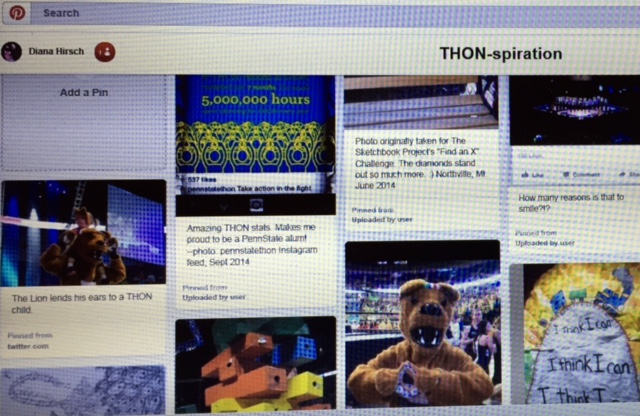
“THON-spiration” collects images related to the fight against childhood cancer and The Penn State Dance Marathon (THON); it is currently my most popular board.

As I was typing this post, I created “Books by D.W. Hirsch” Board.  In the first 24 hours, I had 24 followers.  How cool is that!

I can’t guarantee any success like that, but I can share tips I’ve discovered along this social journey.

Tips to get the most exposure to yourself and your Boards:

  • Creative titles.  Make your Boards sound so exciting that people can’t resist clicking on them.
  • Maximize the description box.  Don’t write wordy paragraphs; space out long sections of sentences.  Include hashtags, keywords, and related websites, but use tabs or double-spaces between these words.
  • Choose the most interesting, active image to Pin if you have multiple options from a website.
  • Credit the original artist every time you share personal content.  Let them know you’ve done that and they may follow you back.
  • For more ideas, search a general word.  Type the word “writing” and you get subcategories of novel; inspiration; prompts; quotes; and more

Some writing-related Board ideas include:

  • Writers you like and blogs you follow.  Be sure to describe why you include them.
  • Books you like or want to read.  This gives people a look into your personal likes, and they may discover a new book to read after seeing your interests.
  • Share and be social: promote other bloggers or writers by posting their content.
  • List blog or writing challenges for future exploration.
  • Promote personal blog posts.  Group these sites into related categories and boards.
  • Share other media images like screenshots of your Twitter posts.  Be mindful of others’ privacy.
  • Favorite quotes

Pinterest works best for people who actively wander around the Internet.  Creating a Board or Pinning an item can take as little as 3 minutes, but this may be an awkward medium for some.  It takes time to ensure the correct link, to write an appropriate description, and then roam around Pinterest looking for people to connect and share interests.

What site platform works best for you?  Are you still discovering?  Share your thoughts in the comments below.

Books and Death

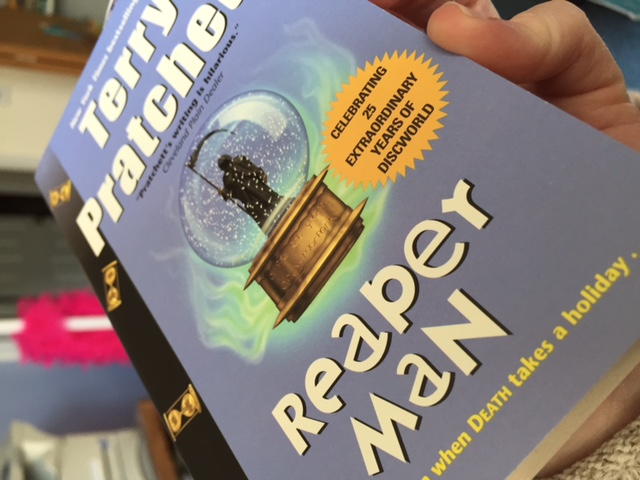
Reaper ManI recently read a blogpost reflecting on the death of author Terry Pratchett.  Terry Pratchett…why did that name sound familiar to me?

The reflective blogger lived in the UK and noted that Pratchett was a best-selling English author of fantasy novels.  I guess that’s why I hadn’t heard the news.  He must be a bigger deal there than here across the pond.  But that name still tugged at me. Did I ever read his books?

Of course I did.  I’m embarrassed to admit that.  I didn’t make the connection until I did an Internet search.  He wrote the Discworld series, a satirical set of stories that ties together dragons, witches, politicians, gods, cats and centaurs that live in a flat world.  During high school, I dove into book series like this as well as the Myth series by Robert Aspirin and the Xanth series by Piers Anthony.

The Color of Magic was Discworld Book 1, a tale about our hero wizard, Rincewind, who travels from his home city of Ankh-Morpork to the edge of the Disc, a journey that is actually a chess game played by gods.  Suddenly nostalgic, wanting to feel a part of it all and properly mourn the death of a fine writer, I searched my stash for his book.

My bookshelf boasts blank journals and an eclectic combination of my read-or-to-be-read-again books.  Many of my sentimental favorites are in boxes in the basement, callously but deliberately misplaced from my reach, so I wasn’t sure I’d find anything upstairs, but that was the easiest place to start.  I was surprised when I saw right there on the second shelf, third book down on the overflow sideways stack, was the book Reaper Man by Terry Pratchett.

This wasn’t the first book in the series, yet I know I bought this one for a reason.  Why?

Two things caught my attention.  One, the front cover blurb reads, “It’s no vacation when Death takes a holiday.”  That’s what must have caught my eye because cover art does nothing for me.  This version showed the Grim Reaper with scythe inside a snow globe.  Charming, I suppose, but titles and taglines grab my valuable reading attention.

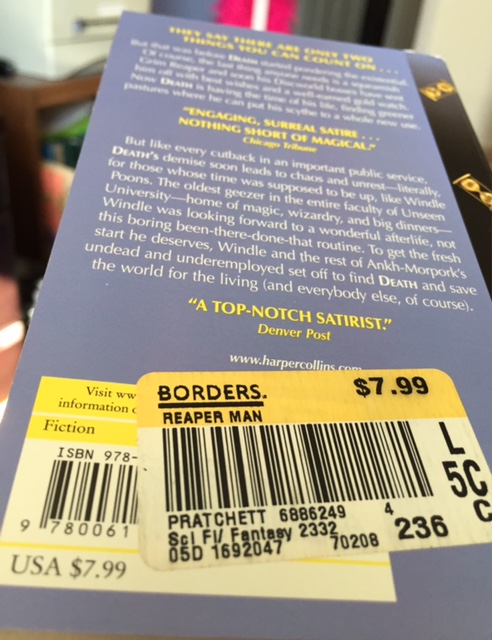
Reaper Man BordersThe second thing was the back cover.  The price tag was from Borders, a bookstore chain that died almost exactly 4 years ago.  Based on the book’s placement on my bookshelf, I must have bought it from the custom-built-from-scratch store that opened 8 months after I moved to Michigan.  This new store was less than 3 miles from my house, freshly built for me I liked to think, but that store became the default hangout spot for my husband and me.  I wandered the aisles and often took a magazine or my journal to the upstairs café before he joined me.

The store chain closed in July 2011, displacing us shortly after I became Foursquare Mayor of that location, and an appliance store snuck into those walls.

This one book brought back so many memories.  It was Death in so many forms.

In December 2014, I committed one New Year’s non-Resolution to revisit an old favorite book.  At the time, I had one particular book in mind, using this as an excuse to read that book for the third or fourth time.  But now I think this is the one to revive and explore.  Who knows?  Maybe I’ll write a review about it to remember reading it this time.