Author Archives: dwhirsch

I Published a Book in 10 Hours

Jimmy the burgler

I did it!

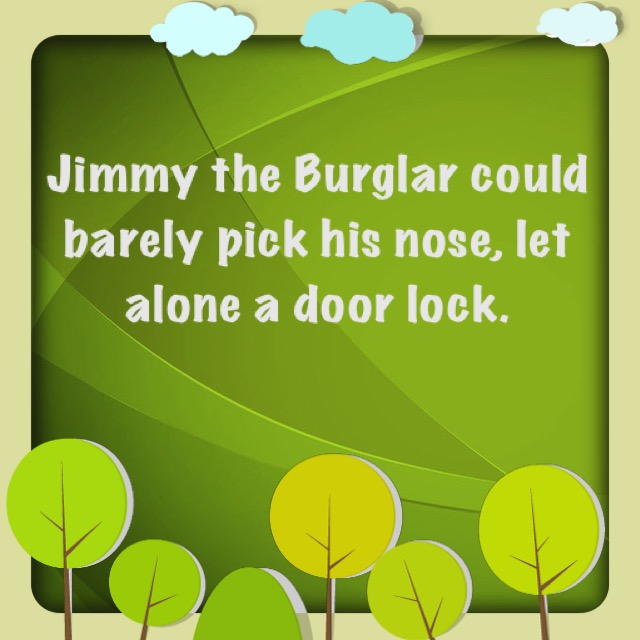
Families inspire us and intimidate us.  Jimmy’s mother, father and brother are all members of the Burglars Union Guild (BUG), and he is expected to follow in their footsteps.  Jimmy has slippery fingers and not in the slick, pickpocket ways; he drops things.  That lack of dexterity is just the start of his struggles to gain entrance into the most elite thief organization.  The story of his life is now immortalized in electronic bytes.  I published a book.

I didn’t do all that writing in one day, as I proposed in my original challenge.  I also spent more than 10 hours writing Jimmy the Burglar.  Regardless, I completed the challenge.

I feel really good about that because this is my first fiction piece in a long, long time.  Fiction is easier to write than memoir because I could make up whatever stuff I wanted.  Fiction is also harder to write than a memoir because I had to make up whatever stuff I wanted.

This is my third self-published book, and I learn new elements with each effort.  This time, I experimented by writing the first draft in longhand.  At 2 hours and 56 minutes of writing, I hit a wall: great story elements, but no tension.  Typing that first part in gave me time to think about the story I wanted to tell here and now and in 10-ish hours.  I initially focused on the entire family history as related to the evolution of the Guild, but in that writing, I developed incredible backstory fodder for future Jimmy short stories.  The tale worth telling today is the evolution of Jimmy’s final exam for BUG membership: his MOTH (Modus Operandi Thesis Heist).  After the humiliation he experienced working with Big M, it is vital that Jimmy’s MOTH get all the details right.

At 7 hours and 42 minutes, I was having Too Much Fun writing. So much fun that, I forgot to reset the timer at one point.

After 16 hours (approximately) and 5100 words (23 pgs.), you can read Jimmy the Burglar’s first adventure on Amazon.com.

How did your story turn out?  If you completed the challenge, post your link below.  If you didn’t, share your thoughts now about the experience for all of us so we can learn from it.  And for me, I’d love to know your thoughts about my book. Whaddya think?

If you’re looking for some inspiration and encouragement to complete a book like this, there is a day-long workshop planned for early 2015 in the metro Detroit area.  Stay tuned for the details.

Even if publication isn’t your goal, doing a challenge like this is immensely satisfying. I have typed “The End” on a piece of my writing and am now moving on to “The Next.”

Writing: Promises or Priorities?

They say timing is everything.  I agree.

So is letting go.  That’s why I say to whomever “they” are that I’m extending my 10-hour book publishing challenge to December 18.

Why?  First of all, it’s my blog challenge and I set the rules.  (And my blog editors said it was okay.)

Second, I felt overwhelmed by things crashing into each other.  Fundraising to dance in THON clashed with my seeking financial support for my Indiegogo campaign.  The extra shifts for my part-time job slammed into prep work time for my Zentangle classes.

The last and most important time-suck of the month was me.  I watched my Major Crimes DVDs over and over, obsessing because the new season starts next week.  I wandered aimlessly through the playgrounds of Instagram.  I tell myself that writing haiku through Ku and Notegraphy phone apps was a productive use of my time, but, really, that was another distraction.

I sound just like that person I wrote about last month.

Now, I did catch a cold.  I was not so sick that wiggling my toes hurt, but I sniffled enough where leaning over my keyboard caused my nose to drip and drool on the keyboard. Any precious time I could snort the mucus back, I spent that time on my memoir.

Outside of that, I chose to be careless with my time, and now I’m here apologizing and making excuses.  Why did I not value my time and talent?

I thought about it.  I figured I’d have more success collecting donations for THON when I wasn’t asking people to buy my book.  Rather than compete with holiday parties and family events, it made more sense to me to plan a marketing strategy for my Zentangle classes in the New Year when I wasn’t marketing my memoir and my Indiegogo crowdfunding campaign.  At some point, the money from working extra hours at my job was not worth the time that could have been spent writing my memoir.

Are you seeing the theme here?  Believe it or not, I didn’t at first.  When you think about your responsibilities–I mean, really think about them–listing your life out like chapter outlines will identify the events that really matter to you. Here I’ve moved on to the next step, the follow-through that freezes many would-be writers: I’m letting go of extraneous tasks and planning.  Not everyone does that.  They usually give up.

I didn’t give up; I refocused. That’s not an excuse, although we may see it as such. If we do, then we fail, fizzle and flop.  I didn’t think I needed to prioritize, but I couldn’t identify what really mattered until then. Of all the items on my list, my memoir was most important to me.  Knowing that, I could push everything else aside.

All of this brings us back to the postponed eBook challenge. Yes, some readers who were expecting Part Two this month may be disappointed, but remember, I’m rescheduling it, not giving up.  Think of it as…increased anticipation.

How has this shift in priorities helped my memoir time? With the extra time, I was open to rearrange and commit to the Chapter order.  After doing that, the process flowed better. Both self-editing and finding an editor takes longer than I thought.  Re-launching the Indiegogo campaign was frustrating and disappointing, but the descriptions and perks are now more enticing.  I’ve explored marketing ideas and am planning specific actions of specific dates.  For other ideas, I’m letting those all percolate.

Did you make a writing promise to yourself and were unsuccessful?  No one can change what happened yesterday.  It’s been done, but that doesn’t mean you’re a failure.  How do we start fresh without feeling guilty?

First, forgive yourself.  We’re all human, but we can do simple, little things.  What should you consider when planning your writing time, or anything else, really?  I can offer some advice.

1. Don’t rely on To-Do lists.  From my experience, they appear organized but are often overwhelming, and thus counterproductive.

2. Don’t say yes to things just because that time isn’t blocked off on your calendar.

3. Break up your lunch hour by standing up and physically moving away from your desk.  If that’s the time you squeeze in exercise, give yourself permission to write during one or two of those times.  Take your laptop into an empty conference room or even your car to write away from distractions.  No laptop? Use paper and a pen, as we dinosaurs did in the pre-digital age.

4. Family and relationship time is important so look for ways to balance the two. I can write in the living room on the couch next to my husband as we watch episodes of The Big Bang Theory.

No matter what you do, the key is making the time.

Did I say any of this would be easy?  If it was, we’d be doing it all and there would be no need for me to write this post.  We’d all be published authors with worldwide readership.

We know self publishing is possible. I can’t promise readers will love your stories, but if you don’t publish, how will people be able to read them?  If you have already completed the 10-Hour Challenge and published a book, leave the link information below in the comments.  If not, then you have another 30 days.  Timing is everything.

Ready? Set. Go!

You can write and publish your story in 10 hours

I dare you.

Do you remember when writing was fun and carefree? I do. As a kid, I would pull out a notepad and write stories just because that’s how I chose to pass the time. I mostly wrote fantasy stories, some science fiction without all that technical mumbo-jumbo. My dragons had their own rules of behavior and almost every character had an apostrophe in their name.

I created bizarre plot twists. I didn’t fuss with grammar or sentence structure. I didn’t care if the stories were proper writing; I just wrote a rough draft that I always thought was complete. I had fun.

Somewhere along the way, writing became structured and proper. Because of that formal format reality, I look at those drafts now and I think, “What silly little creations.” Why did I bother? Why did anyone or I care?

I expect that if you’re reading this blog, you remember that feeling, or you know someone who has. You, as a reader, can tell when the writer was having a good time and when it was an assignment. I invite you to rediscover that freedom and write with abandon. No doubt, you still have one of those stories down on paper or in your head. This month, I dare you to complete it and publish.

I talk a lot about self-publishing as if it’s gospel. The fact that I’ve done it twice–soon to be three times–does not make me an expert, but I feel confident in it. I know the powerful feeling of control, a feeling that comes from writing, editing and finishing a piece of work. Hitting the Publish button on Amazon is a daring and satisfying moment. I want you to experience that feeling.

Why should you?

Even if you don’t dream of publishing, I challenge you to do this. It’s a sense of accomplishment to write a draft, to edit that draft and by publishing it that means you finish something that you’ve started. Maybe you just have a story to tell, say it’s a letter to your parents, and wouldn’t it be cool to download it onto their Kindle for Christmas? Maybe you have a story about you and your friend. How cool would that be?

When you were in school and had an essay exam, the class eventually ended and you handed in your work as-is. At that moment, you were done. It was a relief, wasn’t it?

National Novel Writing Month (NaNoWriMo) is coming up in November. The concept behind NaNoWriMo is to kickstart you into completing a full-length first draft, but writing 50,000 words in 30 days can be intimidating. Even though that breaks down to 1667 words a day, or 69 words an hour, that finite number may be too large to be comforting. I suggest something doable.

My idea is a spin off from JA Konrath’s blogpost back in August 22, 2013.  The idea mingled fun with structure. Pretend writing is your business. Sit down at the beginning of your 8-hour business workday and write a story, edit it and publish it online. It can be that easy.

My two published short stories have been a result of that challenge. My approach was to start at 8am with a cup of coffee and an open Word document. I write one sentence so the screen is no longer blank. Then I just write, completing my first, rough draft by 12noon. I take a typical hour lunch break. From 1-5pm, I rewrite and edit my text. You can format and upload your text in that timespan as well, but consider taking a dinner break, and then work an hour or two of overtime creating an account, formatting the text, uploading it to the site, and adding cover art.

True, each time I began with a vague story idea and direction, but that was it. There was no outline, no structure, and no definitive plan. I could just as easily have pulled out one of my silly little fantasy stories and see what I can do with it now.

My first e-Book experience was my memoir about a trip my mom and I took. The book–Mom, Star Trek and Las Vegas: A Grand Adventure required research because Trekkies or Trekkers will know if a name is incorrect or a date is wrong. I thought I could sit down in one eight-hour stretch, but I did not. I wrote an hour here, two hours there, made 20 minutes for research here and so on. I was committed to finishing it, whatever the timeframe.

Writers who took the 8-hour challenge, published by August 30. That was eight days after the issued challenge. I’ve read some of the published work and some of them read as if written in 8 hours. But so what? The author wrote, edited, and completed the work. That was the fun of it.

On October 6, after 18 hours and 45 minutes, give or take, I was an officially published author. That was 45 days after the initial post. Final word count: 5657 words, about 22 pages.

My mom memoir e-Book won a national award: third place in the NFPW 2014 Communications Contest.

My second eBook–Lessons from Dad: A Letter to You–was a prelude to my upcoming novel memoir. I released it on June 14, 2014: Father’s Day. I counted it by the number of edits–four, including initial draft–rather than hours, which I estimate took 12 hours. That book is 5111 words, or 21 pages. For 99cents, both books are a bargain read.

What’s the number one reason people don’t do this? Without conducting scientific research, my personal experience is “I don’t have the time.” Wrong. You don’t make the time.

You say you’re too busy, that there are too many other tasks distracting you? You have dinner to cook. Your kids have after-school activities and you’re the driver. You volunteer at the library. You work a 9-to-5 job and commute an hour each way. You have a report to write. There are weekly soccer matches to attend, so you wake up at 6:45am every Saturday. You go to church. You have a monthly date night with your spouse. Your favorite TV show has begun a new season. Repeat week.

Excuses. All excuses. They are reasons, but they are also excuses.

I will attempt this by my next blog post. So, what does my life look like? I don’t have kids to factor in, but I picked up about five extra shifts at my part time job between now and then. I’m traveling out-of-state, teaching Zentangle classes, co-hosting a monthly art group, having a Halloween scrapbook crop at my house, celebrating my 11th wedding anniversary, and raising funds to dance in February’s THON.

I am madly editing my dad memoir novel for ePublication on November 20, my father’s birthday. I’m promoting that book on Twitter, Instagram and my Facebook Author page. Let’s not forget that I have my own blog to maintain, including my annual Halloween blog hop post.  There are articles to write for Michigan Scrapbooker Magazine. I’m editing posts for this blog, critiquing submissions for this writers group, and writing the follow-up November post of this challenge. In utter madness, I also signed up for NaNoWriMo this year.

And there are the daily mundane To-Do items: doctor appointments, cooking, grocery shopping, laundry, mailing birthday cards. Did I mention I was married and have a husband to not ignore?

If I can find time in that, then you can make time in your schedule.

This is not a setup. I don’t have a finished work sitting in the wings planned for this blog challenge. I have ignored my Jimmy the Burglar story for way too long. I mentioned it first back on this blog in March and haven’t touched it since. That’s seven months. I’ve written segments in my head but nothing on paper.

Do you feel that if you don’t write for X-minutes at a time then you’ll lose your flow, and focus and might as well not even start? If you choose to accept this challenge, make it work for you. Don’t have a whole day? I bet you can find an hour a day for 8 days. Maybe 30 minutes for 16 days. Does it take longer than 10 hours? So what? Don’t let the timeframe freeze you, but use it as a guideline, an incentive, a strong deadline.

Don’t be embarrassed by it. Don’t expect best-selling material, although you might surprise yourself. It’s most likely a short story, and there is nothing wrong with that. My books are the length of approximately three of this 1650-word blog post.

What’s in it for you is a sense of accomplishment and completion. As writers, we are always in the middle of something. Or, we write that first draft and never go back to it. I’ve done NaNoWriMo for three years, and I have yet to continue one of those 50K drafts. Unfinished work is a plague on would-be writers.

Stop whining.

You raise kids and release them into the world after 18 years. You write that college essay in 50 minutes and then submit it for a grade. You plan a wedding and eventually the bride walks down the aisle. At some point, there’s that moment of letting go. Stop the mindless edits and let your writing be that free.

As an incentive, I promise to download your book and read it and review it, even if it takes me a few months to get through them. Add your link to the comments section in my November 18 post, or share your thoughts about the overall experience.

Discover what kind of book you can to write in 10 hours!
Crowdfunding Your Writer Dreams

Did you know people would donate money to help publish your book?

I’m not talking about a publishing house advance. I’m talking about regular people like the grocery store clerk, other writers and your favorite coffee shop barista.  These people believe in you and your project.  How is this possible, you ask?  It’s because of crowdfunding.

Crowdfunding is “the practice of funding a project or venture by raising monetary contributions from a large number of people, typically via the Internet.” These sites allow artists and inventors to connect with supportive people who are willing to invest in something they believe in a product as much as you do. The methodology is similar to the phone fundraising campaigns by public television stations: People give you money to work on your project. You give them stuff in return as thanks.  That’s it.

Weird, right? Why would strangers believe in your work so much that they want you to succeed?  That they want to read your book and help you get that published?  I mean, it’s one thing to ask a friend “Can I borrow $20?” only these people aren’t necessarily intimate in your life.  Since I cannot draw from my 401K, cash in my vast inheritance or withdraw from my millions in lottery winnings, I am exploring this option to get funds to hire an editor and cover artist.

After discussing experiences with others who have used various crowdfunding sites,

I chose Indiegogo for my experiment. Kickstarter was my initial choice because I had explored the site previously, but you only receive the funds if your project is completely funded.  If you ask for $600 but only get $597 in pledges, all the money refunds to the backers.  Indiegogo gives you the option to set up your account to keep whatever money you’ve raised minus a percentage.  To me, something is better than nothing is, so that sold me.  I also found more book projects on that site than on others to use as examples.

HOW TO GET STARTED

To begin a campaign, you have to do some initial research about costs and timing. How much does an editor, developer, or production house charge for their services?  What company offers the best quality of materials?  What is the turnaround time?  Once you have that information, you’ll need to backtrack to determine an end and start date.  Crowdfunding sites offer different lengths for your campaign, much like running an eBay auction.  You have to set up your account, fill in project ideas, possibly make a video…and all of this takes time, so backtrack even further.  Time management is important here.

WHAT WILL I OFFER?

Since I’m writing a memoir, I am looking for personal things. I can’t name a character after a backer–although if I was writing a fiction novel, I’d offer that perk–but I can offer other things like  photos of me and Dad, special unpublished stories, autographed limited print editions, or even an actual letter from Dad to me.

HOW DO I FIND THESE PEOPLE?

How will I find these helpful, adventurous folks to contribute to my dream? Aside from my email list of friends and relatives, I plan to promote it on my various social media.  This is where my “author’s platform” comes into play.  I have a network of people who like my tweets, who read my blog, follow my boards on Pinterest, enjoy my Instagram writing photos, connect with me on LinkedIn and are Facebook friends.  It’s a start.

CONCLUSION

Setting a deadline is good for motivation. Proclaiming it to the world, holding myself accountable to others is a good thing.  My book is publishing on November 20, 2014, which was my Dad’s birthday, and that’s a very good thing.  I have a lot to do in the next 61 days.  If you want to follow my progress, check out my memoir campaign [coming soon].  I’ll continue to share my experiences here and on my personal blog, Wolf Howlings.  I hope you’ll learn something along with me.  It’s a bold new world out there, and you have to be bold.  Just like Dad, I am bold.

Amazon, Hachette and “the wretched $9.99 price point”

Print is dead.

At least, that’s what the Big Five publishing houses fear. One company is fighting the potential loss of sales and its possible demise in a public battle that affects readers and writers alike.

Before 2007 or so, the only way an author’s story was read was through a print copy in brick-and-mortar bookstores. The only way to get into a bookstore was through a major publisher. Knowing their control, these large publishers chose the stories and genres people read, the prices at which books were sold and what the authors got paid.

Now that snippy digital upstarts like me are snooting our way in and circumventing the system they so strategically designed, publishers are no longer needed. With digital formats, there is no gatekeeping; I can write and publish any book at any length in any genre I choose and at any price.

Without hardcover or paperback books, the publishers’ choking grip on the market disappears with the turn of a page. The Big Five lose all public prestige, respect, expertise, control and sales. Especially sales.

Welcome to the battle between Hachette and Amazon.

Hachette wants to charge high e-book prices to discourage electronic sales and boost paper sales. Amazon wants to keep prices of e-books favorable to consumers. This dispute has been going on for years. To understand the impact of today’s feud, let’s go back in time for a brief history….  (Shout out thanks to J.A. Konrath’s timeline for the format inspiration that I use.)

NOVEMBER 2007

Amazon releases the company’s Kindle e-reader.

NOVEMBER 2009

Barnes & Noble introduces the company’s Nook e-reader.

Retailers continue buying books and e-books using “wholesale pricing,” an agreement in which publishing houses charge half the printed cover price to those retailers. The booksellers then compete with each other by discounting books or offering sales. At this time, hardback book prices range from $15-30.

Amazon is a large company with a large share of the e-book market. They rarely sell at full price, offering book titles below the printed cost, even as far down as $9.99 for bestselling novels. The Big Five publishers make a lot of money through the sales of higher priced hardcover books, and this consumer-friendly price point might encourage more digital sales than paper. These companies didn’t want that to be the standard that consumers would expect to pay.

JANUARY 2010

Apple prepares to release its iPad, but if they offer books in their iBookstore at a price to compete with Amazon, the company will lose money. A publishing executive blames Amazon’s “wretched $9.99 price point.” Apple and the Big Five publishers work out an agreement that benefits everyone. The publishers switch book distribution away from wholesale pricing to the new and improved “agency pricing” model. In this agreement, publishers control the price of the e-book rather than the retailer. Sales percentages are split favorably, as well: 30% to Apple and 70% to publishers. In this scenario, consumers who choose to buy e-books instead of physical copies are, in a sense, be punished for affecting paper sales.

The only caveat is that all publishing houses have to sell this way to all of Apple’s competing retailers, including Amazon. Amazon pushes back, but with everyone else agreeing to this method of distribution, the company has to accept these terms. Book prices on Amazon’s site rise to $12.99 and $14.99. The term “colluded” is later used when referring to this agency pricing arrangement.

APRIL 2010

Apple releases the iPad.

JULY 2010

Amazon reports that digital e-books outsell hardcover books for the first time in history. The agency pricing continues for two years before the U.S. government steps in.

APRIL 2012

The U.S. Justice Department (DOJ) accuses Apple and the publishers of conspiring to raise e-book prices and filed a civil antitrust lawsuit. By developing and utilizing agency model, “the publishers prevented retail price competition resulting in consumers paying millions of dollars more for their e-books” especially for the most popular titles by big-name, best-selling authors.

Three of the Big Five publishing houses, which include Hachette, settle immediately. Retailers resume discounting and offering sales. The publishers pay financial restitutions to consumers and are “prohibited for two years from entering into new agreements that constrain retailers’ ability to offer discounts or other promotions to consumers….” The DoJ settled with two other publishers and Apple by 2013, yet Apple appeals the decision.

Now fast forward to the present year. Apple’s appeal is ongoing as of this post.

JANUARY-FEBRUARY 2014

The 2-year contracts are ending, so new ones need to be negotiated or extended. Amazon sends a contract to Hachette. Because they do not receive a response from Hachette, Amazon removes the site’s pre-order buttons and stops discounting Hachette titles.

MARCH 2014

Hachette’s contract to sell books with Amazon expires, but Amazon extends it into April while both sides negotiate. Because the outcome is uncertain and shipping dates cannot be guaranteed, Amazon reduces the print inventory of Hachette titles.

APRIL 2014

There is now no longer any contract for Amazon to sell Hachette titles on Amazon. Hachette finally makes counter offer, Amazon rejects it.

MAY-JUNE 2014

Hachette authors notice slower sales, so Amazon makes several proposals that they and Hachette offer financial provisions for the authors during negotiations. Hachette declines all of them.

JULY-AUGUST 18, 2014

Here’s when media runs wild with statements, press releases and proposals, oh my!

Hachette compiles its press releases and statements regarding Amazon here.

Propaganda or perspective? Article from Random House editorial assistant Alison Herman with intriguing links at the end.

Big Five authors want print to thrive. Who can blame them? Without physical books, bestselling authors like Stephen King, John Grisham and James Patterson lose their dedicated personal assistants and vacation beach houses. They each become “just another little writer” in a writer’s ocean.

There is a letter from Douglas Preston, a Council Member of the Author’s Guild, signed by authors supporting Hachette. As of August 9, the letter had approximately 900 signatures, published as a full 2-page $110,000 advertisement in the New York Times as “A Letter to Our Readers.”

There is a petition by Change.org urging readers and writers to support the company who supports readers and authors. As of August 9, the petition reached 8000 electronic signatures. (8466 as of my post)

On August 9, The Amazon Books Team releases a letter discussing their point of view from within the negotiation. There are some good links at the end. It’s worth a read through.

The email reply from Hachette CEO Michael Pietsch in response to Amazon’s August 9 letter request for consumers to contact executives about the negotiations.

Amazon releases a statement justifying the $9.99 price point: “For every copy an e-book would sell at $14.99, it would sell 1.74 copies if priced at $9.99. So, for example, if customers would buy 100,000 copies of a particular e-book at $14.99, then customers would buy 174,000 copies of that same e-book at $9.99. Total revenue at $14.99 would be $1,499,000. Total revenue at $9.99 is $1,738,000.”

And here we are, readers and writers, reeling in the wake of potential propaganda from both sides. Marketers in any company can spin numbers any way they want to make the numbers show in their favor. I don’t necessarily believe in Amazon’s exact number or those calculations empirically, but the rationale behind it is solid. If I had $15, would I spend it on one book? Am I more inclined to buy a $9.99 book and a coffee and muffin to enjoy while reading the book? If a purchase like that gives me that pleasure, then I’m encouraged to buy another similarly priced book for a similar experience.

“Why should e-books cost as much as, or more than, a printed copy?” my husband asked me. “There’s no shipping or printing.” He’s a chemist and not in the publishing industry. If this is so elementary to someone outside the industry, how is it lost on someone in the publishing business?

I’m not necessarily pro-Amazon, but I am pro-information. Some people do not have the drive or desire to do it all, so turning their work over to a Big Five publisher is the best option for them. But how is Hachette assisting and nurturing its authors when it let their contract with Amazon expire, and thus all its authors’ contracts as well?

If Amazon wins this battle, they will dominate the market…for now. At some point, all Amazon authors could be stuck with a business model that no longer offers today’s benefits, and then Amazon becomes the Big One publisher. If that happens, authors are not stuck.

Unlike print, where the only way to publish was through a publisher, there are now numerous electronic options. No doubt any number of smaller publishers and retailers will develop online stores. Any author can sell directly from their website. These were options never available before.

Who needs who more, Amazon or Hachette?

Who, or what, do authors need?

Print may be dying, but books and stories never will.