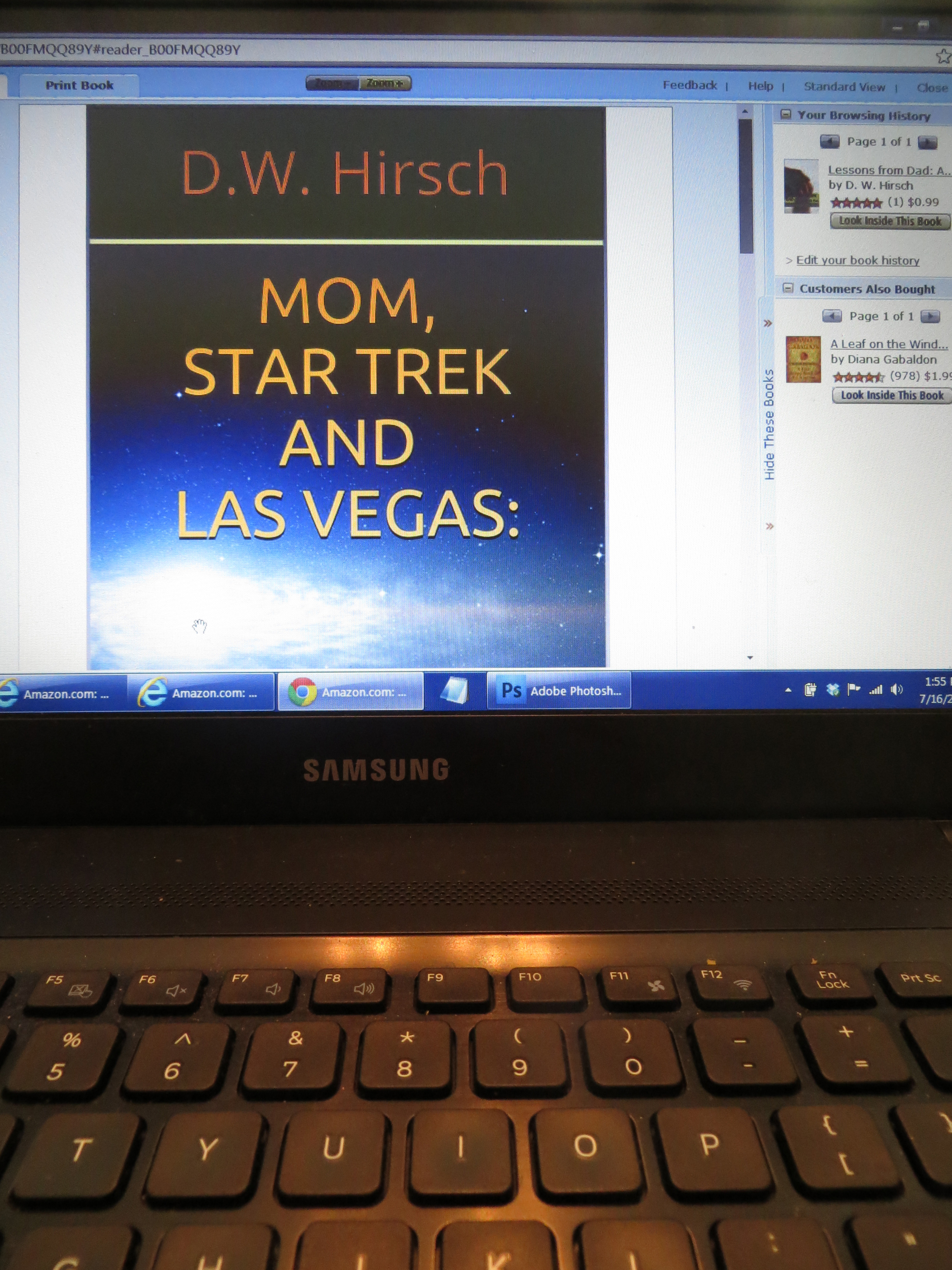
Author Archives: dwhirsch

Yes, you can publish a book

My thoughts on self-publishing


What is stopping you from publishing your book?  You are.

I have self-published two books so far, and I am thrilled about it.  With the introduction of eReaders, writers have complete freedom in their craft.  You have the ability to post anything online through a blog and various social media, and now you have the socially-accepted ability to publish a book.  But that was not always the case.

As recent as 10 years ago, the only way to buy a book was as a printed copy in a brick-and-mortar bookstore.  The only way to get your book into those stores was to sign a contract with one of the traditional publishing houses headquartered in New York.  These companies controlled physical book distribution, and they didn’t make the process of acceptance easy.  Even with well-crafted query letters and strong sample chapters, you still needed a smidgeon of luck that your manuscript found its way to the right editor or agent to believe in you.  If you made it through that professional vetting process, then you had the validation of being a “real” writer.

If your work wasn’t good enough to be accepted by the industry, then the only way to get your story to readers was to fake professionalism.  You had to print it on your own, with the stigma of “vanity press” trailing your byline.  I believe that was a phrase created by publishing houses.  If you had to print and peddle your wares yourself, then you weren’t a professional writer.  This legitimized publishing houses and enhanced their aura of attraction.  Without any sense of quality control or standards, what was there to keep the sludge out?  Such a book was an ego trip, and the only sales would come from family and friends.

On a base level, I understand that perception, especially after my experience at a 1998 independent publishing convention in New York City.  Unknown authors sat at tables just as if they were at a real book signing, so I figured there must have been some judging or invitation to be there.  I came across a hardback book with a colorful cover protected by a clear plastic slipcover.  It was a subject I was interested in writing, so I bought it.  Anyone who looked good must be good.  However, after reading the book, I learned that if you flip to a random page, any page, you will come across a grammatical error, a spelling mistake or a bombing of the F-word.  I’m serious.

No wonder people didn’t trust vanity press authors.  How could you tell a skilled writer from a sloppy ego trip?  Anyone can slap pieces of paper between a sturdy cover; professional-looking photography on the outside doesn’t guarantee that editing and grammatical care was taken on the inside.  I fell for that with the college book.  For all I know, those writers paid to rent table space, so anyone with money could have been there.  Reputable publishers guaranteed those services and more, so you took your chances with independents.

I didn’t have extra cash to toss around just to be labeled a phony.  If I wanted legitimacy as a writer, I would have to play the publishing lottery.

Now welcome to the brave new world of indie publishing.

“Vanity press” fades into obscurity as “self-publishing” gains legitimacy through e-pioneers like vampire series author Amanda Hocking , fantasy writer H.P. Mallory  and mystery-thriller author J.A. Konrath . Self-publishing is now a viable, accepted method of getting books to readers, especially with the popularity of eReaders.

Self-publishing gives anyone the opportunity to be a Published Author.  Young or old, newbie or established, there are no arbitrary opinions guidelines to keep otherwise-successful writers out of the market.  There are no external factors in this enterprise.  No one is sandwiched into a particular subject matter because new genres are created all the time.  Established genres are combined.  There is an outlet for niche topics directed at specialized audiences.  Story length is not limited to traditional page counts. These fringe elements, un-tested and un-proven as even mildly popular, are things traditional publishers would never touch. But you can.

Anyone can be a fantastic storyteller.

Now we can legitimize ourselves.  All writers have egos.

With such ease, there is still that initial concern: how to navigate through the slush to ferret out the gems.  Well, how do you do it now?  When you walk into a bookstore, what do you gravitate towards?  Is it a particular genre, the bestsellers, the sale items or the staff picks?  What makes you pick up a book: cover art, the subject material, the title or reviews and recommendations?  Online browsing is no different.  The book’s “back cover” summary is listed above the reviews.  Just like flipping through pages in a store, many writers offer the reader a sample to download and preview.  Ultimately, you don’t know how good a book is until you read it, just like any traditionally published book.  What is “good” and “bad” is subjective, but now you have more options, authors and books to discover.  It is more likely you’ll find a story worth reading, one you’re interested in.  This is a good thing.  It’s a great thing!

Given that, does a publishing house matter?  Nope.  Readers do not need publishers for distribution because eBooks are available electronically.  I’ve always bought books based on my interest, not the publisher.  Quick, without looking it up online, who publishes Stephen King?  Dean Koontz?  Danielle Steel?  Nora Roberts?  I find that people are brand-loyal with dishwashers, coffee, laundry detergent, cereal and soda pop, but not books.  Think about movies.  Have you ever heard anyone say, “Oh, I won’t see that movie because it’s not produced by 20th Century Fox.” ?  In fact, it’s an honor to have your film selected for the Cannes International Film Festival.  Is that called “vanity filmmaking”?  Many unknown filmmakers are introduced there because artistic quality (good storytelling) is the key there, not the big-name directors (best-selling authors) financed by big-name production studios (publishing houses).

Some writers need that perceived validation.  Some may not want to be involved in the details of work outside of the actual writing.  That’s personal preference.  I’m not one of those people.  I prefer the creative freedom.

Think about it.  You create the cover art you want.  You choose your editor, or make the decision not to use one.  There are no printing costs outside of any print on demand (POD) because publishing is electronic.  You set the price, and you can change that any time and as often as you wish.  At this time, royalties are higher than with a traditional publisher so you earn more money.  You can upload a story of any genre or any length because today’s readers accept both.  You publish on your schedule.  You can upload new versions at any time, thus customizing or updating content.  All it costs you is your time.

Note the theme above?  It’s control.

For all those reasons, I chose to self-publish.  Why not?  As of this post, I have two books available on Amazon.  At short stories that are 21 pages each, no publishing house would waste the ink and dead trees.  I don’t blame them, and I don’t fault them, so I took the power and launched them myself.

Remember that ego thing I mentioned earlier?

Does self-publishing my work–the lack of a traditional publisher– make me less of a writer?  Does having a book in print make me more of one?  I don’t think so, but it’s a fun thing to do.

So far, my self-publishing journey has been a positive one.  I hope you’ll follow me along this adventure because this is not the end.  I’ll continue to share my experiences.  Feel free to share yours in the comments below.

Will I be successful, whatever the definition of “success” is?  Would you be?  How will you ever know if you don’t try?

Nothing is stopping you but you.


Mental images: zombies and coffee

Good, strong writing is found all in the presentation.  Consider the images that come to your mind when you read the following sentence: She was a zombie in need of more K-Cups.

So, what does that refer to?

Right now, you may be floundering and drowning in a sea of possibilities.  You need context to anchor your thoughts.  What should you be thinking of?

Figuratively, that sentence could describe a human female who cannot function without that first morning cup of coffee.  Literally, it could mean that a reanimated female creature drinks coffee and is running low on the packets.

Either way, the writer has set up the scene with specific, descriptive words about setting and circumstance.  Human or supernatural, your female character is of a certain social status to prefer the disposable, single-serve packets used in a Keurig brewer.

Let’s not forget the implied tension.  What if either one of them runs out of the single-serve packets?

Certainly, the story subject matter material is crucial to the events that happen next.  However, without any specific framework, your mind still generated images, thoughts, or presumptions about what that sentence means.  The presentation of that one sentence was strong, just strong enough to engage the reader and yet give freedom to create his or her own specific image.  After all, what does the female look like: blonde or brunette, or is her hair matted and covered in mud?  Is her skin dark or light, green or blue?

You want to choose the right nouns http://www.youtube.com/watch?v=kfnXUWJz0sE&feature=kp , words that create dancing images in the readers mind to solve the puzzle of the author’s intent.  If done well, the descriptions keep the story moving forward and the reader interested and engaged.  Are you intrigued?

If you’ve read this far, then you are and I did my job.  This is how inviting your writing should be.  What kind of images do you want to create for your readers?

How do you do this, find colorful language words to express nuances?  Start with a basic word and look to thesaurus or dictionary.  Typing the word “zombie,” an online thesaurus gives synonyms and antonyms for “odd person,” “ghost,” and “machine.”  Various dictionaries define a zombie as, among other things, a supernatural spirit inhabiting a dead body; a snake god; a tired, apathetic human; a spicy rum drink; and a computer virus.  Think of what other magic you’ll find typing in a different word.

Consider colloquial slang.  At some point zombie came to mean a lethargic person.  The word “shorty” now refers to clothing, cookies and an often-derogatory term for women.  What words can you mesh into new meanings?

You can also create your own connection.  It’s easier to take liberties in fiction and fantasy by the nature of creating a new world with your own rules, but nonfiction benefits from it.  That’s how I wrote the zombie sentence, with a human in mind.  It’s much more exciting than writing The tired woman had no more coffee. It also creates images that are more vibrant.

After writing it, I wondered, what if she was waking up in a post-apocalyptic world?

What does a sleepy zombie look like to you?

Lights, Camera, Action: Verb!

I had one of those ah-ha!, slap-your-head-with-the-palm-of-your-hand-*duh* moments recently.

This time, that moment was about writing.

An article I read discussed ways to improve your writing. In your first draft, the most important thing is to get the words down in whatever perfect or jumbled form you can. The revision stage is where you get creative from those bare bones you have constructed. What is the one element that will instantly make your writing more compelling, creative, and interesting? That’s right: verbs.

Verbs allow us to hear and see. They are our senses. Verbs are integral to any writing, and using them is as simple as Schoolhouse Rock professes. They are action, or lack thereof, and how we manipulate them is important. One word can change the whole outlook and approach to a story. Verbs tell the story. In retrospect, it is an obvious solution, but I didn’t believe it could be that easy until I played around with verbs…and ah-ha!

Consider the sentence: He took the box to the car. The sentence gets you there but not in style.

The verb, the action, in this sentence is “took,” which is the past tense of the word “take.” Often action is seen as immediate, but the past tense is the most common tense used in writing whether that is a novel, magazine, or a news story. Past tense does not negate a reader’s experience in the present. Now change one word: the verb. This is what you get:

He dragged the box to the car.

He pushed the box to the car.

He rolled the box to the car.

He pulled the box

He hefted the box

He carried the box

He lugged the box

He hauled

He hoisted

He moved

Each verb changes the meaning of the sentence and enhances the story. “Drag” and “push” suggests that the box is heavy (is there a dead body in it?) or that the character is weak (is he sick or injured?). Suddenly, the reader has the potential to know more about the story and situation. “Hoist” and “heft” imply circumstances more than “carry” does, but each of those words suggests that the box size is important (is the box lifted by hands or a crane?) or that the character’s physical strength (is he struggling or showing off his muscles?) is integral to the story. The reader becomes more intrigued about the contents of the box and the overall situation. “Move” suggests that the box was in one location (is it hidden in a bedroom?) and has to be in a new place (why and to where?). Now the reader is enticed into the plot and the character’s circumstances.

Now the writer has the opportunity to delve deeper into the overall experience to entertain readers. Consider the sentences above that evolved from changing the word “took” to a more specific and situational verb:

He dragged the box across the gravel towards the station wagon, but it was a long driveway.


He carried the blue box in his suit pocket because it had to be a surprise, and she was already waiting in the car.


He swayed and stumbled with the box on his shoulders, hoping it would fit in the trunk of his beat-up Ford Mustang.


The box had to be moved–now!–so he whipped it up in his arms and dashed outside to the only place he could think of: Jesse’s car.


He placed the brown moving box lightly on the dolly, but he did not see the Fragile This Side Up sticker until he rolled the dolly to the car.


Flip, flop, end over end, Smithy spent ten minutes pushing the empty refrigerator box to the far end of the dump where the rusty motorcycle and broken dresser were already stacked.


All that magic occurred from one changed word. What magic can you create? Ah-ha!

Does your car need a poetic license plate?

Bet’cha you’re a poet and didn’t even know it.

However, ask me if I’m a poet, and my immediate response is no.  After all, poetry is sing-songy rhymes sung by first graders.  Classic poets are older writers spewing stylized language for pages upon pages.  The new wave of poets are hipsters baring their raw, tortured souls for 20 minutes on coffeeshop stages, waxing on the dearth of the human landscape. I’m just a wanna-be hipster, but I do appreciate Spoken Word.  I just don’t “get” a lot of it.

Poetry intimidates me.  I feel pressured to find something meaningful from the long strangling paragraphs of confusing and deep intense emotions.  When I don’t get some passionate, life-changing insight, I feel like a numb, witless slug.  Shakespeare frustrates me because my reading flow is disrupted by looking up too many word definitions.  Again, I’m the imbecile.  Too often, poetry is dissected in a class assignment to study form and intention, not enjoyed for the words themselves.  Poetry becomes work, stale and tedious.  There are ways to make poetry approachable, and that is to have fun.

One of my Top Five Favorite College Projects actually came in a poetry class I took as a junior.  Our assignment had a list of specific rules, including writing in a particular meter with rhythm and using a specific number of words from the glossary provided.  The challenge was the intrigue, and my submission, “To Catch a Frog,” is the only poem I ever committed to memory.  This is the first stanza of the one page poem:

To kiss a frog, some say, may lead

to warts upon one’s foolish head.

So it occurred that fateful eve,

when I was lured to test belief,

departed with my sturdy trap

to catch a frog down Boggy Swamp.

 Poetry can be a space to play and experiment, even for the non-poet writer.  It is fractured storytelling.  You can choose not to follow the traditional rules of grammar or punctuation.  April is National Poetry Month, the NaNoWriMo for poets.  This is the time to celebrate something new or forgotten.

About 14 years ago, I discovered the appeal of haiku. My friend and I traveled to a book expo in New York City.  She is a poet, so it was no surprise that the haiku year caught her eye.  The book features haikus written on postcards and mailed amongst a group of friends.  The poetry form itself presents a limited commitment composing three lines of 5-7-5 syllables.  It is short and structured with some boundaries, thus user-friendly.  Perfect.

We both loved the creativity of it, so we emailed daily haikus to give out Inbox joy and mailed weekend postcards to keep our mailboxes from becoming jealous.  We still do this today, with our subject material less nature-focused and more snippets of life in the style of senryu.photo

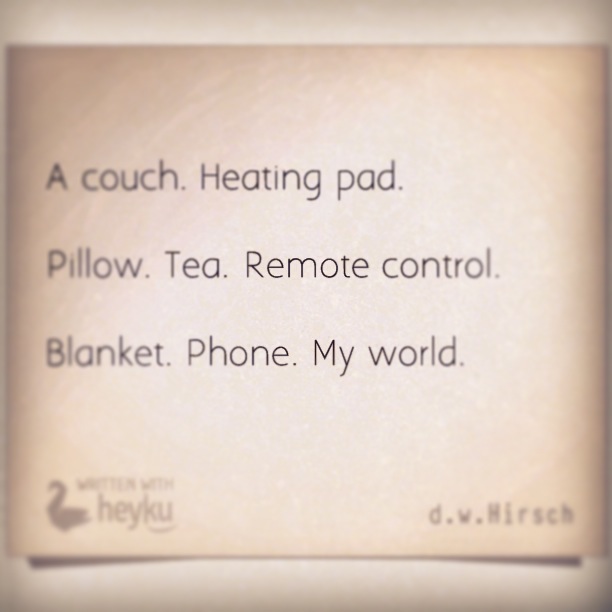
I discovered an iPhone app, Heyku, which encourages anyone to post any type of poetry, with the option to add interactive sketches, photos, or sound to each poem. I do not know the size of this online community, but I find it welcoming because I have followers of my poetry.  I feel safe here, and thus more confident in my approach.  You can find me there at d.w.Hirsch, always under the #haiku tag.  Many of my haikus are now posted on Instagram (dwhirsch) where I can become more hipster with the trendy, special filters.  Whatever the format, whether the month is April or beyond, my writing is whimsical and casual, the way I think poetry should be.

Be your own poet.

A Cracker Jack prize: story ideas

Story ideas do not come in a box of Cracker Jack…or can they?

When I was a kid, the box of molasses-flavored popcorn-nut mix contained cool toys.  It was a delight to pull out some plastic blue ring, too small for any human hand, and squeeze it halfway onto my pinkie finger and imagine it was…anything.  It was a secret decoder ring, and only I had the clues to save the world from the alien spaceship about to destroy humans.  Or the ring gave me super powers, and I would defeat villains by zapping them with my ring from atop flying horses.  I was boundless.

These days, the prizes are downright boring and cheesy if you ask me, but you can still take those cartoon baseball stickers or temporary dragon tattoos and write with abandon.  How?  Good question.

The all-powerful “They” say to choose a situation, emotion or object and launch from there.  Stories come from within so just start writing.  Yeah, that’s easier said than done.

Finding that starting point can be challenging.  I dislike catchphrase advice because without specific examples, I don’t know how to apply those general tips to my writing.  Two tips that annoy me are the seemingly useless “look around you” or “write what you know” how-to suggestions.  Those phrases are cliché until I learned how to make those work specifically for me.

There really is something to the generic advice to “look around you” for ideas.  Consider this: It’s Chinese takeout night, and when you get to dessert, you remember the classic fortune cookie joke-fortune, “Help! I’m a prisoner in a Chinese fortune cookie factory.”  That sentence alone opens countless opportunities.  If you write romance, imagine the hero sweeping in and rescuing the trapped maiden only to be chased by her vengeful lover who locked her away in the factory in the first place.  For the science fiction fans, is the prisoner actually an alien waiting to capture humans?  If you’re geared towards mysteries or thrillers, what does the hero encounter as he or she enters the factory only to discover that the true purpose of the factory is…?

Expand from that plot sentence and “write what you know” to develop characters.  What charming habits do you have that your alien can have to humanize it?  What annoying phrases does your aunt say that could provide tension between the hero and your damsel in distress?  Does your friend have a nervous tic that could distinguish your sleuth?  Could your spouse’s nickname be the name of a Young Adult character?  If your character’s favorite food is Cracker Jack, the same as yours, does this vice affect the story’s outcome?

Suddenly, writing is fun again.

If you feel that your life has not been exciting to this point, then start now.  Take advantage of where you are right now.  “Look around you” and study people at the mall, the dog park, the grocery store or wherever you hang out.  Imagine their stories.  As a wanna-be coffee shop hipster, I hear random snippets of conversation that are fascinating story fodder.  Always carry a journal, napkin or phone notepad to record these moments.  If you tell yourself “Oh, I’ll remember that later,” you probably won’t, at least not with the same flavor you had at that moment.

This personal exploration of people and their traits feels natural for a creative non-fiction writer like me.  I discovered that I can “write what I know” and tell my life story three different ways from three different perspectives: my relationship with my dad; my interactions with my mother; and episodes told from an outsider’s point of view.  Talk about maximizing your material.

I found more “write what you know” opportunities when a few months ago, I rediscovered folders full of high school and college essays, stories and poetry.  I flipped through them and wondered, how did I ever earn a passing grade on that?  What the *bleep* was I thinking when I wrote this crap?  Shudder.  However, reading these embarrassing scraps of paper more closely, I actually found some moments of brilliance and passages I can salvage.  Really, I was that creative?  Really, I was that creative.

If you don’t have past material to repurpose, it is not cheating to borrow inspiration from tools designed to spur imagination.  A quick search of “story ideas” yielded numerous phone apps: Lists for Writers; Storyteller; The Brainstormer; Story Seed Generator; Story Starters; and Flash Fiction Prompter.

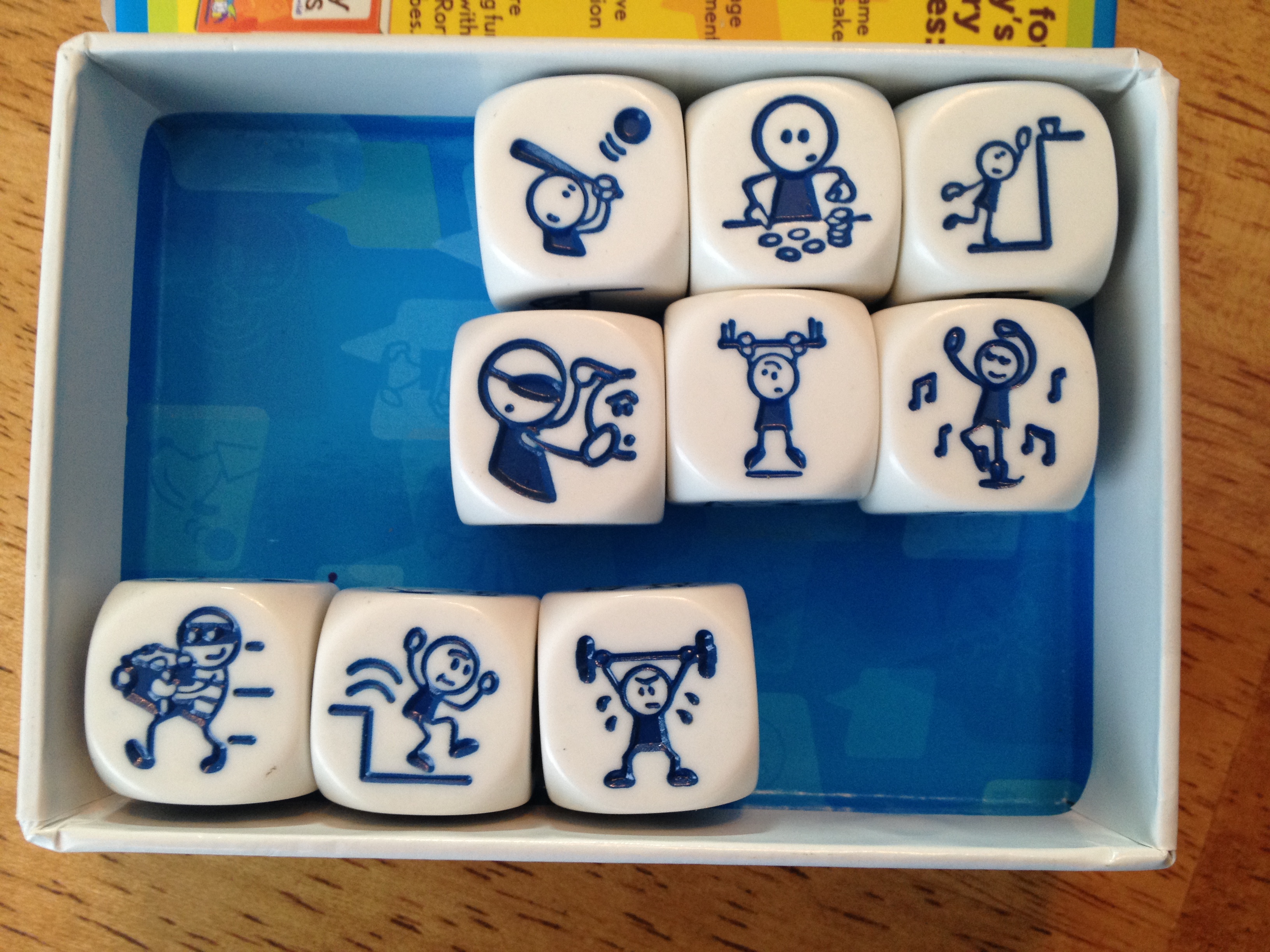
I have not used any of those products, but I did stumble upon the interactive game Story Cubes, which are themed picture dice sets.  Rolling all dice in the Actions set generated an intriguing random assortment.

My Story Cubes inspiration

boxofdice

From this, my character Jimmy the Burglar was born, including the first line of his story:  “Jimmy the Burglar could barely pick his nose let alone a lock.”

Is that a story you would read?

This came from the roll of the dice instead of a Cracker Jack box, but still….  Just think of what you can come up with when you look around and write what you know.