Category Archives: Author’s Craft

Drawing Readers into the 1st Page

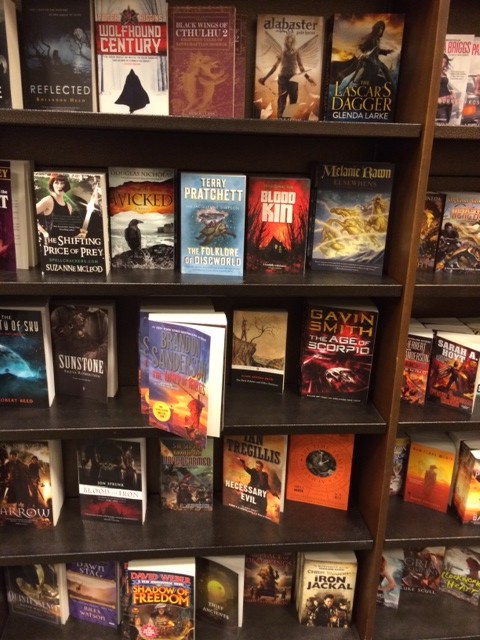
The 1st page, the 1st paragraph, the 1st words can determine whether the author hooks a reader to share the storytelling journey, or if the book gets returned to the shelf for another author. There is so much competition for a reader’s attention, whether on first entering a bookstore or viewing the first page of a virtual store.

B&N |Amazon |Abesbooks |Good Reads
FantasyShelf

John Jakes, a prolific writer, said that in the 1st page of a story, the author should introduce a main character, the setting, and a conflict. These are the key elements for engaging a reader towards investing time in a good story. Let’s look at the opening of one of his classic novels, North and South:

“THE LAD SHOULD TAKE my name,” Windom said after supper. “It’s long past time.”

It was a sore point with him, one he usually raised when he’d been drinking. By the small fire, the boy’s mother closed the Bible on her knees.

Bess Windom had been reading to herself as she did every evening. From watching her lips move, the boy could observe her slow progress. When Windom blurted his remark, Bess had been savoring her favorite verse in the fifth chapter of Matthew: “Blessed are they which are persecuted for righteousness’ sake: for theirs is the kingdom of heaven.”

The boy, Joseph Moffat, sat with his back against a corner of the chimney, whittling a little boat. He was twelve, with his mother’s stocky build, broad shoulders, light brown hair, and eyes so pale blue they seemed colorless sometimes.”[i]

The opening words are infused with tension, coming from a very flawed character. His wife’s non-verbal reaction messages that the demand is not well received, and a sore topic. The pages that follow portrays an abusive family, from which Joseph Moffat dreams of escaping, yet held back with the helpless desire to protect his mother from an alcoholic step-dad. In the end, the boy gains his freedom, but at a high cost. And that’s just the prologue.

Engaging openings draw the reader into the story. You feel connected to a character and their immediate situation, such as Joseph Moffat. The initial conflict might not be THE conflict, but there’s enough tension to promise more if the reader continues to turn pages. Other times, the opening scene may be an accident in slow motion—metaphorically. The reader might not identify with the characters just yet, but the situation is something we cannot look away from, no matter how uncomfortable one might become. Ernest Hemingway masterfully creates such a scene in the first paragraph of The Old Man and the Sea. Here’s just the first half of the 1st paragraph:

“He was an old man who fished alone in a skiff in the Gulf Stream and he had gone eighty-four days now without taking a fish. In the first forty days a boy had been with him. But after forty days without a fish the boy’s parents had told him that the old man was now definitely and finally salao, which is the worst form of unlucky, and the boy had gone at their orders in another boat which caught three good fish the first week.”[ii]

Here’s a man so down on his luck that he’s lost credibility in his profession. Hemingway, following the same concept as John Jakes, introduces the Old Man, the title character, the setting, and THE conflict of the story in the first couple of paragraphs. Life is so hard for the old man that the boy–his former apprentice who is now learning from another–buys him a beer. With tight writing, which is a topic for a different article, Hemingway draws in the reader to view someone worse off than themselves. The old man’s stoic kindness and the boy’s devotion to him keeps us reading, and wondering, “things have got to get better, right?” Yet the rest of the story takes us deeper into experiencing the old man’s sacrifices, struggles, and loss that becomes a form of victory and vindication. But the key is the opening lines about a slow motion car wreck that we just can’t stop watching with the opening page.

Another approach is to open a story in the middle of the action. This entry has the advantage of immersing the reader into the chaos of an immediate conflict. Thrown into the deep waters of action, most often violence, the intent is to build instant momentum. Matthew Reilly is a master of this style. I credit him with establishing the genre of high octane storytelling, where there are no pauses where a character can become introspective, or an author can philosophize. The story is go, Go, GO! Conflict IS the story. One example comes from Scarecrow Returns:

“THE PLANE hurtled down the airstrip, chased by furious machine-gun fire, before it lifted off with a stomach-lurching swoop and soared out over the vast expanse of Arctic sea ice that stretched away to the north.

The plane’s pilot, a 60-year-old scientist named Dr. Vasily Ivanov, knew he wouldn’t get far. As he’d lifted off, he’d seen two Strela-1 anti-aircraft vehicles—amphibious jeep-like vehicles that were each mounted with four 9M31 surface-to-air missiles—speeding down the runway behind him, about to take up firing positions.

He had perhaps thirty seconds before they blasted him out of the sky.”[iii]

While the reader is drawn into the conflict, Reilly follows the theme of introducing a main character,[iv] providing scene context, and a conflict—death is 30 seconds away. The reader needs the three elements to anchor themselves within the chaos. We identify with his desire to escape, and wonder at his fatalistic belief—remember the slow motion car crash strategy. The conflict is intense—machine-gun fire, plane pulling Gs on take-off, and surface-to-air missiles moving into range. If this is the opening, how will the rest of the story continue to climb? Reilly meets this challenge, where other writers fail. They lead with an explosion, and then leave the reader coughing through the smoke of the rest of the story. Few will take that journey.

Good non-fiction starts with a strong opening. Authors, like Chip and Dan Heath, use their opening to illustrate the focus of the book. The focus would be similar to the plot. Here’s the opening to their major book, Switch. What do you think their focus is about?:

“One Saturday in 2000, some unsuspecting moviegoers showed up at a suburban theater in Chicago to catch a 1:05 p.m. matinee of Mel Gibson’s action flick Payback. They were handed a soft drink and a free bucket of popcorn and were asked to stick around after the movie to answer a few questions about the concession stand. These movie fans were unwitting participants in a study of irrational eating behavior. There was something unusual about the popcorn they received.

It was wretched. In fact, it had been carefully engineered to be wretched. It had been popped five days earlier and was so stale that it squeaked when you ate it. One moviegoer later compared it to Styrofoam packing peanuts, and two others, forgetting that they’d received the popcorn for free, demanded their money back.”[v]

The Heath brothers open with a social experiment that draws in readers with a story about a scene that most of us have experienced—eating popcorn at a movie theater. They turn the experience on it’s head by offering free popcorn that’s “wretched” in various sizes. Regardless if the study participants got a medium, large, or extra large tub, of the 5 day old popcorn, they ate all of it. From there the book lays out an elaborate argument about the difficulty for people to change, and how to go about succeeding in changing mindsets. What’s important here is that the opening paragraphs suck in readers, who before they realize it, are 3-4 chapters into a book about complex ideas—and they’re invested.

Characters, scene, conflict: starting with the 1st words, all three elements are present in the first paragraph, of the first page of most books that succeed in drawing in readers. Now once you have them, the next challenge is keeping them. How that works is another tale to be told. But as readers, you already know what those might be…

__________________________

[i] Jakes, John (2013-05-21). The North and South Trilogy: North and South, Love and War, and Heaven and Hell (Kindle Locations 204-211). Open Road Media. Kindle Edition.

[ii] Hemingway, Ernest (2002-07-25). The Old Man and the Sea (p. 3). Scribner. Kindle Edition.

[iii] Reilly, Matthew (2012-01-03). Scarecrow Returns (Kindle Locations 256-262). Simon & Schuster, Inc.. Kindle Edition.

[iv] Actually, Dr. Vasily Ivanov dies five pages later. He’s not the main character of the story. That would be Scarecrow. But Dr. Vasily is the key character of the prologue. All of the elements that John Jakes discussed are present to draw and satisfy readers.

[v] Heath, Chip; Heath, Dan (2010-02-10). Switch: How to Change Things When Change Is Hard (p. 1). Crown Publishing Group. Kindle Edition.

What’s Magic in a Million Words?

In addition to being a ‘word’ person, I’m also a ‘numbers’ person.  So when I hear someone say, “You have to write a million words before you will have something good enough to publish,” both sides of my brain start to fire up.  Can you imagine?  A magic number to work toward, and when you reach it all your writing dreams will come true.  Sounds wonderful, but I know it doesn’t work like that.

Nonetheless, a lot of people seem to be striving to meet that magical number.  Do a search on the internet for the phrase ‘write a million words’ and you’ll see what I mean.  So what’s the allure?  I think the draw is due to several messages the phrase communicates:

1)       Practice Makes Perfect – This centuries old bit of common sense is motivation to keep at it and work to improve at what you do.  I would modify it to say, “Practice, with feedback, makes perfect.”  You can do a lot of your own editing to improve the quality of your work.  However, getting feedback is important in order to avoid the blind spots you get from being too close to your own writing.  Don’t take the ‘million word’ phrase too literally and wait till you hit the one million mark to show your work to anyone.  The better way is to get feedback as you go and be open to constructive advice.

2)       Persevere – Rejection comes with the job so don’t take being turned down by publishers and agents personally.  If you self-publish and don’t gain an audience, don’t take that personally either.  There are many reasons why your work might not be accepted.  You may never find out the reasons, and if you do it may not make any sense or have anything to do with your talent.  So when a rejection letter comes in, resolve to keep going and continue on your writing path.

3)       It’s Helpful to Have a Goal – No matter how much you love writing, there may be times when you can use some extra incentive to keep you moving along.  Getting to the million word mark can be a fun way of challenging yourself, or creating a friendly rivalry between writers.  Organized events such as the National Novel Writing Month offer support and resources to help and encourage you toward your goal.

Ultimately, writing is a journey with no fixed end and no roadmaps to sure things or dead ends.  If things don’t happen for you in the first one million words, maybe it will happen in the second.  Author Ursula K. Le Guin said “It is good to have an end to journey toward, but it is the journey that matters in the end.”  Enjoy your journey, wherever it may take you.  That’s where the magic lies and the only person who can stop it is you.  Don’t let it end too soon.

Six Sensible Rules for Suspense

Amy stirs, half asleep and freezing cold with a putrid taste sticking to her throat. In the distance, her two dogs bark frantically. Much closer, the wind whistles in the fog and gently brushes her cheek, and that puzzles her…?

Amy wakes with a jolt and shivers with fear. “Glenn!” she calls, coughs and shoves the lump that is her husband. “Glenn! There’s a fire! Glenn, wake up!”

Glenn feels flaccid and clammy, and just snores through the thick smoke now rushing over them. She looks towards the dresser and the digital clock but sees only dark. “Glenn!” She turns him over, her voice hysterical, harsh. She swallows clawing smoke and stale booze. Glenn snores. Amy tries to get out of bed but the smoke and the heat beat her back.

“Brian! Bria! Jump!!” What was a putrid, cold fog only seconds ago is now an oven pouring out suffocation. “Jump!!”

She pulls the comforter over her head and thinks of her children as she clasps her throat. The smoke presses down and crushes all hope. She hears the roar of a locomotive drown out the dogs, and she whimpers with her last breath, “Please, jump!”

What did you see in this scene?

Did you see a cold, dark, two-story house on fire? Did you see Amy’s dogs downstairs barking to get someone’s attention? Her kids asleep, already dead, or hopefully jumping for their lives? Did you see fire roaring up the stairwell? A desperate woman trying to wake a drunk? Did you see Amy surrender to the sheer weight of her circumstances? In less than a minute, did you see what mattered most in her all-too-brief life?

If so, you’ve got a pretty good mind’s eye because the entire 60-seconds was clouded in smoke.

Amy couldn’t see a thing! She coughed the smoke, heard the dogs, the wind and the fire, felt and smelled the inebriated Glenn and the putrid of something toxic. Jump shouted that it was a two-story house, wind and roar brought smoke and fire rushing up the stairs. Stale booze gave you a taste of why Glenn was not waking up. Not one word was written for the eyes. If the only sense Amy had were her vision, she would have died in her sleep like Glenn. End of story. And that is exactly what writing to the other senses does – it wakes up your reader, it lets them see through the smoke.

The senses are five vital, but very different, utensils in the writing’s toolbox. Here are my six sensible rules for how to use them correctly.

General Rule: “Taste and touch follow what we see. Smells and sounds precede our sight.”
Where you can show better tension, wordplay becomes fuel for your fire and you’ll want to break the rules. That’s the fun bit, but that’s not the first rule.

First Rule. “Don’t stop to smell the roses in first draft, just get your hero to safe harbor.” In other words, don’t let the minutia bog you down; finish the scene. Finish your novel.

It is only natural for the suspense author to write through his/her eyes because we envision our story as we write it – We make this stuff up! In first draft, it is much easier to just paint the broad strokes while our fireworks are still in the air. Fair enough. But use your second draft to color in all the tiny, mind-searing, sparkling bursts with precision. Not just: “Stole a Jet Ski and zigzagged out into the storm dodging bullets.” (1st draft). Let your readers: “Inhale the salty air, feel the rumble of the engine through her thighs and hold on tight as the Jet Ski slams-hard-against-the-surf, while Sluggo’s bullets wiz past her ear.” (2nd draft). Save those salty, rumbling details for when you’re more relaxed and can take the time to study the scene carefully, with all five of your senses functioning freely.

Second Rule: “Cleverly, but clearly, break the rest of the rules where it adds suspense.” Do this where it adds more tension, comedy or calamity.

“Just slept on it funny,” he gruffed and limped away.

That works, in a lame way, because people don’t usually sound gruff when they are trying to be funny (or use the word lame when trying to be serious), and your actions or characters will become indelible.

Third Rule: “Hearing delivers more than just sound.”

Sound is the hardest of all the senses to fool on the page, so it should be the easiest “other” sense to write to. Be careful: sound is also the only sense that we rely on with impunity. The other four work in harmony, they confirm or cancel each other out, but sound is a lone actor in the dark. Because we have two ears, we also get a sense of direction and distance which adds to the tension. When a sound beckons your character, and before they turn their eyes in that direction, their mind has already played back memories of what that sound – or voice – meant. Just reusing that sound and response in a later chapter can recall all the trauma in the first scene. You can now draw comparisons to that first scene without saying another word, without compromising pace or tension.

“A shot rang out! He heard the cock of an antique Winchester and knew who was behind it.” (2nd scene – I’ll let you color in the first scene.)

Your character will trust their ears before their eyes. They’ll likely first crouch, scream or run, or smile, laugh or pucker up based on what they hear, then see if they’re right. Or horribly wrong!

Horrific sights should freeze your mortal characters to a point where they cannot move. Frightening sounds should have them running first, thinking later.

Fourth Rule: “Touch and taste are secondary to sight.”

These two senses always confirm what we see. Well, almost always. Walk, barefoot through a dark cave and stepped on something cold and slimy that went hissss, and clearly you see a snake. But that only works in a dark cave, and because our ears confirmed our worst fears.

Touch and taste we can take as one because we rarely use them together – popcorn being one exception; sex being another. But touch and taste only work in only a limited way on the page because these two senses are internal by nature. If what you write is out of sync with dear reader’s preconceived notion, your tasty words will not be enrichment at all. One woman’s yum is another’s woman’s yuck.

No vegetarian is going to agree with your “mouth-watering” response to the question, how was the beef Wellington? (1st draft) But what if your character’s response were instead, “She rolled her eyes, held her tummy and tongued her lips.” (2nd) Carnivorous readers might still salivate, but your vegetarian audience might see gag me and make me throw up from the same three motions. And you haven’t carelessly taken a segment of your audience out of the story. That’s what I mean by be careful with taste and touch.

Generic feelings (kiss, hold, hug), and tastes (salty, cold, hot) work best with strong adverbs like humongous and dainty. Unique feelings (itching, stinging, horrifying) and tastes (briny, zesty, spicy) work best on their own.

Fifth Rule: “When in doubt, follow your nose.”

Scent is a different breed of cat all together. In my piece at the beginning, it is the smell of smoke that awakens Amy, and she has full command of all of her senses within a heartbeat. We cannot ignore the scent of fear. If something foreign gets past our nose, our subconscious instantly knows that it can’t let anything happen to our breathing. Scent is the only one of the five sense that will wake us up from a deep sleep with our adrenalin already pumping.

Scents stick with us, too. Some, forever…. Close your eyes, take a deep breath, and take in memories like: That wonderful aroma of Grandma’s kitchen; your wedding corsage; your dog after it caught the skunk. If the last one of these got you to blink or your nostrils to twitch, I rest my case. “Wonderful aroma” and “skunk” don’t fit. But, you knew that.

So the only trick here is to use scents correctly, by appeal. Fragrances heighten a sensual scene, or turn the screws on uncertain moments. Aromas can instantly cast light on the dark, or call forth a forgotten memory. Odors tell time’s passage, they foretell danger down the road and quickly time-stamp past, traumatic events.

Sixth Rule: “Men focus on the hunt; women gather on the periphery.”

Which brings us to the eyes. Writing descriptive suspense for the eyes is as easy as carrying on a conversation with a close confidant. Just vividly put on the page what your mind’s eye beholds and don’t hold back. If you’re writing in third-person, imagine your friend is telling you instead.

Only, it is important to remember that your men and women will see things differently. And that difference is primordial. And that primordial instinct is the very essence of believable suspense.

In pre-historic times, the male hunters depended on silence to sneak up on their prey. They used their two eyes together to fix on the distance needed to throw their spear and kill dinner. Another hunter knew exactly what this man was thinking by just following his gaze. Gatherers – the women, children and one-eyed old men – depended on making noise and using their voices to scare the wild things from the berry bushes. For protection, women used their two eyes to focus on two or more things at the same time. They learned to depend on their peripheral vision to spot movements off to the side. One wrong move and they’d be stung or bitten, or become the dinner.

Those two unique survival traits are still in our eyes today. Men still look straight into who or what has their mental focus, and women are still much quicker at spotting movement on the periphery while looking you in the eye.

That’s true about not only the lady’s deep, baby-blue, mischievous, sparkling, haunting, adorned, oval, cat-like, vicious, emerald, crying, smiling, laughing, sad, happy or otherwise adorable eyes that we can clearly see, but her mind’s eye, too. Her sixth sense is broad. His is keen.

Six Sensible Rules for Suspense
1) Don’t stop to smell the roses in first draft, just get your hero to safe harbor.
2) Cleverly, but clearly, break the rules where it make more suspense.
3) Hearing delivers more than just sound: direction; distance; friend-or-foe.
4) Touch and taste are secondary to sight.
5) When in doubt, follow your nose.
6) Men focus on the hunt; women gather on the periphery.

Next Month: Information dumps. Those lumps of facts and timestamps that precede your storyline are so often the hidden, root cause for your character’s actions. Until you get them on the page your story remains convoluted where you want to be clear. But factoids are just the canvas, not the painting. You can’t allow them to slow down the action and quick pace that is suspense! They’re essential, and, at the right moment, need to be clearly conveyed, but it doesn’t have to read like a rap sheet. Next month we’ll look at how to backfill your story without slowing down the action.

Potty Mouth

Last November, one of my favorite cozy mystery authors, Ali Brandon, who writes the Black Cat Bookshop Mysteries series, blogged about her characters’ reluctance to use bathrooms. (Check out her blog here.) If you think about it, you don’t read about characters using the facilities. You don’t see this often on TV either. I mean how many times did Jack Bauer go during the 24 hours he spent saving the world?

Ever wonder why that is? After all, it’s perfectly normal to have to use the restroom. Considering how much coffee, baked goods, dinner, and alcohol are consumed by cozy characters, Ali Brandon points out that there’s no reason why an author can’t include a bathroom trip or two in her story as long as it doesn’t slow down the action.

During our last Deadwood Writers holiday dinner, a very nice lady asked me about my day job. I was happy to answer that I’m a janitor for a professional cleaning company and I currently clean at an institute of higher education. Then she asked me if I had learned anything from my job that I could apply to my writing. Hmm . . . how to answer that question, considering we were at dinner, and the biggest lesson I had learned was how gross people can be. My coworkers and I were constantly picking up half-empty beverage bottles, paper towels, discarded pens, and those little pieces that students tear off the edges of paper that’s been ripped out of spiral bound notebooks.

But the most disgusting thing I learned while doing my job is that a lot of people have absolutely no concept of restroom manners–I mean the basic things we were all taught during potty training. Things like flushing the toilet or urinal, washing your hands, and throwing your trash in the trashcan have literally gone by the wayside.

These activities are social mores we learned at a young age. They are not optional. Have you ever heard a mother tell her child, “You can skip washing your hands. Nothing bad will happen”? No. How about, “Don’t bother flushing the toilet. The next person will get it”? No.

That’s why I don’t understand how people can leave a bathroom stall in such dire straits. If they tried leaving such messes at home, their mothers would knock them into next Tuesday. Wives would turn husbands out of their bedrooms for some of the infractions I’ve seen. Bathrooms across the metro area would ring out with admonitions like: “Were you born in a barn?”; “Didn’t I teach you better than that?”; “If I’ve told you once, I’ve told you a hundred thousand times. . . .”

So writers, what does this mean for you and me? Pundits advise us to make our characters believable. I’m here to tell you that a believable character not only uses the restroom, but he or she leaves evidence of the visit behind. Either the facilities are just as clean, or cleaner, as they were when the user entered; or sometimes, the floor, seat and/or bowl is covered with biohazardous material. And believe me, you can’t get more graphic or gross than what I’ve seen in real life.

Take the potty break as an opportunity to reveal your character’s true self. After using the restroom and washing up, your character grabs a soap-covered paper towel and cleans the seat, handle, stall door lock, and the faucets. Why? Is he obsessive-compulsive? Is he getting rid of fingerprints–or DNA? Does your character have a disease that’s spread through contact with biological material which he hopes to contain? Is he a twisted bioterrorist spreading infected blood or urine throughout the bathroom instead of cleaning it?

Don’t forget the humorous aspect of bathroom use. A fish-out-of-water character, who is unfamiliar with motion-controlled facilities at an upscale restaurant or hotel, might do battle with the auto-flush toilet, or the self-dispensing hand soap. And if you write for middle grade readers, you can get away with a lot in the name of potty humor. Just ask Matt Stone and Trey Parker, creators of South Park.

So don’t fear leading your character into the bathroom, just be sure to put the seat down when you’re done.

Paranormal Traits

A trait is a distinguishing characteristic or quality, especially of one’s personal nature, defined by Dictionary.com. When using traits with a paranormal twist you can go with classic takes, such as mind to mind communication that Bram Stoker uses in Dracula and, one of the most common vampire traits, the elongated fangs. Stoker takes Dracula’s desire to speak to Mina enhancing it into a physical experience in mind and body transcending all logic, creating intimacy where there was none.

Taking things a step further, let’s look at the Argeneau Series by Lynsay Sands. The mind to mind communication in Sands vampires (Immortals as she calls them) becomes sexually charged as the heroes and heroines learn they are life mates. They share each other’s pleasure to a point their intimacy boils to such a peak they pass out, anywhere. She’s created a situation where she uses all the five senses, smell, sight, sound, taste, and touch. However, what happens goes beyond the physical and becomes a sharing between the two characters on a mental level. With humans, to the extent she explains, this would not be possible in real life. This adds something to her vampires that no one had ever seen yet in the genre.

Conflict develops when the no-fangers, vampires without fangs come on the scene. Let’s just say, they’re a tad bit crazy. To make it even more fun she adds a third type without fangs called edentates, another generation not touched by the crazies. She goes into detail about the three distinctions adding history to the series and to her characters. These are some of the steamiest, funniest, and scariest scenes I’ve ever read. Lynsay Sands uses the physical trait to drive the plot arc in several of her books, motivating good and evil in a race to meet their goals.

My favorite character trait is smell. With most predators, smell is a basic tool in their repertoire. J.R. Ward uses the trait brilliantly in the Black Dagger Brotherhood series. Introduced first in Dark Lover, Wrath and Beth meet, and at first, Wrath is lead to her by duty. However, when he gets near her, her scent is so intoxicating he has to have her. Eventually Beth can’t resist him either. His scent is headier than a spicy merlot laden with pheromones. He’s like a drug and she’s drawn to him in every way. As intimacy grows, the musky scent cloaks the chosen mate of the vampire, warning any other males or females to back off. With this one trait, J.R. Ward creates some sexy heart pounding moments in and out of the bedroom.

Werewolves, another classic paranormal creature, can also compel readers with the use of unique traits. For example, take a snap shot of the wolf in its normal habitat and find traits that translate into the human hero or heroine. Nalini Singh does this in her Psy/Changeling series. Ask yourself, how does a male wolf act/react to a female wolf? Outside forces threaten the female, how would the alpha wolf handle the threat? Immerse yourself in the five senses of a wolf. What would he do around a female to show his interest? Would he rub, lick, or bite the female to mark her with his scent? Even the words rub, lick, and bite spice up a scene, heating up the romance between human characters. How would it enhance a paranormal romance? Would he use sound, his howl to attract a female or scare away an enemy, let someone know he was hurt? How do these questions translate from wolf to human characters? Does the alpha male fight other males to stake his claim of the female? Is the human hearing extra sensitive alongside sight, smell, taste, and touch?

My examples above of vampires and werewolves are not the only human traits to translate into paranormal characters; the two are just more widely recognized. You decide what traits work best for your characters helping create intensity, intimacy, and excitement that ramp up your plot, compelling readers to turn pages. Use the five senses and physical traits to open doors in your mind. But be careful. The traits you decide on have to have purpose that drive the story forward, twisting the normal into paranormal.

Happy Writing!