“Don’t be afraid to fail, be afraid not to try.” Randy Rubin
How many times have you thought about writing a story, poem, essay, or memoir and failed to even try. How many times have you questioned your desire to write and thought, “What’s the use? No one will want to read my work.”
Do you want to write the great American novel or at least a manuscript that you want published? Did you start writing the murder mystery that has kept you intrigued for a couple of years or the steamy romance that makes you need a cold shower? Did you finish your story including the revisions, and then decide that it wasn’t good enough? And then did you put your project away without sending it to an agent? Why? Afraid of failure? If you don’t try, you’ve already failed.
You must learn to ignore those negative thoughts filling your head. Also avoid the naysayers in your life who think your writing is a hobby. Listen to honest critics, not cloying friends and relatives who think everything you write is perfect. Connect with people who can give you helpful feedback on your work. Listen to the suggestions of your critique group, but remember to stay true to your own voice.
If you really want to be a writer, understand that sometimes you may fail to find an agent, fail to sell your work, or fail to win the writing contest. Continue to write your stories because you will improve with practice. But if you do not try, you have failed yourself.
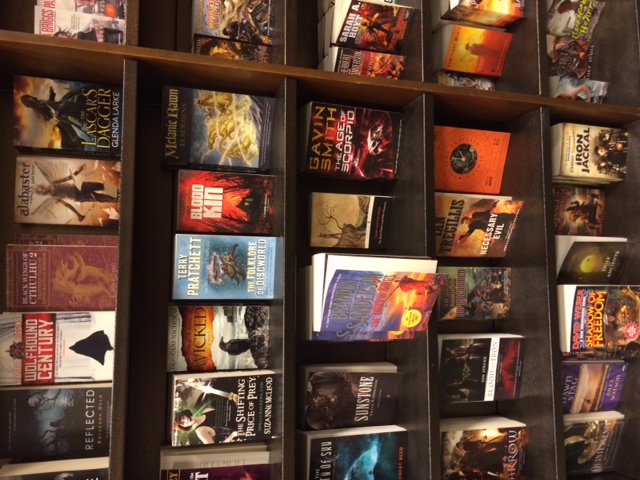
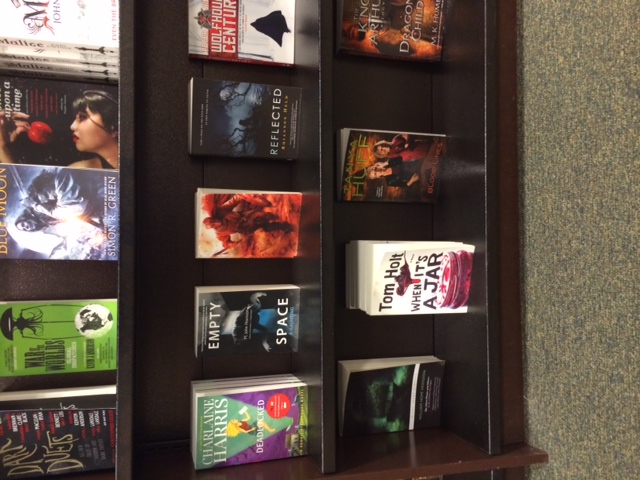
In the United States, if you visit a bookstore’s Fantasy section, urban and contemporary genres are dominant. Kelly Armstrong, Jim Butcher, Simon Green, and Patricia Briggs are some of the authors you’ll find that define fantasy literature. Magic and paranormal races exist in worlds that are familiar to us in interesting and personal ways. Jim Butcher’s Dresden Files series is based in Chicago where I grew up. Although Butcher does not live in Chicago (as of this post) he does a great job using the city as a base for great storytelling.
The age of sword and sorcery, middle age and ancient world time periods, are not passed, but just explored by a smaller group of authors. Just look at a store’s bookshelves to see what’s present on the real estate. Jennifer Roberson, Tamora Pierce, Brandon Sanderson, George Martin, and R.A. Salvatore offer worlds of wonder, magic, and swordplay that entertains with strong characters and in-depth culture and/or politics.
The fantasy writers that may be on the endangered species list represent the gritty underbelly of the ancient worlds as told by Robert Howard, David Gemmell, and Mary Gentle. Battles are unsanitized, the heroes are not clean spirited individuals who’s actions can go mostly unquestioned as the “right” and “fair” choice. Authors like George Martin have such elements—although his stories fill the need for taking a balcony view of intrigue and governance from mostly the leadership perspective.
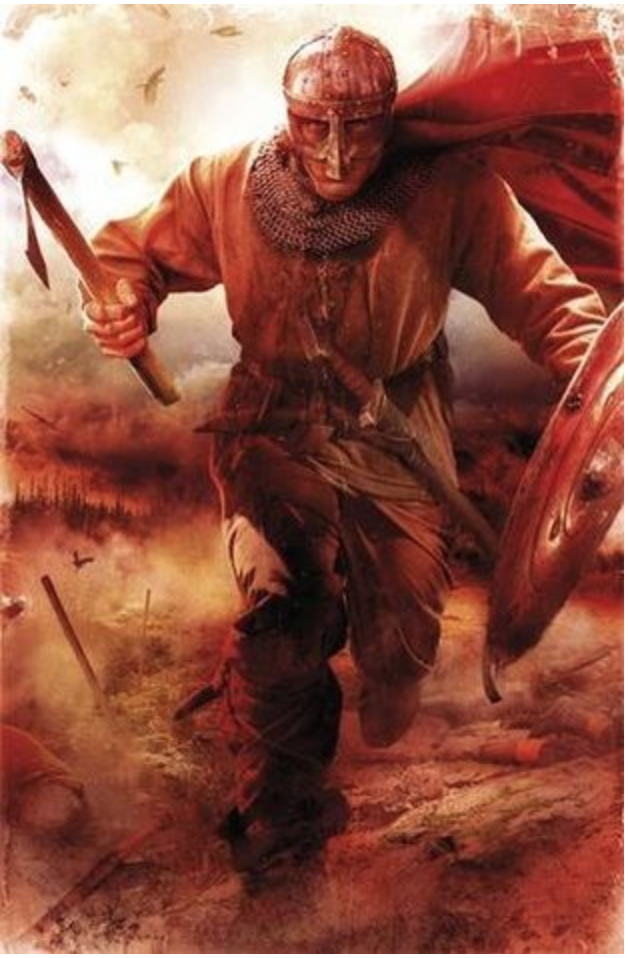
Nathan Hawke represents the next cohort of authors who picked up the banner from David Gemmell and others to continue to tell the gritty tale of complex heroes whose choices leave the reader unsettled even while accepting the choices made. Nathan Hawke’s Gallow—a 3 book series—uses the motif of the loner warrior who reluctantly takes on the cause of others.
Character Complexity
“Beside him Sarvic turned to run. A Vathan spear reached for him. Gallow chopped it away; and then he was slipping back and the whole line was falling apart and the Vathen were pressing forward, pushed by the ranks behind them, stumbling over the bodies of the fallen. For a moment the dead slowed them. Gallow turned and threw himself away from the Vathan shields. The earth under his feet was slick, ground to mud by the press of boots and watered with blood and sweat. A spear point hit him in the back like a kick from a horse. He staggered and slipped but kept on running as fast as he could. If the blow had pierced his mail he’d find out soon enough. The rest of the Marroc were scattering, fleeing down the back of the hill with the roars of the Vathen right behind. Javelots and stones rained around him but he didn’t look back. Didn’t dare, not yet.”[i]
With this opening in the first book, Nathan Hawke takes readers on a grand and gritty journey with Gallow, a warrior gifted at killing in a shield wall or alone against many. All he wants is to be left alone as a family man and a blacksmith for a community that despises him. Yet his sense of honor drives him along a path that takes him far from home, risking his life and those of others, and making deadly enemies of those he once called friends.
Hawke’s writing style is spare, reminiscent of Hemmingway. If a camera represented his writing craft, it would be tight focus images of people and places, exposing the imperfections and failings—so that no character that moves the stories forward is static or stock. And none are completely good or evil. Cruel men are capable of random acts of kindness, and good characters may commit heinous acts in the name of what they hold dear. Such character complexity effectively engages readers to follow each story line, and wonder at the potential unpredictability. For example, after a battle where Prince Medrin orchestrates the death of one of his generals, Screambreaker, he attends his funeral and speaks genuine words of honor to the dead:
“…the Lhosir stopped what they were doing and honoured the Screambreaker and the dead who’d fallen beside him. [Medrin] let the old ones do that, Tolvis Loudmouth and the rest. Let them start the pyre and, when the pyre was built, put the bodies of those they most wanted to honour on top and set it alight. [Medrin] said a few words himself, because he was their prince after all, then let the old ones who’d fought with the Screambreaker against the Marroc finish speaking him out. The pyre was huge and there probably wasn’t a single Lhosir who hadn’t put a piece of something on it.”[ii]
Prince Medrin enjoys torturing common people and then mutilating their bodies on stakes along roadways for all to see and fear. Yet, he pays honor to a fallen champion who he perceived as a rival. This is Hawke’s gift for character development that also moves the story forward.
Sword and Sorcery
In Nathan Hawke’s world there are ancient artifacts of power such as a red sword that cuts through steel like butter, which can only be effectively blocked by a special shield. There are ghoul dogs that hunt tirelessly in swamps and forests for human flesh. All of these pale to the much feared Shadewalkers:
“When Oribas walked toward the end of the arc of salt, the shadewalker moved with him. It kept moving, stepping gingerly along the line until it found its end and looked up. Its dead face didn’t change but perhaps its eyes gleamed a little brighter as it sensed its victory. It advanced quickly. Addic cried out, turned and ran while Oribas simply stepped over the line of salt to be on the other side. The shadewalker came at him, stopped abruptly at the salt and began to walk along the line again, looking for a way past.”[iii]
Shadewalkers are undying or undead warriors, who are nearly impossible to destroy, unless you have knowledge of the ancients and unshaking courage. The magic does not dominate the story. Hawke uses it judiciously in parts of the story for the greatest impact.
Some would point out that authors like Robert Jordan, George Martin, R.A. Salvatore, Steven Erikson, and Glen Cook also carry the mantel for Sword and Sorcery. All deserve credit for skillful craft in their own right. Of these authors, only Glen Cook comes closest to the grainy side of fantasy in ancient settings that brings alive the starkness of humanity through complex characters. David Gemmell was the leader in this area in recent decades, until his passing.
Last November I visited several bookstores in Sydney Australia. I was immediately struck by the volume of authors who wrote in this genre of Fantasy. Many have yet to land on American shores, but can be found via e-books and places like Abebooks. Perhaps on my personal journey to find more like Nathan Hawke, I will find that the lands to explore are across oceans.[iv] Until then, check out Nathan Hawke’s stories for engaging and powerful author’s craft.
(As of this posting, Nathan Hawke comes to U.S. Bookstores: BN in Ann Arbor MI)
I have a 12 year old daughter, Cherice, who is a voracious reader. She can go into a library without having any idea what story to pick, and five minutes later she comes out with a book. Once she starts reading the book, she goes on and on about how good it is. I have wondered to myself how this is possible when I can spend an hour in the library reading the vignettes of potential books only to find the book I end up taking home doesn’t hold my interest beyond the first chapter.
So, I decided that I would interview my daughter and find out exactly what it was that she found interesting about a story. Then I thought why not share this information with others so that they may be able to incorporate some of these ideas into their own writing.
We eventually talked about what she liked concerning:
• Storyline • Characters • Action
In this blog, I’m going to focus on storyline.
Cherice likes a story line that has an issue come up early in the story, and at the time, the significance of the issue is not clear. Only later does the issue play a significant part in the story. For example, in the book Divergent (Veronica Roth, 2011), early in the story the protagonist admits that there is only one mirror in her house and that she is only allowed to look in the mirror for a few minutes per day. This idea grabbed my daughter’s attention and she was willing to read on and sacrifice her time to find out why this was so. There may be a technical term for this, but for the purpose of this blog entry I’m going to call it “anticipation,” because that’s what it does for my daughter. She begins to wonder how this event will tie into the story later, and, therefore, it keeps her turning the pages.
It’s my opinion that a lot of good stories seem to be written in reverse. This process allows the author to plant items of anticipation early in the story knowing that he/she will resolve them later.
In another example from the book Fablehaven (Brandon Mull, 2006), early in the story a brother and his sister are told by their Grandfather that they cannot go into the woods. Of course my daughter, like so many other readers, had to find out what was in the woods, so it kept her turning the pages.
Cherice is only 12, so the anticipation that keeps her turning the pages of a book might be different for an older or younger reader. Regardless of the age of the reader, he/she has to be given a reason to turn the page. What better reason than to continually raise the reader’s curiosity with good anticipation.
By the middle of this century, the successful fiction novel is going to involve a lot more than just words-on-the-page. Already, graphic novels are becoming animated and eBooks are reading the stories aloud. It won’t be long before Harry Potterflies out of our tablet in a hologram while J. K. Rowling sits on our digital screen and read to us, her universal audience of one.
Actual printed matter — the stuff of ink and paper — in the future novel is going to be strictly cover art and internal illustrations suitable for framing. The Author’s contribution to this piece of art will be a caption of the very essence of the image itself; the words that created it. But, sadly, that’s the only text of the author’s we will read in 2050 ink. “Limited Edition” will lose all meaning, right along with “Remainder Bin.” Soon, “Deluxe Edition” will mean that very same artwork only signed by the author and/or illustrator(s), and also the animator(s), holograph artists and voice artists who will help produce the POE Prize (Pulitzer-Oscar-Emmy) winners in 2050. Print versions, where they exist at all, will be expensive pre-ordered Collector Editions bound in (by then) genuine Corinthian Naugahyde, or they will be biodegradable, print-on-demand paperbacks that, in a pinch, can double as toilet paper.
All of these added features take talents beyond what most of today’s writers possess, or want to possess. But collaboration of such talents will be the keys to the kingdom within a few years.
Why? Because it’s more entertaining! You can get a glimpse of the future now. Anomaly, has an app that produces short, holographic animations that jump off the pages of the printed book. It’s surreal. It’s half way to the future.
Unlike biographers and historians, fiction writers are strictly in the entertainment business. We don’t seek to teach or preach to a known audience, we must create our own. The better we entertain, the bigger the audience. Simple as that. Biographers and historians have no such concerns, but then, they don’t have their readers sitting on the edge of their chair, either.
Funny, if we look back in time we can clearly see our future. One hundred years ago, new fiction writers got their stories serialized in magazines first. Readers had to wait until the next issue for the next installment. The author was tasked with keeping their audience in suspense and caring enough about what happens next to buy the next issue. Both Arthur Conan Doyle and Edgar Rice Burroughs got their start this way, among many others. The complete novel version would come out the following year, or not, depending on magazine sales. Only successful novels were then followed by a movie or play adaptation.
First you’d get a little and like, then you’d get a lot and love it, then you’d get it all in-your-face but sometimes want to spit.
Blogs, tablets, home theater. Same play, different stage. Today, if we want the wider audience to swallow our story and feel satisfied, we have to write to resonate in every format, else what the author sees is not what the wider audience gets.
And that’s the rub. Often, the audio and visual versions of novels do not resonate with those who have already read the book. The author has to take control of his/her works before this point. Inflections can’t be out of place in tomorrow’s digital novel. Liberties can’t be allowed that change what the author intended for so-called creative license. Authors had little care in the matter 100 years ago, when fiction was still in its adolescence. By the time the movie or play adaptation came out, they’d long since moved on, high on their next novel.
Only a handful of authors thought of their works in terms of perpetuity. Edgar Rice Burroughs did. Arthur Conan Doyle did not. Both were hallmark visionaries, yet history tells their personal tales vastly different.
Some of Conan Doyle’s adaptations have been spectacular, like the BBC’s Sherlock Holmes series of several years ago that starred the late Jeremy Brett. Doyle would have been proud of that one. But most other renditions of the world’s first forensics sleuth — and there are many — do Doyle a disservice, or at least the author’s intent, leaving the viewer who hasn’t read the original stories to wonder what all the fuss was about 100 years ago. The original Sherlock Holmes was a bipedal bloodhound, everything Doyle wrote centered on that singular aspect. It was Holmes’ superior intellect and cunning methods of deduction that kept readers clamoring for more. Yet, modern adaptations brush Holmes’s methodical pace, his creative thinking, and sometimes even his flair for the dramatic ending under the carpet. For the last 50 years, contemporary stories have centered on Sherlock’s lack of love life (Irene Adler; The woman in A Scandal in Belgravia), or his fetish with cocaine–legal at the time– in (The Seven-Per-Cent Solution). If you’d only read or watch the newer versions you’d think Holmes was just an insensitive, bi-polar drug addict with sexual hang ups, and Doyle’s estate has been unable to stop any of it.
Edgar Rice Burroughs, on the other hand, controlled all aspects of his writing: creating, publishing, distribution, artwork, and adaptations into other formats, by mid-career. Tarzan hasn’t changed one iota. Burroughs was honored with a U.S. postal stamp to commemorate the 100th anniversary of Tarzan, and the ape-man was still as handsome as he was in 1912. Some adaptations have been laughable, true, but Tarzan has gone agelessly into a second life in the funny papers and on the silver screen, and license was sold by Burroughs and his estate for every one of these versions. His estate enjoys that foresight to this day with Andy Briggs’ “New Adventures” of Tarzan stories, and a new, subscriber-based, weekly online comic strip of the man who had a six pack long before Budweiser.
Will fiction authors have the vision to get collaboration right this time around?
Will the Author — the Creator of the very essence of the story itself — finally get to conduct the orchestra in this land of digital perpetuity? Or just continue to play first violin?
Depends on what tale we tell I suppose, and how well we show it to the widest audience.
April’s Blog: Show Don’t Tell. It’s the first rule any new novelist learns, but it means more than just opening up the reader’s eyes. Next month, we’ll look at how writing to the reader’s other senses can often paint a more vivid picture than the eyes can see, and how that raises the temperature of today’s suspense novels.
Story ideas do not come in a box of Cracker Jack…or can they?
When I was a kid, the box of molasses-flavored popcorn-nut mix contained cool toys. It was a delight to pull out some plastic blue ring, too small for any human hand, and squeeze it halfway onto my pinkie finger and imagine it was…anything. It was a secret decoder ring, and only I had the clues to save the world from the alien spaceship about to destroy humans. Or the ring gave me super powers, and I would defeat villains by zapping them with my ring from atop flying horses. I was boundless.
These days, the prizes are downright boring and cheesy if you ask me, but you can still take those cartoon baseball stickers or temporary dragon tattoos and write with abandon. How? Good question.
The all-powerful “They” say to choose a situation, emotion or object and launch from there. Stories come from within so just start writing. Yeah, that’s easier said than done.
Finding that starting point can be challenging. I dislike catchphrase advice because without specific examples, I don’t know how to apply those general tips to my writing. Two tips that annoy me are the seemingly useless “look around you” or “write what you know” how-to suggestions. Those phrases are cliché until I learned how to make those work specifically for me.
There really is something to the generic advice to “look around you” for ideas. Consider this: It’s Chinese takeout night, and when you get to dessert, you remember the classic fortune cookie joke-fortune, “Help! I’m a prisoner in a Chinese fortune cookie factory.” That sentence alone opens countless opportunities. If you write romance, imagine the hero sweeping in and rescuing the trapped maiden only to be chased by her vengeful lover who locked her away in the factory in the first place. For the science fiction fans, is the prisoner actually an alien waiting to capture humans? If you’re geared towards mysteries or thrillers, what does the hero encounter as he or she enters the factory only to discover that the true purpose of the factory is…?
Expand from that plot sentence and “write what you know” to develop characters. What charming habits do you have that your alien can have to humanize it? What annoying phrases does your aunt say that could provide tension between the hero and your damsel in distress? Does your friend have a nervous tic that could distinguish your sleuth? Could your spouse’s nickname be the name of a Young Adult character? If your character’s favorite food is Cracker Jack, the same as yours, does this vice affect the story’s outcome?
Suddenly, writing is fun again.
If you feel that your life has not been exciting to this point, then start now. Take advantage of where you are right now. “Look around you” and study people at the mall, the dog park, the grocery store or wherever you hang out. Imagine their stories. As a wanna-be coffee shop hipster, I hear random snippets of conversation that are fascinating story fodder. Always carry a journal, napkin or phone notepad to record these moments. If you tell yourself “Oh, I’ll remember that later,” you probably won’t, at least not with the same flavor you had at that moment.
This personal exploration of people and their traits feels natural for a creative non-fiction writer like me. I discovered that I can “write what I know” and tell my life story three different ways from three different perspectives: my relationship with my dad; my interactions with my mother; and episodes told from an outsider’s point of view. Talk about maximizing your material.
I found more “write what you know” opportunities when a few months ago, I rediscovered folders full of high school and college essays, stories and poetry. I flipped through them and wondered, how did I ever earn a passing grade on that? What the *bleep* was I thinking when I wrote this crap? Shudder. However, reading these embarrassing scraps of paper more closely, I actually found some moments of brilliance and passages I can salvage. Really, I was that creative? Really, I was that creative.
If you don’t have past material to repurpose, it is not cheating to borrow inspiration from tools designed to spur imagination. A quick search of “story ideas” yielded numerous phone apps: Lists for Writers; Storyteller; The Brainstormer; Story Seed Generator; Story Starters; and Flash Fiction Prompter.
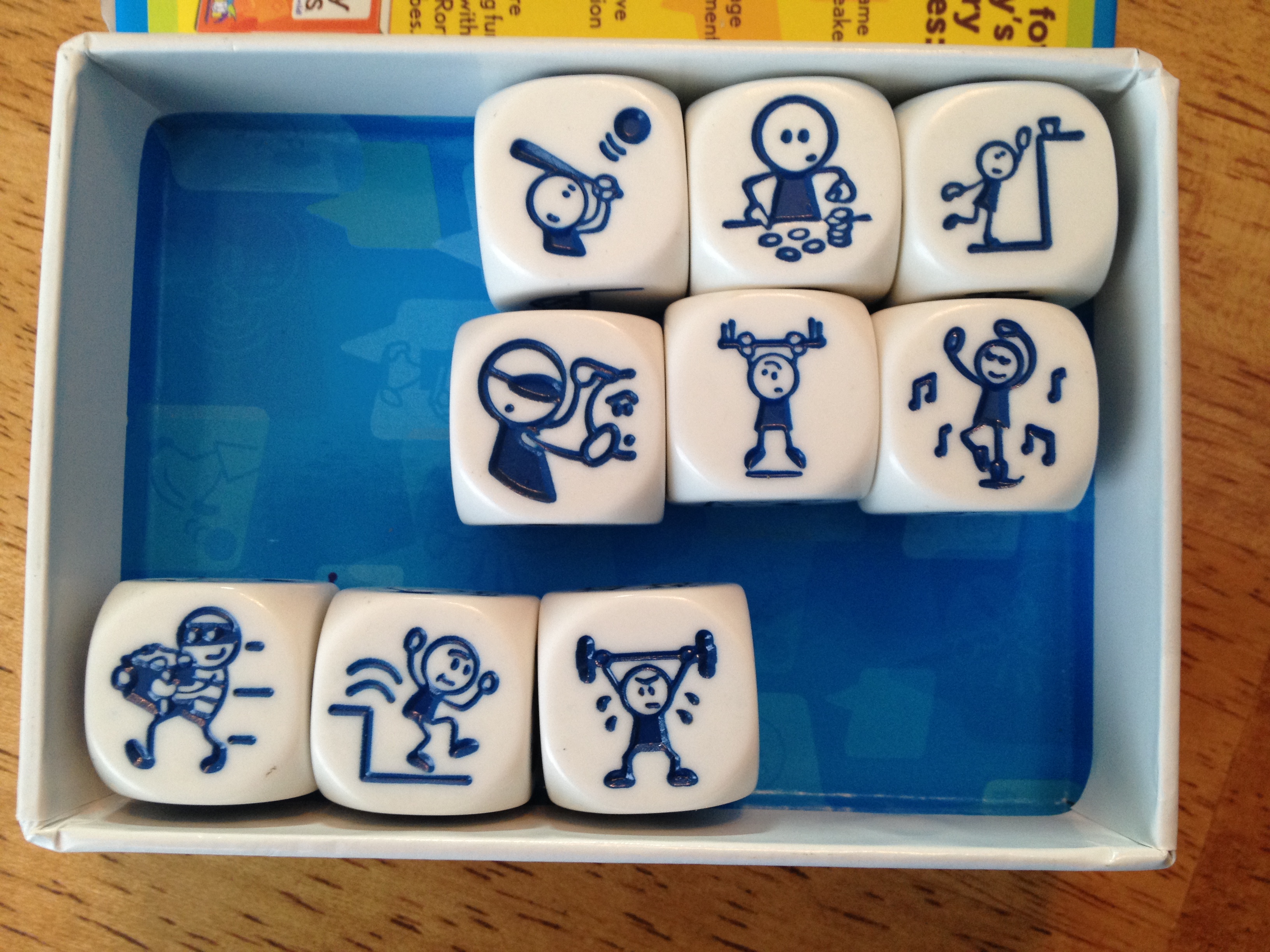
I have not used any of those products, but I did stumble upon the interactive game Story Cubes, which are themed picture dice sets. Rolling all dice in the Actions set generated an intriguing random assortment.
My Story Cubes inspiration
From this, my character Jimmy the Burglar was born, including the first line of his story: “Jimmy the Burglar could barely pick his nose let alone a lock.”
Is that a story you would read?
This came from the roll of the dice instead of a Cracker Jack box, but still…. Just think of what you can come up with when you look around and write what you know.