Category Archives: Editing & Revision

How Important is the Title?

What weight should we give to the title of a novel?

If the sum of a book is 100%, is the title worth 20% or 80%? On the one hand, if the title isn’t catchy then potential book buyers may never pick it up. All the efforts the author has put in will never be tested. What a waste for both author and reader. On the other hand, if the title is too convoluted readers may not understand the direction the author is taking them. Like a four-star chef, authors want readers to finish their creation. Putting it aside half-finished is worse than having never started. It is the difference between telling the waiter, “I’ll try something else, thank you,” and telling your friends, “I’ll never eat in that restaurant again.”

This question has been weighing heavily on my mind for the past few months as I turn the final corner on writing Knock Softly (working title). I’ve asked a few fellow writers – those who are in my writing group and have read the manuscript so far – to think of something better. Nothing is sticking. I try not to fret about it, tell myself it’s not important until you finish, but that finish line is now in sight and the fret is turning into sweat.

Let’s look at the responsibility of a title. That’s right, a title has responsibilities. First and foremost it has to succinctly sum up your story. It also has to be catchy enough to cause a reaction. It should say either “pick me up” or “not for me.” But is that all? Shouldn’t the title also come into to play at the end of the read? Shouldn’t the reader be able to see that title again on someone else’s shelf and be able to recall the entire story? Have an engaging conversation with that person over the book? Gone with the Wind does that. So does Hunt for Red October and To Kill a Mockingbird, and numerous others. That’s my dilemma with Knock Softly. I want a title that will recall the entire tome when next you see it again.

I came up with Knock Softly strictly as a constant reminder to myself that no main characters die in this story – there are things worse than death. Cancer is the villain. Curing our heroine is the story’s master thread, and keeping that central to the other events in the story hasn’t been difficult. Those other events include our heroine’s infidelity and a tortured past life she’s kept secret from her husband and children. Only mitochondrial DNA can save her now. To get it, her husband must delve into her dark past. Her desire to die with her secret is almost as strong as her will to live for her children and the child she carries. Knock Softly doesn’t convey any of that.

In Knock Softly, we have a mother of two, pregnant with another man’s child and suffering stage-4 cancer. She refuses to abort the baby, even though it increasingly diminishes her own chances of survival. Her husband rides the full length of the emotional rapids as he discovers there is so much more to the woman he married.

I don’t have the answer to my question; what weight should we give to the title of a novel?

I suspect it’s a squishy number, based on how strong the author’s own name is. Steven King could call his next novel Untitled and it would sell out. I doubt 100 copies would sell if my name were on it. For someone like me, a mild-mannered suspense writer whose day job is composing coherent internet ads in forty characters or less, I suspect the title is worth nearly half of everything written. It is in advertising, and in selling newspapers.

Now taking good suggestions for A.K.A. Knock Softly. Anyone?

I Published a Book in 10 Hours

Jimmy the burgler

I did it!

Families inspire us and intimidate us.  Jimmy’s mother, father and brother are all members of the Burglars Union Guild (BUG), and he is expected to follow in their footsteps.  Jimmy has slippery fingers and not in the slick, pickpocket ways; he drops things.  That lack of dexterity is just the start of his struggles to gain entrance into the most elite thief organization.  The story of his life is now immortalized in electronic bytes.  I published a book.

I didn’t do all that writing in one day, as I proposed in my original challenge.  I also spent more than 10 hours writing Jimmy the Burglar.  Regardless, I completed the challenge.

I feel really good about that because this is my first fiction piece in a long, long time.  Fiction is easier to write than memoir because I could make up whatever stuff I wanted.  Fiction is also harder to write than a memoir because I had to make up whatever stuff I wanted.

This is my third self-published book, and I learn new elements with each effort.  This time, I experimented by writing the first draft in longhand.  At 2 hours and 56 minutes of writing, I hit a wall: great story elements, but no tension.  Typing that first part in gave me time to think about the story I wanted to tell here and now and in 10-ish hours.  I initially focused on the entire family history as related to the evolution of the Guild, but in that writing, I developed incredible backstory fodder for future Jimmy short stories.  The tale worth telling today is the evolution of Jimmy’s final exam for BUG membership: his MOTH (Modus Operandi Thesis Heist).  After the humiliation he experienced working with Big M, it is vital that Jimmy’s MOTH get all the details right.

At 7 hours and 42 minutes, I was having Too Much Fun writing. So much fun that, I forgot to reset the timer at one point.

After 16 hours (approximately) and 5100 words (23 pgs.), you can read Jimmy the Burglar’s first adventure on Amazon.com.

How did your story turn out?  If you completed the challenge, post your link below.  If you didn’t, share your thoughts now about the experience for all of us so we can learn from it.  And for me, I’d love to know your thoughts about my book. Whaddya think?

If you’re looking for some inspiration and encouragement to complete a book like this, there is a day-long workshop planned for early 2015 in the metro Detroit area.  Stay tuned for the details.

Even if publication isn’t your goal, doing a challenge like this is immensely satisfying. I have typed “The End” on a piece of my writing and am now moving on to “The Next.”

A Talisman, a Tool

What does a tarot deck, an athame, a grimoire, silver and a cross have in common? I’m sure you can guess. They all are tools used in the paranormal trade that are staples in any number of different manuscripts. But how do your characters use them, and how can you as a writer find authentic information that will read true within your characters? Some tools you’ve probably read or heard about come from perceived truths based on lore passed down from generation to generation. Others stem traditionally from religious practices, be it Christianity or Paganism.

I am Christian, not Catholic, but the first symbol of Christianity besides Jesus and the cross that comes to mind is the rosary, a string of beads used specifically for prayer and meditation. It’s an important part in the daily lives of a Catholic. But what about those that are not practicing Catholics? Did you ever wonder why someone dangles a rosary from a rearview mirror of his or her car? Or why they might place a rosary on a mantel next to a picture of a deceased loved one. At some level that persons mind has a powerful connection to the rosary. It gives him or her some assurance that God is with them. It’s a visible reminder of something greater than they are, seated deeply in their faith.

Near the opposite end of the spectrum is Paganism, not to be confused with an Atheist who doesn’t believe in God. Definition no. 2 on Dictionary.com lists a pagan as a person that is not Christian, Jewish or Muslim. The definition of a pagan I like most is, “a follower of any various contemporary religions that are based on the worship of nature or the Earth; a neopagan.” Do they have something similar to the rosary?

What am I alluding to here exactly? Consider the creation of a talisman. A talisman, an object with special meaning for its owner, used by a witch or Wiccan, is no different from a Catholic that clings to their rosary. I know some might think differently, but in both cases, each person believes the items hold power based on their faith, so it’s important to understand how it holds that power for the character you are building.

Even if you’re not developing a witch or a Catholic, what if the girl next door carries a worry-stone in her pocket because her mother said it would lesson her anxiety. Would a blue-eyed, glass broche pinned to a baby’s onesie help ward off evil? Could the mother of the baby become obsessed in her quest to hide her baby from evil, the broche being the catalyst? Would she do something drastic making future events spin out of control?

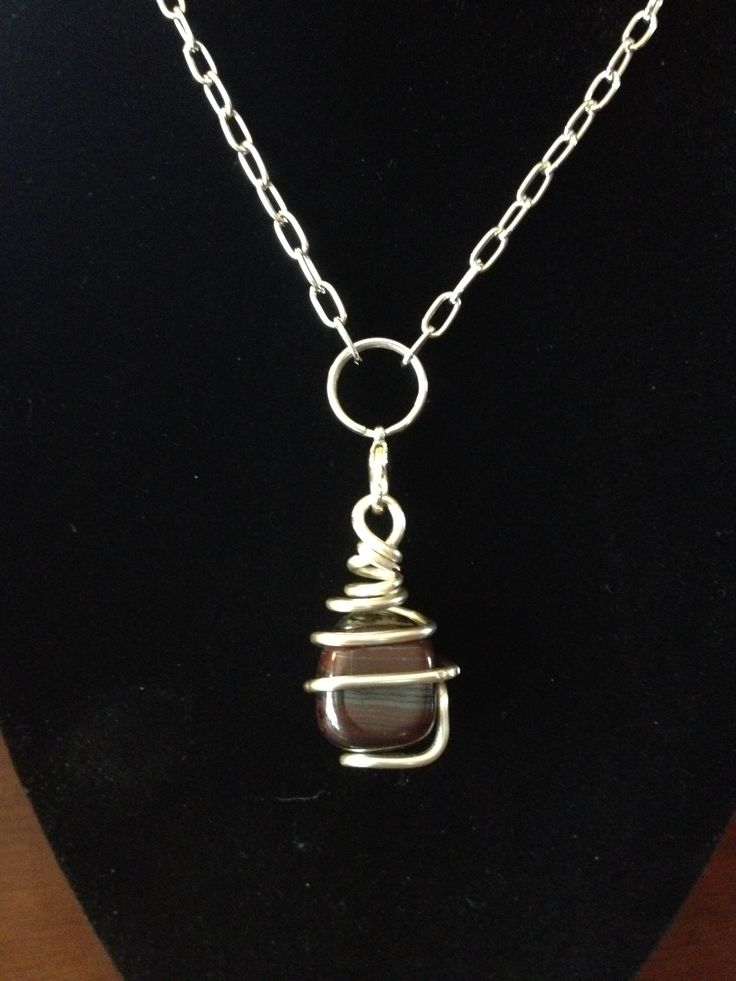
Wrapped tiger iron pendant by WjK DESiGNS

Wrapped tiger iron pendant by WjK DESiGNS

A very mundane character could be similar in my own beliefs. I occasionally wear stones that have meaning for me. It’s not because I believe in witchcraft, it’s because when I wear a stone it has a purpose–besides looking nice—placing a specific intent in my mind as to where I should focus my creativity or thoughts. It acts as a reminder. The photo on the right shows a tiger-iron stone I purchased from Earth Lore in Plymouth, MI, that I made into a necklace. Defined by the expertise of the owners of Earth Lore the stone brings the bearer confidence, strength, and insight of the tiger-eye with the grounding energy of jasper and hematite, or it can boost creativity.

The use of a talisman, a tarot card or rosary gives the writer a different avenue, draping their characters in thick layers of back-story. They add elements that are significant to the characters helping move them toward his or her goal, enriching your story.

Even looking back on the way I used the Hermit tarot card in my last post, the paranormal tool used, helped flush out a purpose or path to get around writers block for character development. Still that same use, drawing a tarot card, could be something a witch, a psychic, a telepath, uses to gain knowledge for his or her goals.

Developing a ghost story where the protagonist is hunting ghosts might add a very long list of technical and scientific tools, but the key word is scientific not supernatural. But what if your character were sensitive to ghosts, what tools introduced could press the tension up in the story?

In this case, might the tool be his or her body or consciousness? Could it be the ghost becomes the tool in your manuscript? The main character is a medium in this case, channeling the spirit of the ghost. On the other hand, the ghost could be malevolent, similar to a poltergeist or one that possesses, controlling your character. Maybe he or she becomes your antagonist instead and the ghost becomes his tool to terrorize because of a symbiotic relationship. The outside source or tool, the ghost, can give you a vast number of options for developing a characters mannerisms, flaws, and idiosyncrasies.

Another great example of a tool in a paranormal world (this one is fantasy) is the ring in Lord of the Rings by J.R.R. Tolkien. It’s one of the most iconic tools in a fictional world. Many scholars could go on and on about the symbolism of the one ring, fashioned for the most evil being in Middle-Earth, or a king, or a Hobbit, and let’s not forget Gollum. If you look at all of these characters, the ring did something different for each of them, driven by Tolkien’s imagination and words.

It’s fascinating to me, the idea of a talisman. Look to your own lives, your surroundings. What’s on your desk, your nightstand? Did you have a box filled with little things you’ve collected over the years, each having a memory attached to it? We all have them in some form or another, a necklace, a coin, a stone. Maybe we don’t know why we carry them, but the need is within us, even if it’s on a subconscious level.

If I give a character a particular item, how does it move them through a story, does it corrupt, does it help, and does it give him or her power? Does an enemy want it for his own, and what happens to your hero or heroine then? So many things can cascade into something else, when you give a character a tool. But be careful. If you see it throughout a story, it has to have meaning, a past, a present, a purpose. All you and I have to do is choose what that purpose is.

Happy Writing!

It Couldn’t Be More Personal

During my childhood, my grandmother taught me little lessons. I learned how to fold and crease a sheet of paper over and over until it resembled the expanding membrane of an accordion but wasn’t constrained by the edges of a musical instrument. My creation could be waved in the air to blow away summer heat. Gramma also showed me a more advanced origami technique, although she never called it that, of creating a miniature upright piano. I’ve long forgotten those more complicated steps; however, I can still make a pretty good fan.

These memories came to me while editing an article for Deadwood Writers Voices. All I needed was to know whether to italicize or put quotation marks around a TV program’s title. Hoping to confirm my suspicion on the correct usage, I looked in The Chicago Manual of Style and was distracted by something else I came across first. The reference guide said, “The name of a living person should, wherever possible, correspond to that person’s own usage.” (CMOS, section 8.3)

How silly was that statement? It reminded me of those caution labels that are printed on coffee cups: “Careful! Contents may be hot!” When buying a cup of coffee, I certainly expect it to be, and hope it will be, hot. Regarding my own name, as a living person, shouldn’t I know better than anyone else what it is and how to spell it? Of course!

So why would CMOS bother to point out the obvious? I think the book’s editors and advisory board meant to impress upon writers the importance of spelling names correctly. But it’s not as cut and dry as it appears. For example, my grandmother ended her surname in an “i.” Her brother ended his in an “o.” Gramma’s sisters threw an extra “e” in the middle somewhere. I grew up never knowing how to correctly spell my ancestors’ last name. I’m sure they each had a convincing reason for why they did things the way they did, but I can only speculate. Maybe the ending depended upon gender: an “i” for females and “o” for males?

I’ve even thought that the difference in spellings could have had something to do with a mistake in documentation. Perhaps an official incorrectly recorded my great-grandfather’s name when Grandpa immigrated to the US from Italy. That mishap could have resulted in multiple versions of the family name surviving and competing with one another. I wish I could ask one of my living relatives but none know why there was confusion in the first place.

A lesson comes to mind for us conscientious writers: we should be watching for the unique or unconventional preferences of our subjects. For instance, friends of mine are named “Lesley” and “Sheri.” Not Leslie and not Sherry. To them, anything other than the way they spell their own names is just not correct. I’d feel the same if they addressed letters to me with “Kelli” or “Kellie.” It doesn’t look right, and to me, it doesn’t feel right.

During verbal conversations, accidents happen for sure, like when my husband calls me Kathy, his sister’s name, or when I yell to one of my sons and out stumbles his brother’s name instead. There’s also forgetting someone’s name altogether. Faulty utterances like these are common and easily forgivable. In fact, it’s rare for anyone I know to point out spoken errors at all. They seem to understand and just let them go.

There’s a higher expectation placed upon writers, however. When we commit thoughts to paper, we are responsible to verify the facts being presented, to pay attention to details. Very often, the records being created are permanent, and they’re always subject to public scrutiny. A simple mistake could jeopardize credibility with an audience. Misspellings, particularly of names, make it appear that we don’t know, care about, or respect our subjects well enough. At the very least, a person’s name, like Grandpa’s, should be documented precisely as he wishes (“to correspond to that person’s own usage”). It’s important to at least that one person.

You can write and publish your story in 10 hours

I dare you.

Do you remember when writing was fun and carefree? I do. As a kid, I would pull out a notepad and write stories just because that’s how I chose to pass the time. I mostly wrote fantasy stories, some science fiction without all that technical mumbo-jumbo. My dragons had their own rules of behavior and almost every character had an apostrophe in their name.

I created bizarre plot twists. I didn’t fuss with grammar or sentence structure. I didn’t care if the stories were proper writing; I just wrote a rough draft that I always thought was complete. I had fun.

Somewhere along the way, writing became structured and proper. Because of that formal format reality, I look at those drafts now and I think, “What silly little creations.” Why did I bother? Why did anyone or I care?

I expect that if you’re reading this blog, you remember that feeling, or you know someone who has. You, as a reader, can tell when the writer was having a good time and when it was an assignment. I invite you to rediscover that freedom and write with abandon. No doubt, you still have one of those stories down on paper or in your head. This month, I dare you to complete it and publish.

I talk a lot about self-publishing as if it’s gospel. The fact that I’ve done it twice–soon to be three times–does not make me an expert, but I feel confident in it. I know the powerful feeling of control, a feeling that comes from writing, editing and finishing a piece of work. Hitting the Publish button on Amazon is a daring and satisfying moment. I want you to experience that feeling.

Why should you?

Even if you don’t dream of publishing, I challenge you to do this. It’s a sense of accomplishment to write a draft, to edit that draft and by publishing it that means you finish something that you’ve started. Maybe you just have a story to tell, say it’s a letter to your parents, and wouldn’t it be cool to download it onto their Kindle for Christmas? Maybe you have a story about you and your friend. How cool would that be?

When you were in school and had an essay exam, the class eventually ended and you handed in your work as-is. At that moment, you were done. It was a relief, wasn’t it?

National Novel Writing Month (NaNoWriMo) is coming up in November. The concept behind NaNoWriMo is to kickstart you into completing a full-length first draft, but writing 50,000 words in 30 days can be intimidating. Even though that breaks down to 1667 words a day, or 69 words an hour, that finite number may be too large to be comforting. I suggest something doable.

My idea is a spin off from JA Konrath’s blogpost back in August 22, 2013.  The idea mingled fun with structure. Pretend writing is your business. Sit down at the beginning of your 8-hour business workday and write a story, edit it and publish it online. It can be that easy.

My two published short stories have been a result of that challenge. My approach was to start at 8am with a cup of coffee and an open Word document. I write one sentence so the screen is no longer blank. Then I just write, completing my first, rough draft by 12noon. I take a typical hour lunch break. From 1-5pm, I rewrite and edit my text. You can format and upload your text in that timespan as well, but consider taking a dinner break, and then work an hour or two of overtime creating an account, formatting the text, uploading it to the site, and adding cover art.

True, each time I began with a vague story idea and direction, but that was it. There was no outline, no structure, and no definitive plan. I could just as easily have pulled out one of my silly little fantasy stories and see what I can do with it now.

My first e-Book experience was my memoir about a trip my mom and I took. The book–Mom, Star Trek and Las Vegas: A Grand Adventure required research because Trekkies or Trekkers will know if a name is incorrect or a date is wrong. I thought I could sit down in one eight-hour stretch, but I did not. I wrote an hour here, two hours there, made 20 minutes for research here and so on. I was committed to finishing it, whatever the timeframe.

Writers who took the 8-hour challenge, published by August 30. That was eight days after the issued challenge. I’ve read some of the published work and some of them read as if written in 8 hours. But so what? The author wrote, edited, and completed the work. That was the fun of it.

On October 6, after 18 hours and 45 minutes, give or take, I was an officially published author. That was 45 days after the initial post. Final word count: 5657 words, about 22 pages.

My mom memoir e-Book won a national award: third place in the NFPW 2014 Communications Contest.

My second eBook–Lessons from Dad: A Letter to You–was a prelude to my upcoming novel memoir. I released it on June 14, 2014: Father’s Day. I counted it by the number of edits–four, including initial draft–rather than hours, which I estimate took 12 hours. That book is 5111 words, or 21 pages. For 99cents, both books are a bargain read.

What’s the number one reason people don’t do this? Without conducting scientific research, my personal experience is “I don’t have the time.” Wrong. You don’t make the time.

You say you’re too busy, that there are too many other tasks distracting you? You have dinner to cook. Your kids have after-school activities and you’re the driver. You volunteer at the library. You work a 9-to-5 job and commute an hour each way. You have a report to write. There are weekly soccer matches to attend, so you wake up at 6:45am every Saturday. You go to church. You have a monthly date night with your spouse. Your favorite TV show has begun a new season. Repeat week.

Excuses. All excuses. They are reasons, but they are also excuses.

I will attempt this by my next blog post. So, what does my life look like? I don’t have kids to factor in, but I picked up about five extra shifts at my part time job between now and then. I’m traveling out-of-state, teaching Zentangle classes, co-hosting a monthly art group, having a Halloween scrapbook crop at my house, celebrating my 11th wedding anniversary, and raising funds to dance in February’s THON.

I am madly editing my dad memoir novel for ePublication on November 20, my father’s birthday. I’m promoting that book on Twitter, Instagram and my Facebook Author page. Let’s not forget that I have my own blog to maintain, including my annual Halloween blog hop post.  There are articles to write for Michigan Scrapbooker Magazine. I’m editing posts for this blog, critiquing submissions for this writers group, and writing the follow-up November post of this challenge. In utter madness, I also signed up for NaNoWriMo this year.

And there are the daily mundane To-Do items: doctor appointments, cooking, grocery shopping, laundry, mailing birthday cards. Did I mention I was married and have a husband to not ignore?

If I can find time in that, then you can make time in your schedule.

This is not a setup. I don’t have a finished work sitting in the wings planned for this blog challenge. I have ignored my Jimmy the Burglar story for way too long. I mentioned it first back on this blog in March and haven’t touched it since. That’s seven months. I’ve written segments in my head but nothing on paper.

Do you feel that if you don’t write for X-minutes at a time then you’ll lose your flow, and focus and might as well not even start? If you choose to accept this challenge, make it work for you. Don’t have a whole day? I bet you can find an hour a day for 8 days. Maybe 30 minutes for 16 days. Does it take longer than 10 hours? So what? Don’t let the timeframe freeze you, but use it as a guideline, an incentive, a strong deadline.

Don’t be embarrassed by it. Don’t expect best-selling material, although you might surprise yourself. It’s most likely a short story, and there is nothing wrong with that. My books are the length of approximately three of this 1650-word blog post.

What’s in it for you is a sense of accomplishment and completion. As writers, we are always in the middle of something. Or, we write that first draft and never go back to it. I’ve done NaNoWriMo for three years, and I have yet to continue one of those 50K drafts. Unfinished work is a plague on would-be writers.

Stop whining.

You raise kids and release them into the world after 18 years. You write that college essay in 50 minutes and then submit it for a grade. You plan a wedding and eventually the bride walks down the aisle. At some point, there’s that moment of letting go. Stop the mindless edits and let your writing be that free.

As an incentive, I promise to download your book and read it and review it, even if it takes me a few months to get through them. Add your link to the comments section in my November 18 post, or share your thoughts about the overall experience.

Discover what kind of book you can to write in 10 hours!