I’ve been asked on more than one occasion why I don’t go to the movies anymore, or watch drama television. My short answer is, ‘It puts me to sleep.’ Which is true enough, but when I analyze it, I realize it’s not the visuals that put me off, but the audio tracks. Every time someone of 007’s elk gets into a jam – which is about every other minute in most dramas – the producer decides to trump the scene with sound effects. It’s almost as if they’re trying to block your inner ear. And they succeed, overwhelmingly so. That’s the main reason I don’t watch what I write. Listening to pianos and violins while watching our hero and villain duke it out on the edge of a cliff is a stretch too far. Where’s the orchestra? To catch this on the page, the novelist would have to write something like… “With each punch I landed, violins screeched in my ear; with each punch he landed, a piano struck a low chord.” That’s about as ridiculous as it sounds!
Films and television drama today are all eye candy, but the worst of the worst are sitcoms with laugh tracks. I think Seinfeld is great, but I can’t watch it for more than a few minutes. I’m old enough to judge what’s funny and would love to be able to see it without someone else’s interpretation. I love standup comedy, though.
Novelists have to appeal to more than just the eyes if they want to capture readers. The only way you can do that on the page is to get inside the head of your reader; open up their inner senses. Only on the page can you taste what’s cooking, feel the warmth of a touch, and smell the earthy dew at dawn. None of which comes across on the screen. Today’s film producers put so much weight on visual effects they’ve forgotten that silence speaks volumes.
Alfred Hitchcock was the master of silence. Hitchcock – whose logo was his bulbous silhouette – could keep an audience holding its collective breath staring at a pitch-black stairwell with only creaking footsteps getting louder. No soundtrack could be more frightening.
I enjoy watching most live sporting events. They usually do a good job with color commentary that adds to the coverage. But a few sportscasters just tell you what the cameras are showing, and that’s about as entertaining as having someone sitting next to you constantly saying watch this! Live auto racing is notorious for watch this commentary. Watching auto racing on mute is more dramatic, too.
I also enjoy watching programs that deal with nature, animals, science and history. Some of these programs are starting to introduce soundtracks, and I think they’re making a mistake. I guess they’re afraid they’ll lose the audience if they don’t put out something dramatic to hear while the lion slowly stalks the antelope on a starry night. I’d rather hear the crickets go quiet as the lion closes in. I’d rather see the antelope perk its ears at the sudden dead quiet. That would be much more dramatic, whether you’re rooting for the lion or the antelope. Instead, they cue the orchestra and rob viewers of nature’s voice. Where’s the remote?
My wife subscribes to Netflix and will watch hour after hour of the same series. She calls it binge TV. I call it nap time.
Every novelist needs a copy editor. Why? Because a copy editor makes sure the author is wearing his pants before he steps on stage, makes sure the author doesn’t have a trail of toilet paper stuck to her high heel as the lights come up. Yes, typos are that glaring.
Novelists cannot correct their own typographical errors because they know too much. Knowing what was meant to be said, the author reads what’s in their head not what’s on the page. It’s not a fault, just a fact. A copy editor will not have those preconceived blind spots. They will catch where you wrote breathe instead of breath. Copy editors will see the wrong use of their, they’re and there where your eyes will not. They will find your misplaced commas and misused semi colons and correct grammar where necessary. They will pick up on common wrong-word errors that spellcheck cannot, like typing were when you want where. And at finding missing little words like, for, an, and, at, or and so. Your mind’s eye does not see these kinds of mistakes, either.
Your copy editor is the last person to edit your story before you send it off to your publisher, so you’ll want to entrust this person with as polished a manuscript as possible. The best way to do this is to re-read your entire novel one last time, only lip-syncing it from start to finish.
You don’t have to say the words out loud, but you do need to move your tongue, lips and jaw. What happens is your mouth slows down your mind and forces you to say and see what is on the page. You are also likely to discover syntax errors, run on sentences, passive voices and homonyms, all the stuff that trips up coordination between the tongue and the eye. You’ll discover errors in pacing and entire passages that, really, can be cut. Your only criteria at this point is to clean up and clarify; everything else should be done. Reading like this will catch most of these common errors.
A good copy editor is essential today, whether you are self-publishing or have an agent. What comes out of his or her hands is what will stand the test of time. You, the author, will make all the suggested changes (or not) and correct the typos before submitting it, so in that sense you always have the last word. But by lip-syncing your novel one last time, you will make the copy editor’s job much easier, and much faster.
Who should you hire for this? Yes, I said hire, not ask as a favor. If you are really serious about wanting others to recognize your work, don’t skimp here. Ask other writers who they’ve used and who they would recommend. When you find someone you hear is good, and available, take them to dinner. You don’t have to wine and dine them, but get to know them and what they like to read. Ask them about their funniest stories with editing. That will tell you how much they like their job. Offer a few quips of your own about your research or who your protagonist is based on. At the end of dinner, you’ll both know each other better. You’re looking for someone who wants a personal stake in your novel, who wants to be as proud as you are to see their name attached to it. What they charge, what you pay, should be secondary to that.
How much you should pay is entirely up to you and your copy editor. Somewhere between a dollar a page and three dollars a page seems to be the going rate. The two copy editors I have worked with both charged a flat rate. I paid $250 for my first novel and $350 for my second, but they both moonlighted and neither could be bound to a timeline. The first time I hired a librarian, the second time an accountant. Both were equally methodical. I discovered accountants are very good at finding words that don’t add up, if you hire one who has a good command of the English language. English teachers are another good source. An editor who reads your genre can be helpful, but don’t make that your only criteria. Critical editing is not what a copy editor edits for. All of your plot development, character development and timelines should be nailed down long before a copy editor sees it.
One final word on typos. No one gets them all, and that’s a good thing if you are in the antiquarian, collectable book business. If you don’t believe me, just go ask Alice. Or Huck. Or that “fool Red Cross woman” in One Flew over the Cuckoo’s Nest. True first print runs of these classics, identified by their typos, are selling for several times what a second printing will fetch. But that still doesn’t bode well for the author.
With Knock Softly (KS) finished, it’s time to clean up. But first, the statistics.
With “The End,” KS crossed the finish line at 128,814 words, 448 pages in manuscript format, in 44 Chapters. It took 21 months to write and I compiled 28 pages of notes, plus a thick folder of printed articles. There are four main characters and four support characters as well as a cast of over two dozen doctors, nurses, lawyers and the like. There are two main settings and a couple of side trips. And two dogs. And one mysterious friend who seems to know everything. Done.
Then I played “Leapfrog” with the novel, only going backwards. I re-read chapters 43 and 44, then re-read 41 and 42, then 39 and 40 and so on, until I finished back at chapter one. This allowed me to know where I was going and to be sure each chapter led clearly and succinctly to the next. It also allowed me to “kill my darlings.” I’ve spoken of them before; those cleaver little verses that seemed so cute at the time. But in leapfrog, they appeared as obstacles that only got in the way of a good jump. I also identified areas that needed shoring up for what comes next, and those I marked with an “R/W.” I did not rewrite anything, just cut and identified what needed more work.
The manuscript now weighs in at 120,090 words, 429 mms pages. It took seven days and produced another page and a half of notes. Twenty pages went into the dust bin, 8,800 worthless words. Bye, darlings.
Now comes the real fun part; I get to play God! I will start again from the beginning, only now knowing all, I will tighten the read, heighten the valleys and smooth the jagged edges with that last chapter, last page, paragraph, the very last word, in mind.
Some of the things I will be on the lookout for are, first and foremost, character development. I want to be sure my folks develop on pace and keep with their persona. I was amazed at how many times my characters cried. I didn’t set out to make weaklings but that’s how they appeared in some scenes. I noticed a lot of character movements when a simple he said, she said, would work better, faster. Even after leapfrog, the characters are still smiling 148 times, sighing 48 times, and mad or angry 51 times. Not to mention all the tears. I’ve still got work to do.
You don’t see these things while writing first draft because you are wearing each character’s hat and navigating them through uncharted waters. Your adrenalin is flowing and you just want to keep the action moving forward. You forget they’re human, that they need to breathe, too. I don’t how much more there is to cut. I don’t have a target word count or anything. I’m letting KS sit for a few weeks before I come back to it with fresh eyes.
Am I happy? So far. Satisfied? Not yet. Eager? Yep!
Next month, we’ll take a look at correctile dysfunction; the author’s inability to line edit their own work.
-Phil
Seoul Legacy, The Orphan’s Flu is available in paperback on Abe, and on Amazon in paperback & ebook.
The Freya Project is available in hardcover and limited edition from the author. Quantities from Countinghouse Press.
Max crouched down, squished himself in between two other six-year olds and waited eagerly, like a compressed spring about to uncoil, for his turn. He looked up at his older cousin, Alexandra, and whispered, “What’s a sin?”
He was a little embarrassed and hoped no one other than Alexandra had heard him. She had seen what was going on between him and the other boy. She would understand that it wasn’t Max’s fault he hadn’t been completely listening to Miss Becca, his vacation Bible school teacher.
He thought it was nice that some of the married teachers, including Miss Becca, didn’t always want to be called Mrs. So-and-So. Miss Becca let you call her by her first name, as long as you added “Miss” beforehand. Max first met Miss Becca in church. She sat next to him a couple times during worship service, and every now and then she taught his Sunday school class. Max liked the way she paid attention to him when he talked with her. She looked him right in the eyes and didn’t seem bothered by any of his questions.
Today, she asked that everyone call her Lady Becca. All the lady teachers, the girls, and she were strolling around like royalty, with their chins up and heads high. When she spoke, she didn’t pronounce words like she normally did. Everything she said seemed more proper and formal, and to top that off, she taught the boys how to bow and the girls how to curtsy.
“Too bad for them,” Max thought. Bowing was so much better. It didn’t require practice like the girls were doing. Boys were way more cool. They could pretend to be brave knights defending a kingdom. He was glad that his mom knew about the medieval theme and let him take a toy sword to the summer program. Swords weren’t normally allowed at church. Max figured this week would be fun.
When Lady Becca had explained what a sin was, Max was distracted by his new friend, Aidan, who kept trying to take Max’s sword away from him. “Just for a minute,” Aidan had pleaded, but Max knew better than to give up his plastic weapon. He might never get it back! It was no wonder he missed some of what his teacher had said. He was lucky just to have caught the most important part: only one person in all of history has never sinned. “But what exactly are my sins?” he silently worried.
Without hesitating, Alexandra simultaneously answered the question he asked out loud and the one he was thinking. She said, “A sin is anything you do that’s wrong.”
“Thanks, Alex,” he softly replied.
Alexandra preferred to be called “Alex.” That’s what her mom called her, what her dad called her, and what Max called her, usually. Alex was pretty smart…and she paid attention. Or, she paid attention…and was pretty smart. One way or another, she seemed to know about God’s son who came down from heaven to be with people. Alex was fourteen and old enough to be Lady Becca’s youth helper. All the teachers had at least one of the older kids to help teach the younger children about the stories in the Bible.
Lady Becca described Jesus as both God and man but a man like no other. She gave examples: He had never lied; never cheated; and never hit his brother, not even once. She said, “Lots of people liked Jesus because he was good at fixing things. Many people hated him because they didn’t know him very well.”
“For even the Son of Man did not come to be served, but to serve, and to give his life as a ransom for many.” Jesus’ words as recorded in Mark 11:45 (NIV). Photo by Kelly Bixby
Alex added, “Other people had no feelings whatsoever about him, because they had never heard of him.”
Max took the piece of paper that Lady Becca held out to him. He noticed that it was shaped like a hand, so he held the paper up and compared it to his own. His palm fit inside the paper’s edges almost perfectly. It was as if Max had spread his fingers wide, plopped them upon a single sheet of paper, pencilled up and down, around and around, and then cut along all the lines to end up with the paper he was now holding. Max followed Lady Becca’s instructions and wrote his name in crayon on the front of it.
Lady Becca’s red velvet gown swept the floor as she continued moving about the room, passing from person to person, with the goal of giving everyone their own hand-shaped sheet of paper. She wore a stretchy silver fabric band around her head. It had one lone ruby-colored jewel in the center and wasn’t meant to look like a more elaborate, richly adorned crown. After all, she wasn’t “Queen Becca.” But she was dressed like someone who belonged in a castle.
When Lady Becca walked towards Lily, the tallest girl in the class, Max could see Lily’s eyes widen in anticipation. He didn’t think it was the paper she was excited about, however. He saw that she longingly eyed the bejeweled, golden scepter in Lady Becca’s left hand. The decorative staff was just slightly taller than Lily herself, who was about four-feet tall. Purple and gold ribbons streamed from the top of it to halfway down. Max guessed that each girl in the class was hoping for the opportunity to run around waving the fancy stick in the air and making the ribbons fly.
“Get rid of all the frilly stuff, and that stick just might come in handy,” Max muttered to himself. Then he heard the girls collectively sigh when their teacher tucked the prop under one arm so she could finish passing out sheets of paper.
Lady Becca said that everybody except Jesus sins. Max thought that didn’t make sense, because everybody knows the only things babies do are eat, sleep, cry and poop. Sometimes they smile too, but that’s just when they have gas. (He had heard that from Alex, who was too polite to say, “fart.”) How could they do anything wrong? They’re babies. Maybe Lady Becca didn’t know what she was talking about.
After thinking more about it, though, Max realized that Alex couldn’t be completely right either. Max was able to make Alex’s baby brother, Theo, smile just about any time Max tried. All he had to do was look Theo right in the eyes and make a big and wide smile first. A lot of times, he also made Theo giggle by doing that. There wasn’t gas at all.
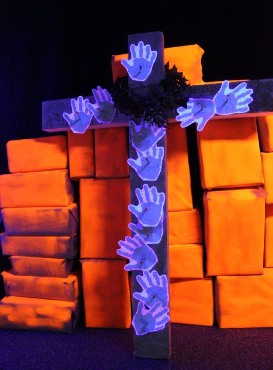
It was nearly Max’s turn to stick his sheet of paper onto the Styrofoam cross that leaned against a makeshift wall inside the classroom. The paper was meant to represent one of Max’s sins, and the cross represented the real, wooden one Jesus died on. Around the top hung a crown of thorns similar to the one Roman soldiers had used to jab into Jesus’ head to torture him and make fun of him. This was serious.
Over 2,000 years ago, Jesus sacrificed himself so that people’s sins could be forgiven. Couldn’t God just change the rules? God can do anything He wants! Why did God want Jesus to die? Max was beginning to see how little he understood sin.
Max wasn’t quite certain if he was wrong by not sharing his sword with Aiden. “He should have brought his own. This one’s mine, and that kid might ruin it,” Max reasoned. Yet somehow, deep inside, he didn’t feel very good.
Max thought Aiden looked kind of sad. He remembered feeling that way himself just last week when Alex rode her bike over to visit. She brought an ice-cream sandwich. It was Max’s favorite and she knew it. She hadn’t given him even a tiny bite and ate the whole thing in front of him!
Lady Becca encouraged the class to study the Bible whenever they had questions about how God wants them to behave. She assured them that God wants what is best for them. She said, “God wrote a really long love note and sent his Word for all people. Sometimes it might seem confusing, but the more you read the Bible, the more you’ll come to understand how God wants you to live.”
Max thought, “Alex should take a look at what the Bible says about sharing.”
A moment later, Max surprised Aiden by lending him his sword. Then, the brave-hearted knight, Sir Max, approached the cross and let Jesus take away his sin.
“It is better to fail in originality than to succeed in imitation.” – Herman Melville
As the only female in my undergrad speech class, I comfortably delivered the speeches required by the professor’s syllabus. Comfortable that is until we received a new assignment, a five to seven minute demonstration speech using props, pictures, or other visual effects. After each presentation, our classmates would make comments about the subject and the presentation.
Testosterone filled the classroom as each student quickly stated what his subject would be. Topics included: how to fix a lamp cord, how to replace a garbage disposal, how to change the oil and oil filter in a car, how to give basketball officials’ signals, and how to use various repair tools.
Still living at home, I was used to my father doing all household repairs. However, he did teach my sister and me the difference between a Phillips screwdriver and a slotted screwdriver, a wrench and a ratchet, as well as vise grips and pliers. He taught us how to use a hammer without damaging a finger, how to clean walls bottom up to avoid streaks, and my favorite: how to jiggle the handle of the toilet to stop it from leaking. I knew a few repair tricks, but I knew I couldn’t compete with the men in demonstrating how to fix anything.
I didn’t pick a topic immediately and chose to be the last speaker in the rotation. What could I possibly demonstrate to a group of men who would give informative speeches showing their expertise in fixing a myriad of things? After much thought, I selected my topic, practiced what I would say, and carefully prepared my props.
On the day of my presentation, I opened my bag of visual effects in front of the class and said, “Today, I’m going to teach you how to make a dress.”
The look of surprise on the male professor’s face was priceless. I held up a large piece of fabric and a simple dress pattern and said, “This is what you start with.”
Putting those items aside, I held up a piece of fabric with pattern pieces pinned in place. I held up a pair of pinking shears and explained that they were preferable to plain scissors because they prevented the cut fabric from raveling. I described how darts are made to provide a smooth fit over the curvy parts of a woman’s body. I showed how I sewed a zipper into the dress.
All eyes were on me as I ended my demonstration speech with, “This is what the finished product looks like,” as I modeled the simple black form fitting dress. The applause that followed was heartwarming, but the positive comments told me that I succeeded.
I dared to be different. When have you dared to try something different?