Category Archives: Nonfiction

Playing Trump on the House-Of-Cards

Opinion is solely the author’s


I had a funny thought. If Donald Trump and Gary Hart met up with Neil Diamond and Sam Spade to play cards, Trump would insist on playing Clubs. Would he lead with his golf club, night club, yacht club, or his billy club?

House of Cards - ArchialAlternativeFilesWordPress

Donald Trump has certainly stirred up the nation. Love him or hate him, you have to give him that, and then you have to wonder why. His apparent lack of understanding is actually well understood by many who don’t Get It (what the feds are doing). A lot of people think our government is rigged and now only works for those who grease the wheels. They see the great divide getting wider with Congress leading the charge.

They may be right. For the first time in history, most Senators and Congressmen are millionaires. That says a lot about what this sitting batch of politicians have been up to since getting elected. The problem is, there really isn’t a better candidate than Donald Trump. It’s sad that in a nation as smart as ours, we wind up with him leading the Four Stooges into this summer’s conventions.

Ted Cruz isn’t going to fix what’s broke. Neither is Hillary Clinton. Other issues aside, there isn’t a shadow of difference between them when it comes to the top one percent’s overarching influence. John Kasich is probably the most electable republican in November, but the meek no longer survives in the Party of Lincoln.

Bernie Sanders is like the funny grandfather who loves to tell you all the things your parents did wrong. That’s why, I think, he has the nation’s youth on his side. He also has, by far, more individual contributors than Hillary Clinton. No matter how much money each person gives, they still only get one vote in return. Hillary’s PAC supporters remind me of Captain Gulliver being tied down by 100 Lilliputians. I think Bernie is a better candidate than Hillary, but the problem with any democratic President is that we gain nothing but four more years of gridlock.

The only thing on the republican-held Senate and House agendas will be stopping the clock for yet another four years. In the past decade, Congress has passed numerous laws that benefit few but affect millions as if the consumer doesn’t matter. Our laws are now written, not by congressmen, but by lobbyists for congressmen. Trump is the only one who wants to change that. The others just want to be contestants on Who Wants To Be A Millionaire. And that, regardless of anything else Trump declares, decrees, boasts, belittles or bungles, is what’s going to get him elected.

I just don’t want to hire a nerd to fix my plumbing. We tried that in Michigan.

At the federal level, there is not enough support for the impoverished city of Flint; everyone is too busy campaigning. On the state level, there is not enough urgency or empathy, and way too much politics – still! This is a House-Of-Cards that has already fallen.

Governor Snyder’s business acumen in governmental issues does not infuse a lot of confidence to elect a billionaire businessman to the White House. Not in Michigan, anyway, where we see everyone just dragging their feet and pointing fingers, and nothing getting done.

Flint is a killer example of cronyism. Literally, in the case of Legionnaire Disease, and long-term in the case of thousands of children under the age of six, who drank government-issued lead poison. It was totally preventable if those appointed to manage the city had followed established safety guidelines. Then, when their snafu surfaced, it was covered up for almost a year while Lansing, the EPA, the MDEQ and Flint’s Emergency Manager(s) played the blame game. While people were dying!

Is this what we are to expect on a national level if The Businessman is running the country?

Flint wasn’t the first mole to get whacked, and it won’t be the last. There are hundreds, if not thousands, of American cities large and small that are operating water supply systems with 50, 70, 100-year-old lead-leaching pipes. If the next President wants to build a jobs program that will reach across the nation, as well as across the aisle, then upgrading the nation’s potable water system would be a healthy place to start. Roads and bridges are important, too, and the rails and docks are in even greater need of modernization. Then there is the aging and overburdened electrical grid that all of us depend on almost as much as oxygen.

There’s lots to do. We just need to elect people who want to aspire to things besides becoming millionaires. Or hiring apprentices. It’s a pity we don’t have a None of the Above option on the bottom of each ballot.

Playing Trump in November will certainly bring down the House-Of-Cards that is today’s Capital Hill. And, who knows? Without all of the special interest lobbyists setting congressional agendas, a political career might become noble again.

But I still need to hear more substance from Trump before I can vote for him. Washington is a lot closer to Lansing than it appears on the map.


Read On!

-Phil


Coffee Shop Chronicles: Writing Letters

IMG_0479Tuscan Cafe
Northville, MI

What is that woman writing?

“Hey, behind you,” I whisper to my husband. “There’s a woman writing.”

We’re sitting along the wall in what I’m calling “our spot.” I seem to default here when I come in; the light is good and I’m out of the way from the main path. My husband finished his mocha coffee latte drink a few minutes ago and is checking something on his phone. I glance over his shoulder and see a woman writing.

I don’t know how I know that she’s writing something personal, but I do. Maybe it’s the slouch her shoulders, determined but relaxed. Maybe it’s the slow way her hand moves, the pause she makes, deliberate yet light and free. She’s focused but not intense. Is it a story? Journaling? A project?

I’m curious.

My husband half turns, that way, when you try to casually stare without being obvious. I’m staring directly at her. She doesn’t notice me.

“I can’t tell,” he says.

Neither can I, but it’s time to leave.

“I want to see,” I say.

The exit is behind me; there’s no reason for me to move in her direction. I stand up and shrug my coat on. I make my go-to excuse, and I say it loud enough so that if she was listening, she wouldn’t be suspicious.

“I’m going to use the bathroom before we leave.” That door is in front of me, so I can conveniently walk past the writing woman.

She is writing Thank You cards.

The cards are white, but they don’t have that white embossed shiny-matte, off-white texture of wedding cards. Her cards have Thank You in black, neutral font. The text is friendly and readable, not some flowery script but not a dull Garamond or Times New Roman. There’s a color design clustered in the center around Thank You–flowers, I think–but the style is neither masculine nor feminine. There’s a stack of cards next to her in a non-descript box with a flimsy plastic lid that you’d find in a Hallmark store. It looks like she’s writing with an ink pen, nothing fancy but higher quality than you’d get in an office supply store.

I see all of this in about 5 seconds, maybe 10. Staring can be creepy, and there’s no time to casually chat. I don’t want to disturb the magic. She’s intent and focused and fortunately doesn’t see me staring at her and the table full of notecards.

I walk out.
I don’t bother to fake-stop in the bathroom.

I think of this now because it’s April, the month of so many things: National Poetry Month; Camp NaNoWriMo; National Rebuilding Month; Testicular Cancer Month, Autism Awareness Month, and National Card and Letter Writing Month.

I started writing letters to my friend about two months ago. These are notecards from Target $1 Spot. The 8 cards are all the same design with the word “Gratitude” on the front. I bought them because they’re a friendly peach color with matching envelopes.

So far, I’ve received no letters in return and I don’t expect any. I write as if we were talking side by side and, yes, I write them when I’m in coffee shops. These small cards aren’t intimidating because there’s only room for a thought or three, just short and fun. And now I discovered a whole movement.

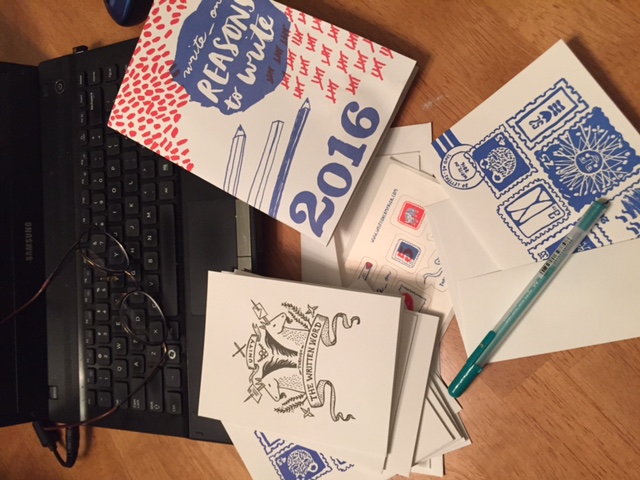
There’s a campaign called Write_On which distributed 10,000 free writing starter kits to encourage people to write a letter a day in April. I’m not a fan of setting daily deadlines; to me, it’s a setup for self-failure if you miss a day. Regardless, I signed up for and received one of the kits.

The six-card kit includes envelopes for mailing–as a papercrafter, I can say that including envelopes is the polite thing to do. There’s stationary with envelope, stickers, a colorful inspiration booklet and a gelly roll pen. I’m a writer. I like paper. I like pens. Any letter writing I do, once a day or not, spreads more joy than if I didn’t write at all.

I’ll never know what that woman was writing or thanking people for, but do I need to?

Three Principles to Fly By

Because we fly a lot, my husband Greg and I are sensitive to airplane etiquette. Recently, we were disturbed by a man who was clipping his fingernails two rows ahead of us on a plane. Now I know that clippers have advanced to the point that some can trap wayward debris in carefully designed, built-in cavities. I also know, firsthand, that they don’t work perfectly. Odds and ends always get away. It’s bad enough to have to brush off a seat full of cookie crumbs left by a previous passenger. But fingernails…really?

Dear Friends, let’s take a look at some of the ways we can be a little more courteous to our fellow passengers.

1. Take care of personal grooming in privacy.

As you prepare for travel, there are many things to consider. You may have to temporarily stop delivery of your mail or ask a neighbor to collect it while you are away. If you have pets or plants, you need to make arrangements for someone to care for them. Checking the weather forecast will help you determine the type of clothes to pack.

Before adding toiletries to your luggage, take a couple of minutes and put your nail clippers to use. If you just can’t squeeze in the time before your trip, place the coveted clippers next to its dreadful cousin—the nose hair trimmer—in your suitcase, where the two can keep each other company until arrival at your final destination. No one wants to see or hear either of those in action.

KellyDeadwood-2016-4April-binoculars

People are watching.

I’m pleased to say that I’ve never witnessed anyone onboard pulling out a razor to tend to a few missed spots. Personally, I have been tempted to paint my nails while en route, but I abide by the unspoken, yet commonly understood, rule that certain finishing touches aren’t spectator sports.

2. Pay attention to your boarding status.

Unfortunately, we are not all treated equally in the caste system of airline travel. At least that’s the case with Delta Airlines, upon which Greg and I frequently rely. Dare I say: polite discrimination is necessary in the boarding process?

On your boarding pass is the heading, Zone. Look beneath it to find a poorly disguised indication of your affluence. This is what determines when you may embark. Unseasoned travelers, or anti-establishment rebels, typically rise too soon from their seats, crowd together, and block the path of First Class and Premium passengers—the upper crust of airplane society who board before most everyone else. For the majority of us in other designated Zones, I suggest we step to the side and allow High Society to go more easily on their way. Additionally, let’s bow, ever so slightly, as they pass by. They have, after all, impressed us with the status they have achieved by either paying big bucks for their cushy seats or by manipulating airline miles and credit card spending to earn upgrades into the royal realm. They deserve our silent admiration, if only for a moment. Take solace in knowing that even they must yield to people needing assistance or to those traveling with children under two, with strollers or car seats.

Next to board are various levels of the working/middle class. These are my people. We own the Sky…Zone. We achieve higher and higher status—Silver to Gold to Platinum to Diamond Medallion—as we accrue more and more miles through air travel or as we rack up exorbitant credit card balances. We are frequent flyers, good spenders, and oftentimes, both.

The extent of snobbery in Sky Zone most recently cost me $19 extra to upgrade from basic, main cabin seating to Delta Comfort+. It was well worth a bite size Twix and mini banana, wine, extra leg room, and free SHOWTIME episodes of Penny Dreadful, Season 2. Is it not obvious that Sky Zone people are on our way towards magnificence and, like those who went before us, deserve a clear path to our assigned seats?

Zones 1, 2, and 3 are reserved for the have-nots. Because of their lowly position in the pecking order, they are last to be summoned forward and, once onboard, may struggle to find room in the overhead bins. Do not fret if you are assigned to one of these final categories. You are still classier than the other people waiting to board who sit in front of charging stations and don’t intend to share the extremely limited power. They roll their eyes and begrudgingly lean an inch to one side when someone approaches and asks to plug-in. If it were up to me, I would strip the classless of their coffee or tea, water or juice, peanuts, pretzels, or crumbly cookies. Make way! For cryin’ out loud.

Ahem. Air travel affords the perfect opportunity to practice getting along with other people.

3. Once on board, stow your belongings, sit back, relax, and control yourself.

Don’t:
• Kick the seat or tap too hard on the personal entertainment system in front of you.
• Monopolize the armrests or invade your seat-mate’s allotted space.
• Recline your own seat too quickly.
Do:
• Speak softly when carrying on conversations.
• Cover your mouth when sneezing or coughing.
• Say please and thank you to the stewards.

We can’t rely on rocket science alone to make airline travel more enjoyable. Let’s remember our manners.

(Farting is fine as long as you deliver silent ones. No one can really tell where those come from anyway.)

Jury Duty


 “Jury Summons Notice: You have been selected to serve as a Juror. Failure to report will be considered a criminal offense. Please report on your assigned date.” Receiving a jury notice from a federal court is an occasion for mixed feelings. I was never sure whether my first experience was typical, but it certainly was entertaining. I appeared at Michigan’s 3rd Judicial Circuit Court serving Wayne County and, by mid-morning, seven of us were sworn in to hear a civil suit. Since we weren’t allowed to take notes, we would need to recapture what happened afterward and agree to every detail of several days of testimony, no easy task. Plaintiff was a man in his late thirties suing Coca Cola and a truck driver for running a stop sign and smashing into his car. He hadn’t been injured at the time but, now, seven years later, was claiming his neck hurt and he was suffering from despondency as a result. He seemed listless, sitting with downcast eyes and pitiful expression.

Just as we were beginning to feel sorry for him, the defense revealed Mr. Despondent had since played several seasons of professional European football in the United Kingdom. Uh, oh. I could only wonder whether his neck hurt from soccer or he was despondent over a bad season. How can a professional soccer player complain of a sore neck from a seven-year-old automobile accident? But Coca-Cola’s attorneys didn’t have a compelling argument why their truck driver shouldn’t be held liable.

We were led to a jury room to begin deliberating, and a fellow-juror turned to me and said, “We’ve decided to elect you foreman, so tell us what to do.”

No one had said how a foreman was to get a jury to reach a consensus, so I pondered a minute. “All right, but the first thing we should do is to agree about what we heard. What I heard was the truck driver went through a stop sign and smashed the plaintiff’s car. Although he went to a hospital for examination, he wasn’t injured enough to prevent playing professional European football. Now his neck aches, and he’s despondent. Sorry, but I’m despondent even being here. But the defense didn’t give us a reason why they are not liable for the accident, right?

Since no one heard anything different, we voted on slips of paper and decided to find for Mr. Despondent’s seven-year-old bumps and bruises and his smashed car. But now we needed to decide what that meant. “We have to consider the cost of plaintiff’s car and hospital examination and, after that, his pain and suffering. My problem is I think this guy is faking his disabilities. If you agree, let’s cover his out of pocket costs and get him out of here. Maybe he’ll have a better soccer season next year if he plays for another team. Each of us should write a dollar number on a slip of paper so we can see what the maximum and minimum are we think he should receive.”

The least amount was $10,000, the most $2,000,000.  I went over the actual costs and took another poll before we decided $40,000 was an amount everyone could agree with. We trooped back into the courtroom and the judge thanked us for having decided appropriately. We later discovered Michigan law allows plaintiff’s attorneys up to 47% of awarded damages. I could only hope Mr. Despondent had enough money to buy a few soccer balls and a happier outlook on life. At least we saved Coca Cola two million dollars.

We returned to the waiting room and were called back to a courtroom to hear a criminal case. A young, tough-looking, black defendant in prison garb was charged with shooting a jewelry store owner after robbing him. He huddled with a court-appointed attorney while the charges were read and prospective jurors called to the jury box. Each was asked whether they could make a fair and impartial judgment after hearing the testimony. The defendant’s attorney asked one prospective juror whether she could remain unbiased if someone testified the defendant was seen in the vicinity of the crime. She was dismissed for having potential bias. Apparently, to prove his point, the attorney then asked the next potential juror, “On the basis the defendant is presumed innocent until proven guilty, could you remain unbiased even if testimony revealed he emerged from the jewelry store with a smoking gun in his hand?”

Before the startled juror could reply, a man seated with me in the rear of the courtroom mumbled in a voice loud enough that carried all the way to the judge’s bench, “Hell No.” The entire courtroom was deathly silent; everyone turning to stare at our suddenly-mute juror ranks.

The defense attorney turned to the judge, “Your Honor, I want the prospective juror who said that to identify himself and be removed from the courtroom.”

The judge commanded, “Whoever said that, please stand up.” After a moment of shuffling feet and embarrassment, a guy meekly rose to his feet.  “Prospective juror, you are excused.  Please return to the Juror’s Room on the first floor.” There was a sigh of relief that a moment of unpleasantness had passed and business resumed.

However, the man who had actually spoken the words was still seated beside me and we smiled at each other in mutual understanding. Seconds later, he was sworn in without difficulty. After the panel was filled, the rest of us were excused and I returned to the jury room. In this case, perhaps, sleeping dogs should be left alone.

Coffee Shop Chronicles: The Virtues of Public Transportation

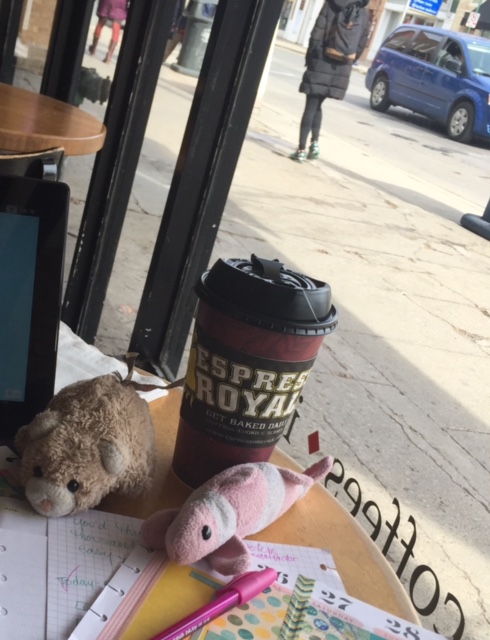
FullSizeRender (1)Espresso Royale

Ann Arbor, MI

“The niche is all yours,” the tall, lanky guy says, referring to this cluster of soft chairs he’s getting up from.

“I don’t need all this space.  I like to be self-contained,” I say with a thank-you nod as I put my bag on one table.  Then I smile at him.  “Besides, this is the only clean table.”

It’s true that I like to have room enough to spread out, but not so much as to intrude on others’ space.  Not so much the case for the previous coffee shop patrons.  There’s a candy wrapper on one table.  This coffee shop doesn’t even sell candy.  There’s a coat on another chair as a placeholder, a reserved sign made of fabric.

“That’s trusting,” I say to the guy, pointing to a woman’s purse hanging on the back of an empty chair.

“Anyone could walk off with that,” he says.

Ann Arbor is a walking town.  Most stores are close enough to each other that walking from your apartment to a restaurant and then the small, specialty grocery store before returning home is easier than driving.  A bus passes outside on State Street.  Even in the rain, public transportation is the better option.

“Yeah, or hop on a bus,” I say.

Growing up in the city limits of Pittsburgh, PA, public transportation was plentiful, much like Ann Arbor and its surrounding neighborhoods.  Pittsburgh is a bigger city, of course, much bigger, and we used it all the time after our family car died.  I remember Dad coming home after work with an armful of bus schedules.  He plopped himself on the floor in the middle of the living room, spread out the maps and began to figure out how the heck you traveled to downtown from our house.

Fortunately, we lived on a bus route.  It was a good bus route, one of the main ones, not far from a depot garage.  Buses had a frequent schedule in my neighborhood, even on Sundays.

A light rail system was constructed when I started high school.  That was my first exposure to “subways,” a misnomer I always thought because the T ran underground for only three stops.  It was an above-ground transportation outside downtown proper.

“My friend’s dad could read the entire New York Times in a tight space on the subway,” he says.

I’m impressed.  I could never stand and read on a bus.  My survival skills in tight spaces came from sitting down.  Maybe this is why I can be self-contained sitting down in a coffee shop.

Riders learn to multitask early.  You eat a sandwich in your seat without spilling any on the passenger next to you; the tantalizing smell throughout the bus was out of your control.  You sleep with your head against the window and intuitive feel when it’s time to wake up to get off at your stop.  You learn how to place paper grocery store bags on the floor so that passengers won’t step on or trip over them.

I did develop strong legs and a sense of balance to stand upright and not tip over as the bus bounced and jerked and turned corners.  You learned to politely shove your way through a smash of people to exit at your stop.  You talked with the people you saw every day, creatures of habit you all were, work and school schedules always the same.  You gave up your seat for people with packages, women with children, and the gentle older folks.

This guy must be a rider of sorts because he continues to discuss public systems.  He says the John P. Getty Museum in Los Angeles is located at the top of a mountain.  The area has a great system in its three-car train that goes up the mountain.  The ride is smooth and the flow of traffic is easy.

This reminds me of the Duquesne and Monongahela Inclines in Pittsburgh.  It’s a unique experience to be pulled up a mountain.  I guess it’s like what a ski lift is like, except the inclines are big boxes that hold about 50 people.  They’re fun to ride, especially when seasoned riders scare the first-timers by saying, “Oh, I hope this doesn’t fall and plummet down.”

I smile and nod with the guy, saying. “The lessons you learn on public transportation will help you through your lifetime.”