Category Archives: Nonfiction

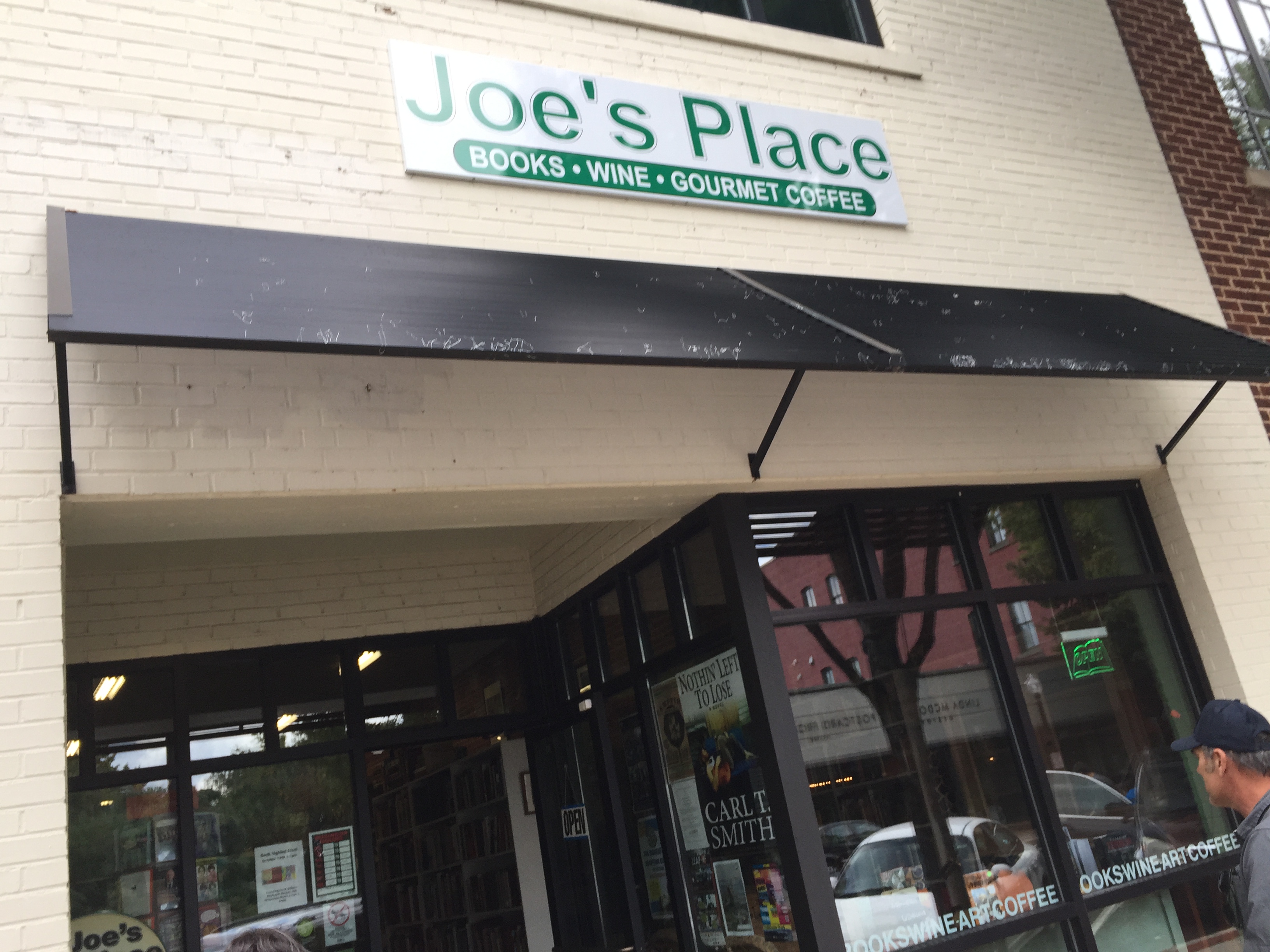
Joe’s Place

I’m sometimes asked what do I most enjoy about visiting bookstores. My first thought is the excitement of possibly finding a book that I’ve been searching for or a book that I’d not realized that I was searching for. Usually it’s one signed by the author or an older paperback that can only be found in an independent bookstore. Yet, I’ve developed a deeper joy in the discovery of bookstores that have personality. That is to say that when walking into a store, I feel welcomed and invited to learn its story–like making a new friend. Not all bookstores have a character that extends beyond the anonymous store. In fact, some stores want customers to feel like each of their stores are the same, with item location in the same place regardless of where you visit, or menu you choose from. Then there are the independent bookstores, as is true with other businesses, that strive to bring to life their personality, as unique and distinct as individuals. When you find those places like The Java Place and Joe’s Place, you choose to return to them every chance you can as with old friends.

Joe’s Place by John McCarthy

2014-10-15 16.37.31

The storefront indicates that Joe’s Place sells books and wine, which opens lots of questions as to what I would find. Is it an antiquarian store? Perhaps it’s a wine seller with books on the side? A moment’s concerning thought arose: Did I just drive almost an hour to Greenville SC for a bookstore that was actually a Party Store? At this point, I just had to know.

2014-10-15 16.50.06

Crossing the threshold, a bar counter and tables were center of the room. Wine bottles stacked alongside, and a sign displayed prices for wine and…coffee drinks? Classical music soared through the room. Diamond shaped shelves constructed for wine bottles were stuffed with books. It was then that I exhaled. There were many shelves of books in the main area, and the corner room near the back. All genres are present for the voracious reader, the teen, the parent looking for something to occupy their young child, and those who are interested in all things non-fiction. But that’s not all. There is a glass cabinet, once the home for expensive bottles of wine, that houses antiquarian volumes for the selective book collector. There is truely something for everyone’s book interest.

2014-10-15 16.50.03The proprietor sat behind a register counter that was typical of book sellers I’ve found everywhere along my travels. The owners are a husband and wife team who shared a dream of establishing a bookstore to serve the local patrons. Prior to the store, they traveled far to visit their favorite bookstores. Interestingly, Joe’s Place is not named after either of the couple, but is named in honor of a brother. The reason for this was not shared. There was a sense of reverence in the silence that followed sharing the origin of the store’s name.


Joe’s Place offers an ambiance that is part bookstore, part cafe, and part wine tasting soiree. It is a place, as the proprietor said, “Where you can have a coffee or glass of wine while checking out books to decide on purchasing.” The downtown area where the store is located feels like a mix of an upscale college community and yuppy climate that welcomes tourists to walk the streets and visit the eclectic shops. Joe’s Place is a welcoming stop for locals and visitors to catch their breath, have a drink, and check out a good book to start and purchase for their journey.


Joe’s Place

640 S Main St, Ste 101 B, Greenville, SC 29601

http://www.yelp.com/biz/joes-place-greenville

Facebook: https://www.facebook.com/pages/Joes-Place/374123676056714

2014-10-15 16.41.10 2014-10-15 16.43.03


Amazing Lady, Jennifer

I went down to the basement through a narrow spiral staircase from the kitchen. The tiny kitchen has a small cooking stove and a large rice cooker on the counter.

Jennifer has set up her beauty parlor in the basement and takes care of customers at any time, early morning and late evenings. Customers are mostly family members: husbands, wives and children.

In the basement there are three almost brand new red toolboxes with several shallow drawers and strong and sturdy wheels attached to the bottom. The unhealthy plants with dry brown leaves from outdoors for winter are placed on top of the toolboxes. An old revolving chair is in front of the only mirror and one armchair is attached to a large hair dryer. There is an old sofa that is covered with a slipcover for customers who are waiting their turn. An old TV is on the shelf for watching Korean soap operas.

The thing I like most in the basement is a radiant heater from Costco that warmed up my leg while I sat on the chair in front of the small mirror. One other thing was a calendar from Jennifer’s Korean Catholic church with the date of the lunar calendar hung near the mirror. I need to know two days in the lunar calendar per year: My mother-in-law’s birthday and Korean Thanksgiving which is on August 15 in the lunar calendar and around the end of September in the solar calendar.

When I turned on the basement light, Jennifer came down immediately after me and turned on the heater. I sat on the chair shivering and she put a towel and gown around my neck and she started to touch my hair.

“Your hair grows fast. It is long. That means your hair is quite healthy,” Jennifer commented.

“I was busy and I just kept it in a pony tail. It looks ugly, but…” I did not finish my sentence and continued, “I needed a perm to last for three or four months at least, maybe a tight curl helps it to last longer?”

“Let’s see.” Jennifer continuously touched my hair with her warm fingers.

Before Jennifer finished her sentence we heard loud noises from upstairs and something hit the floor. BANG!! BANG!! It was like a grenade hit the floor and would make a hole in the basement ceiling.

Jennifer dropped her brush on the floor and ran upstairs. Again the loud voices spread throughout the house as loud as thunder. A few minutes later the storm calmed down and the kitchen door was opened and closed with a bang. Somebody ran out into the street.

She felt that she was caught in the middle between two giant forces and neither was willing to give an inch (like a small ship at sea caught between two gigantic humpback whales). But she was all right for handling this awkward situation. She came downstairs holding her breath and started to curl my hair. The quiet moment sprawled through the basement.

“Last night our house was so cold I thought that I would freeze to death. (It was not true). Kwang put the thermostat down to 65 F.” I was just making conversation to break the silence.

Maybe Jennifer did not hear what I said. Her hands were trembling a little bit, but she was able to settle her emotions.

Jennifer has taken care of my hair for more than twenty years now, but we have never talked about our personal lives. I did not even tell her about my business and I just told her all the time how busy I was with four children and a heavy workload. In exchange, she told me the stories of Korean soap operas that she watched.

I wished that I could avoid this uncomfortable moment and just say goodbye to her and leave but the perm takes about two hours. There was no way I could leave or comfort her.

Finally Jennifer thawed the chilly moment and started her amazing story. “Bob and I have two sons and one is a business manager of a small company and our second is institutionalized and just came home for the weekend.”

Silence reigned for a few minutes and then she continued that whenever her second son, Harry, came home there were frequent quarrels between father and son. Everybody had bruises on their faces and bodies. “When Harry is in the institution our home is much quieter than before. Since Bob is acting as a child, he starts the quarrels and not his son.”

I lost the words. I just thought about what a unique life she has. Then she went on. In December 1951 during the Korean War, her hometown was in Kangwon Province, which was in the South Korean territory before 1953. Her first husband died on the battlefield as a sergeant. She left home with a seven month old son and a three-year-old daughter with one thick blanket. Her son was on her back and the blanket and everything else was on her head. She walked with her three-year-old daughter for several miles to the train station where all the townspeople would leave for the south to avoid the war zone. Many, many times her three year old daughter lay down on the snow, cried and did not want to walk any more. Everybody had to leave the town because the North Korean and the Chinese armies flooded toward the town.

It was dark when she finally got to the train station where the refugees were. She was one of the last people to evacuate the town. All the people were in cargo trains and there was not even one inch of space left. People sat on other people’s laps. There was no room for them to stretch out their legs. This was the only transportation to leave the town.

Her hands were getting warmer and she was getting faster with curling my hair and her mind seemed to have regained control and she continued, “For three days we were in a cargo train without any food and could not even go out for a pit stop. When people needed it, they passed around a can for an emergency. For three days we did not eat anything and nothing came out as discharge. I sat on the lap of a middle aged gentleman and I used the can on his lap.”

Another silent moment passed and my curiosity increased as to how she met Bob.

After three days the train stopped at its final destination of Daegu, that is a city in the middle of South Korea, which is now the second largest city in Korea. The refugee camps were full of people from North Korea and they were setting up another one but it was not ready. About one hundred to two hundred people did not have a place to spend a couple of nights until the camp was up.

Jennifer walked on for several miles with two children looking for a place to stay. After several rejections, she found a house with a barn. Jennifer asked the landowner if she could stay a couple of nights here until she could go to the camp. The owner was a very kind and warm-hearted person and explained her reasoning. “How can I let you sleep in the barn while we are inside the house?”

“If you let me stay here, it will be a great place since I have a thick blanket and we can be warm staying here,” Jennifer replied.

About a week later Jennifer and the two children finally went into the refugee camp. At that time there were several refugee camps around the town. The government provided a meal once a day with rice balls and bean sprout soup.

Jennifer continues, “After I settled down in the refugee camp I began to be concerned with the whereabouts of my family (parents and siblings). They were evacuated at a different time from North Korea and I did not know their location.” A couple of months later Jennifer got news that her parents were in a different refugee camp.

Finally the family was reunited but no jobs were available and getting food was very difficult. Her daughter was crying from hunger and her son was trying to suck Jennifer’s milk from an empty breast. Because of malnutrition her son started to walk at the age of two and Jennifer did not have a period for three years.

Through the assistance of the Catholic Church, Jennifer collected a mixture of leftover food. It was waste food from individual dishes from the U.S. army. It was more nutritious than just bean sprout soup or other Korean food at that time. With these connections Jennifer started to wash clothes for the G.I.s. First one and two, then later she operated a laundromat for about two hundred G.I.s with the assistance of several employees.

Business was booming and it seemed to rake in money from the ground and the laundromat space was full of G.I. clothes. One day one soldier’s clothes were in our laundromat for several weeks without a checkout. I asked his friend the reason. He said it was Bob who was new to this division and because his paperwork was not properly done on time, the payment of his salary was delayed so he could not get his clothes back.”

Jennifer asked his friend to take his clothes and pay for it later. Jennifer’s intention was that she needed the space, but Bob thought differently about Jennifer. Bob paid back with a letter saying that he wanted to marry her.

Jennifer didn’t even blink her eyes at his proposal. She totally ignored him. She had many reasons. She already had two children from a previous marriage and Korean tradition did not allow for mixed race marriage at that time, especially marriage to a G.I. It means one class lower than our traditional social system. Koreans can no longer be proud of their pure blood because of so many mixed racial marriages.

Bob came to the Laundromat every day and sent her letters almost daily. Then he moved to another location and that division moved out of the town and a military police (MP) division came to that location. She operated the laundromat for a couple more years to serve the MPs and then she closed it.

Years passed, and Jennifer had a visitor from her church. Father Paul came. At that time Jennifer was with her father. Father Paul was hesitant to break the silence and finally he asked Jennifer’s father to leave the room in order to talk with Jennifer privately. After her father left the room Father Paul took out a ragged letter from his inside pocket. It was a letter from Bob. Since Jennifer had closed the Laundromat, Bob did not know her address, so he sent the letter to the main office of the Catholic Church and it was forwarded and finally wound up with Father Paul. Father Paul knew that Jennifer would not marry an American G.I., breaking Korean tradition. Not only this, Jennifer already had two children of her own. Her family and church members decided to at least meet Bob and then make the decision but this meeting did not mean “YES”.

It was nine years since the first time Jennifer had seen Bob at the laundromat. Bob flew in the first time with a ring. Nothing happened. The second time nothing happened and the third time he brought another ring.

Jennifer’s family and the priest thought he was a very decent man and he had fallen in love deeply with Jennifer. He would make Jennifer happy for a long time. They married in the Catholic Church.

As soon as Jennifer married Bob she began to recognize that Bob was not normal. He was different from what she first thought.

“Jennifer, how can you stay with him?” I interrupted her. I could not hear her story any more without frustration.

“This year is our 45th anniversary.”

I lost words. What an amazing woman. She has carried this load of frustration and uncertainty of Bob’s abnormal character for forty-five years. And I was full of sorrow for her. The Catholic principle made her stay with him without divorcing him. This was only my thought. But it’s possible that they might have many happy moments together.

“Bob is now in a nursing home fighting for his life.” Jennifer could not finish her sentence; tears were running down her cheeks.

Costco’s Looking Out For You

I was so pleased with myself. I felt I had really gotten through. I’d spent a long time writing my letter explaining things. I thought the phone call went well too. But, it was his last remark that stayed with me. Now I wonder…

I live in Ann Arbor. A little over a year ago, Costco built a new store on the southwest side of town. My husband, Michael, and I decided to join. We like Costco because of their products, prices and friendly service.

Once a week, we stop for gas and then go into the store to do some shopping. We have their Gold Star or basic card. One Saturday, near our renewal date, we stopped by the front desk to see if we’d save more money by upgrading to their Executive Membership. The manager in charge was very helpful. He asked us a few questions: How many people in your household? Did you mostly buy gas or food?

Since we are only two people, and considering that gasoline makes up a great percentage of our purchases, we wouldn’t save more money if we upgraded. The regular card was our best bet. We appreciated his helpfulness and honesty.

The following week, when we were checking out, the cashier asked me if we’d like to upgrade our membership. I told her, “Thank you. No.”

She told me we were missing out. With the money we were spending at Costco, we’d get money back at the end of the year if we upgraded. She was “only looking out for our best interest”.

I repeated, “Thank you. No.”

She started in a third time. I thought a little explanation might help. I said we’d already consulted with the person in charge of the membership desk and, in our case, we wouldn’t be getting money back. (At Costco you don’t get money back based on what you pay for gas.)

Michael and I discussed this interchange as we were leaving. Neither of us liked the way she continued to push after I’d told her “no” the first time, let alone having to repeat no three times. We especially noted her remark that she, who didn’t know us, needed to be looking out for our best interests. It seemed a little arrogant.

The following week, after getting gas, we were back in the store shopping. This time a different cashier started in. The only difference from last week was: She was louder, more aggressive if possible, it was crowded, and people on both sides of us as well as behind were listening.  I must have said, “No, thank you” at least six times.

She persisted:

“You really should upgrade your membership. I’m only trying to help you.”

“You don’t understand. I’m looking out for your best interest. Believe me.”

“If you don’t want to upgrade with me, you need to do it at the membership desk. You’ll save lots of money. I know. I can tell by looking at your account here on the screen.”

I swiped our card, got our receipt and we walked toward the exit. She was still talking.

What, we asked each other, did she read on that screen that she felt entitled her to continue harassing us after we’d said “no”?  What did she know about our best interests? She was a stranger.

We concluded, the screen must have said something like this:

“Look at this couple. They’re over 65. Therefore they’re stupid. Everyone knows, as you get older you get stupider and stupider. They don’t know what’s best for them. It’s your duty to save them from themselves. You know what’s best for them. Even though you’ve never met them before or checked out their financial situation, you know how they should spend their money. You can recognize a good deal when you see it. If they resist upgrading, that’s proof of how really stupid they are. It’s your duty to look out for them. Obviously they can’t look out for themselves. You’re only doing this for their own good. You have their best interests at heart.”

We were horrified to think that we’d have to go through this experience every time we checked out. We decided, maybe a letter to the manager of the Ann Arbor Costco store might help.

I sat down to write the letter as soon as we got home. I began by relating several positive customer service experiences we’d had at Costco. I included the anecdote about the front desk manager helping us decide that the Executive Membership wasn’t for us.

I then related the stories about the two cashiers. I wrote what we thought the screen might have said that caused them to act like that.

I asked that whatever the screen actually did say that caused the cashiers to act this way be deleted. The next time we came to Costco, we wanted to have a pleasant experience.

I gave my identifying information and asked the manager to phone.

Two mornings later one of the Costco managers called. We chatted for about five minutes about the letter. He apologized and said he was sorry for our experience. He would talk with the cashiers. He didn’t know what caused them to act that way but he would look into it. He wanted to keep us as Costco customers and to have a good experience when we came to the store.

I thought, “Wow! This is really going well. He’s listening. He’s going to do something. Our next experience should be fine. I must have explained things really clearly.”

Then the manager concluded by saying something along the lines of, “I want you to know that at Costco we’re always looking out for our customers’ best interests.”

Now, I wonder, did I really make my point? Or, maybe not…

Writing: Promises or Priorities?

They say timing is everything.  I agree.

So is letting go.  That’s why I say to whomever “they” are that I’m extending my 10-hour book publishing challenge to December 18.

Why?  First of all, it’s my blog challenge and I set the rules.  (And my blog editors said it was okay.)

Second, I felt overwhelmed by things crashing into each other.  Fundraising to dance in THON clashed with my seeking financial support for my Indiegogo campaign.  The extra shifts for my part-time job slammed into prep work time for my Zentangle classes.

The last and most important time-suck of the month was me.  I watched my Major Crimes DVDs over and over, obsessing because the new season starts next week.  I wandered aimlessly through the playgrounds of Instagram.  I tell myself that writing haiku through Ku and Notegraphy phone apps was a productive use of my time, but, really, that was another distraction.

I sound just like that person I wrote about last month.

Now, I did catch a cold.  I was not so sick that wiggling my toes hurt, but I sniffled enough where leaning over my keyboard caused my nose to drip and drool on the keyboard. Any precious time I could snort the mucus back, I spent that time on my memoir.

Outside of that, I chose to be careless with my time, and now I’m here apologizing and making excuses.  Why did I not value my time and talent?

I thought about it.  I figured I’d have more success collecting donations for THON when I wasn’t asking people to buy my book.  Rather than compete with holiday parties and family events, it made more sense to me to plan a marketing strategy for my Zentangle classes in the New Year when I wasn’t marketing my memoir and my Indiegogo crowdfunding campaign.  At some point, the money from working extra hours at my job was not worth the time that could have been spent writing my memoir.

Are you seeing the theme here?  Believe it or not, I didn’t at first.  When you think about your responsibilities–I mean, really think about them–listing your life out like chapter outlines will identify the events that really matter to you. Here I’ve moved on to the next step, the follow-through that freezes many would-be writers: I’m letting go of extraneous tasks and planning.  Not everyone does that.  They usually give up.

I didn’t give up; I refocused. That’s not an excuse, although we may see it as such. If we do, then we fail, fizzle and flop.  I didn’t think I needed to prioritize, but I couldn’t identify what really mattered until then. Of all the items on my list, my memoir was most important to me.  Knowing that, I could push everything else aside.

All of this brings us back to the postponed eBook challenge. Yes, some readers who were expecting Part Two this month may be disappointed, but remember, I’m rescheduling it, not giving up.  Think of it as…increased anticipation.

How has this shift in priorities helped my memoir time? With the extra time, I was open to rearrange and commit to the Chapter order.  After doing that, the process flowed better. Both self-editing and finding an editor takes longer than I thought.  Re-launching the Indiegogo campaign was frustrating and disappointing, but the descriptions and perks are now more enticing.  I’ve explored marketing ideas and am planning specific actions of specific dates.  For other ideas, I’m letting those all percolate.

Did you make a writing promise to yourself and were unsuccessful?  No one can change what happened yesterday.  It’s been done, but that doesn’t mean you’re a failure.  How do we start fresh without feeling guilty?

First, forgive yourself.  We’re all human, but we can do simple, little things.  What should you consider when planning your writing time, or anything else, really?  I can offer some advice.

1. Don’t rely on To-Do lists.  From my experience, they appear organized but are often overwhelming, and thus counterproductive.

2. Don’t say yes to things just because that time isn’t blocked off on your calendar.

3. Break up your lunch hour by standing up and physically moving away from your desk.  If that’s the time you squeeze in exercise, give yourself permission to write during one or two of those times.  Take your laptop into an empty conference room or even your car to write away from distractions.  No laptop? Use paper and a pen, as we dinosaurs did in the pre-digital age.

4. Family and relationship time is important so look for ways to balance the two. I can write in the living room on the couch next to my husband as we watch episodes of The Big Bang Theory.

No matter what you do, the key is making the time.

Did I say any of this would be easy?  If it was, we’d be doing it all and there would be no need for me to write this post.  We’d all be published authors with worldwide readership.

We know self publishing is possible. I can’t promise readers will love your stories, but if you don’t publish, how will people be able to read them?  If you have already completed the 10-Hour Challenge and published a book, leave the link information below in the comments.  If not, then you have another 30 days.  Timing is everything.

Ready? Set. Go!

Pieces and Pages – First 2 Find a Gem

Geocaching is a fun, year round activity. You take coordinates from the geocaching website, enter them into a GPS device such as an app on your phone, and go on a treasure hunt. It’s amazing the gems you can find. In geocaching there is a concept: First to Find (F2F). When a cache is set up, the first person to find it has bragging rights of F2F. Such is the case for this blog edition. I was looking for a place in Livonia to grab a quick dinner before joining fellow Deadwood Writers for an evening of…writing. As I was turning into a mini-strip mall in Livonia, my mental radar locked on a store sign that said “Books.” By sheer luck, I’d found an independent bookstore in a place that I’ve driven by many times. Usually, Yelp guides my travels to identify such gems, but I’d never expected to find some place in an area I’m very familiar with. As it turned out it was only six months old, which makes it new. It is my F2F that I hope that you will find on your travels.

Pieces & Pages: First to Find – a Gem by John McCarthy (Twitter)

2014-08-27 17.58.36

My first impression on entering the store: spare and clean. The bookshelves in the middle of the room are spaced evenly and precisely apart. Additional bookshelves line three walls. Tables are set in the window front, which reminds me of the game stores that sell and encourage play of the many fantasy card games like Magic: the Gathering and Yu-gi-ou. My second impression was the welcoming atmosphere created by the storeowner, Jill, who greeted me on stepping inside and inquires if she can assist me.

2014-08-27 17.59.20

Many genres are represented, offering recent and older classics that will tempt you. I’m always looking for some of the hard to find books, such as Piers Anthony’s Battle Circle series. I have the compilation already, and I found one of the stand-alone books in very good condition in the Science Fiction section.

2014-08-27 18.12.28


The comic book section is small, containing current titles. Collectors can order and hold a series that may interest patrons. Tables are available to those who want to read before deciding on a purchase and for playing games that are kept in an Events schedule.

2014-08-27 18.08.27

As independent stores go, this one is part of an emerging trend to combine the traditional bookstore with comics and gaming. I’ve visited several places that did this, but few that gave equal treatment to attract all audiences. Only the future will tell how successful this approach becomes. Store culture is an important key which is steered by the owner. In this case, Pieces & Pages has taken strides to meet the needs of its diverse audience.

Stop in and decide for yourself.

Pieces & Pages

BOOKS \ GAMES \ COMICS

31155 Plymouth Road, Livonia, Michigan 48150

Contact and Store Hours