The following post is one of several reasons I love my job. Travel can be tough, like the time I worked in 3 different states in one week while fighting flu-like symptoms. Then there are times like this trip that introduced me to The Java Script. I met people who love their job, running a unique and impressive bookstore that I happened upon via Yelp. It’s stores like these that gives me hope that the independent bookstores can thrive. As I continue these journeys I’ll be adding more pictures to my Pinterest board, and tweeting about them at @jmccarthyeds. There are many precious gems to keep alive. Here’s another one. Enjoy.
The Java Script: Where Genres Come to Life by John McCarthy
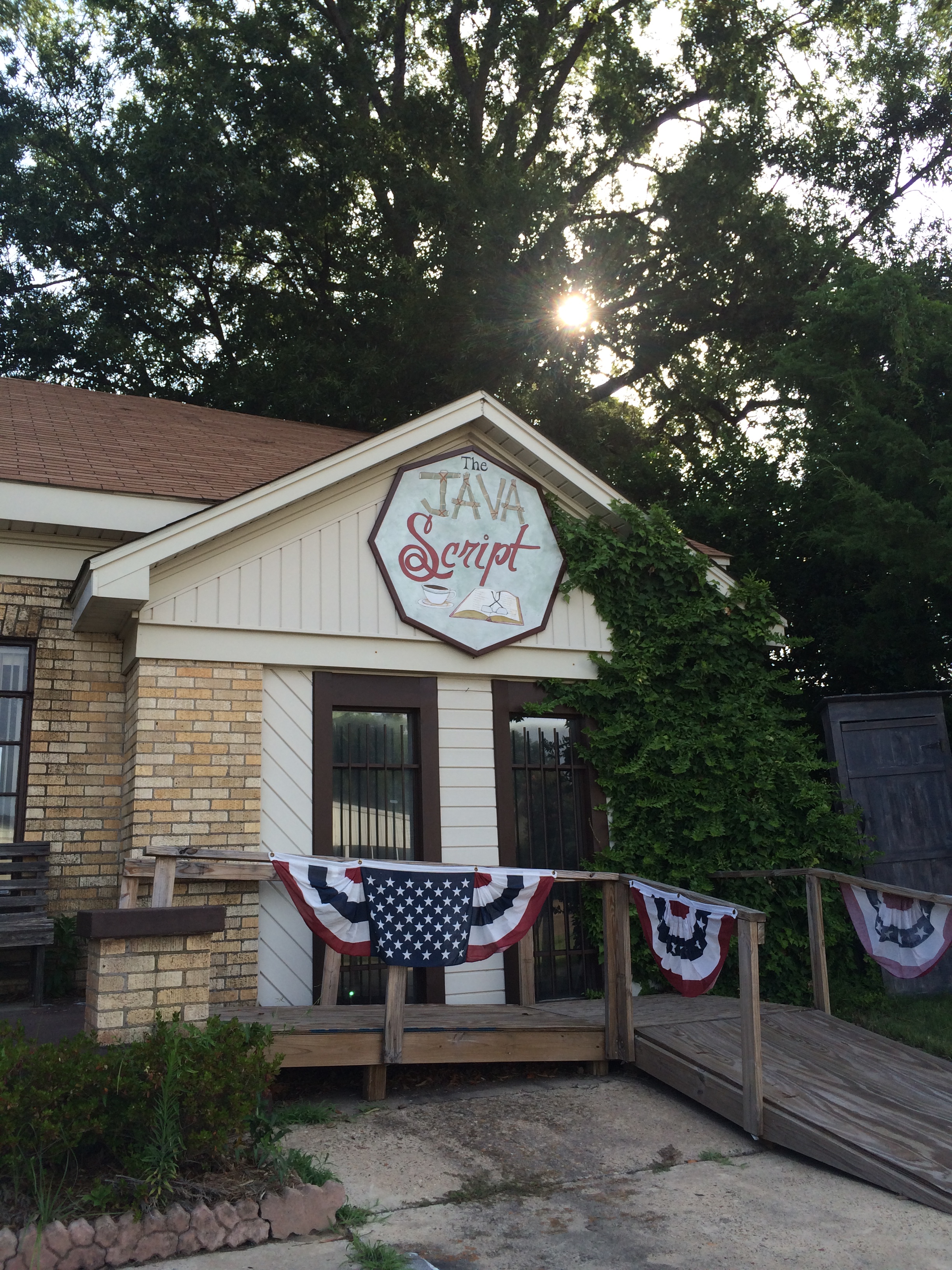
Texarkanna is a tale of two states shared by one city. Three hours away from Dallas, its distant cousin—Texarkanna is a center where all roads must pass through. Some might look upon the city with its many pawn shops and see what might have been. This would be an error of lack of vision. Like any urban community, the city has many worthwhile places to stay, eat, and visit. One such gem is The Java Script, a mom and pop (literally) bookstore on the Arkansas side, a block away from one of the main thoroughfares.
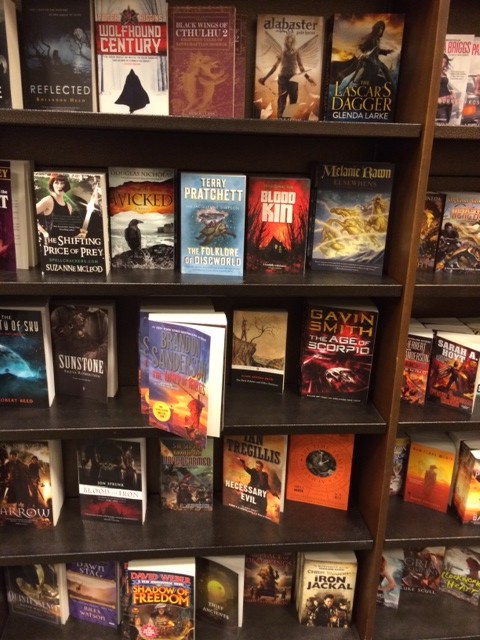
The bookstore name implies a café that serves coffee. No coffee is for sale as of this posting, although if you ask Debra Hall and Gene Keller, the owners, for a cup, they might provide one, given their hospitable nature. When I entered the store, they treated me like an invited guest, and I’m sure that’s how everyone coming to the store is made to feel. Debra Hall gave me a tour of the rooms—each decorated to fit the genre theme of the books it housed. I felt like I was on a journey inside the worlds of Western, Mystery, Science Fiction, and others. My favorite was the YA & Children’s room. Carpeted in fake grass and a picnic table, the bookshelves lined one wall in the brightly lit room. In the main room there is a bookcase of books by local authors and books signed by authors.
The store once held antique typewriters and other artifacts. Unfortunately, a week prior to my visit, those items were stolen. When you visit this store, and it is worth a visit if you are within 3 hours, such as Dallas or Little Rock, you’ll realize how depraved a robber must be to intrude on the lives of these people. I arrived at the store with an hour to spare before they closed. That day was Debra’s birthday, which they did not mention until I was ready to leave. Had I known, I would have left sooner, but such is their hospitality.
This is the first bookstore that I’ve explored that did such a brilliant job of designing the rooms based on the genres they sold. Amazing! The selection is modest, yet substantive enough that I found 5 books to enjoy.
When passing through Texarkanna, Texas, visit The Java Script. The experience will be better than a caffeine boost. What gems of bookstores have you discovered?
Metaphors can be a tool for building strong visual connections and entertain. I’ve thought often about this gem of a store that I found hidden in the most unlikely place. What follows is my attempt to bring to life the emotional links to a place worth visiting if you’re ever in downtown Burbank, CA.
There was once a bright shiny kingdom where the homes and castle were pristine from the care by the townspeople. The farms resided along a river that sparkled at night and provided crisp cold water for crops and an abundance of fish to feed everyone. But one day an ogre ventured into the area. It devoured the crops, drained the river with it’s insatiable thirst, and gathered all the fish for it’s personal store. The townspeople pleaded for help, and the King’s son, a brave and well loved protector, rode from the castle on a great stead, and an army at his beck. At the ogre’s cave, half hidden by a garden of flowers and thick trees, the prince shouted,
“Monster, I challenge you to single–”
The ogre, stung by being called a monster, roared, “Combat!”
“No.” The prince was no fool. Fighting this gigantic monster would likely mean his own death. “I challenge you to a drinking contest. Winner gains all that you have stolen.” At the sweep of his arms, soldiers rolled forth two large casks.
The Ogre laughed. “I’ll not be tricked into drinking poisoned ale.” It thundered forward, swinging a mammoth club carved from some of the hardest oak.
“Ah monster, you wound my honor. I shall drink from both casks to prove that both are the same.” The prince quickly poured a cup from each, and with a flourish, drained both mugs.
The Ogre paused. It’d been long since he’d had such fare, and the victory was assured given his greater mass. “I accept, and after I’ve won I will grind your bones into my fish soup!”
The Ogre ripped a hole into one cask and drained it before the prince could finish his next cup. “I win.” The Ogre roared, before draining the other cask.
“As do I. You shall sleep deeply for a thousand years,” The prince said.
“But you drank it too.” The Ogre thumped to it’s knees.
“Aye. And I took the antidote before coming here. Now sleep without dreams,” the prince commanded. The Ogre fell forward, deeply asleep.
On exploring the cave, amidst the piles of bones from fish and beasts, the prince and his soldiers recovered the crops and found many hidden treasures that helped the kingdom recover.
. . .
Downtown Burbank is a trendy area with a mix of stores and restaurants ranging from trendy to local hangouts. Less than a 30-minute drive to downtown LA—depending on time of day and traffic—it reminds me of being the little sister to downtown Berkley where the museum quality space of Book, Inc. resides. Great weather for walks through a nice area. It’s a couple of blocks away from a mini-outdoor mall that is anchored by a Barnes and Noble (BN). BN maintains a standard spacious two story storefront with pristine shelves filled with the current titles across many genres, and the sound of the blender draws you to its café where you can get a drink and a snack, while reading from your literary selection. The real adventure is found several blocks away.
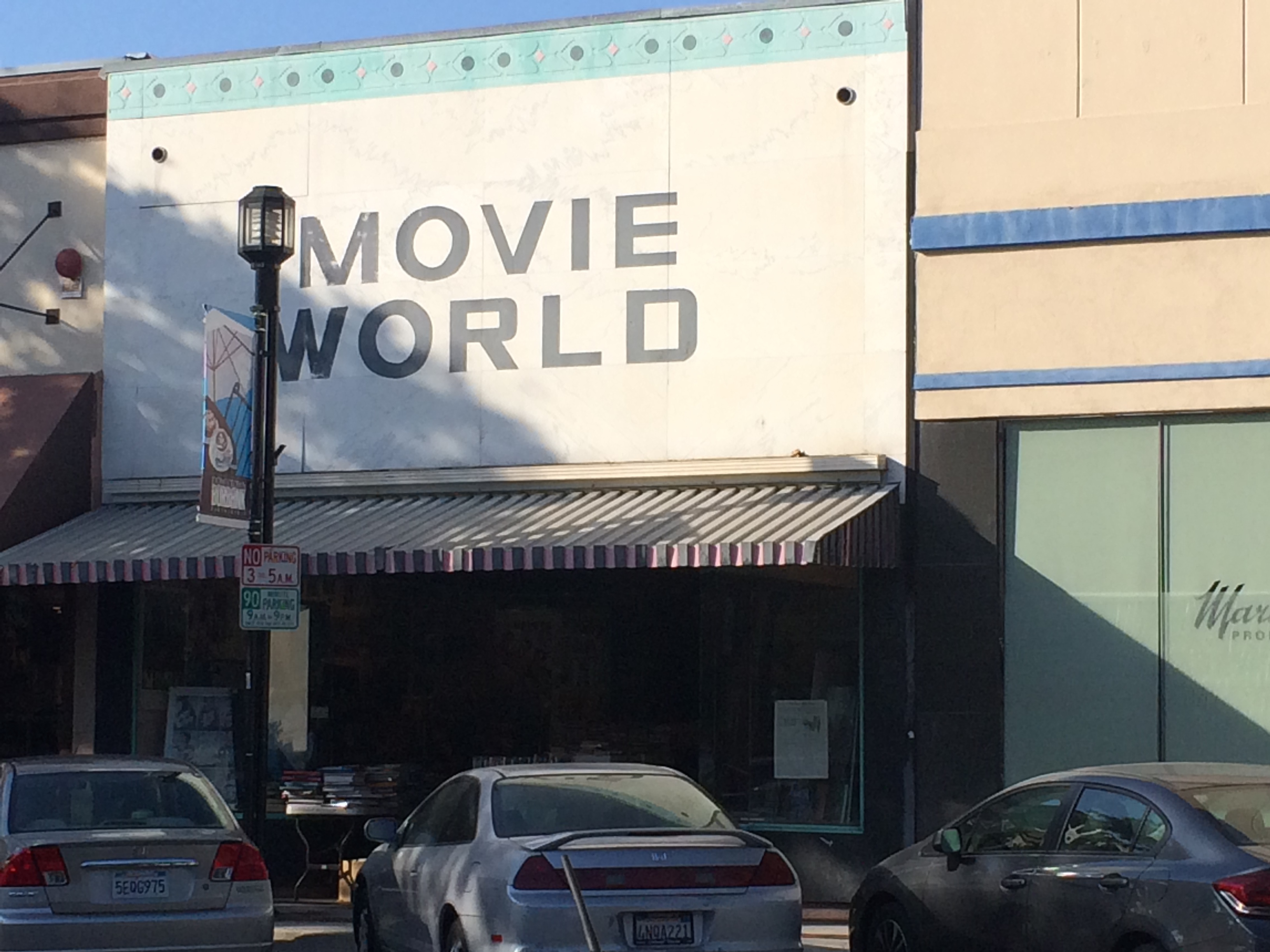
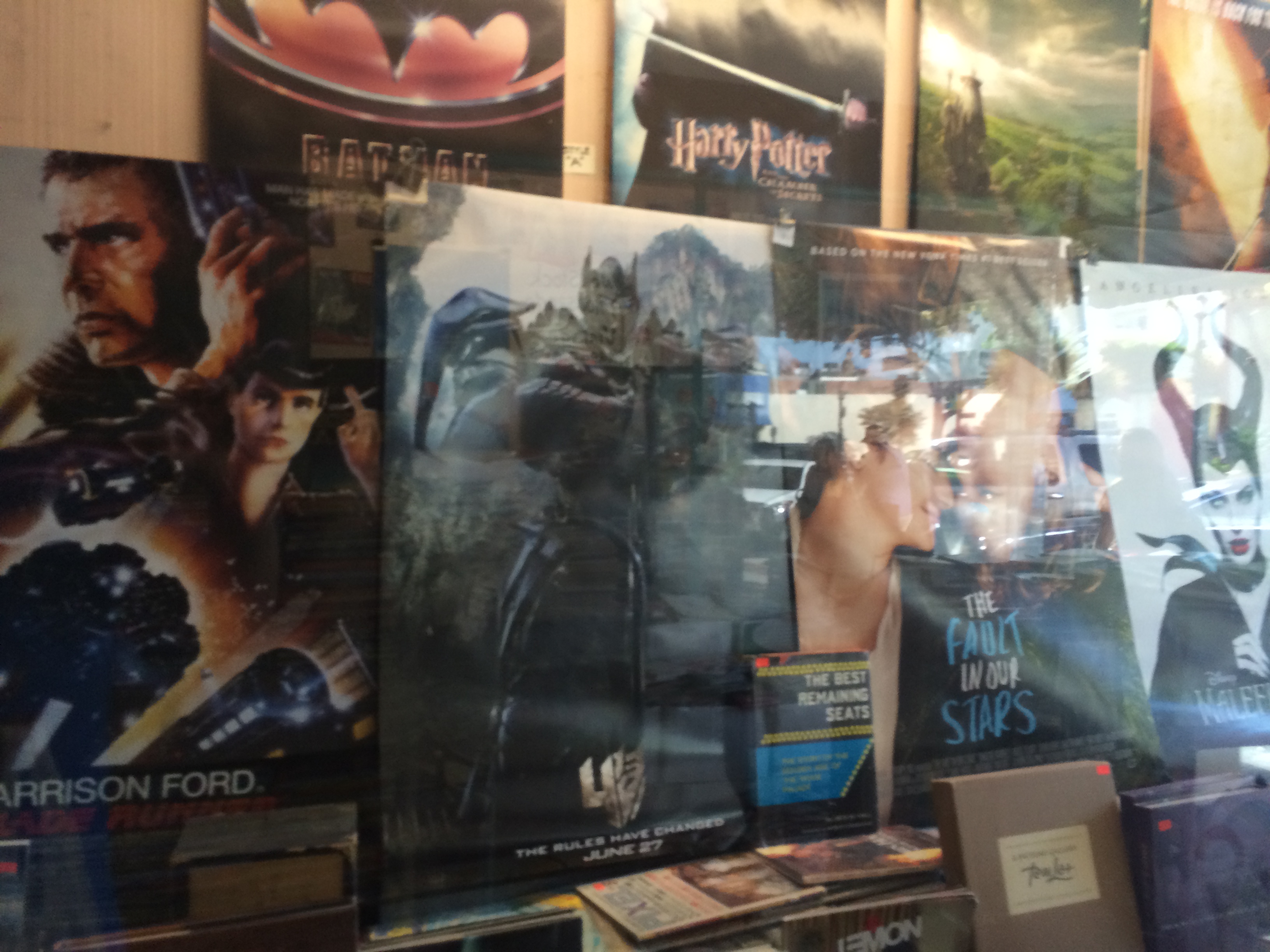
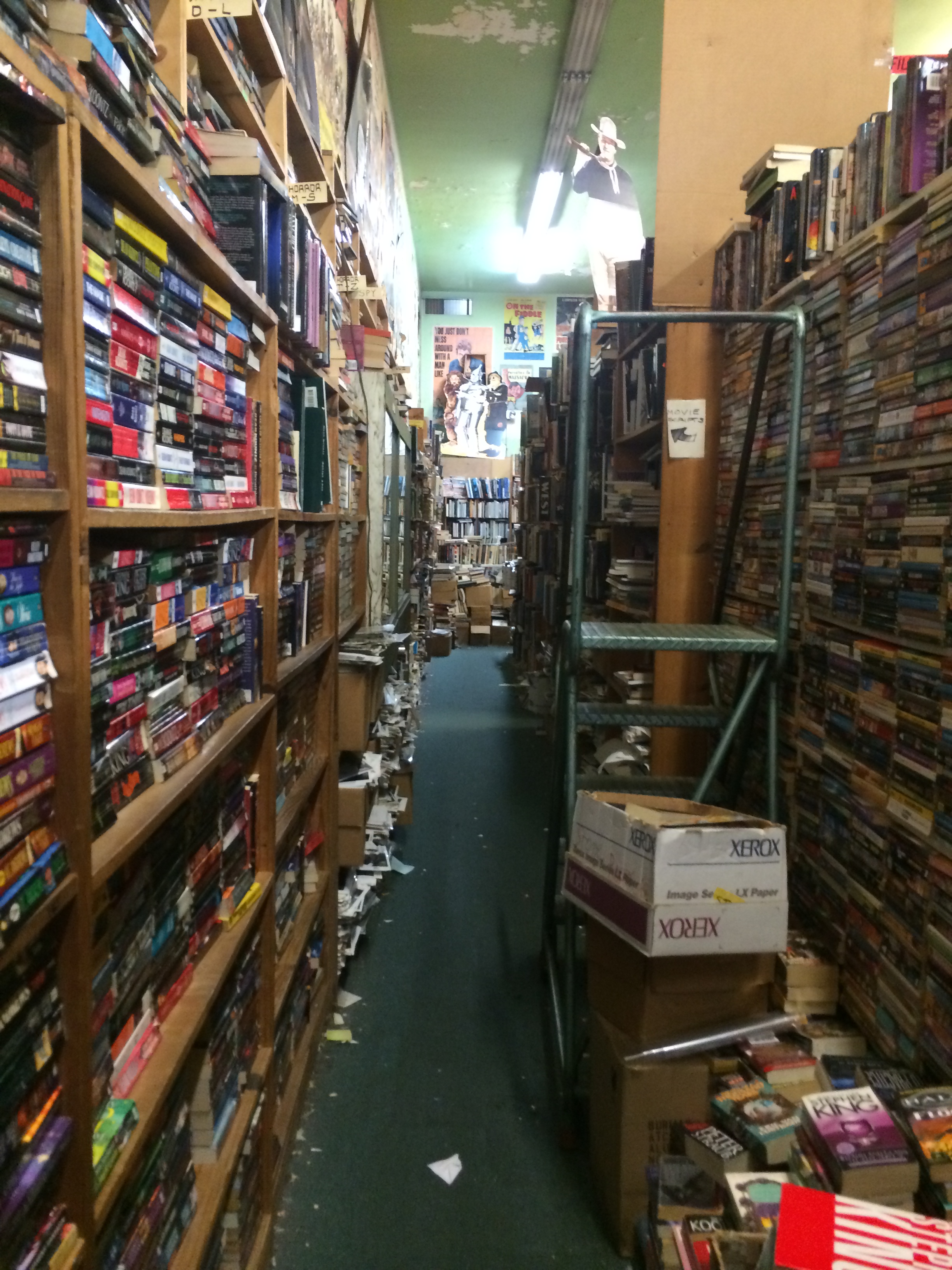
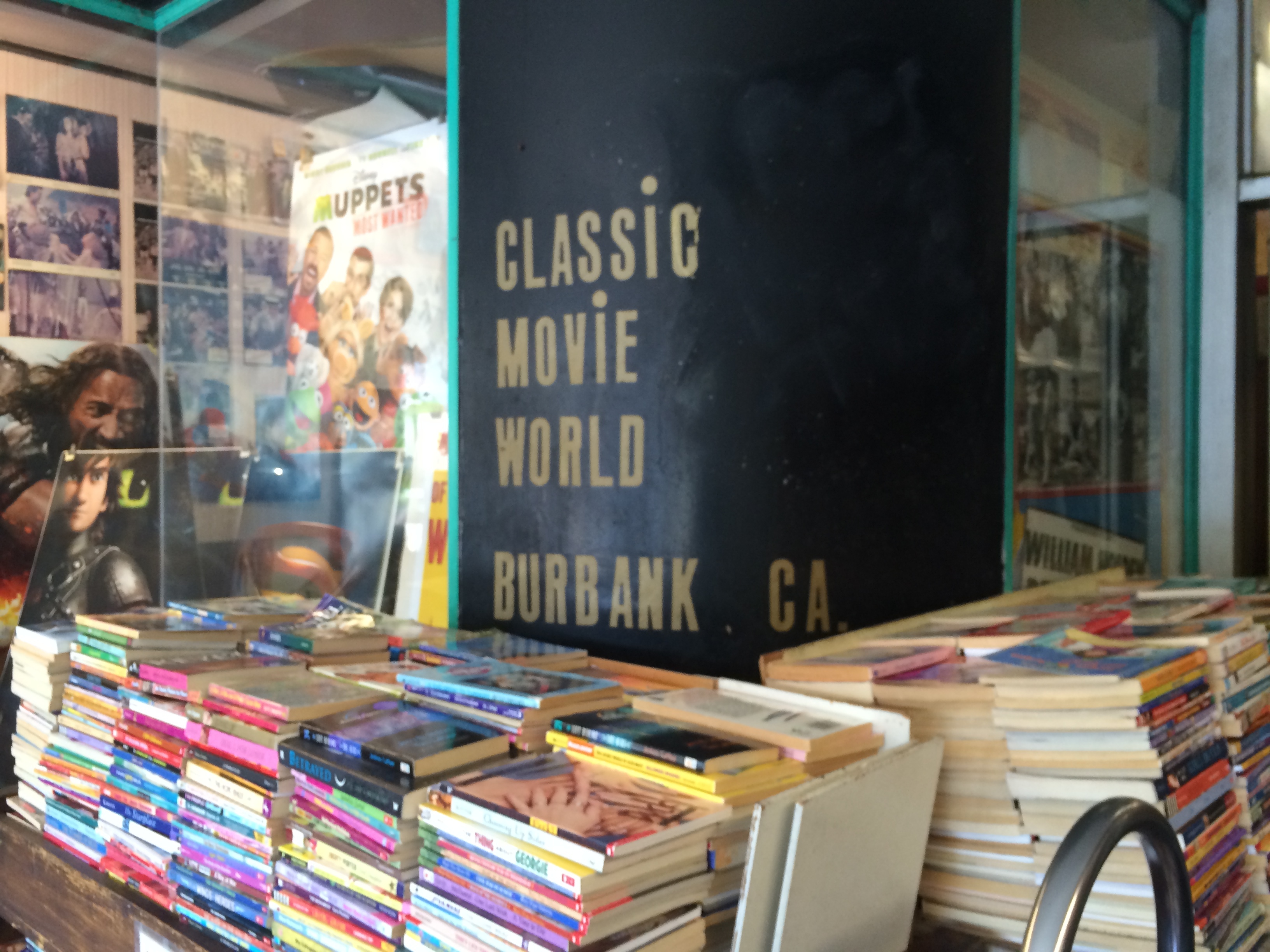
Almost hidden in plain sight is a dark space between two stores. From a distance it looks like a store that’s been closed, yet is cluttered with movie posters from an era of beta and vhs cassettes. A sign reads Movie World. Tables piled with books sit outside of the store like guardians of a dark cave that—in such a trendy neighborhood—draws one’s eyes away from the store like a magical protection ward that transmits the psychic message, “Pass this place by. There is nothing of interest for you.”
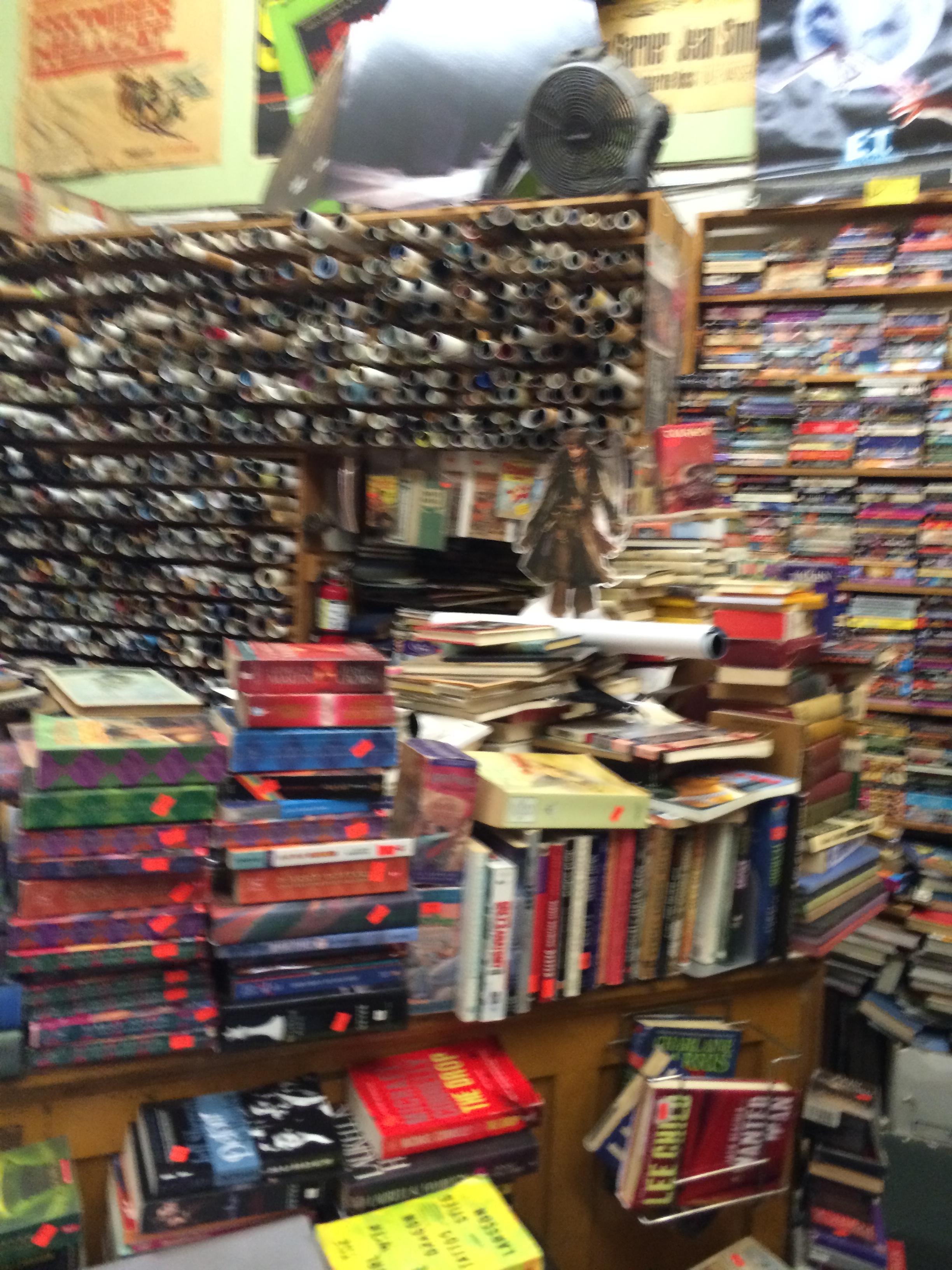
I ignored the warning and peered deeper into the shadows to find an open door where more books lay. Curiosity pulled me inside to find a world, vastly different from the outside. The ogre’s cave had tall bookshelves that carved narrow labyrinths to the back of the store space. Like piles of bones left by the ogre, books are stacked on the floor and crammed into shelves, thus creating narrow paths to explore. All genres are present and grouped accordingly. The books are in good condition, despite the untidy piles and tightly packed shelves.
It’s best to be like an archeologist who explores a past civilization than a treasure hunter. If you know what author or title you seek, you have a better chance of making great finds than to scan and hope to stumble on something special. There is simply too many books in a system that appears composed of random piles of books grouped by genres.
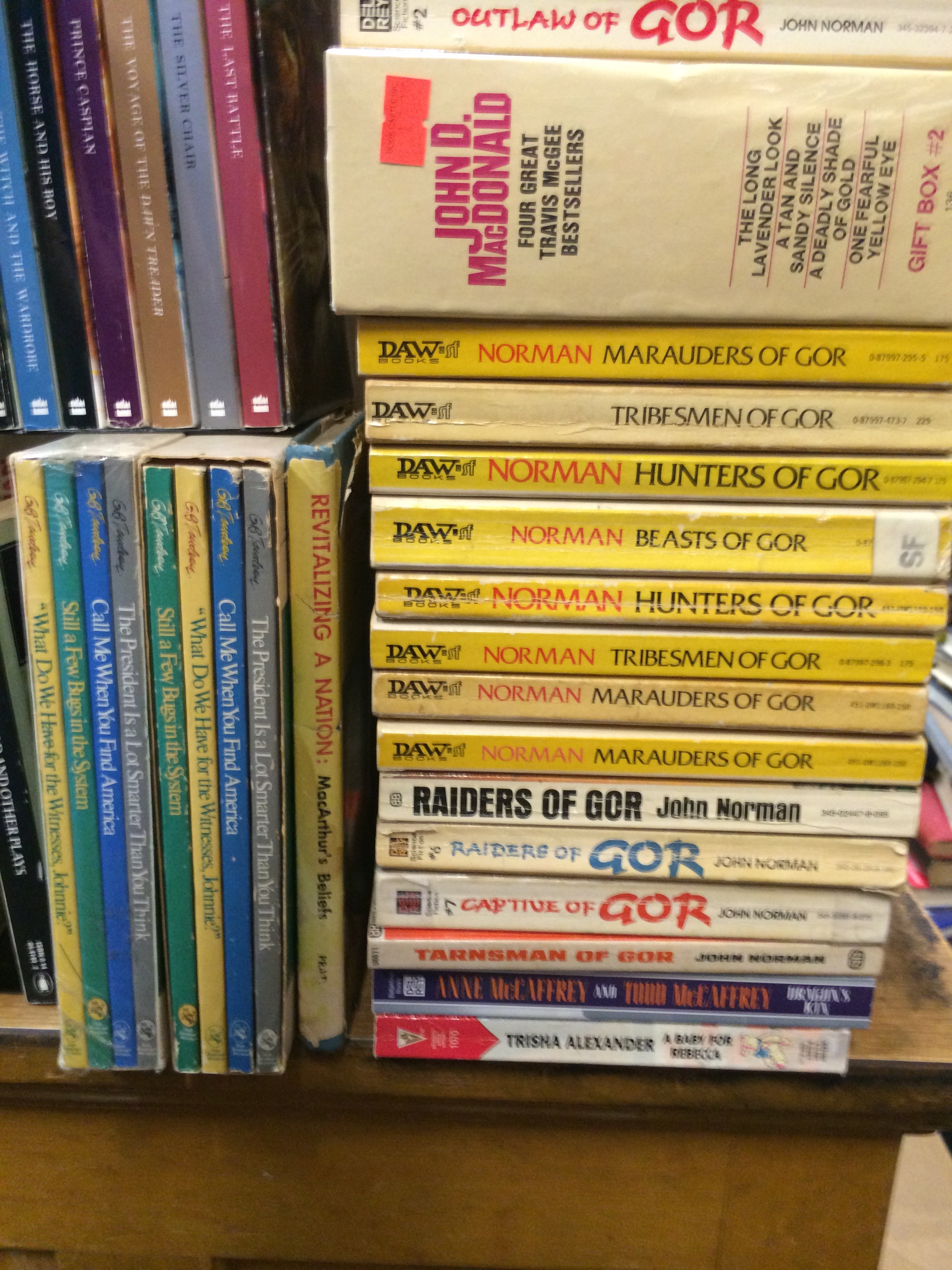
The smell of paper and bindings is strong, like the breath of the ogre—but lacks discomfort. Hunters of books in their earlier printings will make interesting discoveries, such as a boxed set of C.S. Lewis’ Chronicles of Narnia next to a stack of John Norman books from his Gor series, or many movie posters from movies that you may not have heard of before.
There is much to find in Book Castle’s Movie World. If you can get past the Ogre’s magical ward, you’ll find treasures well worth the experience. But beware, the labyrinth of books and artifacts can suck you in for many hours, in which time, the Ogre could awaken.
Every bookstore has character. That’s what engages or deters customers from frequent visitation. Some are polished formal affairs that feel like a museum or perhaps an art gallery—look but don’t touch. While others may be rustic family affairs where the shopkeepers are boisterous, compelling visitors to engage them in the news of the day or talk about favorite books and authors. Then there are the places where the shopkeeper responds with grunts to give clear directions of book availability and to make change. Along with the people, the books and store structure add to that character.
I’m John McCarthy, and I’m a Bookstore Ethnographer. I travel to many places for my work of Education Consulting. During my “free” time, I love to visit bookstores, where other travelers might find the local pub, golf course, restaurant, or beach. These posts are not intended as reviews. I am a social activist who speaks on behalf of the books. My intention is to capture the character of each store, which is shaped by the selection and care of books by the shopkeepers and the store structure. Follow my Pinterest board for pictures of the stores I visit and follow me on Twitter for more about my work in Education, Bookstore Ethnography, and other articles. Share your bookstores by comment below or a tweet to @jmccarthyeds. If I’m in the area, I will very likely visit.
A block from the bookstore is an Apple Store, where I stopped to get help with my laptop. The area is filled with shopping and restaurants in what appears to be an affluent neighborhood. Parking close by offers 2 hours of free parking, where I was lucky to find someone just leaving a spot.
The front of Book Inc. reminded me of an art gallery store front with large windows and stone stairs up to a common porch with other stores. Inside, the single room is deep, well lit, and showcases a pristine set up of bookshelves and open lanes to any section of the store. Every genre is represented with new books in tightly fitted shelving. The selection for each genre is modest, which may be due to the size of the store. You can find anything that’s current, with little from past decades except for classics.
Like some bookstores, there are staff recommendation cards posted by books or author series that share why customers might take a chance on such a purchase. What I found unique to my travels were the reviews posted by customers. The store keeps a basket of index cards, and encourages customers to write their own book reviews. There was one by a high school student whose review was for a YA novel. It makes good business sense to invite these comments, like we find on Amazon and other places. I wonder why I have not seen this great strategy in other bookstores?
Several employees talked to each other about book related stuff, looking busy as they went about their responsibilities. I walked up and down the store several times without being approached for offered assistance. Maybe I looked like I was zeroed into the books, which would be better than the alternatives. The conversations was business, like you would find at many non-bookstores. Perhaps this is because of the touristy nature of the area? Hard to say from a 25 minute visit. The time was well spent in an artful-looking bookstore.
When writing non-fiction, there is much from fiction that can be incorporated. Metaphors and storytelling are important tools in such a writer’s toolbox. In what may be a series of pieces about bookstores across the United States, and a few other countries along my travels, I will explore these locations with an eye for using tools that are similar to writing fiction. I hope you share this journey. Please share your favorite bookstores in the comments section. If I pass through your area, I’ll visit, and bring the experience to this blog… John McCarthy
The Dawn Treader is one of those ports of call that from the outside appears to be a typical storefront. Bookshelves line the sidewalk in front with the bargain books for a dollar or less. All are used or well loved in usage depending on your view point. Like any seafaring ship, you must enter to find the treasure inside. And oh what plunder there is to be gained.
On first setting foot inside, I’m reminded of the time I took my son on a sleepover in a submarine. For such a small vessel, the inside was packed with compartments that, had I’d not known better, I’d think the sub was much larger from the outside. The same illusion occurs on first entering the Dawn Treader. The store entrance is spacious and open–that is if you consider a 6’ by 10 foot area surrounded by bookshelves as open. On the left is the cash register with stacks of books on the floor and desk, siren’s temptation that calls to you when making a purchase—“buy me, just one more book.” There are a few shallow steps up into what can only be described as narrow winding passageways of shelves filled with books. The different paths take you deep into the store–more so than one would believe could be the capacity from the view outside of the store front.
Antiquities to contemporary books pack the shelves. Along one passage there is a cart of mystery and suspense novels that are all signed by the authors. On this sojourn, I found two such treasures, King of the Corner by Loren D. Estelman and The Book of Lies by Brad Meltzer–both 1st editions & 1st printings.
At the furthest depths of the store the “passageway” opens up into the best collection of Science Fiction/Fantasy that I’ve seen anywhere. It rivals even King Bookstore, a 5 story monolith bookstore in the heart of Detroit. A curving 20-30’ wall contains floor to ceiling shelves of tightly packed hardcovers. Three rows of 2 sets of bookshelves, also floor to ceiling, are tightly packed with paperbacks. Many decades are well represented by great stories, such as the 1970s. I uncovered original paperbacks from classic, and still incredible series, such as Thieves’ World, Conan, and the original Star Trek.
Part of lore for the magical world of the Fey is that time spent there does not measure in the same way as the mortal world. Time exploring the “decks” of the Dawn Treader is the same. Beware of entering the store, thinking you have ten minutes to kill, as an hour will pass when next you leave the premises. Enter if you dare.
Dawn Treader – Established since 1992 (per website)
The 1st page, the 1st paragraph, the 1st words can determine whether the author hooks a reader to share the storytelling journey, or if the book gets returned to the shelf for another author. There is so much competition for a reader’s attention, whether on first entering a bookstore or viewing the first page of a virtual store.
John Jakes, a prolific writer, said that in the 1st page of a story, the author should introduce a main character, the setting, and a conflict. These are the key elements for engaging a reader towards investing time in a good story. Let’s look at the opening of one of his classic novels, North and South:
“THE LAD SHOULD TAKE my name,” Windom said after supper. “It’s long past time.”
It was a sore point with him, one he usually raised when he’d been drinking. By the small fire, the boy’s mother closed the Bible on her knees.
Bess Windom had been reading to herself as she did every evening. From watching her lips move, the boy could observe her slow progress. When Windom blurted his remark, Bess had been savoring her favorite verse in the fifth chapter of Matthew: “Blessed are they which are persecuted for righteousness’ sake: for theirs is the kingdom of heaven.”
The boy, Joseph Moffat, sat with his back against a corner of the chimney, whittling a little boat. He was twelve, with his mother’s stocky build, broad shoulders, light brown hair, and eyes so pale blue they seemed colorless sometimes.”[i]
The opening words are infused with tension, coming from a very flawed character. His wife’s non-verbal reaction messages that the demand is not well received, and a sore topic. The pages that follow portrays an abusive family, from which Joseph Moffat dreams of escaping, yet held back with the helpless desire to protect his mother from an alcoholic step-dad. In the end, the boy gains his freedom, but at a high cost. And that’s just the prologue.
Engaging openings draw the reader into the story. You feel connected to a character and their immediate situation, such as Joseph Moffat. The initial conflict might not be THE conflict, but there’s enough tension to promise more if the reader continues to turn pages. Other times, the opening scene may be an accident in slow motion—metaphorically. The reader might not identify with the characters just yet, but the situation is something we cannot look away from, no matter how uncomfortable one might become. Ernest Hemingway masterfully creates such a scene in the first paragraph of The Old Man and the Sea. Here’s just the first half of the 1st paragraph:
“He was an old man who fished alone in a skiff in the Gulf Stream and he had gone eighty-four days now without taking a fish. In the first forty days a boy had been with him. But after forty days without a fish the boy’s parents had told him that the old man was now definitely and finally salao, which is the worst form of unlucky, and the boy had gone at their orders in another boat which caught three good fish the first week.”[ii]
Here’s a man so down on his luck that he’s lost credibility in his profession. Hemingway, following the same concept as John Jakes, introduces the Old Man, the title character, the setting, and THE conflict of the story in the first couple of paragraphs. Life is so hard for the old man that the boy–his former apprentice who is now learning from another–buys him a beer. With tight writing, which is a topic for a different article, Hemingway draws in the reader to view someone worse off than themselves. The old man’s stoic kindness and the boy’s devotion to him keeps us reading, and wondering, “things have got to get better, right?” Yet the rest of the story takes us deeper into experiencing the old man’s sacrifices, struggles, and loss that becomes a form of victory and vindication. But the key is the opening lines about a slow motion car wreck that we just can’t stop watching with the opening page.
Another approach is to open a story in the middle of the action. This entry has the advantage of immersing the reader into the chaos of an immediate conflict. Thrown into the deep waters of action, most often violence, the intent is to build instant momentum. Matthew Reilly is a master of this style. I credit him with establishing the genre of high octane storytelling, where there are no pauses where a character can become introspective, or an author can philosophize. The story is go, Go, GO! Conflict IS the story. One example comes from Scarecrow Returns:
“THE PLANE hurtled down the airstrip, chased by furious machine-gun fire, before it lifted off with a stomach-lurching swoop and soared out over the vast expanse of Arctic sea ice that stretched away to the north.
The plane’s pilot, a 60-year-old scientist named Dr. Vasily Ivanov, knew he wouldn’t get far. As he’d lifted off, he’d seen two Strela-1 anti-aircraft vehicles—amphibious jeep-like vehicles that were each mounted with four 9M31 surface-to-air missiles—speeding down the runway behind him, about to take up firing positions.
He had perhaps thirty seconds before they blasted him out of the sky.”[iii]
While the reader is drawn into the conflict, Reilly follows the theme of introducing a main character,[iv] providing scene context, and a conflict—death is 30 seconds away. The reader needs the three elements to anchor themselves within the chaos. We identify with his desire to escape, and wonder at his fatalistic belief—remember the slow motion car crash strategy. The conflict is intense—machine-gun fire, plane pulling Gs on take-off, and surface-to-air missiles moving into range. If this is the opening, how will the rest of the story continue to climb? Reilly meets this challenge, where other writers fail. They lead with an explosion, and then leave the reader coughing through the smoke of the rest of the story. Few will take that journey.
Good non-fiction starts with a strong opening. Authors, like Chip and Dan Heath, use their opening to illustrate the focus of the book. The focus would be similar to the plot. Here’s the opening to their major book, Switch. What do you think their focus is about?:
“One Saturday in 2000, some unsuspecting moviegoers showed up at a suburban theater in Chicago to catch a 1:05 p.m. matinee of Mel Gibson’s action flick Payback. They were handed a soft drink and a free bucket of popcorn and were asked to stick around after the movie to answer a few questions about the concession stand. These movie fans were unwitting participants in a study of irrational eating behavior. There was something unusual about the popcorn they received.
It was wretched. In fact, it had been carefully engineered to be wretched. It had been popped five days earlier and was so stale that it squeaked when you ate it. One moviegoer later compared it to Styrofoam packing peanuts, and two others, forgetting that they’d received the popcorn for free, demanded their money back.”[v]
The Heath brothers open with a social experiment that draws in readers with a story about a scene that most of us have experienced—eating popcorn at a movie theater. They turn the experience on it’s head by offering free popcorn that’s “wretched” in various sizes. Regardless if the study participants got a medium, large, or extra large tub, of the 5 day old popcorn, they ate all of it. From there the book lays out an elaborate argument about the difficulty for people to change, and how to go about succeeding in changing mindsets. What’s important here is that the opening paragraphs suck in readers, who before they realize it, are 3-4 chapters into a book about complex ideas—and they’re invested.
Characters, scene, conflict: starting with the 1st words, all three elements are present in the first paragraph, of the first page of most books that succeed in drawing in readers. Now once you have them, the next challenge is keeping them. How that works is another tale to be told. But as readers, you already know what those might be…
__________________________
[i] Jakes, John (2013-05-21). The North and South Trilogy: North and South, Love and War, and Heaven and Hell (Kindle Locations 204-211). Open Road Media. Kindle Edition.
[ii] Hemingway, Ernest (2002-07-25). The Old Man and the Sea (p. 3). Scribner. Kindle Edition.
[iii] Reilly, Matthew (2012-01-03). Scarecrow Returns (Kindle Locations 256-262). Simon & Schuster, Inc.. Kindle Edition.
[iv] Actually, Dr. Vasily Ivanov dies five pages later. He’s not the main character of the story. That would be Scarecrow. But Dr. Vasily is the key character of the prologue. All of the elements that John Jakes discussed are present to draw and satisfy readers.
[v] Heath, Chip; Heath, Dan (2010-02-10). Switch: How to Change Things When Change Is Hard (p. 1). Crown Publishing Group. Kindle Edition.

 2.
2. 3.
3. 4.
4.