Tag Archives: memories

Read Books, Review Books, Remember Books

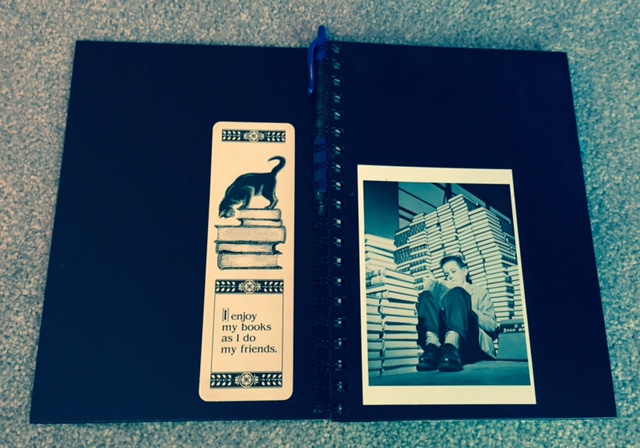
FullSizeRenderOn this blog, I’ve written about journal writing.  I’ve written about reading books.  There was a time when I did both: I read books and journaled about them. Go figure.

After last month’s journal expedition, I wandered through my bookshelf and discovered a journal wherein I reviewed books for myself as a reminder of what I read and what I thought.  I forgot I had done that.

My inspiration came from those funky “record your recollections” books found in your bookstore’s gift section.  The fun titles and decorative covers invite you to review wines, where you drank them and save the wine labels. You could write about the places you traveled and significant snippets of the journey. Journal titles encouraged memories of meals and restaurants, favorite songs, meaningful quotes, garden plantings, lists and more. Since my two main interests were books and movies, I decided I would chronicle my impressions of each.

Rather than pay for a fancy-schmancy, pretentious book with pages too small for a proper review,    I could make my own book better than any preprinted book. Besides, I found a pair of regal spiral bound notebooks, elegant in their 8″x10″ stature. The simple black hardcover was perfect for a funky, relevant, inspirational postcard. I clipped identical, important-looking blue gel pens in the rings.  I was set to write whether at home or on-the-go.

I recorded each book in the same look, manner, and design: “The Title” by Author; Month and year I finished reading, and my review.

It was the prehistoric equivalent of modern day Goodreads.
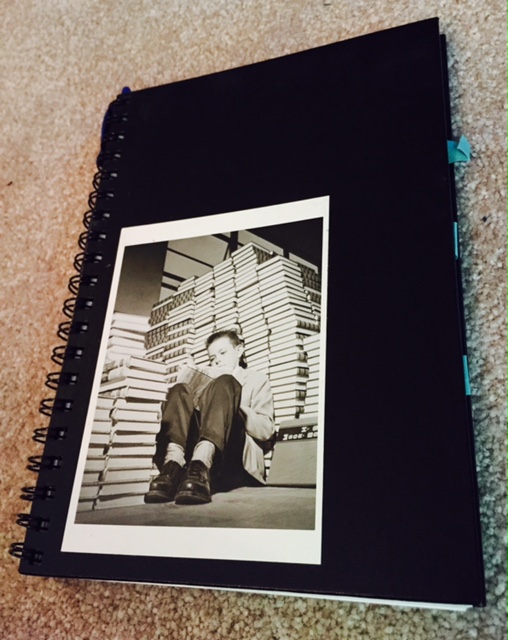
FullSizeRender2I tabbed four sections. The front main pages were reviews of the books I read. The second tabbed section I reserved for books recommended to me or that I wanted to read. The last section has some pencil scribblings on the first page; it looks like I planned a “books I borrowed or loaned.” I didn’t know enough people who read books. There is a third section tabbed off but with nothing written on those pages I have no clue what I intended.

I reviewed books from July 1999 through September 2002. My first reviewed book will remain nameless because it is so horrible. I wrote: “College life…here was my chance to see how someone else does it. I’ve learned how not to do it. I have no idea what any of the characters look like. Everyone swore, drank and got drunk. C’mon, a keg at your final? A torture to read but I had to finish it for story’s sake. I forgot that there had been a framing structure at the beginning. Events just end and everything is summed up neatly, compactly, and smoothly like the end of the stereotypical sitcom. Now writing about it, I can put it out of my mind.”

That book was my first exposure to self-published books, often called vanity press back then. This book had to be good. After all, it was a hardback book, with a colorful cover, I discovered at an independent book fair in New York City. That gave it validation. Ever since I read it, this is the book I refer to anytime I need an example of poor writing and the desperate need for an editor.

The General’s Daughter by Nelson DeMille. July 1999

“Print from this ‘old style’ trade paperback dirties my fingers. I like the movie better than the book. Narrator often sounded like the author, not the character.” The ending was given away too soon. Very few ‘he said’ in text and was often confused by who was speaking. Movie was more coherent, flowed better.”

The House of Seven Gables by Nathaniel Hawthorne. November 5, 1999

“Never was I so glad to finish a book!”

I developed a fascination about writing the true story of a real person. I moved away from fiction and desperately sought solid nonfiction. I read a series of disappointing memoirs after that. One review included my insightful comment: “In the last two memoirs, the struggle is established at the beginning but then the readers never reap the benefits of success.”

Good advice to remember as I finish my memoir.

Tuesdays with Morrie by Mitch Albom. November 25, 1999

“This book made me uncomfy [uncomfortable]. That was wonderful! I want to read it again.” In January 2000, I did just that. “The second reading as powerful as the first. Real writing, honest and true yet not sappy. There’s a reason this has been on the best seller list for over 100 weeks.”

Falling Leaves by Adeline Yen Mah. Saturday, March 4, 2000

“A tragic memoir wonderfully told. Her words: simple, and I got so caught up in her storytelling I didn’t notice.”

The Joy Luck Club by Amy Tan. June 2000

“Good example of a story told through many smaller, seemingly unrelated stories. I’d like to see how the movie translated this fine book.”

As of this writing, I have not yet seen the movie.

The Girl’s Guide to Hunting and Fishing by Melissa Bank. August 13, 2000

“What a quick read! Recommended by Jane, I echo her thoughts: I wish I’d written this book.”

Memoirs of a Geisha by Arthur Golden. March 2001

“It has been so long since a book snagged me so completely. I was up nights swallowing every word until way past my practical bedtime.”

I wrote about the Harry Potter series from December 1999 to 2002. Interesting how my opinion has changed since those initial readings.

My last entry is Diary of a Mad Bride by Laura Wolf. September 2002

“B-day gift from Dawn, I read it in about one week. Funny, and a lot more truth in there than any bride would care to admit. Written in short journal entries, it’s easy to read. I must read this closer to my wedding 🙂 again!”

I never did read that book again, but maybe I will now, especially since I am married.  One part of my New Year’s Non-Resolutions is to revisit and reread an old favorite book.  I’m faced with a dilemma: which one do I choose?

Do you have any recommendations of good books to read, or ones to avoid?
How do you choose a writing journal?

Just like magic wands, a journal must choose you.

As a child, I expressed my deepest thoughts, heartbreak and angst in various hardcover journals, college-ruled notebooks and at least one Dear Diary with a metal lock. Did you pour your heart out in a journal? I still journal, but not as much as I used to. I wish I could say that’s because I have no adult angst, but I can’t lie. To make sure I carve the time out to reflect on myself, “journaling more often” is one of my New Year’s Non-Resolutions I committed to with my writers group.

My old journal ended today after five months of use. In my younger days, I could’ve blown through that purse-size, 4”x6” journal in less than two months. And in my younger days, I would never have used such a small book. Regardless, I need a new journal.

I have a collection of journals ready for words waiting for me on my bookshelf upstairs. Too many, one might say, but I hold an emotional attachment. Besides, can you ever have enough journals, whatever the style?

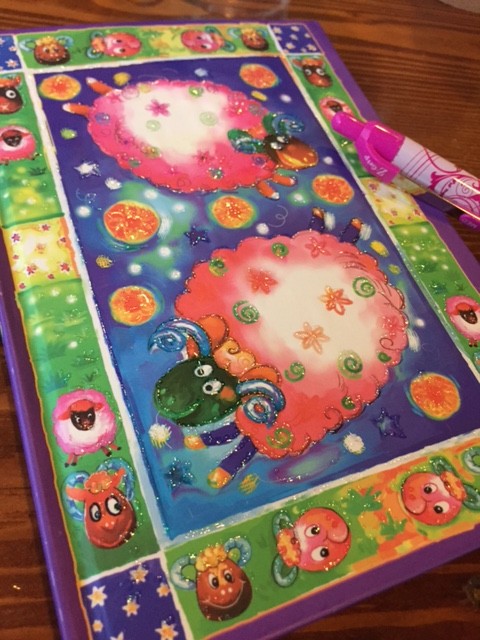
Dancing space sheep swirl around me, complete with glitter and memories.

Dancing space sheep swirl around me, complete with glitter and memories.

As I slide my hand down the row, examining each spine and shape, I think about reducing my stack. Here’s an opportunity to donate old journals I no longer enjoy writing in, either by size or style, and toss out ones with bad karma. I’m thinking of a specific one given to me by an ex-boyfriend’s mother, but I may have used it already. I don’t recall what it looks like when a bright purple spine pops out at me. Friendly bubble letters beckon me with one word: Journal. I pull it off the shelf and cradle it in my hand, staring at the cover. At least 30 seconds pass before I figure out that the abstract glittery shapes are sheep floating in space. It’s rather trippy.

Each white, lined page of the 5×7″ book is bordered with a quilt-like pattern of muted mauve hearts and stars. Sometimes I prefer pages with lines to keep my sentences straight and even, and other times, wide-open blank pages inspire me. Sometimes I like to write on bright white to show a pen’s true color, while other times my eyes want a muted tan or yellow page. This portable, lined, white-page journal in my hands seems fine to me. The psychedelic cover makes me weirdly happy. Now to flip to the inside cover and see if I made any notes about the journal’s date or where it came from.

Karma’s a bitch.

This journal was a birthday gift 15 years ago from a friend I no longer talk to, mailed to me at a previous job that was absolutely vile.

This is the kind of karma I was talking about, so I set it aside, not even putting it back on the shelf. There are plenty of other journals here. A leather dragon-covered book is too heavy. One large notebook has a handmade cover with buttons on it, a good memory of the person who made it for me, but a bit awkward for my needs right now. I don’t want this other one with a wooden cover. That blue Moleskine is too small. The ring binding on another is too big. Nothing fits my mood except the funky sheep journal.

This empty journal is scrawled with memories. I taped the original mailing label inside the front cover, which is why I know from where it was mailed. Just seeing the company name brings back stomach-churning memories of the underpaid job with the stuffy upstairs office where I worked. I remember the two sloppy mistakes I made that make me feel uncomfortable and stupid to this day, and the disrespectful ex-boyfriend I worked with who constantly yelled insults at me.

During that time, I had my friend, that lovely woman who knew me well enough to know I’d enjoy a fun-looking journal, perhaps a dollar store find, and mail it to me at work to brighten my day. Even today, I recognize her thick, curvy handwriting from the numerous letters we mailed each other. We met during one of my most unique summer jobs. And for reasons I don’t recall now, we immediately became friends. I took my first trip to Walt Disney World with her and a friend. She and I took a road trip to Salem, Massachusetts one Halloween weekend. The last good memory I have with her is bouncing on her friend’s outdoor trampoline on the afternoon my boyfriend-now-husband called to tell me he bought a new car, the car we still drive today.

She and I lived about seven hours away. I only saw her when I drove home to see my parents, and even then, I didn’t always have the time for the extra 2-hour drive. This one weekend, however, I was home for a long weekend and my Sunday was completely open. We could meet halfway and catch up in person, so I called her.

“I can’t,” she said. “I watch football with my boyfriend on Sundays.”

I never knew her to be a sports fan, but I was a far-away friend in town for the day. “What’s it going to hurt, taking one afternoon off?” I asked.

“I can’t. We watch football on Sundays.”

I understood that sports aspect with guys; my boyfriend-now-husband watched college football on Saturdays. He liked it when I watched the games with him, but if I wasn’t there one weekend–like this weekend I was currently away for–his life didn’t end and we didn’t break up. I’ll be there to watch games with him weekend, but I will not be within driving distance of my friend next weekend.

“Not just this one Sunday?” I asked her, hearing my voice rise in a pleading tone.

“We watch the game together,” she replied.

I never met her boyfriend, but I got the sense he was a demanding man.

Maybe it was just my imagination, but my friend was always independent. If she hadn’t been dating him, I was sure she’d make the time to see me. I told her how hurt I was, how I thought he might be controlling and I was saying that because I was looking out for her, as a friend should, but in the end, I lost the argument. We spoke once or twice on the phone after that, but she stopped returning my calls. I lost my friend.

I was surprised to receive a sympathy card from her when my dad died. She must have been on the overall distribution list when I emailed the news out. That was a nice gesture, really touching, but I didn’t know what to say, where to begin again. I don’t recall mailing a reply to her.

Now this journal calls me. I don’t know why. Does the journal want me to fill it with good memories, turning something positive out of a bad memory? Is its purpose to just fill the pages and “git ‘er done” and out of my life? Does my journal want some closure for me? Some reminder of better times, or is it a nudge to do something more?

All I know is that the two floating cosmic sheep make me smile, and I have to choose this as my next journal. Maybe with a wave of a metaphysical wand, I’ll figure this out by the end of the journal. Or maybe the last page will be just a last page.

The Gentleman’s Game and a Lady’s Ambition

Dear Readers, I had planned on blogging about a carpenter who uses his professional talents in his pastime of building sand sculptures. I met him and his wife last month and intend to share his story. However, I’ve decided to submit that article to a magazine and hope to get it published. For those of you, especially Marc and Debbie, who were expecting to read that article here, this month, please stay tuned for an update. If all goes well, I’ll have good news, and the article itself, to reveal at a later date. For now, please enjoy the following post in which I explain my perspective on golf.


“Do you golf?” seems to be a polite way for a golfer to ask someone else what he or she really wants to know: “Are you a good golfer?” The first question, although gentle, invokes just a hint of tension, as in “What do you do for a living?” The more specific second question verges into the realm of intrusiveness, like “How much money do you make?” A skillful, confident golfer would respond with a simple “Yes,” and no additional explanation would be needed. Instead, both good and bad golfers feel compelled to either elaborate on their level of expertise or mention how little they get out and practice.

Married to a golf addict, I refuse to be a golf widow. I play just enough so that I have a decent drive, can handle my irons, and don’t embarrass my husband too badly on the course. The one important thing I need to work on, however, is establishing my handicap—a golf score average developed from more than par, in my case. Somehow, I’ve avoided attaching the tell-tale label of a high handicap to myself for my entire golf life. Now I’m realizing the far-reaching extent of not embracing the numbers and exposing my personal limitation: I’m in golf limbo.

IMG_1858

Oasis Nine fairway, The Phoenician. Scottsdale, AZ. Photograph by Greg Bixby, March 2015.

Without figuring out my own handicap, I can’t expect other golfers to know if I can keep pace or if I’ll slow the game down and burden my partners. To play with undesignated handicappers like me calls upon gracious golfers to offer, “We’re just out to have fun.” They’re good sports. Impatient golfers quickly seek to round out their foursomes with other known decent golfers so they can avoid the discomfort of playing with someone who makes it on the green in two and then takes a four putt.

I appreciate the gracious and can’t blame the impatient. Athletes of all kinds push themselves harder when they know their competitors have talent. Good golfers are motivated that way, and sometimes it’s just more fun to be evenly paired. You’re more likely to be relaxed and finish each hole in a timely manner.

Because I don’t play regularly, my golf prowess is subject to speculation. There’s a tendency for people who don’t know me to pass judgement on my abilities. Recently, after a round of golf during a business event, a woman who hadn’t been able to golf that day herself asked me if I had gotten stuck behind the slow group. I was pretty sure she thought I was the cause of the delay, since I was the only female in the two foursomes, and it’s often presumed to be difficult for women to keep pace with men. Feeling a bit defensive, I carefully selected my response and admitted to her, “I think we were the slow group.”

I wasn’t significantly hampering my group’s time, however. One of the men hadn’t played in several years. It took him a little while to get used to the set of clubs he had borrowed from the course and to find his swing again after being away from the sport for so long. As he worked out the kinks in his play, I relaxed more and more and shot one of my best games to date.

IMG_1896

Sunset view from the 8th tee, Desert Nine, The Phoenician. Photograph by Kelly Bixby, March 2015.

Even so, I realize that I have to focus on lowering my average score. Not just because of the image I want to present, but so I can enjoy specific privileges. I discovered that without an established handicap of 36 or less, I can’t play at world-renowned St Andrews Links, known synonymously as “the home of golf.”

Located in Scotland, St Andrews offers seven courses and is revered by golf’s masters. The Links’ online history page proudly boasts, “When Nicklaus waved goodbye to his adoring fans from the Swilcan Bridge in his final round of professional golf at the 2005 Open it demonstrated the warmth and affection held for the place where the game started.” Jack Nicklaus himself professed: “If a golfer is going to be remembered, he must win the title at St Andrews.” As one of the world’s most accomplished players, he achieved three Open wins, and two were at St Andrews on The Old Course.

St Andrews is open to the public and fuels the aspirations of amateurs, including my husband. His passion has infected me and I’ve learned to love and respect the gentleman’s game. After years of warming up to it, I’ve gathered fond memories: a particularly awesome chip shot and a well-played round; gorgeous scenery connected by expertly-groomed greens and fairways; intrinsic challenges and friendly conversations. My husband’s pilgrimage to golf mecca is important to me as well and is a part of our future plans. Someday it will be my turn to step upon the sacred ground at The Old Course, push my tee into the soft earth, and square up to take a swing. By nightfall, I’ll tally my score and tuck away favorite moments from across the pond. ‘Till then, I’m perfecting my answer to that loaded question, “Do you golf?” by simply and confidently replying, “Yes!”

Stanley and Lucy

Spring is the time that the Canadian geese are visiting in the Metro West Industrial Park in Plymouth, Michigan. Since Chrysan has the biggest front lawn on Keel Street in the industrial park, naturally we have more geese as guests who were looking for worms on the lawn. Occasionally I had to make a sudden stop when a flock of geese were crossing from one lawn to another with little goslings. With a “honk, honk” they crossed the busy street without any rush, just waddling.

A lonely goose waddling on the lawn is very rare. They are always in flocks, or at least in a pair, but once I saw one goose alone on the front lawn. Mmm, that cannot happen … just one goose. Talking to myself, I looked around the south end of the building. Following the pair rule, the male goose was heading to the north with the “honk, honk”, thereby telling her he was coming.

“Kwang, geese never travel alone. They are always in groups or at least in pairs.” He was silent without any comment on my observation. He was digesting why I brought up this unusual subject and also calculating what I wanted from him this time. “So, let’s go everywhere together like geese,” I continued without looking at his face. He was still silent with his face down over the Detroit News. I assumed that his ears were filtering what he wanted to hear. “You are silent. Silence means ‘yes’. Let’s go,” I added.

“Where?” finally Kwang broke his silence in surprise.

“To Grandma’s,” I answered with a soft voice, reading his expression. My mother’s grave is on the corner of Novi Road and 12 Mile Road, at Oakland Cemetery. Our family calls it “Grandma’s grave”.

“No”, with strong rejection, and then he lowered his voice one octave, “You go alone.”

“I just explained about geese in pairs theory, going everywhere together.” My voice was almost begging him to go together to Grandma’s. Late afternoon at the end of March the sky was gray … a snowstorm might start any moment instead of rain. It was getting cold and windy. Once a week visit to Grandma’s is one of my regular scheduled stops since 1996 if I am in town. The most powerful geese’s pair theory let Kwang’s heart thaw, or was it my nagging power … and we went to Grandma’s together as a couple before we finished our cups of coffee as geese.

Two years ago a goose was nesting at the south side of our plant. Actually near the loading dock. For Heaven’s sake, why here? There are many other places to make their nest, I murmured with surprise and uneasy feelings. Then I went to Jeff, the plant manager, who was unloading bulk base oil from a tank wagon. “Hey, Jeff, how long has the goose been sitting on the nest without moving or changing position?” When I asked Jeff, my voice was vibrating with a mixture of deep concern and excitement with the goose nesting.

“Oh, no, Kook-Wha, they take turns. The gander is watching the nest very carefully from a distance, and he takes a turn to let her rest.”

“How do you know if it is female or male?”

“Geese are always together as a pair. The gander is protecting the female who is on the nest all of the time.” Jeff’s observation made perfect sense but he forgot my question … how many weeks has she been sitting on her nest?

I could not control my curiosity. I approached the nest closer and closer, and stopped two yards away. Suddenly with a loud “honk, honk” a goose flew down from the sky. Actually, he came from the roof with “honk, honk”, and he was ready to attack me in full force. I ran away from the nest as fast as I could.

Jeff came over and warned me, “See, Kook-Wha, be careful. You may get hurt. Sometimes they can become quite nasty,” he warned me.

Holding my breath, “Yes. I should.” Then I went back to my office without further observation. A cup of coffee helped my disturbed mind to settle down and I sank into deep thought. Why was the gander on the roof?

“Kook-Wha, is something wrong? You look very tired,” Julie, our office manager, asked me with serious concern.

“Nothing. I am fine.”

Julie left my office shaking her head that she could not understand my unusual behavior.

About one month later Jeff ran into my office. He was almost screaming with excitement. “A baby came out. A baby came out.”

“How many? How many?” I screamed back at him.

Jeff did not answer my question but went back to the nest area. With extreme joyfulness, I wanted to follow him and check into it, but instead I calmed down and just waited in my office for further news.

Through the windows I could see the gander standing five yards away from the nest in the middle of the truck driveway with his head up to the sky. “Honk, honk” expressing his excitement. Jeff still did not give me any numbers. The next morning I saw that the gander was still in the same spot protecting the nest.

In the afternoon I heard really loud “honk, honk” through the windows. It echoed a mixture of desperation and misery. Jeff came to me again quite emotional, and upset … “One baby was killed. A truck ran over it. The gander will not move from the spot.” I saw through the window that the gander was flapping his wings and honking. The poor goose, I turned back from the window and wondered how many goslings were left unharmed.

In the spring of 2009, when I came back from the trip in Asia I found a new goose nest this time it was by the flowerbed on the north side of the building which is near the employee entrance under the conference room windows. It was a much safer place than near the loading dock, but it is still a heavy traffic area. The nest was under the tall shrubs and between the hydrangeas and the Christmas poinsettia. In the morning there was nice sunlight and in the afternoon it has reasonable shadows to protect the geese from sunburn. I am not sure whether a goose can get a sunburn.

Again this foolish goose makes a nest near busy traffic. I talked to myself thinking that I hope this time nothing goes wrong and they have a successful hatch.

As soon as I entered my office Bonnie mentioned, “Did you see the nest?”

“Yes. I saw it. How long has the nest been there?”

“About a week,” Bonnie answered with her face full of smiles.

I did not like her answer at all. I wished It is ready to hatch was her answer instead.

“Just one week?” I questioned her, and then I changed the subject, talking about the trip to Asia. I was getting a headache from anxiety and frustration from previous experiences of geese hatching. How can we keep the nest three or four weeks more without any accidents in order to have the goslings born safely.

I took a picture of the goose sitting on the nest from about 5 feet away. She sat calmly without moving her body but her head was moving to the left and right with fear of my approach. You will be okay, I am trying to protect you as much as possible. Hello, goose, do not worry, I promised her.

Soon I heard a “Honk, honk, honk” noise coming from the roof. The goose was looking down at me from above my head on the roof and he was ready to attack me. Oh, my gosh. Again I upset the gander. Hello, gander, I will not hurt your friend. Believe me, I will not.   I took a picture of him on the roof, too and quickly went back to my office. I was relieved that at least he did not jump on me from the roof.

The next day was Saturday. I got to the office later than usual. Oh, no. Oh, my gosh, what happened last night? I screamed and screamed when I saw the broken nest. Luckily nobody was near to hear my screams. One large unbroken egg was about two feet away from the nest and a couple of broken eggs were on the top of the nest. What happened? What happened? I could not control my screaming from desperate anxiety. I phoned Kwang, seeking comfort from him. As usual he was quiet at the end of the telephone. I hung up slowly, trying to forget the broken eggs.

That same day in the evening we had dinner with friends from Carmel, Indiana. They told us an interesting story about Canadian geese that built their nest just under the dining room window again in the flowerbed. They named them Lucy and Stanley. For weeks Lucy sat on the nest and Stanley guarded it. Even if we had the exact same experience twice, we did not make any comment. We just listened to their story with curiosity and thrills.

Ken and Nancy told us the whole four weeks experience with unbelievable excitement. They gave all sorts of support to have 100% successful hatching. They did not use the front entrance of their house and just watched them from a distance. Also, they told the same story, Stanley was on the roof protecting and watching Lucy on the nest. Their house is in a gated community with five car garage and there is quite a distance between the houses. For four weeks they could only use the entrance from the garage without any inconvenience. Also, human traffic was much less in their community, and in their absolutely quiet neighborhood Lucy and Stanley had the best conditions for hatching the goslings in peace and comfort.

One day they saw seven baby goslings going in a straight line into the pond in their back yard. Of course, Lucy was in the front and the seven goslings followed her. The newborn goslings went into the pond without any fear or hesitation and were swimming away except for one. The last one was hesitating at the edge of the pond and could not jump into the pond. Then later Lucy and Stanley came back and escorted the last one to the pond and watched to make sure that it went into the water.

We did not tell Ken and Nancy our two unsuccessful sad experiences. I could not get rid of the image of the broken eggs in the nest from my mind for a couple of days. As my five-year-old grandson, I asked myself why? Why couldn’t our geese make it in our yard?  I understood the first failure well enough. There was too much heavy traffic of trucks. For the second one all the employees did their best to protect her without disturbing her by walking on tiptoes and closing doors quietly. But if the geese could not hatch in our yard, then what is the reason?

The list of clues of the second failure popped into my mind. It could be blamed on the wild animals. In our large wooded back yard there are still deer, raccoons and other wild animals living there. Every winter I have seen footprints of deer near the evergreen trees around the plants. Maybe at night while looking for food they came and destroyed the nest. One gander could not protect the nest against a wild animal attack.

The vanished nest was about six inches deep and two feet wide, like a fort. A nest consists of mulch with very tight, strong structure like a concrete wall. It cannot be destroyed easily, not like a bird’s floppy nest of straw and branches. It was several layers of mulch with sturdy construction.

I hope they come again as a pair for third and fourth attempts. We will do our best for a successful hatching.

Abram

After two serious pieces, I was planning on writing a lighter, more humorous blog, this month, something more tied to my first piece which came out in February.  That seems so long ago. It’s hard to believe that I once was having a problem thinking of something to write about.

Then I reread the comments people made about “More Voices From the Past”. I immediately noticed something new. I had readers. Real readers. Readers who not only read what I wrote but took the time to comment on it! I was convinced. I needed to stop worrying about lightening the mood and write about what they wanted to know: What happened to Abram?

I’ve grown up with the story of Abram. I’ve known it by heart, ever since I was a young child. Writing about him now, I wanted to see if there was something more, some detail that I didn’t know or might have forgotten. So I decided to call my Mom. She’s now 101 and living with my sister in California. She remembers everything as if it happened yesterday.

We talked for a while and went over the major points. I had a few more questions I wanted to ask when she said, “Claire, this is so sad. I don’t want to talk about it anymore. Let’s change the subject.” Imagine, I thought, this is seventy-three years later and for my Mom it was like it had happened yesterday. Poof! Seventy-three years vanishing in a few seconds and the terrible sadness and loss is still there.

Mom remembered that my Dad had finally gotten Abram the visa to come to the U.S., probably sometime in late 1941. But Abram had insisted (and I remember Grandma and Papa saying the same thing) that he had to stop off in Switzerland for his health first. He wasn’t feeling well. He’d see a doctor and after that he’d come straight to America.

Why? Why? Why did he insist on stopping off in Switzerland first and then coming to America? I remember my parents and grandparents asking this question over and over for many years. There was never an answer.

Abram never came again to America, not in 1941 or ’42 or ever. It was a fateful decision.

Next time I’ll talk about what happened to him and how we found out.