“The niche is all yours,” the tall, lanky guy says, referring to this cluster of soft chairs he’s getting up from.
“I don’t need all this space. I like to be self-contained,” I say with a thank-you nod as I put my bag on one table. Then I smile at him. “Besides, this is the only clean table.”
It’s true that I like to have room enough to spread out, but not so much as to intrude on others’ space. Not so much the case for the previous coffee shop patrons. There’s a candy wrapper on one table. This coffee shop doesn’t even sell candy. There’s a coat on another chair as a placeholder, a reserved sign made of fabric.
“That’s trusting,” I say to the guy, pointing to a woman’s purse hanging on the back of an empty chair.
“Anyone could walk off with that,” he says.
Ann Arbor is a walking town. Most stores are close enough to each other that walking from your apartment to a restaurant and then the small, specialty grocery store before returning home is easier than driving. A bus passes outside on State Street. Even in the rain, public transportation is the better option.
“Yeah, or hop on a bus,” I say.
Growing up in the city limits of Pittsburgh, PA, public transportation was plentiful, much like Ann Arbor and its surrounding neighborhoods. Pittsburgh is a bigger city, of course, much bigger, and we used it all the time after our family car died. I remember Dad coming home after work with an armful of bus schedules. He plopped himself on the floor in the middle of the living room, spread out the maps and began to figure out how the heck you traveled to downtown from our house.
Fortunately, we lived on a bus route. It was a good bus route, one of the main ones, not far from a depot garage. Buses had a frequent schedule in my neighborhood, even on Sundays.
A light rail system was constructed when I started high school. That was my first exposure to “subways,” a misnomer I always thought because the T ran underground for only three stops. It was an above-ground transportation outside downtown proper.
“My friend’s dad could read the entire New York Times in a tight space on the subway,” he says.
I’m impressed. I could never stand and read on a bus. My survival skills in tight spaces came from sitting down. Maybe this is why I can be self-contained sitting down in a coffee shop.
Riders learn to multitask early. You eat a sandwich in your seat without spilling any on the passenger next to you; the tantalizing smell throughout the bus was out of your control. You sleep with your head against the window and intuitive feel when it’s time to wake up to get off at your stop. You learn how to place paper grocery store bags on the floor so that passengers won’t step on or trip over them.
I did develop strong legs and a sense of balance to stand upright and not tip over as the bus bounced and jerked and turned corners. You learned to politely shove your way through a smash of people to exit at your stop. You talked with the people you saw every day, creatures of habit you all were, work and school schedules always the same. You gave up your seat for people with packages, women with children, and the gentle older folks.
This guy must be a rider of sorts because he continues to discuss public systems. He says the John P. Getty Museum in Los Angeles is located at the top of a mountain. The area has a great system in its three-car train that goes up the mountain. The ride is smooth and the flow of traffic is easy.
This reminds me of the Duquesne and Monongahela Inclines in Pittsburgh. It’s a unique experience to be pulled up a mountain. I guess it’s like what a ski lift is like, except the inclines are big boxes that hold about 50 people. They’re fun to ride, especially when seasoned riders scare the first-timers by saying, “Oh, I hope this doesn’t fall and plummet down.”
I smile and nod with the guy, saying. “The lessons you learn on public transportation will help you through your lifetime.”
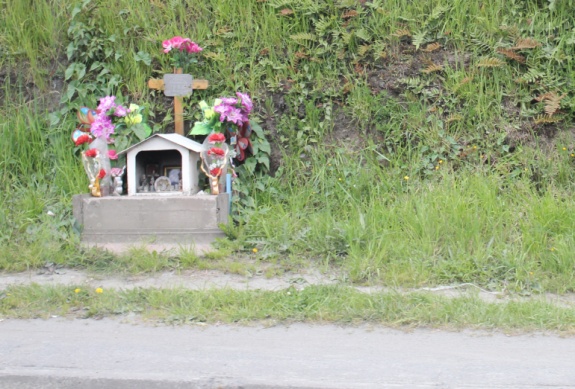
You drive by an intersection and take notice of a weathered and worn wooden cross poking up from the ground. Around it are faded silk flowers, some tattered stuffed animals, burnt candles, and remnants of hand-written notes that resisted being carried away by the wind. You know someone died in that spot and someone else has been grieving there.
During a vacation to Chile a couple years ago, I saw elaborate memorial structures placed alongside many of that beautiful country’s roads. The shoulders were sporadically adorned with what looked like tiny, dollhouse-sized churches. Some were wooden, but most were little concrete buildings built upon concrete foundations. Inside, there were framed photographs, crucifixes, printed prayers, figurines, and candles. Flowers flanked the outsides. One display was remarkably huge—about six-feet square, with a foot-high iron gate enclosing the entire display. That one was further from the road than others I’d viewed, and I’m guessing it was on private property. Each miniature building I drove past, however, seemed to be permanently affixed to the ground.
In Chile, an animita is a place where people mourn the deceased, petition for help, and give thanks for answered prayers.
I remember that as a teenager I watched old western movies. Whenever one of the good cowboys was shot to death, his comrades did all they could to bury him. If they were on the run and in a hurry, they quickly covered him in rocks. If given a little more time, they dug a shallow grave, covered the body in dirt, and marked the site with a makeshift cross.
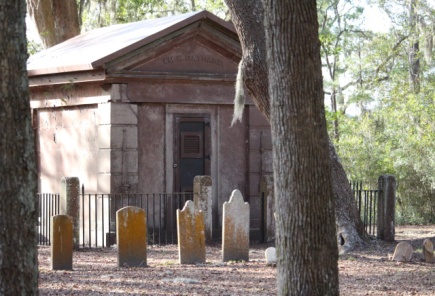
People have been memorializing the dead for centuries. Egyptian kings have their pyramids. In India, the Taj Mahal houses the body of an emperor’s beloved wife. Here in the United States, the wealthy erect mausoleums too, although they are admittedly much smaller. All of us will die, but only some of us will plan for our inevitable demise.
In the 1980s, a popular advertisement encouraged people to select the ingredients they wanted on their pizzas by answering: “What do you want on your Tombstone?” It made a normally serious topic light and fun . . . and, in particular, tasty. It was genius. The Tombstone Pizza Company name wasn’t easily forgotten, even all these years later. The ad worked in part because it made us face our own mortality for just a moment while we pondered how we wanted to be remembered. What would people say about us after our deaths?
Built in 1846, William Eddings Baynard’s mausoleum is the oldest standing structure on Hilton Head Island, South Carolina.
Frankly, if we don’t convey careful instructions or plan ahead of time, we aren’t the ones who decide what goes on our pizza or what gets written on our own granite tombstones. Let’s hope that the immortalizing words associated with us end up being written by someone who abides by our wishes or at least likes us enough to say nice things.
You can learn a lot about a person by visiting his or her gravesite. For some reason, that fun isn’t high on the list of any of my friends and family. Rarely does anyone ever want to join me in a stroll through a graveyard. Yes, I’ve actually asked family and friends to do that, especially during travel to foreign countries. Most often, the closest I come to walking hallowed ground turns out to be nothing more than a chance drive-by encounter on the way to some other point of interest.
The one time my husband, his sister and her husband humored me, we delicately tip-toed around the fresh, loose soil of above-ground graves in a church cemetery on the Leeward Island of St. Kitts. We visited long enough for me to take several photos.
An eternal resting place on St. Kitts overlooks the Atlantic Ocean.
When I noticed that my companions weren’t walking alongside or trailing behind me, I realized that they didn’t share my curiosity over the differences in Kittitian burial customs from those in the United States. I saw that my family was lingering near our rental car and I figured it was time to go. We hopped back into the new Honda CRV. Then we accidentally drove over a metal industrial anchor of some sort. After incurring over two thousand dollars in repair costs to the rental car, certain relatives don’t want to stop at cemeteries with me anymore.
That’s one explanation for why I, more cautiously, poked around the internet this month and found a variety of interesting memorials to share with you.
Elijah Jefferson Bond, the patentee of the Ouija board, was buried in an unmarked grave at Maryland’s Green Mount Cemetery in 1921. Eighty-seven years later, a Ouija board collector, enthusiast, and expert, Robert Murch, successfully located Bond’s grave.
Games can’t be played forever, or can they? (Photo, courtesy of Ryan Schweitzer, via findagrave.com)
Murch obtained all the necessary permissions and funds needed to erect a memorial headstone. He commissioned a clever and befitting design to honor the deceased Mr. Bond. Bond’s once unmarked gravesite could have been permanently forgotten, but that’s unlikely to happen now that he has an intriguing monument.
Yet, I wonder: would Bond have chosen to rest beneath a granite version of a game that encourages conversations with dead people?
Someone is bound to ask him, via a Ouija board, although it won’t be me. I don’t want to open that creepy door to the spirit world.
Princess Diana is buried on a private island on her Spencer family’s property. A temple inscribed with her name faces the island. Her brother’s words memorialize her this way:
We give thanks for the life of a woman I am so proud to be able to call my sister. The unique, the complex, the extraordinary & irreplaceable Diana whose beauty both internal and external will never be extinguished from our minds.
I think all those complimentary words would be well-received by Diana. The temple, in my opinion, is a bit much, but she was a princess. Most people wouldn’t expect anything less than extravagance like that for a woman loved throughout the world.
Another ideal tribute honors author Walter Lord. His gravesite is identified by a stone bench, inscribed with the names of his best-selling books, one of which was A Night to Remember, about the sinking of the Titanic. The welcoming setting invites visitors to rest for a little while, maybe even with one of Lord’s popular books in hand.
President Richard Nixon began his presidency with words that were later placed on his tombstone. It’s intriguing that his grave is absent a lofty title or noteworthy achievement. Instead, there’s simply a humble quote: “The greatest honor history can bestow is the title of peacemaker.”
That’s a nice thought for us mere mortals to aspire to.
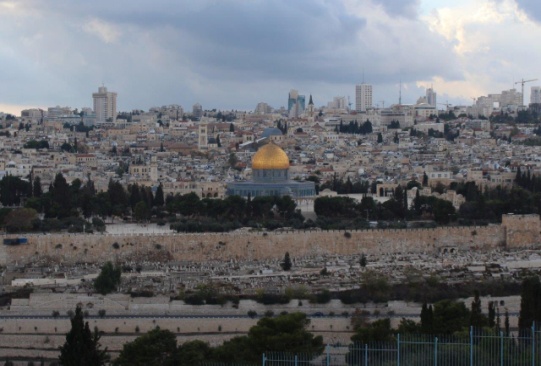
The land beneath the dome in Jerusalem is revered by Christians, Jews and Muslims, although for different religious reasons.
Covering a rock where Muslims believe Muhammad ascended to heaven is a shrine known as The Dome of the Rock. In Jerusalem, it stands out from all other buildings. There’s no mistaking the ornate memorial, topped in gold. During a trip I took to Israel in 2014 with my church-family, Christians were not welcome within the shrine’s doors, so we appreciated the splendor from afar.
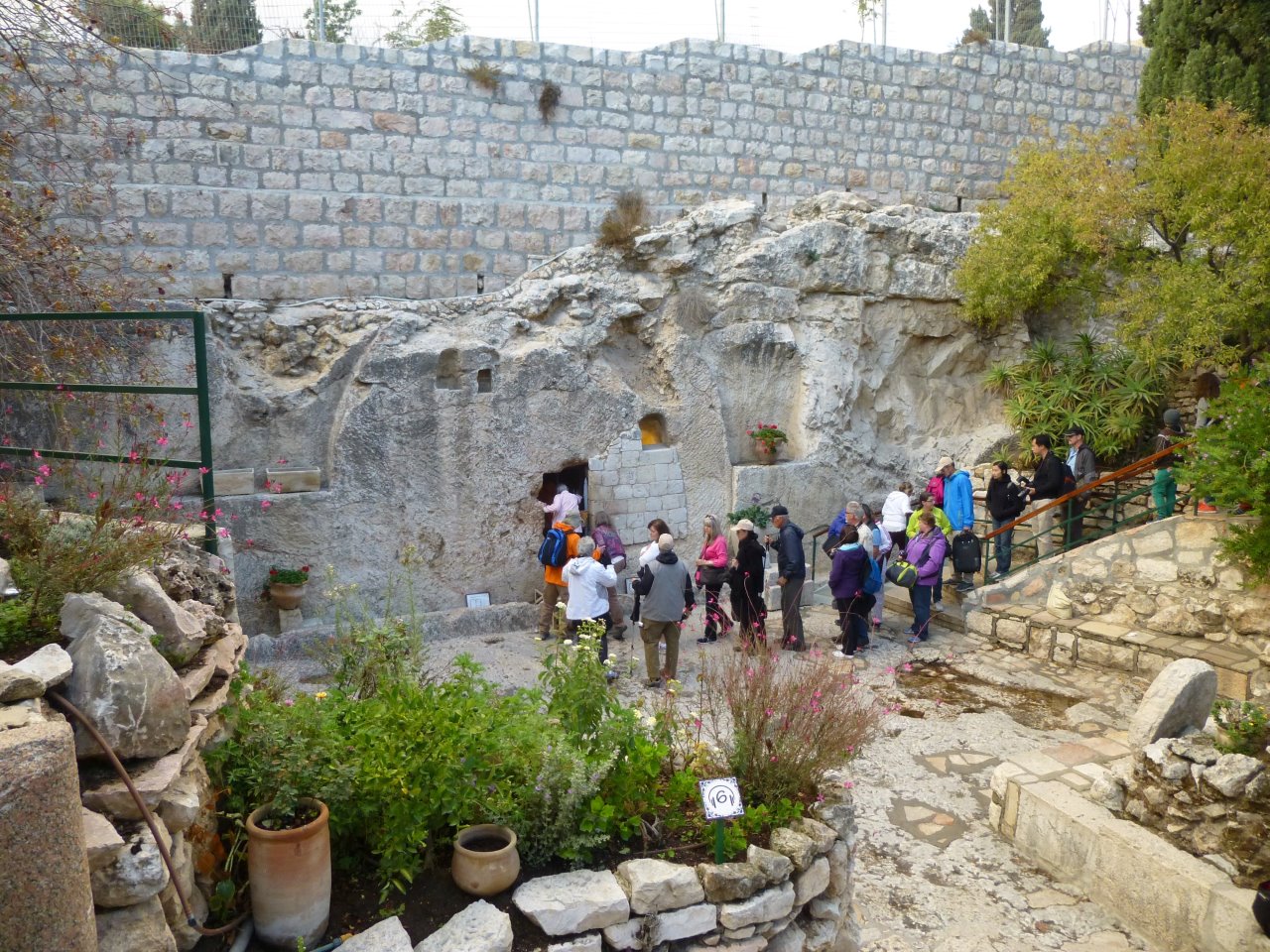
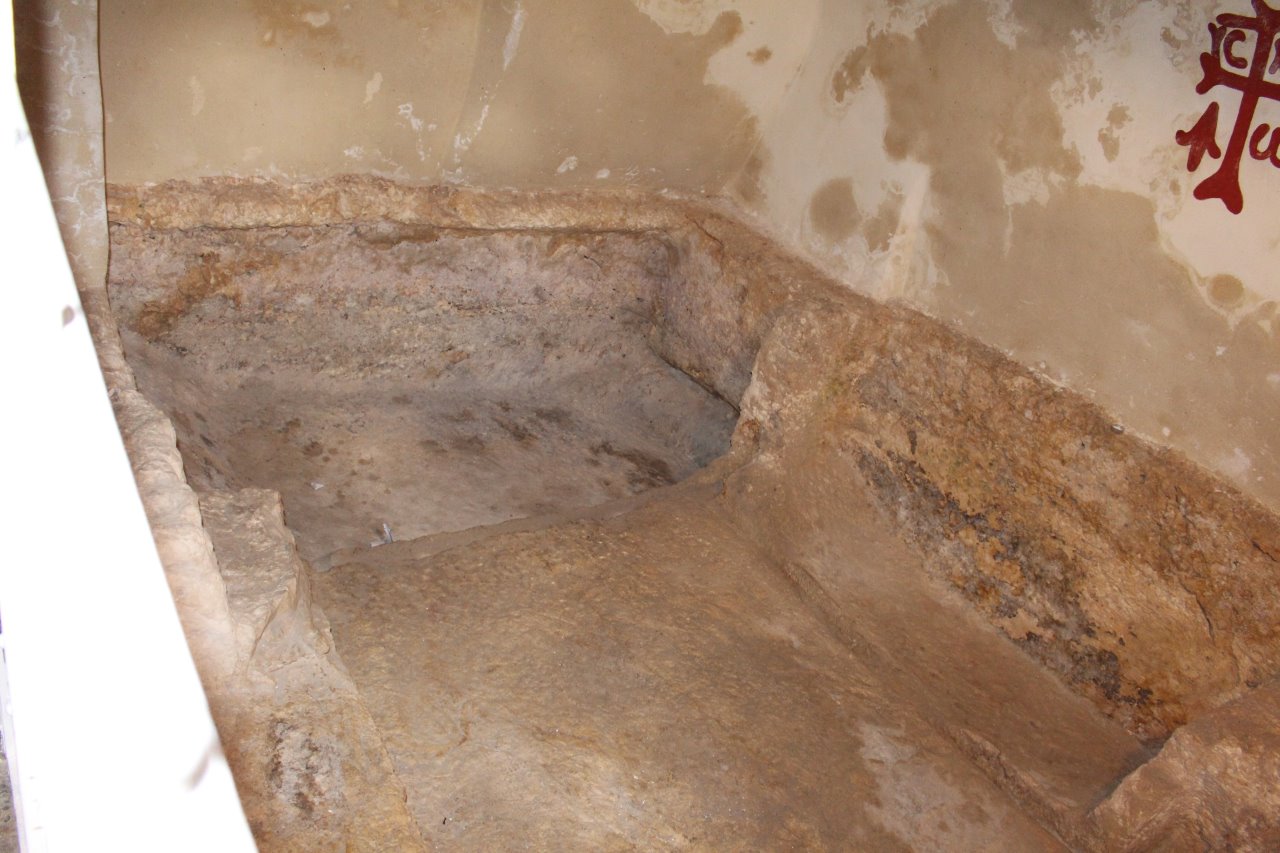
That was okay with me. I had another, personally more meaningful, tomb to visit. This other one, known as the Garden Tomb, was literally fit for a king. Not because it was extravagant or ornate or covered in gold. It was none of those things. There was nothing fancy about this other tomb. It was simply a cold, barren cave with a hard, stone floor. It was a tomb that long ago may have been customized to accommodate Jesus’s body. Some people believe that the King of Kings was too tall for His borrowed burial space and it had to be chiselled and lengthened to accommodate His height. Others more simply acknowledge that the Garden Tomb’s characteristics match historical records of Jesus’s burial.
Either way, this place in Jerusalem is where people come to pay homage to Jesus and to pray. I entered the solemn tomb and stood with my pastor and his wife. My pastor was weeping. In that moment, I recalled the torture Jesus endured before His death. I cried too. If anyone deserved a shrine or a temple, it was God incarnate Who sacrificed His life for the redemption of my sin.
The Garden Tomb. (Photo, courtesy of Chris Bixby)
The grounds surrounding Jesus’s burial tomb are full of flowers and plants, and there are many sitting areas that inspire personal reflection and prayer. Nature’s beauty helps comfort us in our grief. But the stark reality is that we mere mortals die. Those left behind visit gravesites, leave flowers, tenderly care for the little plots of earth where our loved ones rest. We continue in conversation with those departed. Our greatest comfort, however, comes from knowing we’ll see them again.
Before His own death, Jesus predicted, “We are going up to Jerusalem, and everything that is written by the prophets about the Son of Man will be fulfilled. He will be handed over to the Gentiles. They will mock him, insult him, spit on him, flog him and kill him. On the third day he will rise again.” (Luke 18:31)
“Why do you look for the living among the dead? He is not here; he has risen!” (Luke 24:5-6)
Jesus has no tombstone that screams accolades. The most obvious hint of His importance, royalty, and divinity was added years after His burial place was discovered. Where a stone once blocked His tomb’s entrance is now a wooden door with an inscription: “He is Risen.”
Indeed. Conquering death is worth celebrating. “Blessed are those who have not seen and yet have believed” (Jesus’s words from John 20:29.)
Billy Joel had it right: it’s always been a matter of trust.
3:43pm
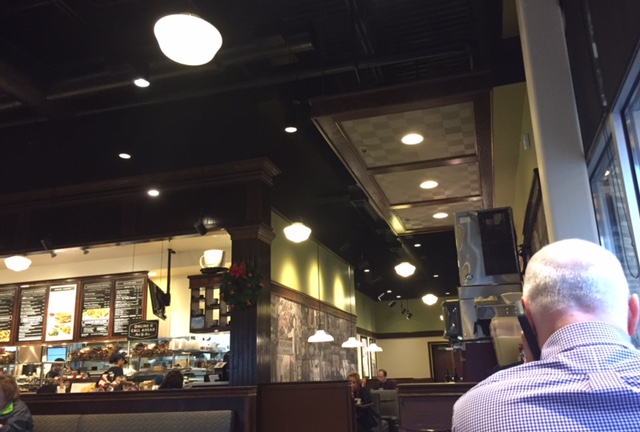
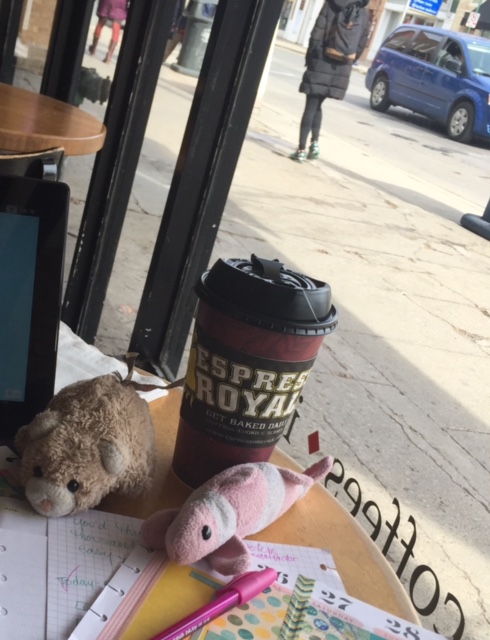
A strange little coffee shop that is, or was once, a restaurant. This place serves the typical coffees and latte espresso drinks, but it also offers a choice of real food, not just the token pastries. I ordered my sandwich and soup at the counter like I’m at fast food restaurant, but the staff delivers it to your table or booth. This place has booths. They look comfy, red leather-ish, but I’m at a four-person table. There’re just a few other people in here, so I don’t feel guilty taking up the room. I see the employees bussing other tables, a strange mix of customer service.
The guy behind me is the only other business-y person here. I know he’s a “professional” because he’s been on his cell phone since he arrived. I’ve refilled my coffee twice; he hasn’t stood up yet. Doesn’t he have to use the bathroom?
“My wife can tell you better….”
He’s got a small briefcase at his side with a thick black leather day planner of sorts. He wears a blue button-down shirt. A bag of chips with his sandwich, not baby carrots. An iced drink not hot, and a tablet-type laptop he’s working on.
“I’m a relationship guy myself….” I overhear.
I can tell that.
3:56pm
He finally hangs up his phone and walks away, leaving all of his stuff on the chair. He’s not careless; he’s natural.
There’s an unwritten code of trust in coffee shops—don’t touch other peoples’ stuff. It never crosses my mind to do anything like that. I guess he feels the same way. It’s also echo-y empty in here now, safety in no numbers. Regardless of how many people are in a room, I, leave my computer and my bags open while I stand, stretch or go to the restroom. I recently started putting my laptop monitor to sleep when I step away. Not that I’m writing secret recipes of potato chips, but I feel protective of my writing these days.
Being casual with my stuff does not mean stupid. I always carry my purse and cell phone when I walk out of site. My purse holds the important things in my life: car keys, wallet, Office Guys, writing journal and lip balm. After that, everything else is replaceable. Losing my current writing drafts, my photos, and those expensive power supply plugs would suck–especially since I haven’t backed up my work in months–but I don’t need to pack up and carry all my stuff when I walk 10 feet away.
I learned the potential danger of having my purse out of site years ago while grocery shopping in New Jersey. I was digging through a pile of apples when this guy walks up behind me. “You shouldn’t leave your purse unattended in your shopping cart,” he said, startling me. “Anyone could walk off with it.” Like he could have, I thought. I thanked him for that advice and continued shopping with my purse on my shoulder. Because of that, I always carry my driver’s license and credit cards close to me. My laptop and pens are worth money, but they’re really only valuable to me.
Is it because laptops are so cheap these days?
No, there’s just this hands-off vibe, this respect for other patrons. Haven’t found it in any other stores, food places or restaurants. Just coffee shops.
Is it the clientele? Does the cost of drinking expensive coffee give you higher morals? Are people too wrapped up in themselves, like Cell Phone Guy behind me? Maybe we’re all too intense on working that few can’t be bothered with thievery?
Is it the neighborhoods which coffee shops live in that breed safety? Even in a questionable strip mall like this one, where the coffee shop is on an exposed corner next to a European wax salon and a chain Mexican restaurant, I feel secure.
Is it exclusivity? Remember, this coffee costs money. People like Mr. Cell Phone can afford it. Even me, a freelance writer, I splurge for the luxury of space to write.
Is it chain store vs. Shop Local mentality? I would never leave my valuables in some McFastfood joint, for example, but I’m not threatened in coffee shops whether it’s an independent store, a local chain or a big name chain. I have no paranoid delusions, no sense that somebody’s watching me. There’s just something about the atmosphere, the expectation.
In Charles Dickens’s A Christmas Carol, Ebenezer Scrooge was obsessed over the accumulation of wealth. He was greedy, hoarding his pennies. He was mean, complaining about the poor. He was nasty, wishing ill on others. No one wanted to be around him. His main problem, however, was that he had lost his joy. Wretched behavior grew in the chasm left behind. In a last ditch effort to save Scrooge’s soul from eternal torment, three ghosts individually appeared to him to whisk him through time: past, present, and future. With the Spirits’ guidance, Scrooge examined poignant moments of his life and was convinced that he needed both a change of heart and a change in behavior.
Similarly, we’ve all had moments in which we’ve buried our joy so deeply that it seems like we’ll need several miracles to find it again. We battle busy schedules and stress over unfinished projects. We say things we don’t mean to loved ones and regret how we’ve hurt them. We obsess over wrongs done to us and harbor contempt towards offenders. Financial worries, health scares, and tension all add to our woe. We want to dismiss everyone and everything with a loud “Bah! Humbug!”
But we don’t have to hide from the Grim Reaper—or avoid answering the phone—by curling up beneath our covers on cold, dark mornings. There are ways to get through the gloom and into the light. We just need a healthy disposition and a route to lead us back to joy. The three avenues that help me are to give, pray, and sing.
GIVE A year ago, I fueled my van at Costco and started to maneuver past the pumps. I wasn’t in too much of a hurry. I had plenty of time to meet my boys at their school and take them home. It was cold, about 40 degrees. The boys would keep warm inside until they saw me arrive.
Just as I was about to exit the Costco lot onto a busy road, I saw a young woman walking through the grass. She struggled on the uneven ground in part because she was lugging an infant carrier. I had no doubt there was a baby tucked underneath the layers of blankets. Of the two travelers, the young mother was the one crying.
For once in my life, I wasn’t conflicted over whether or not to offer help. I rolled my window down and shouted a couple of times in the woman’s direction before she heard my offers to give her a ride.
Quote taken from A Christmas Carol. Photo by Kelly Bixby
She told me that her van had run out of gas in a lot across the street from Costco. She had seen the gas pumps and made her way over to ask for help. A man whom she had approached was rude and turned her away. Her tears led me to believe that she was emotionally defeated by the time I came upon her.
According to Jesus, “It is more blessed to give than to receive” (Acts 20:35). Through my chance meeting with the young mother, I know exactly how it feels to be blessed. It is joy to be handed trust and confidence from a stranger. It is joy to provide for another person. It is joy to cry together, hug goodbye and wish good upon one another.
In Matthew 25:35, we read, “For I was hungry and you gave me something to eat, I was thirsty and you gave me something to drink, I was a stranger and you invited me in, I needed clothes and you clothed me, I was sick and you looked after me, I was in prison and you came to visit me.” If you’re inspired to give of yourself in any of these ways, you’ll meet a need in someone’s life. Sometimes they’ll thank you. Sometimes they won’t. When you give freely, without expecting anything in return, you’ll feel differently, and you’ll want to give more.
PRAY There was a time when I couldn’t imagine squeezing a single minute out of my day for any other being, even God. I was a busy mother, wife, daughter, sister, friend, volunteer, committee member…titles galore. For crying out loud, I couldn’t possibly support one more relationship! And then, I gave in to an ever-present tug: “Do not be anxious about anything, but in everything, by prayer and petition, with thanksgiving, present your requests to God” (Philippians 4:6). So, God joined me during my early morning showers.
Praying while showering may seem disrespectful to people of other faiths who are tied to strict worship ceremonies and customs. But my Christian faith teaches that nothing stands between the Creator of the Universe and me. I can approach Him anytime and anywhere. I may be casual and speak conversationally with Him. Alternatively, I can be formal and lower myself to the ground in reverence, never losing sight of the fact that He is owed my perpetual thanks and utmost respect.
Throughout my years spent getting to know Him, I’ve discovered that He has quite a sense of humor. He’s very opinionated and He’s jealous for my attention. He’s loving and kind too. And sometimes His expression of love comes with harsh discipline. What’s really cool, however, is that He provides me with all that I need.
We work well together: I seek His input into my life and He directs me…I may have that statement backwards. Either way, I don’t always listen, and the path isn’t always easy or clear. I’ve tripped over plenty of litter—ugly sin and temptations, disappointment and heartache—scattered by the world. I’m not immune to any of it. Often, I wonder if I might even be more susceptible to it than people who don’t care about His approval.
The beauty of His and my relationship with one another is that He knows what I truly think about Him, and I get to experience the joy of His companionship as He walks with me through all my trials. It feels good to know that He is ever present and looks forward to our one-on-One time. “Go into your room, close the door and pray to your father, who is unseen” (Matthew 6:6).
SING The Detroit Christian radio station, K-LOVE 106.3 FM, challenged its audience members to spend thirty days listening to nothing else but Christian radio. The point was for listeners to replace worldly distractions with the praiseworthy songs and positive messages provided by Christian radio programming. For me, that meant that I would have to turn off daytime TV shows and evening news programs.
I did it! I tuned out mainstream media and primarily listened to three stations: K-LOVE; Faith Talk 1500; and WMUZ 103.5 FM – The Light. For well-over a year now, my life has been practically void of televised news and I don’t miss it one bit. There are plenty of other ways to get information. My friends, family, and church all provide enough details for me to feel like I have some idea as to what is happening in the world. If I want to know more, I look to the Internet and mindfully select what I want to read or view. By choosing to do this, I am not bombarded with overly negative and repetitively broadcast stories. Bucking popular information sources and spending time singing along to songs of worship has brought greater peace to my life and more productivity to my days.
I admit to venturing astray by going to hear the Rolling Stones play at Comerica Park; how could I not? I collected nearly every one of their albums during my youth. By the way, the concert was amazing! The guys all defied their ages as they played a dozen and a half of their iconic songs, and I had fun singing.
In comparison, a year earlier my husband and I celebrated our wedding anniversary by attending a concert performance of Christian artists: Third Day, Mercy Me, and Colton Dixon. That concert was amazing for a different reason: Christian music seeps into my soul like nothing else. I carry songs of praise almost constantly in the background of my mind. And the joy I feel is powerful enough to get me fervently dancing. That’s a phenomenon for a conservative girl like me. With my arms reaching towards heaven, I belt out words of worship, words reserved for the King of Kings. Mick may still jump around like a thirty-five year-old, but I know my heart belongs to Jesus. I feel it in my joyful soul.
“Sing and make music in your heart to the Lord, always giving thanks to God the Father for everything, in the name of our Lord Jesus Christ” (Ephesians 5:19).
This Christmas, I hope you’ll plot your way to joy. GIVE cheerfully, PRAY boldly, and SING loudly!
I failed my children by not pushing them further in studying spelling and vocabulary. One of my sons, a senior in high school, said to me that he just doesn’t know very many words. His limited repertoire made writing essays for his college applications a difficult and grueling process. Writing never came easily to him.
In contrast, I’ve always loved penning my thoughts and studying the mechanics of grammar, selecting the right words to convey my meaning. I love playing Boggle and Scrabble, and I look forward to quizzing myself with Reader’s Digest’s “Word Power.” I stop myself from giving my son too much writing advice because it’s important that he express his own thoughts in his own way. In looking back at the differences in our educations, I have an idea of why he struggles more than I do.
My elementary and junior high schools encouraged participation in spelling bees. I spent hours on rote memorization with the help of my patient mom. She read pages full of words out loud to me, one word at a time. I never once thought to ask her what the origin of an unfamiliar word was, but today’s top spelling bee contestants frequently make use of that rather sophisticated technique. If I had known there was more to studying spelling than memorization, I might not have lost first place to Kathy Trotter in the sixth grade. I didn’t know how to spell curry. Rote memorization only got me so far. Fortunately, I wasn’t competing for a college scholarship. The short-term goal was simply praise, a dictionary, and a trophy. The lifetime benefit was that I became a good speller.
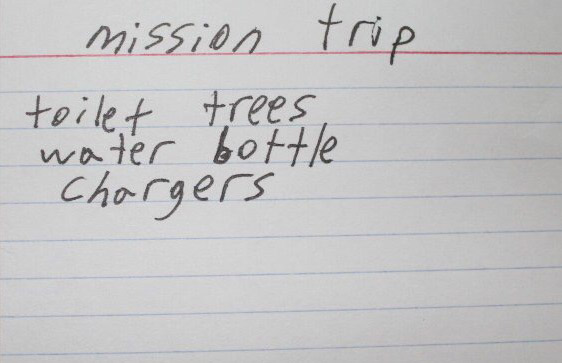
Spelling and vocabulary matter: I had to let my son know that toiletries would be easier to pack.
Sixth grade for my children was a different experience. Their spelling words were taken from their own journal entries. The children were tested on words which they individually used in their own writing exercises. I understood the practicality of holding students responsible for using self-selected words correctly. But I wanted a bigger challenge for my kids. How would they learn new and unfamiliar words and to expand their knowledge of language?
I reminded myself that teachers aren’t solely or primarily responsible for our children’s educations. As parents, we need to instruct and guide. To complement my children’s elementary school lessons, I developed a game that I thought would challenge them and be fun for our entire family.
During one week, I randomly selected a word each day from our two-volume dictionary. By the end of the week, we all had to know how to spell the seven chosen words and combine them into one sentence. The sentence could be longer than seven words, but it had to reflect correct usage and meaning. Essentially, the family and I studied a word a day—similar in scope to what Merriam-Webster currently offers online—but my game involved the added challenge I was seeking.
So that you can see how this game worked, I’m going to borrow the seven “Word of The Day” selections which Merriam-Webster promoted from October 29 – November 4, 2015. First, we have to consider the definitions of the words. The list below is taken verbatim from www.merriam-webster.com.
Pellucid: admitting maximum passage of light without diffusion or distortion; reflecting light evenly from all surfaces; easy to understand
Underwhelm: to fail to impress or stimulate
Ebullient: boiling, agitated; having or showing liveliness and enthusiasm; exuberant
Microburst: a violent short-lived localized downdraft that creates extreme wind shears at low altitudes and is usually associated with thunderstorms
Ruddy: having a healthy reddish color; red, reddish
Confidant: one to whom secrets are entrusted; especially: an intimate friend
Trepid: timorous, fearful
Now comes the hard part: we have to consider those definitions in anticipation of using the seven words to construct one sentence. Here’s my solution to the puzzle:
My ruddyconfidant was caught in a microburst which left her so trepid that, when she couldn’t describe the situation in a pellucid manner, I was underwhelmed, despite her apparently ebullient experience.
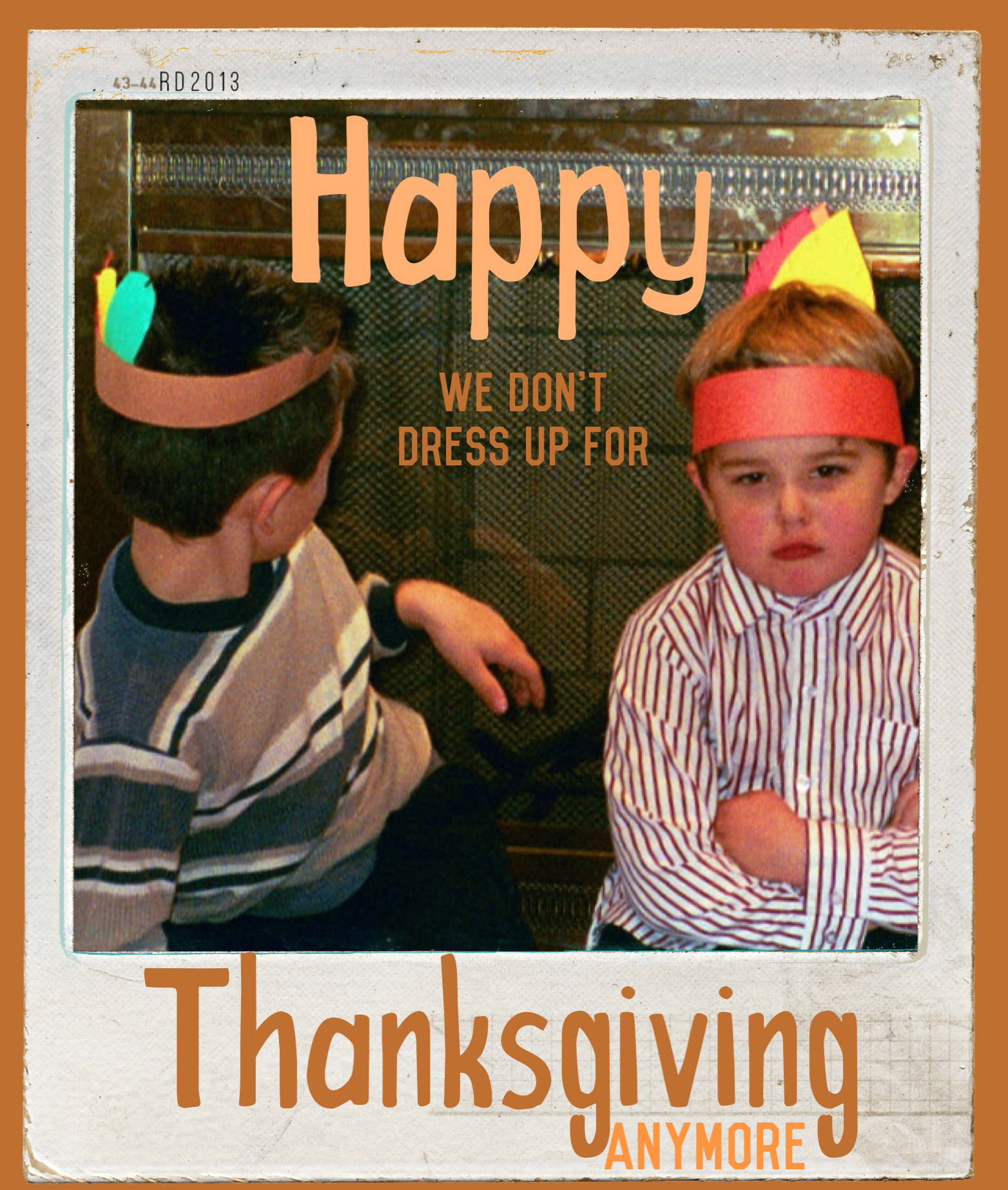
If I wanted to break the rules of grammar when creating this meme, I would have written Happy Givingthanks.
. Sadly, my kids never really enjoyed the game as much as I did, and it was quickly forgotten. But thank goodness, they now have smart phones and can share highly entertaining, often grammatically incorrect, internet memes with one another. If only people like my kids understood the rules before they broke them.
 Espresso Royale