Category Archives: Author’s Craft

Write Something

“You might not write well every day, but you can always edit a bad page. You can’t edit a blank page.” Jodi Picoult

Creative writing is not the same as making a pot of homemade chicken noodle soup. Once you put an ingredient in the pot, you can’t remove that item. The flavor changes with each addition of a vegetable, meat, or spice. Soup-making mistakes aren’t easily corrected.

Writing is different. You can put on paper descriptive words that don’t quite capture your thoughts. Continue writing. You can change words that you have written, but you can’t change what you don’t write.

Are you staring at a blank sheet of paper or blank screen? That’s writer’s block. Try quick writing which is timed, continuous writing without self-editing. Pick a subject; don’t agonize about it. Open a dictionary, novel, or newspaper. Pick any word. That becomes your topic for freewriting. This seems silly at first. However, your mind isn’t hampered by spelling errors, punctuation concerns, or difficult plot points. Write for fifteen minutes without stopping to change anything.

My first experience with quick writing came when a creative writing instructor told the class to write the word “chair” at the top of a sheet of paper. We were given ten minutes to write about a chair. At first I struggled. When I began to imagine who might sit in that chair, my writing took off.

Don’t want to try quick writing? Write about something you’ve seen or heard today. After reading a newspaper article, give your opinion of the information or on the writer’s interpretation of the event. Read a book and change one significant detail to give your spin to the tale.

Another way to stop the dreaded writer’s block is to take an idea from a book you’ve read or movie you’ve seen recently. Pick a scenario you would have created differently. Write this scene your way without stopping to correct spelling, change names, or edit in any way.

Try this: Close your eyes and picture a moonlit beach in the Caribbean. If you’re into murder mysteries, picture a couple walking down the beach when suddenly the woman pulls out a gun and shoots the man. If you’re into romance, picture that same couple suddenly dropping to the sand to make out. If you’re into science fiction, picture the couple discovering unidentifiable footprints in the sand. If you’re into memoirs, try to remember the last time you walked a sandy beach.

Do you self-edit as you write? Stop it! Editing while you’re working on your manuscript stops the creative flow. If you think of an alternate word, type it in red, underline it, or put it in the margin without deleting what you’ve already written. Check your thesaurus later to select the best word. You can always edit later by adding thoughts, deleting dialogue, or changing plots. YOU CAN’T CHANGE WHAT YOU DON’T WRITE

Finding Fiction in Real Life

“There are more bizarre stories in reality than any of us could imagine.” – J. Garth

If I wrote a story about an elephant buried at a shopping mall in the United States, no one would believe the plot was plausible. And yet it’s true. In 1972, Little Jennie, an aging elephant with a traveling circus, died at the mall and was buried immediately at “what is now Summit Place Mall in Waterford.” (Detroit Free Press, August 11, 2014, front page)

If I wrote a story about the compassion and empathy that a gorilla can exhibit, few people would want to believe it. After all, gorillas are just animals. Now that it is documented that Koko the gorilla expressed her sorrow at the loss of her friend, actor Robin Williams, people may now believe that gorillas are closer to humans than we thought.

Who would believe a young man with cerebral palsy could write a novel using only the toes of his left foot? I read Christy Brown’s Down All the Days long before it became the movie, “My Left Foot,” starring Daniel Day-Lewis. The novel depicts life in Dublin, Ireland from the point of view of a young man suffering from cerebral palsy.

When I read the newspaper or watch television news, I’m often amazed by the real world. Why would a young person pour a flammable liquid on his chest then set the liquid on fire on a dare? Why would a woman kill her family and herself because she suddenly lost her job? Why would a child kill himself because he is gay? How does someone strapped with dynamite walk into a building and blow himself up for a cause?

Real life presents some bizarre stories. If you choose to write stories “ripped from the headlines,” you must be prepared with convincing plots, believable characters, realistic dialogue, and sights and sounds that satisfy us. Are you prepared to make the bizarre believable?

Inking Out First Impressions

No doubt, you already know how to add adjectives and adverbs to Mr. & Mrs. Fashion Forward’s outward appearance, so I will hold off on the physical aspects of first impressions – height, weight, color of eyes, etc. – until the end of this blog. And I am not going to discuss what it takes for your book to make a good first impression on the shelf – cover artwork, font size, colors and the blurb on the back. That is a separate topic unto itself. This blog is about how to utilize three of storytelling’s four fundamental pillars to build the strongest, most vivid first impressions for characters and scenes, on the page:

  • Where is this story taking place? (geographical and social settings)
  • When is this story taking place? (historically, seasonally)
  • Who is it about? (age and wisdom, but not physical appearance)

It is these three spiraling timelines – where, when and who – that I use to create memorable first impressions.

The other pillar – What is happening? – is plot line, which I discussed in July.

Where. Your story’s setting should have a “connection to place” if you want to make a good first impression. Get to know your scenery up close and personal. Visit. If you can’t go, then find that location in Google Maps, click “street view” and see what it looks like. Search “local events” to get a flavor for the eats, beats and treats around the area, and then pick out a feature or landmark that can help cement your story. Scenery is usually set during your book’s slower moments, away from the action, but don’t go crazy here; it’s only minutiae. One or two quick, accurate, local details will do.

Where also indicates social position. Who are your characters’ circle of friends? What are their family and workplace situations like? How do your characters behave in their community? Not that authors needs to tell all of this stuff to make a good story, but they do need to know all of it in order to develop their characters – in character. It is the action of your characters within their social, home and work settings that shows where their motivation lies.

Case in point. In my upcoming novel, Knock Softly (working title), the protagonist, Edvard Bergman, at the age of seven, loses both of his parents in a house fire. That event dictates how he manages his business and his family in the story. There is no prelude. Readers do not know the backstory when Knock Softly opens, 38 years after the fire. First, the reader sees that Edvard has built a fire station on his research campus because the nearest fire department is 12 miles away. At home, Edvard has installed sprinklers in the kitchen and garage ceilings, as well as above the fireplace, a fireplace that’s never been lit. Readers learn that Ed will not allow his children to sleep with locked doors, and that all second story bedrooms have rope ladders. Ed’s demeanor is played out in actions and reactions long before readers learn why he is pyrophobic.

When. In order to write realistic fiction, the author must be in touch with the era in which the story takes place. That is why contemporary suspense is so popular. It’s the easiest for the author to imitate, and it’s the easiest for the reader to follow. Before you write the scene, think about what was really going on at that point in time. Read the local newspaper for around the time of your story and see what everyone was talking about. You just might discover something newsworthy that will help place your story to that time in that town, city or park. Incorporating history and a few seasonal aspects into your background will lend authenticity to your story and make it seem more real.

Watch out for seasonal changes in longer stories, they can cause slipups that are hard to spot by the author. I needed to cut the line “…acorns crunched under his step…” from one scene in Knock Softly because that scene takes place in July. I first wrote it in the fall of last year. At the time, I was attempting to incorporate a soft sound into a quiet walk in the park. It was just minutiae, but I never caught the error until last July, when I was walking my dogs in the park and could not find a single acorn to crunch under foot… Oops!

Who. Very young kids, up to about the age of seven, will believe anything their parents, teachers, guardians and older siblings tell them. That’s why they make lousy protagonists in suspense. On the page, just have very young characters do what their elders tell them and you’ll be fine. But after about age seven, appropriate behavior for kids is the toughest feature of all to nail down. Especially through puberty – when shoe sizes and career goals change overnight.

Be careful what your characters say with older kids on the page – they absorb everything. Gossip, and how children interpret what they overhear, will grab a kid’s attention in a way that telling them directly cannot. It’s, I learned verses you told me, to their young minds. The older we get, the less we trust hearsay and gossip, but to kids it’s golden nectar.

You can use these three factoids to make great suspense between young and old:

  • Kids and young adults are constantly looking outward to see what else is available. Adults are ego-focused by their mid-thirties.
  • You can’t teach a know-it-all and teenagers already know everything, so they say and do the first thing they think of. A rational adult will take whatever time necessary to make the right decision.
  • When confronted with unknown situations, kids become flustered and everything speeds up for them. Adults become keenly aware in unfamiliar situations, and everything slows down.

These transitions do not begin until we gain more confidence in our decisions–twenty-something for most people.

As you start to draw your older characters, imagine you are meeting them for the first time, just like your readers really are. Your character’s life doesn’t begin at this point. You and your readers are effectively dropping in on them. Yet, even though the reader knows very little about the character’s past, there is much they will assume until you tell them otherwise. I have found these assumptions are true with most adults:

  • Day by day, our ambitions spiral us onward and upward to bigger and better.
  • But in reality, our life becomes focused through a narrower and narrower lens as we gray.
  • The older we get, the more we want, but the less we are willing to accept.

Some glues harden quicker than others, but most people set their course in life by thirty-something. That’s not to say life can’t come unglued. Read: midlife crisis. There are tons of suspense and mystery novels built around this time in a character’s life and it is fun, fun stuff to write. Just keep in mind that by midlife most mortal characters know what sorts of things they’re good at, what kinds of people they like to be around and what entertains them. And they go for more, not less, in life’s next chapter.

Exceptions, of course, always make for better stories. Exceptions to the norm that give depth to the storyline can build lasting first impressions, but if the “exception” does not move your story forward, the words are just bulk. That’s true for scenes and character traits.

As for the physical aspects of character, let me ask you: what color were Dracula’s eyes? On which cheek was Capone’s scar? In the Sherlock Holmes series, on which leg did Doctor Watson received his old war wound? Once your characters are fleshed out, you can color their eyes, skin and hair and dress them as you like; it won’t matter. Fangs, scars, limps and the like all make for great imagery, but it is the personality to which these images are attached that readers will remember first and foremost.


Next Month: Not sure yet. Any suggestions? Contact me via the comments section below.
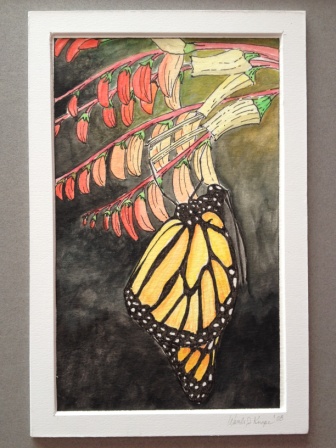
The Monarch

Knape, Wendi. Monarch Butterfly, 2008. Ink and watercolor on paper.

Knape, Wendi. Monarch Butterfly, 2008.
Ink and watercolor on paper.

In my last blog Clarity I talked about how much my work has improved since I started writing. What you don’t know is the inspiration that started my writing journey was a monarch butterfly.

Laid off from an at-will company (the company didn’t have to tell me why they let me go) in 2003, I felt lost. My mind spit out all sorts of detritus about why I was let go, bogging me down in a depression that had its claws deep. I was unsure of my talent in my chosen field, which was architectural design. I didn’t know how I should move forward with my career, though I knew that I needed to do something that I would enjoy. At the time I decided to focus more on my family; it just wasn’t going to be enough. The stay-at-home-mom label wasn’t for me. There’s nothing wrong with the designation. Parenting is hard work, and raising my children so they become good adults is important to me, I just wanted something more, so I let my thoughts percolate.

Drawing and painting is a passion of mine, but having the time to do it was hard with a full time job so, I always put it off for another day. Reading is another joy that helped me through some awful days too. Getting lost in worlds that other people create was something that helped pull me out of my mental fog. Eventually, the idea of taking my talent in art and my love of reading got me thinking about pushing my career in a new direction. I asked myself, was it viable? The problem was I didn’t know what it was. Did I have what it would take to make something out of my love of art and reading? Could I help support my family by drawing or painting? How could I take the joy of reading and make it into something worthwhile? I didn’t know, so the thoughts kept going round and round, making me undecided on what street to walk down.

My mind was in a continual loop of worry, as I drove to the store, when a monarch butterfly flew past my windshield. The first thing that popped into my head was, I should paint that. The second thing was what if I wrote a story about the monarch. Could I write as well as the authors I read? I was reading children’s books at the time, my two girls ages were five and three, and those books were illustrated. Could I write and illustrate a book?

That was my ‘aha’ moment. I felt lighter than I had in a long time and got excited about what it could mean for my family and me. Seeing the butterfly wasn’t the only factor, but a primary one, allowing me to throw away thoughts circling in my head that weren’t doing any good. I started illustrating and writing my first picture book, Becoming Lucy, a story about a painted lady caterpillar being bullied because she had yet to go through her metamorphosis.

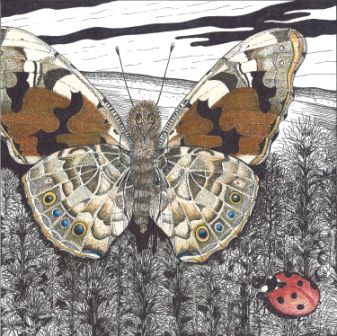
Knape, Wendi. Painted Lady w/ Ladybug, 2008. Ink and colored pencil on paper.

Knape, Wendi. Painted Lady w/ Ladybug, 2008.
Ink and colored pencil on paper.

You’re probably wondering how I went from writing and illustrating children’s picture books to writing paranormal romance novels. It was a gradual shift, moving from the picture book to middle grade stories, to young adult and finally to adult stories. It was a better headspace for me. Some people would tell you children’s genres are easy to write, but they are not. Getting into the mindset of a child, pre-teen or teen is difficult. I was too serious as a kid and I couldn’t remember how to be a kid and wasn’t able to capture the essence of one. Therefore, I shifted my thinking and tried my hand at something I love to read, romance, eventually paranormal romance.

Already in the Deadwood Writers Group, with their support and encouragement the other writers told me I should try my hand at the romance genre. The change was nerve racking, but I gave it a go and wrote my first sex scene, jumping head first into the deep end of the pool. It felt weird and exhilarating all at the same time, I even laughed aloud because I couldn’t believe I was writing one. It was like a river racing toward a waterfall. Ideas started pouring from my mind into a large pool, it harboring ideas for later. It was fun and I haven’t stopped since. I’m comfortable here. It’s not an easy business to break into but I keep my hope close to my chest that one day it will pay off. I still draw and paint, but writing is my inspiration, and I’m very satisfied.

Happy writing!

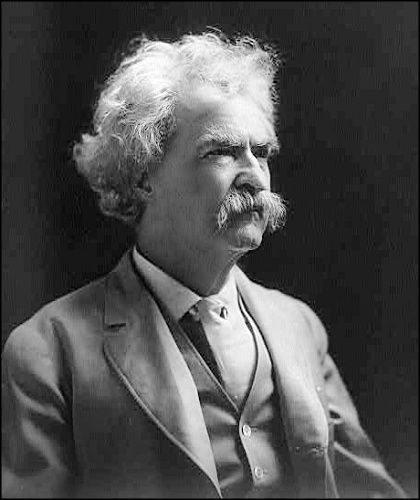
3 Writing Lessons from Ken Burns’ Mark Twain

Mark_Twain - BP

PBS television is a great resource for anyone interested in the works or lives of authors.  If you are an early riser, or good at setting a DVR, you can watch Terry Tazioli on Well Read interview authors such as Elizabeth Gilbert (Eat, Pray, Love), Amy Tan (The Joy Luck Club), or Khaled Hosseini (The Kite Runner) about their latest works and creative process.  American Masters has profiled Alice Walker (The Color Purple) and J.D. Salinger (The Catcher in the Rye) among others this year.

Last month I watched a reshowing of Ken Burns’ documentary on Mark Twain.  I recommend this compelling portrait of one of America’s foremost authors.  It reveals Twain’s monumental life along with his more personal, sometimes heartbreaking, experiences.  You’ll discover why his books continue to be read the world over as significant literary works.  After watching the film, I wondered what lessons specific to the writer can be drawn from the presentation.  So, I watched it again and discovered three takeaways.

1. Notice the details of people, places, and things

Writers tend to be natural people watchers, but how close do you look?  Do you notice the way people hold themselves?  The way people comb their hair or wear their hat?  Do they speak slow and steady or fast and jittery?  What about the places you go?  Are there smells in the air?  A certain color to the grass?  Sounds drifting in from someplace close by?  What’s interesting about the things around you?

If you stick to what is easy to see, you run the risk of giving the reader only the mundane.  The details provide little sprinklings of spice you can use to create more compelling narratives and characters.

2. Explore unconventional publishing methods

Twain’s Innocents Abroad published as a subscription book in 1869.  Sold door to door by salesmen, literary critics rarely bothered to review these works.  Both ePublishing and self-publishing have started out with similar low regard from established literary circles.

By going the subscription route, Twain got his books into the hands of the masses.  People who didn’t frequent or have access to bookstores could purchase his book causing sales to flourish.  In time he was promoted as “the people’s author.”  Going the traditional route for publishing is an option.  At the same time, keep an open mind to other opportunities that can also land you an audience.

3. Write about what it is to be human

We live in rich environments for storytelling.  You may think your life uninteresting, but it is a human life filled with people and experiences to which many can relate.  Add to that the social issues going on around us and you have fertile ground for your imagination to comment on the human condition.  A writer conceives from this bounty something that is magical, thought provoking, or revolutionary then wraps it up in an entertaining package.

Writers can take sides on social issues to influence people’s thinking for the betterment of our culture or ourselves.  Even the lightest works can help people see more about themselves and to understand significant things about our journey through this world.  Ultimately, that is the genius of Samuel Clemens’ Mark Twain.