Category Archives: Author’s Craft

Minutiae

According to Merriam-Webster.com, “Mystery” means anything that is not understood. Its origin pre-dates the bible. “Suspense” is defined as nervousness or excitement caused by wondering what will happen. It was first used in the 1500’s. “Minutiae” means trifles, details and smallness, and it dates to 1782, making it the new kid on the vocabulary block. The elements of minutiae can enhance both mystery and suspense, but they are used differently in each genre.

In a mystery, you don’t know who done it; that’s for the protagonist and the readers to figure out. The author plants clues throughout the story, and those clues are often in the minutiae, the small details in the beginning that have large consequences in the end. For example, break a fingernail in Chapter 1 and have that fingernail show up at the scene-of-the-crime in Chapter 7. Mystery readers need to be on their toes, constantly asking themselves, “Why did the author choose this minutiae to express that scene?” Readers won’t fault the author if they figure it out before the end. Instead, they will think of themselves as very clever for having done so.

In a suspense novel, the reader knows who did the dastardly deed, often from the opening chapter. There is no mystery to the story itself. Instead, there is plenty of mystique in the characters, and the readers are left asking, “Why does she always do that?” Readers don’t fault the author if the character’s mystique is double-handed or morally corrupt, so long as the author explains the minutiae in a rational way for that character’s development.

In a mystery, minutiae mystifies the storyline, in suspense it mystifies the characters and their actions.

What you choose say is just as important as when you say it. Character traits are popular with authors because these small details pull double duty with character development, and they don’t have a “sell by” date, meaning you can bring them back in your next chapter or next novel.

One place where minutiae can play a part in your novel is when you want to slow down the pace. Never use minutiae to speed up the action, like: His fist floated into Fred’s flabby gut. He heard him go oomph and gleefully watched Fred double over in pain. Instead say: He hit Fred once and watched him double over. Only use minutiae to slow down the action: The wine’s robust aroma floated in the air and competed with her perfume. He inhaled deeply, slowly; this was a night he had to savor.

Entirely new scenes and romantic moments can also benefit with a sprinkle of minutiae, to let the scene breathe. But this minutiae is only used once to full effect, then condensed for any revisits. Case in point: here’s a “first” scene from my upcoming novel Knock Softly (working title). The characters make several visits to the park and dog run with our protagonist, Edvard, and his two dogs, Rufus and Pudge, throughout the story. The dogs weigh 75 and 25 pounds respectively. (The novel goes into more detail on the dogs, too, but here such detail would only be minutiae.) This scene involves only a small portion of the 1.2-mile walk. Knock Softly is told in present tense.

Long before they arrive at the dog run, Ed has to walk the dogs past a family of oaks that proves to be home to an entire community of squirrels. The trees are a magnificent cluster whose matriarch stands dead center and at least 80 feet tall. The grounds under the oaks are well shaded and almost barren of other trees or tall vegetation. Their broad branches and long, fingered leaves steal all the sun’s rays leaving this part of the walk always cooler, darker. Rufus lifts his ears in eager anticipation and starts pulling on the leash. Ed wraps the leash around his wrist and braces for impact.

Readers revisit this part of the path again in another scene several pages later, but in the second scene, the pace is much faster and it is dialog that sets the pace. The scenery is just the canvas:

They’re getting closer to the oaks and both Ed and Rufus know it. He wraps the leash around his wrist before they get to the shadows and gives it quick jerk to let the dog know who is boss. Ed tells Jane… And the dialog follows.

All the minutiae from the first scene are present in the second, just not on the page. Left in the readers’ thought bubbles are the cluster of trees, the squirrels, and all the other previously established minutiae. To put all of that on the page again would only bog the story down when it wants to run.

And never use the same minutiae twice – that’s worse than marrying your brother-in-law in the same wedding dress.

Next Month: First Impressions
They say you never get a second chance to make a first impression, but much of fiction is character development. Development means change, and suspense means changing those first impressions. To write a great first impression in a novel, you have to first think about what your characters are going to develop into. Then figure out what kinds of darling details, social settings and backstories you need to get them there. Next month we’ll look at how to make a good first impression on the page.

Clarity

When I dream of becoming a published author, I see myself as a stand out amongst a large populous of romance authors. My books sit alongside those written by authors I’ve admired and learned from by reading and being absorbed by the characters they’ve created and the stories they continue to roll out year after year. I want people to get thrilled when they see a new release date, from author ,Wendi Knape, and automatically click the to read category on their goodreads.com account, so I keep moving forward. Nonetheless, in my writer’s life, there are days when things weigh me down, a little voice whispering I won’t succeed no matter how many edits. However, I never let myself forget my end goal and always remember that I have a lot of encouragement from writer friends, plus all the resources in books and blogs regarding the writing craft.

With my first manuscript I didn’t stop writing to try to publish, I jumped to the next manuscript, and the next, and so on. In my experience, through writing and wise words from other authors, it’s best to leave a completed manuscript alone and come back to it to see what needs fixing.

When I moved on and was about halfway through writing book two, I went back to my first manuscript and tackled editing it several times so I could enter the RWA Golden Heart contest. All along, I’ve felt there’s been something missing from its pages, even after several edits. That I didn’t place in the contest let me know it still needed work, but now I had scores to lead me in the right direction. But still, it wasn’t a decisive critique it was just numbers relating to content.

I kept asking myself, where’s the spark that encourages the reader to turn the page? The spark was elusive, as if it was a living thing, hiding in the dark, just waiting for me to come to its rescue. I was becoming more and more frustrated each time I sat down to edit, mired in words that had gone blurry, lost in a sea of plot. The characters got what they wanted with little conflict. I couldn’t find my way out of the editing fog. Until reading, Make a Sceneby Jordan E. Rosenfeld, and nearly at the same time, a blog piece titled, The Difference between Idea, Premise and Plot, by Janice Hardy on Janice Hardy’s Fiction University website, things didn’t click. When I combined the two ideas, I got excited. Now I held the flickering spark and watched it dance on my fingertips. Fixing problems wasn’t going to be easy but it also wasn’t going to be like Atlas holding up the celestial sphere.

First, let’s look at The Difference between Idea, Premise and Plot. My idea was a good one, the premise was simple and strong, the plot was tagging along like a good pet, but it wasn’t quite pulling me forward like an excited puppy. When I got to story–which Janice Hardy added after a comment from a reader–the emotional element, the internal conflicts my characters would have to overcome, they easily overcame the problems. When I say easy, my hunky hero quickly decided he wasn’t afraid to take on the vampire protagonist–really an alien that needed to feed off human blood–to his home where he would help her find her mentor. Not only in the beginning did the protagonists acquiesce to circumstance, it was throughout that they jumped in feet first and fell in love in a blink. Usually, the reader is at the halfway point before the first love scene. Three quarters through, the protagonists discover they love each and still are keeping it from each other. The declaration of love is a highlight near the end.

If readers know what happens so soon, why should they turn pages?

What was missing?

Janice Hardy’s article allowed me to see that, though my idea was a good one, it wasn’t a complete story. Her break down from Idea, to Premise, Plot and finally her addition of Story, gave me a clearer vision as each consecutive step built on the other leading me to a stronger story concept. I even went on to develop other story ideas that I want in the series based on characters I love. When I got my hands on Rosenfeld’s book, Janice Hardy’s article only enhanced my start-up thoughts as each story came to life.

Half way through Make a Scene, I can tell you that I’ll re-read this book. It’s that good. I’m not saying this is the only book out there to help improve my writing, but Rosenfeld has a way of telling the reader, through examples and clear explanation, how to take my writing to the next level. Butterflies were flitting around in my stomach, my excitement palpable again. What Rosenfeld reiterates throughout is, “plot and character cannot be separated”[1]. I saw the holes in my story, now I could fill them.

The fixes came to me like magic causing me to write like the Mad Hatter at teatime. Narrative and dialogue I wrote, that included thoughts and actions of my protagonists meeting in opposition, help push the plot forward while still building a crescendo as the two characters come together and fall in love, simultaneously dealing with outside forces pulling them apart. Without tension, the reader will put the book down, and I definitely don’t want that to happen.

In my first draft and up until my latest draft of, A New Life, I was telling the reader some of Miseeka’s, my female protagonist’s, back-story. She already knew she would need to drink human blood. Here is an excerpt.

Her parents were blinded by their need to place her on the throne, to pass down their legacy to her. They thought him a wonderful influence on her and the Liti people. But Miseeka knew what a twisted soul he harbored. He was evil. She wouldn’t be beaten or manipulated by him again. So, her plan to flee Liti had formed and she looked for help from Healer Bacchius and other’s he trusted still on Liti.

The problem with the plan was that she would have to feed on humans. He said that Earth’s atmosphere was made up of oxygen, which the Liti could not breathe. Therefore, to survive, any Liti that resided on Earth would have to consume the blood of humans directly from, based on a human’s anatomy, the carotid artery.

It repulsed Miseeka to think she would have to feed off humans. She feared consuming all the human’s life blood. Would she have to kill to survive? She had to contact Bacchius as soon as she landed, if she survived. There were few canisters of Liti air, and it wouldn’t last for long.

While Miseeka dreamed, she could barely get her lungs to work as the escape pod, programmed for Earth, moved through the vast silence of space.

Being a first draft, this is a mess. I use passive voice, I’m telling instead of showing and the tension is nonexistent.

Now look at my latest draft, the one I wrote after reading Make a Scene. I’ll let the section of manuscript speak for itself. Just know that Miseeka has crashed on Earth and realizes she’s no longer near her ship.

Miseeka came awake, blinking and confused.

She slowly got up, swaying in the darkness, as if she was drunk. Looking down to take stock of her form, she saw a sticky wetness smeared over her hibernation suit. What happened?

More aware of her surroundings, she noticed her lungs working efficiently. Miseeka took another breath and suddenly the most delicious aroma filled her renewed lungs and her hands automatically lifted to her mouth as her nose followed the scent to meet them. She swiped at her chin and mouth, and began to lick the unfamiliar treat from her fingers without conscious thought. At one point, she groaned aloud. There was an instant reaction to the liquid she consumed, making her heart pump faster and her desire for more reach a new high. What was this ambrosia, she wondered? She moved to find the source, stumbling, losing her balance toppling onto something.

Miseeka’s mind screamed at the horror of what she had fallen upon. Dear goddess! A human. She scrambled off the male, caught in his limbs, kicking out to get away. “Let me go, let me go?” She screamed, falling over on her belly. She clawed at the undergrowth, the pine needles pricking her hands, digging into her knees, the earth turning over to reveal it’s pungent smell, when she proceeded to vomit onto the forest floor everything she had stolen, until she felt hallow and her breaths became labored once again. Her stomach cramped with the emptiness.

What is happing to me?

Her mouth gapped and sucked in the atmosphere as she tried to remain on her hands and knees, but her lungs continued to burn and her surroundings started to darken as she became lightheaded. Why couldn’t she breathe?

She fell to her side and rolled to her back. Miseeka turned her head toward the human. The man was dead. I am a killer. Her mind went wild with the repercussions; the line of thinking that suddenly came upon her caused the shakes to start riddling her body deep within. She had torn the man’s neck out and fed on him. She was a monster.

Miseeka wanted to laugh. She was now the monster she was trying to escape. She lifted her red hands blackened by the night and realized the only source for her survival, human blood.

With that painful truth, she gave in to the darkness and passed out.

Can you see the difference? By withholding information that I had given Miseeka in the first draft–she would need to feed on human blood–I’ve added a slice of heart pounding tension that ups her internal and external conflicts. Now Miseeka is worried about killing the next human she encounters plus becoming a monster, adding complications. This also bumps up Miseeka’s character development letting the reader know that she has good morals and doesn’t want to hurt anyone. I want the reader to care about her so they’ll keep reading.[2] To complicate her life even further, Kyle, my leading man, comes upon Miseeka just as she stirs from unconsciousness needing to feed. That adds even more tension. What will she do next? The reader will have to turn the page.

Between my first draft and the latest one, a lot had to change. I still want to change more. The lesson? Staring at my own work can leave me hitting my head against a brick wall with an impression of said wall on my forehead. We as writers’ sometimes need to take a step back and reevaluate, so we can get our book on bookstore shelves next to our favorite authors. If we need to find help to see how, the good, the bad, and the downright ugly really look in our manuscripts, a book about writing might do the trick. All writers’ occasionally need is a refresher course in their writing life. So why not find it in one of your favorite books on writing.

What’s your favorite go-to book on writing?

Happy writing!


[1]Jordan E. Rosenfeld, MAKE A SCENE Crafting a Powerful Story One Scene at a Time, (Writer’s Digest Books 2008) 106.

[2] Jordan E. Rosenfeld, MAKE A SCENE Crafting a Powerful Story One Scene at a Time, (Writer’s Digest Books 2008)21-28,63
What Do You Know?

“Write What You Know.” Original Author Unknown

“Beware of advice—even this.” Carl Sandberg


Creative juices are flowing. Your protagonist takes a high-powered position in a renowned law firm to be closer to her love interest. The romance is simple for you to write, however you know almost nothing about a criminal law firm. To make the story realistic, research is necessary. Even the pros do it.


Tom Clancy, known for espionage and military based novels such as The Hunt for Red October, Patriot Games, The Sum of All Fears, and Clear and Present Danger, was never in the military. Clancy had a bachelor’s degree in English literature and worked in the insurance business. His fascination with the military motivated him to do the research to create his best-selling novels.


Vince Flynn, a dyslexic who graduated with a degree in economics, was medically disqualified from entering the Marine Aviation Program. He quit his commercial real estate job to work full time on his first novel, Term Limits, a political thriller. Flynn also wrote Transfer of Power, The Third Option, and Act of Treason. Having no military or political background, he did a lot of research to get essential facts correct.


Harlan Coben studied political science in college and writes mysteries, such as Tell No One, Deal Breaker, Just One Look, and Six Years.


Some best-selling authors use the knowledge of their occupations to create heart-stopping plots. Robin Cook is a physician who writes medical thrillers, i.e. Coma and Contagion. Tess Gerritsen is a physician who wrote Call After Midnight, a romantic thriller, as well as a series of novels that spawned the television series, “Rizzoli & Isles.”


Michael Crichton, an anthropology professor, studied medicine and did exhaustive research to write medical thrillers. He is well-known for Jurassic Park, Twister, and The Andromeda Strain which were made into popular movies. Crichton also created the television series, E. R.


Are you motivated enough to thoroughly research your topic of interest to complete your novel? Will you be the next Tom Clancy, Tess Gerritsen, or Vince Flynn? What are you interested in researching?

Entering the Ogre’s Cave: Book Castle’s Movie World

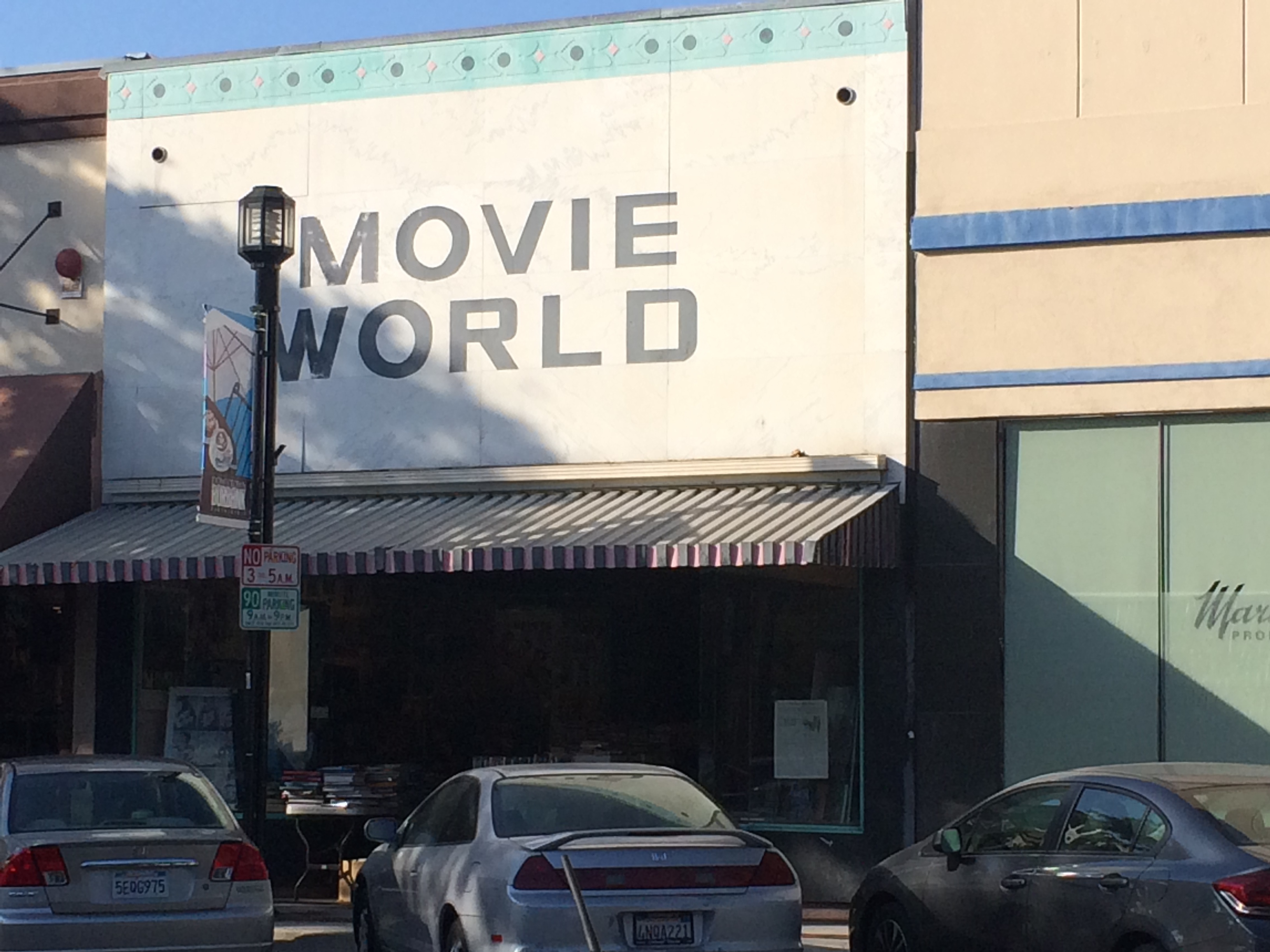
Metaphors can be a tool for building strong visual connections and entertain. I’ve thought often about this gem of a store that I found hidden in the most unlikely place. What follows is my attempt to bring to life the emotional links to a place worth visiting if you’re ever in downtown Burbank, CA.

Book Castle’s Movie World in Burbank, CA by John McCarthy

There was once a bright shiny kingdom where the homes and castle were pristine from the care by the townspeople. The farms resided along a river that sparkled at night and provided crisp cold water for crops and an abundance of fish to feed everyone. But one day an ogre ventured into the area. It devoured the crops, drained the river with it’s insatiable thirst, and gathered all the fish for it’s personal store. The townspeople pleaded for help, and the King’s son, a brave and well loved protector, rode from the castle on a great stead, and an army at his beck. At the ogre’s cave, half hidden by a garden of flowers and thick trees, the prince shouted,

“Monster, I challenge you to single–”

The ogre, stung by being called a monster, roared, “Combat!”

“No.” The prince was no fool. Fighting this gigantic monster would likely mean his own death. “I challenge you to a drinking contest. Winner gains all that you have stolen.” At the sweep of his arms, soldiers rolled forth two large casks.

The Ogre laughed. “I’ll not be tricked into drinking poisoned ale.” It thundered forward, swinging a mammoth club carved from some of the hardest oak.

“Ah monster, you wound my honor. I shall drink from both casks to prove that both are the same.” The prince quickly poured a cup from each, and with a flourish, drained both mugs.

The Ogre paused. It’d been long since he’d had such fare, and the victory was assured given his greater mass. “I accept, and after I’ve won I will grind your bones into my fish soup!”

The Ogre ripped a hole into one cask and drained it before the prince could finish his next cup. “I win.” The Ogre roared, before draining the other cask.

“As do I. You shall sleep deeply for a thousand years,” The prince said.

“But you drank it too.” The Ogre thumped to it’s knees.

“Aye. And I took the antidote before coming here. Now sleep without dreams,” the prince commanded. The Ogre fell forward, deeply asleep.

On exploring the cave, amidst the piles of bones from fish and beasts, the prince and his soldiers recovered the crops and found many hidden treasures that helped the kingdom recover.

. . .

Downtown Burbank is a trendy area with a mix of stores and restaurants ranging from trendy to local hangouts. Less than a 30-minute drive to downtown LA—depending on time of day and traffic—it reminds me of being the little sister to downtown Berkley where the museum quality space of Book, Inc. resides. Great weather for walks through a nice area. It’s a couple of blocks away from a mini-outdoor mall that is anchored by a Barnes and Noble (BN). BN maintains a standard spacious two story storefront with pristine shelves filled with the current titles across many genres, and the sound of the blender draws you to its café where you can get a drink and a snack, while reading from your literary selection. The real adventure is found several blocks away.

IMG_1802

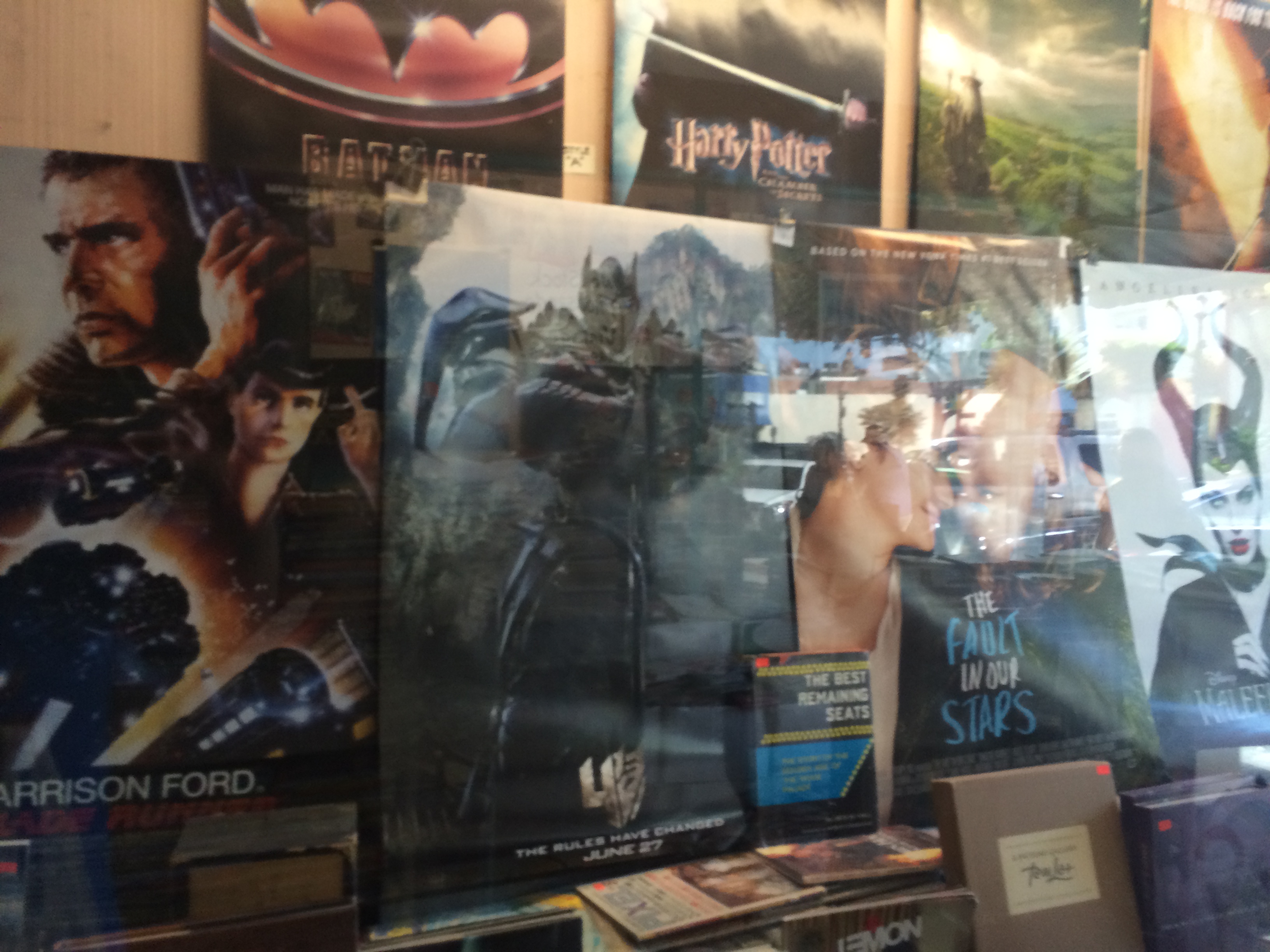
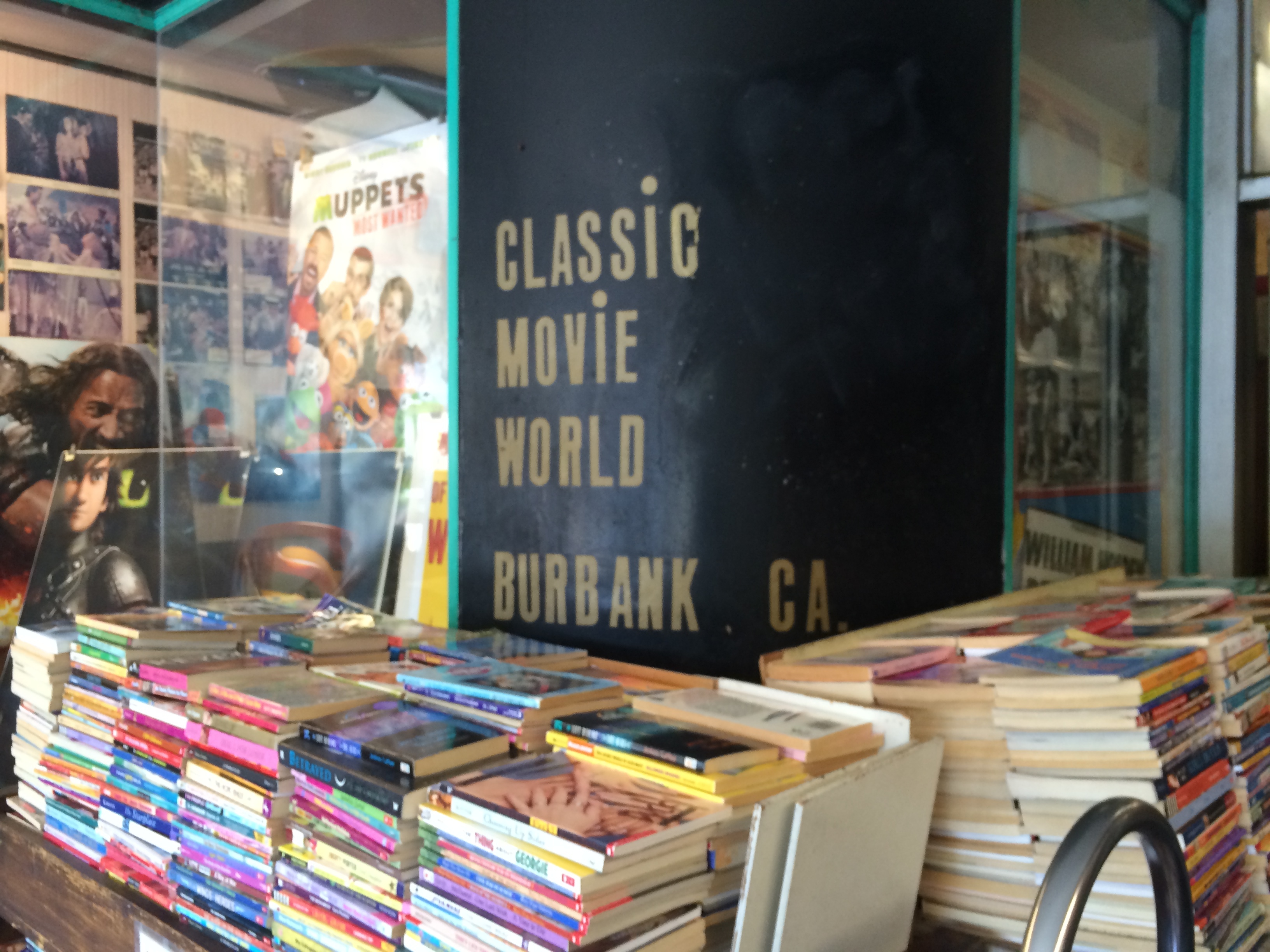
Almost hidden in plain sight is a dark space between two stores. From a distance it looks like a store that’s been closed, yet is cluttered with movie posters from an era of beta and vhs cassettes. A sign reads Movie World. Tables piled with books sit outside of the store like guardians of a dark cave that—in such a trendy neighborhood—draws one’s eyes away from the store like a magical protection ward that transmits the psychic message, “Pass this place by. There is nothing of interest for you.”

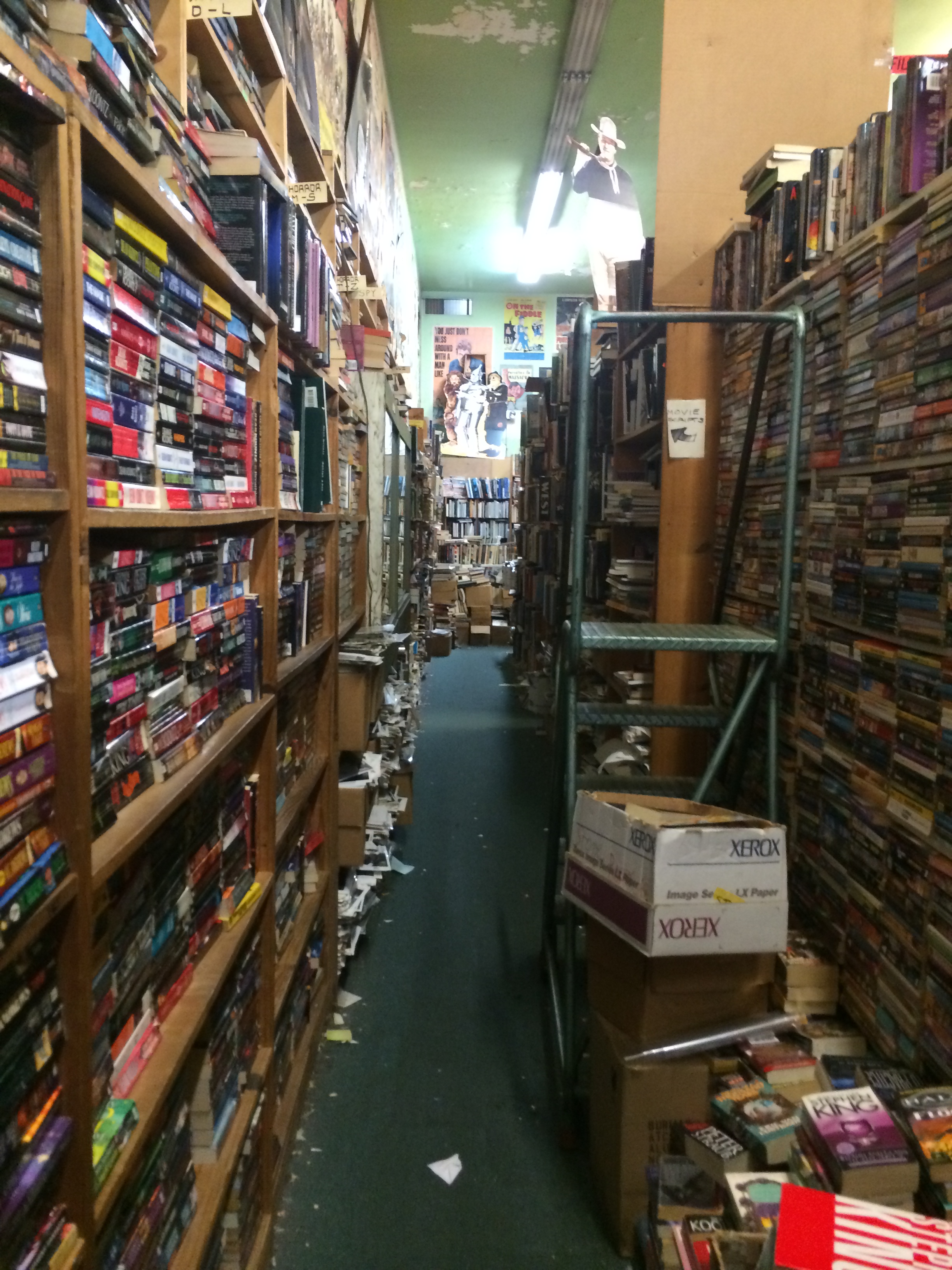
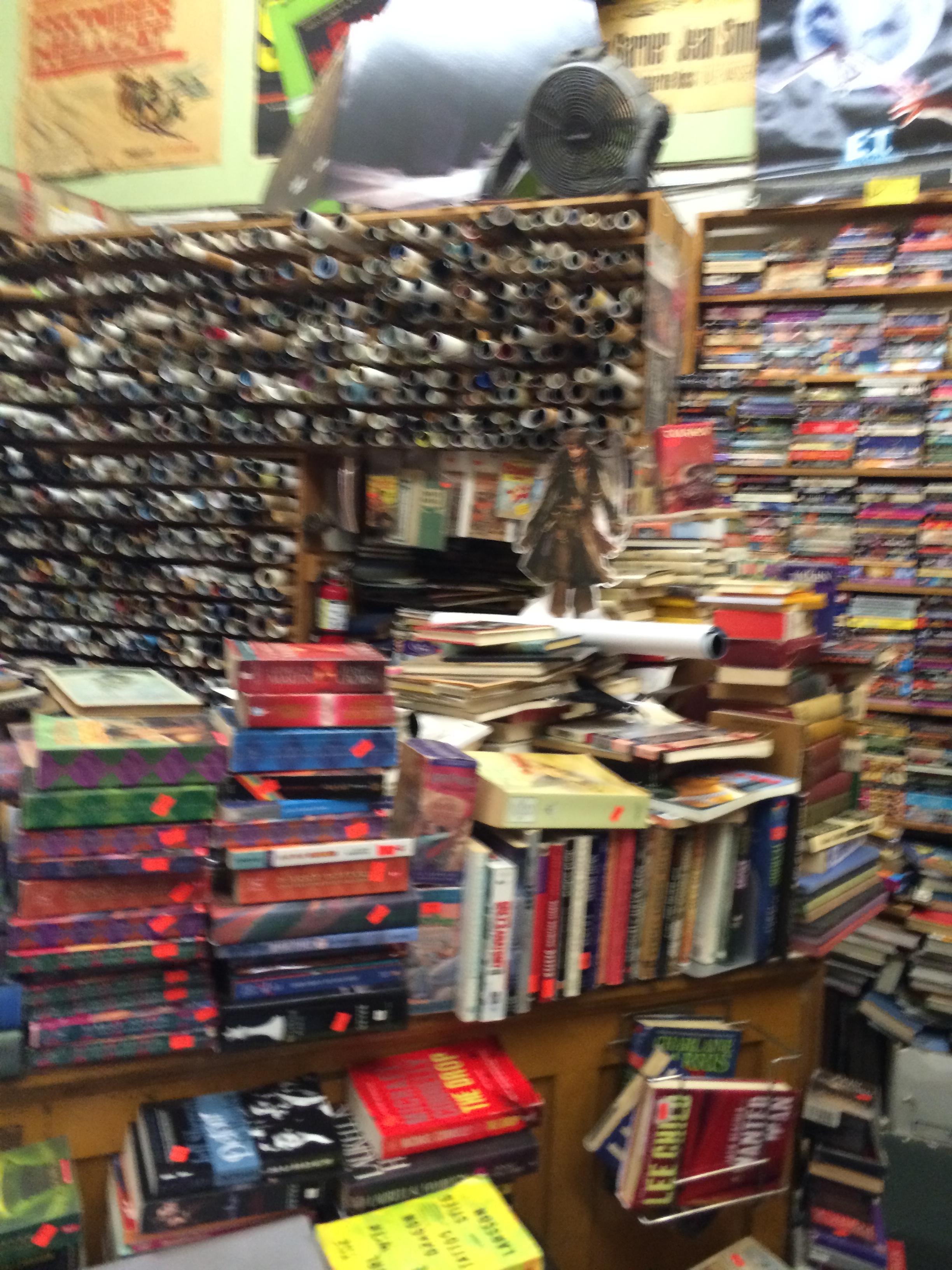
I ignored the warning and peered deeper into the shadows to find an open door where more books lay. Curiosity pulled me inside to find a world, vastly different from the outside. The ogre’s cave had tall bookshelves that carved narrow labyrinths to the back of the store space.  Like piles of bones left by the ogre, books are stacked on the floor and crammed into shelves, thus creating narrow paths to explore. All genres are present and grouped accordingly. The books are in good condition, despite the untidy piles and tightly packed shelves.

IMG_1792

It’s best to be like an archeologist who explores a past civilization than a treasure hunter. If you know what author or title you seek, you have a better chance of making great finds than to scan and hope to stumble on something special. There is simply too many books in a system that appears composed of random piles of books grouped by genres.

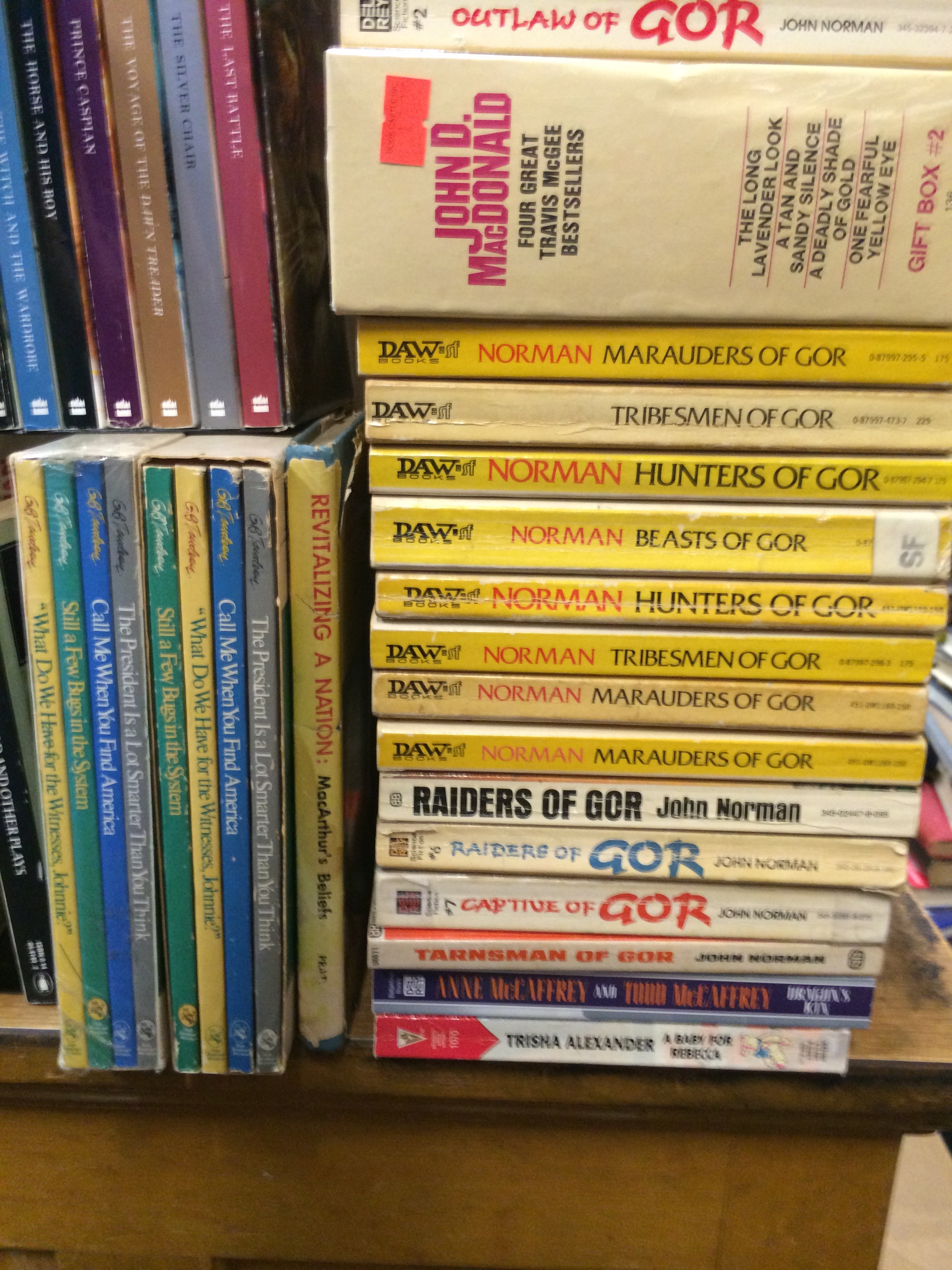
The smell of paper and bindings is strong, like the breath of the ogre—but lacks discomfort. Hunters of books in their earlier printings will make interesting discoveries, such as a boxed set of C.S. Lewis’ Chronicles of Narnia next to a stack of John Norman books from his Gor series, or many movie posters from movies that you may not have heard of before.

IMG_1795

There is much to find in Book Castle’s Movie World. If you can get past the Ogre’s magical ward, you’ll find treasures well worth the experience. But beware, the labyrinth of books and artifacts can suck you in for many hours, in which time, the Ogre could awaken.

2014-06-09 17.53.48 2014-06-09 17.37.24 IMG_1798

Curse-ive Writing

Have you ever been reading a book and been jarred by the use of a curse word?  While I believe that swearing is something to avoid as a matter of personal virtue, I understand the dramatic effect and occasional necessity to a storyline.  However, sometimes the use of curse words doesn’t fit with the story, or character, making it come across as more out of place than your maiden aunt in a mosh pit.

When deciding if a curse word is appropriate, try thinking about two things.  One is the background of the character.  For instance, how would the character’s mother react upon hearing her child swearing?  Would ‘conniption fit’ describe her as she got out a bar of soap to teach the kid a lesson?  If so, your character is not likely to use swear words easily, even as an adult, with the taste of Ivory soap lingering in his memory.  Is the mother not around or doesn’t she care what the child said?  In this case, it’s quite possible that using expletives has become second nature to your character.

The other thing to think about is the situation.  Even a character living with flashbacks of soap dinners can be in a circumstance where a curse word will slip out.  Someone pushed to an emotional breaking point can let loose words she never thought she could.

There’s a great scene in the movie Speed (1994, screenplay by Graham Yost) where you can see this playing out.  Keanu Reeves, as Officer Jack Traven, is hanging through an access panel of the floor of a bus to check out a bomb that could blow him and the passengers up if the vehicle falls below 50 miles per hour.  Alan Ruck is Stephens, a passenger using a cell phone to act as the relay for a conversation between Traven and another officer.  After describing several aspects of the bomb, Traven reacts with a phrase that includes the ‘F’ word.  Stephens’ reaction is hesitation and then to translate it as “Oh darn.”

Traven’s outburst is situational from seeing “enough C4 on this thing to put a hole in the world.”  In light of this, any resistance he may have to swearing has broken down.  On the other hand, Stephens doesn’t know about the C4 and hasn’t reached that point.  He grapples with repeating the phrase then settles for something more compatible with his state of mind.

As people ‘mind their manners’ in everyday life, it’s up to you as an author to mind the manners of your characters.  Making the dialog realistic to their temperament and situation is important when using curse words.  Considering the impact of these expressions, tread carefully.  Your character’s mother may be watching.