Category Archives: Nonfiction

All Love Is Created Equal

In 1958, Richard Loving drove his fiancé Mildred Jeter from their home in rural Central Point, Virginia to Washington, D.C. to get married. Then they returned to Virginia to live. A few weeks later, the county sheriff arrived in the middle of the night to arrest the couple for breaking the miscegenation laws.


Miscegenation, which is marriage or cohabitation between two people from different racial groups, was illegal in 24 states in 1958. Richard was white and Mildred was black. They were jailed even though Mildred was pregnant at the time. When brought to trial, they were given the option of spending one to five years in jail or accepting banishment from the state of Virginia for 25 years. They weren’t allowed to be in Virginia at the same time for the entire length of the banishment. They pled guilty and opted to leave for Washington, D.C. But when it was time for Mildred to have her baby, she returned to Virginia to be near her family for the delivery. Although it was illegal, Richard also returned with her.


Caught together in Virginia, they were arrested. The Lovings pled guilty to miscegenation and again were forced to leave town. They moved back to Washington, D.C. where they lived for several years and had two more children. But in 1963, Mildred wanting to return to Virginia, wrote a letter to Attorney General Robert F. Kennedy telling him of their situation. The soft-spoken couple was referred to the ACLU which led to Virginia court cases and appeals to decriminalize interracial marriage.


On March 18, 1966, the love story, not the court case, of Richard and Mildred Loving was depicted in Life Magazine in a photo essay titled, “The Crime of Being Married.”


After losing in Virginia, their case was brought before the United States Supreme Court. The couple opted not to attend the proceedings.


On April 10, 1967, their attorney, Bernard S. Cohen, presented the case to the Supreme Court adding Richard Loving’s statement, “Tell the judge that I love my wife.”


At that time there were still 16 states, all in the southeast quadrant of the United States, which prohibited marriage between a black person and a white person.


On June 12, 1967, the Court unanimously ruled that Virginia’s anti-miscegenation statute violated the Due Process Clause and the Equal Protection Clause of the Fourteenth Amendment. Chief Justice Earl Warren’s opinion held that “Marriage is one of the basic civil rights of man fundamental to our very existence and survival.” This landmark case permanently changed the history of the United States. Now marriage between members of any ethnic group can no longer be prohibited.


In spite of the vitriol over a 2013 Cheerios commercial depicting an interracial couple and their adorable biracial daughter, 87% of Americans approve of interracial marriages. Only 4% approved in 1958.

https://youtu.be/pbWeH9cztHw

Demographer, William Frey of the Brookings Institution said, “We’re becoming much more of an integrated, multiracial society.”

The documentary, “Loving Story,” depicting the lives of the Loving family, won the WGA Screenplay Award AFI Discovery Channel Silverdocs in 2011. Now the highly rated, poignant film, “Loving,” brings their love story to the big screen. The film recreated some of the scenes pictured in the Life Magazine article.


I give thanks to Richard and Mildred Loving for fighting so hard for their right to live as a married couple in their home state. Their selfless act changed our country in numerous ways and made it legal for me to enjoy the life I do with the man I love.

Summer Camp

I was administering vaccinations against cholera, black plague, and black fever as part of an annual active-duty deployment. It was a hot, July afternoon at Phelps Collins Air National Guard base west of Alpena, Michigan. Trained as an Operating Room Specialist in the United States Air Force, I was qualified to assist in major surgeries but was tired of giving shots to air-policemen, cooks, and pilots griping about worldwide deployment immunizations. Our 127th Tactical Reconnaissance Group needed world-wide disease protection and, for some reason, few guardsmen wanted major operations performed on them during a two-week summer camp.

Although our unit had never been called up, protection against cholera, black plague, and black fever might be less useful in an Alpena bar but might be a good idea in a remote mid-east desert village. After being on my feet all day, I was ready for dinner in the base chow-hall but I was the one last to leave, still awaiting my replacement.  Without any other hospital personnel there, the Phelps Collins siren began wailing in the distance, signaling an emergency on the flight line.

Months earlier, between giving shots and helping with physical examinations, I had learned to drive the big blue hospital “deuce-and-a-quarter”, a truck-based military ambulance, so I ran outside to drive or ride if someone was already in the seat. But no one was there. I jumped in the driver’s seat, started the engine, flicked the military radio on, and pointed the vehicle toward the flight-line waiting for a doctor to appear. I wasn’t supposed to arrive on the tarmac without a doctor, but an airplane was in trouble and we had to have medical personnel there within a few minutes of the siren sounding.


After what seemed an eternity, Doc Cooper and our Senior Master Sergeant, Joe, burst through the infirmary door, bags and hats flying. They managed to jump in and I gunned the engine, dropped the clutch, and took off. Others were running to catch us but the only one that counted was Doc Cooper and they knew it. My feet danced on the pedals, power-shifting through the gears. With our siren screaming and red light flashing, base traffic dove for the side of the road.


 “What’s happening?” Doc yelled, hanging onto the window sill with both hands. The engine roared as we skidded onto the last road toward the hangars and apron tarmac.


“I hope it’s not one of our 84’s” I yelled back. They both knew I meant our 127th TAC reconnaissance RF84F Thunderstreak single-seat airplanes. The 127th had lost one a few years before and a pilot had perished. We certainly didn’t need another incident.


I slammed the shift lever back and forth and the pine trees flew past, but I managed to stay on the blacktop, finally roaring toward the base tower. There were two “Mantis” fire rigs already moving at a good clip on the taxi-way. These huge, self-contained, fire-suppression machines were small houses on wheels with elevated foam-dispensers on their fronts like over-sized, pincer-wielding praying mantises. Two more huge fire engines emerged with lights blazing from a nearby hangar. The radio was mostly static until we heard an order from Phelps Collin’s tower.


“Ambulance, proceed north 200 yards and pull alongside the first fire engine. Await further orders.”


We rolled to a stop beside the first fire rig adorned with sweating, black-clad fire fighters clinging to its sides. There was nothing to see or out of the ordinary; no black clouds, roaring flames, or mounds of airplane wreckage. We took a collective deep breath and worried about what was going to happen next. A fireman near us said there might be an emergency landing about to happen. Curious onlookers drifted out of the dining hall hundreds of yards away. An Operations Officer trotted over.


“All of our jets have returned for the day, including the C47 Gooney Bird. But there’s a Cessna 310 about ten minutes out that’s in trouble. Someone flying from Ann Arbor to Mackinaw Island says the nose landing gear light won’t indicate whether it’s up or down. We’re the closest airstrip with equipment to handle something like this, so he’s thinking of setting it down on the grass beside the concrete runway gear up. If he changes his mind and tries to land on the concrete, he’ll be a sliding fire-ball in no time. Stick around. If he doesn’t get it right, you’ll have to pick up what’s left.”


Joe worried for us. “You know, landing a prop airplane gear up on grass or concrete is a last resort for any pilot. He can’t eject, and it’s doubtful he has a parachute or could bail out anyway. The grass is bumpy on both sides of the runway. He’ll have to cut power on both engines in the last seconds before the belly hits the grass and hope the propellers stop level with the wings. If either one isn’t, it’ll catch on the ground and spin him into a flaming, 100-mile-an hour funeral pyre.”


We stared at a cloudless blue sky, the air-base siren dying away, only increasing the tension. Everyone craned skyward searching for a 310 Cessna. Doc Cooper suddenly sat upright, concerned. “Forget propellers. Assuming he’ll try gear up, if one of the three wheels only partially deploys, it’ll snag and the plane will cart-wheel the length of the runway. Did anyone say whether there are passengers? You know, I don’t think he can dump excessive fuel in flight.” He paused. “We may not be set up to handle this from a medical stand point.”


Everyone was wishing they were somewhere else and not in a catastrophe in the making. The moment the Cessna touched grass, gear up without power, it would be an out-of-control, 2-1/2 ton aluminum beer can, filled with high-octane aviation fuel. At that point, pilot and passengers would be in a thrill ride and in even greater trouble if a fuel line ripped off or a gas tank split because fire rigs need time to arrive at the scene.


A tiny dot appeared in the distance and an airplane came into view to begin circling the field a mile out. Base tower and pilot discussed alternatives until the sleek twin-engine Cessna suddenly altered its path, lining up with the main concrete runway. Joe squinted, commenting, “Look, he’s coming in low and slow for a trial pass, testing the wind and low air speed handling.”


The pilot flew the plane slowly, much closer to ground than normal, landing gear up, checking grass conditions and undulations on our side of the main runway. We were all quiet, fascinated by the inevitable. Doc Cooper fingered his medical kit. I wondered whether we would need tourniquets, compresses, and splints. But we didn’t have oxygen, back braces, or even body-bags. How would we handle internal bleeding, closed head-wounds, open arteries, much less horrible burns on site? Alpena’s hospital and Oscoda’s Wurtsmith Air Base were a long way off.


The Cessna circled a last time before lining up with the grass next to the concrete runway, main landing gear and nose gear retracted. So it would be grass. With minimum power, skimming grass-height at 100 mph, the pilot shut off both engines and the propellers stopped safely horizontally with the plane sinking to earth. Out of its element, the 310 was no longer a flying machine but an uncontrollable sliding machine ill-suited for its new job. Rudder and tail surfaces no longer effective, it slid past us into the distance in a haze of dust and grass.


Before it came to a graceful stop a quarter-mile away, I gunned the ambulance engine, following the fire rigs at a safe distance. Nothing seemed to have flown off the airplane or broken apart and no fire balls erupted from split fuel lines or tanks. In the distance, the tiny figure of a pilot opened the hatch, clambered out, and sat on the wing waiting for our emergency vehicles. There didn’t seem to be any passengers.


It all ended quickly. The praying mantises arrived and crouched, ready to unleash their enormous foam cannons at the first sign of fire, but nothing happened except the plane sat smoking and tinkling from cooling metal. Doc Cooper clambered out and performed a brief examination of the pilot, whose only injury seemed to be hurt feelings. The Cessna sat in the grass at the end of runway like a discarded child’s toy.


I needed a drink, but the Phelps Collins enlisted men’s bar didn’t open for hours.


A Writer Gives Thanks

2016-11-picWith the hustle and bustle of the holiday season ramping up, I’m taking a break from writing short stories this month. Instead, in honor of Thanksgiving, I’m sharing my list (in no particular order) of people and things for which I’m thankful, from my writer’s point of view:

  • All my teachers from grade school through college who found a way to encourage and inspire me to write. They taught me the fundamentals I use to this day.
  • My editor Kelly Bixby. Her passion for grammar and the written word keeps pushing me to improve my writing.
  • Deadwood Writers Voices as a forum for sharing my work. Having this commitment gives me a regular deadline to meet so I actually produce something.
  • Everyone who reads my writing on DWV as well as people who leave comments. You help me know someone is out there participating in my experience.
  • Grace Black and Ink In Thirds magazine for publishing one of my poems in the October 2016 issue. It’s a powerful feeling to hear the word “accepted” instead of “rejected.”
  • My cat Calder. He makes writing not so solitary, especially when he thinks my fingers—typing on the keyboard—are toys to bite or swat at with his paws.
  • The physical therapists who are getting my shoulder back into shape. Typing and using the mouse for long periods of time is still a challenge, but my stamina is increasing.
  • The Deadwood Writers critique group. Your support, friendship, feedback, and encouragement are invaluable.

HAPPY THANKSGIVING!

Coffee Shop Chronicles: Coffee, books and the end of an era

img_7200Borders Bookstore

Canton, MI

April 2011

I came here because I have a coupon.

The coupon is for 33% off one item or 20% off your entire purchase.  I’m upstairs sampling the vanilla bean loaf, and there’s this weird aftertaste.  The black tea is helping only so much.  I’m glad I have a peanut butter sandwich with me.  It’s not gourmet breakfast, but I do feel like a queen as I look over the café railing down upon the bookstore.

It’s 9 o’clock on a Saturday, and it’s a bustling morning.  I stood at the door as the store opened, and now I’m in my favorite seat here, a table along the railing.

I think, dream and wonder…why do I have only one coupon?  I want to walk out with the whole bookstore.  Right now, I want one particular book.  I’ll go tease myself and see if the paperback is out yet.  The vanilla loaf taste is still hanging on my tongue anyway.

Tongue.  Teeth.  Fangs.  Vampire fangs.  Vlad the vampire.

I’m into Young Adult books, but I don’t like hardbacks.  Hardbacks are heavy to carry and you can’t fold the covers back to make it comfortable in your hands.  I got sucked into this vampire series by…oh, I don’t recall how or who introduced me to it.  The first book was in paperback, I know that, and maybe the smiley vampire face on the cover caught my eye.  I’ve read eighth grade through eleventh grade, but Vlad’s senior year is still a mystery.  It hasn’t been a year yet–the standard time between hardback release and paperbacks–but a girl can hope and think, dream and wonder.

I walk instinctively to the right side of the store and look under “B” for Brewer.  My eyes jump from bookend to bookend, shelf by shelf.  Hardback–hardback–hardback–paperback.  There it is!  Paperback!  Tucked at the edge of the shelf, hidden in the shadows of overhead lights, is The Chronicles of Vladimir Tod: Twelfth Grade Kills.

I grab it and drop it on the floor.  I’m so excited I can’t even hold it!  I dash over to my husband who wanders the CD racks, of course.

“Oh, this trip was so worth it!” I say.  I have waited so long.  I smile, I gleam, I may even be glowing.

How many more times will I feel like this?

How many more times will I be this excited about a book series–so excited!–so excited for a paperback because it’s cheaper and lighter and more flexible than a hardback?  How many more times will I be able to walk into a bookstore, pick up a book made of paper and walk out with my treasure?

A purchase.

The glisten of a glossy cover.  The ruffle of pages flipping through them.  The smudgy fingerprints in margins from cheap ink.  The triumph of finding what you want.  To leave with the treasure.

There’s joy of being able to flip through a book for a sample; through the entire book, not just some random chapter.  In fact, by doing this now, I find another YA novel to buy.  That book is here but more expensive at $9.99.  I’ll wait for another coupon.

An actual purchase.  Even the smell.  I pull it up to my nose, to make sure.  There’s that musty, raw dusty smell.  Yes.  The delicious anticipation.  Page One awaits.

With the dying brick-n-mortar stores going the way of the Dodo, I will probably not have many more moments like this.

I walk by the shelves one more time to relive the glorious moment.  It’s the only paperback there.  Or it was.  It’s mine now.

Vlad is $8.99.  I use the coupon, but I would have bought it without one.

Even the receipt is a bookmark.


Dead Rising: Not Your Typical Zombie Game

The video game franchises of Fallout and Resident Evil are among my all-time favorites, but they are far from the only series I absolutely love.  I would say that what I enjoy most about story-driven video games is that they offer a departure from everyday conventional life.  My adventures have ranged from uniting a dozen different alien races to combat a common threat (the Mass Effect trilogy), battling dragons, giants, and other fantasy medieval beasts while trying to prevent the end of the world (Skyrim), and finding that manipulating the fabric of time comes with a steep price (Life is Strange).

Yet there are very few video games that offer an escape from reality to the extent that the Dead Rising series does.

My first experience with this series was with the first Dead Rising for the WII system.  While that version is “watered down” and doesn’t have the same amount of content as its Xbox 360 counterpart, it is still a very enjoyable game. The basic scenario is that photojournalist Frank West gets a tip that strange events taking place in a small Colorado town called Willamette.  He has a friend transport him inside the town by helicopter to avoid the military barricades on the ground.  When some army copters show up to chase him and his pilot out, Frank jumps onto the roof of Willamette’s shopping mall rather than lose the chance for a possible award-winning story.

Upon making it down to one of the main entrances for the mall, Frank discovers a group of survivors building a barricade to keep a horde of zombies from getting in. This plan quickly fails when one batty old woman spots her beloved poodle outside and opens the doors in an attempt to rescue her pet.  How she managed this with the other survivors failing to stop her is anyone’s guess.  Frank is one of the few people to escape the zombie swarm and make it to the mall’s security office before the door is welded shut by a surviving guard.

jeanettedeadwood-2016-11nov-photo

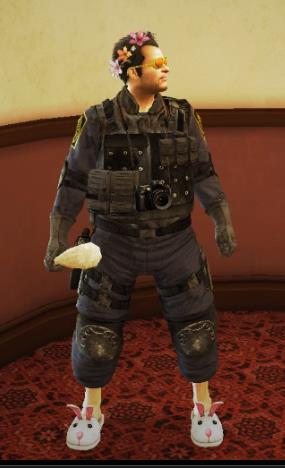
My favorite ensemble for Frank in
Dead Rising 2: Off the Record

The remainder of the game entails Frank using an air duct to get back out into the mall to rescue stray survivors, battle zombies and the occasional psychopath (more on that later), and uncover the truth of what started the epidemic, or strange events, plaguing Willamette. And that’s where the real fun begins.

The primary thing that sets Dead Rising apart from other zombie apocalypse games is that the game’s emphasis is on making the overall experience more comedic than horrific.  Aside from the clothing to change into and food needed to replenish health, any object that can be picked up by Frank can be used as a weapon, however unconventional.  This includes — but is not limited to – guns, wooden benches, sledgehammers, trash cans, cash registers, mannequins, hangers, and a stack of CDs.

Another element that adds to the overall fun factor is that Frank can swap his own clothes for one of the many outfits available throughout the mall. The player even has the option to have him wear a woman’s dress or a banana hammock while running around killing zombies.

The third staple of the game and of the series in general, is that the player must also face off against certain people labeled psychopaths. For the most part, this means either people who are using the outbreak as an excuse to engage in criminal activity or ordinary civilians who don’t cope well with the end of the world as they know it.  Most of them also add to the humor element present in the game.  My personal favorite is the supermarket manager encountered early on.

While Frank escapes Willamette in the best possible ending out of multiple conclusions, the military fails to keep the epidemic from spilling out into the world. And that’s where the setup for the second game comes in. Dead Rising 2 takes place in the fictitious Fortune City, an area consisting largely of casinos and shopping centers.  Fortune City also capitalizes on the epidemic by making zombie killing a spectator sport in a gladiator-type arena.  A new outbreak occurs when someone deliberately sets loose the zombies to be used in the fights from confinement.

The most interesting thing about Dead Rising 2 is that there are two separate versions of it, each existing as its own game.  This one introduces a down-on-his-luck motocross rider named Chuck Greene as the hero.  The other, a spinoff subtitled Off the Record, sees the return of Frank as the lead protagonist.  There are so many differences between the two that each tells a story unique to Chuck or Frank.  One thing that remains the same is that each protagonist strives to expose the mastermind behind the outbreak and bring him or her to justice.

Dead Rising 2 retains all the elements that made its predecessor so humorous, but also embellishes on them. There are three times as many objects to use as a weapon than those present in the first game. And two objects can now be combined to create a more carnage-inducing, often wacky means of killing zombies, with the exception of the beer hat.

In my opinion, the psychopaths encountered in the second game are even more comical than those in the original. My personal favorite is Carl Schiff, the postal worker who is determined to deliver the mail even in light of the outbreak.  His dialogue is dependent on if one is playing as Chuck or Frank, but both encounters are equally entertaining.

Dead Rising 3 brings the overall story full circle by tying up loose ends from the first and second games. The protagonist this time is a young mechanic named Nick Ramos who finds himself at the center of yet another outbreak.  Nick discovers that he may hold the key to eradicating the zombie epidemic once and for all.

Like Frank and Chuck before him, Nick can change into any outfit present in the game. While Dead Rising 3 ups the fun factor by eliminating the need to create combo weapons at workbenches and introducing combo vehicles, it lacks humor in one area.  I know I’m not alone based on reviews I’ve read find Dead Rising 3 psychopaths more off-putting than entertaining.  There are fewer of them in this game, and most are made to represent one of the seven deadly sins.  Suffice to say, the one for gluttony is particularly nasty.

The other downside, as with the first two games, is that the player is racing the clock. To get the best possible ending, the mystery behind the outbreak must be solved within a set amount of time.  As much as I love the series, the games don’t allow for much wandering to your heart’s content without getting a “game over.”  And with the ending of the third game having such finality about it, this seemed to be it for the franchise.

I recently heard news of a fourth game due out in December 2016, and I couldn’t be more excited. From what I’ve read, Dead Rising 4 will breathe new life into the series, no pun intended.  Frank is set to return as the main character, and the franchise is literally going back to its roots.  The action will take place in a rebuilt shopping mall in Willamette, introduce a new breed of zombies unrelated to the ones featured in the original trilogy, and will for once ditch the timer.  The notion of having all the time in the world to explore the environment while solving the mystery at the core of the story has me anxious to begin playing this game.

As long as it retains or surpasses the hilariousness that the franchise is most famous for, all the better.