Category Archives: Nonfiction

Coffee Shop Chronicles: Playing Games

Tuscan Cafe
Northville, MI

It really does come down to games, Dominos or not.

This afternoon is my writing time. I’m sitting at a table against the wall under the lamp shade so I have light to type by. I just finished two Americanos, light on steamed milk. The first Americano had a smidge of gingerbread syrup to spice up the holiday season, and the second was just straight up. You’d think I was a serious coffee drinker, but, really, I’m just a novice who latched onto some impressive-sounding coffee name. I feel like I belong here.
2016-1Jan-TucsonCafe-DeadwoodCoffeePic

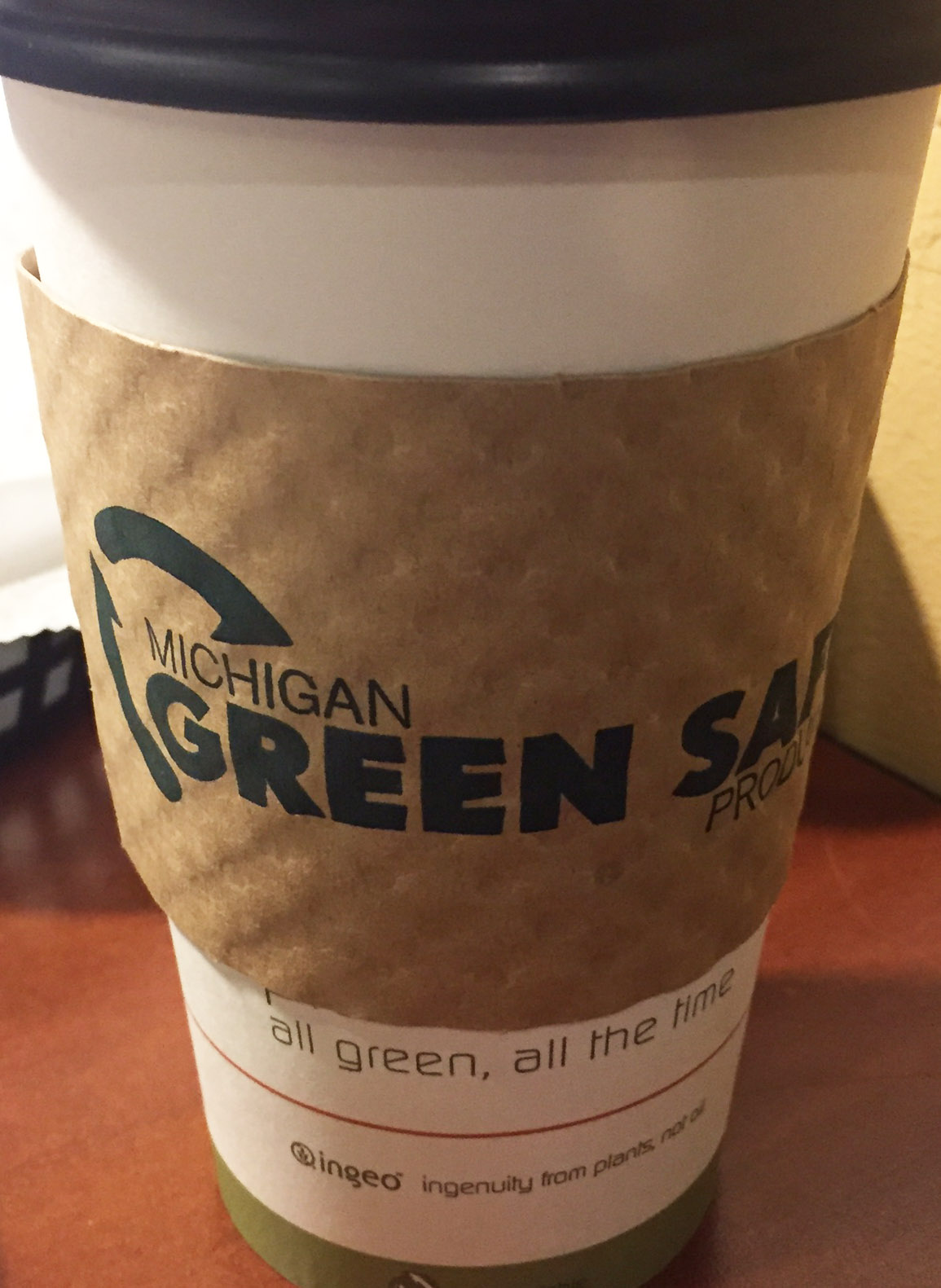
Tuscan Cafe: environmentally friendly

I’m gathering my laptop and notebook to leave when a guy and a boy walk in and sit at the small circular table by the window. From what I overhear, he seems to be a Big Brother to the 13-year-old 8th grader.

I’ve got plenty of room on my rectangular table for everything I have, so I stop packing up and pull out my journal to record the moment.

BB leans forward and asks, “How’s the relationship with you and your brothers?” That’s what makes me think Big Brother in the first place. That and the time is now 3:30pm, which is just after school.

I overhear BB say he likes that the boy plays Minecraft, that “…it’s a game that requires you to work as a team.” I don’t know the game, but I feel like I should. I’ve heard it enough in pop culture media. Note to self: look that up.

Now BB teaches the boy how to play Dominos. This is significant because last night I watched my Season 2 DVD set of Major Crimes. The last episode I saw is what I call the Lost Horizons episode. Tim Conway plays the episode’s main character, Howard. In one scene, he flirts with the female lead, Capt. Raydor, mentioning Dominos.

Howard: “I could teach you to play Dominos, but I, uh, don’t have my Dominos with me.”

Capt. Raydor: “I already know how to play Dominos.”

Howard: “I bet you do.”

At the same time, in another room, Lt. Provenza questions someone else who talks about Dominos.

Provenza says, “It always comes down to Dominos.”

So here I am, watching BB teach the boy to play. I don’t know how to play Dominos, actually. I know how to match numbers but not the rules of scoring. I also know how to stack them in a row so they all fall down. Who plays Dominos?

I half listen as I write and half watch without trying to stare directly at them. I want to hear BB explain how to play. The big window gives me an excuse to look in that direction. If we accidentally make eye contact, I can glance over at the bike chained to the tree or the church across the street or the cars driving by on Center Street. I could even turn my head to the left and stare at the long, roomy wooden table that divides the coffee shop into thirds.

2016-1Jan-TucsonCafe-DeadwoodCoffeePic-MiracleYahtzee

Coffee drinks and games: together time

My husband and I play games in coffee shops, usually Yahtzee in various Starbucks. It’s a Travel Yahtzee game we, ironically, bought at Starbucks a few years ago when they promoted toys and activities among their products. We have Travel Scrabble from that time, and we’ve bought other portable games through the years. These are our “date nights” because we get out of the house, spend time together and drink coffee. A long table like that one would be roomy, but distant. We choose cozy tables like this one I’m at or the one the guys are sitting at now.

I miss any Dominos explanation over the mellow music playing overhead, but the discussion of games continues. BB: “I wasn’t good at Tetris when I was young.” Now I have a frame of reference of the guy’s age. He’s a child of the 80s.

Then BB asks: “Is that coffee making you tired?”

Boy: “Yeah.”

Thirteen years old and introduced to coffee. That’s our society today.

BB and boy wrap up their visit and pack up the chunky white tiles into a snap-close metal box. I never hear how to play Dominos, but the game box looks like it was the original BB had as a younger guy.

I’ve seen some people play games in coffee shops. Last week, at Miracle Coffee, two women had a pile of board games, they looked old, worn and well-loved. Gathering their games up when we arrived, they saw us pull out our Travel Yahtzee. We all got talking about board games. They may have mentioned that there is a Triple Yahtzee game out there, a game I vaguely remember, like maybe I had it as a kid. Maybe I still have it. I’ll look through my childhood toy box in the basement.

Classic board games have become “the thing” these days. The box designs look retro, but they’re all too new, looking fake. I believe in using authentic items. In scrapbooking, I use the real photo, scan a copy if it’s precious and irreplaceable. In mixed media art, I incorporate real tickets, tea bag tags, and cancelled stamps. Because of this, I prefer original game boxes that hold the authentic game.

Games are a good thing, old or new, especially if they bring us together.

My Fair Share of the Green Flash

I’m not sure when it was that I first heard about the phenomenon of the green flash. I don’t remember when I first looked for it. I just know that I’ve been looking for years.

Throughout my lifetime of chasing sunsets, I never spotted a bright green glow rise above the setting sun. Dozens, maybe hundreds, of times I planted myself on a shoreline at dusk. My feet sifted the sand between my toes. I faced the horizon and watched the sun drop below the surface of the earth in the exact spot where the ocean met the sky. There, I admired a dramatic display of light as the sun and sky swirled clouds and blended colors together before resting for the night. Never did I see the end of a day punctuated with an exclamatory pop of green.

It was as if the celestial wonder was determined to hide from me. I began to doubt its very existence. I surmised that, even if it was real, catching a glimpse of the green flash at sunset was as unlikely an experience as viewing Halley’s Comet.

In 2007, Disney writers spun Caribbean lore to their advantage when they presented an explanation for the elusive sighting in Pirates of the Caribbean: At World’s End. Onboard a pirate ship and navigating a crew to Davy Jones’ Locker—the Underworld—Captain Barbossa asked deckhand, Gibbs, “[Have you] ever gazed upon the green flash?”

Gibbs began a dramatic response: “I reckon I’ve seen my fair share. Happens on rare occasion; the last glimpse of sunset, a green flash shoots up into the sky. Some go their whole lives without ever seeing it. Some claim to have seen it who ain’t. And some say—”

“It signals when a soul comes back to this world, from the dead!” crewman Pintel interrupted Gibbs and finished the statement.

Impressive storytelling, I thought upon hearing those lines, but I recognized the clever manipulation amongst them. Writers and producers had already created a fictitious world in which cursed men were unable to die and at least one mangy pirate looked strangely attractive. Why not suspend belief further by breathing life into something else that wasn’t real? I was now convinced that the green flash was just a myth.

KellyDeadwood-2016-1Jan-7320

My family and I stare too soon at the setting sun.

In March of 2015, I met a Caribbean woman who perpetuated the legend. Relatives and I spent one of our vacation days in Nevis. We waited for a ferry to take us back to St. Kitts where we had rented a condo for a week. The gatekeeper at the dock in early evening was the same person who braided tourists’ hair on the beach during the heat of the day. We didn’t recognize her, but rather she—quite observant and well acquainted with the comings and goings of visitors—noticed us.

Her name was Sweet Pea, and she created goodwill by meeting and greeting island guests. Among her favorites, I found out, were Kelly Ripa and her daughter, Lola. Sweet Pea had braided Lola’s hair, of course.

While my family and I talked with Sweet Pea, the night sky started to poke the sun downward. Our host became excited and told us to watch the horizon for the green flash. I had to look away from her for a moment in order to hide my smirk. I also couldn’t let her see me rolling my eyes in disbelief of this touristy tale.

KellyDeadwood-2016-1Jan-7323

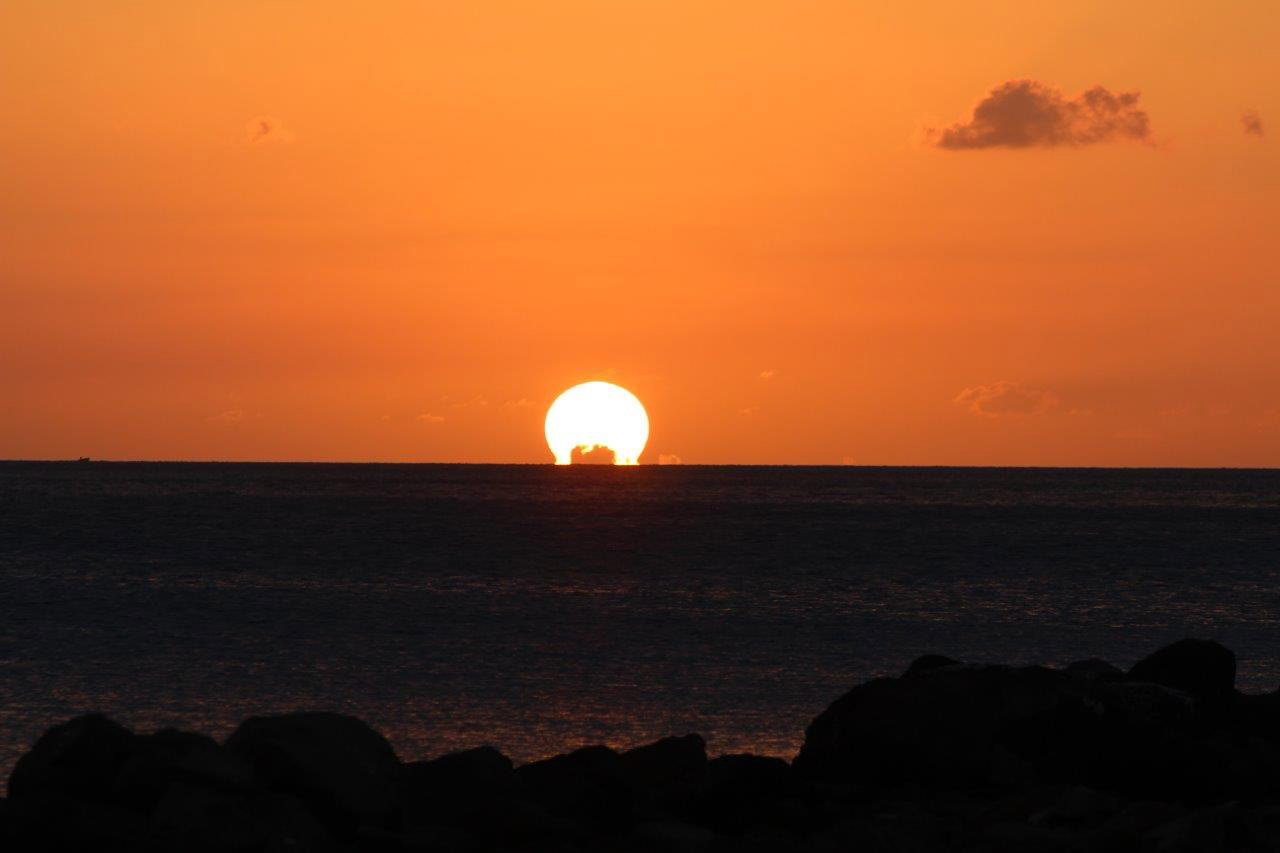
A cloud moves in just as the sun is starting to widen at its base.

The sun continued to lose its commanding presence in the night sky. As if embarrassed by its decreasing status, the sun found a place to hide. It slipped behind a ship that had been docked and abandoned sometime long-ago in the tiny port. For sure now, we wouldn’t be seeing the green flash—or fabricating an impressive story of having seen it.

Sweet Pea didn’t give up. She urged my husband to hurry and make his way to the stationary ship for a better look. “Climb to the highest spot you can! Quickly! You don’t want to miss it!” She was insistent, so off my husband, Greg, ran with his camera in hand. I turned to my in-laws and dismissed the nonsense. “It’s just a myth,” I said. Sure enough, Greg came back without having seen a green flash in the distant horizon.

That night, we returned to our condo and researched this supposed phenomenon. Some of us just couldn’t let it go. That’s when I learned that I was wrong. Physicists, airplane pilots, NASA scientists, and layman all have something credible to say about green flashes. My family and I were intrigued to hunt again.

Two nights later, we packed our cameras and a telescopic lens and drove to a nearby beach. For awhile, it hurt to look at the setting sun, which meant we shouldn’t be doing that just yet. The sun needed to sink further down before it couldn’t damage our eyesight, but no one wanted to miss seeing the green flash. We continued stealing peeks.

KellyDeadwood-2016-1Jan-7331Original

A green tinge is beginning to form along the outer edges of the oblong-shaped sun as it sets below the horizon.

With precision, each of us gazed as the sun settled. A cruise ship passed by. A cloud rolled in. A small boat skirted off to the south. While all those others seemed disinterested, we were riveted and hopeful. The sun sunk lower and lower. It touched the surface of the water and continued sinking.

The perfectly round shape became more and more oblong, but tinier and tinier. In the next instance, the oblong image completely separated from and hovered over the ocean.

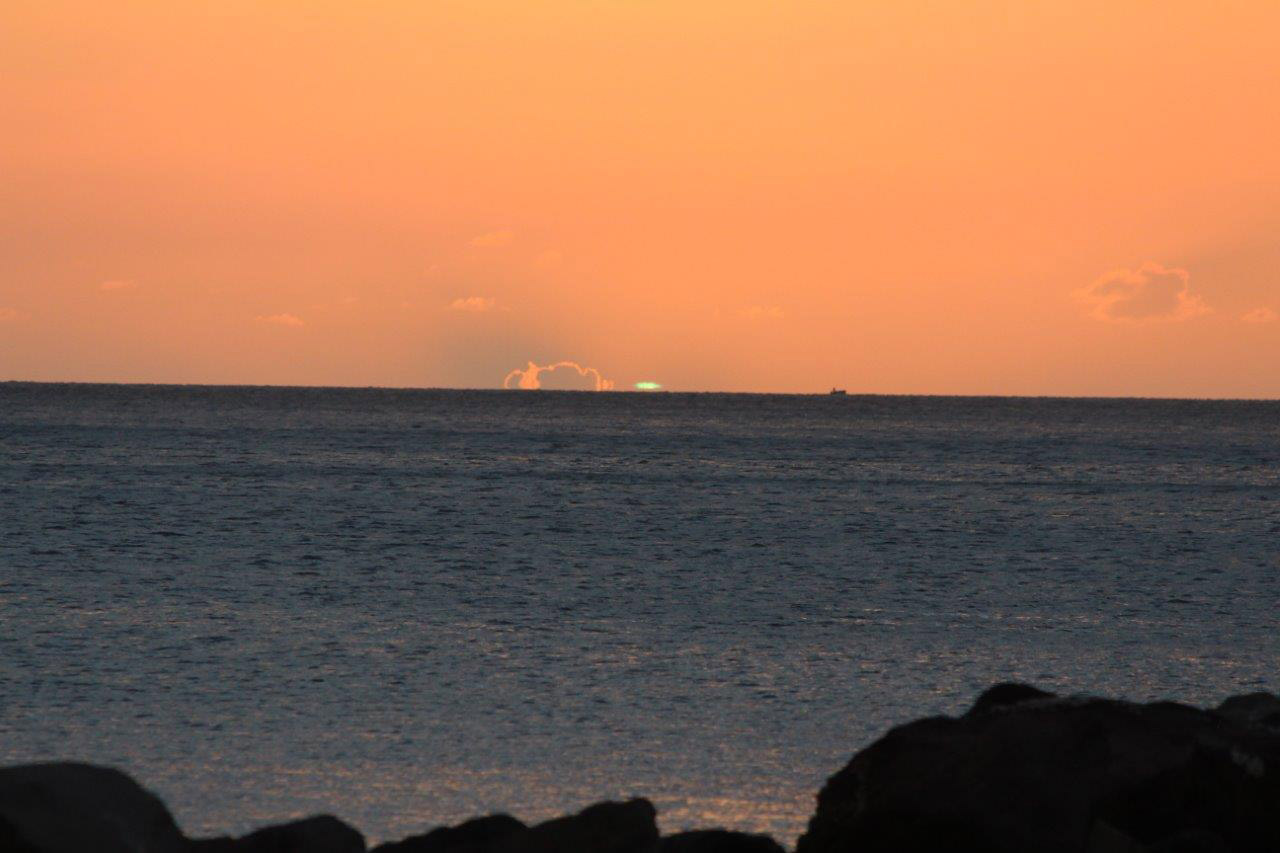
We were rewarded for our renewed faith. We saw a green bubble, an oval of light, a dot in the exclamation point that marked “The End!” of our search.
.
.

KellyDeadwood-2016-1Jan-7339

The marvelous green flash appears off the coast of St. Kitts, March 20, 2015. Photograph, Greg Bixby

The green flash appeared and disappeared almost immediately—less than a second or two, as we expected from our research. Greg’s timing was just right. He captured the moment in pictures!

My disbelief had turned to awe in two short days. It seemed as if true belief was a prerequisite to finding it.

I never expected to see it again.

Just seven months later, I had fun telling a golf partner about it while we finished a round at Torrey Pines in San Diego. I shared my story as the sun was quickly setting. My new friend had never heard of the green flash, so I told her to carefully watch the sun itself in its final performance of the day. Our husbands moved ahead of us, while we two ladies paused to look out over the ocean. This time there were no cameras to capture the sighting, but our hooting and hollering announced our thrill of seeing it.

I don’t know if I’ll ever be lucky enough to see the green flash for a third time, but I’ll forever be chasing sunsets in search of it. If I’m really blessed, I may even spot the epic blue flash.

Learn more about the green flash at astronomer Andrew T. Young’s page: www-rohan.sdsu.edu/~aty.

World Neighbors

Attachment-1

This year marked a first for me. I learned about a major event happening in another country via Twitter instead of from a television or radio news announcement. Getting the information on my phone, less than an hour after the crisis started, made me realize how fast world news reaches us today. Compare that to a catastrophe occurring a hundred years ago. For example, if an earthquake hit a remote region of China in 1915, it wasn’t likely that anyone outside of that country would hear about it. The news might not have even made it out of the impacted region.

When bad news travelled slowly or not at all, it was easier to feel comfortable that all was well. Tragic events happening close to home were usually few and far between, which if you think about it is actually still the case. What’s different is that every world event can come into our homes at amazing speed. An earthquake in one country, a terrorist attack in another, drought on another continent—we may hear it all in a single newscast. At best, it’s unsettling. At worst, it depresses a person’s spirit.

We are now world neighbors. There’s no escaping the fact. And we need to start living and thinking that way. In some ways we have, such as when we donate to relief efforts. In other ways we haven’t. You can find plenty of examples of people being bad neighbors in much of the politically charged rhetoric being espoused today.

Technology and economics made us neighbors. I believe it can help us become good neighbors and even friends. Technology makes it conceivable that my wish at the end of this blog could actually reach people worldwide. It’s a hope. It’s a start.

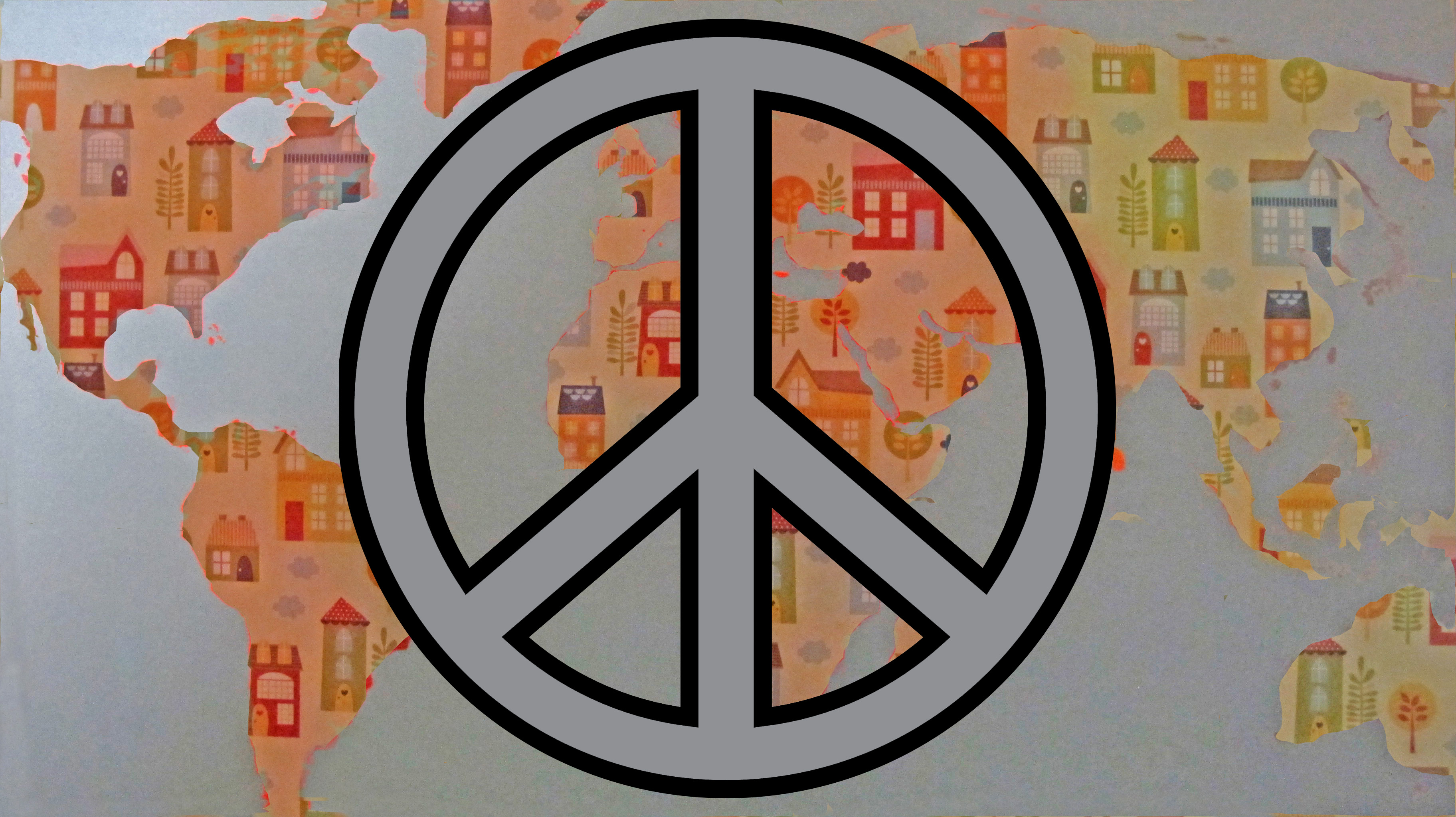
To my world neighbors, as we end this year and begin a new one, I wish you peace, goodwill, and safety for all our days together on this planet Earth.

Giving…Thanks…

20150412_002

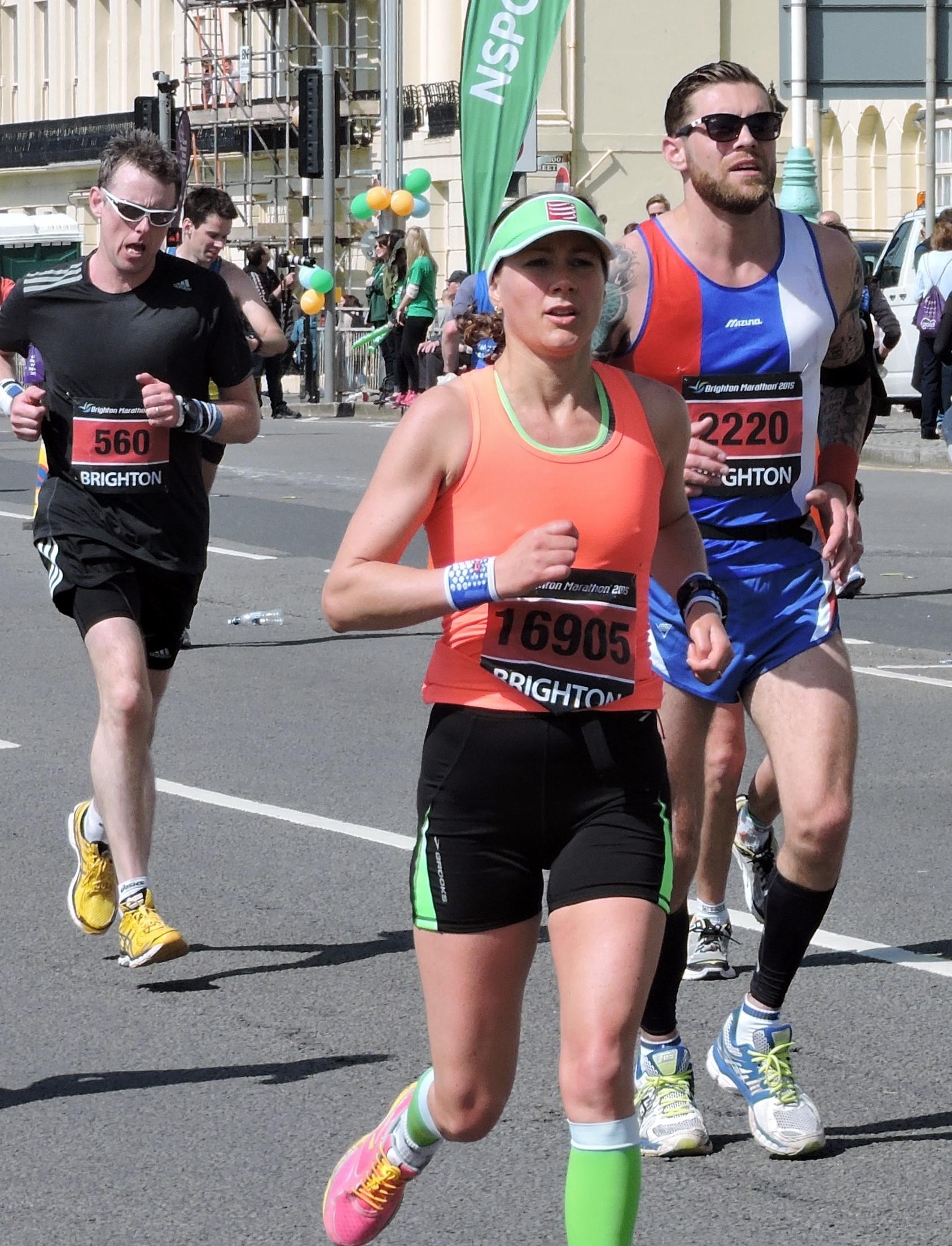
On Thanksgiving morning, I rose early on a rainy and cold day for a 5k race. My daughter arranges the volunteering that she and I do for several years. We’ve run in road races, but during warmer seasons.

Each year, we’re assigned a spot on the running route to give our water or point runners towards a turn. It’s two hours of standing in the cold, yet the time flies. As runners pass, we shout encouragement:

“Good job!”

“Great running!”

“You’re doing great!”

“Way to go!”

“You can do it!”

Many runners pass by, without seeming to hear. But I know that they do, having been in their running shoes. When running in these events, it means a lot to me to hear people calling out encouragement. Strangers who I don’t know, and who may very well not be shouting to me—it does not matter. I am energized and appreciative. So I call out encouragement even when it seems that I’m talking to myself. I believe that the runners hunger for it. Some runners grunt acknowledgement, something that I do, and others do express gratitude.

20150412_014

The last third of the participants walk the course. We cheer them with just as much enthusiasm as for the frontrunners. There is no judgment or value placed on pacing. They are all outside on a cold and rainy day—participating.

This event reminds me of the value of giving thanks, not just at a race or when we gather later with our families to celebrate Thanksgiving. Showing appreciation is a simple act that represents the act of giving of ourselves to others.

December is a time of giving. Cynics would say that it’s a time of spending money and shopping for stuff. They might go further to say that December is the opposite of giving. These cynics are right. Unless…

We can choose to act with recognition of the opportunities to show appreciation through our interactions. For example, thanking a sales clerk when they complete a sale for us shows appreciation of their efforts. If you are working with a customer, saying thanks or have a great day—matters. Even knowing that such responses are most likely the result of store training, it’s still nice to hear. So lets all do our part.

Saying “thank you” is a gift of giving, as are other expressions of appreciation and encouragement. Let’s embrace this season to give thanks everyday to someone. Such practice for 31 days could engrain such actions into our normal practice that it extends into the new year. That’s a gift worth giving.


Wordplay: My Geek Is Showing

I failed my children by not pushing them further in studying spelling and vocabulary. One of my sons, a senior in high school, said to me that he just doesn’t know very many words. His limited repertoire made writing essays for his college applications a difficult and grueling process. Writing never came easily to him.

In contrast, I’ve always loved penning my thoughts and studying the mechanics of grammar, selecting the right words to convey my meaning. I love playing Boggle and Scrabble, and I look forward to quizzing myself with Reader’s Digest’s “Word Power.” I stop myself from giving my son too much writing advice because it’s important that he express his own thoughts in his own way. In looking back at the differences in our educations, I have an idea of why he struggles more than I do.

My elementary and junior high schools encouraged participation in spelling bees. I spent hours on rote memorization with the help of my patient mom. She read pages full of words out loud to me, one word at a time. I never once thought to ask her what the origin of an unfamiliar word was, but today’s top spelling bee contestants frequently make use of that rather sophisticated technique. If I had known there was more to studying spelling than memorization, I might not have lost first place to Kathy Trotter in the sixth grade. I didn’t know how to spell curry. Rote memorization only got me so far. Fortunately, I wasn’t competing for a college scholarship. The short-term goal was simply praise, a dictionary, and a trophy. The lifetime benefit was that I became a good speller.

KellyDeadwood-2015-11Nov-ToiletTreesList

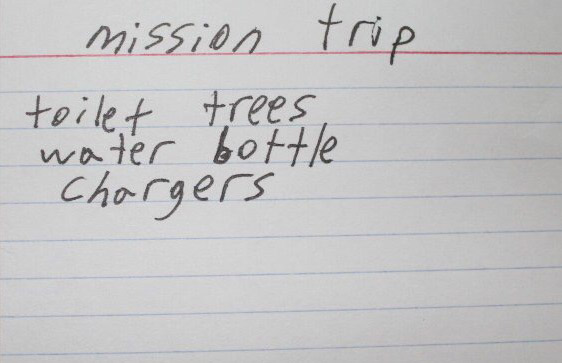
Spelling and vocabulary matter: I had to let my son know that toiletries would be easier to pack.

Sixth grade for my children was a different experience. Their spelling words were taken from their own journal entries. The children were tested on words which they individually used in their own writing exercises. I understood the practicality of holding students responsible for using self-selected words correctly. But I wanted a bigger challenge for my kids. How would they learn new and unfamiliar words and to expand their knowledge of language?

I reminded myself that teachers aren’t solely or primarily responsible for our children’s educations. As parents, we need to instruct and guide. To complement my children’s elementary school lessons, I developed a game that I thought would challenge them and be fun for our entire family.

During one week, I randomly selected a word each day from our two-volume dictionary. By the end of the week, we all had to know how to spell the seven chosen words and combine them into one sentence. The sentence could be longer than seven words, but it had to reflect correct usage and meaning. Essentially, the family and I studied a word a day—similar in scope to what Merriam-Webster currently offers online—but my game involved the added challenge I was seeking.

So that you can see how this game worked, I’m going to borrow the seven “Word of The Day” selections which Merriam-Webster promoted from October 29 – November 4, 2015. First, we have to consider the definitions of the words. The list below is taken verbatim from www.merriam-webster.com.

Pellucid: admitting maximum passage of light without diffusion or distortion; reflecting light evenly from all surfaces; easy to understand

Underwhelm: to fail to impress or stimulate

Ebullient: boiling, agitated; having or showing liveliness and enthusiasm; exuberant

Microburst: a violent short-lived localized downdraft that creates extreme wind shears at low altitudes and is usually associated with thunderstorms

Ruddy: having a healthy reddish color; red, reddish

Confidant: one to whom secrets are entrusted; especially: an intimate friend

Trepid:  timorous, fearful

Now comes the hard part: we have to consider those definitions in anticipation of using the seven words to construct one sentence. Here’s my solution to the puzzle:

My ruddy confidant was caught in a microburst which left her so trepid that, when she couldn’t describe the situation in a pellucid manner, I was underwhelmed, despite her apparently ebullient experience.

KellyDeadwood-2015-11Nov-KellyMemeThanksgiving

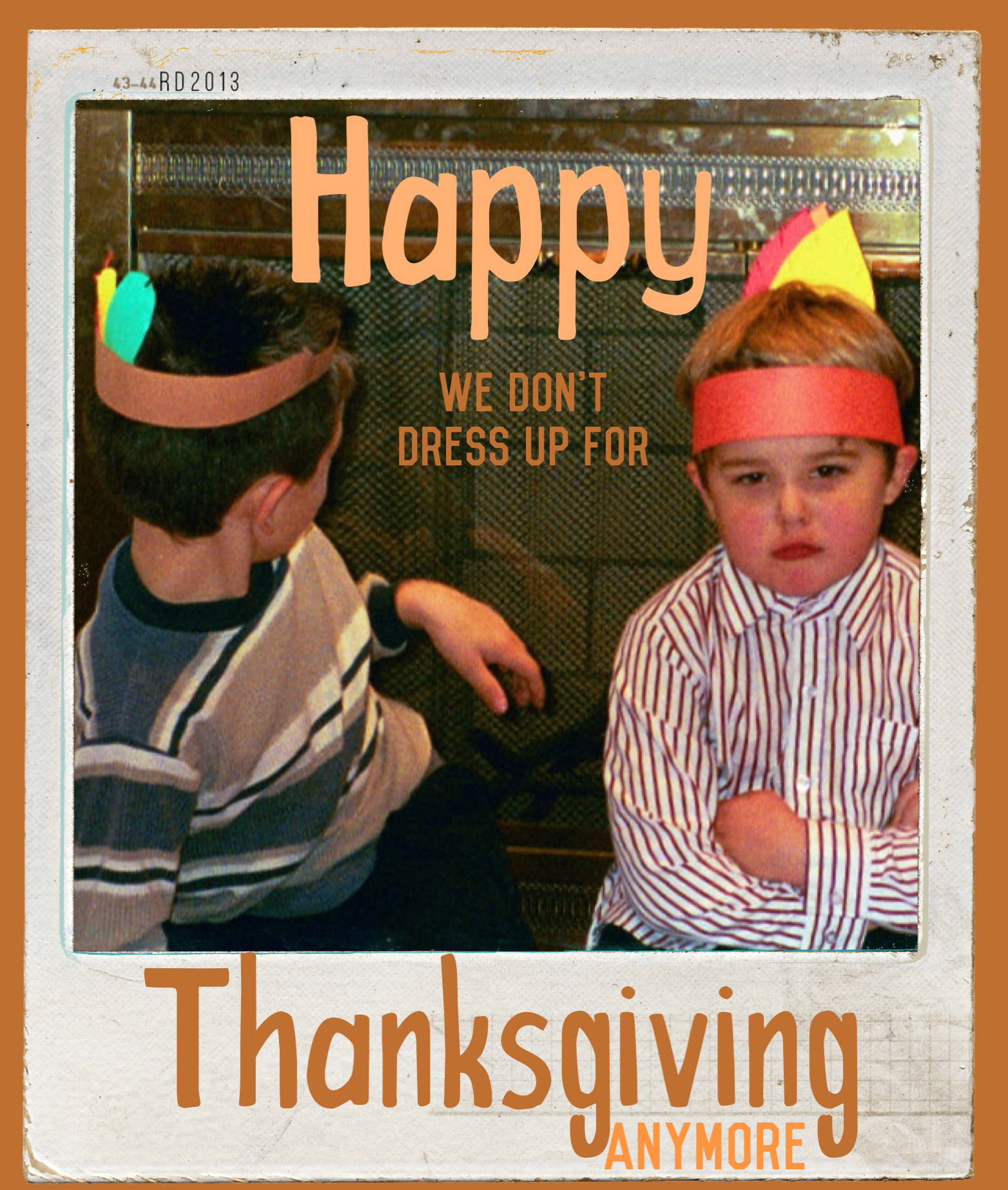
If I wanted to break the rules of grammar when creating this meme, I would have written Happy Givingthanks.

.
Sadly, my kids never really enjoyed the game as much as I did, and it was quickly forgotten. But thank goodness, they now have smart phones and can share highly entertaining, often grammatically incorrect, internet memes with one another. If only people like my kids understood the rules before they broke them.