Category Archives: -Diana Hirsch

How do you choose a writing journal?

Just like magic wands, a journal must choose you.

As a child, I expressed my deepest thoughts, heartbreak and angst in various hardcover journals, college-ruled notebooks and at least one Dear Diary with a metal lock. Did you pour your heart out in a journal? I still journal, but not as much as I used to. I wish I could say that’s because I have no adult angst, but I can’t lie. To make sure I carve the time out to reflect on myself, “journaling more often” is one of my New Year’s Non-Resolutions I committed to with my writers group.

My old journal ended today after five months of use. In my younger days, I could’ve blown through that purse-size, 4”x6” journal in less than two months. And in my younger days, I would never have used such a small book. Regardless, I need a new journal.

I have a collection of journals ready for words waiting for me on my bookshelf upstairs. Too many, one might say, but I hold an emotional attachment. Besides, can you ever have enough journals, whatever the style?
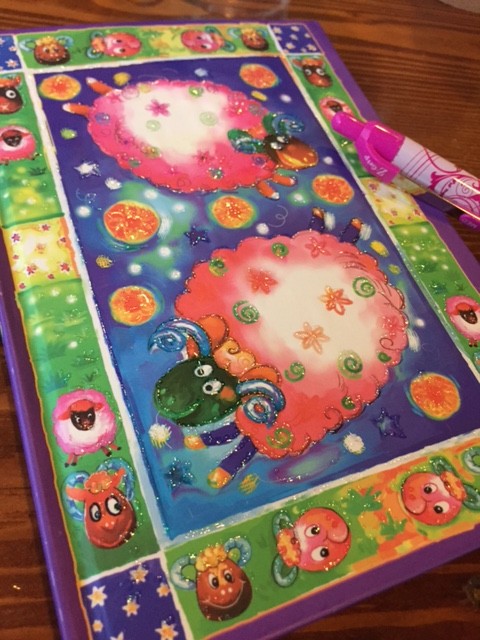
Dancing space sheep swirl around me, complete with glitter and memories.

Dancing space sheep swirl around me, complete with glitter and memories.

As I slide my hand down the row, examining each spine and shape, I think about reducing my stack. Here’s an opportunity to donate old journals I no longer enjoy writing in, either by size or style, and toss out ones with bad karma. I’m thinking of a specific one given to me by an ex-boyfriend’s mother, but I may have used it already. I don’t recall what it looks like when a bright purple spine pops out at me. Friendly bubble letters beckon me with one word: Journal. I pull it off the shelf and cradle it in my hand, staring at the cover. At least 30 seconds pass before I figure out that the abstract glittery shapes are sheep floating in space. It’s rather trippy.

Each white, lined page of the 5×7″ book is bordered with a quilt-like pattern of muted mauve hearts and stars. Sometimes I prefer pages with lines to keep my sentences straight and even, and other times, wide-open blank pages inspire me. Sometimes I like to write on bright white to show a pen’s true color, while other times my eyes want a muted tan or yellow page. This portable, lined, white-page journal in my hands seems fine to me. The psychedelic cover makes me weirdly happy. Now to flip to the inside cover and see if I made any notes about the journal’s date or where it came from.

Karma’s a bitch.

This journal was a birthday gift 15 years ago from a friend I no longer talk to, mailed to me at a previous job that was absolutely vile.

This is the kind of karma I was talking about, so I set it aside, not even putting it back on the shelf. There are plenty of other journals here. A leather dragon-covered book is too heavy. One large notebook has a handmade cover with buttons on it, a good memory of the person who made it for me, but a bit awkward for my needs right now. I don’t want this other one with a wooden cover. That blue Moleskine is too small. The ring binding on another is too big. Nothing fits my mood except the funky sheep journal.

This empty journal is scrawled with memories. I taped the original mailing label inside the front cover, which is why I know from where it was mailed. Just seeing the company name brings back stomach-churning memories of the underpaid job with the stuffy upstairs office where I worked. I remember the two sloppy mistakes I made that make me feel uncomfortable and stupid to this day, and the disrespectful ex-boyfriend I worked with who constantly yelled insults at me.

During that time, I had my friend, that lovely woman who knew me well enough to know I’d enjoy a fun-looking journal, perhaps a dollar store find, and mail it to me at work to brighten my day. Even today, I recognize her thick, curvy handwriting from the numerous letters we mailed each other. We met during one of my most unique summer jobs. And for reasons I don’t recall now, we immediately became friends. I took my first trip to Walt Disney World with her and a friend. She and I took a road trip to Salem, Massachusetts one Halloween weekend. The last good memory I have with her is bouncing on her friend’s outdoor trampoline on the afternoon my boyfriend-now-husband called to tell me he bought a new car, the car we still drive today.

She and I lived about seven hours away. I only saw her when I drove home to see my parents, and even then, I didn’t always have the time for the extra 2-hour drive. This one weekend, however, I was home for a long weekend and my Sunday was completely open. We could meet halfway and catch up in person, so I called her.

“I can’t,” she said. “I watch football with my boyfriend on Sundays.”

I never knew her to be a sports fan, but I was a far-away friend in town for the day. “What’s it going to hurt, taking one afternoon off?” I asked.

“I can’t. We watch football on Sundays.”

I understood that sports aspect with guys; my boyfriend-now-husband watched college football on Saturdays. He liked it when I watched the games with him, but if I wasn’t there one weekend–like this weekend I was currently away for–his life didn’t end and we didn’t break up. I’ll be there to watch games with him weekend, but I will not be within driving distance of my friend next weekend.

“Not just this one Sunday?” I asked her, hearing my voice rise in a pleading tone.

“We watch the game together,” she replied.

I never met her boyfriend, but I got the sense he was a demanding man.

Maybe it was just my imagination, but my friend was always independent. If she hadn’t been dating him, I was sure she’d make the time to see me. I told her how hurt I was, how I thought he might be controlling and I was saying that because I was looking out for her, as a friend should, but in the end, I lost the argument. We spoke once or twice on the phone after that, but she stopped returning my calls. I lost my friend.

I was surprised to receive a sympathy card from her when my dad died. She must have been on the overall distribution list when I emailed the news out. That was a nice gesture, really touching, but I didn’t know what to say, where to begin again. I don’t recall mailing a reply to her.

Now this journal calls me. I don’t know why. Does the journal want me to fill it with good memories, turning something positive out of a bad memory? Is its purpose to just fill the pages and “git ‘er done” and out of my life? Does my journal want some closure for me? Some reminder of better times, or is it a nudge to do something more?

All I know is that the two floating cosmic sheep make me smile, and I have to choose this as my next journal. Maybe with a wave of a metaphysical wand, I’ll figure this out by the end of the journal. Or maybe the last page will be just a last page.

Do You (Still) Read Books?

When is the last time you read a book?

My answer to that question is: late February.  But my real answer should be: I don’t read enough.  And that’s a sad thing for a writer.

I talk a lot about the way we wrote as kids, just for the fun of it, no expectations, just playing with words.  I should also be dancing with books, traveling through other worlds to experience the words of others.  I should be reading not necessarily to learn from or to study with an eye towards technique, but really, just to pass the time.

“Should” is an evil, passive excuse of a word.  Anything that “should” be done “needs” to be done.  That is so much easier to say than do because there is so much more in the world to do.

Welcome to the world of social media.  We pass our time with heads buried in our phones or tablets, getting neck cramps from looking down too much, missing the scenery we ride by and not hearing the people around us.  Given that, who wants to carry a book when you’ve got hundreds downloaded onto your Kindle or Nook app?  Further frustration:  who wants to open those apps when you can have the three-star-rush of Angry Birds or discovering five new Pinterest recipes for banana nut bread?

The world of electronic gadgets and the bright shiny oooooooh of it all do suck me in.  I don’t spend my time reading books.  That makes me sad, but I don’t see myself changing my routine.

The most recent book I finished was a memoir recommended to me.  I bought it—a physical copy—because that person said, it sounded like the type of memoir I was writing.  I bought it to study and learn from it, the story being a secondary aspect.  It turns out that the approach worked for me; the story was not a great one and I didn’t connect with the character, but there were lines of brilliant emotion that struck my heart.  I wonder: would I have bought that book just off a bookshelf, physical store or otherwise, if I didn’t have that writing connection to it?

I’m writing this in a Starbucks, and what a twist of coincidence just now.  I overhear a conversation between two women where one says, “Have you read the latest James Patterson novel?”  I’m pausing to listen.  The music’s loud enough and the women are far enough away that I’m only hearing snippets.  “He has a team of writers.”  “He’s always on top of it.”  “It’s always a mystery story.”  “Reading Wall Street Journal,” at which point I think the discussion has moved on to other topics.

I am thrilled to hear this conversation.  Angled towards each other, these women are still a community of two.  What are they doing?  I have to get a closer look.  I’m a terrible judge of age, but they look the age of people who still prefer reading paperbacks.  Do they have a roughed-up paperback between them?  That’d be so cool.  I tell myself I need to sweeten my coffee more, so I shuffle by and peer over their shoulders.  They’re both looking down at large smartphones or small tablets.  I am actually disappointed.  I tell myself that regardless where or how they read it, they read it.  Together.

They’re doing more than I am.

Months ago, I made reading a priority and set goals for the year.  I contributed my part to my writers group’s list of our New Year’s Writing Non-Resolutions.  You can read everyone’s lists here. One of my non-resolutions is what I think is an achievable reading goal for me.

As a writer, I feel a need to be more involved on Goodreads, so I updated my pathetically outdated account.  I enrolled in the 2015 Reading Challenge.  The number of books that I think is achievable for me is…well, check it out here and form your own opinion.

My list of books “currently reading” or “want to read” include two that people want me to review and/or critique.  Now I’m a reviewer.  Now I’m reading with a purpose, an obligation.  It’s more like a job.

When was the last time I wandered a bookstore with the intention of finding a book to read for selfish pleasure?  I don’t know.  I really don’t know.  There’s a lack of bookstores in my part of southeast Michigan.  There are two Barnes and Noble bookstores located a short drive from me.  There is one nice local independent store of new and used books, and then there’s one junky, cluttered used bookstore.  There’s a fabulous large used bookstore on the edge of Detroit, but it’s just far enough away for me to think of it as out of the way.  Nice excuses soothing my guilty conscience.

I guess I should stop making excuses for not reading.

Insta-success with Instagram

Twitter is stupid, and Instagram is for people who can’t read.”–Max, 2 Broke Girls

I always think of that quote when I mention Instagram to others.  Instagram is a social site for sharing snapshots.  If you don’t like imagetaking pictures, this post won’t be for you, but you should read to the end just to make sure.

As a writer, or any business owner, you need to find social media platforms that work for you and your desired end goals.  The sites need to be ones that you will maintain and that are fun for you.  I think Facebook is a big time-suck with algorithms that don’t let me see the feeds of everyone I want to in the order that I want to.  Still, I have a Facebook Author Page that I modestly keep up with.  I have discovered informative people through Twitter and it seems to be popular for writers.  It’s hard to keep up with the news feed some days, but there’s some good interaction with my tweets.

What about Instagram?  I’m a scrapbooker and, by default, take hundreds of photos every month.  I’m surprised it took me so long to find the value in Instagram.  My first two photos posted the week of June 10-16, 2012 (138 weeks ago) when I was just playing around with some filters on my first smartphone.  They were pictures of teddy bears.  I didn’t know what else to do with it, so I trailed off and lost interest.  I picked it up again the week of February 2-7, 2014 (53 weeks ago, or just over a year) as an outlet to showcase my writing, initially my haiku poetry.  Now I use Instagram for my writing and…well, stop on over and check out my photos at @dwhirsch.

I use Instagram as a marketing tool as much as a social experience.  I don’t pretend to know everything about Instagram.  I read information from bloggers who have done the research, such as @jenns_trends, who is a goddess on Insta-information.  What I’m offering is my personal experiences and successes adapting those tools.

To use Instagram effectively, you have to decide what you plan to share.  This can change over time, but start with some initial rules.  My guidelines are the same ones I have for my personal blog.  I never post pictures of friends or family without first getting their consent.  I don’t post photos of my house because I have “location services” turned on my phone.  I don’t want people to know where not to find me when I’m out of town.  There’s nothing valuable, explicit, religious, political, controversial or anything my dad–were he still alive–would be disappointed to read about me.

image

Instagram is Insta-easy to use, and the site’s features are relatively uncomplicated and obsessively playful.  It’s free to set up, and I recommend you snag your profile information now: create your Name (generally your real name or business) and Username (what you’ll be known @as). Photos are posted in a square, and most smartphones have a “square” option in the camera settings. If not, or if a square cuts off some important part of your photo, there are many free apps that will shrink your photo and place a border around it. To post, just upload a photo or 15-second video that you take live or have stored in your smartphone library. You can alter your media with black-and-white, sepia or color filters, with additional tools to adjust the image’s brightness, contrast or saturation level.  Finish it off with a frame or vignette, add a caption and press Share.

Now that you’re live, how do people find you?  Your 153-character bio, along with your photo’s caption, and hashtags need to be creative, potent and relevant.  Going back to Max’s quote comparing Twitter and Instagram, the latter is not restricted to 140 characters.  Your photo or video should tell a complete story, but you can use about 440 words to explain that image. This comment section is vital because you can tell your story and highlight your image using crucial hashtags.

Instagram is hashtag heaven. People with similar interests will find you based on how you tag your images.  Common hashtags reflect those you find on Twitter, but you don’t have to be familiar with Twitter to use Instagram.  Think about what your picture is about and tag your image with common terms.  As a snapshot in the moment, you can showcase a twisted #tree branch, a royal #sunset, a #selfie in your awesome new #shirt, an art exhibit or the #bananabread you’re baking.  You’ll get a feel for tags once you start using them.  Tags have no spaces and use just alphabet characters with no suggestions, so type in exactly what you’re looking for.  Much like Twitter lists, you can also create hashtags to group your own images in a somewhat folder design.  Some of mine include #iamapoetess, #SnuffletFinse and #Champsp. Be sure to check out this group’s posts, which are under the same hashtag as on Twitter: #dwriters.

The Explore tab complements tags by suggesting people to follow based on tags you use, images you’ve ‘Liked’ and people or companies that your followers follow.

image

Oh, yes, companies use this.  Instagram is a successful marketing tool, a highly-used space to display products from #clothing to #cosmetics. Check out companies like @Bathandbodyworks, @Ford and @Applebees.

I sometimes stage my work because I want my followers to see the best of me.  I give my followers a peek into my writing, #Zentangle art and my overall creative process while infusing my quirky personality and personal interests.  Think about it: if I follow a particular author, I feel more connected to the “person” rather than to the “celebrity.”  Therefore, I’ve taken my book cover image and overlaid a part of a review on top of it.  I type up actual text from my latest #shortstory or #poetry.  Photo editing can be fun.

Given my goals, I show images of blue-inked-up work as I edit my current draft.  I show the #coffee shops where I #amwriting. I show the stages of my Zentangle #wip so people can see my creation from start to finish. I have too much fun with it on the go not to let it be organic.

Remember, social media is social. I share my work and myself because like Max on #twobrokegirls, the experience on Instagram is more social. I comment more than I Like because the image doesn’t always grab me but the story in the caption section does.
image When someone takes the time to comment on my work, I respond to every–and I mean every!–comment made to me even if that person replied with a smiley face emoji.  I appreciate the time that person spent appreciating me, similarly the gratitude when I receive a #bookreview on #Amazon or #Goodreads.  If nothing else, I reply “Thank you.”  People like you when you like them.

What are the benefits?  The most important is meeting people with similar interests.  I’m reading a #memoir recommended by a follower who is #writing her own memoir. I’m inspired by new #art and #painting techniques.  I’ve been challenged to take pictures in #blackandwhite.  I could meet any number of them for #coffee if I was in their area.  I have a connection to these people. You can do the same with your peers and have fun doing it.

Why You Should (Shamelessly Self-) Promote Yourself

I believe in shameless self-promotion and so should you.

I don’t mean just with your writing but with all aspects of your life.  You need to be passionate.  Who else is going to get excited about you and your work if you aren’t?

I have never taken off work on my birthday, and I never will.  It’s a waste of a good opportunity.  When someone asks that standard “How are you doing today?” question, I reply, “I’m doing great; today’s my birthday.”  I always get a smile and some variation of “Oh, I didn’t know.  Happy Birthday!”  It’s a bonus when that comment is followed by a “Let me treat you to lunch/coffee/spa day/paid week off” offer.

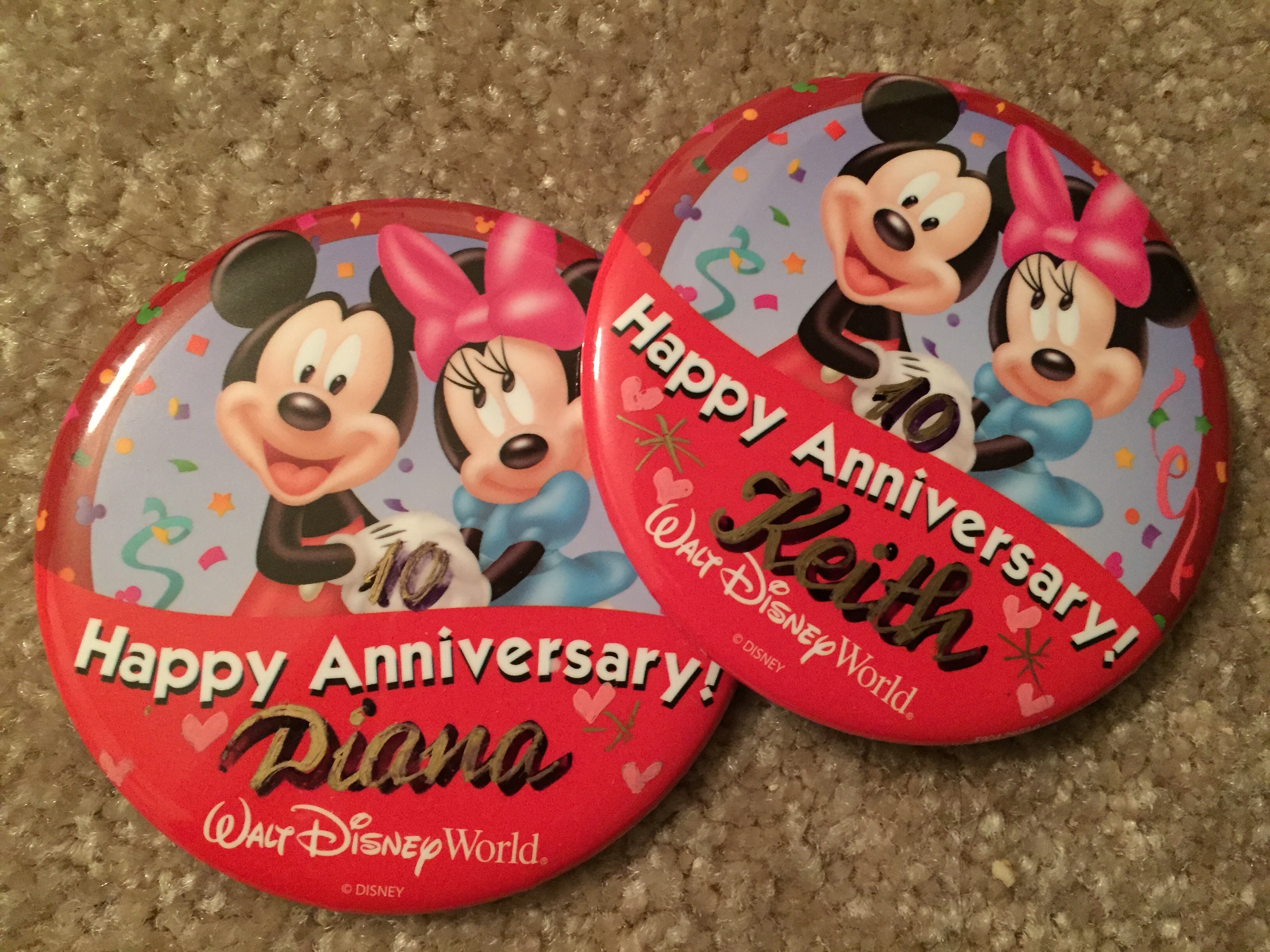
FullSizeRenderbuttonsI’m all about free stuff.  My husband and I celebrate every fifth wedding anniversary in Walt Disney World.  The resort staff knows we’re there for our special occasion–they know because we told them–so they give us large, cheerful Happy Anniversary buttons that we wear.  Because these days being married more than nine weeks can be an accomplishment, I tell everyone we meet “It’s our ##-year wedding anniversary.”  Compliments feel good. We get numerous congratulations, free drinks, special appetizers and special treats.  On our 2013 trip, a gift shop cast member took our buttons and surprised us with free personalization of our names and “10th anniversary” artfully crafted in gold calligraphy.  Those buttons were the most complimented, commented and coveted aspect of our trip.

The point is no one knows to celebrate you if you don’t share that information.  By telling people, you are celebrating you yourself.  Others will follow your lead and celebrate.

No one would have done anything if we weren’t bold.  Being bold is not egotistical or vain.  It is being proud of your accomplishments, whether they are personal or professional.

Think about the kids you know, yours or others.  Would you be hesitant to share the fact that one of them made first trumpet in the band?  Would you be embarrassed to brag that he or she won the science fair?  Would you volunteer that information?  If you don’t hold that back, then why would you hesitant to share your writing success?

To increase your success, you must promote your work.  Promoting can be as simple as telling people, “I am a writer.”  With every book I publish–three to date, all available through kindle on Amazon–I send an email out to my family, friends and acquaintances stating, “I published a book, (Title).  Go to (this link), please buy my book, and then leave me a review at (this link).  Thank you.”

When you ask, you may be surprised by what you will get.  With emails like that, I received reviews of Lessons from Dad: a Letter to You and a 4-star rating of my first fiction book, Jimmy the Burglar.  My most successful project publication to date is my first short story, Mom, Star Trek and Las Vegas: a Grand adventure with 10 reviews, two first place state awards and one third place National award. Give them a read yourself, and let me know what you think.

In order for people to know you’re a writer, you must tell them.  By promoting yourself, you are holding yourself accountable to others, thus motivating you to set goals and deadlines.  It also encourages you to write when you feel uninspired or stuck.  Will this generate sales?  Maybe and maybe not.  If sales are a part of your goals, then exposure is what you need.

Doing self-promotion can be intimidating.  I’m outgoing,–I get that spirit from my Dad–so it’s not as scary for me.  This does not mean I am not tentative. What if no one likes my writing?  If no one knows I exist, I’ll never know. And I want to know.

I promote myself on a variety of social media sites: Instagram, Twitter, Pinterest and, reluctantly, Facebook.  The more people who see me, the more I am noticed.  Those two statements are different.

Am I that important to merit or deserve all this media attention?  Yes I am.  I’m a talented wordsmith with three books, two columns staff for Michigan Scrapbooker Magazine and one award-winning blog.  However, some people may think these are modest successes and therefore, I’m not worth all this fuss.  I’m simply pretending to be more than I am.

But I’ll never be more than I am without believing I am.  You need that fierce approach to your writing.

If you’re not proud of your work and share your pride, why should anyone else be excited?  I won’t be.

Be strong.  Be fierce.  Be shameless.  Be successful.

I Published a Book in 10 Hours

Jimmy the burgler

I did it!

Families inspire us and intimidate us.  Jimmy’s mother, father and brother are all members of the Burglars Union Guild (BUG), and he is expected to follow in their footsteps.  Jimmy has slippery fingers and not in the slick, pickpocket ways; he drops things.  That lack of dexterity is just the start of his struggles to gain entrance into the most elite thief organization.  The story of his life is now immortalized in electronic bytes.  I published a book.

I didn’t do all that writing in one day, as I proposed in my original challenge.  I also spent more than 10 hours writing Jimmy the Burglar.  Regardless, I completed the challenge.

I feel really good about that because this is my first fiction piece in a long, long time.  Fiction is easier to write than memoir because I could make up whatever stuff I wanted.  Fiction is also harder to write than a memoir because I had to make up whatever stuff I wanted.

This is my third self-published book, and I learn new elements with each effort.  This time, I experimented by writing the first draft in longhand.  At 2 hours and 56 minutes of writing, I hit a wall: great story elements, but no tension.  Typing that first part in gave me time to think about the story I wanted to tell here and now and in 10-ish hours.  I initially focused on the entire family history as related to the evolution of the Guild, but in that writing, I developed incredible backstory fodder for future Jimmy short stories.  The tale worth telling today is the evolution of Jimmy’s final exam for BUG membership: his MOTH (Modus Operandi Thesis Heist).  After the humiliation he experienced working with Big M, it is vital that Jimmy’s MOTH get all the details right.

At 7 hours and 42 minutes, I was having Too Much Fun writing. So much fun that, I forgot to reset the timer at one point.

After 16 hours (approximately) and 5100 words (23 pgs.), you can read Jimmy the Burglar’s first adventure on Amazon.com.

How did your story turn out?  If you completed the challenge, post your link below.  If you didn’t, share your thoughts now about the experience for all of us so we can learn from it.  And for me, I’d love to know your thoughts about my book. Whaddya think?

If you’re looking for some inspiration and encouragement to complete a book like this, there is a day-long workshop planned for early 2015 in the metro Detroit area.  Stay tuned for the details.

Even if publication isn’t your goal, doing a challenge like this is immensely satisfying. I have typed “The End” on a piece of my writing and am now moving on to “The Next.”