Category Archives: -Diana Hirsch

Writing: Promises or Priorities?

They say timing is everything.  I agree.

So is letting go.  That’s why I say to whomever “they” are that I’m extending my 10-hour book publishing challenge to December 18.

Why?  First of all, it’s my blog challenge and I set the rules.  (And my blog editors said it was okay.)

Second, I felt overwhelmed by things crashing into each other.  Fundraising to dance in THON clashed with my seeking financial support for my Indiegogo campaign.  The extra shifts for my part-time job slammed into prep work time for my Zentangle classes.

The last and most important time-suck of the month was me.  I watched my Major Crimes DVDs over and over, obsessing because the new season starts next week.  I wandered aimlessly through the playgrounds of Instagram.  I tell myself that writing haiku through Ku and Notegraphy phone apps was a productive use of my time, but, really, that was another distraction.

I sound just like that person I wrote about last month.

Now, I did catch a cold.  I was not so sick that wiggling my toes hurt, but I sniffled enough where leaning over my keyboard caused my nose to drip and drool on the keyboard. Any precious time I could snort the mucus back, I spent that time on my memoir.

Outside of that, I chose to be careless with my time, and now I’m here apologizing and making excuses.  Why did I not value my time and talent?

I thought about it.  I figured I’d have more success collecting donations for THON when I wasn’t asking people to buy my book.  Rather than compete with holiday parties and family events, it made more sense to me to plan a marketing strategy for my Zentangle classes in the New Year when I wasn’t marketing my memoir and my Indiegogo crowdfunding campaign.  At some point, the money from working extra hours at my job was not worth the time that could have been spent writing my memoir.

Are you seeing the theme here?  Believe it or not, I didn’t at first.  When you think about your responsibilities–I mean, really think about them–listing your life out like chapter outlines will identify the events that really matter to you. Here I’ve moved on to the next step, the follow-through that freezes many would-be writers: I’m letting go of extraneous tasks and planning.  Not everyone does that.  They usually give up.

I didn’t give up; I refocused. That’s not an excuse, although we may see it as such. If we do, then we fail, fizzle and flop.  I didn’t think I needed to prioritize, but I couldn’t identify what really mattered until then. Of all the items on my list, my memoir was most important to me.  Knowing that, I could push everything else aside.

All of this brings us back to the postponed eBook challenge. Yes, some readers who were expecting Part Two this month may be disappointed, but remember, I’m rescheduling it, not giving up.  Think of it as…increased anticipation.

How has this shift in priorities helped my memoir time? With the extra time, I was open to rearrange and commit to the Chapter order.  After doing that, the process flowed better. Both self-editing and finding an editor takes longer than I thought.  Re-launching the Indiegogo campaign was frustrating and disappointing, but the descriptions and perks are now more enticing.  I’ve explored marketing ideas and am planning specific actions of specific dates.  For other ideas, I’m letting those all percolate.

Did you make a writing promise to yourself and were unsuccessful?  No one can change what happened yesterday.  It’s been done, but that doesn’t mean you’re a failure.  How do we start fresh without feeling guilty?

First, forgive yourself.  We’re all human, but we can do simple, little things.  What should you consider when planning your writing time, or anything else, really?  I can offer some advice.

1. Don’t rely on To-Do lists.  From my experience, they appear organized but are often overwhelming, and thus counterproductive.

2. Don’t say yes to things just because that time isn’t blocked off on your calendar.

3. Break up your lunch hour by standing up and physically moving away from your desk.  If that’s the time you squeeze in exercise, give yourself permission to write during one or two of those times.  Take your laptop into an empty conference room or even your car to write away from distractions.  No laptop? Use paper and a pen, as we dinosaurs did in the pre-digital age.

4. Family and relationship time is important so look for ways to balance the two. I can write in the living room on the couch next to my husband as we watch episodes of The Big Bang Theory.

No matter what you do, the key is making the time.

Did I say any of this would be easy?  If it was, we’d be doing it all and there would be no need for me to write this post.  We’d all be published authors with worldwide readership.

We know self publishing is possible. I can’t promise readers will love your stories, but if you don’t publish, how will people be able to read them?  If you have already completed the 10-Hour Challenge and published a book, leave the link information below in the comments.  If not, then you have another 30 days.  Timing is everything.

Ready? Set. Go!
You can write and publish your story in 10 hours

I dare you.

Do you remember when writing was fun and carefree? I do. As a kid, I would pull out a notepad and write stories just because that’s how I chose to pass the time. I mostly wrote fantasy stories, some science fiction without all that technical mumbo-jumbo. My dragons had their own rules of behavior and almost every character had an apostrophe in their name.

I created bizarre plot twists. I didn’t fuss with grammar or sentence structure. I didn’t care if the stories were proper writing; I just wrote a rough draft that I always thought was complete. I had fun.

Somewhere along the way, writing became structured and proper. Because of that formal format reality, I look at those drafts now and I think, “What silly little creations.” Why did I bother? Why did anyone or I care?

I expect that if you’re reading this blog, you remember that feeling, or you know someone who has. You, as a reader, can tell when the writer was having a good time and when it was an assignment. I invite you to rediscover that freedom and write with abandon. No doubt, you still have one of those stories down on paper or in your head. This month, I dare you to complete it and publish.

I talk a lot about self-publishing as if it’s gospel. The fact that I’ve done it twice–soon to be three times–does not make me an expert, but I feel confident in it. I know the powerful feeling of control, a feeling that comes from writing, editing and finishing a piece of work. Hitting the Publish button on Amazon is a daring and satisfying moment. I want you to experience that feeling.

Why should you?

Even if you don’t dream of publishing, I challenge you to do this. It’s a sense of accomplishment to write a draft, to edit that draft and by publishing it that means you finish something that you’ve started. Maybe you just have a story to tell, say it’s a letter to your parents, and wouldn’t it be cool to download it onto their Kindle for Christmas? Maybe you have a story about you and your friend. How cool would that be?

When you were in school and had an essay exam, the class eventually ended and you handed in your work as-is. At that moment, you were done. It was a relief, wasn’t it?

National Novel Writing Month (NaNoWriMo) is coming up in November. The concept behind NaNoWriMo is to kickstart you into completing a full-length first draft, but writing 50,000 words in 30 days can be intimidating. Even though that breaks down to 1667 words a day, or 69 words an hour, that finite number may be too large to be comforting. I suggest something doable.

My idea is a spin off from JA Konrath’s blogpost back in August 22, 2013.  The idea mingled fun with structure. Pretend writing is your business. Sit down at the beginning of your 8-hour business workday and write a story, edit it and publish it online. It can be that easy.

My two published short stories have been a result of that challenge. My approach was to start at 8am with a cup of coffee and an open Word document. I write one sentence so the screen is no longer blank. Then I just write, completing my first, rough draft by 12noon. I take a typical hour lunch break. From 1-5pm, I rewrite and edit my text. You can format and upload your text in that timespan as well, but consider taking a dinner break, and then work an hour or two of overtime creating an account, formatting the text, uploading it to the site, and adding cover art.

True, each time I began with a vague story idea and direction, but that was it. There was no outline, no structure, and no definitive plan. I could just as easily have pulled out one of my silly little fantasy stories and see what I can do with it now.

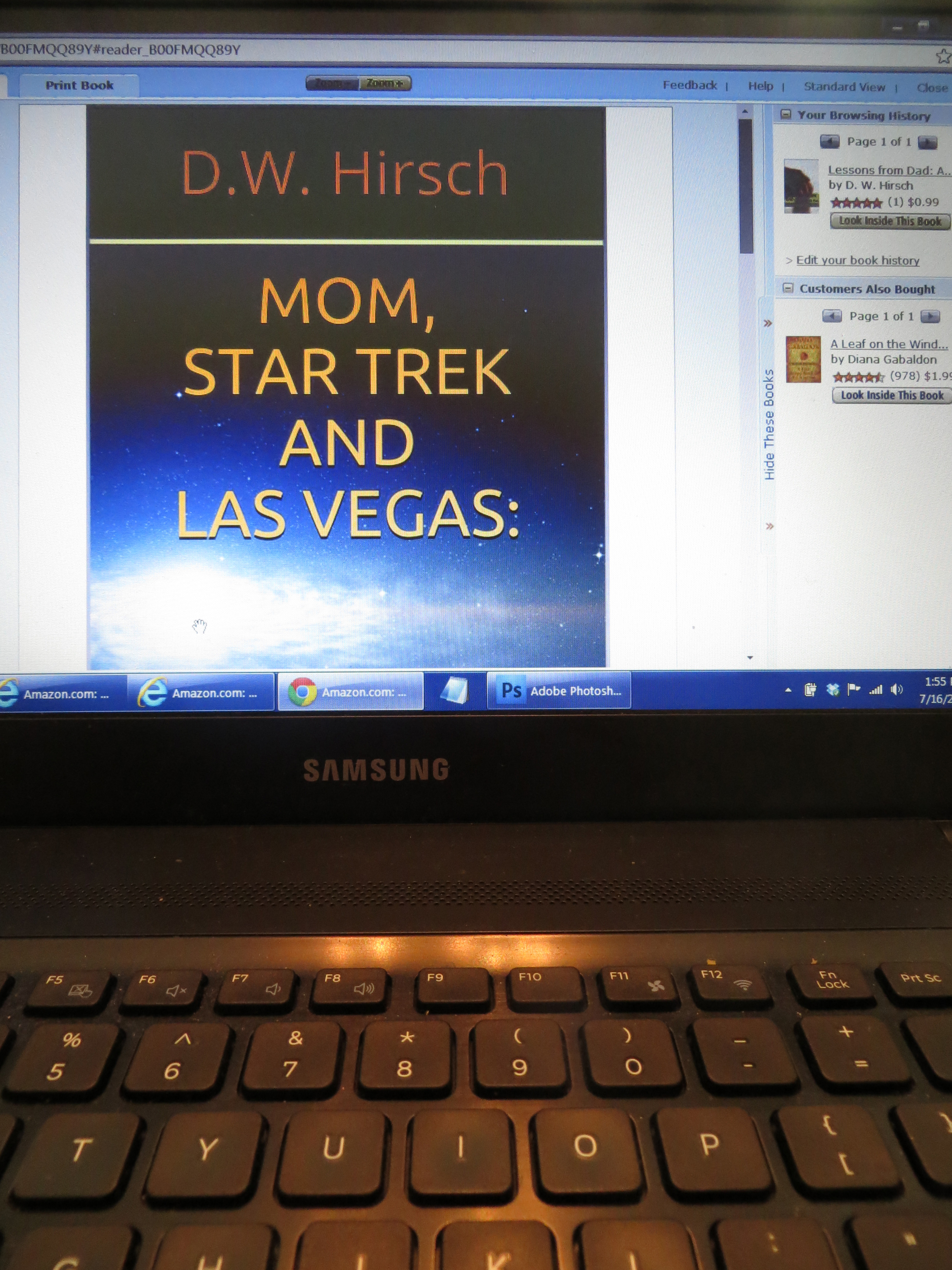
My first e-Book experience was my memoir about a trip my mom and I took. The book–Mom, Star Trek and Las Vegas: A Grand Adventure required research because Trekkies or Trekkers will know if a name is incorrect or a date is wrong. I thought I could sit down in one eight-hour stretch, but I did not. I wrote an hour here, two hours there, made 20 minutes for research here and so on. I was committed to finishing it, whatever the timeframe.

Writers who took the 8-hour challenge, published by August 30. That was eight days after the issued challenge. I’ve read some of the published work and some of them read as if written in 8 hours. But so what? The author wrote, edited, and completed the work. That was the fun of it.

On October 6, after 18 hours and 45 minutes, give or take, I was an officially published author. That was 45 days after the initial post. Final word count: 5657 words, about 22 pages.

My mom memoir e-Book won a national award: third place in the NFPW 2014 Communications Contest.

My second eBook–Lessons from Dad: A Letter to You–was a prelude to my upcoming novel memoir. I released it on June 14, 2014: Father’s Day. I counted it by the number of edits–four, including initial draft–rather than hours, which I estimate took 12 hours. That book is 5111 words, or 21 pages. For 99cents, both books are a bargain read.

What’s the number one reason people don’t do this? Without conducting scientific research, my personal experience is “I don’t have the time.” Wrong. You don’t make the time.

You say you’re too busy, that there are too many other tasks distracting you? You have dinner to cook. Your kids have after-school activities and you’re the driver. You volunteer at the library. You work a 9-to-5 job and commute an hour each way. You have a report to write. There are weekly soccer matches to attend, so you wake up at 6:45am every Saturday. You go to church. You have a monthly date night with your spouse. Your favorite TV show has begun a new season. Repeat week.

Excuses. All excuses. They are reasons, but they are also excuses.

I will attempt this by my next blog post. So, what does my life look like? I don’t have kids to factor in, but I picked up about five extra shifts at my part time job between now and then. I’m traveling out-of-state, teaching Zentangle classes, co-hosting a monthly art group, having a Halloween scrapbook crop at my house, celebrating my 11th wedding anniversary, and raising funds to dance in February’s THON.

I am madly editing my dad memoir novel for ePublication on November 20, my father’s birthday. I’m promoting that book on Twitter, Instagram and my Facebook Author page. Let’s not forget that I have my own blog to maintain, including my annual Halloween blog hop post.  There are articles to write for Michigan Scrapbooker Magazine. I’m editing posts for this blog, critiquing submissions for this writers group, and writing the follow-up November post of this challenge. In utter madness, I also signed up for NaNoWriMo this year.

And there are the daily mundane To-Do items: doctor appointments, cooking, grocery shopping, laundry, mailing birthday cards. Did I mention I was married and have a husband to not ignore?

If I can find time in that, then you can make time in your schedule.

This is not a setup. I don’t have a finished work sitting in the wings planned for this blog challenge. I have ignored my Jimmy the Burglar story for way too long. I mentioned it first back on this blog in March and haven’t touched it since. That’s seven months. I’ve written segments in my head but nothing on paper.

Do you feel that if you don’t write for X-minutes at a time then you’ll lose your flow, and focus and might as well not even start? If you choose to accept this challenge, make it work for you. Don’t have a whole day? I bet you can find an hour a day for 8 days. Maybe 30 minutes for 16 days. Does it take longer than 10 hours? So what? Don’t let the timeframe freeze you, but use it as a guideline, an incentive, a strong deadline.

Don’t be embarrassed by it. Don’t expect best-selling material, although you might surprise yourself. It’s most likely a short story, and there is nothing wrong with that. My books are the length of approximately three of this 1650-word blog post.

What’s in it for you is a sense of accomplishment and completion. As writers, we are always in the middle of something. Or, we write that first draft and never go back to it. I’ve done NaNoWriMo for three years, and I have yet to continue one of those 50K drafts. Unfinished work is a plague on would-be writers.

Stop whining.

You raise kids and release them into the world after 18 years. You write that college essay in 50 minutes and then submit it for a grade. You plan a wedding and eventually the bride walks down the aisle. At some point, there’s that moment of letting go. Stop the mindless edits and let your writing be that free.

As an incentive, I promise to download your book and read it and review it, even if it takes me a few months to get through them. Add your link to the comments section in my November 18 post, or share your thoughts about the overall experience.

Discover what kind of book you can to write in 10 hours!

Amazon, Hachette and “the wretched $9.99 price point”

Print is dead.

At least, that’s what the Big Five publishing houses fear. One company is fighting the potential loss of sales and its possible demise in a public battle that affects readers and writers alike.

Before 2007 or so, the only way an author’s story was read was through a print copy in brick-and-mortar bookstores. The only way to get into a bookstore was through a major publisher. Knowing their control, these large publishers chose the stories and genres people read, the prices at which books were sold and what the authors got paid.

Now that snippy digital upstarts like me are snooting our way in and circumventing the system they so strategically designed, publishers are no longer needed. With digital formats, there is no gatekeeping; I can write and publish any book at any length in any genre I choose and at any price.

Without hardcover or paperback books, the publishers’ choking grip on the market disappears with the turn of a page. The Big Five lose all public prestige, respect, expertise, control and sales. Especially sales.

Welcome to the battle between Hachette and Amazon.

Hachette wants to charge high e-book prices to discourage electronic sales and boost paper sales. Amazon wants to keep prices of e-books favorable to consumers. This dispute has been going on for years. To understand the impact of today’s feud, let’s go back in time for a brief history….  (Shout out thanks to J.A. Konrath’s timeline for the format inspiration that I use.)

NOVEMBER 2007

Amazon releases the company’s Kindle e-reader.

NOVEMBER 2009

Barnes & Noble introduces the company’s Nook e-reader.

Retailers continue buying books and e-books using “wholesale pricing,” an agreement in which publishing houses charge half the printed cover price to those retailers. The booksellers then compete with each other by discounting books or offering sales. At this time, hardback book prices range from $15-30.

Amazon is a large company with a large share of the e-book market. They rarely sell at full price, offering book titles below the printed cost, even as far down as $9.99 for bestselling novels. The Big Five publishers make a lot of money through the sales of higher priced hardcover books, and this consumer-friendly price point might encourage more digital sales than paper. These companies didn’t want that to be the standard that consumers would expect to pay.

JANUARY 2010

Apple prepares to release its iPad, but if they offer books in their iBookstore at a price to compete with Amazon, the company will lose money. A publishing executive blames Amazon’s “wretched $9.99 price point.” Apple and the Big Five publishers work out an agreement that benefits everyone. The publishers switch book distribution away from wholesale pricing to the new and improved “agency pricing” model. In this agreement, publishers control the price of the e-book rather than the retailer. Sales percentages are split favorably, as well: 30% to Apple and 70% to publishers. In this scenario, consumers who choose to buy e-books instead of physical copies are, in a sense, be punished for affecting paper sales.

The only caveat is that all publishing houses have to sell this way to all of Apple’s competing retailers, including Amazon. Amazon pushes back, but with everyone else agreeing to this method of distribution, the company has to accept these terms. Book prices on Amazon’s site rise to $12.99 and $14.99. The term “colluded” is later used when referring to this agency pricing arrangement.

APRIL 2010

Apple releases the iPad.

JULY 2010

Amazon reports that digital e-books outsell hardcover books for the first time in history. The agency pricing continues for two years before the U.S. government steps in.

APRIL 2012

The U.S. Justice Department (DOJ) accuses Apple and the publishers of conspiring to raise e-book prices and filed a civil antitrust lawsuit. By developing and utilizing agency model, “the publishers prevented retail price competition resulting in consumers paying millions of dollars more for their e-books” especially for the most popular titles by big-name, best-selling authors.

Three of the Big Five publishing houses, which include Hachette, settle immediately. Retailers resume discounting and offering sales. The publishers pay financial restitutions to consumers and are “prohibited for two years from entering into new agreements that constrain retailers’ ability to offer discounts or other promotions to consumers….” The DoJ settled with two other publishers and Apple by 2013, yet Apple appeals the decision.

Now fast forward to the present year. Apple’s appeal is ongoing as of this post.

JANUARY-FEBRUARY 2014

The 2-year contracts are ending, so new ones need to be negotiated or extended. Amazon sends a contract to Hachette. Because they do not receive a response from Hachette, Amazon removes the site’s pre-order buttons and stops discounting Hachette titles.

MARCH 2014

Hachette’s contract to sell books with Amazon expires, but Amazon extends it into April while both sides negotiate. Because the outcome is uncertain and shipping dates cannot be guaranteed, Amazon reduces the print inventory of Hachette titles.

APRIL 2014

There is now no longer any contract for Amazon to sell Hachette titles on Amazon. Hachette finally makes counter offer, Amazon rejects it.

MAY-JUNE 2014

Hachette authors notice slower sales, so Amazon makes several proposals that they and Hachette offer financial provisions for the authors during negotiations. Hachette declines all of them.

JULY-AUGUST 18, 2014

Here’s when media runs wild with statements, press releases and proposals, oh my!

Hachette compiles its press releases and statements regarding Amazon here.

Propaganda or perspective? Article from Random House editorial assistant Alison Herman with intriguing links at the end.

Big Five authors want print to thrive. Who can blame them? Without physical books, bestselling authors like Stephen King, John Grisham and James Patterson lose their dedicated personal assistants and vacation beach houses. They each become “just another little writer” in a writer’s ocean.

There is a letter from Douglas Preston, a Council Member of the Author’s Guild, signed by authors supporting Hachette. As of August 9, the letter had approximately 900 signatures, published as a full 2-page $110,000 advertisement in the New York Times as “A Letter to Our Readers.”

There is a petition by Change.org urging readers and writers to support the company who supports readers and authors. As of August 9, the petition reached 8000 electronic signatures. (8466 as of my post)

On August 9, The Amazon Books Team releases a letter discussing their point of view from within the negotiation. There are some good links at the end. It’s worth a read through.

The email reply from Hachette CEO Michael Pietsch in response to Amazon’s August 9 letter request for consumers to contact executives about the negotiations.

Amazon releases a statement justifying the $9.99 price point: “For every copy an e-book would sell at $14.99, it would sell 1.74 copies if priced at $9.99. So, for example, if customers would buy 100,000 copies of a particular e-book at $14.99, then customers would buy 174,000 copies of that same e-book at $9.99. Total revenue at $14.99 would be $1,499,000. Total revenue at $9.99 is $1,738,000.”

And here we are, readers and writers, reeling in the wake of potential propaganda from both sides. Marketers in any company can spin numbers any way they want to make the numbers show in their favor. I don’t necessarily believe in Amazon’s exact number or those calculations empirically, but the rationale behind it is solid. If I had $15, would I spend it on one book? Am I more inclined to buy a $9.99 book and a coffee and muffin to enjoy while reading the book? If a purchase like that gives me that pleasure, then I’m encouraged to buy another similarly priced book for a similar experience.

“Why should e-books cost as much as, or more than, a printed copy?” my husband asked me. “There’s no shipping or printing.” He’s a chemist and not in the publishing industry. If this is so elementary to someone outside the industry, how is it lost on someone in the publishing business?

I’m not necessarily pro-Amazon, but I am pro-information. Some people do not have the drive or desire to do it all, so turning their work over to a Big Five publisher is the best option for them. But how is Hachette assisting and nurturing its authors when it let their contract with Amazon expire, and thus all its authors’ contracts as well?

If Amazon wins this battle, they will dominate the market…for now. At some point, all Amazon authors could be stuck with a business model that no longer offers today’s benefits, and then Amazon becomes the Big One publisher. If that happens, authors are not stuck.

Unlike print, where the only way to publish was through a publisher, there are now numerous electronic options. No doubt any number of smaller publishers and retailers will develop online stores. Any author can sell directly from their website. These were options never available before.

Who needs who more, Amazon or Hachette?

Who, or what, do authors need?

Print may be dying, but books and stories never will.

Yes, you can publish a book

My thoughts on self-publishing


What is stopping you from publishing your book?  You are.

I have self-published two books so far, and I am thrilled about it.  With the introduction of eReaders, writers have complete freedom in their craft.  You have the ability to post anything online through a blog and various social media, and now you have the socially-accepted ability to publish a book.  But that was not always the case.

As recent as 10 years ago, the only way to buy a book was as a printed copy in a brick-and-mortar bookstore.  The only way to get your book into those stores was to sign a contract with one of the traditional publishing houses headquartered in New York.  These companies controlled physical book distribution, and they didn’t make the process of acceptance easy.  Even with well-crafted query letters and strong sample chapters, you still needed a smidgeon of luck that your manuscript found its way to the right editor or agent to believe in you.  If you made it through that professional vetting process, then you had the validation of being a “real” writer.

If your work wasn’t good enough to be accepted by the industry, then the only way to get your story to readers was to fake professionalism.  You had to print it on your own, with the stigma of “vanity press” trailing your byline.  I believe that was a phrase created by publishing houses.  If you had to print and peddle your wares yourself, then you weren’t a professional writer.  This legitimized publishing houses and enhanced their aura of attraction.  Without any sense of quality control or standards, what was there to keep the sludge out?  Such a book was an ego trip, and the only sales would come from family and friends.

On a base level, I understand that perception, especially after my experience at a 1998 independent publishing convention in New York City.  Unknown authors sat at tables just as if they were at a real book signing, so I figured there must have been some judging or invitation to be there.  I came across a hardback book with a colorful cover protected by a clear plastic slipcover.  It was a subject I was interested in writing, so I bought it.  Anyone who looked good must be good.  However, after reading the book, I learned that if you flip to a random page, any page, you will come across a grammatical error, a spelling mistake or a bombing of the F-word.  I’m serious.

No wonder people didn’t trust vanity press authors.  How could you tell a skilled writer from a sloppy ego trip?  Anyone can slap pieces of paper between a sturdy cover; professional-looking photography on the outside doesn’t guarantee that editing and grammatical care was taken on the inside.  I fell for that with the college book.  For all I know, those writers paid to rent table space, so anyone with money could have been there.  Reputable publishers guaranteed those services and more, so you took your chances with independents.

I didn’t have extra cash to toss around just to be labeled a phony.  If I wanted legitimacy as a writer, I would have to play the publishing lottery.

Now welcome to the brave new world of indie publishing.

“Vanity press” fades into obscurity as “self-publishing” gains legitimacy through e-pioneers like vampire series author Amanda Hocking , fantasy writer H.P. Mallory  and mystery-thriller author J.A. Konrath . Self-publishing is now a viable, accepted method of getting books to readers, especially with the popularity of eReaders.

Self-publishing gives anyone the opportunity to be a Published Author.  Young or old, newbie or established, there are no arbitrary opinions guidelines to keep otherwise-successful writers out of the market.  There are no external factors in this enterprise.  No one is sandwiched into a particular subject matter because new genres are created all the time.  Established genres are combined.  There is an outlet for niche topics directed at specialized audiences.  Story length is not limited to traditional page counts. These fringe elements, un-tested and un-proven as even mildly popular, are things traditional publishers would never touch. But you can.

Anyone can be a fantastic storyteller.

Now we can legitimize ourselves.  All writers have egos.

With such ease, there is still that initial concern: how to navigate through the slush to ferret out the gems.  Well, how do you do it now?  When you walk into a bookstore, what do you gravitate towards?  Is it a particular genre, the bestsellers, the sale items or the staff picks?  What makes you pick up a book: cover art, the subject material, the title or reviews and recommendations?  Online browsing is no different.  The book’s “back cover” summary is listed above the reviews.  Just like flipping through pages in a store, many writers offer the reader a sample to download and preview.  Ultimately, you don’t know how good a book is until you read it, just like any traditionally published book.  What is “good” and “bad” is subjective, but now you have more options, authors and books to discover.  It is more likely you’ll find a story worth reading, one you’re interested in.  This is a good thing.  It’s a great thing!

Given that, does a publishing house matter?  Nope.  Readers do not need publishers for distribution because eBooks are available electronically.  I’ve always bought books based on my interest, not the publisher.  Quick, without looking it up online, who publishes Stephen King?  Dean Koontz?  Danielle Steel?  Nora Roberts?  I find that people are brand-loyal with dishwashers, coffee, laundry detergent, cereal and soda pop, but not books.  Think about movies.  Have you ever heard anyone say, “Oh, I won’t see that movie because it’s not produced by 20th Century Fox.” ?  In fact, it’s an honor to have your film selected for the Cannes International Film Festival.  Is that called “vanity filmmaking”?  Many unknown filmmakers are introduced there because artistic quality (good storytelling) is the key there, not the big-name directors (best-selling authors) financed by big-name production studios (publishing houses).

Some writers need that perceived validation.  Some may not want to be involved in the details of work outside of the actual writing.  That’s personal preference.  I’m not one of those people.  I prefer the creative freedom.

Think about it.  You create the cover art you want.  You choose your editor, or make the decision not to use one.  There are no printing costs outside of any print on demand (POD) because publishing is electronic.  You set the price, and you can change that any time and as often as you wish.  At this time, royalties are higher than with a traditional publisher so you earn more money.  You can upload a story of any genre or any length because today’s readers accept both.  You publish on your schedule.  You can upload new versions at any time, thus customizing or updating content.  All it costs you is your time.

Note the theme above?  It’s control.

For all those reasons, I chose to self-publish.  Why not?  As of this post, I have two books available on Amazon.  At short stories that are 21 pages each, no publishing house would waste the ink and dead trees.  I don’t blame them, and I don’t fault them, so I took the power and launched them myself.

Remember that ego thing I mentioned earlier?

Does self-publishing my work–the lack of a traditional publisher– make me less of a writer?  Does having a book in print make me more of one?  I don’t think so, but it’s a fun thing to do.

So far, my self-publishing journey has been a positive one.  I hope you’ll follow me along this adventure because this is not the end.  I’ll continue to share my experiences.  Feel free to share yours in the comments below.

Will I be successful, whatever the definition of “success” is?  Would you be?  How will you ever know if you don’t try?

Nothing is stopping you but you.


Mental images: zombies and coffee

Good, strong writing is found all in the presentation.  Consider the images that come to your mind when you read the following sentence: She was a zombie in need of more K-Cups.

So, what does that refer to?

Right now, you may be floundering and drowning in a sea of possibilities.  You need context to anchor your thoughts.  What should you be thinking of?

Figuratively, that sentence could describe a human female who cannot function without that first morning cup of coffee.  Literally, it could mean that a reanimated female creature drinks coffee and is running low on the packets.

Either way, the writer has set up the scene with specific, descriptive words about setting and circumstance.  Human or supernatural, your female character is of a certain social status to prefer the disposable, single-serve packets used in a Keurig brewer.

Let’s not forget the implied tension.  What if either one of them runs out of the single-serve packets?

Certainly, the story subject matter material is crucial to the events that happen next.  However, without any specific framework, your mind still generated images, thoughts, or presumptions about what that sentence means.  The presentation of that one sentence was strong, just strong enough to engage the reader and yet give freedom to create his or her own specific image.  After all, what does the female look like: blonde or brunette, or is her hair matted and covered in mud?  Is her skin dark or light, green or blue?

You want to choose the right nouns http://www.youtube.com/watch?v=kfnXUWJz0sE&feature=kp , words that create dancing images in the readers mind to solve the puzzle of the author’s intent.  If done well, the descriptions keep the story moving forward and the reader interested and engaged.  Are you intrigued?

If you’ve read this far, then you are and I did my job.  This is how inviting your writing should be.  What kind of images do you want to create for your readers?

How do you do this, find colorful language words to express nuances?  Start with a basic word and look to thesaurus or dictionary.  Typing the word “zombie,” an online thesaurus gives synonyms and antonyms for “odd person,” “ghost,” and “machine.”  Various dictionaries define a zombie as, among other things, a supernatural spirit inhabiting a dead body; a snake god; a tired, apathetic human; a spicy rum drink; and a computer virus.  Think of what other magic you’ll find typing in a different word.

Consider colloquial slang.  At some point zombie came to mean a lethargic person.  The word “shorty” now refers to clothing, cookies and an often-derogatory term for women.  What words can you mesh into new meanings?

You can also create your own connection.  It’s easier to take liberties in fiction and fantasy by the nature of creating a new world with your own rules, but nonfiction benefits from it.  That’s how I wrote the zombie sentence, with a human in mind.  It’s much more exciting than writing The tired woman had no more coffee. It also creates images that are more vibrant.

After writing it, I wondered, what if she was waking up in a post-apocalyptic world?

What does a sleepy zombie look like to you?