Category Archives: -Diana Hirsch

Lights, Camera, Action: Verb!

I had one of those ah-ha!, slap-your-head-with-the-palm-of-your-hand-*duh* moments recently.

This time, that moment was about writing.

An article I read discussed ways to improve your writing. In your first draft, the most important thing is to get the words down in whatever perfect or jumbled form you can. The revision stage is where you get creative from those bare bones you have constructed. What is the one element that will instantly make your writing more compelling, creative, and interesting? That’s right: verbs.

Verbs allow us to hear and see. They are our senses. Verbs are integral to any writing, and using them is as simple as Schoolhouse Rock professes. They are action, or lack thereof, and how we manipulate them is important. One word can change the whole outlook and approach to a story. Verbs tell the story. In retrospect, it is an obvious solution, but I didn’t believe it could be that easy until I played around with verbs…and ah-ha!

Consider the sentence: He took the box to the car. The sentence gets you there but not in style.

The verb, the action, in this sentence is “took,” which is the past tense of the word “take.” Often action is seen as immediate, but the past tense is the most common tense used in writing whether that is a novel, magazine, or a news story. Past tense does not negate a reader’s experience in the present. Now change one word: the verb. This is what you get:

He dragged the box to the car.

He pushed the box to the car.

He rolled the box to the car.

He pulled the box

He hefted the box

He carried the box

He lugged the box

He hauled

He hoisted

He moved

Each verb changes the meaning of the sentence and enhances the story. “Drag” and “push” suggests that the box is heavy (is there a dead body in it?) or that the character is weak (is he sick or injured?). Suddenly, the reader has the potential to know more about the story and situation. “Hoist” and “heft” imply circumstances more than “carry” does, but each of those words suggests that the box size is important (is the box lifted by hands or a crane?) or that the character’s physical strength (is he struggling or showing off his muscles?) is integral to the story. The reader becomes more intrigued about the contents of the box and the overall situation. “Move” suggests that the box was in one location (is it hidden in a bedroom?) and has to be in a new place (why and to where?). Now the reader is enticed into the plot and the character’s circumstances.

Now the writer has the opportunity to delve deeper into the overall experience to entertain readers. Consider the sentences above that evolved from changing the word “took” to a more specific and situational verb:

He dragged the box across the gravel towards the station wagon, but it was a long driveway.


He carried the blue box in his suit pocket because it had to be a surprise, and she was already waiting in the car.


He swayed and stumbled with the box on his shoulders, hoping it would fit in the trunk of his beat-up Ford Mustang.


The box had to be moved–now!–so he whipped it up in his arms and dashed outside to the only place he could think of: Jesse’s car.


He placed the brown moving box lightly on the dolly, but he did not see the Fragile This Side Up sticker until he rolled the dolly to the car.


Flip, flop, end over end, Smithy spent ten minutes pushing the empty refrigerator box to the far end of the dump where the rusty motorcycle and broken dresser were already stacked.


All that magic occurred from one changed word. What magic can you create? Ah-ha!
Does your car need a poetic license plate?

Bet’cha you’re a poet and didn’t even know it.

However, ask me if I’m a poet, and my immediate response is no.  After all, poetry is sing-songy rhymes sung by first graders.  Classic poets are older writers spewing stylized language for pages upon pages.  The new wave of poets are hipsters baring their raw, tortured souls for 20 minutes on coffeeshop stages, waxing on the dearth of the human landscape. I’m just a wanna-be hipster, but I do appreciate Spoken Word.  I just don’t “get” a lot of it.

Poetry intimidates me.  I feel pressured to find something meaningful from the long strangling paragraphs of confusing and deep intense emotions.  When I don’t get some passionate, life-changing insight, I feel like a numb, witless slug.  Shakespeare frustrates me because my reading flow is disrupted by looking up too many word definitions.  Again, I’m the imbecile.  Too often, poetry is dissected in a class assignment to study form and intention, not enjoyed for the words themselves.  Poetry becomes work, stale and tedious.  There are ways to make poetry approachable, and that is to have fun.

One of my Top Five Favorite College Projects actually came in a poetry class I took as a junior.  Our assignment had a list of specific rules, including writing in a particular meter with rhythm and using a specific number of words from the glossary provided.  The challenge was the intrigue, and my submission, “To Catch a Frog,” is the only poem I ever committed to memory.  This is the first stanza of the one page poem:

To kiss a frog, some say, may lead

to warts upon one’s foolish head.

So it occurred that fateful eve,

when I was lured to test belief,

departed with my sturdy trap

to catch a frog down Boggy Swamp.

 Poetry can be a space to play and experiment, even for the non-poet writer.  It is fractured storytelling.  You can choose not to follow the traditional rules of grammar or punctuation.  April is National Poetry Month, the NaNoWriMo for poets.  This is the time to celebrate something new or forgotten.

About 14 years ago, I discovered the appeal of haiku. My friend and I traveled to a book expo in New York City.  She is a poet, so it was no surprise that the haiku year caught her eye.  The book features haikus written on postcards and mailed amongst a group of friends.  The poetry form itself presents a limited commitment composing three lines of 5-7-5 syllables.  It is short and structured with some boundaries, thus user-friendly.  Perfect.

We both loved the creativity of it, so we emailed daily haikus to give out Inbox joy and mailed weekend postcards to keep our mailboxes from becoming jealous.  We still do this today, with our subject material less nature-focused and more snippets of life in the style of senryu.photo

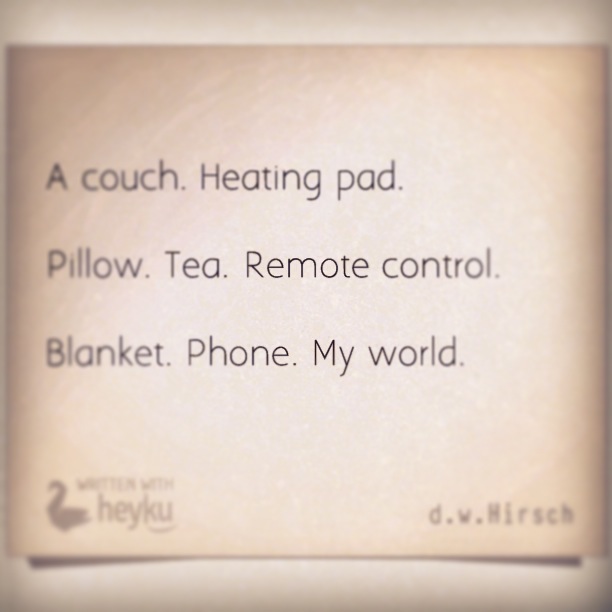
I discovered an iPhone app, Heyku, which encourages anyone to post any type of poetry, with the option to add interactive sketches, photos, or sound to each poem. I do not know the size of this online community, but I find it welcoming because I have followers of my poetry.  I feel safe here, and thus more confident in my approach.  You can find me there at d.w.Hirsch, always under the #haiku tag.  Many of my haikus are now posted on Instagram (dwhirsch) where I can become more hipster with the trendy, special filters.  Whatever the format, whether the month is April or beyond, my writing is whimsical and casual, the way I think poetry should be.

Be your own poet.

A Cracker Jack prize: story ideas

Story ideas do not come in a box of Cracker Jack…or can they?

When I was a kid, the box of molasses-flavored popcorn-nut mix contained cool toys.  It was a delight to pull out some plastic blue ring, too small for any human hand, and squeeze it halfway onto my pinkie finger and imagine it was…anything.  It was a secret decoder ring, and only I had the clues to save the world from the alien spaceship about to destroy humans.  Or the ring gave me super powers, and I would defeat villains by zapping them with my ring from atop flying horses.  I was boundless.

These days, the prizes are downright boring and cheesy if you ask me, but you can still take those cartoon baseball stickers or temporary dragon tattoos and write with abandon.  How?  Good question.

The all-powerful “They” say to choose a situation, emotion or object and launch from there.  Stories come from within so just start writing.  Yeah, that’s easier said than done.

Finding that starting point can be challenging.  I dislike catchphrase advice because without specific examples, I don’t know how to apply those general tips to my writing.  Two tips that annoy me are the seemingly useless “look around you” or “write what you know” how-to suggestions.  Those phrases are cliché until I learned how to make those work specifically for me.

There really is something to the generic advice to “look around you” for ideas.  Consider this: It’s Chinese takeout night, and when you get to dessert, you remember the classic fortune cookie joke-fortune, “Help! I’m a prisoner in a Chinese fortune cookie factory.”  That sentence alone opens countless opportunities.  If you write romance, imagine the hero sweeping in and rescuing the trapped maiden only to be chased by her vengeful lover who locked her away in the factory in the first place.  For the science fiction fans, is the prisoner actually an alien waiting to capture humans?  If you’re geared towards mysteries or thrillers, what does the hero encounter as he or she enters the factory only to discover that the true purpose of the factory is…?

Expand from that plot sentence and “write what you know” to develop characters.  What charming habits do you have that your alien can have to humanize it?  What annoying phrases does your aunt say that could provide tension between the hero and your damsel in distress?  Does your friend have a nervous tic that could distinguish your sleuth?  Could your spouse’s nickname be the name of a Young Adult character?  If your character’s favorite food is Cracker Jack, the same as yours, does this vice affect the story’s outcome?

Suddenly, writing is fun again.

If you feel that your life has not been exciting to this point, then start now.  Take advantage of where you are right now.  “Look around you” and study people at the mall, the dog park, the grocery store or wherever you hang out.  Imagine their stories.  As a wanna-be coffee shop hipster, I hear random snippets of conversation that are fascinating story fodder.  Always carry a journal, napkin or phone notepad to record these moments.  If you tell yourself “Oh, I’ll remember that later,” you probably won’t, at least not with the same flavor you had at that moment.

This personal exploration of people and their traits feels natural for a creative non-fiction writer like me.  I discovered that I can “write what I know” and tell my life story three different ways from three different perspectives: my relationship with my dad; my interactions with my mother; and episodes told from an outsider’s point of view.  Talk about maximizing your material.

I found more “write what you know” opportunities when a few months ago, I rediscovered folders full of high school and college essays, stories and poetry.  I flipped through them and wondered, how did I ever earn a passing grade on that?  What the *bleep* was I thinking when I wrote this crap?  Shudder.  However, reading these embarrassing scraps of paper more closely, I actually found some moments of brilliance and passages I can salvage.  Really, I was that creative?  Really, I was that creative.

If you don’t have past material to repurpose, it is not cheating to borrow inspiration from tools designed to spur imagination.  A quick search of “story ideas” yielded numerous phone apps: Lists for Writers; Storyteller; The Brainstormer; Story Seed Generator; Story Starters; and Flash Fiction Prompter.

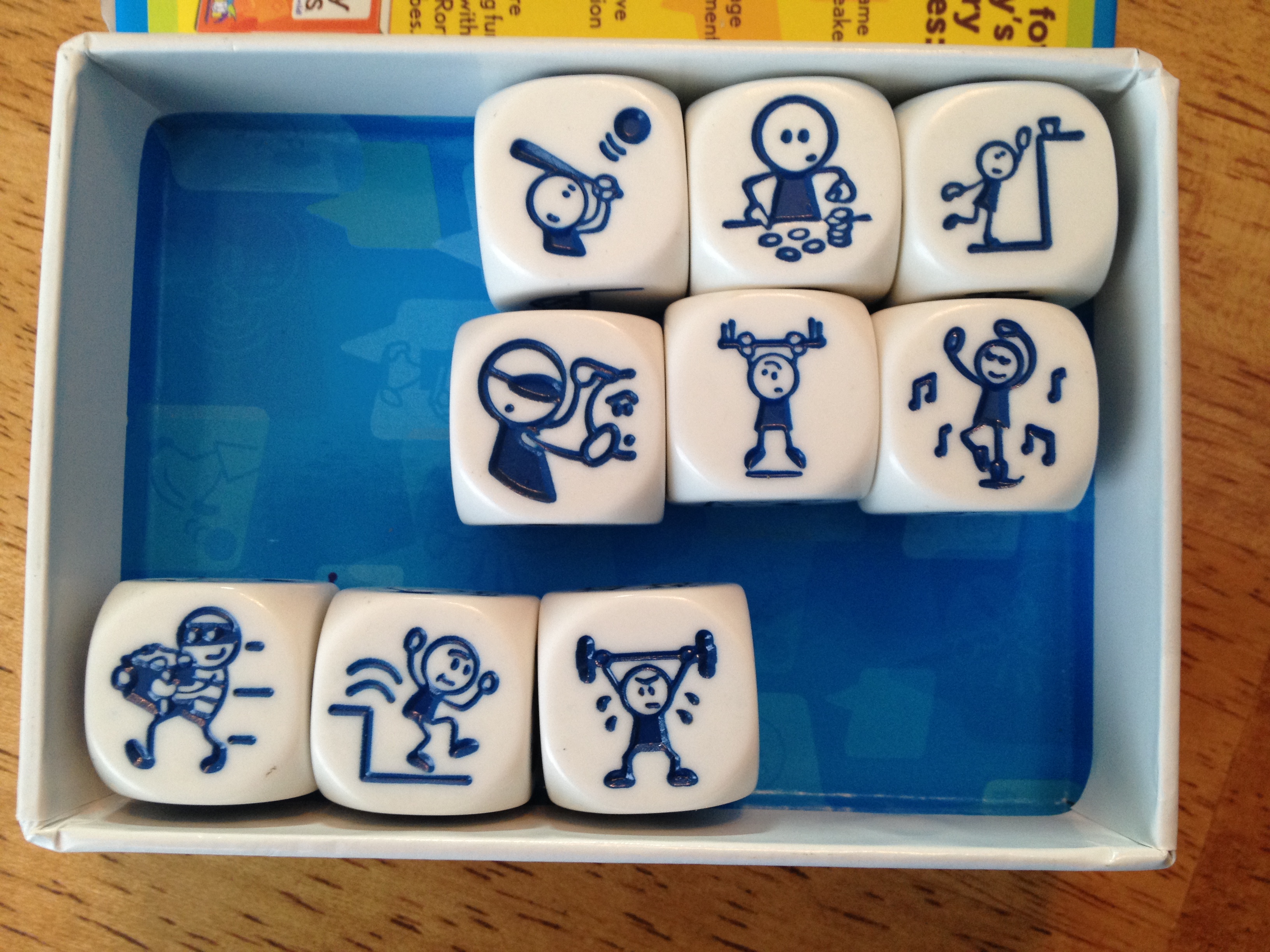
I have not used any of those products, but I did stumble upon the interactive game Story Cubes, which are themed picture dice sets.  Rolling all dice in the Actions set generated an intriguing random assortment.

My Story Cubes inspiration

boxofdice

From this, my character Jimmy the Burglar was born, including the first line of his story:  “Jimmy the Burglar could barely pick his nose let alone a lock.”

Is that a story you would read?

This came from the roll of the dice instead of a Cracker Jack box, but still….  Just think of what you can come up with when you look around and write what you know.

The Writer’s Life

I have been a writer since age 5, but it has taken years for others to realize that.

I was always a writer, or, more directly, I was always writing.  The act of writing does make one a writer, but the subtleties of that are profound.  Writing is an activity that kids do as a school assignment or what adults do in their serious job.  Writing is an element of something else, not a stand-alone profession.  Why should writing be considered anything more than a hobby?  It is for the reader.

I was a child who was not good at sports and had no siblings to annoy or be annoyed by.  I had the time, and I recognized at that early age that I was creative.  My parents encouraged me or at least positively tolerated the hours I spent hunched over a pad of paper.  I kept diaries of thoughts, personal struggles, observations, conversation snippets and story ideas.  My middle school English teacher let me write stories for extra credit.  I continued that in high school, writing one teacher-acclaimed sequel to some book we read in class, some sort of social commentary combining 1984 and the character K-9 from the British TV show Doctor Who.  Then came the big moment: I was editor of my high school newspaper.  I made it; I was a writer.

I guess I was.

Wanting to learn more about the craft of writing, I took enough college poetry, creative nonfiction and fiction classes to obtain an English Writing minor.  Despite this, in my mind I was just a kid writing words.  I was not a writer.

Non-writers defined–and still does to an extent–that a “writer” is someone who earns enough money writing to pay the bills and put food on the table.  I had a full-time “real job”, but I did not define myself by that.  When people asked what I did, I said, “I write.”  Inevitably, the next question was, “Ooh, what do you write?”  My reply was always a bit choked: “I write in my journal.”  Because I could not point to a genre much less an actual published anything, people’s eyes glazed, they gave me a polite “oh,” and then looked over my shoulder as if at a dinner party looking for someone more interesting to talk to.  Society dismissed me.  It’s hard to argue with that; they’re right.

A coworker mentioned that she knew someone at a newspaper who was looking for writers.  The editor and I connected on the phone.  After an introduction and some discussion of my experience, the editor asked, “We really need someone to write a singles beat for us.  Do you know where all the 20-somethings go for fun?”

I was 20-something.  I was single.  I wrote.  “Absolutely!” I said.

No sooner did I hang up with the editor–my editor!–with an introductory article assignment, than I picked it up the phone, called my friend, and asked, “Hey, where do single people hang out around here?”

With a foot, or at least a pen, in the door, that first assignment led to another and then another.  My name was in print in a real publication, a free weekly newspaper.  Yes, you did not pay for it, but the paper had advertisers as well as columns on local news, sports and event.  I was legitimately published, and got paid; therefore, it counted as real.

I wanted some of that non-singles writing action, so I approached the Arts editor.  She gave me an assignment, and suddenly, I had a writing portfolio.

She called me after I submitted my third article and said, “Let’s discuss this piece.  You need to make some changes in your writing.”  She proceeded to take me through my article, line-by-line, and pointed out where my writing needed improvement.  She told me where a verb should be more active (she gave an example), where sentence length should be tweaked (gave example), where a description could be tighter and stronger (gave example) and so on.  I learned more about writing in that hour than I did all my years in college.  I followed her invaluable, free advice, and my writing got stronger.  I noticed it and so did she.

I’ve since written award-winning articles for newspapers and magazines, all a bit of luck, opportunity and skill.  I’ve had my queried ideas accepted, giving me freedom and confidence in my skills.  I published my first eBook in 2013, the first of many.  I’m here to share my perspectives and the struggles I have.  I hope you’ll learn with me as I continue my journey of writing.

I mean, my journey as a writer.