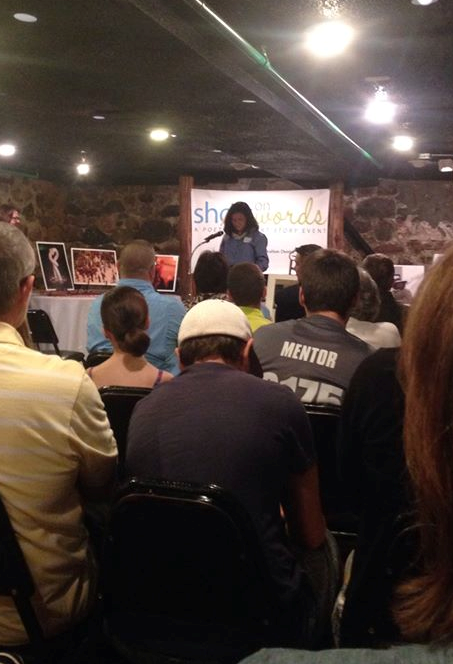
Four E’s of Public Readings

Karens picWith less than one week before my first public reading, I panic. Oh sure, I’ve read at writers workshops, but other writers expect flat expressionless words and concentrate on the print. I usually flub a few words, stumble along internally editing as I read and neglect any attention to how I sound. I’m a terrible reader, and now I’m subjecting an innocent and unsuspecting audience not only to my words but also my reading.

My story of 1500 words takes almost fifteen minutes to read aloud. Ten minutes is the ideal length according to Randy Susan Meyer of the Huffington Post in “Ten Tips for Writers Reading in Public.”  Now if I could channel my inner George Saunders, I might finish in five minutes. He races through the audio recordings of his stories in the Tenth of December.  His reading pace creates “excitement” which is one of the goals for writers reading in public.

Meyer recommends to either “entertain, enlighten, excite, engage” and always smile. From the four E’s, I decide to “engage” the audience. Eye contact is the key. And if I remember to smile, that’s an added bonus.

Now comes the tough part – practicing. I find an old copy of my story with critique comments. My writing group’s questions, comments and quandary float in the margins of my hardcopy. The comments are my target list of places to add extra emphasis and accomplish the equivalent of saying, “Don’t miss this. It’s important.”

I underline words and mark places for voice inflection. My story becomes a musical score with crescendos and decrescendos. I add a few staccatos and mark the tempo changes fast and slow.

My biggest struggle is conveying changes in speakers – the ones without attribution tags. In print, a reader can see the carriage return to the next line. My solutions include moving a non-verbal action by the speaker to the beginning of the sentence, pausing before changing speakers, and varying the rate of speech for each character.

I draw on what I learned at previous jobs. Big companies with hordes of human relations people — scheduling training every time you stand from your desk to fetch a cup of coffee — develop employees with twenty-first century skills, such as presenting and communicating. I benefit from years of presentations and public speaking classes.

Thank you HR. I love you and take back all the mean things I said

about your training programs. You made me a better person.

I know how to stand and where to look. Practice eliminates little distractions, such as turning or flipping pages. My pages are in a leather binder to prevent my shaking hands from spoiling the illusion that I know what I’m doing.

Writer’s Relief, “Open Mike Night: Ten Tips For Reading Your Writing In Public,” provides useful tips: arrive early, use a big font, and dress professionally. As a writer, however, I want to know how early, how big and what is considered a writer’s professional clothes. Will I have a podium to set my notes?  Or will I stand alone behind a microphone?  I choose slacks and heels and rock the “I just left the office thirty minutes ago” look.

My preparation includes watching videos of accomplished writers at public readings. I’m fascinated by Sherman Alexie. Critics call him a stand-up comic. He writes. He jokes. He makes films. He entertains.

Karens second picWriters Relief also advises what appears to be obvious. “Maintain an audible volume.”  At my reading, my personal cheering section sits beside me. When another writer stands to read, one of my cheerleaders whispers, “Read louder and slower than that.”

Thanks to my pre-worries and research, my nervousness disappears when I begin reading. I make eye contact and people smile at me. At one point in the reading, I notice the room is silent and listening. This wonderful audience cares about my crazy made-up characters. They laugh at the right spots and respond with thunderous applause. Thank you, gracious audience. Then, I remember to smile.

Tags: Public readings, Randy Susan Meyers, Huffington Post, Writer’s Relief, George Saunders, Sherman Alexie


Shut the Noise

“Nothing will ever be attempted if all possible objections must first be overcome.”

Samuel Johnson

Do you edit as you write? Do you struggle with every word, sentence, paragraph, character, and scene before you decide that your writing is not yet perfect? Do you hit the delete button more often than the save button? Do you hear the critic in your head saying that you can’t write, that you need to find another hobby?

Shut the noise! Stop allowing your inner critic to dictate the success or failure of your writing life. Quiet that voice in your head which is telling you to quit.

Not easy you say? Of course, it’s not. Your inner voice fears rejection. It fears failure. It even fears success. That voice is afraid of jumping off the high diving board, riding a motorcycle, or taking a chance on love. That voice has held you back long enough. Take a plunge. Take a ride. Take a leap of faith. Try something different. Be brave. Write what you feel. Write what you’ve always wanted to write. Write with abandon. Write without restrictions. Even if what you write is not the next great American novel (Whose is?), just write because that is what you want to do.

Some writers say, “If you don’t write in spite of your inner critic or negative feedback from others, then you’re not really a writer.” I disagree. Some people are born with a stronger sense of self-worth than others, but that doesn’t mean that they are better writers. It just means they are more capable of forging ahead in spite of the negative voices.

Do you really want to write? Than do it! Don’t worry about imperfections as you work. Just write! You can always edit once you finish.

Stories from the Road: Airport Diaries Pt 1 TSA Precheck Survival Guide

For over a year, I’ve written about bookstores. It’s a pleasure for me to find new independent stores, support them with my patronage, and promote them through this blog. I will continue to do this as there are still stores I’ve not visited. Some I’ve been told about and others are still waiting to be noticed. At this time, I’m expanding my stories to include other travel tales. It’s amazing both in good, surprising, and head-shaking ways. As I share these please comment below or to my Twitterhttps://twitter.com/JMcCarthyEdS–your thoughts and experiences. Have you gone through a similar experience? What have you seen. Let’s share our stories from the road…

Stories from the Road: Airport Diaries, Part 1 TSA Precheck Survival

flyairplane

Airport travel is an acquired skill-set that anyone can pick up. The regular security lines are a great place to learn the ropes before ever setting foot in a TSA Precheck line. That line is for all of those who went through a rigorous background check so that they can get through security faster, without taking off shoes, belts, wallets, and anything in pockets. The bonus is passing through the metal detector instead of the body scanner.

There are three things to know about TSA Precheck that makes the experience smooth and low stress for you and those in line behind you.

  1. Do not get into the TSA Precheck line if you don’t have the clearance.

This may seem too obvious, but it happens 9 times out of 10 at Detroit Metro Airport. I enter the gate where the banner signifies the pathway for TSA Precheck only. There are four people in front of me. Three of the four people are told by the polite security personnel to go to the line for normal processing. I can understand how one person might mistakenly enter the line, but three is not an accident. The first person gets their ticket scanned and the resultant beep indicates they do not have the clearance. When this is explained, the other people in line should realize their fate.

No logo for TSA Precheck on the ticket means no entrance. Somehow they must think that their situation will be different. It’s not. The rest of us who went through the background check, set up the soonest available appointment 30 days out, and paid the fee are now held up from our short connection* because of these people who did not go through the vetting process. Please do not try to take the short line if you do not have TSA Precheck. Security will not let you through.

Just to be clear for those unfamiliar with TSA Precheck: These travelers go through a shorter and faster security check line because we’ve been vetted, and because not enough people have gone through the process to slow the line. This means we might show up for our flights under the recommended two hours, perhaps with 45 minutes to an hour before our gate closes. Time is of the essence. Each person trying to cut the line without clearance leads to unnecessary stress. Yes, we should be responsible for choosing to operate on a short timeline, but now we can blame the non-vetted person instead.

  1. Have ticket and ID ready

During one security check in Raleigh-Durham, there was a line of five of us. We all waited patiently for our turn to see the security person reviewing tickets and id. The couple in front of me on their turn, walked up to the security and proceeded to shuffle through pockets and purse to find their ticket and ID. They took their time as if no line of TSA Precheck travelers were not burning holes into their backs.

Just as with the normal security line, please have your plane ticket and ID ready to show. This is especially important for the TSA Precheck line. You’re dealing mostly with seasoned travelers who expect everyone to do their part on getting through the line as fast as possible. Not having a ticket and ID ready is like going to present before a seasoned professional group having not prepared for the event.

  1. Listen and follow directions

Once past the ticket and ID security point, the staff reminds everyone what they can and cannot take through the screening. What they say is specific and concrete. Some of those rules (as of this posting) are:

  • Leave all tech inside your bags
  • Empty pockets, except for wallet
  • Leave your shoes on
  • Do not take off your belt

The rest is standard fare from the normal security, such as amounts of liquids.

A first time TSA Precheck traveler may be disconcerted. That’s understandable, and why the security people endlessly repeat the above information. Listen. Follow their directions. Freezing like a scared animal is not a good tactic when there are experienced travelers waiting behind you. Best to step out of the line to gather your thoughts or turn for help. A security person or harried traveler will be happy to assist, if only to get the line moving again.

Safe travels.


Summer Snow

2015-06 PicIt’s summer snow time!  Not freak storms where six-sided frozen ice crystals fall on the ground as if it were December.  I mean the fluffy seed pods that look like cotton floating in the air.  Watching the aerobatics of these fuzzy flyers always brings a smile to my face.  Even now as a storm brews outside, the summer snow adds lightness to the weather’s ugly background.

I’ve always wondered what creates this seasonal display and decided to do some investigation.  At first I thought it to be milkweed.  However, it turns out milkweed seeds let loose in the fall.  After a little more digging, I found the most likely source is cottonwood (poplar) trees.

Where do they grow?  Although I see their seeds flying, I can’t say I’ve ever seen a tree with pods like in the pictures I looked at.  That may be because these are some of the tallest (67 – 130 ft.) growing trees around with branches too high to see the pods.  Even if the pods are largely out of sight, the seeds do a great job of making the presence of the trees known.

There’s a danger to doing research into things you look at in wonder and enjoyment.  It’s finding out realities that make you lose your engagement with what seems transcendent or even divine.  In this case, I found my pleasure under attack from stories about how the loss of milkweed in the environment is one factor in the decline of monarch butterfly populations.  Another assault came from reports that people cut down cottonwoods in a mistaken belief that it will reduce pollens that cause allergies.

My defense is to remember how much fun it is to drive through seed squalls without fear of losing visibility or traction.  Another is thinking about making angels in patches of cotton on the lawn.

Playing Leapfrog

phil7.1.12With Knock Softly (KS) finished, it’s time to clean up. But first, the statistics.

With “The End,” KS crossed the finish line at 128,814 words, 448 pages in manuscript format, in 44 Chapters. It took 21 months to write and I compiled 28 pages of notes, plus a thick folder of printed articles. There are four main characters and four support characters as well as a cast of over two dozen doctors, nurses, lawyers and the like. There are two main settings and a couple of side trips. And two dogs. And one mysterious friend who seems to know everything. Done.

Then I played “Leapfrog” with the novel, only going backwards. I re-read chapters 43 and 44, then re-read 41 and 42, then 39 and 40 and so on, until I finished back at chapter one. This allowed me to know where I was going and to be sure each chapter led clearly and succinctly to the next. It also allowed me to “kill my darlings.” I’ve spoken of them before; those cleaver little verses that seemed so cute at the time. But in leapfrog, they appeared as obstacles that only got in the way of a good jump. I also identified areas that needed shoring up for what comes next, and those I marked with an “R/W.” I did not rewrite anything, just cut and identified what needed more work.

The manuscript now weighs in at 120,090 words, 429 mms pages. It took seven days and produced another page and a half of notes. Twenty pages went into the dust bin, 8,800 worthless words. Bye, darlings.

Now comes the real fun part; I get to play God! I will start again from the beginning, only now knowing all, I will tighten the read, heighten the valleys and smooth the jagged edges with that last chapter, last page, paragraph, the very last word, in mind.

Some of the things I will be on the lookout for are, first and foremost, character development. I want to be sure my folks develop on pace and keep with their persona. I was amazed at how many times my characters cried. I didn’t set out to make weaklings but that’s how they appeared in some scenes. I noticed a lot of character movements when a simple he said, she said, would work better, faster. Even after leapfrog, the characters are still smiling 148 times, sighing 48 times, and mad or angry 51 times. Not to mention all the tears. I’ve still got work to do.

You don’t see these things while writing first draft because you are wearing each character’s hat and navigating them through uncharted waters. Your adrenalin is flowing and you just want to keep the action moving forward. You forget they’re human, that they need to breathe, too. I don’t how much more there is to cut. I don’t have a target word count or anything. I’m letting KS sit for a few weeks before I come back to it with fresh eyes.

Am I happy? So far. Satisfied? Not yet. Eager? Yep!

Next month, we’ll take a look at correctile dysfunction; the author’s inability to line edit their own work.

-Phil


Seoul40  Freya40

Seoul Legacy, The Orphan’s Flu is available in paperback on Abe, and on Amazon in paperback & ebook.

The Freya Project is available in hardcover and limited edition from the author. Quantities from Countinghouse Press.