Tag Archives: marketing

Aspirations and Efficiency

This past December my Deadwood Writers Voices editor, John McCarthy, asked us if we were thinking ahead into 2018 and would we like to share what was on our minds for our writer’s life. There was also a post by Robin Covington on her Facebook page asking if we could pick one word to carry us through the new year what would it be. My word was efficiency. To reach my goal, I’m combining the answers to both questions because I find that I need one to go with the other if I’m going to make any progress in my career.

The answer to the first part is:

  • Dive deep into A NEW LIFE, book 1 in my Leeti vampire series, and see what needs to be done so it’s ready to be published.
  • Write on a schedule instead of when I feel like an idea is brewing.
  • Continue to develop new stories in a loose format so when I’m ready I can start writing the novel.

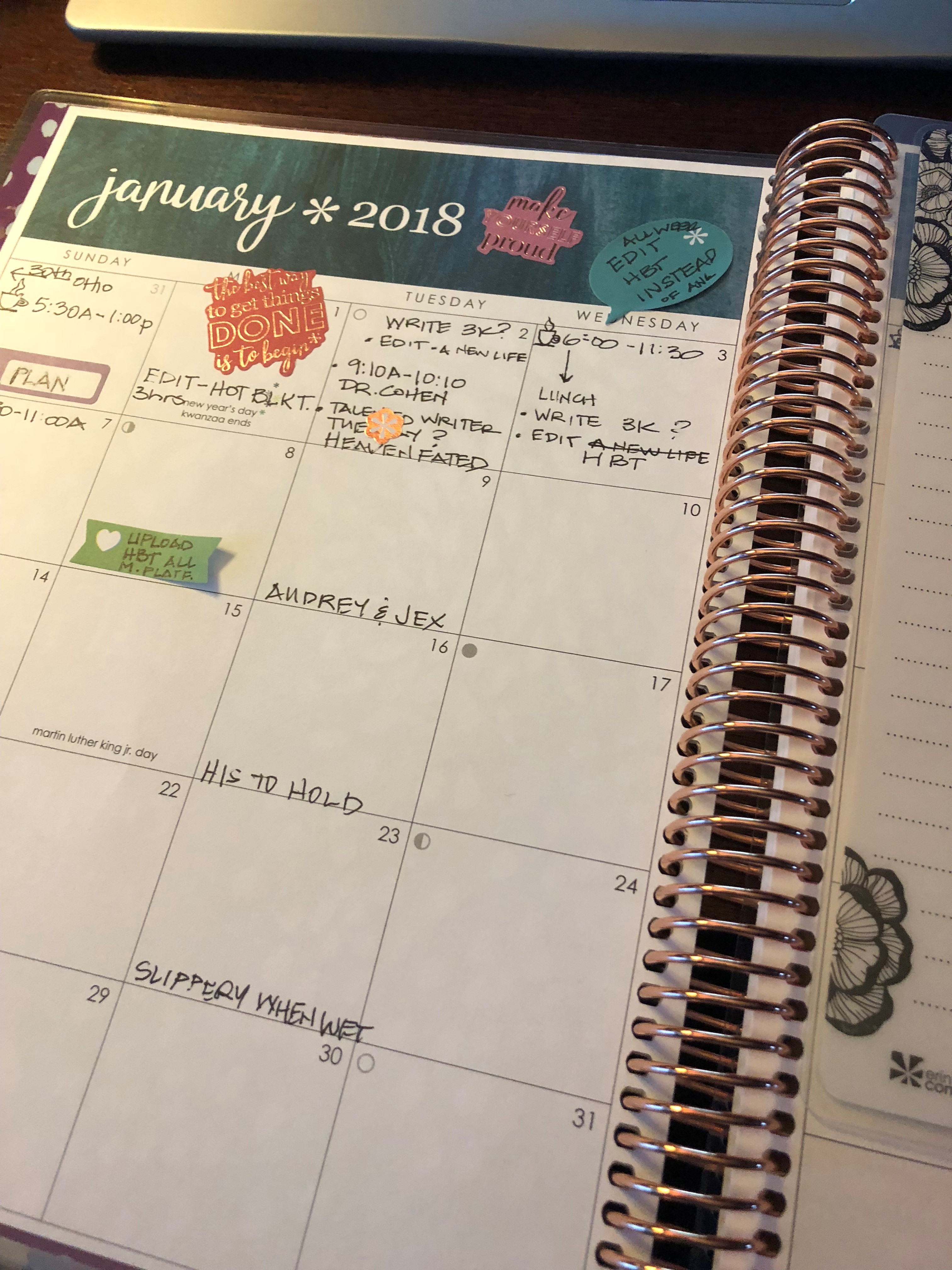
To help with the points above, I asked the same person, Robin Covington, what she used as an organization tool. She had mentioned Erin Condren’s Life Planners. What’s great about them is that an individual can customize it for a particular use. Plus, bonus, the planners, are made in America. In my case, writing. Here’s the link https://www.erincondren.com/. What it’s going to help me do is narrow my focus on writing while the appointments and scheduling for my family are on the periphery of this schedule.

In my twenties, I used Franklin Covey’s planning system, but I don’t think that style works for what’s happening in my life. I need more visual space to plan my day to day tasks. And I don’t want it to be on the computer. I want to be able to spread it out, look at it, touch it, get a feel for what’s happening next. I won’t stop using my computer schedule because I love being able to get a notification telling me that I better get on my way to make my appointment on time. But having something that is not digital helps my creative side and allows me to get down on paper the ideas of the sexy heroes and heroines I’m writing into stories. And one thing I did learn from Franklin Covey was how to prioritize a full schedule and strive to reach my life goals.

For the first point, regarding A New Life re-reading and editing content, I also need to tackle the grammar errors for publication and make sure the storyline is consistent. With all the things listed above scheduling is essential. If I tell myself I’ll set aside some time for the next day, if I’m not being specific in my listed tasks it won’t get done. I’ll sit down and read or go shopping.

Writing on a schedule seems natural enough, the dates and times and all. It’s the other things that get in the way that hinder the process. So, scheduling the time to write is what’s got to happen.  I’m used to free-writing on Tuesday’s. It’s my day off from making coffee and I have a significant amount of time. What should I do, I write it on the schedule. Appointment. Write on the schedule. Cello lessons for Kid #1. Write it on the schedule. My hope is, the time I set aside to write is productive. I still want to read as many romance novels as I can, but with my hours laid out, it will be easier to focus my ideas and get things done.

Marketing Hot Blacktop is something I’ve been doing throughout 2017, but I don’t think I’ve been as consistent as I can be. I could be using Facebook more efficiently plus all the other media platforms. I need to plan time to watch some tutorials. I need to link my Twitter, Pinterest, and Snapchat accounts to ramp up my marketing presence. Each one is part of my story, and I need to use them the best that I can. Here’s a helpful video I’ve watched regarding scheduling for a marketing focus by author Hildie McQueen.

And for the developing of stories, this planner system will allow me to add pics and fun notes about characters I’m developing, story ideas, arcs, and other tidbits. There are extra pages to use just for this purpose.

Now I have a plan. Here’s to being more efficient in 2018. Happy writing!
Editor’s Note: Writing isn’t the Difficult Step

So far this year, Deadwood Writers members have been actively publishing books and articles for a wider audience. Here are the books:

This list simply adds to the ongoing list of work produced by those who call themselves Deadwood Writers. Publishing work is a great accomplishment. Anyone who has done so can attest to that. But the work has only begun.

Writing isn’t the difficult step. Yes, it’s challenging, sometimes it feels impossible. Also, there are many who start and never finish. I have several incomplete manuscripts along my journey. But in relative terms, once the book is written and published, now there are the logistics of getting others to notice and read the book.

To put this in context, once someone is published, they have to sell their books. Get others to see the value of taking the time to buy the book and read it. Hopefully enough people like what they read and post a positive review.

There’s just the minor detail of getting one’s book noticed.

Creating and executing a marking plan is crucial. Rarely, and I do mean RARELY, does the publisher provide a marking budget that supports the author’s travels and their direct communications to the public. They do promote the book on their website and send it out to various media agencies, but the book is likely bundled with other’s books.

The best marketing is done by the author. No one is, or shouldn’t be, as passionate about the book as the author. Otherwise, the book is D.O.A.

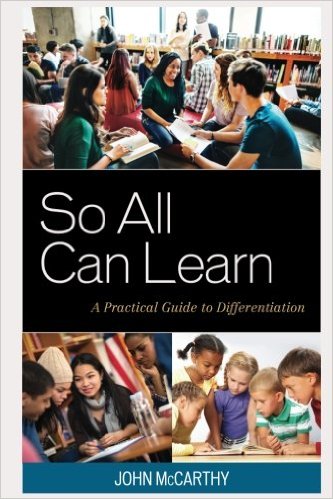
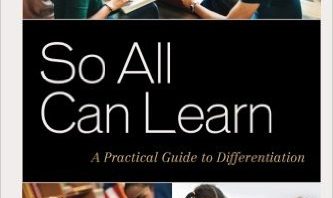
Marketing requires a plan to get the message out to others. Using social media. Getting early reviews that are positive. And many more needs. One of the best steps I took for preparing my book, So All Can Learn: A Practical Guide to Differentiation is hired Sylvia Hubbard for a one hour coaching session to address any needs that I might not have considered. Sylvia provided me with an abundance of strategies and ideas from her own extensive experiences (https://sylviahubbard.com).

The website is up for So All Can Learn (www.soallcanlearn.org). I am currently lining up presentations and talks on the topic of my book, so that people who attend will get a sneak peak of the treasures they’ll find within.

Once you have a plan, implement and commit to it. The marketing work never ends.

#This! A writer’s Social Media Friend

hashtags

Check out John McCarthy’s posts & other publications and follow @JMcCarthyEdS or Subscribe for news about his new instructional book coming in early 2017.

***

I like to write at my favorite watering hole: Starbucks. The place might vary but the “feel” is the same. So much so, that every Starbucks I spend time in is like a reflective copy of “the one” I visit in the multidimensional worlds. It just so happened that I ran into one of my writer friends and fellow Deadwood Writer, Diana Hirsch @dianahirsch (See her publications at http://dwhirsch.com). She also seems to live and travel among Starbucks, but usually in different dimensional paths than me. Her travels are well recorded. What makes mentioning her in this particular post serendipitous is that Diana does great work with social media marketing regarding her publications and life as an author.

An author is metaphorically and in reality an independent business. Self promotion is integral to their making a living. One author once recruited me to be her publicist for a novel. She said, “I need you to promote my book so that I can focus on writing my next book. I only want to write, not do the promotional work.” I gently turned her down. There is no better promoter than the author. Yet, I understand her feelings as the process for marketing is daunting. Where to start? How do you get the word out? Hashtags is one answer.

In social media, hashtags (or the # pound sign) represents categories for conversation. People follow the ones that represents their interests. For example, I follow:

#2Write

#AmWriting

#Dwriters

Here is a sample from Caitlin Muir “44 essential twitter hashtags every author should know”

#AmEditing

#WordCount

#WriterWednesday

#WritersLife

#YALitChat

#LitChat

#MemoirChat

#BookMarket

#ScriptChat

#PoetTues

#ZineChat

#WritingParty

#IndieAuthors

#WriteChat

#NaNoWriMo

#PBLitChat

Hashtags work with many social media tools such as Twitter, Instagram, and Facebook. Search for them and follow the conversations. When you are ready, reply back or share the posts in your social media of choice.

For authors looking to promote their published work, add hashtags to a social media post. That way, those who follow the hashtag will see your post. Share the post 3 times in a week for 3 weeks. Use different social media tools to get out the word.

Not using hashtags is like shouting in a dark auditorium. You have no idea who heard you, nor if anyone is around. A hashtag lights of the room and ensures that all who are listening (to the hashtag) gets the message.

Upcoming Posts This Month

  • June 2: Erica Stensrud – Do We Remember?
    Here is a special post to honor the men and women who enlist. They are all important and should be remembered. Read the first from Erica, a new voice, who we hope to see more posts in the future.
  • June 5: Jeanette A – Fallout 3: WTF Moments
    Ever played the games Fallout 3 or Fallout Vegas? Here’s a unique look at the game by a writer who plays the games in an unorthodox and successful way.
  • June 6: Barbara Pattee – The Trip of a Lifetime: Australia and New Zealand – Part 2
    The adventures continue as Barbara regales us on her amazing travel halfway across the globe from home.
  • June 8: Karen Kittrell – Give it to me straight: Fates and furies, Part 1 of 3
    Sequential plots, fractured plots, and story arc – Karen has it all in this deconstruction of a novel that gives insights into author craft. Read alongside her with a critical author’s eye.
  • June 15: Jon Reed – Bones
    Jon has the gift to make a true story about a fractured bone compelling and humorous. Become drawn into his latest personal adventure.
  • June 18: Diana Hirsch – @dianahirsch – Coffeeshop Chronicles
    Follow the monthly caffeinated escapades and explore life, opinions and values through coffeeshops, even if you’re a tea drinker.  You never know.
  • June 21: Claire Murray – Chautauqua
    It begins by asking what do you think when you hear the name Chautauqua, Chautauqua, New York? It talks about The Chautauqua being an adult educational experience in the 18th and 19th centuries and how Road Scholar has continued that tradition. It ends by agreeing with Theodore Roosevelt that it is “the most American thing in America”.
  • June 24: Sue Remisiewicz – @SueRemi – Lunch With a Stranger
    Will a casual encounter during lunch become something more for Alice? Find out in this new piece of flash fiction.


Editors Note: Self-Marketing – An Author’s Responsibility

inspiration

In publishing, the conventional wisdom is that authors are their best marketers. This idea is sometimes a hard pill to swallow. Authors love to write. That’s what they do. Marketing is a distraction that should be pushed on to the publishers. Right?

Um, no.

People buy books because they like the premise, the subject, and/or the author. One would be hard pressed to find someone who says, “I love books by this ___ publisher. I get everything they put out.” An author carries far more influence, or at least they can if they put energy into their marketing. If the book is an author’s conduit with the writer for developing a relationship, marketing keeps it alive until the next publication nourishment.

Social Media is an author’s friend. It’s a bounty of tools to engage with a potential readership before, during, and after a piece is written and published. Publication alone is like standing alone in a desert at night. There is no one to hear you sing, shout, or whisper. Social media like Twitter and Instagram is the equivalent to having a megaphone to start. Build a network of followers and use relevant hashtags (#) turns the megaphone into a satellite television broadcast to local communities. Here are some authors who do an amazing job with their “broadcasts”:

Hashtags are a powerful tool for expanding one’s influence.

  • #dwriters – all things about author’s craft and staying up to date on publications on this site: Deadwood Writers’ Voices.
  • #amwriting – find an eclectic resource of writing references and conversations by writers.
  • #2write – an up and coming place for resources on writing. Soon to be a chat group for live conversations by aspiring and published authors.

More on hashtags in the next installment. But here’s an article with 44 Essential Twitter Hashtags Every Author Should Know.

***

John McCarthy, Ed.S. has a forthcoming book in late 2016: So All Can Learn: A Practical Guide to Differentiation

Follow @jmccarthyeds & @stsorywynd for more updates and commentary.

***

Check out the May edition of Deadwood Writers Voices. Here is a sampling of what you can expect:

The Trip of a Lifetime: Australia and New Zealand Part 1 by Barbara Pattee on May 6

Barbara describes in detail the beginning of the enlightening tour she and her husband took to two island nations on the other side of the world.

Hot Blacktop, Ch. 11 Full Throttle, by Wendi Knape – @wendijowrites on May 10

Sienna’s shields protecting her heart are starting to break. Will she finally let Saint tear them down? Read Hot Blacktop’s Chapter 11, Full Throttle to find out.

Coffeeshop Chronicles by Diana Hirsch – @dianahirsch on May 18

Follow the monthly caffeinated escapades and explore life, opinions and values through coffeeshops, even if you’re a tea drinker.

Memory? By Claire Murray – @ClaireAAMI on May 21

Why do we remember some things so clearly and forget others? Why, on some occasions, when we hear a chance comment, do memories come flooding back but other times when we try to remember something we can’t?

Fine Dining by Sue Remisiewicz – @SueRemi on May 24

A monster reemerges after being buried for centuries and craving human flesh to eat.

Paper’s First Mass Extinction

The digital age is upon us, it’s everywhere we look today. Literally, no industry is safe when doctors can now print 3-D parts for a heart valve repair minutes later. What possible chance do printed books have by the year 2025? Slim to none, sorry to say.

By then, publishers will only print Limited Edition books that authors and illustrators will sign and that collectors and fans will treat like trophies. Books will only be purchased – and thus printed – for their beauty or their collector appeal by 2025. Attractive, leather bindings with inlaid gold designs touting popular titles will command hundreds of dollars, but the “trade editions” will all be ninety-nine cent digital versions.

Text books – all learning material for that matter – will fall like dinosaurs during the first mass extinction of pulp. These books will die out because of their sheer weight alone, but so, too, will all sci-fi, suspense, mystery and romance stories. Novels will lose out because they hold no advantage on paper. They are more expensive and take longer for everyone involved, from author to publisher to seller to readers. In the end, economics rule. Without some other inherent value, there will be no reason to keep a novel once you’re done reading it. If that’s the case and e-books remain cheaper, then print is dead. Long live E!

Some genres should survive until 2025. Children’s books will still be in print because they are illustrated, but their days are numbered, too. Biographies with their childhood photographs, documents, maps, and other such supporting evidence have a home on the future bookshelf for those very reasons, at least for a while longer. Religious material will continue in print because you take this Book with you to Church to read along with the faithful. Even so, at some point, churches, too, will be distributing prayers, sermons and missals on e-readers left in the pews.

Cookbooks and other reference material – the kinds of books that people dog-ear and write in the margins of – will continue to be printed because we treat them like tools while working on related projects. It’s hard to see other formats surviving, though. How are you going to convince today’s youth to put down their iPhones and pick up something printed on paper?

The year 2025 is only a decade away. For the first mass extinction of paper to come true by then, all these dire predictions will need to travel at the speed of light.

Exactly!

A decade from now, authors, Amazon, and the publishers who are sure to follow, will be too busy translating their e-novels into other languages without making embarrassing mistakes. That will be everyone’s main concern. The war over “cover price” will be long over. Free market enterprise will set the price. It always does in the end.

I think third world countries will be the new marketing frontier ten years from now, not just for books but for e-everything. Authors and publishers could thrive with the Polaroid Theory of Marketing in those countries by providing them with cheap e-readers and free internet.

Dr. Edwin Land’s marketing strategy in the 1960s was to effectively “give away the camera to sell the film.” This was akin to financial suicide in an industry where cameras cost hundreds of dollars and the photographic film costs pennies to turn into pictures. But Land had a theory, which was this: people will pay dearly for instant gratification.

Land priced one version, the Polaroid Swinger,  under $20.00. Cameras were not household items in the 1960s until Land’s affordable entry pricing made them popular. But, where 35mm film was cheap – $4.00 to develop a roll of 36 photos – it had to be mailed to a company to be turned into pictures. It took about a week to process, and sometimes you got someone else’s pictures back instead of your own. That could get embarrassing. Polaroid sold ten pictures for $7.00, but you held your Polaroid picture in your hand one minute later, while the moment was still fresh. It was our first taste of instant gratification, and we showed great marketers like Edwin Land, Bill Gates and Steven Jobs just how much more we were willing to pay for it.

Create a $20.00 e-reader today and the Polaroid Theory guarantees that everyone of age in Africa, Asia and the poorer parts of the Americas will have access to all kinds of books. With today’s technology, all it requires is a few drones parked in the sky to gain access to millions – billions – of potential e-book buyers. This means instant global gratification for e-books and global extinction for print. A $20.00 e-reader could conquer the world with ten books for seven bucks instead of ten pictures. Everyone from author to publisher makes more money with the Polaroid Theory because millions of more copies are sold. The costs to create more copies spiral down with the economy-of-scale, and if the novel never catches on, the cost of failure is survivable.

Think bigger than that. It is possible bilingual e-books could give rise to English as Earth’s common language by 2025. It almost is now. Think of what that means to all fiction authors, regardless their native tongue.

Printed matter’s second life is destined to become firewood at some point during in the next decade. Even something as sought after today as a first edition of J. K. Rowling’s Harry Potter and the Goblet of Fire, I’m sorry to say. As an antiquarian dealer, I worry about this a lot. I’ve stopped investing in modern classics produced after 1980.

Tomorrow’s bookshelf is today’s trophy cabinet. By 2025, we’ll keep our treasured tomes locked behind glass and out of direct sunlight. When someone asks if they can take one out, we’ll smile and say, “I’ve got that book on my iPad, too, if you’d like to read it.”

Next Month: Back to the topic of writing. If the future of fiction novels is strictly digital, how will that affect the way authors pace their stories? Are we headed for the 140-character novel? Will an author need to work with an illustrator to have any chance of success? Is writing a novel morphing from solitude to team project? And, if so, then whose e-voice is this, anyway? Stop by next month and explore these thoughts with me.