Tag Archives: writing

Writer’s Block: 8 Strategies to Bust Out

In my last blog, A Picture is worth a Thousand Words, I talked about free writing. The pictures I used sparked my imagination, but pictures aren’t the only way to get out of a creative rut, they were just one example.

Writers know that a slide into the white abyss of a blank page will eventually happen; the dreaded writers block. We also know how to influence our writing style for the best results, what exercises we can use to push our thoughts into a colorful explosion of images created by our words. Even if we’re trying to start a new project, develop a new character, or find a crazy and different meet-cute that will attract readers, we all have certain exercises we like to use. Or we find the ones that help our creative process unfold.

Here are some of my favorite ways to break down walls that are stalling my creativity, or what I use to come up with something fresh.

Tarot Cards

A few years ago, one of my favorite mystery writers was having issues with character development. Her main protagonist in her series is a psychic. The first idea that came to mind was to suggest the author pull a tarot card and use it to develop character traits.
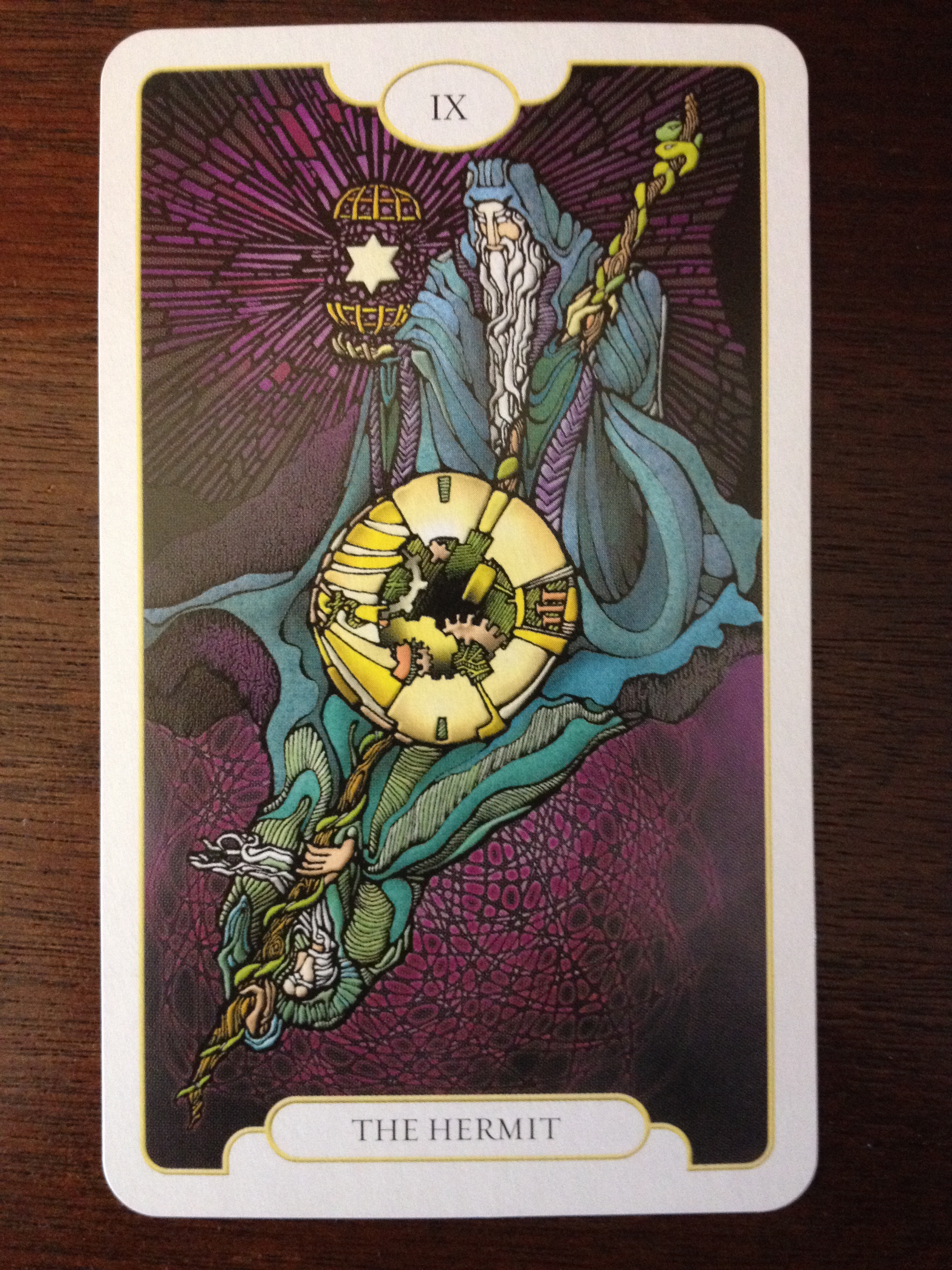
Zach Wong, Revelations Tarot

Zach Wong, Revelations Tarot

I randomly pulled one of my own tarot cards while writing this and drew The Hermit card. In Zach Wong’s depiction of The Hermit from Revelations Tarot–based on Arthur Edward Waite’s and Pamela Colman Smith’s tarot deck–the image represents “a teacher, someone wise, or an old soul who can point you in the right direction.”[1] The card, “recommends wisdom and forethought before making a decision.” [2] If I draw the card in reverse (upside-down), “the card reflects the need to run away from situations and to hide from problems.”[3] The interpretation of the card is completely up to the author. My take on the card is the character could be on an internal journey that will lead to answers that he/she has been searching for, finding happiness. In reverse, it could mean the character mired in his or her mind, morphs into an unreality that threatens them or others. Hero or villain, draw your own conclusions.

Word Association

Another exercise I like to use when I’m stuck is word association. Even though in your own work you’ve developed everything down to the single gray hair that your character can’t seem to get rid of, he or she might not be moving in a direction you foresaw. So what do you do? Try listing words in a column, by hand—a change of medium might help too—that relate to an inner turmoil or flaw your character has that is keeping him from getting to the end of his journey. In an adjacent column, write down where you want your character to end up, what place you might want him to go physically, or something he might need to find, a person he needs to see, things that make him feel good, or bad, etc. It’s all up to you. Nothing may come from the exercise, but you might also light a fire that you don’t want to extinguish.

A book that shows a slightly different take on word association is Plot & Structure: Techniques and exercises for crafting a plot that grips readers from start to finish by James Scott Bell. Bell talks about the use of mind maps.[4] He breaks it down into three steps: ready, fire, and aim.

  • Ready, invites you to pick a concept you want to develop. Pick a word the story should revolve around. Bell gives baseball as his example.
  • Fire, inspires a scrawl of words with connections and associations to the one word concept.
  • Aim, allows the writer to sift through words they have written down. Bell’s exercise inspires the writer to find direction to their thoughts and gives a good sense of the journey the writer might want to take as the story unfolds.

Books

A great place to find writing help are the old trusty books about writing. We all have them. A few I’ve found very helpful are Writing Tools by Roy Peter Clark, Make a Scene by Jordan Rosenfeld, which I spoke of in an earlier post, Clarity, and Write Starts by Hal Zina Bennett.

In Writing Tools, Clark gives clear editing tools allowing us to improve on what we’ve written, which once done helps engage the reader more. With the use of chapters like, Tool 6, Take it easy on the –ings, or Tool 28, Put odd and interesting things together, he helps us in the editing process. For the latter, Clark gives an example from Madame Bovary by Gustave Flaubert. The author uses ironic juxtaposition to enhance a scene and make Madame Bovary oblivious to Rodolphe Boulanger’s true intentions.[5] What if you did this with your own work? Take one of your scenes and change it up. How can the background give you focus to the mood or motives of your character, while leaving the other character in the scene in the dark? It might allow you to richen your dialogue or give a dull scene a glow that never would have come about if you hadn’t taken the time to look into tools that work for you.

The examples above might not be perfect for you, but they could give you a jumping off point to do your own search on the internet. Below are a few places you might want to start your search.

  • Fiction University by Janice Hardy takes you through several areas of the writing process and answers many questions that might motivate you to write again.
  • One Minute Writer – This blog is a place where writing from a prompt can help you get words on the page; any words.
  • 13 Famous Writers – Read about famous authors own solutions for writers block.
  • A Map to Get Out of Writer’s Block – A great diagram of questions you need to ask yourself to help clear your thoughts and get writing again.

[1]Zach Wong, Revelations Tarot Companion, Llewellyn Publications, 2005, 29.

[2]Zach Wong, Revelations Tarot Companion, Llewellyn Publications, 2005, 29.

[3] Zach Wong, Revelations Tarot Companion, Llewellyn Publications, 2005, 30.

[4] James Scott Bell, Plot & Structure: Techniques and exercises for crafting a plot that grips readers from start to finish, Writer’s Digest Books 2004, 45-46.

[5] Roy Peter Clark, Writing Tools, Little, Brown and Company, 2006, 137.
Write What You Know

When I first started writing for Deadwood Writers’ Voices a few months ago, I agonized over what I was going to write about. Then I went to California. There I read some letters that members of my family, who I’d heard about but never met, had written long ago. The letters brought them to life. I could hear my relatives speaking in their own words. I felt that we’d finally met.

I started writing their stories. That was very helpful, besides being enjoyable. I didn’t have to ask myself each month, what am I going to write about? I knew. I was going to write the next part of the story.

Now the series is finished. I need to find something new to write about. This morning I decided to try a different approach. Instead of panicking, I was going to do what all the books said: Write what you know. To be honest, I didn’t have much faith in this approach, but what did I have to lose?

I decided to go swimming. It’s my favorite form of exercise: 45 minutes in the warm water pool going back and forth. I feel so good afterwards, relaxed, happy, stress free. The icing on the cake is I’ve actually lost a few pounds along the way.

It was a perfect day. The sun was shining. It was still cool outside. I felt energized.

I threw my swim bag in the front seat, popped into my car and started driving. It’s eight minutes from my garage to a parking spot at the WCC Health Club.

I drove out of the condo and turned left to go down Dixboro Road. Wow! All I could see on my side of the street was a line of red taillights and not one of them was moving. Ugh! It was five minutes to nine.

The first intersection was exactly one mile south on Geddes. It handles all the cars of people going to work coming down Dixboro and those exiting from I-23 to go down East Huron River Drive to get to Washtenaw Community College, St. Joseph Mercy Hospital and, most important to me, the Health Club.

It’s always busy this time of day but never like this: One mile of taillights and no one moved. This was a first! Then I remembered last night’s storm. The stoplight at the corner was probably out. And, knowing the Ann Arbor police, they probably hadn’t sent anyone to direct traffic. Their philosophy is, “Let them work it out.”

In the distance, I could see the headlights of three cars coming toward me. Suddenly the two cars in front of me made very fast U-turns and went up Woodridge Avenue to my right.

Mmmmm. If I’m quick, I could do the same thing. That would take me to Earhart, which would bring me to Plymouth Road where I could get on #I-23 and go south around this mess to Washtenaw Avenue. Then I could turn up Golfside and, voilà, I’d be there. In other words I could make a circle going west around the whole area, come in from the east side and have my swim after all. It shouldn’t take more than about ten minutes.

Congratulating myself on my quick thinking, I turned onto Plymouth Road and drove across the top of I-23 so I could get on the ramp going south.

“Ugh!” was all I could say. Looking down at the southbound lanes I wanted to cry. No one was moving there either. It was just one long parking lot.

O.K. now it’s time for another brilliant idea and this one better work. I could go south on Green Road, then west a little to Huron River Parkway. I could still make the western circle and I’d be down on Washtenaw, which hopefully would be moving.

Then I looked up. Straight ahead, Plymouth Road was stopped. The light was red. The intersection was clogged. No one was going in any direction and it didn’t look like anyone would be anytime soon.

Suddenly, although the sun was still shinning and the air was crisp, it wasn’t such a beautiful day anymore.

Luckily I was able to maneuver myself into the left lane and turn into the strip mall. I drove past Zamaaman’s, the Korean Restaurant, and turned left past Busch’s. Now I could skip the sea of cars at the light and exit onto Green Road.

Heading south on Green Road, I started to smile again: no traffic. The same was true on Huron Parkway. I just floated along and made a left onto Washtenaw and even that wasn’t too bad.

Best of all, every light was working all the way east to Golfside. I turned left at East Huron River Drive, drove past St. Joe’s and into the WCC Health Club’s parking lot at exactly 9:33. Not bad, only 38 minutes to drive what should have taken eight!

Minutiae

According to Merriam-Webster.com, “Mystery” means anything that is not understood. Its origin pre-dates the bible. “Suspense” is defined as nervousness or excitement caused by wondering what will happen. It was first used in the 1500’s. “Minutiae” means trifles, details and smallness, and it dates to 1782, making it the new kid on the vocabulary block. The elements of minutiae can enhance both mystery and suspense, but they are used differently in each genre.

In a mystery, you don’t know who done it; that’s for the protagonist and the readers to figure out. The author plants clues throughout the story, and those clues are often in the minutiae, the small details in the beginning that have large consequences in the end. For example, break a fingernail in Chapter 1 and have that fingernail show up at the scene-of-the-crime in Chapter 7. Mystery readers need to be on their toes, constantly asking themselves, “Why did the author choose this minutiae to express that scene?” Readers won’t fault the author if they figure it out before the end. Instead, they will think of themselves as very clever for having done so.

In a suspense novel, the reader knows who did the dastardly deed, often from the opening chapter. There is no mystery to the story itself. Instead, there is plenty of mystique in the characters, and the readers are left asking, “Why does she always do that?” Readers don’t fault the author if the character’s mystique is double-handed or morally corrupt, so long as the author explains the minutiae in a rational way for that character’s development.

In a mystery, minutiae mystifies the storyline, in suspense it mystifies the characters and their actions.

What you choose say is just as important as when you say it. Character traits are popular with authors because these small details pull double duty with character development, and they don’t have a “sell by” date, meaning you can bring them back in your next chapter or next novel.

One place where minutiae can play a part in your novel is when you want to slow down the pace. Never use minutiae to speed up the action, like: His fist floated into Fred’s flabby gut. He heard him go oomph and gleefully watched Fred double over in pain. Instead say: He hit Fred once and watched him double over. Only use minutiae to slow down the action: The wine’s robust aroma floated in the air and competed with her perfume. He inhaled deeply, slowly; this was a night he had to savor.

Entirely new scenes and romantic moments can also benefit with a sprinkle of minutiae, to let the scene breathe. But this minutiae is only used once to full effect, then condensed for any revisits. Case in point: here’s a “first” scene from my upcoming novel Knock Softly (working title). The characters make several visits to the park and dog run with our protagonist, Edvard, and his two dogs, Rufus and Pudge, throughout the story. The dogs weigh 75 and 25 pounds respectively. (The novel goes into more detail on the dogs, too, but here such detail would only be minutiae.) This scene involves only a small portion of the 1.2-mile walk. Knock Softly is told in present tense.

Long before they arrive at the dog run, Ed has to walk the dogs past a family of oaks that proves to be home to an entire community of squirrels. The trees are a magnificent cluster whose matriarch stands dead center and at least 80 feet tall. The grounds under the oaks are well shaded and almost barren of other trees or tall vegetation. Their broad branches and long, fingered leaves steal all the sun’s rays leaving this part of the walk always cooler, darker. Rufus lifts his ears in eager anticipation and starts pulling on the leash. Ed wraps the leash around his wrist and braces for impact.

Readers revisit this part of the path again in another scene several pages later, but in the second scene, the pace is much faster and it is dialog that sets the pace. The scenery is just the canvas:

They’re getting closer to the oaks and both Ed and Rufus know it. He wraps the leash around his wrist before they get to the shadows and gives it quick jerk to let the dog know who is boss. Ed tells Jane… And the dialog follows.

All the minutiae from the first scene are present in the second, just not on the page. Left in the readers’ thought bubbles are the cluster of trees, the squirrels, and all the other previously established minutiae. To put all of that on the page again would only bog the story down when it wants to run.

And never use the same minutiae twice – that’s worse than marrying your brother-in-law in the same wedding dress.

Next Month: First Impressions
They say you never get a second chance to make a first impression, but much of fiction is character development. Development means change, and suspense means changing those first impressions. To write a great first impression in a novel, you have to first think about what your characters are going to develop into. Then figure out what kinds of darling details, social settings and backstories you need to get them there. Next month we’ll look at how to make a good first impression on the page.

Amazon, Hachette and “the wretched $9.99 price point”

Print is dead.

At least, that’s what the Big Five publishing houses fear. One company is fighting the potential loss of sales and its possible demise in a public battle that affects readers and writers alike.

Before 2007 or so, the only way an author’s story was read was through a print copy in brick-and-mortar bookstores. The only way to get into a bookstore was through a major publisher. Knowing their control, these large publishers chose the stories and genres people read, the prices at which books were sold and what the authors got paid.

Now that snippy digital upstarts like me are snooting our way in and circumventing the system they so strategically designed, publishers are no longer needed. With digital formats, there is no gatekeeping; I can write and publish any book at any length in any genre I choose and at any price.

Without hardcover or paperback books, the publishers’ choking grip on the market disappears with the turn of a page. The Big Five lose all public prestige, respect, expertise, control and sales. Especially sales.

Welcome to the battle between Hachette and Amazon.

Hachette wants to charge high e-book prices to discourage electronic sales and boost paper sales. Amazon wants to keep prices of e-books favorable to consumers. This dispute has been going on for years. To understand the impact of today’s feud, let’s go back in time for a brief history….  (Shout out thanks to J.A. Konrath’s timeline for the format inspiration that I use.)

NOVEMBER 2007

Amazon releases the company’s Kindle e-reader.

NOVEMBER 2009

Barnes & Noble introduces the company’s Nook e-reader.

Retailers continue buying books and e-books using “wholesale pricing,” an agreement in which publishing houses charge half the printed cover price to those retailers. The booksellers then compete with each other by discounting books or offering sales. At this time, hardback book prices range from $15-30.

Amazon is a large company with a large share of the e-book market. They rarely sell at full price, offering book titles below the printed cost, even as far down as $9.99 for bestselling novels. The Big Five publishers make a lot of money through the sales of higher priced hardcover books, and this consumer-friendly price point might encourage more digital sales than paper. These companies didn’t want that to be the standard that consumers would expect to pay.

JANUARY 2010

Apple prepares to release its iPad, but if they offer books in their iBookstore at a price to compete with Amazon, the company will lose money. A publishing executive blames Amazon’s “wretched $9.99 price point.” Apple and the Big Five publishers work out an agreement that benefits everyone. The publishers switch book distribution away from wholesale pricing to the new and improved “agency pricing” model. In this agreement, publishers control the price of the e-book rather than the retailer. Sales percentages are split favorably, as well: 30% to Apple and 70% to publishers. In this scenario, consumers who choose to buy e-books instead of physical copies are, in a sense, be punished for affecting paper sales.

The only caveat is that all publishing houses have to sell this way to all of Apple’s competing retailers, including Amazon. Amazon pushes back, but with everyone else agreeing to this method of distribution, the company has to accept these terms. Book prices on Amazon’s site rise to $12.99 and $14.99. The term “colluded” is later used when referring to this agency pricing arrangement.

APRIL 2010

Apple releases the iPad.

JULY 2010

Amazon reports that digital e-books outsell hardcover books for the first time in history. The agency pricing continues for two years before the U.S. government steps in.

APRIL 2012

The U.S. Justice Department (DOJ) accuses Apple and the publishers of conspiring to raise e-book prices and filed a civil antitrust lawsuit. By developing and utilizing agency model, “the publishers prevented retail price competition resulting in consumers paying millions of dollars more for their e-books” especially for the most popular titles by big-name, best-selling authors.

Three of the Big Five publishing houses, which include Hachette, settle immediately. Retailers resume discounting and offering sales. The publishers pay financial restitutions to consumers and are “prohibited for two years from entering into new agreements that constrain retailers’ ability to offer discounts or other promotions to consumers….” The DoJ settled with two other publishers and Apple by 2013, yet Apple appeals the decision.

Now fast forward to the present year. Apple’s appeal is ongoing as of this post.

JANUARY-FEBRUARY 2014

The 2-year contracts are ending, so new ones need to be negotiated or extended. Amazon sends a contract to Hachette. Because they do not receive a response from Hachette, Amazon removes the site’s pre-order buttons and stops discounting Hachette titles.

MARCH 2014

Hachette’s contract to sell books with Amazon expires, but Amazon extends it into April while both sides negotiate. Because the outcome is uncertain and shipping dates cannot be guaranteed, Amazon reduces the print inventory of Hachette titles.

APRIL 2014

There is now no longer any contract for Amazon to sell Hachette titles on Amazon. Hachette finally makes counter offer, Amazon rejects it.

MAY-JUNE 2014

Hachette authors notice slower sales, so Amazon makes several proposals that they and Hachette offer financial provisions for the authors during negotiations. Hachette declines all of them.

JULY-AUGUST 18, 2014

Here’s when media runs wild with statements, press releases and proposals, oh my!

Hachette compiles its press releases and statements regarding Amazon here.

Propaganda or perspective? Article from Random House editorial assistant Alison Herman with intriguing links at the end.

Big Five authors want print to thrive. Who can blame them? Without physical books, bestselling authors like Stephen King, John Grisham and James Patterson lose their dedicated personal assistants and vacation beach houses. They each become “just another little writer” in a writer’s ocean.

There is a letter from Douglas Preston, a Council Member of the Author’s Guild, signed by authors supporting Hachette. As of August 9, the letter had approximately 900 signatures, published as a full 2-page $110,000 advertisement in the New York Times as “A Letter to Our Readers.”

There is a petition by Change.org urging readers and writers to support the company who supports readers and authors. As of August 9, the petition reached 8000 electronic signatures. (8466 as of my post)

On August 9, The Amazon Books Team releases a letter discussing their point of view from within the negotiation. There are some good links at the end. It’s worth a read through.

The email reply from Hachette CEO Michael Pietsch in response to Amazon’s August 9 letter request for consumers to contact executives about the negotiations.

Amazon releases a statement justifying the $9.99 price point: “For every copy an e-book would sell at $14.99, it would sell 1.74 copies if priced at $9.99. So, for example, if customers would buy 100,000 copies of a particular e-book at $14.99, then customers would buy 174,000 copies of that same e-book at $9.99. Total revenue at $14.99 would be $1,499,000. Total revenue at $9.99 is $1,738,000.”

And here we are, readers and writers, reeling in the wake of potential propaganda from both sides. Marketers in any company can spin numbers any way they want to make the numbers show in their favor. I don’t necessarily believe in Amazon’s exact number or those calculations empirically, but the rationale behind it is solid. If I had $15, would I spend it on one book? Am I more inclined to buy a $9.99 book and a coffee and muffin to enjoy while reading the book? If a purchase like that gives me that pleasure, then I’m encouraged to buy another similarly priced book for a similar experience.

“Why should e-books cost as much as, or more than, a printed copy?” my husband asked me. “There’s no shipping or printing.” He’s a chemist and not in the publishing industry. If this is so elementary to someone outside the industry, how is it lost on someone in the publishing business?

I’m not necessarily pro-Amazon, but I am pro-information. Some people do not have the drive or desire to do it all, so turning their work over to a Big Five publisher is the best option for them. But how is Hachette assisting and nurturing its authors when it let their contract with Amazon expire, and thus all its authors’ contracts as well?

If Amazon wins this battle, they will dominate the market…for now. At some point, all Amazon authors could be stuck with a business model that no longer offers today’s benefits, and then Amazon becomes the Big One publisher. If that happens, authors are not stuck.

Unlike print, where the only way to publish was through a publisher, there are now numerous electronic options. No doubt any number of smaller publishers and retailers will develop online stores. Any author can sell directly from their website. These were options never available before.

Who needs who more, Amazon or Hachette?

Who, or what, do authors need?

Print may be dying, but books and stories never will.

Yes, you can publish a book

My thoughts on self-publishing


What is stopping you from publishing your book?  You are.

I have self-published two books so far, and I am thrilled about it.  With the introduction of eReaders, writers have complete freedom in their craft.  You have the ability to post anything online through a blog and various social media, and now you have the socially-accepted ability to publish a book.  But that was not always the case.

As recent as 10 years ago, the only way to buy a book was as a printed copy in a brick-and-mortar bookstore.  The only way to get your book into those stores was to sign a contract with one of the traditional publishing houses headquartered in New York.  These companies controlled physical book distribution, and they didn’t make the process of acceptance easy.  Even with well-crafted query letters and strong sample chapters, you still needed a smidgeon of luck that your manuscript found its way to the right editor or agent to believe in you.  If you made it through that professional vetting process, then you had the validation of being a “real” writer.

If your work wasn’t good enough to be accepted by the industry, then the only way to get your story to readers was to fake professionalism.  You had to print it on your own, with the stigma of “vanity press” trailing your byline.  I believe that was a phrase created by publishing houses.  If you had to print and peddle your wares yourself, then you weren’t a professional writer.  This legitimized publishing houses and enhanced their aura of attraction.  Without any sense of quality control or standards, what was there to keep the sludge out?  Such a book was an ego trip, and the only sales would come from family and friends.

On a base level, I understand that perception, especially after my experience at a 1998 independent publishing convention in New York City.  Unknown authors sat at tables just as if they were at a real book signing, so I figured there must have been some judging or invitation to be there.  I came across a hardback book with a colorful cover protected by a clear plastic slipcover.  It was a subject I was interested in writing, so I bought it.  Anyone who looked good must be good.  However, after reading the book, I learned that if you flip to a random page, any page, you will come across a grammatical error, a spelling mistake or a bombing of the F-word.  I’m serious.

No wonder people didn’t trust vanity press authors.  How could you tell a skilled writer from a sloppy ego trip?  Anyone can slap pieces of paper between a sturdy cover; professional-looking photography on the outside doesn’t guarantee that editing and grammatical care was taken on the inside.  I fell for that with the college book.  For all I know, those writers paid to rent table space, so anyone with money could have been there.  Reputable publishers guaranteed those services and more, so you took your chances with independents.

I didn’t have extra cash to toss around just to be labeled a phony.  If I wanted legitimacy as a writer, I would have to play the publishing lottery.

Now welcome to the brave new world of indie publishing.

“Vanity press” fades into obscurity as “self-publishing” gains legitimacy through e-pioneers like vampire series author Amanda Hocking , fantasy writer H.P. Mallory  and mystery-thriller author J.A. Konrath . Self-publishing is now a viable, accepted method of getting books to readers, especially with the popularity of eReaders.

Self-publishing gives anyone the opportunity to be a Published Author.  Young or old, newbie or established, there are no arbitrary opinions guidelines to keep otherwise-successful writers out of the market.  There are no external factors in this enterprise.  No one is sandwiched into a particular subject matter because new genres are created all the time.  Established genres are combined.  There is an outlet for niche topics directed at specialized audiences.  Story length is not limited to traditional page counts. These fringe elements, un-tested and un-proven as even mildly popular, are things traditional publishers would never touch. But you can.

Anyone can be a fantastic storyteller.

Now we can legitimize ourselves.  All writers have egos.

With such ease, there is still that initial concern: how to navigate through the slush to ferret out the gems.  Well, how do you do it now?  When you walk into a bookstore, what do you gravitate towards?  Is it a particular genre, the bestsellers, the sale items or the staff picks?  What makes you pick up a book: cover art, the subject material, the title or reviews and recommendations?  Online browsing is no different.  The book’s “back cover” summary is listed above the reviews.  Just like flipping through pages in a store, many writers offer the reader a sample to download and preview.  Ultimately, you don’t know how good a book is until you read it, just like any traditionally published book.  What is “good” and “bad” is subjective, but now you have more options, authors and books to discover.  It is more likely you’ll find a story worth reading, one you’re interested in.  This is a good thing.  It’s a great thing!

Given that, does a publishing house matter?  Nope.  Readers do not need publishers for distribution because eBooks are available electronically.  I’ve always bought books based on my interest, not the publisher.  Quick, without looking it up online, who publishes Stephen King?  Dean Koontz?  Danielle Steel?  Nora Roberts?  I find that people are brand-loyal with dishwashers, coffee, laundry detergent, cereal and soda pop, but not books.  Think about movies.  Have you ever heard anyone say, “Oh, I won’t see that movie because it’s not produced by 20th Century Fox.” ?  In fact, it’s an honor to have your film selected for the Cannes International Film Festival.  Is that called “vanity filmmaking”?  Many unknown filmmakers are introduced there because artistic quality (good storytelling) is the key there, not the big-name directors (best-selling authors) financed by big-name production studios (publishing houses).

Some writers need that perceived validation.  Some may not want to be involved in the details of work outside of the actual writing.  That’s personal preference.  I’m not one of those people.  I prefer the creative freedom.

Think about it.  You create the cover art you want.  You choose your editor, or make the decision not to use one.  There are no printing costs outside of any print on demand (POD) because publishing is electronic.  You set the price, and you can change that any time and as often as you wish.  At this time, royalties are higher than with a traditional publisher so you earn more money.  You can upload a story of any genre or any length because today’s readers accept both.  You publish on your schedule.  You can upload new versions at any time, thus customizing or updating content.  All it costs you is your time.

Note the theme above?  It’s control.

For all those reasons, I chose to self-publish.  Why not?  As of this post, I have two books available on Amazon.  At short stories that are 21 pages each, no publishing house would waste the ink and dead trees.  I don’t blame them, and I don’t fault them, so I took the power and launched them myself.

Remember that ego thing I mentioned earlier?

Does self-publishing my work–the lack of a traditional publisher– make me less of a writer?  Does having a book in print make me more of one?  I don’t think so, but it’s a fun thing to do.

So far, my self-publishing journey has been a positive one.  I hope you’ll follow me along this adventure because this is not the end.  I’ll continue to share my experiences.  Feel free to share yours in the comments below.

Will I be successful, whatever the definition of “success” is?  Would you be?  How will you ever know if you don’t try?

Nothing is stopping you but you.