Tag Archives: writing

Wordplay: My Geek Is Showing

I failed my children by not pushing them further in studying spelling and vocabulary. One of my sons, a senior in high school, said to me that he just doesn’t know very many words. His limited repertoire made writing essays for his college applications a difficult and grueling process. Writing never came easily to him.

In contrast, I’ve always loved penning my thoughts and studying the mechanics of grammar, selecting the right words to convey my meaning. I love playing Boggle and Scrabble, and I look forward to quizzing myself with Reader’s Digest’s “Word Power.” I stop myself from giving my son too much writing advice because it’s important that he express his own thoughts in his own way. In looking back at the differences in our educations, I have an idea of why he struggles more than I do.

My elementary and junior high schools encouraged participation in spelling bees. I spent hours on rote memorization with the help of my patient mom. She read pages full of words out loud to me, one word at a time. I never once thought to ask her what the origin of an unfamiliar word was, but today’s top spelling bee contestants frequently make use of that rather sophisticated technique. If I had known there was more to studying spelling than memorization, I might not have lost first place to Kathy Trotter in the sixth grade. I didn’t know how to spell curry. Rote memorization only got me so far. Fortunately, I wasn’t competing for a college scholarship. The short-term goal was simply praise, a dictionary, and a trophy. The lifetime benefit was that I became a good speller.
KellyDeadwood-2015-11Nov-ToiletTreesList

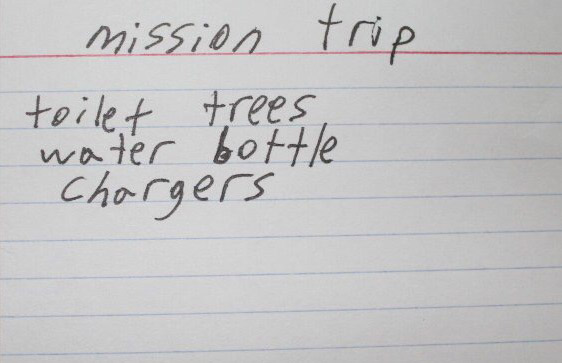
Spelling and vocabulary matter: I had to let my son know that toiletries would be easier to pack.

Sixth grade for my children was a different experience. Their spelling words were taken from their own journal entries. The children were tested on words which they individually used in their own writing exercises. I understood the practicality of holding students responsible for using self-selected words correctly. But I wanted a bigger challenge for my kids. How would they learn new and unfamiliar words and to expand their knowledge of language?

I reminded myself that teachers aren’t solely or primarily responsible for our children’s educations. As parents, we need to instruct and guide. To complement my children’s elementary school lessons, I developed a game that I thought would challenge them and be fun for our entire family.

During one week, I randomly selected a word each day from our two-volume dictionary. By the end of the week, we all had to know how to spell the seven chosen words and combine them into one sentence. The sentence could be longer than seven words, but it had to reflect correct usage and meaning. Essentially, the family and I studied a word a day—similar in scope to what Merriam-Webster currently offers online—but my game involved the added challenge I was seeking.

So that you can see how this game worked, I’m going to borrow the seven “Word of The Day” selections which Merriam-Webster promoted from October 29 – November 4, 2015. First, we have to consider the definitions of the words. The list below is taken verbatim from www.merriam-webster.com.

Pellucid: admitting maximum passage of light without diffusion or distortion; reflecting light evenly from all surfaces; easy to understand

Underwhelm: to fail to impress or stimulate

Ebullient: boiling, agitated; having or showing liveliness and enthusiasm; exuberant

Microburst: a violent short-lived localized downdraft that creates extreme wind shears at low altitudes and is usually associated with thunderstorms

Ruddy: having a healthy reddish color; red, reddish

Confidant: one to whom secrets are entrusted; especially: an intimate friend

Trepid:  timorous, fearful

Now comes the hard part: we have to consider those definitions in anticipation of using the seven words to construct one sentence. Here’s my solution to the puzzle:

My ruddy confidant was caught in a microburst which left her so trepid that, when she couldn’t describe the situation in a pellucid manner, I was underwhelmed, despite her apparently ebullient experience.
KellyDeadwood-2015-11Nov-KellyMemeThanksgiving

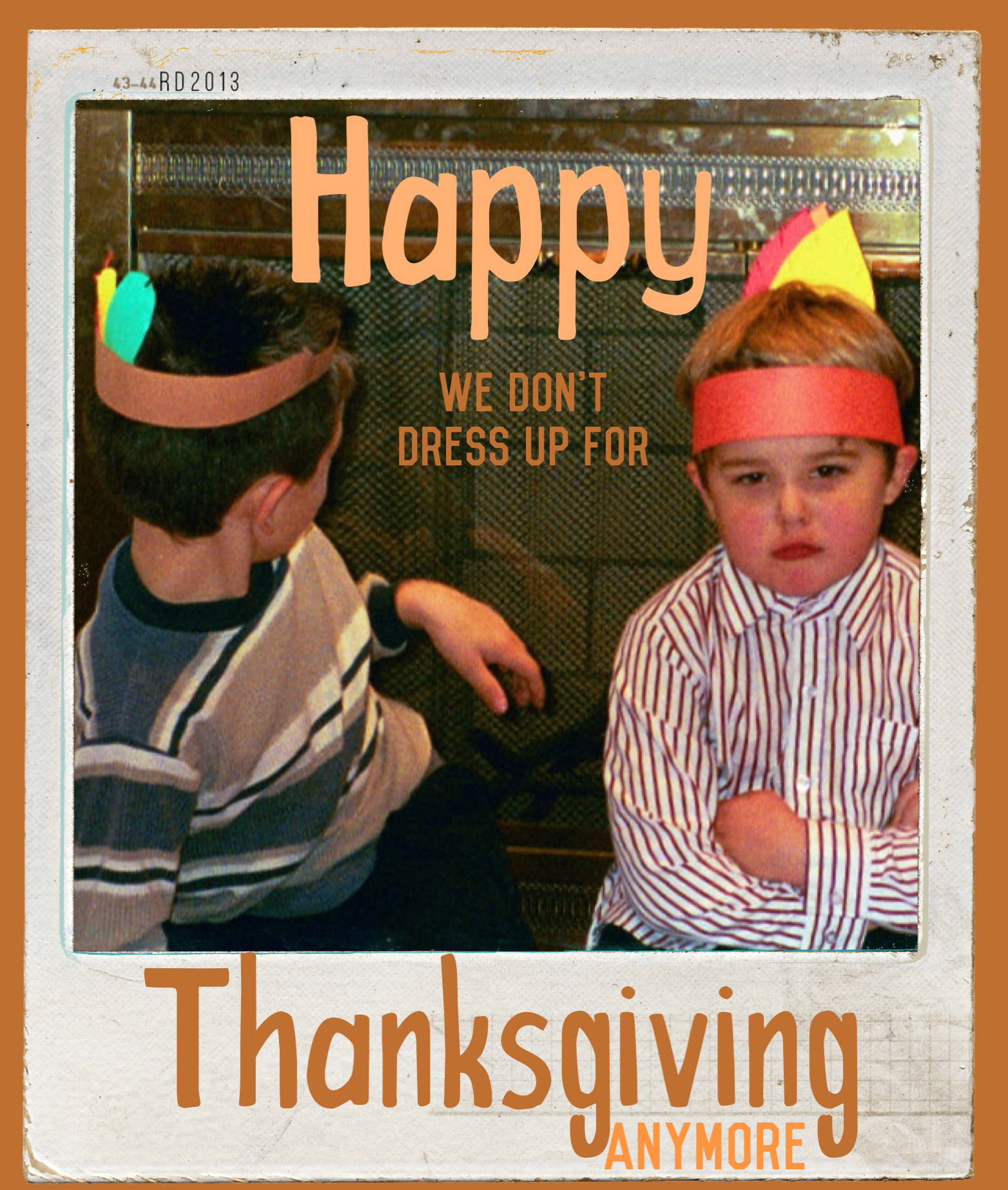
If I wanted to break the rules of grammar when creating this meme, I would have written Happy Givingthanks.

.
Sadly, my kids never really enjoyed the game as much as I did, and it was quickly forgotten. But thank goodness, they now have smart phones and can share highly entertaining, often grammatically incorrect, internet memes with one another. If only people like my kids understood the rules before they broke them.

What is Writing?

What is writing to you? Writing can mean many things to different people.

1–Writing is exhausting.

Remembering the rules of syntax and sentence structure is a struggle. Perfection halts our progress putting words to paper.

1–Writing is exhilarating.

Initially, don’t worry about spelling and sentence structure. There is a freedom to words. Getting your struggles and thoughts out of your mind and onto paper clears your head. Once they are released into your world, you can address them. Accomplishing that is a thrilling expression.

2–Writing is personal.

It is risky to write. You expose yourself to others’ judgement. Your self-image becomes vulnerable to criticism. Those are scary moments.

2–Writing is personal.

When you share your words, you share your experience. Others do relate to that. Hearing someone say “I learned from this,” “I was entertained,” and “this made me cry,” is a compliment and a success.

3–Writing is reclusive.

Writing is just between you and your thoughts; nothing else. You have no coworkers or teammates to rely on.

3–Writing is sociable.

Virtual communities of writers understand your struggles. Social media connects people around the globe. Local writing groups strengthen that support. A kind, inquisitive word from a stranger in a coffee shop is supportive and reminds you that you are not alone.

4– Writing is frustrating.

Ideas are fleeting. Motivation rises and falls. You slam into the Writers Block wall over and over and over again.

4–Writing is invigorating.

By declaring, “Writing is worth making the time for,” you choose to commit to yourself. You whisk a reader away into a world you control. You paint with words, drawing scenes in your readers’ minds. Extra incentive comes from the release into the world. It is rewarding to receive a positive review on a reading website or from someone who is not your immediate family network and friends.

5–Writing is limited.

Only a few rare people get a publishing contract. Large publishing houses have limited resources of time, printing, ink, and space. If you do not make a living by writing, then you do not have a “real” job. If you just dabble in your journal, you’re not doing any real writing. Without public validation, all efforts are snubbed as “just a hobby.”

5–Writing is limitless.

If expression is your only goal, then laptops, electronic tablets, journals or paper and pen are all friends. Writing anywhere is accessible. If publishing is a goal, the publishing options range from working with a Big 5 publishing house to a small startup publisher. Self-publishing has become mainstream, be it an eBook, paperback or picture book. You own your options and control your future.

6– Writing is work.

Standard books are long. Whatever your measurement–word count of page length–completing something that complex is a massive task. Revisions take time, a lot of time, and are often disappointing. Writing is intimidating.

6–Writing is work.

There is power in writing the words “The End” on your work.

That’s what writing is to me.

What is writing to you?

Plotting for the Flaw

Stories begin with character. I usually develop a character by writing his or her thoughts, language and interactions. A more efficient writing style would first plan and construct character flaws to build the story.

“Write Fiction Like a Pro,” an online class by Steve Alcorn, defines a flaw as an emotional shortcoming of the character.  All great stories build on the protagonist realizing and overcoming one of these flaws. The classic flaws include lack of self-confidence, lack of self-worth, insecurity, naivety, inability to put the past behind, inability to face the past, inability to trust others, inability to make a commitment, stubbornness, rashness, prejudice, selfishness, arrogance, envy and greed.

Earlier this year, the New Yorker published a short story, “All You Have To Do,” by Sarah Braunstein. One of the reviews claimed the narrator’s flaw was that he sees his world in a limited way. What kind of flaw is that? A real flaw might be naivety, lack of self-worth, or inability to make a commitment.

The next on the plotting block is the antagonist’s flaw. A story’s conflict originates from the antagonist’s opposing force with an equal but opposite flaw. For example, Divergent by Veronica Roth, pairs protagonist, Tris (lack of confidence) with Erudite leader, Jeanine Matthews (overconfident). Unlike the protagonist, the antagonist’s flaw is tragic and causes failure. The antagonist’s composition was perhaps my biggest take away from this online class.

My goal in any class is to refine my work-in-progress list. The target this time was a short story I wrote in March. The story was too big for 1500 words, and additional scenes were already forming in my mind. Then, Ginny Wiehardt posted Top 7 Signs Your Short Story Wants to be a Novel, and I knew what I had to do. My protagonist’s flaw was an inability to put the past behind. While he fought a secret enemy, the opposition was missing. I tweaked the teenage shopkeeper to focus on his own selfish future with a hint of sociopath in the mix. The lack of concern for others gave my protagonist a reason and a cause to live in the present.

Another exercise in the class included identifying the passion that inspires my writing. My answer was relationships, secrets and science. Consider the relationship of parents and their teenage children. Both are ready to part, fearful of the separation, and concerned about the secrets lurking between them. To practice flaws — opposition and a subtle mirroring — here is an example of characters I dreamed to life today:
matriculation ceremony2The parent, the story’s protagonist, selects the farthest seat from the incoming students at the matriculation ceremony. His folding chair, one of the few seats in the late afternoon shade, has a slight leftward tilt, the ground slanting toward the sidewalk of the college quadrangle. The protagonist takes a printed program, a quality piece designed for a permanent place in the bottom of some mother’s drawer, and finds his son’s name. The boy reminds him somewhat of his ex-wife but more specifically of his brother-in-law, currently housed at the federal penitentiary in Otisville, New York. He scans the other students’ names. From the thousand enrolled in the same graduating class with his progeny, one name is a blatant defiance of the strict and conditional wording that accompanied his generous gift to the college of science. He stands, tosses the program in the trash can and glances right just in time to see his son, the antagonist, hand lifted in a mocking wave as if nothing was wrong.

This character sketch offers many potential flaws to build a story. The protagonist is rash and unable to put the past behind. The antagonist hints at some arrogance and naivety. Many things could go wrong on a near perfect August day.

Another practice idea is to watch movies for the character flaws in the protagonist and the antagonist. Watch for the conflict, and you will find the flaws whether the movie is Silver Linings Playbook, Man of Steel, Run All Night, or Woman in Gold.

Using Social Media to Overcome Writer’s Block?

Writing takes practice.

Sure, we all know that, but too often, we are frozen by the blank screen or paper we call Writers Block. At least, that’s the excuse we tell ourselves.

The only way to break down that wall is to write.

And that brings us back to the beginning. How do we begin writing? Where do we find ideas?

Blog Writing Challenges

 Whether you have written or write for a blog, you need some social media presence to maximize this option. People are sharing their creative arsenal to battle the widespread war of writer’s block across the webisphere. These challenges are sites all across the Internet. Your journey is to find them.

I’m a fan of the social media site Twitter. Unlike Facebook, it’s an open media without memberships or restrictions. Connecting with writers and readers and celebrities is a Follow click away. Unlike LinkedIn, it’s not business-focused. Unlike Google+, this is not a new, unknown experiment. Twitter is established, creative and short to swallow with its 140-character limit in each Tweet. It’s easy to find similar topics and groups with a simple #hashtag search.

On the day I wrote this, I found an array of challenges with directed yet general hashtag searches. Some of these lead directly to the moderator’s website, while others simply group posts together under that specific hashtag.

Searching the Twitter hashtag #challenge showed writing and non-writing Tweets.  Scrolling through feed, the most relevant ones came from users like @convince to post a photo with every Tweet for one week, @RonovanWrites with his weekly haiku prompt  and @lettrs posing a #WordOfTheDay challenge.

One of my favorite hashtags is #6WordStory, a challenge posed by @Kelsye. Other searches relevant and directed to writers include: #WritingChallenge; #poetrychallenge; #FiveSentenceFiction; #haikuchallenge; and #fictionchallenge.

Twitter is not case-sensitive, so upper- and lower-case usage is personal preference. The words get you to the same location. I like to capitalize some of the longer hashtags to make them easier to read.

The beauty of Twitter is the prompts are provided, and the ideas out there are bountiful. Once you find an inspirational idea, attack that challenge with all your creative energy. Many people link to their personal blogposts, but you don’t need a blog to participate. Create a separate file on your computer and dedicate 15 minutes a day to play with words. Do an email exchange with a friend or family member. If you are uncomfortable sharing, choose a journal to write in for your personal enjoyment.

If you want to publicly share your accomplishments submit these, or parts of it, on your social media or link posts to your personal blog. If you want to make a visual expression of your art, use a smartphone app like InstaQuote or Notegraphy to create a graphic to share with others or save to your camera roll.

Using photos allows your social media reach to increase. The Twitter user @asilartist tied her #9WordStory challenge together by cross-posting from her @reclaimed poet Instagram account. The same hashtag exploration applies there. I found creative posts with the tags: #WritingChallenge; #PoetryChallenge; #threewordstory; #poemaday; #flashfiction; and #4WordStory.

Beware! Most users will use more than one tag, adding several related hashtags so their post can reach various audiences. As your curiosity increases, you will find yourself winding through a maze of related hashtags so that you can forget the original hashtag you started searching for. It’s glorious. It’s frustrating.

There are worse things than being lost in a new tag that connects to a newer tag that inspires you to search for a personal interest of yours. It’s the only way to drag yourself over that tall writers block wall.

Marital Advice for Grammarians

I never want to be thought of as an annoying individual who likes to point out other people’s mistakes. With that in mind, when my husband recently said “…for you and I,” I stopped myself from saying, “You mean, ‘for you and me.’”

KellyDeadwood-2015-8Aug-TightCrop

In that brief moment between hearing the mistake and wanting to straighten it out, I decided that I wasn’t about to trade marital bliss for a lofty disposition.

Does anyone—even a supportive husband—ever really appreciate unsolicited grammar advice? It may be meant as constructive, but when it’s directed at you, the unexpected input seems like full-blown criticism. As if you failed a test that you didn’t know you were being graded on. You feel disrespected by the Grammar Police, insulted and stifled from saying whatever was on your mind.

A member in one of my online writing groups recently posed a question to the rest of the group. I immediately noticed that his question contained a common error: using “there” instead of “their.” Pretty much everyone is prone to making similar mistakes. We forget to apply certain rules or are guilty of little typos. In those instances, we simply lower our guard and something slips, unchecked and uncensored, through our fingertips. I wasn’t about to publicly point out the blogger’s mistake since it wasn’t important to the ensuing conversation.

Another writer, however, was excessively harsh. This stickler rudely asserted his opinion that “someone ought to be using a dictionary to improve THEIR spelling.” Ouch! Point made, although it wasn’t really a spelling error but more of an error in word choice. Notably, no one—myself included—seemed bothered enough by that faux pas to make an issue out of it.

Similarly, there was no good reason that the there/their matter couldn’t have been addressed in a friendlier, less offensive, and perhaps even private way. By politely ignoring the situation altogether, the rest of the group sent a subtle message to the one outspoken member that perfection isn’t always necessary, especially in informal settings.

I was glad I had sided with the discerning writers who let both the original mistake and the poor response go unaddressed. But it’s hard for me to subdue my persnickety nature. I admittedly harbor some intolerance towards common grammatical mistakes. There are standards, and writers are expected to lead by example. We’re judged not only by our ability to tell a story, but also by our mastery of punctuation, spelling, word usage, and sentence structure.

We have decisions to make over the tiniest details. For example, do we use a numeral or spell out the number itself when referring to a centennial home as being one hundred years old? (Usually it is spelled out, but there are exceptions.) Should e-mail be hyphenated? (Yes.) Can we abbreviate okay as Ok? (No. Capitalize the entire abbreviation, as in OK.) Is the title to a blog italicized or placed within quotation marks? (The name of the Web site is italicized and an article posted on the site is placed in quotation marks.) Do we trust our phone’s spell check when it inserts an apostrophe into our family’s last name…when we’re not showing possession? (No! The Bixbys don’t like that.)

A writer’s ability to convey clear and concise thoughts is dependent upon all these things, in addition to understanding the basic parts of speech. It is our job to expertly unite a myriad of facets—nouns, pronouns, adjectives, verbs, adverbs, prepositions, conjunctions, and interjections—so that our work reflects both definitive grammar and intuitive usage.

There is a lot to remember, so let’s find support in reputable guidebooks, like The Chicago Manual of Style. Then understand that despite our best efforts, occasionally, you and I are going to mess up. We should strive for—but not expect—personal perfection, be kind when offering advice to others, and relax with the people we love.