Tag Archives: writing

What to Expect When Your Writing Class is Online

Tempted by the forty free online writing classes available at my public library, I enrolled as an experiment. The full catalog of 350 courses competed with MOOCs (massive open online courses) and delivered a shorter continuing education opportunity in writing and other business topics. I joined with a hundred online learners from across the country and Canada for a brief six weeks of creative writing lessons. The interaction and other classmates were as interesting as the course content.

The exercises began innocently enough asking each student’s reason for taking the class. I’ll share several of my submissions. For instance, here’s my introduction:

The dog made me do it. He worries about neglecting important things like watching sunsets, skipping rocks at the lake and hiking nearby trails.

sitting writer2It was irreverent compared to the other classmates’ expressions of genuine excitement and unbridled nervousness. They used their first name, their full name or a nickname like Jelly Bean, Milwaukee Maiden, GalSal or Mother Bird. The anonymous classroom became a haven for over sharing. I discovered, most of the class was currently in crisis – death of a loved one, newly retired, birth of an infant, empty nests, schizophrenia, cancer, abuse, graduates from high school or college, English lit major wanna be’s, traumatized veterans, divorcees, joblessness, dead end jobs, stressful “on the verge of quitting” jobs, sexuality concerns, and caregivers to parents and spouses. The class offered an outlet to cope, a catharsis for the traumas of the past, present and future.

To that note, I was not so far removed from crisis myself. One of the assignments required writing about a candle. Pent up emotions spilled into this exercise. Yes, tears fell on the keyboard over an imaginary candle with a fictitious past.

The tin box sits next to an empty and worn book of matches from a Mexican restaurant near my mother’s old house and a cigarette lighter I confiscated when my teenager flirted with smoking. Graphic whirls of block printed roses decorate the lid. The image resembles both my college hand-carved block printing and my Connecticut rose garden including the wicked, hateful thorns of the floribundas deceptively named Cinderella. Yet, the tin hints of a different Cinderella – purses, crowns, wavy flourishes and little flower dots of pink – and a costume, plastic face mask on top of a printed rayon tunic visible through the cellophane window of a shallow cardboard box. I lift the candle’s lid, smell the sickly perfume of roses and remember my mother. I spark the lighter. The candle wick, a charred nub at the bottom of a melted ring in the wax, fails to light. I return the heart-shaped tin and matches to the drawer with other keepsakes and throw the lighter in the trash under the sink.

Two months after writing about that candle, I reread my passage and still feel the complex emotional mother child relationship, filled with roses, thorns and cigarette lighters. Fortunately, the next assignment was safe from my own memories and focused on a prompt, an ex-spouse arriving on a bus in a snowstorm. Each student chose a point of view and present or past tense. My classmates, more savvy to the woes and causes of divorce, wrote of anger, betrayal, infidelities, abuse and addiction. Instead, I wrote of a homesick young man uncertain of his future.

John jolted awake at the bus driver’s announcement of Grand Haven. The snow globe effect of pelting white flakes obscured the view of his hometown bus depot. He grabbed his backpack and rushed to the door to find whichever family member drew the short straw and had to pick him up in this miserable weather. His mom probably paced at home at the front door waiting for him, having planned a family get-together to hear his tales of living in New York, the small bit part in an off Broadway theater and his new friends in the city. Bounding down the steps, John slipped on the last wet step, tumbled out the door and landed spread eagle on top of a woman waiting with her bag. Expecting her to be angry or hurt, John jumped up only to discover Martha hysterically laughing and joking about his daring dive and poor timing to wait until their divorce was final for a grand effort.

The most joyful assignment embraced free writing – unfiltered and unedited. The instructor explained about Galumphing and Bricolage. Galumphing was to select an item from three different categories – a person, a place, and an object. I chose Bricolage which was to write whatever comes to mind about trivial objects, such as a candy wrapper.

The iridescent candy wrapper rested in my palm, a tidy two inch square of yellowish cellophane. In my kitchen, I sucked on the hard candy, mystified at the pleasant, yet unrecognizable, exotic flavor. And when I glanced again at the wrapper, it was twice the size. I scratched at my head, pondering where had I found this odd candy. Oh yes, it was in the console of my car after I had let my lost, and recently found, relative Larry take the car for the week to Burning Man. I wanted to ask him about the candy, but Larry, was still sleeping in my guest bedroom, a walk-in closet if you want to be precise, and by the sound of his snoring, probably out of contact for the next four to six days. Now, the candy wrapper was weighing heavy on my hands and increasing to the size of a poster board. I reached for the ruler in my kitchen drawer and found I was too short. The wrapper had not grow; I had shrunk. Naked, I slipped out of my very large clothes and tore a bit of the wrapper to use for petite clothing. I vaguely remembered seeing other candies in different colored wrappers. If the yellow wrapped candy made me small, what did the others do? Which color should I eat next?

For each of the assignments The instructor urged the class to follow the golden rule of feedback – give comments to receive comments. My fragile crisis-fraught classmates needed support, encouragement and praise for their brave undertakings. And every evening, I returned to the class website to see the comments left for me, such as the ones below on my Bricolage candy wrapper exercise.

Jenn on 5/28/2015 10:09:51 AM

What a great twist! I love it! Makes me think of Alice in Wonderland or Charlie and the Chocolate Factory. So creative!

GalSal on 5/28/2015 12:46:57 PM

Wow–I was so fooled until you said you had shrunk.  Great imagination!

Chuck on 5/29/2015 8:17:01 AM

Great creativity, it kept me spellbound.  Are we having fun yet?

Joy on 5/29/2015 5:27:38 PM

I struggled with bricolage but you made it seem easy to be creative with something so simple

Dave on 5/30/2015 10:10:56 AM

A great start and you could take it in two interesting ways.  The obvious, fantasy way, is to go on a hunt for the other candy.  The other way, the candy having come from Burning Man, is that the character is tripping and she might have some explaining to do to people that wonder why she is running around naked with a piece of candy wrapper for clothing.

Lea on 5/30/2015 6:42:35 PM

It also makes me think of Alice in Wonderland! I like the normalcy at the beginning while it slowly starts to become magical. Great 🙂

Mama Crow on 6/1/2015 5:53:07 AM

What an adventurous piece! Great job keeping the imagination vividly strong!

Milwaukee Maiden/Linda on 6/3/2015 4:52:21 PM

Very good storyline with a twist. I enjoyed reading it. You will make a great writer.

The course made me appreciate the ability of technology to engage humanity across the country. The encouraging comments were fun and an unexpected treasure. Before the class ended and all the words deleted, I copied the comments to a file and saved them for a time when I might need generous and supportive comments. For now, another class begins.

 

Four E’s of Public Readings

Karens picWith less than one week before my first public reading, I panic. Oh sure, I’ve read at writers workshops, but other writers expect flat expressionless words and concentrate on the print. I usually flub a few words, stumble along internally editing as I read and neglect any attention to how I sound. I’m a terrible reader, and now I’m subjecting an innocent and unsuspecting audience not only to my words but also my reading.

My story of 1500 words takes almost fifteen minutes to read aloud. Ten minutes is the ideal length according to Randy Susan Meyer of the Huffington Post in “Ten Tips for Writers Reading in Public.”  Now if I could channel my inner George Saunders, I might finish in five minutes. He races through the audio recordings of his stories in the Tenth of December.  His reading pace creates “excitement” which is one of the goals for writers reading in public.

Meyer recommends to either “entertain, enlighten, excite, engage” and always smile. From the four E’s, I decide to “engage” the audience. Eye contact is the key. And if I remember to smile, that’s an added bonus.

Now comes the tough part – practicing. I find an old copy of my story with critique comments. My writing group’s questions, comments and quandary float in the margins of my hardcopy. The comments are my target list of places to add extra emphasis and accomplish the equivalent of saying, “Don’t miss this. It’s important.”

I underline words and mark places for voice inflection. My story becomes a musical score with crescendos and decrescendos. I add a few staccatos and mark the tempo changes fast and slow.

My biggest struggle is conveying changes in speakers – the ones without attribution tags. In print, a reader can see the carriage return to the next line. My solutions include moving a non-verbal action by the speaker to the beginning of the sentence, pausing before changing speakers, and varying the rate of speech for each character.

I draw on what I learned at previous jobs. Big companies with hordes of human relations people — scheduling training every time you stand from your desk to fetch a cup of coffee — develop employees with twenty-first century skills, such as presenting and communicating. I benefit from years of presentations and public speaking classes.

Thank you HR. I love you and take back all the mean things I said

about your training programs. You made me a better person.

I know how to stand and where to look. Practice eliminates little distractions, such as turning or flipping pages. My pages are in a leather binder to prevent my shaking hands from spoiling the illusion that I know what I’m doing.

Writer’s Relief, “Open Mike Night: Ten Tips For Reading Your Writing In Public,” provides useful tips: arrive early, use a big font, and dress professionally. As a writer, however, I want to know how early, how big and what is considered a writer’s professional clothes. Will I have a podium to set my notes?  Or will I stand alone behind a microphone?  I choose slacks and heels and rock the “I just left the office thirty minutes ago” look.

My preparation includes watching videos of accomplished writers at public readings. I’m fascinated by Sherman Alexie. Critics call him a stand-up comic. He writes. He jokes. He makes films. He entertains.

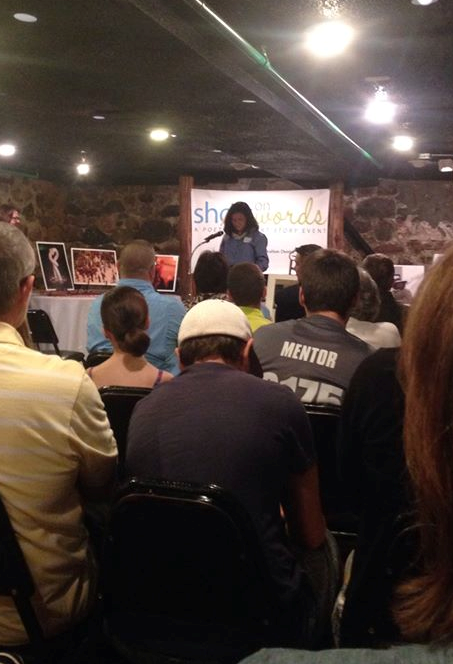
Karens second picWriters Relief also advises what appears to be obvious. “Maintain an audible volume.”  At my reading, my personal cheering section sits beside me. When another writer stands to read, one of my cheerleaders whispers, “Read louder and slower than that.”

Thanks to my pre-worries and research, my nervousness disappears when I begin reading. I make eye contact and people smile at me. At one point in the reading, I notice the room is silent and listening. This wonderful audience cares about my crazy made-up characters. They laugh at the right spots and respond with thunderous applause. Thank you, gracious audience. Then, I remember to smile.

Tags: Public readings, Randy Susan Meyers, Huffington Post, Writer’s Relief, George Saunders, Sherman Alexie

Shut the Noise

“Nothing will ever be attempted if all possible objections must first be overcome.”

Samuel Johnson

Do you edit as you write? Do you struggle with every word, sentence, paragraph, character, and scene before you decide that your writing is not yet perfect? Do you hit the delete button more often than the save button? Do you hear the critic in your head saying that you can’t write, that you need to find another hobby?

Shut the noise! Stop allowing your inner critic to dictate the success or failure of your writing life. Quiet that voice in your head which is telling you to quit.

Not easy you say? Of course, it’s not. Your inner voice fears rejection. It fears failure. It even fears success. That voice is afraid of jumping off the high diving board, riding a motorcycle, or taking a chance on love. That voice has held you back long enough. Take a plunge. Take a ride. Take a leap of faith. Try something different. Be brave. Write what you feel. Write what you’ve always wanted to write. Write with abandon. Write without restrictions. Even if what you write is not the next great American novel (Whose is?), just write because that is what you want to do.

Some writers say, “If you don’t write in spite of your inner critic or negative feedback from others, then you’re not really a writer.” I disagree. Some people are born with a stronger sense of self-worth than others, but that doesn’t mean that they are better writers. It just means they are more capable of forging ahead in spite of the negative voices.

Do you really want to write? Than do it! Don’t worry about imperfections as you work. Just write! You can always edit once you finish.

The Rich and (In)famous

Being able to travel is one privilege I never take for granted. As a writer, everywhere I go, I try to keep my eyes open for something unique. What better place to find material than a crowded airport? You never know who you’ll bump into.

The day after we attended the 141st Kentucky Derby, my husband, Greg, and I were shuttled from our downtown Louisville hotel back to the city’s international airport. We arrived at our terminal to check our bags curb-side and saw a lone skycap finishing with a young lady.

While waiting for him to assist us, I noticed a small group of people gathered outside of an SUV just beyond the skycap station. They caught my attention because they didn’t look like family sending one of their beloved off on a trip. There weren’t hugs or tears as they said goodbye to one another. The interaction was professional as each of the individuals shook hands and smiled pleasantly. Most curiously, the collective was made of four armed and uniformed police officers, a plainclothesman sporting a weapon and a badge, a man dressed in business-casual attire, and another gentleman wearing a very expensive looking suit. I wondered what all the fuss was about.

I first speculated that the plainclothesman was a highly ranked police official, had come in for Derby, and was on his way home. Then, I thought that maybe someone famous was still in the SUV, but I couldn’t see anyone else. My husband offered an equally likely scenario: “Maybe they’re transporting a criminal.”

Hoping to uncover the real story, I whispered to the skycap, “Who are those people?”

The skycap, who looked to be middle-aged like me, replied quietly, “They’re with Neno, the Rapper.”

As if I now perfectly understood the magnitude of this musician’s reputation, I nodded my head in agreement but replied, “I’ve never heard of him.”

“Neither have I, dear,” he admitted as he shook his head side to side. “Neither have I.”

Greg generally has no interest in hobnobbing with the rich and famous, so we didn’t spend our time lingering and hoping to catch a glimpse of Neno. We kept to our normal airport routine—cleared security, browsed through a few stores, and eventually got in line at Starbucks. To our surprise, we ended up right behind the crowd of officers we had seen earlier.

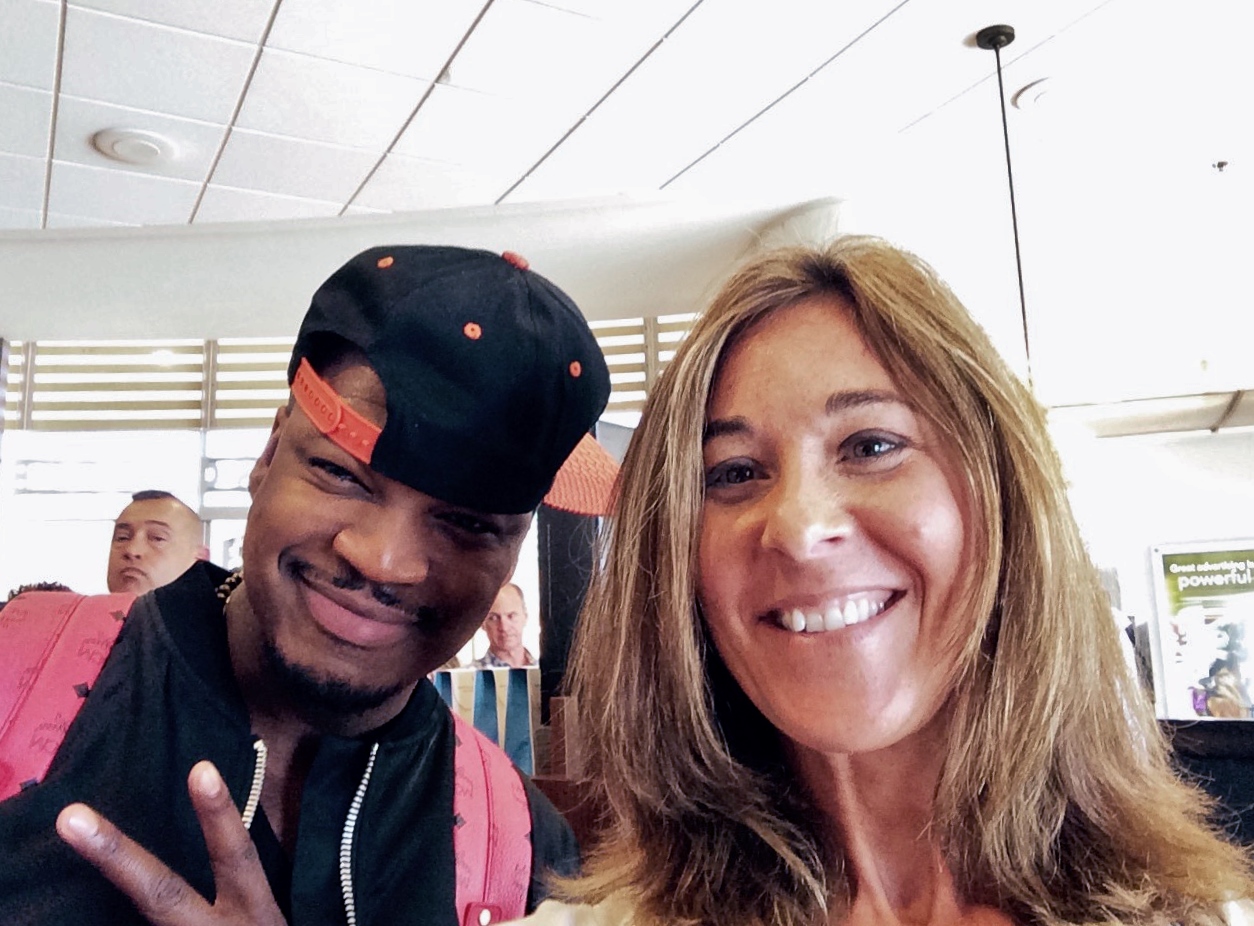
The entourage now surrounded and closely guarded an attractive man I did not recognize but assumed was Neno. He was dressed casually in dark clothes and a jacket, wore a baseball cap, and was quiet when he spoke. He didn’t seem preoccupied with drawing attention to himself. I got the impression that if women would leave him alone, he’d likely get through the airport without being bothered by more than speculative whispers and stares.

A barista was smitten. She stepped from behind the counter and asked Neno if he would pose for a picture with her.

A moment later, a woman older than me took out her cell phone and snapped a picture of the rapper as he smiled for her. I’m guessing that she couldn’t have known, anymore than I did, exactly who he was.

The excited reactions of the other women made me question whether or not I was missing out on a brush with greatness. I conceded that a photo with the celebrity could be something to literally write home about. “Okay then,” I muttered out loud and thought, “Why not?”

Ne-Yo and Kelly

What’s not to love about Non-Fiction?

I approached Neno and asked if he wouldn’t mind taking a selfie with me. He was gracious and cool as he leaned in close to me and flashed a peace sign towards the camera. I couldn’t pretend to be a big fan, shower him with accolades, or carry on much of a conversation, so I simply thanked him and wished him a safe flight.

A moment later, Neno and his protective huddle walked away and business at Starbucks tried to return to normal. I placed my order and received it—incorrectly filled.

“I’m sorry. I’m trying to calm down,” said Starbucks Girl.

“It’s OK,” I replied. “You’ve got googly eyes. I understand.”

I couldn’t help but smile as I watched the starstruck young lady work to regain focus on her job. She successfully processed a correct order for me, and I strolled off to Google who this Neno could be.

I searched online sites through the convenient but tiny view afforded by my iPhone 5s. What I found was deplorable. Matthew Best, aka Neno the Rapper, had been arrested in 2013 in New York City’s biggest gun bust. His activities and his music lyrics reflected a parent’s nightmare—full of foul language, drug references, and disrespect.

Maybe I had misinterpreted Neno’s hand gesture in the selfie. What I thought was a peace sign could have been a defiant and crude way of flipping me off. His smooth smile masking truer intentions?

It seemed that my husband may have been right after all: the officers were transporting a criminal.

I was embarrassed that there were witnesses who had seen three generations of women make this guy out to be someone special. I couldn’t understand why Starbucks Girl was so enamoured with Neno that, after our paparazzi moments, she was still frazzled and had gotten my order wrong. At the time, her behavior was endearing. But now, knowing Neno’s background, I couldn’t accept that the girl was blushing over this gangster-type. What did she admire about him? Had he been falsely accused? Acquitted and on his way to testify against others? In my own brief encounter with him, Neno was polite and charismatic, not at all characteristic of the man splattered on nymag.com and other websites. He must have reformed from his sinister ways. I had to go back to Starbucks Girl for answers.

The line was now longer, and it appeared that the girl had regained her composure. She was too busy to confront, so I talked with one of her co-workers.

Going with a direct approach (who was I kidding, anyway?), I asked the young man: “Can you tell me what you know about the celebrity who came through here a little while ago?”

I learned that I had made a big, big mistake. The man that we ladies had posed with wasn’t the notorious thug, Neno the Rapper. He was Ne-Yo, the award-winning Rhythm and Blues singer.

Ne-Yo is associated with other huge personalities: Rihanna, Cèline Dion, Kanye West, Mariah Carey, Jennifer Hudson and more, lots more. He starred in Red Tails with Terrence Howard and Cuba Gooding Jr. and appeared on “The Tonight Show with Jay Leno.” He sang on “Good Morning America” and “Live with Kelly and Michael.” He’s a popular artist who shares stories through his music lyrics.

I had come face to face with Who’s Who in Hollywood but had no idea who he was.

I looked up Ne-Yo’s latest album, Non-Fiction, on iTunes, and didn’t listen for long. Frankly, his sexually explicit subject matter and lyrics are far too liberal for my conservative nature. This celebrity sighting, however, reminded me of the critical need to verify facts when telling a true story.  I decided to leave the heartthrob to the younger or more impressionable ladies and nearly admitted to my husband that he was right—some things are better left at the curb.

One Part Genesis, One Part Darwin and One Part Machiavelli

Although I might plan to relax or sleep, writing ideas germinate at the oddest times. I jot a note on Monday to write about one topic. Tuesday counters with a new subject or two. Wednesday offers three more choices. After the month passes, I have pages of new ideas for short stories, posts, and even novel worthy topics. The difficulty comes in choosing and debating the strength of each idea.

A genesis process begins before each project. An idea fragment initiates a chain reaction. In true Genesis fashion, here’s what happens to an idea for something as simple as a blog post.

The Paris Review tweets a 1980s interview with Raymond Carver which begat
rereading “What We Talk About When We Talk About Love” which begat
watching Birdman and the use of Carver in the movie which begat
finding other films directed by Alejandro G. Inarritu which begat
studying Inarritu’s co-writers and the two years to write the script which begat
researching cinematography for a one-shot narrative which begat
discussing the similarities between Birdman and a play which begat
outlining theme connections between Carver’s story and the film which begat
finding examples of magical realism . . .

Now Darwin, the scientist whose name symbolizes survival of the fittest, comes into play. The possibilities for the Carver idea within what I call my “genesis stage” are numerous. I keep this idea, and who knows, it might be a post on this blog in the future. The subject interests me much more than one of my other ideas about the financial funding of literary magazines. Although valuation practices and financial topics are potential dinner conversation at my table, the rest of the world might be in REM sleep after appetizers. Unless a topic can evolve, the idea turns cold, extinct and not fit to survive in my black and white world of words.

As the deadline approaches, I enter the “Machiavellian stage” of decision making. In the example of this blog post, three ideas remain – the Carver Birdman Connection (CBC), Writing of Mom (MOM), and Genesis, Darwin and Machiavelli (GDM). Now, my brain wrestles with the competing ideas.

CBC: There’s research into my idea. But how will it hold together?
MOM: Remember mother’s birthday is on the post date.
GDM: There’s not much time. The MOM topic is a bit too sentimental.
MOM: What about “writing secrets” kept from mom?
CBC: That could be rich.
GDM: MOM is too fluffy for June. That’s an August topic.
CBC: I suppose it is between GDM and me. I have a wealth of material.
GDM: Carver-Birdman is too heavy for a June post.
CBC: My topic is fascinating. It could be more than a blog post.
GDM: You’re right, it’s too big for a blog post. Discussion over. Now write.

With the argument settled, the post topic practically writes itself. Tomorrow begins a new round of genesis, Darwinism and Machiavellian debate over which story to finish or whether it’s time to return to the manuscripts.