Tag Archives: writing

Read Books, Review Books, Remember Books

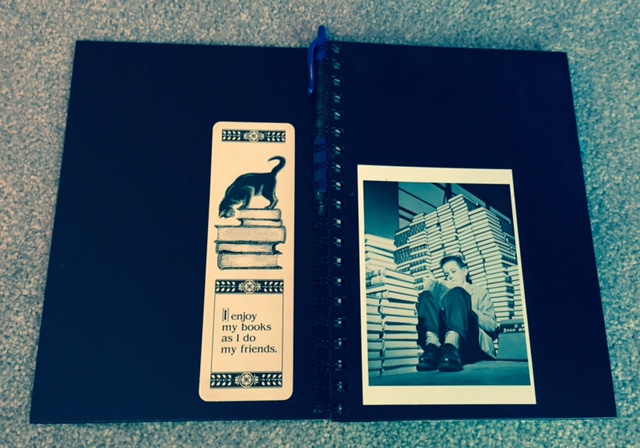
FullSizeRenderOn this blog, I’ve written about journal writing.  I’ve written about reading books.  There was a time when I did both: I read books and journaled about them. Go figure.

After last month’s journal expedition, I wandered through my bookshelf and discovered a journal wherein I reviewed books for myself as a reminder of what I read and what I thought.  I forgot I had done that.

My inspiration came from those funky “record your recollections” books found in your bookstore’s gift section.  The fun titles and decorative covers invite you to review wines, where you drank them and save the wine labels. You could write about the places you traveled and significant snippets of the journey. Journal titles encouraged memories of meals and restaurants, favorite songs, meaningful quotes, garden plantings, lists and more. Since my two main interests were books and movies, I decided I would chronicle my impressions of each.

Rather than pay for a fancy-schmancy, pretentious book with pages too small for a proper review,    I could make my own book better than any preprinted book. Besides, I found a pair of regal spiral bound notebooks, elegant in their 8″x10″ stature. The simple black hardcover was perfect for a funky, relevant, inspirational postcard. I clipped identical, important-looking blue gel pens in the rings.  I was set to write whether at home or on-the-go.

I recorded each book in the same look, manner, and design: “The Title” by Author; Month and year I finished reading, and my review.

It was the prehistoric equivalent of modern day Goodreads.
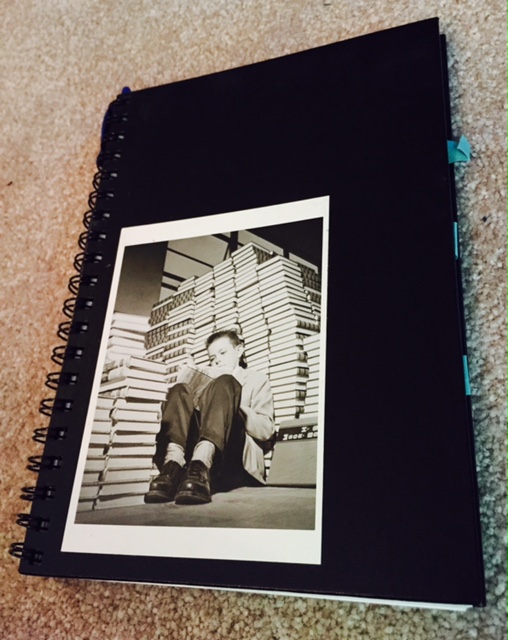
FullSizeRender2I tabbed four sections. The front main pages were reviews of the books I read. The second tabbed section I reserved for books recommended to me or that I wanted to read. The last section has some pencil scribblings on the first page; it looks like I planned a “books I borrowed or loaned.” I didn’t know enough people who read books. There is a third section tabbed off but with nothing written on those pages I have no clue what I intended.

I reviewed books from July 1999 through September 2002. My first reviewed book will remain nameless because it is so horrible. I wrote: “College life…here was my chance to see how someone else does it. I’ve learned how not to do it. I have no idea what any of the characters look like. Everyone swore, drank and got drunk. C’mon, a keg at your final? A torture to read but I had to finish it for story’s sake. I forgot that there had been a framing structure at the beginning. Events just end and everything is summed up neatly, compactly, and smoothly like the end of the stereotypical sitcom. Now writing about it, I can put it out of my mind.”

That book was my first exposure to self-published books, often called vanity press back then. This book had to be good. After all, it was a hardback book, with a colorful cover, I discovered at an independent book fair in New York City. That gave it validation. Ever since I read it, this is the book I refer to anytime I need an example of poor writing and the desperate need for an editor.

The General’s Daughter by Nelson DeMille. July 1999

“Print from this ‘old style’ trade paperback dirties my fingers. I like the movie better than the book. Narrator often sounded like the author, not the character.” The ending was given away too soon. Very few ‘he said’ in text and was often confused by who was speaking. Movie was more coherent, flowed better.”

The House of Seven Gables by Nathaniel Hawthorne. November 5, 1999

“Never was I so glad to finish a book!”

I developed a fascination about writing the true story of a real person. I moved away from fiction and desperately sought solid nonfiction. I read a series of disappointing memoirs after that. One review included my insightful comment: “In the last two memoirs, the struggle is established at the beginning but then the readers never reap the benefits of success.”

Good advice to remember as I finish my memoir.

Tuesdays with Morrie by Mitch Albom. November 25, 1999

“This book made me uncomfy [uncomfortable]. That was wonderful! I want to read it again.” In January 2000, I did just that. “The second reading as powerful as the first. Real writing, honest and true yet not sappy. There’s a reason this has been on the best seller list for over 100 weeks.”

Falling Leaves by Adeline Yen Mah. Saturday, March 4, 2000

“A tragic memoir wonderfully told. Her words: simple, and I got so caught up in her storytelling I didn’t notice.”

The Joy Luck Club by Amy Tan. June 2000

“Good example of a story told through many smaller, seemingly unrelated stories. I’d like to see how the movie translated this fine book.”

As of this writing, I have not yet seen the movie.

The Girl’s Guide to Hunting and Fishing by Melissa Bank. August 13, 2000

“What a quick read! Recommended by Jane, I echo her thoughts: I wish I’d written this book.”

Memoirs of a Geisha by Arthur Golden. March 2001

“It has been so long since a book snagged me so completely. I was up nights swallowing every word until way past my practical bedtime.”

I wrote about the Harry Potter series from December 1999 to 2002. Interesting how my opinion has changed since those initial readings.

My last entry is Diary of a Mad Bride by Laura Wolf. September 2002

“B-day gift from Dawn, I read it in about one week. Funny, and a lot more truth in there than any bride would care to admit. Written in short journal entries, it’s easy to read. I must read this closer to my wedding 🙂 again!”

I never did read that book again, but maybe I will now, especially since I am married.  One part of my New Year’s Non-Resolutions is to revisit and reread an old favorite book.  I’m faced with a dilemma: which one do I choose?

Do you have any recommendations of good books to read, or ones to avoid?
Help Wanted – First Sentence

Look, my old friend, my opening sentence . . . things are not working out. The other sentences are having to work overtime to make up for you. You’re not doing your share of the work, and your fit with the rest of the story is not what I expected. I thought you were the one. But I’ve changed and you are . . . still the same bunch of words I wrote last year. I’m sorry, but you have to go. You’re deleted.

Help Wanted: New first sentence needed in short story. Must be a team player, innovative, hard working, and dependable. Preferred applicants will have experience in attention grabbing, mood creation, and innuendo. Relocation possible.

A first sentence creates curiosity. In a short story, the writer wastes no time and no words delivering the beginning of the story. The main character incurs conflict almost immediately and begins in the action or mood of the piece. First sentences can deceive to intrigue the reader. Others warn of impending troubles. Point of view and narrative distance add richness and texture to the story and the voice of the writer. The theme is almost tangible in the first paragraph if not the very first sentence.

When I need a new sentence, I reference my favorite openers. Why does the sentence work? What is the unanswered question? Do words like beautiful, murderous and homeless lure readers? Can a sparse statement say more than a long sentence? How does Wolfe or Faulkner paint broad brushstrokes of the scene’s details? The collection below of short and long sentences demonstrates the magic of a powerful opening line.

“It seemed to Myop as she skipped lightly from her house to pigpen to smokehouse that the days had never been as beautiful as these.” — Alice Walker, “Flowers”

“One day you have a home and the next you don’t, but I’m not going to tell you my particular reasons for being homeless, because it is my secret story, and Indians have to work hard to keep secrets from hungry white folks.” — Sherman Alexie, “What You Pawn, I Will Redeem”

“In walks these three girls in nothing but bathing suits.” — John Updike, “A&P”

“Anders couldn’t get to the bank until just before it closed, so of course the line was endless and he got stuck behind two women whose loud, stupid conversation put him in a murderous temper.” — Tobias Wolfe, “Bullet in the Brain”

“‘Tell me things I won’t mind forgetting,’ she said.” — Amy Hempel, “In the Cemetery Where Al Jolson is Buried”

“Bill and Arlene Miller were a happy couple.” Raymond Carver, “Neighbors”

“As Gregor Samsa awoke one morning from uneasy dreams he found himself transformed in his bed into a gigantic insect.” — Franz Kafka, “The Metamorphosis”

“They discovered the first one in a cupboard above the stove, beside an unopened bottle of malt vinegar.” — Jhumpa Lahiri, “This Blessed House”

“When Miss Emily Grierson died, our whole town went to her funeral: the men through a sort of respectful affection for a fallen monument, the women mostly out of curiosity to see the inside of her house, which no one save an old manservant – a combined gardener and cook – had seen in at least ten years.” — William Faulkner, “A Rose For Emily”

“Do not go outside.” — Ander Monson, “To Reduce Your Likelihood of Murder”

“The thousand injuries of Fortunato I had borne as I best could, but when he ventured upon insult, I vowed revenge.” — Edgar Allan Poe, “The Cask of Amontillado”

“On the third day of rain they had killed so many crabs inside the house that Pelayo had to cross his drenched courtyard and throw them into the sea, because the newborn child had a temperature all night and they thought it was due to the stench.” — Gabriel Garcia Marquez, “A Very Old Man with Enormous Wings”

After reading successful first sentences, I interview several job applicants for my new first sentence. I try each one in the vacant space at the beginning of my story. The new sentences are so eager to please, changing to fit with the rest of the piece. Then, one sentence works harder than the rest.

Applying for the open position? Your application says you’re flexible with change. Good, my edits might move or change you. You might not even recognize yourself when I’m finished. Here’s where you will work. Sit down. Try it out. Think you can do the job?


How do you choose a writing journal?

Just like magic wands, a journal must choose you.

As a child, I expressed my deepest thoughts, heartbreak and angst in various hardcover journals, college-ruled notebooks and at least one Dear Diary with a metal lock. Did you pour your heart out in a journal? I still journal, but not as much as I used to. I wish I could say that’s because I have no adult angst, but I can’t lie. To make sure I carve the time out to reflect on myself, “journaling more often” is one of my New Year’s Non-Resolutions I committed to with my writers group.

My old journal ended today after five months of use. In my younger days, I could’ve blown through that purse-size, 4”x6” journal in less than two months. And in my younger days, I would never have used such a small book. Regardless, I need a new journal.

I have a collection of journals ready for words waiting for me on my bookshelf upstairs. Too many, one might say, but I hold an emotional attachment. Besides, can you ever have enough journals, whatever the style?

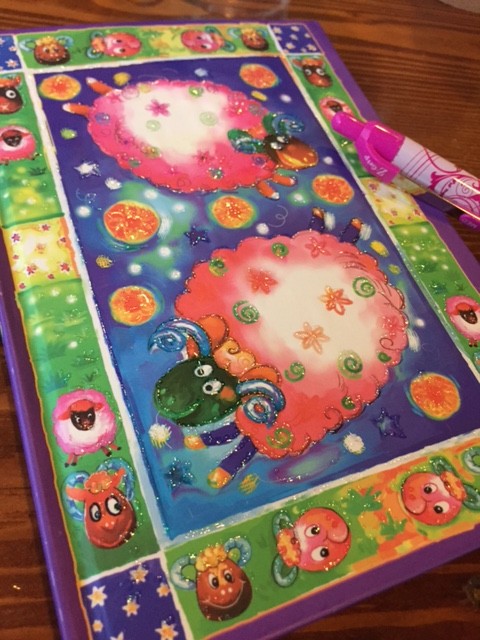
Dancing space sheep swirl around me, complete with glitter and memories.

Dancing space sheep swirl around me, complete with glitter and memories.

As I slide my hand down the row, examining each spine and shape, I think about reducing my stack. Here’s an opportunity to donate old journals I no longer enjoy writing in, either by size or style, and toss out ones with bad karma. I’m thinking of a specific one given to me by an ex-boyfriend’s mother, but I may have used it already. I don’t recall what it looks like when a bright purple spine pops out at me. Friendly bubble letters beckon me with one word: Journal. I pull it off the shelf and cradle it in my hand, staring at the cover. At least 30 seconds pass before I figure out that the abstract glittery shapes are sheep floating in space. It’s rather trippy.

Each white, lined page of the 5×7″ book is bordered with a quilt-like pattern of muted mauve hearts and stars. Sometimes I prefer pages with lines to keep my sentences straight and even, and other times, wide-open blank pages inspire me. Sometimes I like to write on bright white to show a pen’s true color, while other times my eyes want a muted tan or yellow page. This portable, lined, white-page journal in my hands seems fine to me. The psychedelic cover makes me weirdly happy. Now to flip to the inside cover and see if I made any notes about the journal’s date or where it came from.

Karma’s a bitch.

This journal was a birthday gift 15 years ago from a friend I no longer talk to, mailed to me at a previous job that was absolutely vile.

This is the kind of karma I was talking about, so I set it aside, not even putting it back on the shelf. There are plenty of other journals here. A leather dragon-covered book is too heavy. One large notebook has a handmade cover with buttons on it, a good memory of the person who made it for me, but a bit awkward for my needs right now. I don’t want this other one with a wooden cover. That blue Moleskine is too small. The ring binding on another is too big. Nothing fits my mood except the funky sheep journal.

This empty journal is scrawled with memories. I taped the original mailing label inside the front cover, which is why I know from where it was mailed. Just seeing the company name brings back stomach-churning memories of the underpaid job with the stuffy upstairs office where I worked. I remember the two sloppy mistakes I made that make me feel uncomfortable and stupid to this day, and the disrespectful ex-boyfriend I worked with who constantly yelled insults at me.

During that time, I had my friend, that lovely woman who knew me well enough to know I’d enjoy a fun-looking journal, perhaps a dollar store find, and mail it to me at work to brighten my day. Even today, I recognize her thick, curvy handwriting from the numerous letters we mailed each other. We met during one of my most unique summer jobs. And for reasons I don’t recall now, we immediately became friends. I took my first trip to Walt Disney World with her and a friend. She and I took a road trip to Salem, Massachusetts one Halloween weekend. The last good memory I have with her is bouncing on her friend’s outdoor trampoline on the afternoon my boyfriend-now-husband called to tell me he bought a new car, the car we still drive today.

She and I lived about seven hours away. I only saw her when I drove home to see my parents, and even then, I didn’t always have the time for the extra 2-hour drive. This one weekend, however, I was home for a long weekend and my Sunday was completely open. We could meet halfway and catch up in person, so I called her.

“I can’t,” she said. “I watch football with my boyfriend on Sundays.”

I never knew her to be a sports fan, but I was a far-away friend in town for the day. “What’s it going to hurt, taking one afternoon off?” I asked.

“I can’t. We watch football on Sundays.”

I understood that sports aspect with guys; my boyfriend-now-husband watched college football on Saturdays. He liked it when I watched the games with him, but if I wasn’t there one weekend–like this weekend I was currently away for–his life didn’t end and we didn’t break up. I’ll be there to watch games with him weekend, but I will not be within driving distance of my friend next weekend.

“Not just this one Sunday?” I asked her, hearing my voice rise in a pleading tone.

“We watch the game together,” she replied.

I never met her boyfriend, but I got the sense he was a demanding man.

Maybe it was just my imagination, but my friend was always independent. If she hadn’t been dating him, I was sure she’d make the time to see me. I told her how hurt I was, how I thought he might be controlling and I was saying that because I was looking out for her, as a friend should, but in the end, I lost the argument. We spoke once or twice on the phone after that, but she stopped returning my calls. I lost my friend.

I was surprised to receive a sympathy card from her when my dad died. She must have been on the overall distribution list when I emailed the news out. That was a nice gesture, really touching, but I didn’t know what to say, where to begin again. I don’t recall mailing a reply to her.

Now this journal calls me. I don’t know why. Does the journal want me to fill it with good memories, turning something positive out of a bad memory? Is its purpose to just fill the pages and “git ‘er done” and out of my life? Does my journal want some closure for me? Some reminder of better times, or is it a nudge to do something more?

All I know is that the two floating cosmic sheep make me smile, and I have to choose this as my next journal. Maybe with a wave of a metaphysical wand, I’ll figure this out by the end of the journal. Or maybe the last page will be just a last page.

Hungry for a Short Story

WARNING: May cause cravings for Spanish tapas and short stories.

A meal of Spanish tapas is similar to the reading of short stories. Imagine different flavorful dishes served one after another – combinations of vegetables, fish, cheeses and more. Dinner guests suffice with a few bites of each dish. Add dates, sherry and marinated olives to the next round of tapas. Still hungry? Order again from the menus – hot or cold – with different ingredients, seasonings and sauces. Want more? Then turn the page for the next short story in an anthology because reading these tasty bites are just as delicious.

Like tapas, short stories come in many different forms and structures. Longer stories might be structured as miniature novels. The reader travels at warp speed through the character arch or hero’s journey. A short story, however, might give a glimpse into only one aspect of a longer story. In The Rose Metal Press Field Guide to Writing Flash Fiction, one of the contributing writers, Nathan Leslie, categorizes flash fiction into five basic types: the monologue, the tale, the scene, the snapshot story, and the experiment. Leslie states the individual scene is the most common. The scene format worked for my first short story which I entered and placed in a contest. Since a novelist already thinks in scenes, this style is an easy transition to short stories. Likewise, in a tapas restaurant, an order might begin with the more familiar food items and progress to the more experimental.

The waiter brings the tapas and proudly says the name of the dish. We have ordered several tapas. Perhaps if the restaurant were not so loud, or our Spanish were better, or less of the sangria had found its way to our glasses, we would know what was in front of us. Nevertheless, part of the fun is guessing the dish. We sniff for the garlic and look for the pimento. And then, someone sees the olives and knows it is definitely the beef. A novel prolongs the guessing of who “done it” or “will do it.” Guessing games frequent literature, television shows and even childhood playtime such as Hide and Go Seek; Animal, Vegetable, Mineral; and Hangman. Short stories are guessing games on steroids. The form compresses the timeframe and eliminates unnecessary details or facts. The reader must parse through subtle gestures and implications to arrive at the theme and decipher hidden clues, meanings and flavors.

When I mention tapas, I also speak of menus, waiters and restaurants because it is far easier to eat tapas at a restaurant with a bevy of chefs, cooks and busboys. Similarly, short stories are a treasure to read and analyze yet very difficult to write. The challenge is to determine the most concise presentation of the theme and then the best way to reveal the story.

Now I have to decide which theme I want to write next. Which one of these will it resemble?

QUESO DE CABRA CON NUECES – goat cheese rolled in caramelized pecans, served with poached pear in red wine, grapes and toast points

CAZUELA DE PULPO – marinated octopus with sweet peppers and sherry vinaigrette

CAZUELA DE POLLO SALTEADO – casserole of sautéed chicken with garlic, chorizo, mushrooms and amontillado sauce

PINCHO DE SOLOMILLO A LA PIMIENTA – grilled beef brochette rolled in cracked pepper, served with caramelized onions and horseradish sauce

If you’re tempted by these tapas, stop at Emilio’s Tapas in Chicago for any of the menu items above. Take along an anthology of short stories by Spanish authors. Or practice your Spanish and read Colombian short story writer, Gabriel Garcia Marquez.

Write This Not That

Completing a 100,000 word manuscript is a daunting task. Craft elements can go rogue and crash a well-intended plot. Months, and yes, years pass in the process of writing and editing. Babies are born. Children graduate from school. And everyone grows older except for the fledgling characters in the story. For many, even writers disciplined enough to attend writers’ groups, workshops or conferences, the hurdle of a completed manuscript is too high, at least initially. If the goal is publication, then contests are an opportunity to build a writing resume.

Ah contests, I remember them well – working each entry until the last minute before the midnight deadline, correcting stupid (and stupider) mistakes and editing phrases or lines to finish with the right word count or page number. For the price of a contest entry fee, you get all this nail-biting and neurotic sort of fun.

Fortunately, contests also provide a test market for your work, a marking to market of your ability. In other words, how do I compare to a pool of equally aspiring writers? Sometimes, the winners, especially in literary magazines, are so amazing I’m tempted to abandon writing and begin any number of long neglected chores like taxes, continuing education or even cleaning. Other times, the winning entries bring a jaw dropping, head scratching, and audible “huh.” Writing is the quintessential Olympic ice dancing event as opposed to the timed or measured track and field sport.

You can slant the odds in your favor. Creative pursuits require sound project management grounded in probability. For example, is it possible that I might get my first-ever written manuscript published? Yes, but it’s not probable. Can I hone my skills and compete in contests with a possibility of publication? More probable. A combination of strategy, research, practice and numbers makes small wins lead to bigger wins.

Strategy begins with contest selection. Highly advertised contests receive more entries. If my odds of getting struck by lightning are higher than winning – all ego aside – I’m skipping the contest. Contests held by non-writing organizations draw a wider range of writing levels and are better for increasing the odds of placing at the top. Note – the uber literary MFA types are less likely to enter a short story contest sponsored by Ducks Unlimited. Competing against unpublished writers, defined differently by each contest, is another viable strategy. Additionally, research can enhance strategy. I read the publications hosting the contest or writing samples of the past winners. If the judge is announced, I research (i.e. internet literary stalk) the judge’s style, education, publications and demographic factors that might make an entry emotionally connect with him or her. Know the audience. My writing improves from the research alone (if I’m not driven to binge cleaning by the past years’ winners).

Compared to the first two steps, practice is the easy part of the process. This year, my practice area is short stories, and in the coming blog posts, I will share more about short stories, contests, and publications. Finally, the contest process depends on the law of averages – the numbers. The more contests a writer enters (assuming strategy, research and practice) determines the likelihood of success. With that in mind, here is my plan for the coming year, and perhaps, your plan also:

  1. Search for smaller, less publicized contests.
  2. Compile a contest spreadsheet sorted by deadline and word count lengths.
  3. Assess your current writing inventory available for contests.
  4. Look for opportunities to experiment with different lengths or genres.
  5. Identify specific contest deadlines within the next three months.
  6. Research the publication, contest winners, and judges.
  7. Write. Edit. Edit. Write.

Submit. Wait. Submit again.