Author Archives: Barbara Pattee

The Trip of a Lifetime: Australia and New Zealand Part 3

Thursday, March 24: After a hot breakfast and a short coach ride, our tour group boarded the Great Adventures Catamaran for a ride to the Great Barrier Reef. Several of us chose not to snorkel at the reef and disembarked at Green Island. We rode in a glass bottom boat and took the Island Rainforest Walk. A few took a swim at the beach. We had a buffet lunch at the Canopy Grill as part of the excursion. During our time on Green Island, we understood why this is called a rainforest. The heavy downpour continued for quite some time and my raincoat did nothing to keep me dry. Our tour guide, Ronan, said the green itinerary sheet represented the Rainforest. It should have had streaks of blue to represent the water that drenched us.

My husband, Roger, thoroughly enjoyed snorkeling on the Great Barrier Reef. He saw a fantastic variety of coral of many different colors and shapes and a wide variety of fish, but not in large numbers. The tourists who rode to the Great Barrier Reef had a hot and cold buffet lunch onboard the catamaran.

After the snorkelers finished their fun, they picked up the rest of us who were as wet as they were. We returned to the Double Tree by Hilton Hotel to freshen up before taking a two-minute walk to the RSL Club for a four-course dinner.

Friday, March 25: Roger and I decided to relax, do laundry, and take a walking tour of the city. Most of the group went on the optional tour of the Tjapukai Aboriginal Centre to taste bush food, learn about bush medicine, and take boomerang throwing lessons.
Later that afternoon, everyone gathered at the hotel for a Learning and Discovery lecture on the Aboriginal Culture and Life Today. Afterward we left to have dinner on our own.

Saturday, March 26: Some members of our group took the Hot Air Scenic Balloon Ride at sunrise while the rest of us slept in. At 9:30 am our briefing about the Sydney visit was followed by a short coach ride to the Cairns Airport for a three-hour flight to Sydney, Australia. We moved our watches forward one hour, then went directly from the Sydney Airport to Nicks Bar ‘n Grill at the Darling Harbour for dinner. At about 8 pm we checked into the Holiday Inn Darling Harbour.

Sunday, March 27: Our blue sheet itinerary (blue represents the ocean) indicated we were on our way to a guided tour of the beautiful, impressive Sydney Opera House. It was sad to learn that the brilliant Danish architect, Jørn Utzon, who designed the multi-building structure, resigned during the construction and never saw the finished product.

During our next coach ride we saw a spectacular harbor view and stopped for a photo op in Mrs. Macquarie’s Chair. More than 150 years ago, Lady Macquarie’s husband, Governor Lachlan Macquarie, had prisoners carve exposed sandstone rock into the shape of a bench on the peninsula in Sydney Harbour so that she could enjoy the panoramic view of the harbor and wait for her husband as he sailed home from a long journey at sea.

We continued to the Opal Centre for a shopping opportunity. To my very young grandchildren, I sent a picture of a beautiful opal I selected as a wished for birthday gift. The opal only cost $162,750 in Australian dollars. It’s a little cheaper in American dollars, but not by much.

That evening while on the Sidney Harbour Dinner Cruise, we had a perfect nighttime view of the harbor, a splendid view of the opera house, the beautifully lit Sydney Harbour Bridge, and a colorful fireworks display on the harbor.

Monday, March 28: The tour group went by coach to The Rocks at Circular Quay and learned about Sydney’s historical beginning. Because Britain’s prison system was overcrowded, some convicts, skilled tradesmen, and farmers convicted of trivial crimes were shipped to Australia to colonize the island continent. Some of the convicts were later given pardons and parcels of land to farm.

At 10 am we took the two hour Sydney Harbour Coffee Cruise then spent the afternoon exploring the city. At 6 pm the group took a 10-minute walk from the hotel to Stacks Taverna for dinner.

Tuesday, March 29: Several members of our group took the 3 ½ hour walk over the awesome Sydney Harbour Bridge. The participants were tethered to the bridge and not allowed to wear jewelry or carry cameras, purses, or other loose items. The bridge authorities didn’t want anyone or anything falling onto the vehicles on the bridge deck below. Does that give you an idea of how difficult the walk is?

Roger and I opted not to “enjoy” that adventure. Instead we took the coach out of Sydney, toured the Featherdale Wildlife Park, and then stopped for lunch at Roger’s favorite place to be, a golf course. We went to the Blue Mountains for a tour of the canyon, took a ferry back to the harbor, and then took a cab back to the hotel.

Wednesday, March 30: We took the three-hour flight out of Sydney to Queenstown, New Zealand. We had to set our watches forward two hours. Managing the various time zones was sometimes confusing. Thankfully our tour guide Ronan McChesney reminded us of the correct local time. Because we arrived at the airport at 2:30 pm and dinner was scheduled for 6:15 pm, he suggested we buy lunch at the Queenstown Airport. At 4 pm, we arrived at the Rydges Lakeland Hotel to check in and freshen up. At 5 pm we met in the lobby of the hotel to take an orientation walk which ended at the Ballarat Trading Company Restaurant. The décor of the restaurant depicted a replica of the old trading post chalkboard showing the prices of the cattle, sheep, and other items sold there many years ago.

Thursday, March 31: We walked 10 minutes to the Steamer Wharf to take a steam ship to the Walter Peak Sheep Station for a guided tour of the farm. (What we call a farm, they call a station.) While there, we had afternoon tea, coffee, scones, and cakes in their comfortable sitting room and veranda. We also watched a sheep dog herd sheep and saw a demonstration of sheep shearing.

Friday, April 1: At 7:45 am the tour group met in the hotel Lobby to board the coach for a day-long trip to Milford Sound (a fjord). We photographed spectacular scenic waterfalls, some seals, unusual rock formations, beautiful mountains, and took a one hour forty-five-minute boat ride up the fjord with a turnaround at the Tasman Sea. In the first hour, they served a delicious hot buffet style meal on the boat. During the captain’s interesting commentary about the fjord, he told us from which side of the boat we could take good pictures of the various sites.

Those who chose not to take the long trip back by coach could take a $250 scenic flight back. Roger and I chose to take the coach back. We’re a thrifty couple. As a diversion during the long ride, Roger and I played Scrabble on our iPads. At 8 pm we arrived back at the hotel and had dinner on our own. We rested in preparation for the next day’s adventures on a jet boat and on a gondola.

Tags: Great Adventures Catamaran, Great Barrier Reef, scuba dive, Green Island, glass bottom boat, rainforest, RSL Club, Tjapukai Aboriginal Centre, boomerang, Aboriginal Culture, Cairns, Sydney, Nicks Bar ‘n Grill, Darling Harbour, Hot Air Scenic Balloon Ride, Sydney Opera House, Mrs. Macquarie’s Chair, Opal Centre, Sidney Harbour Dinner Cruise, The Rocks at Circular Quay, Stacks Taverna, Sydney Harbour Bridge, Featherdale Wildlife Park, Blue Mountains, Queenstown, time zones, Ballarat Trading Company Restaurant, Steamer Wharf, Walter Peak Sheep Station, Milford Sound, fjord

The Trip of a Lifetime: Australia and New Zealand Part 2

After we boarded the coach on Saturday, March 19, our tour guide, Ronan McChesney, counted his flock of 22, then said, “Close your eyes.”

Oh, Lord, I thought. We have to pray. How bad is this coach driver?

“Visualize your room,” Ronan said. “Did you leave anything in the bathroom? On the hook behind the door? In the wardrobe?” (Wardrobe is Aussie for closet.)

As he continued, I laughed softly realizing he was helping us check for personal items left behind. Ronan repeated this ritual each time we left a hotel. Wise tour guide.

We arrived at the Melbourne airport in preparation for a 2½ hour flight to Alice Springs. Australia has such remote areas that traveling from one populated area or tourist destination to another is accomplished by airplane, long coach rides, or train rides.

Our first tour in Alice Springs was to the impressive Royal Flying Doctor Service (RFDS), one of the most comprehensive aeromedical services in the world. It provides emergency and primary medical care to Australian residents regardless of race in the rural, remote, and regional areas of the country.

Lunch was on our own in or around the local air-conditioned shopping center. Roger and I chose a small Thai restaurant that served sizeable, delicious portions. On our way back to the coach, we were embraced by an older Aborigine gentleman. We had been instructed by Ronan not to look at an Aborigine directly as a sign of respect. So we were shocked that he would grab us, hug us tightly, and say, “I love you,” several times. We could tell he was a little inebriated.

He released us only after I said, “We love you, too.”

The Telegraph Station was our next stop. Opened in 1872, the Station reduced the isolation of Australians. Previously the exchange of business and personal messages took months but the telegraph’s Morse Code reduced the time to hours.

Photos and written displays at the Station told the story of the Lost Generation (AKA The Stolen Generation). European men deliberately impregnated Aborigine women, forcibly removed the mixed race children, and raised them in dormitories many, many miles from home to become servants for the European settlers in Australia. The children were beat if they spoke their home language or cried to go home. The government encouraged this method for the slow eradication of the Aboriginal race. A riveting movie, “The Rabbit Proof Fence,” depicts the true story of three of those children.

The next day we rode the coach to an optional 4½ tour of the Desert Park. Because of a minor mobility issue, I opted to drive an electric cart at the park where we viewed a large aviary housing a variety of birds, thorny devils, and dingoes. We also saw an amazing Birds of Prey Show where the birds appeared and exited the arena on command.

It was enlightening to hear the Aboriginal Survival in The Desert talk. The Aborigines knew how to live in the remote area, eating what grew in the wild and what plants could be used for medicinal purposes.

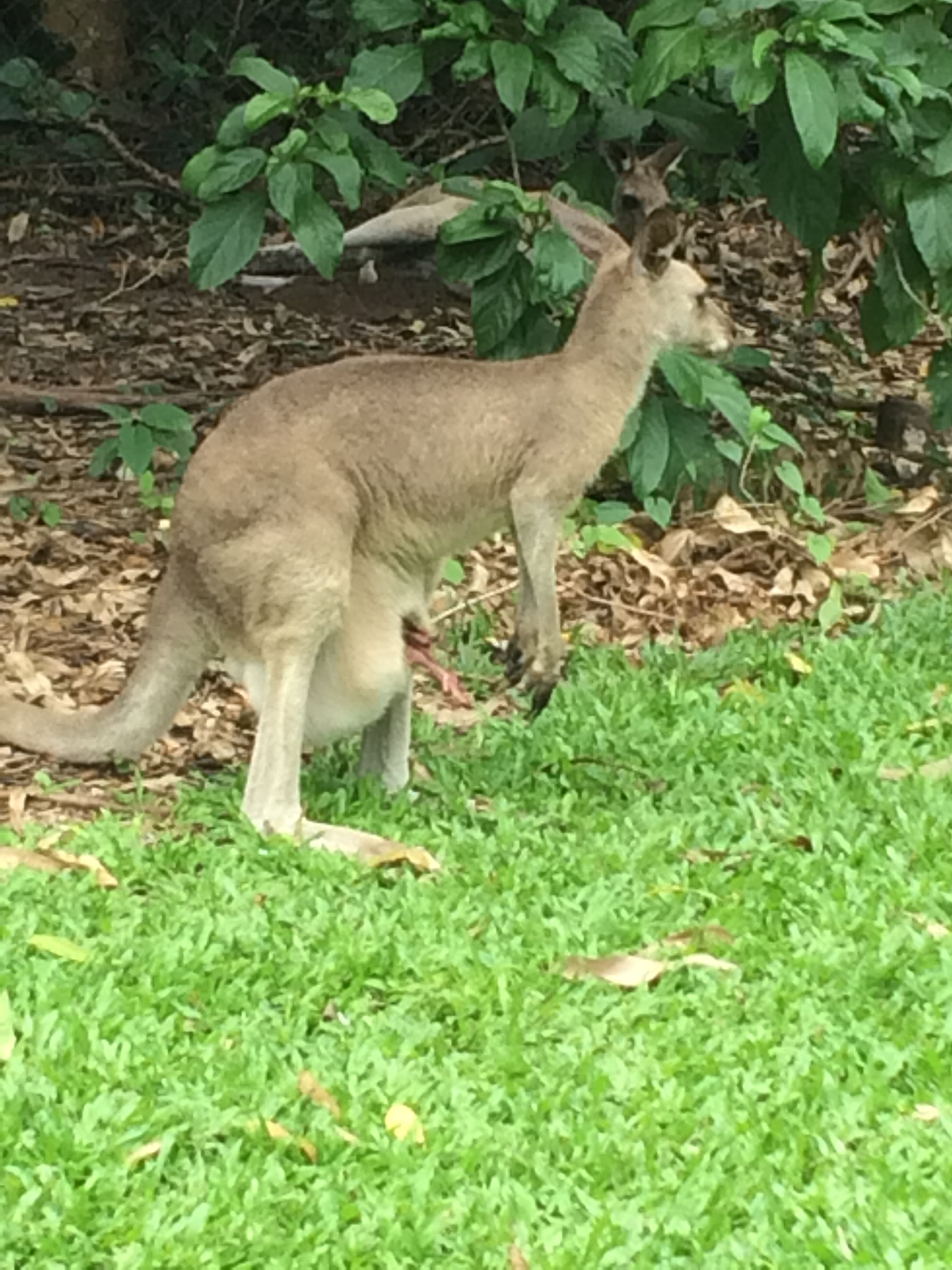
joey2After lunch on our own, our afternoon was spent at Kangaroo Sanctuary operated by Kangaroo Dundee (AKA Chris Barns). He rescues baby kangaroos or joeys from the pouches of their deceased mothers who were hit by cars. He carries the joeys 24/7 in a blanket pouch until they are mature enough to roam around on their own in an enclosed area. When they are able to fend for themselves they are returned to the wild.

Each of us in the tour group took turns carrying one of two of the joeys as we walked the grounds to see kangaroos in the wild and a very aggressive one named Roger in an enclosure. He can’t be released in the wild because he’s too dangerous. Fighting kangaroos can disembowel a person with a single kick.

On Monday, March 21, Roger and I rode side by side on camels guided around an enclosure by a camel trainer. Let me just say, Roger is a much better rider than I am. Afterward we stopped at a picnic area in the Outback for a friendly, family-style picnic with roast chicken, salad, rolls, other fixings and bottled soft drinks provided by Ronan.

At 3:00 pm we finally arrived at the Ayers Rock Hotel and left by 4:00 pm on our way to The Olgas (or Kata Tjuta which means Many Heads) for a 50-minute site-seeing walk. This was followed by a sunset viewing of Uluru, the sacred Aboriginal name for Ayers Rock. The massive rock formation seemed to change colors as the sun set. We were served delicious hors d’oeuvres, fruit, and champagne.

Roger and I and five members of our group joined other tour groups on Tuesday, March 22 to enjoy the beautiful sunrise over Uluru. After breakfast we took a couple of guided tours around parts of Uluru and visited the Uluru – Kata Tjuta – Cultural Center. After lunch we returned to the Ayers Rock Airport for a 2½ hour flight to Cairns to stay at the Double Tree by Hilton Hotel.

Wednesday started with Hartley’s Crocodile Adventures. The guided walk revealed large crocodiles, wallaby feedings, and adorable koalas. Yes, we did get a taste of crocodile meat. Tastes a little like chicken, tough chicken.

Afterward we stopped at an Aussie Pub to listen to the owner discuss his life in Australia and have lunch. This is when I tasted Australia’s famous ginger beer, a delicious, non-alcoholic soft drink.

In the evening we stopped at the Wetherby Cattle Station (Aussie for ranch) to hear the owner lecture us about the cattle business. His wife treated our entire tour group to a delicious home-cooked chicken dinner. We returned to our hotel to rest in preparation for a trip to the Great Barrier Reef on Thursday.


Tags: Alice Springs, Royal Flying Doctor Service, Aborigines, aeromedical service, The Telegraph Station, Morse Code, The Lost Generation, The Stolen Generation, The Rabbit Proof Fence, Desert Park, Birds of Prey, Kangaroo Sanctuary, The Olgas, Kata Tjuta, Uluru, Ayers Rock, Hartley’s Crocodile Adventures, Wetherby Cattle Station


The Trip of a Lifetime: Australia and New Zealand Part 1

My husband, Roger, and I arrived in Los Angeles on Tuesday, March 15 ready for the 8:00 pm flight to Melbourne, Australia. Never in my wildest dreams did I imagine I’d go to “the land down under.” When he first asked if I wanted to travel to Australia and New Zealand, I simply said, “Sure.” He started researching the travel options and I increased my monthly contributions to our travel fund.

A couple we know also wanted to go, so the four of us poured through several catalogs with plans to travel together. We selected Grand Circle Travel® – perfect choice. Our friends planned to join us on the 22nd of March in Cairns.

When the travel information arrived in the mail, we learned about the passport and visa requirements and the luggage restrictions (one 50 pound checked bag and one 15 pound carry-on bag). I chose one 25 pound checked bag, a 12 pound backpack, and a purse large enough to accommodate a small camera and mini iPad. With plans to utilize the hotel laundry facilities, I packed enough for eight days, not for the entire 27-day trip.

Upon arrival at the Melbourne Airport on Thursday, March 17 (losing a day crossing numerous time zones), we felt the extreme heat immediately. We looked for other travelers wearing the Grand Circle name tags and met our tour guide, Ronan McChesney. He was born in Ireland and became an Australian citizen because he loved the island nation so much. During our wonderful time in Australia, we understood why.

After a coach ride from the airport and brief tour around the city, we arrived at the Rendezvous Hotel. Ronan assured us that our luggage would be taken to our rooms. Because it was a little too early for check in, he gave us a brief orientation outside the hotel then took us on a walking tour around the neighborhood. He cautioned us that Australians (Aussies) drive on the left side of the road and pedestrians do NOT have the right of way. Good to know. Ronan said to drink a bottle of water each hour because of the dry heat.

At the Rendezvous Hotel, Ronan picked up all the room keys for the tour group. This was his well-organized duty at each of our hotel stops facilitating our check-ins. We joined Ronan in a conference room for a briefing and get-acquainted session. Each person said his or her name, where they lived, and why they chose to travel to this part of the world. Ronan talked a little about what to expect during this trip. He also explained that Aussies pronounced Melbourne “Melbin,” the city of Alice Springs was just called “The Alice,” and the city of Cairns was called “Cans” or “Kennes.” Ronan distributed headsets which facilitated hearing the tour guides’ dialogue on the various tours throughout the trip. He also gave us a gold sheet of paper giving us the itinerary for the first five days of our journey. The color, he said with a smile, represents the sands of the Outback.

He warned that once we got to our rooms to be careful of that large rectangle covered in a beautiful, colorful pattern in the center of the room that would beckon us to try it out. “Don’t do it. Or you’ll miss dinner.” Sleeping in the afternoon meant not sleeping at night. Adjusting to jet lag wasn’t too bad for us.

After going to our rooms and freshening up, we were free to tour the city or to rest. Roger and I toured, then joined our group for dinner at the hotel. Whenever our prepaid dinners were with the group, Ronan had us select in advance our culinary choices from a prepared menu. This allowed the restaurant to have the meals for our group of twenty-three, including Ronan, ready upon our arrival.

On Friday, March 18, we enjoyed a full hot breakfast at the hotel (every breakfast was included in the cost of the trip). Wearing our battery-operated headsets, we met in the lobby at 9:00 am ready to board the coach for the half day Melbourne City Sightseeing Tour. We stopped at the beautiful, impressive St. Patrick’s Cathedral, then saw the Melbourne Cricket Ground and the Australian Open Tennis Centre. We visited the Shrine of Remembrance which honored the Australians who fought in World War I and World War II. Family members were unable to receive the bodies of their deceased loved ones because of the distance and expense; therefore, this Shrine of Remembrance was designed to honor the military.

That night some of us went to the Fairy Penguin Parade at Philip Island to watch the Little Penguins (much smaller than what we usually see at Penguinariums) come out of the water to return to their nesting places on shore. We were not allowed to take pictures, with or without a flash, because that frightens the penguins causing them to throw up. They would starve. After the show, I saw an adorable little girl about two years old walking like the little penguins. Too cute.

On Saturday, March 19, breakfast at the hotel was at 6 am. Our bags were set outside our rooms at 6.45 am ready to be picked up by porters. Already hot, the temperature was scheduled to reach 95 degrees Fahrenheit. At 7:30 am, we met in the hotel lobby ready to board the coach to the Melbourne Airport to fly to the Alice Springs Airport. Excitement mounted as we prepared to see the Outback, learn about the Aboriginal culture, visit a kangaroo sanctuary, and more.


Happy Anniversary, M & M’s®

mmm
There was complete silence in my classroom. All eyes were on me. The look of disappointment on the faces of the students was heartbreaking.

“I’m sorry, children,” I said. “The principal is in charge.”

The week before a planned party, our principal made an unexpected announcement over the PA system. “There will be no Christmas parties allowed in the classrooms. Every day is to be used for academics only. No exceptions.”

As a teacher, I had promised my adorable, well-behaved students a Christmas party. The children decided who would bring the treats, paper plates, cups, napkins, and pop and I promised to bring a treat for everyone.

To distract the students from the principal’s disappointing announcement, I prepared a week of activity-driven lessons on probability. The first lesson was predicting the probability of getting heads when tossing a coin 200 times. The other lessons included tossing two die and using a spinner, but my favorite lesson was the last one.

Reading about the 75th anniversary of M & M’s® this month reminded me of that day as well as other times with that tasty, colorful, popular chocolate treat. As a child, I chose that as my favorite candy. As a teacher, I used M & M’s® to help children with their colors. And passing out M & M’s® at Halloween never gets old.

On the last day of school before the holidays, I distributed a napkin and a sheet of paper to each student. I then posed three questions to the students. “Approximately how many pieces of candy are in this bag of M & M’s®?” I said as I held up a two-ounce bag. “Put your guesses at the top of the paper next to your name.”

“What are the colors in a bag of M & M’s®? Write your answers on the paper, one color per line.”

“How many of each color do you think are in the bag? Put your guesses next to the color you selected.”

Once students completed their choices, I passed out a bag of M & M’s® to each student and said, “Please open your bags, put the candy on your napkins, and count out the M & M’s® by color to see how close you came to your guesses. Write the actual count next to each guess.”

They enthusiastically worked on their assignment. Upon completion, one of the students said, “Teacher, now what do we do with the candy?”Before I could respond, one of the boys said, “Eat’em. Teacher’s giving us a party.”

Before I could respond, one of the boys said, “Eat’em. Teacher’s giving us a party.”

I collected the empty candy bags to confirm that I didn’t want the candy back. The students’ happy smiles were well worth my effort.


Story Starters #4

“Ripped from the headlines.” Origin unknown.

Robinson Crusoe, a bestselling castaway tale written by Daniel Defoe, was published in 1719. Defoe based his story on the real-life Alexander Selkirk who was rescued after being stranded for five years on an island off the coast of Chile. Numerous versions of Robinson Crusoe, as well as other castaway stories, have been written.

The Finest Hours: The True Story of the U.S. Coast Guard’s Most Daring Sea Rescue, a book by Michael J. Touglas and Casey Sherman, tells how four members of the Coast Guard rescued men off a broken oil tanker. The movie invented characters, imagined dialogue and added drama to emphasize the brutality of the storm.

Eddie the Eagle is a movie based on the real-life British ski jumper, Michael (Eddie) Edwards. He wore thick glasses and leg braces as a child but dreamt of participating in the winter Olympic Games as a downhill skier. Although the screen writer took liberties with the character of Eddie’s coach, the story is a true feel-good story of determination.

Miracles from Heaven: A Little Girl, Her Journey to Heaven, and Her Amazing Story of Healing by Christy Wilson Beam tells the story of a girl with a rare, incurable digestive disorder. On one of Annabel’s rare chances to play outside, she fell three stories headfirst into a hollowed-out tree. The fall cured her.

An episode of Chicago P. D. depicted a six-year-old boy being shot three times in a Chicago alley. The story, taken from a recent Chicago murder case, changed the plot significantly to allow the redemption of key characters.

If you think your idea has to originate from a big headline, you’re wrong. CSI: Cyber presented an episode that involved a fitness wristwatch, stalking, and harvesting organs from unsuspecting donors. The writers took three separate ideas and combined them into a suspenseful story.

You don’t have to write a castaway story, a daring sea rescue, a triumph over adversity, or even about a miraculous medical miracle. Try taking the elements from several different headline-making stories, combine them, embellish the drama, add a surprise conflict, and you’ve got your plot. Tell the spectator’s version of the event and how it affected you. Give that person an even better storyline than the main participants.

Think about reading your newspapers and magazines with an eye for plot ideas. Are you ready?