Category Archives: Author’s Craft

Writing Commitments for 2015: What’s yours?

create

With a new year days away, it’s that time where people make resolutions for the changes they’re making. How next year will be different because…

The problem is that most resolutions are broken, perhaps because they seem more like wishes, hopes, or dreams.

At the last meeting of 2014 for the Deadwood Writers, I invited the members to come up with commitments to grow themselves as writers. As they share their plans below, the invitation is extended to you:

What are 1 to 3 concrete steps that you will take to improve yourself as a writer. Be specific and concrete–something you can track or measure.

Non-example A: I will be a published author this year.

Example A:

  1. I will complete a short story or article.
  2. I will compose a query letter for the story or article.
  3. I will use Writers Market to identify 5-10 publishers who accept simultaneous submissions and send the query letter with the short story or article.

Non-Example B: I will write more this year.

Example B:

  1. I will read 25 books within the genres that I want to write.
  2. I will write a draft of 2 stories that fits within the genres.
  3. I will share these drafts with 3 people for their feedback regarding fitting the genre, plot development, and character development.

Share your writing commitments in the comments section below.

Now here are Writing Commitments by members of the Deadwood Writers…

John McCarthy

  1. I will read at least 10 books across genres that I like to write about: Education, Fantasy, Horror, Young Adult. I’ll write a review on Good Reads or Amazon or on this blog.
  2. I will learn writing techniques from the writing styles of at least 3 authors from reading their work, which I’ll share during the Deadwood Writers’ study sessions.
  3. I will create a detailed outline and chapters for an Education book on Differentiated Instruction for the 2*+ Century — to be shared with 3 writer colleagues for feedback.

Claire Murray

  1. I will start writing my blog post earlier each month this year.
  2. I will focus my attention more on the humor in the situations that are happening around me so I have more things to write about.
  3. I will read a book on writing.

Book Lover

  1. I will enter the Writer’s Digest Short Story Contest
  2. I will send two short humor pieces to Reader’s Digest
  3. I will write 25,000 words of my novel

Karen Kittrell

  1. Continue study on flash fiction by reading at least one writing book and attending at least one appropriate workshop.
  2. Submit to at least one contest, magazine, editor or agent.
  3. Write for Deadwood Writers’ Voices and/or create my own blog.

David Buehrle

  1. Set aside 8 hours per week for writing,
  2. Read 2-3 books that can guide me to better writing techniques.
  3. Let 7 days pass after writing a section before beginning my own edits.

Wendi Knape

  1. Complete final edit for A New Life in January.
  2. Prepare and send A New Life manuscript query letters to 10 or more agents in February.
  3. Complete the first draft of The Girl and the EMT (working title) I started writing while doing NaNoWriMo. I will be as diligent as I was while doing NaNoWriMo. I was about half way through the manuscript when I reached 50,000 words.

Victoria Wright

  1. I will rejoin the deadwood writers voices blog.
  2. I will attend a writing retreat.
  3. I will read 2 or more books about writing.

Diana Hirsch

  1. (A) Find an editor and (B) publish my memoir before June 2015.
  2. Explore at least one new book/genre and revisit an old favorite.
  3. Set aside time to journal at least once a month.

Katie

  1. I will build an author’s website.
  2. I will query at least 15 more agents by mid February.
  3. I will blog for the Deadwood Writers’ Voices (and possibly more websites).

Kelly Bixby

  1. Write a children’s book.
  2. Interview two key people for the biography I’m working on.
  3. Submit at least one article to a magazine.

Sue Remisiewicz

  1. I will start work on one of the novels I have floating in my head.
  2. I will enter one writing contest.
  3. I will put the final edits on the two stories sitting unfinished on my desk.

Jeanette

  1. I will finish my story, Tangled Web.
  2. I will begin work on an original (non-fanfiction) story I’ve been
    brainstorming on for some time.
  3. I will read a book on writing.

Emily Walker

  1. Finish rough draft of current piece and edit.
  2. Submit a (magazine) publication of some kind.
  3. Attend deadwood’s meetings after the baby is born (at least once/month).

Kook-Wha Koh

  1. I will write monthly blogs.
  2.  I will write travel stories and essays.
  3. I will prepare for self publishing the third book in early part of 2016.
A Writer’s End of Year Reflection

What I like most about this time of year is the unique, collective opportunity it offers for spending time on people and things that we might not do otherwise: gift giving, sharing meals, travel, being with friends and family.  Sure there may be irritations along the way, but in the end the goodwill intended ought to bring some light into our lives.  No matter how things go, it’s a rich breeding ground for great story ideas.

However you plan to spend this time, my wish is that it nurtures your spirit and health, and brings you closer to the people you love and the things you like to do.

Take care and may you receive all the best the New Year has to offer!

Imagining Fiction in the Electronic Age

I received a good response to last month’s apocalyptic post on pulp, mostly notes of reminiscences. I had no idea people time-stamped their best reads like they were best dates. Two folks thought enough to put fingers to keyboard and tell me just how wrong I was, and one good friend about chewed my ear off with the same message. But one woman wrote about following a person off a subway, up a flight of stairs and all the way to the crosswalk without that person ever looking up from their Kindle. She didn’t say if they were male or female, old or young, but earlier she had seen the same thing play out from subway to crosswalk, only this person was reading a paperback. What she noticed was how engrossed both readers were in their stories, not the format they were reading them on. To her, and to me, it proves that Content will always be King.

Thanks to all who commented.


Tomorrow’s bestselling fiction authors need to wade through new and exciting waters if they want readers to enjoy their digital content. The future fiction story has to be engaging on every page. Good news! Authors can now use more than just words to engage their readers!

Meaningful graphics strategically placed in the body of the works is soon to be the new norm. Children’s fiction has always been picture book format, so it will just be business as usual for that age group. Adult fiction authors, however, strive to paint just enough of a character or a scene, yet still leave something for the reader’s own imagination. We want to draw characters that remind readers of someone they’ve known: the bitchy boss, the nearsighted neighbor, the real estate lady who knows no quit.

Authors run great risks in the future if they use the wrong graphics. This becomes a fault, graphically speaking, when authors use a well-known person as a metaphor. For example, one of my references to Elizabeth, a main character in my upcoming novel, Knock Softly (working title), says she looks like Little Orphan Annie in one childhood photograph. The reader already knows that Elizabeth is a redhead so that is all I say. I leave all her other attributes to the reader’s imagination; young Elizabeth’s height, voice, dimples or not. Adult fiction readers can color in all the “known” minutiae much faster, and clearer, than the author can. In this case, any companion image of a young Elizabeth would spoil the reader’s own imagination.

Other trip-ups include using well known locations, like Disneyland or the Grand Canyon for example. You don’t want to alter whatever image your reader already has; you want them to recall it. Authors can only do that with words that metaphorically develop their characters against such landmarks. The great e-novel of the future will illuminate the text with images that only the author can bring to life.

Color, not black and white, will adorn future e-pages. Without ink, there is no cost consideration for digitally printing in color, so descriptive hues, shades and shadows will matter as never before. For that reason, future authors need to be just as considerate for what they choose to leave out as what they choose to spell out. Even the very colors that illustrators use have to complement the scene’s mood and drama, otherwise the visuals will wind up competing with the words. It’s a subliminal thing, but ad agencies have been refining the use of color for decades to convey stature, sensuality and attitude. This is nothing new, it’s just found a new home. Black and white will only be used to depict dark and dreary scenes, or to shadow horror too repulsive for vivid interpretation.

Here’s the rub: e-novel readers cannot see how “heavy” a tome is before they buy it. There is no page count. Robert Frost’s The Road Not Taken weighs as much as James Joyce’s Ulysses in e-book format. Instead, there is an indicator at the bottom of each page showing what percentage you’ve completed. It feels like a journey, not a read. Authors need to be aware of this from their first draft onwards. That indicator is like the kids in the backseat of your mind asking, Are we there yet? There is less time for a story to “breathe” in the future e-novel, where pictures purpose the pauses. Each page has to be reason enough for the reader to carry on. Authors are going to have to make the journey just as entertaining as the destination if they want to shut up the brats in the backseat of their reader’s mind. The percentage indicator is neither good nor bad; it’s just a new way of telling time in a novel. We’ll all get used to it. By next Thursday.

E-novels will probably be 75,000 to 100,000 words with a dozen-odd illustrations to richen up the read. Last chapters will be written like soap opera; effectively, lead-ins for tomorrow’s adventure in a continuing series. Authors who create quirky characters that readers want to follow from adventure to adventure will do well.

I Published a Book in 10 Hours

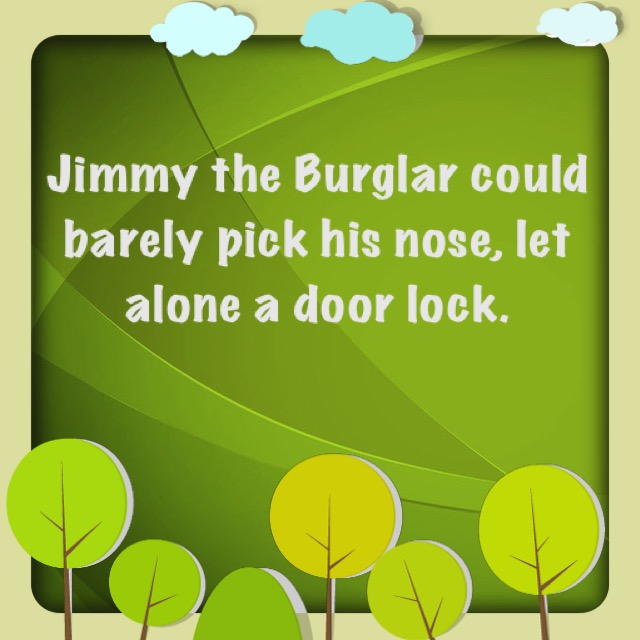
Jimmy the burgler

I did it!

Families inspire us and intimidate us.  Jimmy’s mother, father and brother are all members of the Burglars Union Guild (BUG), and he is expected to follow in their footsteps.  Jimmy has slippery fingers and not in the slick, pickpocket ways; he drops things.  That lack of dexterity is just the start of his struggles to gain entrance into the most elite thief organization.  The story of his life is now immortalized in electronic bytes.  I published a book.

I didn’t do all that writing in one day, as I proposed in my original challenge.  I also spent more than 10 hours writing Jimmy the Burglar.  Regardless, I completed the challenge.

I feel really good about that because this is my first fiction piece in a long, long time.  Fiction is easier to write than memoir because I could make up whatever stuff I wanted.  Fiction is also harder to write than a memoir because I had to make up whatever stuff I wanted.

This is my third self-published book, and I learn new elements with each effort.  This time, I experimented by writing the first draft in longhand.  At 2 hours and 56 minutes of writing, I hit a wall: great story elements, but no tension.  Typing that first part in gave me time to think about the story I wanted to tell here and now and in 10-ish hours.  I initially focused on the entire family history as related to the evolution of the Guild, but in that writing, I developed incredible backstory fodder for future Jimmy short stories.  The tale worth telling today is the evolution of Jimmy’s final exam for BUG membership: his MOTH (Modus Operandi Thesis Heist).  After the humiliation he experienced working with Big M, it is vital that Jimmy’s MOTH get all the details right.

At 7 hours and 42 minutes, I was having Too Much Fun writing. So much fun that, I forgot to reset the timer at one point.

After 16 hours (approximately) and 5100 words (23 pgs.), you can read Jimmy the Burglar’s first adventure on Amazon.com.

How did your story turn out?  If you completed the challenge, post your link below.  If you didn’t, share your thoughts now about the experience for all of us so we can learn from it.  And for me, I’d love to know your thoughts about my book. Whaddya think?

If you’re looking for some inspiration and encouragement to complete a book like this, there is a day-long workshop planned for early 2015 in the metro Detroit area.  Stay tuned for the details.

Even if publication isn’t your goal, doing a challenge like this is immensely satisfying. I have typed “The End” on a piece of my writing and am now moving on to “The Next.”

A Talisman, a Tool

What does a tarot deck, an athame, a grimoire, silver and a cross have in common? I’m sure you can guess. They all are tools used in the paranormal trade that are staples in any number of different manuscripts. But how do your characters use them, and how can you as a writer find authentic information that will read true within your characters? Some tools you’ve probably read or heard about come from perceived truths based on lore passed down from generation to generation. Others stem traditionally from religious practices, be it Christianity or Paganism.

I am Christian, not Catholic, but the first symbol of Christianity besides Jesus and the cross that comes to mind is the rosary, a string of beads used specifically for prayer and meditation. It’s an important part in the daily lives of a Catholic. But what about those that are not practicing Catholics? Did you ever wonder why someone dangles a rosary from a rearview mirror of his or her car? Or why they might place a rosary on a mantel next to a picture of a deceased loved one. At some level that persons mind has a powerful connection to the rosary. It gives him or her some assurance that God is with them. It’s a visible reminder of something greater than they are, seated deeply in their faith.

Near the opposite end of the spectrum is Paganism, not to be confused with an Atheist who doesn’t believe in God. Definition no. 2 on Dictionary.com lists a pagan as a person that is not Christian, Jewish or Muslim. The definition of a pagan I like most is, “a follower of any various contemporary religions that are based on the worship of nature or the Earth; a neopagan.” Do they have something similar to the rosary?

What am I alluding to here exactly? Consider the creation of a talisman. A talisman, an object with special meaning for its owner, used by a witch or Wiccan, is no different from a Catholic that clings to their rosary. I know some might think differently, but in both cases, each person believes the items hold power based on their faith, so it’s important to understand how it holds that power for the character you are building.

Even if you’re not developing a witch or a Catholic, what if the girl next door carries a worry-stone in her pocket because her mother said it would lesson her anxiety. Would a blue-eyed, glass broche pinned to a baby’s onesie help ward off evil? Could the mother of the baby become obsessed in her quest to hide her baby from evil, the broche being the catalyst? Would she do something drastic making future events spin out of control?

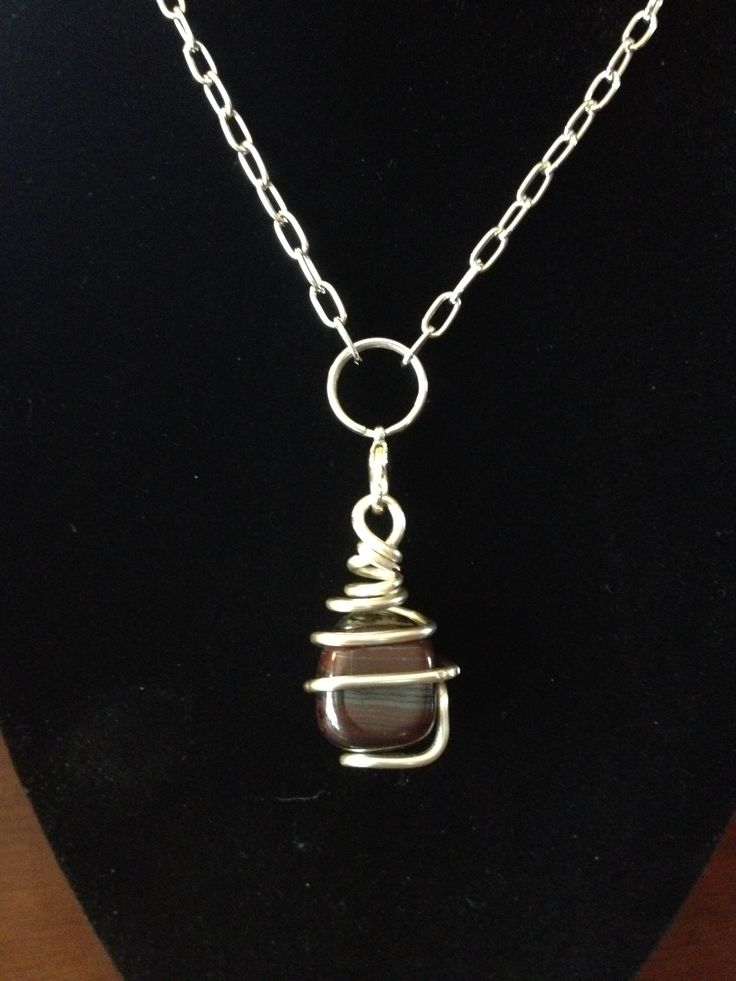
Wrapped tiger iron pendant by WjK DESiGNS

Wrapped tiger iron pendant by WjK DESiGNS

A very mundane character could be similar in my own beliefs. I occasionally wear stones that have meaning for me. It’s not because I believe in witchcraft, it’s because when I wear a stone it has a purpose–besides looking nice—placing a specific intent in my mind as to where I should focus my creativity or thoughts. It acts as a reminder. The photo on the right shows a tiger-iron stone I purchased from Earth Lore in Plymouth, MI, that I made into a necklace. Defined by the expertise of the owners of Earth Lore the stone brings the bearer confidence, strength, and insight of the tiger-eye with the grounding energy of jasper and hematite, or it can boost creativity.

The use of a talisman, a tarot card or rosary gives the writer a different avenue, draping their characters in thick layers of back-story. They add elements that are significant to the characters helping move them toward his or her goal, enriching your story.

Even looking back on the way I used the Hermit tarot card in my last post, the paranormal tool used, helped flush out a purpose or path to get around writers block for character development. Still that same use, drawing a tarot card, could be something a witch, a psychic, a telepath, uses to gain knowledge for his or her goals.

Developing a ghost story where the protagonist is hunting ghosts might add a very long list of technical and scientific tools, but the key word is scientific not supernatural. But what if your character were sensitive to ghosts, what tools introduced could press the tension up in the story?

In this case, might the tool be his or her body or consciousness? Could it be the ghost becomes the tool in your manuscript? The main character is a medium in this case, channeling the spirit of the ghost. On the other hand, the ghost could be malevolent, similar to a poltergeist or one that possesses, controlling your character. Maybe he or she becomes your antagonist instead and the ghost becomes his tool to terrorize because of a symbiotic relationship. The outside source or tool, the ghost, can give you a vast number of options for developing a characters mannerisms, flaws, and idiosyncrasies.

Another great example of a tool in a paranormal world (this one is fantasy) is the ring in Lord of the Rings by J.R.R. Tolkien. It’s one of the most iconic tools in a fictional world. Many scholars could go on and on about the symbolism of the one ring, fashioned for the most evil being in Middle-Earth, or a king, or a Hobbit, and let’s not forget Gollum. If you look at all of these characters, the ring did something different for each of them, driven by Tolkien’s imagination and words.

It’s fascinating to me, the idea of a talisman. Look to your own lives, your surroundings. What’s on your desk, your nightstand? Did you have a box filled with little things you’ve collected over the years, each having a memory attached to it? We all have them in some form or another, a necklace, a coin, a stone. Maybe we don’t know why we carry them, but the need is within us, even if it’s on a subconscious level.

If I give a character a particular item, how does it move them through a story, does it corrupt, does it help, and does it give him or her power? Does an enemy want it for his own, and what happens to your hero or heroine then? So many things can cascade into something else, when you give a character a tool. But be careful. If you see it throughout a story, it has to have meaning, a past, a present, a purpose. All you and I have to do is choose what that purpose is.

Happy Writing!