Category Archives: Author’s Craft

Pinterest for promotion: Tips and inspiration

Penn State PinterestSocial media: is it selling or sharing?

These days, it’s a bit of both.  As a writer, or anyone with a product to promote, social media presents powerful platforms. You can spend more time socializing than writing, so where do you focus your attention?

Pinterest is a social media cut-n-paste website to collect and save online items meaningful to you. Neater than a folder of newspaper clippings from back in the dinosaur days, when you find an image or idea that you want to remember, you “Pin” that image to a “Board” that you create.  Presto! Your collection begins.

The anatomy of a Pin is an image, the description and the website link.  The image is the specific, intriguing picture from the website. If the site isn’t set up to instantly open Pinterest when you hover over the image, you can manually add the image to your Board with the Pin It button you download from Pinterest and save to your computer’s internet taskbar.  The description is whatever you type in as a reminder to you–a cool title, the inspiration for saving it, your impressions–all in 500 words or less.

The website’s link automatically attaches as an electronic sticky note to the “Pinned from” line, and this takes you back to the original post.  If you Pin directly from your smartphone, the Pinned from line simply states, “uploaded by user,” thus creating a static image gallery.

Boards group specific topics or themes together, such as: recipes; parenting; DIY crafts; men’s fashions; travel destinations; and home décor. Quotes and infographics are popular, too.  If you want to connect with users—or Pinners—who share your interest, search the site by category, keyword or user names.  Here’s where the social aspect steps in.

When you discover an image someone else saved, you can Pin that Pinner’s pin to a Board you created, and vice versa.  To see a Pinner’s latest discoveries, you “Follow” that person, and then you choose to follow all or just some of their Boards.  The most popular Pins, popular by Likes or Pins, come up highest on any search.  It’s important to be social to be discovered.

Remember that, “Pinned from”, direct link I mentioned above?  This is where the promotion aspect steps in.  You want to send people to where the action is, so create Boards that link directly to your blogsite, etsy shop or Amazon page.  Create exciting titles and use the description box wisely.  Like other social media, use #hashtags to group your pins and to be instantly site-searchable.  Type in an additional website link in the description box, and it is an active link, giving you additional promotion tool option.

Who do I like?  Who uses Pinterest well?  Who inspires me?

Drive traffic back to your own website like blogger Laurel Regan (Alphabet Salad) by grouping her blog posts, most recently for her April 2015 A to Z Blog Challenge posts.  I found her through that blog hop, and she inspired me to create my own A to Z blog posts Board.

Intrigue your current and future readers like writer Wendi Knape (Wendijowrites) does by teasing them with images that inspire her writing.  One of her stories, Jacob and Charlotte – Meet Cute, features the characters Jacob and Charlotte. Wendi created a Pinterest Board to describe her characters’ “development, clothes, hair, living space [and] favorite foods.”  This inspired me to give readers insights into my own writing process through my “Author Inspiration” board.

My use of Pinterest has been a mixture of art and writing.  “Scrapbooking and artsy-fartsy stuff” collects mini-album and ephemera ideas to pitch to my editor of Michigan Scrapbooker Magazine for future articles.

My Zentangle boards promote my classes as a Certified Zentangle Teacher (CZT) and artwork that inspires me.  Why not let others know what moves me, as well as inspires my works of art?

“Holiday Festivities” gathers spooky ideas and recipes I use to create great visual images for my blog’s annual Halloween post.  See how I used the ideas to create party atmosphere in my 2014 Halloween Party blogpost.

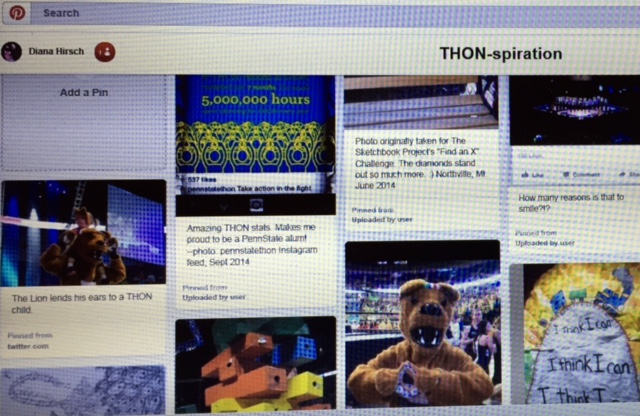
“THON-spiration” collects images related to the fight against childhood cancer and The Penn State Dance Marathon (THON); it is currently my most popular board.

As I was typing this post, I created “Books by D.W. Hirsch” Board.  In the first 24 hours, I had 24 followers.  How cool is that!

I can’t guarantee any success like that, but I can share tips I’ve discovered along this social journey.

Tips to get the most exposure to yourself and your Boards:

  • Creative titles.  Make your Boards sound so exciting that people can’t resist clicking on them.
  • Maximize the description box.  Don’t write wordy paragraphs; space out long sections of sentences.  Include hashtags, keywords, and related websites, but use tabs or double-spaces between these words.
  • Choose the most interesting, active image to Pin if you have multiple options from a website.
  • Credit the original artist every time you share personal content.  Let them know you’ve done that and they may follow you back.
  • For more ideas, search a general word.  Type the word “writing” and you get subcategories of novel; inspiration; prompts; quotes; and more

Some writing-related Board ideas include:

  • Writers you like and blogs you follow.  Be sure to describe why you include them.
  • Books you like or want to read.  This gives people a look into your personal likes, and they may discover a new book to read after seeing your interests.
  • Share and be social: promote other bloggers or writers by posting their content.
  • List blog or writing challenges for future exploration.
  • Promote personal blog posts.  Group these sites into related categories and boards.
  • Share other media images like screenshots of your Twitter posts.  Be mindful of others’ privacy.
  • Favorite quotes

Pinterest works best for people who actively wander around the Internet.  Creating a Board or Pinning an item can take as little as 3 minutes, but this may be an awkward medium for some.  It takes time to ensure the correct link, to write an appropriate description, and then roam around Pinterest looking for people to connect and share interests.

What site platform works best for you?  Are you still discovering?  Share your thoughts in the comments below.

Playing Leapfrog

phil7.1.12With Knock Softly (KS) finished, it’s time to clean up. But first, the statistics.

With “The End,” KS crossed the finish line at 128,814 words, 448 pages in manuscript format, in 44 Chapters. It took 21 months to write and I compiled 28 pages of notes, plus a thick folder of printed articles. There are four main characters and four support characters as well as a cast of over two dozen doctors, nurses, lawyers and the like. There are two main settings and a couple of side trips. And two dogs. And one mysterious friend who seems to know everything. Done.

Then I played “Leapfrog” with the novel, only going backwards. I re-read chapters 43 and 44, then re-read 41 and 42, then 39 and 40 and so on, until I finished back at chapter one. This allowed me to know where I was going and to be sure each chapter led clearly and succinctly to the next. It also allowed me to “kill my darlings.” I’ve spoken of them before; those cleaver little verses that seemed so cute at the time. But in leapfrog, they appeared as obstacles that only got in the way of a good jump. I also identified areas that needed shoring up for what comes next, and those I marked with an “R/W.” I did not rewrite anything, just cut and identified what needed more work.

The manuscript now weighs in at 120,090 words, 429 mms pages. It took seven days and produced another page and a half of notes. Twenty pages went into the dust bin, 8,800 worthless words. Bye, darlings.

Now comes the real fun part; I get to play God! I will start again from the beginning, only now knowing all, I will tighten the read, heighten the valleys and smooth the jagged edges with that last chapter, last page, paragraph, the very last word, in mind.

Some of the things I will be on the lookout for are, first and foremost, character development. I want to be sure my folks develop on pace and keep with their persona. I was amazed at how many times my characters cried. I didn’t set out to make weaklings but that’s how they appeared in some scenes. I noticed a lot of character movements when a simple he said, she said, would work better, faster. Even after leapfrog, the characters are still smiling 148 times, sighing 48 times, and mad or angry 51 times. Not to mention all the tears. I’ve still got work to do.

You don’t see these things while writing first draft because you are wearing each character’s hat and navigating them through uncharted waters. Your adrenalin is flowing and you just want to keep the action moving forward. You forget they’re human, that they need to breathe, too. I don’t how much more there is to cut. I don’t have a target word count or anything. I’m letting KS sit for a few weeks before I come back to it with fresh eyes.

Am I happy? So far. Satisfied? Not yet. Eager? Yep!

Next month, we’ll take a look at correctile dysfunction; the author’s inability to line edit their own work.

-Phil


Seoul40  Freya40

Seoul Legacy, The Orphan’s Flu is available in paperback on Abe, and on Amazon in paperback & ebook.

The Freya Project is available in hardcover and limited edition from the author. Quantities from Countinghouse Press.

In the Beginning – Make It Up

“The scariest moment is always just before you start.” – Stephen King

What causes a writer to stare uncertainly at the blank white page: lack of unique ideas, not sure of how to start a powerful memoir, or even the most effective way to begin a thriller?

“Story Starters” by Lou Willett Stanek, PhD. has some excellent ideas to help jump start your creative juices. Chapter 8 suggests using found objects as a story starter. There could be a fascinating story in an old letter found hidden in a drawer liner, in the words of a secret diary, in the gruff sounding chime of a grandfather clock, in the glass angel for the top of a Christmas tree, or in a bronzed baby shoe. These objects could be the subject of a short story, the beginning of a novel, or could trigger a long lost memory to begin your memoir.

Chapter 5 talks of the dangers of using real-life events or people. Stanek’s advice for fiction writers is to “Make it up.” Using real-life for your stories can be boring (people already know the true story), libelous (someone could sue you for writing about them), or even didactic (people don’t like being lectured to).

If you want to write about real-life events or people, “Make it up.” Alter the premise of the story, switch the genders of the protagonists, select a different location, or change the outcome of the situation.

Keeping a Journal of Ideas is a common suggestion for writers. This journal is not a diary of what you had for lunch but what you see, hear, smell, taste, or touch that might trigger a memory or idea that could be developed. Filling your journal with descriptions of places you’ve visited, unusual names of people, or paraphrasing a conversation you’ve overheard could help you begin a story. Then the next time you find yourself staring at that blank white page, open up your Journal of Ideas and pick one.

What suggestions do you have to for dealing with the dreaded blank white page?

Read Books, Review Books, Remember Books

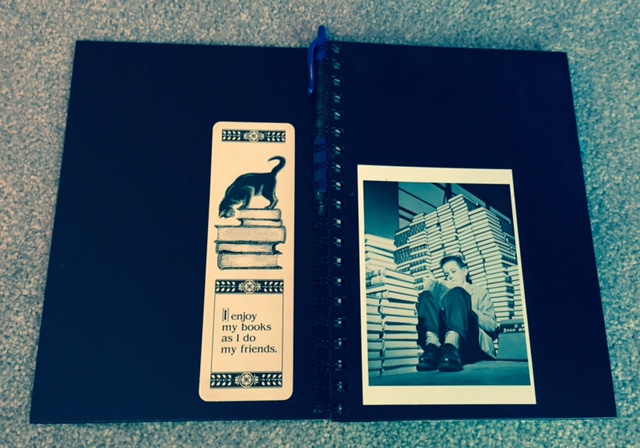
FullSizeRenderOn this blog, I’ve written about journal writing.  I’ve written about reading books.  There was a time when I did both: I read books and journaled about them. Go figure.

After last month’s journal expedition, I wandered through my bookshelf and discovered a journal wherein I reviewed books for myself as a reminder of what I read and what I thought.  I forgot I had done that.

My inspiration came from those funky “record your recollections” books found in your bookstore’s gift section.  The fun titles and decorative covers invite you to review wines, where you drank them and save the wine labels. You could write about the places you traveled and significant snippets of the journey. Journal titles encouraged memories of meals and restaurants, favorite songs, meaningful quotes, garden plantings, lists and more. Since my two main interests were books and movies, I decided I would chronicle my impressions of each.

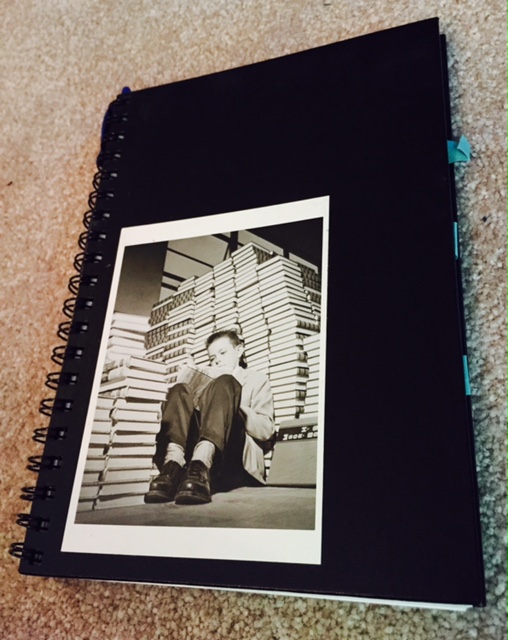
Rather than pay for a fancy-schmancy, pretentious book with pages too small for a proper review,    I could make my own book better than any preprinted book. Besides, I found a pair of regal spiral bound notebooks, elegant in their 8″x10″ stature. The simple black hardcover was perfect for a funky, relevant, inspirational postcard. I clipped identical, important-looking blue gel pens in the rings.  I was set to write whether at home or on-the-go.

I recorded each book in the same look, manner, and design: “The Title” by Author; Month and year I finished reading, and my review.

It was the prehistoric equivalent of modern day Goodreads.

FullSizeRender2I tabbed four sections. The front main pages were reviews of the books I read. The second tabbed section I reserved for books recommended to me or that I wanted to read. The last section has some pencil scribblings on the first page; it looks like I planned a “books I borrowed or loaned.” I didn’t know enough people who read books. There is a third section tabbed off but with nothing written on those pages I have no clue what I intended.

I reviewed books from July 1999 through September 2002. My first reviewed book will remain nameless because it is so horrible. I wrote: “College life…here was my chance to see how someone else does it. I’ve learned how not to do it. I have no idea what any of the characters look like. Everyone swore, drank and got drunk. C’mon, a keg at your final? A torture to read but I had to finish it for story’s sake. I forgot that there had been a framing structure at the beginning. Events just end and everything is summed up neatly, compactly, and smoothly like the end of the stereotypical sitcom. Now writing about it, I can put it out of my mind.”

That book was my first exposure to self-published books, often called vanity press back then. This book had to be good. After all, it was a hardback book, with a colorful cover, I discovered at an independent book fair in New York City. That gave it validation. Ever since I read it, this is the book I refer to anytime I need an example of poor writing and the desperate need for an editor.

The General’s Daughter by Nelson DeMille. July 1999

“Print from this ‘old style’ trade paperback dirties my fingers. I like the movie better than the book. Narrator often sounded like the author, not the character.” The ending was given away too soon. Very few ‘he said’ in text and was often confused by who was speaking. Movie was more coherent, flowed better.”

The House of Seven Gables by Nathaniel Hawthorne. November 5, 1999

“Never was I so glad to finish a book!”

I developed a fascination about writing the true story of a real person. I moved away from fiction and desperately sought solid nonfiction. I read a series of disappointing memoirs after that. One review included my insightful comment: “In the last two memoirs, the struggle is established at the beginning but then the readers never reap the benefits of success.”

Good advice to remember as I finish my memoir.

Tuesdays with Morrie by Mitch Albom. November 25, 1999

“This book made me uncomfy [uncomfortable]. That was wonderful! I want to read it again.” In January 2000, I did just that. “The second reading as powerful as the first. Real writing, honest and true yet not sappy. There’s a reason this has been on the best seller list for over 100 weeks.”

Falling Leaves by Adeline Yen Mah. Saturday, March 4, 2000

“A tragic memoir wonderfully told. Her words: simple, and I got so caught up in her storytelling I didn’t notice.”

The Joy Luck Club by Amy Tan. June 2000

“Good example of a story told through many smaller, seemingly unrelated stories. I’d like to see how the movie translated this fine book.”

As of this writing, I have not yet seen the movie.

The Girl’s Guide to Hunting and Fishing by Melissa Bank. August 13, 2000

“What a quick read! Recommended by Jane, I echo her thoughts: I wish I’d written this book.”

Memoirs of a Geisha by Arthur Golden. March 2001

“It has been so long since a book snagged me so completely. I was up nights swallowing every word until way past my practical bedtime.”

I wrote about the Harry Potter series from December 1999 to 2002. Interesting how my opinion has changed since those initial readings.

My last entry is Diary of a Mad Bride by Laura Wolf. September 2002

“B-day gift from Dawn, I read it in about one week. Funny, and a lot more truth in there than any bride would care to admit. Written in short journal entries, it’s easy to read. I must read this closer to my wedding 🙂 again!”

I never did read that book again, but maybe I will now, especially since I am married.  One part of my New Year’s Non-Resolutions is to revisit and reread an old favorite book.  I’m faced with a dilemma: which one do I choose?

Do you have any recommendations of good books to read, or ones to avoid?

Writing Contests

Writing Contest imageTiming is everything. When it comes to writing contests this is particularly true. One of my goals is to keep entering writing contests, but it always seems my timing is off or my short catalog of work is lacking when it comes to contest rules.

It’s frustrating because entering contests gives a different insight into my work and can lead to better things in the future: the notice of editors and publishers, because they might want to see more work, or because a critique that I received during a contest helped flesh out and improve the writing.

I’ve entered two contests, since my writing journey began in 2008, the Lone Star Writing Competition and the RWA’s Golden Heart Awards contest. Recently, I found the Writer’s Digest Annual Writing Competition, which I really want to submit to, but the problem is I don’t have a piece that is 4000 words or less and the deadline to have something done is May 1st.

Pushing my frustration away, I ask myself, what can I do to be ready for contests matching my goal to become a published romance author? The answer is simple. Research. To prepare, I have to think ahead a year. First, I need to find contests that are appropriate for my goal. Second, I need to read the rules. Third, I need to plan a strategy for the upcoming “contest circuit” in the following year. Finding contests for completed work is ideal, but I also want to expand my project list. In considering contests, I don’t want to sacrifice works in progress, I want to add titles that relate and meet contest criteria.

Usually when browsing the internet for contests, it is spur of the moment, which doesn’t help. Without planning, I’m just going to be racing to try to catch elusive deadlines that are already too close to meet.

Therefore, looking into the future, here’s what is on my agenda:

  1. Find contests that coincide with my goals.
  2. Prepare a schedule of writing and editing to meet the rules for each competition, without compromising what I’m currently working on.
  3. Submit to at least three contests each year.
  4. Make entering contests a habit.

Here are some reasons why writing contests are important to me. As with any type of business, I have to meet deadlines and contests have deadlines. Plus, judges in most contests, rate and/or critique work. So, if I have something to improve on, and I didn’t place, I can dig back into the work. I can make it shine with the proper luster, and resubmit to another contest or go the agent/publisher angle.

As luck would have it, I recently came across a contest whose deadline was on April 30: The Maggie Awards. I met the rule requirements, so submitted my manuscript. There will be a critique. I hope that something will come of it. In the event that it doesn’t I will keep moving forward with my writing, enjoying each story as it unfolds watching my hero’s and heroine’s come to life on each page.

What writing contests have you entered in the past year? If you need some help, finding what is right for you, just Google “writing contests 2015” or below you can hit the links of some I found while doing my own investigating: