Category Archives: Author’s Craft

How do you choose a writing journal?

Just like magic wands, a journal must choose you.

As a child, I expressed my deepest thoughts, heartbreak and angst in various hardcover journals, college-ruled notebooks and at least one Dear Diary with a metal lock. Did you pour your heart out in a journal? I still journal, but not as much as I used to. I wish I could say that’s because I have no adult angst, but I can’t lie. To make sure I carve the time out to reflect on myself, “journaling more often” is one of my New Year’s Non-Resolutions I committed to with my writers group.

My old journal ended today after five months of use. In my younger days, I could’ve blown through that purse-size, 4”x6” journal in less than two months. And in my younger days, I would never have used such a small book. Regardless, I need a new journal.

I have a collection of journals ready for words waiting for me on my bookshelf upstairs. Too many, one might say, but I hold an emotional attachment. Besides, can you ever have enough journals, whatever the style?
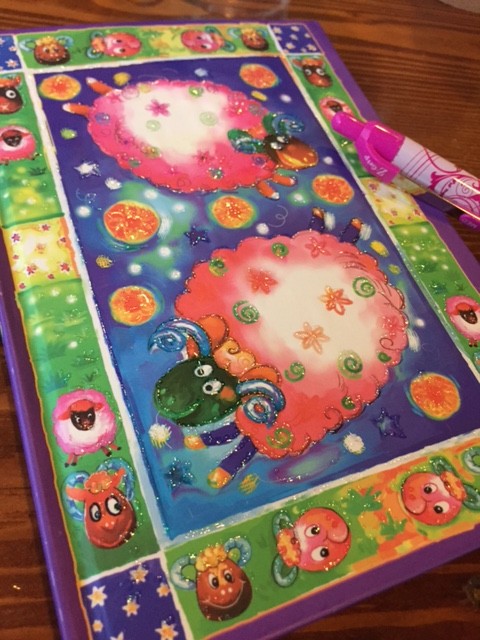
Dancing space sheep swirl around me, complete with glitter and memories.

Dancing space sheep swirl around me, complete with glitter and memories.

As I slide my hand down the row, examining each spine and shape, I think about reducing my stack. Here’s an opportunity to donate old journals I no longer enjoy writing in, either by size or style, and toss out ones with bad karma. I’m thinking of a specific one given to me by an ex-boyfriend’s mother, but I may have used it already. I don’t recall what it looks like when a bright purple spine pops out at me. Friendly bubble letters beckon me with one word: Journal. I pull it off the shelf and cradle it in my hand, staring at the cover. At least 30 seconds pass before I figure out that the abstract glittery shapes are sheep floating in space. It’s rather trippy.

Each white, lined page of the 5×7″ book is bordered with a quilt-like pattern of muted mauve hearts and stars. Sometimes I prefer pages with lines to keep my sentences straight and even, and other times, wide-open blank pages inspire me. Sometimes I like to write on bright white to show a pen’s true color, while other times my eyes want a muted tan or yellow page. This portable, lined, white-page journal in my hands seems fine to me. The psychedelic cover makes me weirdly happy. Now to flip to the inside cover and see if I made any notes about the journal’s date or where it came from.

Karma’s a bitch.

This journal was a birthday gift 15 years ago from a friend I no longer talk to, mailed to me at a previous job that was absolutely vile.

This is the kind of karma I was talking about, so I set it aside, not even putting it back on the shelf. There are plenty of other journals here. A leather dragon-covered book is too heavy. One large notebook has a handmade cover with buttons on it, a good memory of the person who made it for me, but a bit awkward for my needs right now. I don’t want this other one with a wooden cover. That blue Moleskine is too small. The ring binding on another is too big. Nothing fits my mood except the funky sheep journal.

This empty journal is scrawled with memories. I taped the original mailing label inside the front cover, which is why I know from where it was mailed. Just seeing the company name brings back stomach-churning memories of the underpaid job with the stuffy upstairs office where I worked. I remember the two sloppy mistakes I made that make me feel uncomfortable and stupid to this day, and the disrespectful ex-boyfriend I worked with who constantly yelled insults at me.

During that time, I had my friend, that lovely woman who knew me well enough to know I’d enjoy a fun-looking journal, perhaps a dollar store find, and mail it to me at work to brighten my day. Even today, I recognize her thick, curvy handwriting from the numerous letters we mailed each other. We met during one of my most unique summer jobs. And for reasons I don’t recall now, we immediately became friends. I took my first trip to Walt Disney World with her and a friend. She and I took a road trip to Salem, Massachusetts one Halloween weekend. The last good memory I have with her is bouncing on her friend’s outdoor trampoline on the afternoon my boyfriend-now-husband called to tell me he bought a new car, the car we still drive today.

She and I lived about seven hours away. I only saw her when I drove home to see my parents, and even then, I didn’t always have the time for the extra 2-hour drive. This one weekend, however, I was home for a long weekend and my Sunday was completely open. We could meet halfway and catch up in person, so I called her.

“I can’t,” she said. “I watch football with my boyfriend on Sundays.”

I never knew her to be a sports fan, but I was a far-away friend in town for the day. “What’s it going to hurt, taking one afternoon off?” I asked.

“I can’t. We watch football on Sundays.”

I understood that sports aspect with guys; my boyfriend-now-husband watched college football on Saturdays. He liked it when I watched the games with him, but if I wasn’t there one weekend–like this weekend I was currently away for–his life didn’t end and we didn’t break up. I’ll be there to watch games with him weekend, but I will not be within driving distance of my friend next weekend.

“Not just this one Sunday?” I asked her, hearing my voice rise in a pleading tone.

“We watch the game together,” she replied.

I never met her boyfriend, but I got the sense he was a demanding man.

Maybe it was just my imagination, but my friend was always independent. If she hadn’t been dating him, I was sure she’d make the time to see me. I told her how hurt I was, how I thought he might be controlling and I was saying that because I was looking out for her, as a friend should, but in the end, I lost the argument. We spoke once or twice on the phone after that, but she stopped returning my calls. I lost my friend.

I was surprised to receive a sympathy card from her when my dad died. She must have been on the overall distribution list when I emailed the news out. That was a nice gesture, really touching, but I didn’t know what to say, where to begin again. I don’t recall mailing a reply to her.

Now this journal calls me. I don’t know why. Does the journal want me to fill it with good memories, turning something positive out of a bad memory? Is its purpose to just fill the pages and “git ‘er done” and out of my life? Does my journal want some closure for me? Some reminder of better times, or is it a nudge to do something more?

All I know is that the two floating cosmic sheep make me smile, and I have to choose this as my next journal. Maybe with a wave of a metaphysical wand, I’ll figure this out by the end of the journal. Or maybe the last page will be just a last page.

Dare to Be Different

“It is better to fail in originality than to succeed in imitation.” – Herman Melville


As the only female in my undergrad speech class, I comfortably delivered the speeches required by the professor’s syllabus. Comfortable that is until we received a new assignment, a five to seven minute demonstration speech using props, pictures, or other visual effects. After each presentation, our classmates would make comments about the subject and the presentation.

Testosterone filled the classroom as each student quickly stated what his subject would be. Topics included: how to fix a lamp cord, how to replace a garbage disposal, how to change the oil and oil filter in a car, how to give basketball officials’ signals, and how to use various repair tools.

Still living at home, I was used to my father doing all household repairs. However, he did teach my sister and me the difference between a Phillips screwdriver and a slotted screwdriver, a wrench and a ratchet, as well as vise grips and pliers. He taught us how to use a hammer without damaging a finger, how to clean walls bottom up to avoid streaks, and my favorite: how to jiggle the handle of the toilet to stop it from leaking. I knew a few repair tricks, but I knew I couldn’t compete with the men in demonstrating how to fix anything.

I didn’t pick a topic immediately and chose to be the last speaker in the rotation. What could I possibly demonstrate to a group of men who would give informative speeches showing their expertise in fixing a myriad of things? After much thought, I selected my topic, practiced what I would say, and carefully prepared my props.

On the day of my presentation, I opened my bag of visual effects in front of the class and said, “Today, I’m going to teach you how to make a dress.”

The look of surprise on the male professor’s face was priceless. I held up a large piece of fabric and a simple dress pattern and said, “This is what you start with.”

Putting those items aside, I held up a piece of fabric with pattern pieces pinned in place. I held up a pair of pinking shears and explained that they were preferable to plain scissors because they prevented the cut fabric from raveling. I described how darts are made to provide a smooth fit over the curvy parts of a woman’s body. I showed how I sewed a zipper into the dress.

All eyes were on me as I ended my demonstration speech with, “This is what the finished product looks like,” as I modeled the simple black form fitting dress. The applause that followed was heartwarming, but the positive comments told me that I succeeded.

I dared to be different. When have you dared to try something different?

Ride Along by Book Lover

Always curious about the life of a journalist, I decided to do a “ride-along” with a well-known female television reporter. PS Garrett is a well-respected beat reporter for her station which is second in the ratings. I was intrigued by her unusual first name, PS, and hoped to discover its origin.

It was a warm February night on my first “ride-along” with Ms. Garrett. She parked her vehicle discreetly a short distance away from prying eyes at the crime scene. The feel of doom and gloom permeated the air at a suburban gas station where a double homicide occurred. Police officers, as well as reporters from competing stations, were milling around. Ms. Garrett entered her station’s satellite truck already parked at the scene.

I was mesmerized by the technician in the truck working feverishly to correct some technical difficulty. News had to be gathered quickly because they were on a tight deadline.

I paid close attention to Ms. Garrett’s conversation with the police chief as she tried to illicit details of the crime. Her gentle questioning of several locals at the scene helped obtain information about the two teenaged murder victims. Rather than take out a notebook, she committed the information to memory so as not to spook the townspeople.

Garrett — the only reporter from her station on the scene, and the photographer who joined her –worried about meeting the nightly news deadline with enough information to compete with the other stations.

Without crossing the yellow crime scene tape, Barrett saw something the other reporters missed. That disturbing detail sent shivers up my spine. The detail, reluctantly confirmed by the police chief, couldn’t be revealed to avoid alerting the murderer.

I wondered how she could possibly keep the detail from getting out. Would Ms. Garrett keep her job if her boss knew she squelched vital information on the case? She knew the police chief would owe her big time for keeping mum.

Already well past 10 PM, she spent a few minutes writing the story. The on-air broadcaster was hostile and angry that the story was coming in so late leaving precious little time for editing. Garrett readied herself for her live shot just as the antiquated equipment failed again.  She prepared go live without an edited script and no story on tape.

Just then, my doorbell rang. Darn. Company. I’ll have to put down this riveting book, Deadline! Book One by Paula Tutman, and answer the door. I hope my company doesn’t stay too long. Can’t wait to get back to the book. Care to join me?

What’s a Penny Worth?

I buy most of my hair products at Ulta3. I find the people who work there helpful in suggesting the right product for what I need. I also like their sales. My favorite is the one where, if you buy two of something, the third one is free.

Last November I needed some hairspray. I went to Ulta3 and talked with one of the saleswomen. “What hairspray would work best on fine hair that has a mind of its own? I want something to hold it in place. But I don’t want to look like I have a steel helmet on.”

The salesgirl suggested one of the Paul Mitchell products.

I wasn’t sure. “What if it doesn’t work for me? Or, what if I don’t like the way I look?” I asked.

She told me, “Don’t worry”. It’s a Buy 2, Get 1 Free sale. If you’re unhappy, you can bring the unused product back with the receipt and exchange it for something you like.”

That sounded fine. I bought three cans.

When I got home, I put the cans in the bathroom closet because I hadn’t yet finished with the old hairspray I was using.

A few weeks ago, I finally finished the old hairspray and started using one of the new ones. At first it was o.k. But, after a few days, I wasn’t happy with how my hair looked or felt: It felt hard, not fresh and silky, and looked dried out, just like I had a steel helmet on my head. I decided to give it a few more days but nothing improved.

I searched for my receipt, put it and the other two cans in the Ulta3 bag and went back to the store. Once there, I walked to where the Paul Mitchell products are kept and located the hairspray that I was bringing back. I looked around on the shelf to see if they had something else that would look and feel softer on my hair. I read the descriptions on the back of the cans. Finally I found one that sounded good.

I stopped the saleswomen I saw walking by. I told her my problem and asked, “Will this other hairspray work for me?”

“Well,” she said, “The new spray won’t hold your hair as well but it will feel soft and natural.”

I walked to the front of the store to make the exchange. I explained what I wanted to do and the cashier said with a smile, “No problem.” To me, that’s the universal sign that very soon something’s going to go wrong.

The saleswoman entered the product information into the cash register and called for her manager to put in her code to complete the exchange.

The manager came up front. “You know,” she said. “It’s too hard to do it this way. I know an easier way.”

“Fine.” I said. I just wanted to complete the sale and get going. I hadn’t planned on spending this much time at the store.

The manager started ringing up the hairspray. First she swiped the bar codes on the cans I was returning. Then she punched a number of keys. After that she stopped and gazed at the cash register. Lastly, she cancelled everything out and started over.

I watched her do this three times while trying to discreetly peek at my watch to see what time it was now. This was taking much longer than I’d expected.

After the third attempt, something must have gone right, because she asked me to hand her the two new cans of hairspray that I wanted to purchase. She swiped them.

I looked at her expectantly. It looked like everything would be o.k. after all. But then she undid everything and started over again.

At that point I couldn’t help myself. I very obviously looked at my watch. I’d been in the store for almost half an hour.

I looked at the manager again. She was still swiping and pushing buttons on the cash register. I asked her, “What seems to be the problem?”

“The cash register keeps saying you owe a penny in tax, but you don’t.”

“That’s fine. Don’t worry. I’ll pay it.”

“No. You don’t owe it,” she said.

“I don’t care. I’m happy to help fund the government. I’ll pay it.” I put a penny on the counter.

“Are you sure? You really don’t have to do this.”

“I want to.” I picked up my bag with the new hairspray and walked out the door. I felt I had escaped.


Insta-success with Instagram

Twitter is stupid, and Instagram is for people who can’t read.”–Max, 2 Broke Girls

I always think of that quote when I mention Instagram to others.  Instagram is a social site for sharing snapshots.  If you don’t like imagetaking pictures, this post won’t be for you, but you should read to the end just to make sure.

As a writer, or any business owner, you need to find social media platforms that work for you and your desired end goals.  The sites need to be ones that you will maintain and that are fun for you.  I think Facebook is a big time-suck with algorithms that don’t let me see the feeds of everyone I want to in the order that I want to.  Still, I have a Facebook Author Page that I modestly keep up with.  I have discovered informative people through Twitter and it seems to be popular for writers.  It’s hard to keep up with the news feed some days, but there’s some good interaction with my tweets.

What about Instagram?  I’m a scrapbooker and, by default, take hundreds of photos every month.  I’m surprised it took me so long to find the value in Instagram.  My first two photos posted the week of June 10-16, 2012 (138 weeks ago) when I was just playing around with some filters on my first smartphone.  They were pictures of teddy bears.  I didn’t know what else to do with it, so I trailed off and lost interest.  I picked it up again the week of February 2-7, 2014 (53 weeks ago, or just over a year) as an outlet to showcase my writing, initially my haiku poetry.  Now I use Instagram for my writing and…well, stop on over and check out my photos at @dwhirsch.

I use Instagram as a marketing tool as much as a social experience.  I don’t pretend to know everything about Instagram.  I read information from bloggers who have done the research, such as @jenns_trends, who is a goddess on Insta-information.  What I’m offering is my personal experiences and successes adapting those tools.

To use Instagram effectively, you have to decide what you plan to share.  This can change over time, but start with some initial rules.  My guidelines are the same ones I have for my personal blog.  I never post pictures of friends or family without first getting their consent.  I don’t post photos of my house because I have “location services” turned on my phone.  I don’t want people to know where not to find me when I’m out of town.  There’s nothing valuable, explicit, religious, political, controversial or anything my dad–were he still alive–would be disappointed to read about me.

image

Instagram is Insta-easy to use, and the site’s features are relatively uncomplicated and obsessively playful.  It’s free to set up, and I recommend you snag your profile information now: create your Name (generally your real name or business) and Username (what you’ll be known @as). Photos are posted in a square, and most smartphones have a “square” option in the camera settings. If not, or if a square cuts off some important part of your photo, there are many free apps that will shrink your photo and place a border around it. To post, just upload a photo or 15-second video that you take live or have stored in your smartphone library. You can alter your media with black-and-white, sepia or color filters, with additional tools to adjust the image’s brightness, contrast or saturation level.  Finish it off with a frame or vignette, add a caption and press Share.

Now that you’re live, how do people find you?  Your 153-character bio, along with your photo’s caption, and hashtags need to be creative, potent and relevant.  Going back to Max’s quote comparing Twitter and Instagram, the latter is not restricted to 140 characters.  Your photo or video should tell a complete story, but you can use about 440 words to explain that image. This comment section is vital because you can tell your story and highlight your image using crucial hashtags.

Instagram is hashtag heaven. People with similar interests will find you based on how you tag your images.  Common hashtags reflect those you find on Twitter, but you don’t have to be familiar with Twitter to use Instagram.  Think about what your picture is about and tag your image with common terms.  As a snapshot in the moment, you can showcase a twisted #tree branch, a royal #sunset, a #selfie in your awesome new #shirt, an art exhibit or the #bananabread you’re baking.  You’ll get a feel for tags once you start using them.  Tags have no spaces and use just alphabet characters with no suggestions, so type in exactly what you’re looking for.  Much like Twitter lists, you can also create hashtags to group your own images in a somewhat folder design.  Some of mine include #iamapoetess, #SnuffletFinse and #Champsp. Be sure to check out this group’s posts, which are under the same hashtag as on Twitter: #dwriters.

The Explore tab complements tags by suggesting people to follow based on tags you use, images you’ve ‘Liked’ and people or companies that your followers follow.

image

Oh, yes, companies use this.  Instagram is a successful marketing tool, a highly-used space to display products from #clothing to #cosmetics. Check out companies like @Bathandbodyworks, @Ford and @Applebees.

I sometimes stage my work because I want my followers to see the best of me.  I give my followers a peek into my writing, #Zentangle art and my overall creative process while infusing my quirky personality and personal interests.  Think about it: if I follow a particular author, I feel more connected to the “person” rather than to the “celebrity.”  Therefore, I’ve taken my book cover image and overlaid a part of a review on top of it.  I type up actual text from my latest #shortstory or #poetry.  Photo editing can be fun.

Given my goals, I show images of blue-inked-up work as I edit my current draft.  I show the #coffee shops where I #amwriting. I show the stages of my Zentangle #wip so people can see my creation from start to finish. I have too much fun with it on the go not to let it be organic.

Remember, social media is social. I share my work and myself because like Max on #twobrokegirls, the experience on Instagram is more social. I comment more than I Like because the image doesn’t always grab me but the story in the caption section does.
image When someone takes the time to comment on my work, I respond to every–and I mean every!–comment made to me even if that person replied with a smiley face emoji.  I appreciate the time that person spent appreciating me, similarly the gratitude when I receive a #bookreview on #Amazon or #Goodreads.  If nothing else, I reply “Thank you.”  People like you when you like them.

What are the benefits?  The most important is meeting people with similar interests.  I’m reading a #memoir recommended by a follower who is #writing her own memoir. I’m inspired by new #art and #painting techniques.  I’ve been challenged to take pictures in #blackandwhite.  I could meet any number of them for #coffee if I was in their area.  I have a connection to these people. You can do the same with your peers and have fun doing it.