Category Archives: -Phil Rosette

Playing Trump on the House-Of-Cards

Opinion is solely the author’s


I had a funny thought. If Donald Trump and Gary Hart met up with Neil Diamond and Sam Spade to play cards, Trump would insist on playing Clubs. Would he lead with his golf club, night club, yacht club, or his billy club?
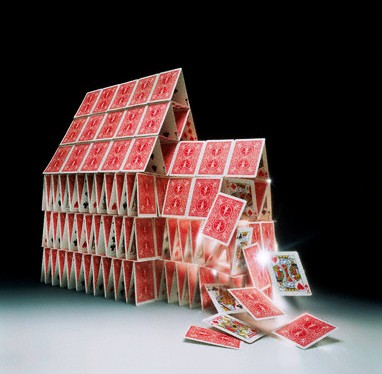
House of Cards - ArchialAlternativeFilesWordPress

Donald Trump has certainly stirred up the nation. Love him or hate him, you have to give him that, and then you have to wonder why. His apparent lack of understanding is actually well understood by many who don’t Get It (what the feds are doing). A lot of people think our government is rigged and now only works for those who grease the wheels. They see the great divide getting wider with Congress leading the charge.

They may be right. For the first time in history, most Senators and Congressmen are millionaires. That says a lot about what this sitting batch of politicians have been up to since getting elected. The problem is, there really isn’t a better candidate than Donald Trump. It’s sad that in a nation as smart as ours, we wind up with him leading the Four Stooges into this summer’s conventions.

Ted Cruz isn’t going to fix what’s broke. Neither is Hillary Clinton. Other issues aside, there isn’t a shadow of difference between them when it comes to the top one percent’s overarching influence. John Kasich is probably the most electable republican in November, but the meek no longer survives in the Party of Lincoln.

Bernie Sanders is like the funny grandfather who loves to tell you all the things your parents did wrong. That’s why, I think, he has the nation’s youth on his side. He also has, by far, more individual contributors than Hillary Clinton. No matter how much money each person gives, they still only get one vote in return. Hillary’s PAC supporters remind me of Captain Gulliver being tied down by 100 Lilliputians. I think Bernie is a better candidate than Hillary, but the problem with any democratic President is that we gain nothing but four more years of gridlock.

The only thing on the republican-held Senate and House agendas will be stopping the clock for yet another four years. In the past decade, Congress has passed numerous laws that benefit few but affect millions as if the consumer doesn’t matter. Our laws are now written, not by congressmen, but by lobbyists for congressmen. Trump is the only one who wants to change that. The others just want to be contestants on Who Wants To Be A Millionaire. And that, regardless of anything else Trump declares, decrees, boasts, belittles or bungles, is what’s going to get him elected.

I just don’t want to hire a nerd to fix my plumbing. We tried that in Michigan.

At the federal level, there is not enough support for the impoverished city of Flint; everyone is too busy campaigning. On the state level, there is not enough urgency or empathy, and way too much politics – still! This is a House-Of-Cards that has already fallen.

Governor Snyder’s business acumen in governmental issues does not infuse a lot of confidence to elect a billionaire businessman to the White House. Not in Michigan, anyway, where we see everyone just dragging their feet and pointing fingers, and nothing getting done.

Flint is a killer example of cronyism. Literally, in the case of Legionnaire Disease, and long-term in the case of thousands of children under the age of six, who drank government-issued lead poison. It was totally preventable if those appointed to manage the city had followed established safety guidelines. Then, when their snafu surfaced, it was covered up for almost a year while Lansing, the EPA, the MDEQ and Flint’s Emergency Manager(s) played the blame game. While people were dying!

Is this what we are to expect on a national level if The Businessman is running the country?

Flint wasn’t the first mole to get whacked, and it won’t be the last. There are hundreds, if not thousands, of American cities large and small that are operating water supply systems with 50, 70, 100-year-old lead-leaching pipes. If the next President wants to build a jobs program that will reach across the nation, as well as across the aisle, then upgrading the nation’s potable water system would be a healthy place to start. Roads and bridges are important, too, and the rails and docks are in even greater need of modernization. Then there is the aging and overburdened electrical grid that all of us depend on almost as much as oxygen.

There’s lots to do. We just need to elect people who want to aspire to things besides becoming millionaires. Or hiring apprentices. It’s a pity we don’t have a None of the Above option on the bottom of each ballot.

Playing Trump in November will certainly bring down the House-Of-Cards that is today’s Capital Hill. And, who knows? Without all of the special interest lobbyists setting congressional agendas, a political career might become noble again.

But I still need to hear more substance from Trump before I can vote for him. Washington is a lot closer to Lansing than it appears on the map.


Read On!

-Phil


So, I Asked Alice…

Here comes fall. What an appropriate name for a season in which the leaves drop as fast as the temperature.

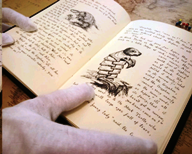
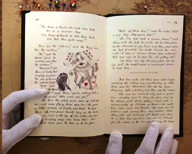
AliceUnderground1My blog last month talked about possibly using crowdsourcing to publish Broken String, my new novel that is now in final edit. I received several comments at Deadwood Writers Voices and thanks to all of you for that.

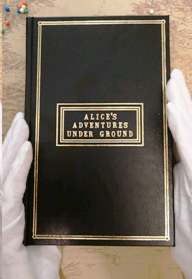
To better understand Kickstarter.com, I decided to “back” one of their book projects. To get a feel for how this might work, I backed the 150th Anniversary Edition of Alice’s Adventures Under Ground. It is being produced in Australia under License from the British Library.

This is Charles Dodgson’s original version of Alice and it includes the 37 illustration Dodgson did himself, with the story in his own hand writing. Lewis Carroll was a pseudonym for Charles Lutwidge Dodgson. His penname was derived from the Latin spelling of his first and middle names, and then reversed and translated back to English.

This 150th Anniversary Edition is leather bound with gold embossed titles with black and white and two-color illustrations. I’m looking forward to seeing it on my classics shelf, after I’ve read it.

AliceUnderground3If you are not familiar with the backstory of Alice, Dodgson originally wrote it as a short story for his College Dean’s daughter. After hearing him tell the tale, twice, during two rowboat trips, Alice Liddell, asked him to write it down for her. He wrote it out in long hand and did his own illustrations, then he had it bound together and gave it to Alice as a Christmas present in 1864. He was encouraged to have it printed for sale and so expanded the story from 15,000 words to 27,500, and brought in renowned illustrator John Tenniel to do better illustrations. He self-published the story, retitled, one year later. That 1865 typeset version is now known as the first edition of Alice in Wonderland. One hundred fifty years later, we have a finely crafted tome of the author’s original words and illustrations, as he presented it to twelve-year-old Alice.

AliceUnderground2Participating with this project has given me insight in how a successful program works. Their costs were projected at AU$20,000 and they raised over AU$109,000 from 1,081 backers worldwide. During the six weeks, I received several emails with updates on the project, complete with pictures of set pages and workers busy on the production. It was a very easy process and it gives me some hope.

Now, I’m not the British Library and my story hasn’t been loved by children of all ages for 150 years, but seeing how they organized the campaign and how they grew interest from under 100 the first week to over 1,000 backers by the end is encouraging.

For my project, I’ll first need to gather a core group of readers, friends and fellow writers to back the project once the campaign does start. Kind of give it a push out the door. Getting that core group to reach out to the friends they know who might enjoy a suspense novel like Broken String is critical to the overall success. Backers of my project would receive deep discounts on signed, first editions of the printed book and first day delivery of the e-book, much like the Alice project offers. I would like to offer versions in limited edition, hard cover, trade paperback and e-book to have the widest price range for backers.

It’s still just an idea germinating in my head. I’ll keep you updated, but I would love to hear from more of you as far as what you think of this idea. What kind of a discount would entice you? Or, what else would be enticing enough for you to back a project like this?

Wanted: Graphic designer for the cover art. Can you recommend anyone?

Crowdsourcing

I was looking into crowdsourcing as a possible way to publish Broken String next year. Kickstarter.com is the one I was looking at, but there are others. Crowdsourcing is a way to find supporters to fund your “project.” That project can be just about anything from a space satellite to a movie, or a book. You start by pledging something in return for supporters’ dollars. One project offered to shout out your name in a ballpark for a pledge of one dollar, but most just offer tee-shirts, mugs or deep discounts on the product they are trying to get started. Kickstarter has had some success with publishing books, but mostly graphic novels and children’s books from what I see on their website. They’ve had a little success with fiction books, but most fiction titles I see are “non-starters;” projects that did not raise the amount of money needed in the time allowed. Non-starters don’t happen and no one is obligated to anything. The project turns into digital dust.

Gulp.

It’s like a poker game where you’re all in. If you win, you’re up, up and away. But if you lose, you’re left with just hot air and no balloon. I’d love to hear from someone who’s published a novel this way, to get an idea of their experience. I’m not afraid to take a chance, I just want to have a look over the cliff before I jump.

Reading through some of Kickstarter’s history and success stories, it seems the most fully funded projects are the ones where you, yourself, bring in a lot of supporters in the beginning. The best way seems to have a rollout where you create a lot “buzz.” Then launch the project on a specific day and get your “circle” to “support” the project on Day-1. That initial surge of interest gets the casual Kickstarter members checking out what all the fuss is about.

That’s great if you’re a big satellite company or a movie mogul where you’ve got thousands following you on social media, but it’s scary for a lonely fiction writer whose circle of friends could be corralled with his belt.

I’d love to hear your thoughts on this. Check out Kickstarter.com if you haven’t already. It’s easy to get lost in some of the projects, many of which are fascinating new ways to tackle old problems, like the mechanic’s glove with a magnetic index finger to hold nuts and washers in place at odd angles. Brilliant!

Would a suspense novel be a success? Would folks want to read it enough to actually buy it? You know, with money? What do I have to lose? Well, confidence for one thing. It’s like amateur night and I’m at the mike. Hope people will laugh at my jokes, but what if they don’t? This isn’t my first trip to the mike, so to speak. Guess I won’t know if my audience is growing or shrinking unless I try.

Kickstarter gives “publish or perish” a whole new ring to it these days. Any hints, ideas or suggestions to help me sleep at night?

I’ve Been Told to Watch What I Write

I’ve been asked on more than one occasion why I don’t go to the movies anymore, or watch drama television. My short answer is, ‘It puts me to sleep.’ Which is true enough, but when I analyze it, I realize it’s not the visuals that put me off, but the audio tracks. Every time someone of 007’s elk gets into a jam – which is about every other minute in most dramas – the producer decides to trump the scene with sound effects. It’s almost as if they’re trying to block your inner ear. And they succeed, overwhelmingly so. That’s the main reason I don’t watch what I write. Listening to pianos and violins while watching our hero and villain duke it out on the edge of a cliff is a stretch too far. Where’s the orchestra? To catch this on the page, the novelist would have to write something like…  “With each punch I landed, violins screeched in my ear; with each punch he landed, a piano struck a low chord.” That’s about as ridiculous as it sounds!


Films and television drama today are all eye candy, but the worst of the worst are sitcoms with laugh tracks. I think Seinfeld is great, but I can’t watch it for more than a few minutes. I’m old enough to judge what’s funny and would love to be able to see it without someone else’s interpretation. I love standup comedy, though.


Novelists have to appeal to more than just the eyes if they want to capture readers. The only way you can do that on the page is to get inside the head of your reader; open up their inner senses. Only on the page can you taste what’s cooking, feel the warmth of a touch, and smell the earthy dew at dawn. None of which comes across on the screen. Today’s film producers put so much weight on visual effects they’ve forgotten that silence speaks volumes.


Alfred Hitchcock was the master of silence. Hitchcock – whose logo was his bulbous silhouette – could keep an audience holding its collective breath staring at a pitch-black stairwell with only creaking footsteps getting louder. No soundtrack could be more frightening.


I enjoy watching most live sporting events. They usually do a good job with color commentary that adds to the coverage. But a few sportscasters just tell you what the cameras are showing, and that’s about as entertaining as having someone sitting next to you constantly saying watch this! Live auto racing is notorious for watch this commentary. Watching auto racing on mute is more dramatic, too.


I also enjoy watching programs that deal with nature, animals, science and history. Some of these programs are starting to introduce soundtracks, and I think they’re making a mistake. I guess they’re afraid they’ll lose the audience if they don’t put out something dramatic to hear while the lion slowly stalks the antelope on a starry night. I’d rather hear the crickets go quiet as the lion closes in. I’d rather see the antelope perk its ears at the sudden dead quiet. That would be much more dramatic, whether you’re rooting for the lion or the antelope. Instead, they cue the orchestra and rob viewers of nature’s voice. Where’s the remote?


My wife subscribes to Netflix and will watch hour after hour of the same series. She calls it binge TV.  I call it nap time.

Typo!

Every novelist needs a copy editor. Why? Because a copy editor makes sure the author is wearing his pants before he steps on stage, makes sure the author doesn’t have a trail of toilet paper stuck to her high heel as the lights come up. Yes, typos are that glaring.

Novelists cannot correct their own typographical errors because they know too much. Knowing what was meant to be said, the author reads what’s in their head not what’s on the page. It’s not a fault, just a fact. A copy editor will not have those preconceived blind spots. They will catch where you wrote breathe instead of breath. Copy editors will see the wrong use of their, they’re and there where your eyes will not. They will find your misplaced commas and misused semi colons and correct grammar where necessary. They will pick up on common wrong-word errors that spellcheck cannot, like typing were when you want where. And at finding missing little words like, for, an, and, at, or and so. Your mind’s eye does not see these kinds of mistakes, either.

Your copy editor is the last person to edit your story before you send it off to your publisher, so you’ll want to entrust this person with as polished a manuscript as possible. The best way to do this is to re-read your entire novel one last time, only lip-syncing it from start to finish.

You don’t have to say the words out loud, but you do need to move your tongue, lips and jaw. What happens is your mouth slows down your mind and forces you to say and see what is on the page. You are also likely to discover syntax errors, run on sentences, passive voices and homonyms, all the stuff that trips up coordination between the tongue and the eye. You’ll discover errors in pacing and entire passages that, really, can be cut. Your only criteria at this point is to clean up and clarify; everything else should be done. Reading like this will catch most of these common errors.

A good copy editor is essential today, whether you are self-publishing or have an agent. What comes out of his or her hands is what will stand the test of time. You, the author, will make all the suggested changes (or not) and correct the typos before submitting it, so in that sense you always have the last word. But by lip-syncing your novel one last time, you will make the copy editor’s job much easier, and much faster.

Who should you hire for this? Yes, I said hire, not ask as a favor. If you are really serious about wanting others to recognize your work, don’t skimp here. Ask other writers who they’ve used and who they would recommend. When you find someone you hear is good, and available, take them to dinner. You don’t have to wine and dine them, but get to know them and what they like to read. Ask them about their funniest stories with editing. That will tell you how much they like their job. Offer a few quips of your own about your research or who your protagonist is based on. At the end of dinner, you’ll both know each other better. You’re looking for someone who wants a personal stake in your novel, who wants to be as proud as you are to see their name attached to it. What they charge, what you pay, should be secondary to that.

How much you should pay is entirely up to you and your copy editor. Somewhere between a dollar a page and three dollars a page seems to be the going rate. The two copy editors I have worked with both charged a flat rate. I paid $250 for my first novel and $350 for my second, but they both moonlighted and neither could be bound to a timeline. The first time I hired a librarian, the second time an accountant. Both were equally methodical. I discovered accountants are very good at finding words that don’t add up, if you hire one who has a good command of the English language.  English teachers are another good source. An editor who reads your genre can be helpful, but don’t make that your only criteria. Critical editing is not what a copy editor edits for. All of your plot development, character development and timelines should be nailed down long before a copy editor sees it.

One final word on typos. No one gets them all, and that’s a good thing if you are in the antiquarian, collectable book business. If you don’t believe me, just go ask Alice. Or Huck. Or that “fool Red Cross woman” in One Flew over the Cuckoo’s Nest. True first print runs of these classics, identified by their typos, are selling for several times what a second printing will fetch. But that still doesn’t bode well for the author.