Tag Archives: creative writing

What to Expect When Your Writing Class is Online

Tempted by the forty free online writing classes available at my public library, I enrolled as an experiment. The full catalog of 350 courses competed with MOOCs (massive open online courses) and delivered a shorter continuing education opportunity in writing and other business topics. I joined with a hundred online learners from across the country and Canada for a brief six weeks of creative writing lessons. The interaction and other classmates were as interesting as the course content.

The exercises began innocently enough asking each student’s reason for taking the class. I’ll share several of my submissions. For instance, here’s my introduction:

The dog made me do it. He worries about neglecting important things like watching sunsets, skipping rocks at the lake and hiking nearby trails.
sitting writer2It was irreverent compared to the other classmates’ expressions of genuine excitement and unbridled nervousness. They used their first name, their full name or a nickname like Jelly Bean, Milwaukee Maiden, GalSal or Mother Bird. The anonymous classroom became a haven for over sharing. I discovered, most of the class was currently in crisis – death of a loved one, newly retired, birth of an infant, empty nests, schizophrenia, cancer, abuse, graduates from high school or college, English lit major wanna be’s, traumatized veterans, divorcees, joblessness, dead end jobs, stressful “on the verge of quitting” jobs, sexuality concerns, and caregivers to parents and spouses. The class offered an outlet to cope, a catharsis for the traumas of the past, present and future.

To that note, I was not so far removed from crisis myself. One of the assignments required writing about a candle. Pent up emotions spilled into this exercise. Yes, tears fell on the keyboard over an imaginary candle with a fictitious past.

The tin box sits next to an empty and worn book of matches from a Mexican restaurant near my mother’s old house and a cigarette lighter I confiscated when my teenager flirted with smoking. Graphic whirls of block printed roses decorate the lid. The image resembles both my college hand-carved block printing and my Connecticut rose garden including the wicked, hateful thorns of the floribundas deceptively named Cinderella. Yet, the tin hints of a different Cinderella – purses, crowns, wavy flourishes and little flower dots of pink – and a costume, plastic face mask on top of a printed rayon tunic visible through the cellophane window of a shallow cardboard box. I lift the candle’s lid, smell the sickly perfume of roses and remember my mother. I spark the lighter. The candle wick, a charred nub at the bottom of a melted ring in the wax, fails to light. I return the heart-shaped tin and matches to the drawer with other keepsakes and throw the lighter in the trash under the sink.

Two months after writing about that candle, I reread my passage and still feel the complex emotional mother child relationship, filled with roses, thorns and cigarette lighters. Fortunately, the next assignment was safe from my own memories and focused on a prompt, an ex-spouse arriving on a bus in a snowstorm. Each student chose a point of view and present or past tense. My classmates, more savvy to the woes and causes of divorce, wrote of anger, betrayal, infidelities, abuse and addiction. Instead, I wrote of a homesick young man uncertain of his future.

John jolted awake at the bus driver’s announcement of Grand Haven. The snow globe effect of pelting white flakes obscured the view of his hometown bus depot. He grabbed his backpack and rushed to the door to find whichever family member drew the short straw and had to pick him up in this miserable weather. His mom probably paced at home at the front door waiting for him, having planned a family get-together to hear his tales of living in New York, the small bit part in an off Broadway theater and his new friends in the city. Bounding down the steps, John slipped on the last wet step, tumbled out the door and landed spread eagle on top of a woman waiting with her bag. Expecting her to be angry or hurt, John jumped up only to discover Martha hysterically laughing and joking about his daring dive and poor timing to wait until their divorce was final for a grand effort.

The most joyful assignment embraced free writing – unfiltered and unedited. The instructor explained about Galumphing and Bricolage. Galumphing was to select an item from three different categories – a person, a place, and an object. I chose Bricolage which was to write whatever comes to mind about trivial objects, such as a candy wrapper.

The iridescent candy wrapper rested in my palm, a tidy two inch square of yellowish cellophane. In my kitchen, I sucked on the hard candy, mystified at the pleasant, yet unrecognizable, exotic flavor. And when I glanced again at the wrapper, it was twice the size. I scratched at my head, pondering where had I found this odd candy. Oh yes, it was in the console of my car after I had let my lost, and recently found, relative Larry take the car for the week to Burning Man. I wanted to ask him about the candy, but Larry, was still sleeping in my guest bedroom, a walk-in closet if you want to be precise, and by the sound of his snoring, probably out of contact for the next four to six days. Now, the candy wrapper was weighing heavy on my hands and increasing to the size of a poster board. I reached for the ruler in my kitchen drawer and found I was too short. The wrapper had not grow; I had shrunk. Naked, I slipped out of my very large clothes and tore a bit of the wrapper to use for petite clothing. I vaguely remembered seeing other candies in different colored wrappers. If the yellow wrapped candy made me small, what did the others do? Which color should I eat next?

For each of the assignments The instructor urged the class to follow the golden rule of feedback – give comments to receive comments. My fragile crisis-fraught classmates needed support, encouragement and praise for their brave undertakings. And every evening, I returned to the class website to see the comments left for me, such as the ones below on my Bricolage candy wrapper exercise.

Jenn on 5/28/2015 10:09:51 AM

What a great twist! I love it! Makes me think of Alice in Wonderland or Charlie and the Chocolate Factory. So creative!

GalSal on 5/28/2015 12:46:57 PM

Wow–I was so fooled until you said you had shrunk.  Great imagination!

Chuck on 5/29/2015 8:17:01 AM

Great creativity, it kept me spellbound.  Are we having fun yet?

Joy on 5/29/2015 5:27:38 PM

I struggled with bricolage but you made it seem easy to be creative with something so simple

Dave on 5/30/2015 10:10:56 AM

A great start and you could take it in two interesting ways.  The obvious, fantasy way, is to go on a hunt for the other candy.  The other way, the candy having come from Burning Man, is that the character is tripping and she might have some explaining to do to people that wonder why she is running around naked with a piece of candy wrapper for clothing.

Lea on 5/30/2015 6:42:35 PM

It also makes me think of Alice in Wonderland! I like the normalcy at the beginning while it slowly starts to become magical. Great 🙂

Mama Crow on 6/1/2015 5:53:07 AM

What an adventurous piece! Great job keeping the imagination vividly strong!

Milwaukee Maiden/Linda on 6/3/2015 4:52:21 PM

Very good storyline with a twist. I enjoyed reading it. You will make a great writer.

The course made me appreciate the ability of technology to engage humanity across the country. The encouraging comments were fun and an unexpected treasure. Before the class ended and all the words deleted, I copied the comments to a file and saved them for a time when I might need generous and supportive comments. For now, another class begins.
 

One Part Genesis, One Part Darwin and One Part Machiavelli

Although I might plan to relax or sleep, writing ideas germinate at the oddest times. I jot a note on Monday to write about one topic. Tuesday counters with a new subject or two. Wednesday offers three more choices. After the month passes, I have pages of new ideas for short stories, posts, and even novel worthy topics. The difficulty comes in choosing and debating the strength of each idea.

A genesis process begins before each project. An idea fragment initiates a chain reaction. In true Genesis fashion, here’s what happens to an idea for something as simple as a blog post.

The Paris Review tweets a 1980s interview with Raymond Carver which begat
rereading “What We Talk About When We Talk About Love” which begat
watching Birdman and the use of Carver in the movie which begat
finding other films directed by Alejandro G. Inarritu which begat
studying Inarritu’s co-writers and the two years to write the script which begat
researching cinematography for a one-shot narrative which begat
discussing the similarities between Birdman and a play which begat
outlining theme connections between Carver’s story and the film which begat
finding examples of magical realism . . .

Now Darwin, the scientist whose name symbolizes survival of the fittest, comes into play. The possibilities for the Carver idea within what I call my “genesis stage” are numerous. I keep this idea, and who knows, it might be a post on this blog in the future. The subject interests me much more than one of my other ideas about the financial funding of literary magazines. Although valuation practices and financial topics are potential dinner conversation at my table, the rest of the world might be in REM sleep after appetizers. Unless a topic can evolve, the idea turns cold, extinct and not fit to survive in my black and white world of words.

As the deadline approaches, I enter the “Machiavellian stage” of decision making. In the example of this blog post, three ideas remain – the Carver Birdman Connection (CBC), Writing of Mom (MOM), and Genesis, Darwin and Machiavelli (GDM). Now, my brain wrestles with the competing ideas.

CBC: There’s research into my idea. But how will it hold together?
MOM: Remember mother’s birthday is on the post date.
GDM: There’s not much time. The MOM topic is a bit too sentimental.
MOM: What about “writing secrets” kept from mom?
CBC: That could be rich.
GDM: MOM is too fluffy for June. That’s an August topic.
CBC: I suppose it is between GDM and me. I have a wealth of material.
GDM: Carver-Birdman is too heavy for a June post.
CBC: My topic is fascinating. It could be more than a blog post.
GDM: You’re right, it’s too big for a blog post. Discussion over. Now write.

With the argument settled, the post topic practically writes itself. Tomorrow begins a new round of genesis, Darwinism and Machiavellian debate over which story to finish or whether it’s time to return to the manuscripts.

A Match Made in Hell

Do you ever feel that your computer is driving you crazy? I do. Lately, every morning after I pour myself a cup of coffee and turn it on, there’s a message on the screen from my security service with an ominous black border around it. It says: “We have encountered a critical error in your files!”

“Oh no! What am I going to do? Has someone hacked into my computer while I was sleeping? Is it going to crash?”

I immediately start looking for this critical error. I try everything I can think of. Nothing works. The next morning it’s there again: the same unnerving message with the black border around it.

Three days ago, I think, “What do I have to lose?” I click on the tab that has the list of infected files and read each of their names. I don’t recognize any of them. They don’t sound like infected files. But, then, who knows what an infected file name sounds like?

“Maybe I should just delete all of them. But, what if I need them later?” A few years ago I’d almost deleted some files I didn’t understand. At the last moment I stopped when I suddenly realized they were system files. I don’t want to make that mistake again.

Then I remember my security service. I click on the tab that says it will tell me what to do. I don’t know who wrote the instructions. They might as well have been written in Mandarin Chinese pictographs for all the help they gave me. I can’t understand a thing.

Then I have a brilliant idea: “I’ll email my security service, describe the problem, and ask for help. They’re supposed to know about these things. They said they’d send me an answer overnight.”

When I wake up the next morning I can’t wait to get to my computer and check my email. There it is: a message from George at my security service.

The first paragraph gives me hope. It is all about how he is going to help me. The second paragraph is more problematic. George tells me to quarantine the infected files and send them to him.

“Quarantine the infected files! How do I quarantine files? If I knew that I probably wouldn’t need George.”

I shoot George an email saying, “Thanks for offering to help, but I don’t have the faintest idea how to quarantine files. Can’t you just remotely access my computer and take the files? I don’t want them.”

When I checked my computer yesterday morning, there it was again: another error message with an ominous black border around it and another email from George. “No problem,” he said, “I’ve just sent you directions.”

I read his directions carefully, all twelve of them. They are single-spaced, in ten-point font, and take up most of the page.

Right after breakfast I sit down and start working my way through the list. After two hours I feel really good. I’d finished eleven of them. “One more to go. Then this will all be George’s problem.”

I read number twelve, three times. It makes no sense to me. I haven’t the faintest idea what he is talking about or where to look.

Then I realize, “I’m really in trouble now. The first direction told me to unhook my security system. Now I can’t do number twelve and I’m exposed to every threat on the web. I have no protection. I have infected, probably very dangerous files, and I don’t know how to send them anywhere.” My head is beginning to throb!

I decide to email George. I tell him, “I’m a mere mortal. I was created before the Age of Computers. Although I have a college education, a master’s degree and a successful career, I can’t figure out number twelve. Please help me!”

This morning I get up and look at my computer. “I think I’d better fortify myself first.” So I take two aspirin and drink a big glass of water for the headache I know I’m going to have. Then I check my email.

There it is, George’s message: “Call this number.”

“Call this number! Why didn’t he tell me this in the first place? I didn’t need the twelve single-spaced directions in ten-point font. The phone number will solve everything.”

I phone and Tom answers. He asks me a few questions, gives me a few simple directions and within five minutes everything is solved.

The critical error message with the ominous black border around it is gone. My screen is clear. I have no more infected files and I don’t need the two aspirin. But, I still feel that my computer and I are a match made in hell.

Read Books, Review Books, Remember Books

FullSizeRenderOn this blog, I’ve written about journal writing.  I’ve written about reading books.  There was a time when I did both: I read books and journaled about them. Go figure.

After last month’s journal expedition, I wandered through my bookshelf and discovered a journal wherein I reviewed books for myself as a reminder of what I read and what I thought.  I forgot I had done that.

My inspiration came from those funky “record your recollections” books found in your bookstore’s gift section.  The fun titles and decorative covers invite you to review wines, where you drank them and save the wine labels. You could write about the places you traveled and significant snippets of the journey. Journal titles encouraged memories of meals and restaurants, favorite songs, meaningful quotes, garden plantings, lists and more. Since my two main interests were books and movies, I decided I would chronicle my impressions of each.

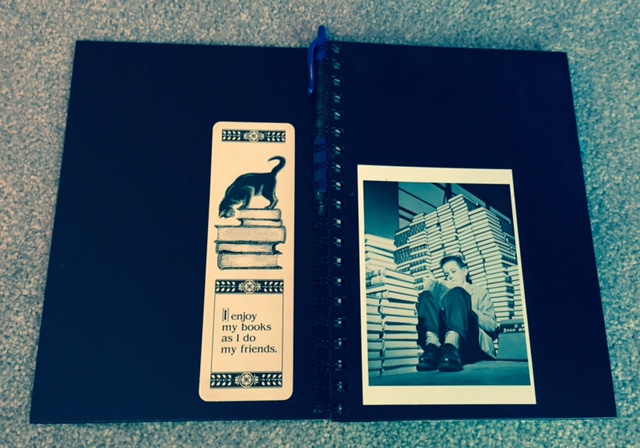
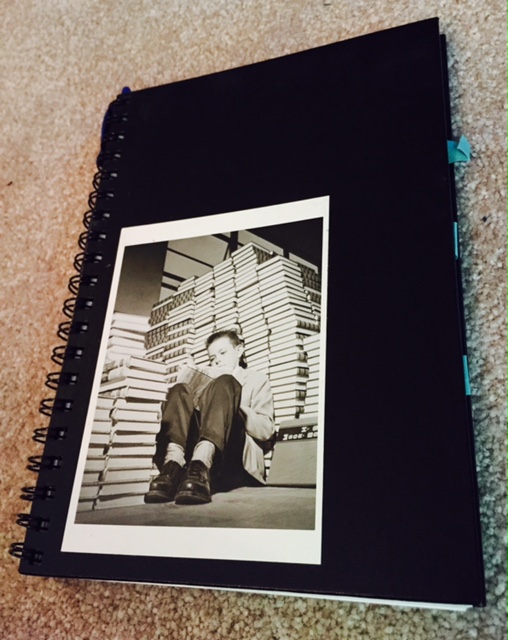
Rather than pay for a fancy-schmancy, pretentious book with pages too small for a proper review,    I could make my own book better than any preprinted book. Besides, I found a pair of regal spiral bound notebooks, elegant in their 8″x10″ stature. The simple black hardcover was perfect for a funky, relevant, inspirational postcard. I clipped identical, important-looking blue gel pens in the rings.  I was set to write whether at home or on-the-go.

I recorded each book in the same look, manner, and design: “The Title” by Author; Month and year I finished reading, and my review.

It was the prehistoric equivalent of modern day Goodreads.

FullSizeRender2I tabbed four sections. The front main pages were reviews of the books I read. The second tabbed section I reserved for books recommended to me or that I wanted to read. The last section has some pencil scribblings on the first page; it looks like I planned a “books I borrowed or loaned.” I didn’t know enough people who read books. There is a third section tabbed off but with nothing written on those pages I have no clue what I intended.

I reviewed books from July 1999 through September 2002. My first reviewed book will remain nameless because it is so horrible. I wrote: “College life…here was my chance to see how someone else does it. I’ve learned how not to do it. I have no idea what any of the characters look like. Everyone swore, drank and got drunk. C’mon, a keg at your final? A torture to read but I had to finish it for story’s sake. I forgot that there had been a framing structure at the beginning. Events just end and everything is summed up neatly, compactly, and smoothly like the end of the stereotypical sitcom. Now writing about it, I can put it out of my mind.”

That book was my first exposure to self-published books, often called vanity press back then. This book had to be good. After all, it was a hardback book, with a colorful cover, I discovered at an independent book fair in New York City. That gave it validation. Ever since I read it, this is the book I refer to anytime I need an example of poor writing and the desperate need for an editor.

The General’s Daughter by Nelson DeMille. July 1999

“Print from this ‘old style’ trade paperback dirties my fingers. I like the movie better than the book. Narrator often sounded like the author, not the character.” The ending was given away too soon. Very few ‘he said’ in text and was often confused by who was speaking. Movie was more coherent, flowed better.”

The House of Seven Gables by Nathaniel Hawthorne. November 5, 1999

“Never was I so glad to finish a book!”

I developed a fascination about writing the true story of a real person. I moved away from fiction and desperately sought solid nonfiction. I read a series of disappointing memoirs after that. One review included my insightful comment: “In the last two memoirs, the struggle is established at the beginning but then the readers never reap the benefits of success.”

Good advice to remember as I finish my memoir.

Tuesdays with Morrie by Mitch Albom. November 25, 1999

“This book made me uncomfy [uncomfortable]. That was wonderful! I want to read it again.” In January 2000, I did just that. “The second reading as powerful as the first. Real writing, honest and true yet not sappy. There’s a reason this has been on the best seller list for over 100 weeks.”

Falling Leaves by Adeline Yen Mah. Saturday, March 4, 2000

“A tragic memoir wonderfully told. Her words: simple, and I got so caught up in her storytelling I didn’t notice.”

The Joy Luck Club by Amy Tan. June 2000

“Good example of a story told through many smaller, seemingly unrelated stories. I’d like to see how the movie translated this fine book.”

As of this writing, I have not yet seen the movie.

The Girl’s Guide to Hunting and Fishing by Melissa Bank. August 13, 2000

“What a quick read! Recommended by Jane, I echo her thoughts: I wish I’d written this book.”

Memoirs of a Geisha by Arthur Golden. March 2001

“It has been so long since a book snagged me so completely. I was up nights swallowing every word until way past my practical bedtime.”

I wrote about the Harry Potter series from December 1999 to 2002. Interesting how my opinion has changed since those initial readings.

My last entry is Diary of a Mad Bride by Laura Wolf. September 2002

“B-day gift from Dawn, I read it in about one week. Funny, and a lot more truth in there than any bride would care to admit. Written in short journal entries, it’s easy to read. I must read this closer to my wedding 🙂 again!”

I never did read that book again, but maybe I will now, especially since I am married.  One part of my New Year’s Non-Resolutions is to revisit and reread an old favorite book.  I’m faced with a dilemma: which one do I choose?

Do you have any recommendations of good books to read, or ones to avoid?

The Kingdom Belongs to Children

Max crouched down, squished himself in between two other six-year olds and waited eagerly, like a compressed spring about to uncoil, for his turn.  He looked up at his older cousin, Alexandra, and whispered, “What’s a sin?”

He was a little embarrassed and hoped no one other than Alexandra had heard him. She had seen what was going on between him and the other boy. She would understand that it wasn’t Max’s fault he hadn’t been completely listening to Miss Becca, his vacation Bible school teacher.

He thought it was nice that some of the married teachers, including Miss Becca, didn’t always want to be called Mrs. So-and-So. Miss Becca let you call her by her first name, as long as you added “Miss” beforehand. Max first met Miss Becca in church. She sat next to him a couple times during worship service, and every now and then she taught his Sunday school class. Max liked the way she paid attention to him when he talked with her. She looked him right in the eyes and didn’t seem bothered by any of his questions.

Today, she asked that everyone call her Lady Becca. All the lady teachers, the girls, and she were strolling around like royalty, with their chins up and heads high. When she spoke, she didn’t pronounce words like she normally did. Everything she said seemed more proper and formal, and to top that off, she taught the boys how to bow and the girls how to curtsy.

“Too bad for them,” Max thought. Bowing was so much better. It didn’t require practice like the girls were doing. Boys were way more cool. They could pretend to be brave knights defending a kingdom. He was glad that his mom knew about the medieval theme and let him take a toy sword to the summer program. Swords weren’t normally allowed at church. Max figured this week would be fun.

When Lady Becca had explained what a sin was, Max was distracted by his new friend, Aidan, who kept trying to take Max’s sword away from him. “Just for a minute,” Aidan had pleaded, but Max knew better than to give up his plastic weapon. He might never get it back! It was no wonder he missed some of what his teacher had said. He was lucky just to have caught the most important part: only one person in all of history has never sinned. “But what exactly are my sins?” he silently worried.

Without hesitating, Alexandra simultaneously answered the question he asked out loud and the one he was thinking. She said, “A sin is anything you do that’s wrong.”

“Thanks, Alex,” he softly replied.

Alexandra preferred to be called “Alex.” That’s what her mom called her, what her dad called her, and what Max called her, usually. Alex was pretty smart…and she paid attention. Or, she paid attention…and was pretty smart. One way or another, she seemed to know about God’s son who came down from heaven to be with people. Alex was fourteen and old enough to be Lady Becca’s youth helper. All the teachers had at least one of the older kids to help teach the younger children about the stories in the Bible.

Lady Becca described Jesus as both God and man but a man like no other. She gave examples: He had never lied; never cheated; and never hit his brother, not even once. She said, “Lots of people liked Jesus because he was good at fixing things. Many people hated him because they didn’t know him very well.”

For even the Son of Man did not come to be served, but to serve, and to give his life as a ransom for many." Jesus' words as recorded in Mark 11:45 (NIV).    Photo by Kelly Bixby

“For even the Son of Man did not come to be served, but to serve, and to give his life as a ransom for many.” Jesus’ words as recorded in Mark 11:45 (NIV). Photo by Kelly Bixby

Alex added, “Other people had no feelings whatsoever about him, because they had never heard of him.”

Max took the piece of paper that Lady Becca held out to him. He noticed that it was shaped like a hand, so he held the paper up and compared it to his own. His palm fit inside the paper’s edges almost perfectly. It was as if Max had spread his fingers wide, plopped them upon a single sheet of paper, pencilled up and down, around and around, and then cut along all the lines to end up with the paper he was now holding. Max followed Lady Becca’s instructions and wrote his name in crayon on the front of it.

Lady Becca’s red velvet gown swept the floor as she continued moving about the room, passing from person to person, with the goal of giving everyone their own hand-shaped sheet of paper. She wore a stretchy silver fabric band around her head. It had one lone ruby-colored jewel in the center and wasn’t meant to look like a more elaborate, richly adorned crown. After all, she wasn’t “Queen Becca.” But she was dressed like someone who belonged in a castle.

When Lady Becca walked towards Lily, the tallest girl in the class, Max could see Lily’s eyes widen in anticipation. He didn’t think it was the paper she was excited about, however. He saw that she longingly eyed the bejeweled, golden scepter in Lady Becca’s left hand. The decorative staff was just slightly taller than Lily herself, who was about four-feet tall. Purple and gold ribbons streamed from the top of it to halfway down. Max guessed that each girl in the class was hoping for the opportunity to run around waving the fancy stick in the air and making the ribbons fly.

“Get rid of all the frilly stuff, and that stick just might come in handy,” Max muttered to himself. Then he heard the girls collectively sigh when their teacher tucked the prop under one arm so she could finish passing out sheets of paper.

Lady Becca said that everybody except Jesus sins. Max thought that didn’t make sense, because everybody knows the only things babies do are eat, sleep, cry and poop. Sometimes they smile too, but that’s just when they have gas. (He had heard that from Alex, who was too polite to say, “fart.”) How could they do anything wrong? They’re babies. Maybe Lady Becca didn’t know what she was talking about.

After thinking more about it, though, Max realized that Alex couldn’t be completely right either. Max was able to make Alex’s baby brother, Theo, smile just about any time Max tried. All he had to do was look Theo right in the eyes and make a big and wide smile first. A lot of times, he also made Theo giggle by doing that. There wasn’t gas at all.

It was nearly Max’s turn to stick his sheet of paper onto the Styrofoam cross that leaned against a makeshift wall inside the classroom. The paper was meant to represent one of Max’s sins, and the cross represented the real, wooden one Jesus died on. Around the top hung a crown of thorns similar to the one Roman soldiers had used to jab into Jesus’ head to torture him and make fun of him. This was serious.

Over 2,000 years ago, Jesus sacrificed himself so that people’s sins could be forgiven. Couldn’t God just change the rules? God can do anything He wants! Why did God want Jesus to die? Max was beginning to see how little he understood sin.

Max wasn’t quite certain if he was wrong by not sharing his sword with Aiden. “He should have brought his own. This one’s mine, and that kid might ruin it,” Max reasoned. Yet somehow, deep inside, he didn’t feel very good.

Max thought Aiden looked kind of sad. He remembered feeling that way himself just last week when Alex rode her bike over to visit. She brought an ice-cream sandwich. It was Max’s favorite and she knew it. She hadn’t given him even a tiny bite and ate the whole thing in front of him!

Lady Becca encouraged the class to study the Bible whenever they had questions about how God wants them to behave. She assured them that God wants what is best for them. She said, “God wrote a really long love note and sent his Word for all people. Sometimes it might seem confusing, but the more you read the Bible, the more you’ll come to understand how God wants you to live.”

Max thought, “Alex should take a look at what the Bible says about sharing.”

A moment later, Max surprised Aiden by lending him his sword. Then, the brave-hearted knight, Sir Max, approached the cross and let Jesus take away his sin.