Tag Archives: creative writing

Star Trek Heritage: Chapter One, Pt. 1

She was having trouble concentrating with that incessant beeping coming from the proximity sensors, but she didn’t stop working. The Borg Cube was closing in. They hadn’t sent any members of their hive onto the ship, but that was hardly reassuring. The rest of the crew aboard the USS Heritage was currently unconscious and that left Ensign Meva Skogland the lone soldier.

She wasn’t entirely sure why whatever knocked out the crew hadn’t affected her, but she thought it might have something to do with her being in decontamination at the time the Borg ship had appeared. She’d have to remember to ask Doctor Syversten about it when this was over…assuming they all survived. What a terrifying thought.

Meva’s hands flew across the console as she assessed the damage to the ship, checked weapon and shield statuses, and monitored the Borg Cube, which was now currently maintaining its’ distance. Whatever the Borg had done had disabled the Heritage’s warp engines, so they weren’t going anywhere anytime soon. Everything else, however, seemed to be functioning properly, the most important system being life support.

Meva had never seen a Borg ship in person before, had never seen the Borg themselves at all, but all the reports said the same things. The Borg disable a ship, send over their hive minions to leech data from the ships computers, and assimilate all members of the ships crew. Not necessarily in that order. Then they move on. Another ship. Another crew. Gone. Assimilated.

So…why weren’t they doing that? Why were they just sitting there? Sure they had disabled the ship just like previous reports said they would. But they hadn’t started the rest of it.

“Shit. What am I supposed to do with this?” Meva muttered to herself. Speaking out loud to herself made her less out of control. She was just an Ensign who worked in the Science Department. She was fresh out of the Academy. Everyone else on board, literally everyone, outranked her. Except now everyone else was out cold, which left only her.  And she knew procedure. They trained you for hostile situations. But you weren’t prepared. Not entirely.

Of course she had basic training in the use of the weapons systems. Everyone on the ship did. Every good Captain insisted on it and Captain Miles was a good Captain.

“He’d be a better Captain if he was awake.”

Meva wasn’t confident in her ability to use the ships weapons systems against this particular enemy and survive. She needed a plan. She worked in the Science Department. Maybe she could science a way out of this. For now it seemed she had the time. The Borg were just sitting there. It was creepy.

“Alright then. Let’s see if we can get these warp engines running. Or at least get it to impulse power. If I can’t do that maybe I can figure out how to wake Syver. Or the Captain. That would be nice.”

Meva grabbed a Data PADD so she could continue to monitor the consoles on the Bridge and headed for Engineering. There were crewmembers all over the place. Many had simply fallen wherever they had been standing when the attack came. Some sporting bruises from hitting the walls, the floor, each other. Some were lying in odd, and obviously uncomfortable, positions. She wished she could help, but with no proper medical training she didn’t even know where to begin.

‘This is one hell of a first assignment,’ she thought as she headed for the turbo lift. She sincerely hoped that the turbo lift didn’t malfunction. She didn’t need to be trapped in an elevator on top of everything else. Then they would all be screwed. ‘As if we aren’t already.’

Meva Skogland had been so excited to be given the chance to serve her first Starfleet assignment aboard the Heritage. It was the ships’ maiden voyage through space and a spot aboard was as coveted as a spot aboard the Federation Flagship Enterprise.

She reached the nearest lift and, surprise surprise, it wasn’t working.

“Great. The Medical Bay it is then.”

Heading toward Dr. Syversten’s office she tried to remember anything she may have learned at the Academy that might help with this. The Kobyashi Maru maybe. Except she failed that test. Everyone did. If she couldn’t wake Syver then she knew it was over.

She reached the Medical Bay in record time. Just like the Bridge and the hallways the bay had personnel laying and sitting wherever they had been. She found the Chief Medical Officer sitting in his office chair, his head lying on his desk like a kid who had fallen asleep at school.

“Doctor?”

Meva shook the doctors shoulder, as if that would do any good. It didn’t. She began looking through drawers and in cabinets. Assuming everything was properly labeled, which it always was, she was hoping to find anything that might be used to wake someone up.

While she searched for something, anything, that would help she continued to monitor the Data PADD. There was still no change from the Borg Cube and Life Support Systems were still functioning. Good. She still had time, but that could change at any moment.

Finally she found a stash of hypo sprays. She looked through them until she found one labeled ‘Epinephrine’.

‘Well, this will either wake him up or give him a heart attack.’

She read the label of the hypo spray, checked Syversten’s medical record in the ships’ computer to make sure he wasn’t allergic to anything, and then, taking a deep breath she stuck the hypo spray into Dr. Syversten’s neck and waited. It didn’t take long. The Doctor’s head shot up as if he’d just had a bucket of water dumped on him.

“What the hell…” he muttered. He was looked groggily around the room.

“Doctor. Are you alright?” Meva asked.

“Ensign Skogland? What’s happening?”

“The ship was attacked, Sir. I think. A Borg Cube sent out some kind of energy pulse that shut down the warp engines. It also seems to have rendered the crew unconscious. Everyone except me anyway. And now you. I was going to try to get the engines back online, but I can’t get down to Engineering. Thought I would try to wake you up instead. I’m really glad it worked.”

“The Borg? They’re here? Why haven’t they taken the ship yet?”

“I don’t know, Sir, but they’ve been here for several hours now. They disabled the ships ability to move, but haven’t done anything else. I’ve been using the time to try and either get the ship away from here or wake up someone who can. That’s where you come in.”

Dr. Syversten got up and looked around. “What did you use to wake me up, Ensign?” he asked.

“I used a hypo spray labeled Epinephrine. I only have Starfleet’s basic first aid training. I was kind of guessing and hoping it worked.”

“I’m very glad you guessed correctly, Ensign. Were you able to wake anyone else?”

“No, Sir.”

“Alright. Well, the best course of action then would be to wake the Captain and the rest of the bridge crew. They’re better trained to handle these sorts of situations. That will give us the time, hopefully, to start taking care of the rest of the crew.”

“Hopefully is right. The Borg haven’t fired on the ship yet, which goes against every report I’ve ever read about them. Granted there aren’t many so we’re probably missing information. We need the Captain.”

“Okay. Let me grab what I can from here and we’ll head to the Bridge.”
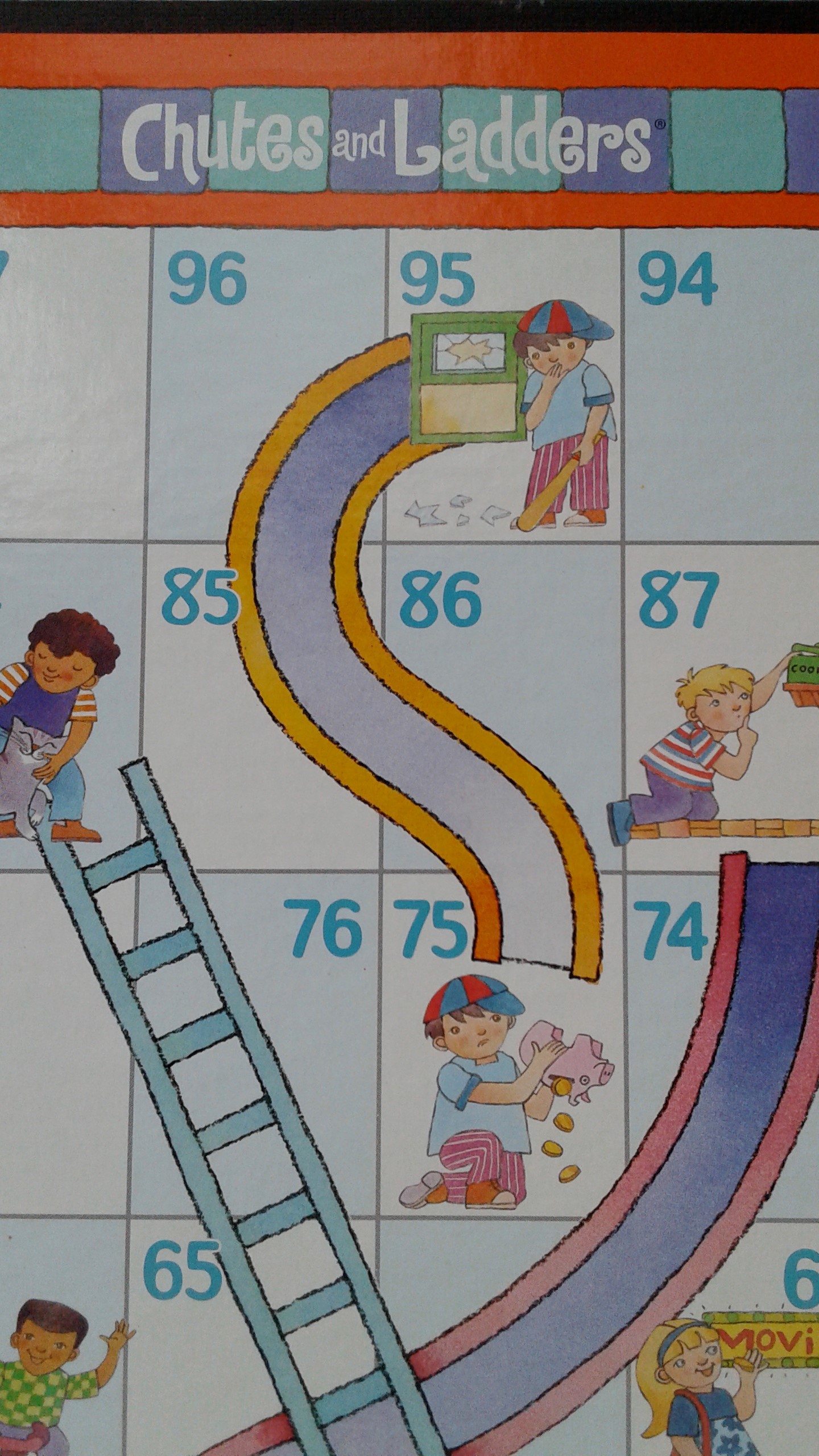
Chutes and Ladders—Plotting for ages 3-100

gameGames teach the mechanics of plot. A player begins Chutes and Ladders on a path with some ladders up and some chutes down. The sequence of action and consequence is plot, pure and simple.

Same Game Different Century

The Milton Bradley game comes from an ancient Indian game called Snakes and Ladders. In Moksha Patam, the game follows Hindu philosophy and morality lessons with few ladders for virtues and many snakes for vices. Salman Rushdie wrote in Midnight’s Children about the game as “the eternal truth that for every ladder you hope to climb, a snake is waiting just around the corner, and for every snake a ladder will compensate.”

Mastering the Game

Snakes are consequences for vices such as disobedience, vanity, vulgarity, theft, lying, drunkenness, debt, murder rage, greed, pride and lust. These plot elements sound like the playbook for Netflix’s House of Cards. In the television series, plot twists are the norm, and consequences rarely weigh on the characters’ decision to act. Character development and flaw emerge as the driving force for plot (see Plotting for the Flaw). In House of Cards, each character’s manipulation, deception and corruption goes without consequence, until the proverbial house of cards tumbles to the ground.

The Parallel Plot Game

Beyond the character contributions to plot, the game board offers second attempts and alternate possibilities—both forms of parallel plots. For example, every child playing this game, has counted the spaces to the next ladder and hoped to roll that exact number. Often, the die indicates a number short of the goal, and the outcome of the game changes. When I missed a ladder, or even worse when I landed on the long slide back to the beginning, I thought what if . . .  what if . . . I had rolled one space more.

The What If Game

The movie, Sliding Doors, is the one space more plot. The film shows two alternate realities based on either catching a train or missing it. Children’s books, such as Goosebumps by R. L. Stine, try this format with choosing different outcomes by flipping a coin, but the choice is one or the other. Sliding Doors shows both outcomes at the same time, jumping between each version in a confusing medley of scenes from the beginning of the film until the ending. As with other parallel plots, the emotional highs and lows are braided and mirrored with the two plot lines (see Paula Picked a Plighted Path . . .). With characters in common, the two plot lines—although parallel and in alternate realities—occasionally trip over each other in theme and traipse into the same settings at even the same times. While this film’s structure rates high for creativity, the challenge is how to bring two stories spiraling in different directions back together at the end. In this film, the solution is a similar event in the same setting with alternate outcomes—life or death. Another example of alternate realities is Maybe in Another Life by Taylor Jenkins Reid which shows alternating chapters of the protagonist’s choices.

The “Back to Square One” Game

In the “back to square one” scenario, a player is trapped and stuck in a repetitive loop of one ladder and one chute. What happens the second time around? The same events? Different? In the movie Groundhog Day, this different perspective occurs and reoccurs as a form of parallel plots. The protagonist tests the limits of his actions (vices) in a seemingly endless cycle of romantic comedy consequences of the “boy loses girl” variety. Eventually, the character decides to use his recycled groundhog days to improve his behavior (virtues), and the character arc takes him to the romantic comedy conclusion of “boy gets girl.”

The Next Generation’s Game

My basement is fertile ground for role playing games such as Grand Theft Auto. In GTA IV, the gamer chooses one of three characters, one of three parallel plots. Video games intensify the game playing experience of previous generations. Readers from this generation will expect parallel plots and creative structures beyond the basics of story.

Story Starters, Part 3

“Writing is a form of therapy; sometimes I wonder how all those who do not write, compose, or paint can manage to escape the madness, melancholia, the panic and fear which is inherent in a human situation.”–Graham Greene

Have you ever found yourself with the wrong friends? A fur hunter in the 1800s was severely injured after a bear attack. Because one of his hunting companions didn’t want to be burdened with continuing to drag the dying man through the brutally cold, uncharted wilderness, he buried the wounded man alive. Wrong companions, riveting adventure. The Revenant is based on a true story of perseverance.

What if you felt that you were born in the wrong body? In the early 20th century, artist Einar Wegener was married to Gerda when he began to realize that he was a woman in a man’s body. With the love and encouragement of his wife, he eventually sought gender re-identification surgery to become Lili Elbe. Wrong body, passionate love story. The movie, The Danish Girl, is loosely based on a true story.

Have you ever found yourself in the wrong place at the wrong time? The nine year old son of a Nazi commandant living near a Jewish internment camp approaches the camp’s wire fence and befriends an imprisoned boy his age. Eventually the Nazi’s naive son crawls under the fence to join his new friend in finding the boy’s lost mother. Wrong place, wrong time, heartbreaking fictional story. The first draft of The Boy in the Striped Pyjamas was written by John Boyne in two and a half days.

What would you do if you felt an attraction to someone of your same gender? Carol, an older, soon-to-be divorced mother of one daughter, is attracted to Therese, a young salesclerk and aspiring photographer. A developing romance between the two women in the early 1950s showed the harsh consequences of their love affair. Wrong time, strained relationship. The movie, Carol, is a story based on the novel, The Price of Salt by Patricia Highsmith.

Have you ever questioned the word of authorities? A Nigerian forensic pathologist’s research on severe brain injuries or chronic traumatic encephalopathy (CTE) causes an uproar in the world of American football. The National Football League questions his findings as Dr. Bennet Omalu questions the NFL’s lack of concern for its players’ wellbeing. Wrong concerns, on-going controversy. The movie, Concussion, is a true story based on the research of Dr. Bennet Omalu.

Consider now what you see as the wrong company, physique, location, relationship, focus, or any other wrong that you see in the human condition. As a writer, you can analyze, portray, or correct what you see as wrong. Don’t just think about it. Write about it. Are you game?

Reflections on Resolutions and Writing

‘Tis the season.

What does your season look like?

It’s December, and I’m running around with holiday madness. I don’t have the time to remember my gift list let alone what I did or didn’t accomplish this year. In fact, if hadn’t written them down, I’d have forgotten I even had thoughts to change my world.

I don’t believe in resolutions. Too often they’re wishes without a specific plan for success. That’s why I embraced my writers’ group commitment to three Non-Resolutions for 2015. The challenge was to identify the “specific and concrete” steps to “improve yourself as a writer.” I did this thinking it a simple challenge something specific and easy it’s the end of the year, tis the season to look ahead while looking back. so I share my successes and failures in life, the universe and everything else.

How did I do? Let’s just say I take ownership of my actions and my non-actions. These were my commitments:

1.(A) Find an editor and (B) publish my memoir before June 2015.

Nope. Nope, nope, nope. Not even close. Every time I sat down to edit, thinking the book just needed some tweaking, I found a jumble of sentence fragments and missplelled words instead. I suspected that organizing the non-chronological series of vignettes was the problem. I came up with creative ways to procrastination. I read blog posts by fiction and nonfiction writers to learn how they handled organization. I read a memoir to see how it was organized. I found checklists to follow, but still my story didn’t flow.

That got me thinking about format and tools to ease my struggles. I purchased Scrivener, a software program has a “corkboard” to organize my thoughts and scenes so I can rearrange as often as needed with a swift swipe of my mouse. This is a useful procrastination, I told myself. I spent two weeks slugging through the detailed tutorial and then hit a snag with the program. I set it aside in frustration to continue after November’s NaNoWriMo. It’s December and is still untouched.

2.Explore at least one new book/genre and revisit an old favorite.

This was a flop. Aside from reading that one memoir early in the year, I didn’t finish another book.


I started what I presumed was “an old favorite” but it wasn’t as interesting as I remembered. I found a sci-fi book that both Mom and I read. I committed to read it at night, maybe not every night, but I put it and a spare pair of reading glasses on my nightstand for convenience. The only space available was at the edge, so the book is too far to reach, and my clumsy, ill-fitting dollar store glasses are awkward to wear. I have made reading more complicated than it should be.

3.Set aside time to journal at least once a month.

I accomplished this! I may have skipped weeks at a time, but I wrote more, that I know. That I feel.  I mingled my thoughts with blog posts and ideas, sprinkled between to-do lists and notes from writers’ conferences and meetings. I rediscovered that I write more fluidly by hand, so I spent more time journaling just for the fun and love of writing on paper. Writing by hand is organic to me, so I will keep journaling.

Nothing is truly a failure. These commitments did not need to be complete, nor did they need to be completed for me to succeed. I learned about myself and gained some valuable perspectives and insights into my actions.

What did I learn?

I need to break my writing and editing tasks into smaller snippets and set a timer. Tell myself “Tuesday morning, research editors” and allot 27 minutes only. I’ll know at the end of the timer I’ll either need a break or feel inspired to keep working. It’s how I survived and won NaNoWriMo.

In 23, 27 or 33 minute segments, I wrote 50,721 words in the last 20 days of the months. I started on November 11, so this equaled 2500 words/day which for me was about 1 1/2 hours per day. That means I can find the time to write because I have the time when I’m not distracted by Major Crimes on TV or Angry Birds on my phone. I remind myself of this daily because not only is it motivating but because in the madness of the month, I discovered a 25,000-word story, a complete one that I can actually work with and interests me. I consider the purchase a distraction and a success. I can use Scrivener to organize this book as I edit to publish by the end of 2015, a swift spellbinding sequel to my initial Jimmy the Burglar book.

Getting back to my roots of handwriting gave me the opportunity to see what I was thinking. Words on paper, written by my hand, helped me focus on what I want to do with my writing. I will change the focus of my blog to include more writing, insights, interviews and inspiration. Posts on Deadwood Writers Voices may change. I want to entertain my readers, offer them something worthwhile, while writing topics that excite my passion and enthusiasm. I’m exploring what those topics may be.

As for reading books, I will purchase a better pair of reading glasses.

Using Social Media to Overcome Writer’s Block?

Writing takes practice.

Sure, we all know that, but too often, we are frozen by the blank screen or paper we call Writers Block. At least, that’s the excuse we tell ourselves.

The only way to break down that wall is to write.

And that brings us back to the beginning. How do we begin writing? Where do we find ideas?

Blog Writing Challenges

 Whether you have written or write for a blog, you need some social media presence to maximize this option. People are sharing their creative arsenal to battle the widespread war of writer’s block across the webisphere. These challenges are sites all across the Internet. Your journey is to find them.

I’m a fan of the social media site Twitter. Unlike Facebook, it’s an open media without memberships or restrictions. Connecting with writers and readers and celebrities is a Follow click away. Unlike LinkedIn, it’s not business-focused. Unlike Google+, this is not a new, unknown experiment. Twitter is established, creative and short to swallow with its 140-character limit in each Tweet. It’s easy to find similar topics and groups with a simple #hashtag search.

On the day I wrote this, I found an array of challenges with directed yet general hashtag searches. Some of these lead directly to the moderator’s website, while others simply group posts together under that specific hashtag.

Searching the Twitter hashtag #challenge showed writing and non-writing Tweets.  Scrolling through feed, the most relevant ones came from users like @convince to post a photo with every Tweet for one week, @RonovanWrites with his weekly haiku prompt  and @lettrs posing a #WordOfTheDay challenge.

One of my favorite hashtags is #6WordStory, a challenge posed by @Kelsye. Other searches relevant and directed to writers include: #WritingChallenge; #poetrychallenge; #FiveSentenceFiction; #haikuchallenge; and #fictionchallenge.

Twitter is not case-sensitive, so upper- and lower-case usage is personal preference. The words get you to the same location. I like to capitalize some of the longer hashtags to make them easier to read.

The beauty of Twitter is the prompts are provided, and the ideas out there are bountiful. Once you find an inspirational idea, attack that challenge with all your creative energy. Many people link to their personal blogposts, but you don’t need a blog to participate. Create a separate file on your computer and dedicate 15 minutes a day to play with words. Do an email exchange with a friend or family member. If you are uncomfortable sharing, choose a journal to write in for your personal enjoyment.

If you want to publicly share your accomplishments submit these, or parts of it, on your social media or link posts to your personal blog. If you want to make a visual expression of your art, use a smartphone app like InstaQuote or Notegraphy to create a graphic to share with others or save to your camera roll.

Using photos allows your social media reach to increase. The Twitter user @asilartist tied her #9WordStory challenge together by cross-posting from her @reclaimed poet Instagram account. The same hashtag exploration applies there. I found creative posts with the tags: #WritingChallenge; #PoetryChallenge; #threewordstory; #poemaday; #flashfiction; and #4WordStory.

Beware! Most users will use more than one tag, adding several related hashtags so their post can reach various audiences. As your curiosity increases, you will find yourself winding through a maze of related hashtags so that you can forget the original hashtag you started searching for. It’s glorious. It’s frustrating.

There are worse things than being lost in a new tag that connects to a newer tag that inspires you to search for a personal interest of yours. It’s the only way to drag yourself over that tall writers block wall.